
Auto Salvage Yard Tire Storage Rack Case Study: Pull-N-Save, West Valley City, Utah
A self-service auto and truck parts yard in the Salt Lake Valley bought sectional tire rack three times over four years. Here is what the records show, why used-tire storage is its own problem, and how another auto recycler can plan a rack run that keeps growing.
West Valley City, UT
Salvage yard location
2017 to 2021
Three verified orders
Sectional tire rack
Product ordered
Used tires
Application
A repeat tire-rack customer in the Salt Lake Valley
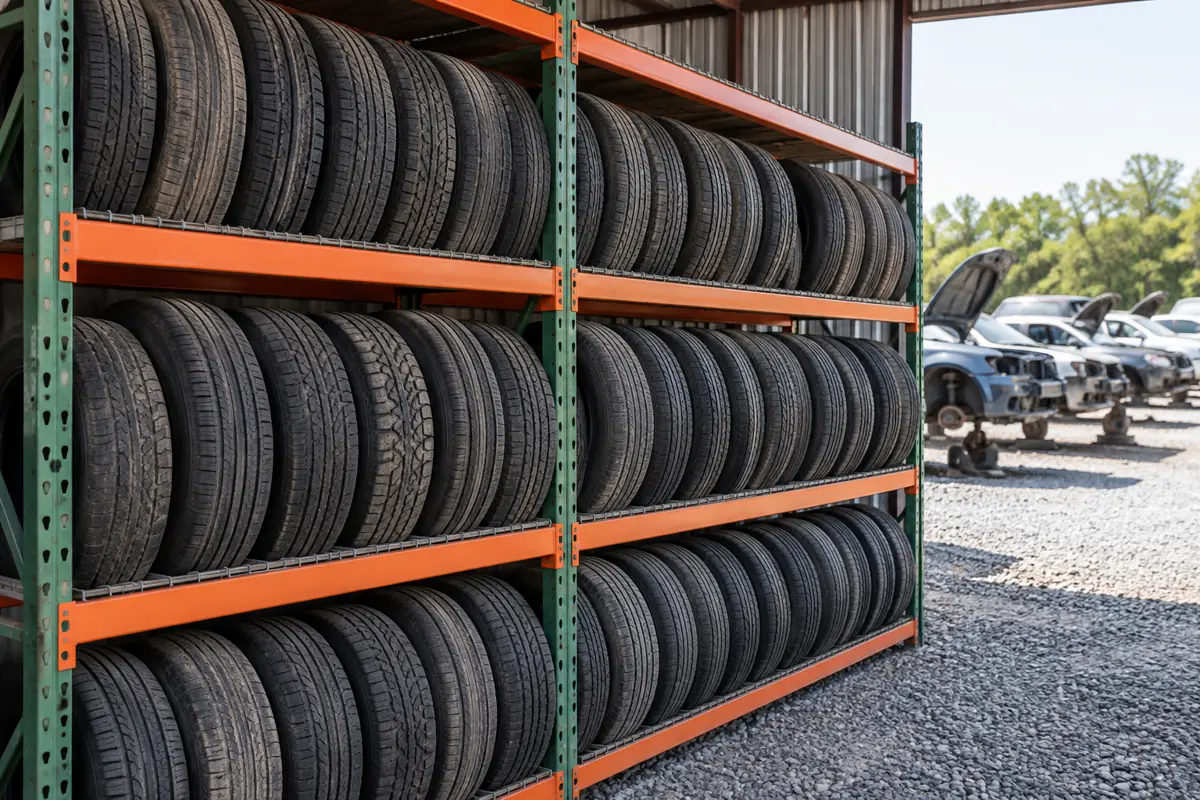
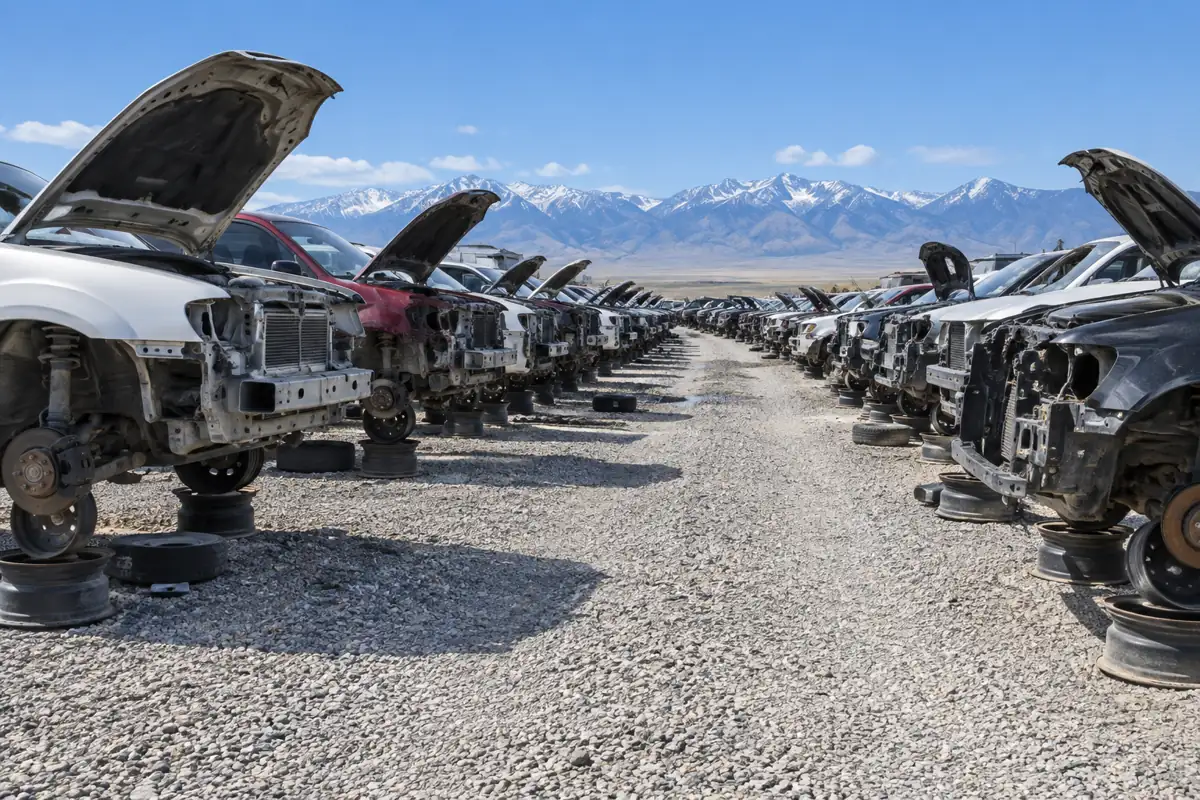
Pull-N-Save operates a self-service auto and truck parts dismantling yard on the west side of the Salt Lake Valley in West Valley City, Utah. Customers walk the rows, pull their own parts from vehicles on stands, and pay at the counter on the way out. Tires are part of that business: every incoming vehicle arrives on a set, and the usable ones become a sorted, ready-to-sell inventory that has to be stored somewhere customers can find their size.
Between 2017 and 2021 the yard placed three tire-rack orders through our Salt Lake City team, and each is recorded as a closed-won project in MH-USA’s CRM with a matching customer quote, purchase order and invoice on file. The first two orders, in March and May 2017, were each four sections of three-level steel tire rack shipped freight-included to the yard, with the second round adding foot plates for the uprights. The third, in December 2021, was a larger component order of upright frames and step beams to extend the storage. Same customer, same address, same product family, and a growing footprint over four years.
That pattern is why the project belongs on the Utah Tire Storage Rack hub alongside Markosian Auto in Tooele, another repeat-order customer. The main Tire Storage Rack hub covers system types and engineering considerations in depth, and the yard’s rack is built from the same upright-and-beam logic as the wider pallet rack systems we design for warehouses.
What the source documents establish
- Customer: Pull-N-Save, a self-service auto and truck parts dismantling yard in West Valley City, Utah
- Orders: March 2017, May 2017 and December 2021, each recorded as closed won with a customer quote, purchase order and invoice
- Product: sectional three-level steel tire rack (starter and add-on units), foot plates on the second order, then upright frames and step beams to extend the run
- Delivery: freight included on all three orders and shipped to the yard address; the second 2017 order shows payment in full
- Scope limit: no installation was quoted, and no completion record, capacity figure or customer statement was found in the sources reviewed
We have left out prices, exact dimensions, component counts on the expansion order, contact names and any drawing or layout details. No deal-specific email correspondence was located for these orders, so the story is built from the CRM and document record only.
Why used-tire storage at a salvage yard is its own problem
A tire shop orders the sizes it expects to sell. A salvage yard gets whatever rolls in on the tow truck. That single difference changes the storage brief. Inventory is unpredictable by size and brand, turnover is constant, and the tires are not new: they need a quick inspection, a sort by size, and a spot where a customer can see the tread and the size marking without unstacking a pile.
There are practical constraints as well. Tires that sit outdoors in pile form collect water, attract pests and deform under their own weight. A pile also hides most of what is in it, so staff spend time digging and customers give up. Fire and building codes treat rubber tires as a high-hazard commodity, and an unmanaged pile is the arrangement inspectors like least. A rack puts every tire upright on its tread, one deep, in a row that can be read from the aisle, and it keeps the storage arrangement predictable when the fire marshal asks how much is stored and how.
Sort once, then sell from the rack
The efficient flow is inspect, sort by size group, and rack immediately. Each shelf level or bay becomes a size range, so a customer looking for a common passenger size goes straight to that section. Tires that fail inspection go to a separate scrap area for recycling pickup rather than sharing the retail row.
The same logic drives our tire shop storage rack guide, but a recycler has one extra rule: the inventory mix will drift with what the yard buys, so the rack should be sized around the busiest size groups, not an even split.
Three orders, one growing rack run
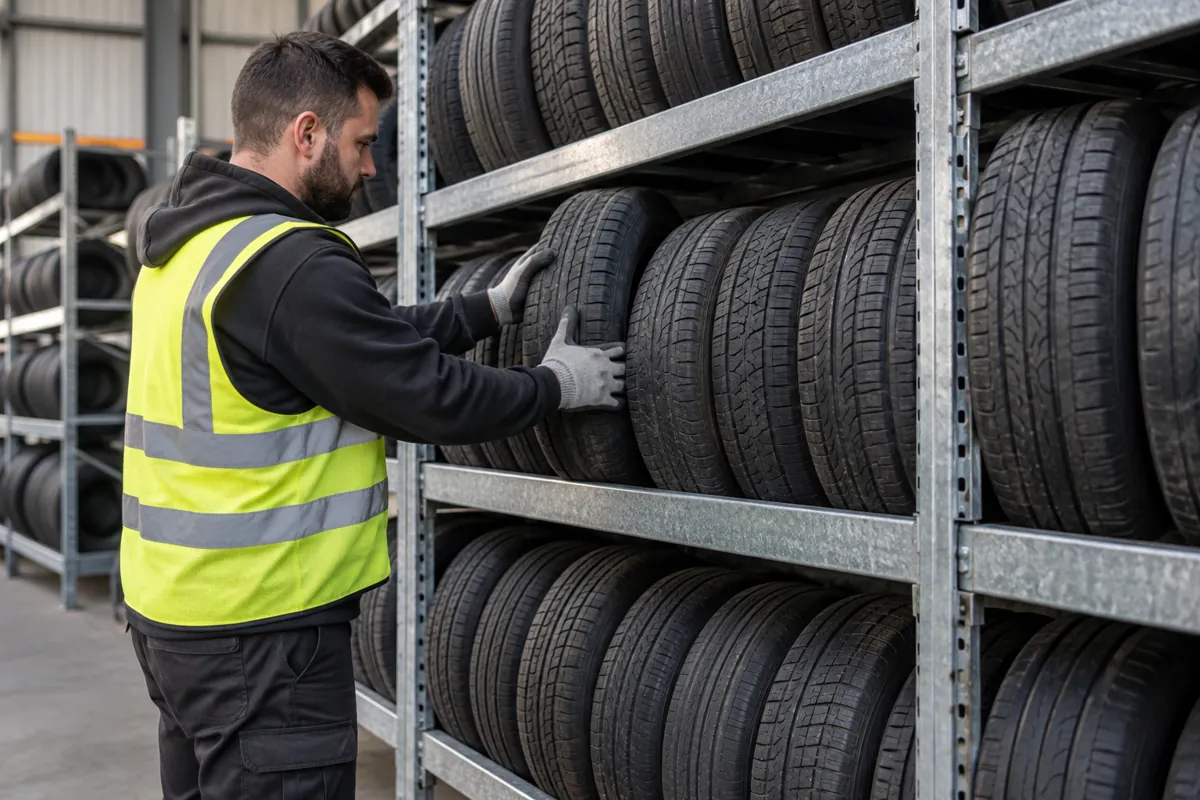
The order history reads like a storage plan that scaled with the business. The first purchase was modest: four sections of three-level sectional rack, two starter units and two add-on units, quoted with a short delivery window and freight included. Two months later the yard ordered the same configuration again, this time adding foot plates so the uprights could be fastened to the floor. In December 2021, with those runs in service for more than four years, the third order was not more starter kits but upright frames and step beams, the components you buy when you are extending existing rack rather than starting a new one.
March 2017
Four sections of three-level steel tire rack (two starters, two add-ons), freight included, quoted for delivery in about ten days.
May 2017
A second four-section order of the same configuration, plus foot plates for the uprights. The invoice on file shows this order paid in full.
December 2021
A larger component order of upright frames and step beams to extend the storage. Quoted with a longer lead time, roughly six weeks at that point in the supply cycle, freight included, 50 percent deposit at order.
Starter, add-on, then components
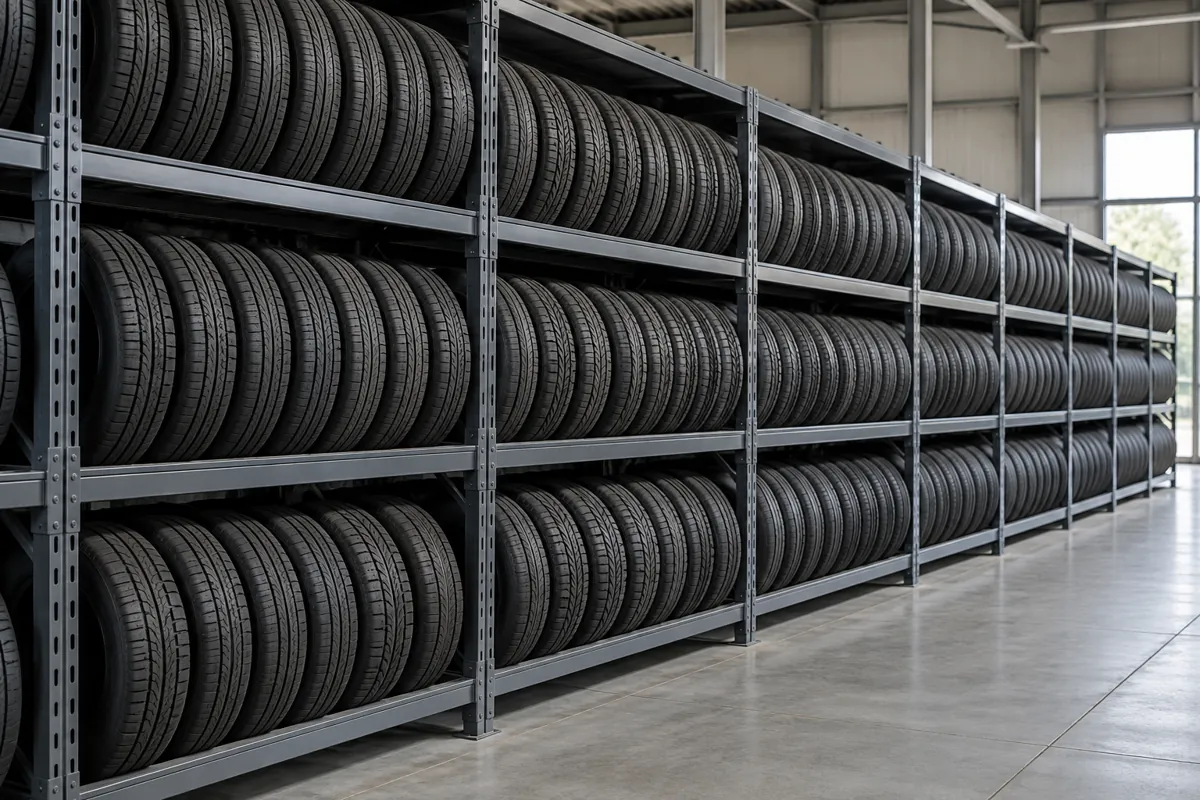
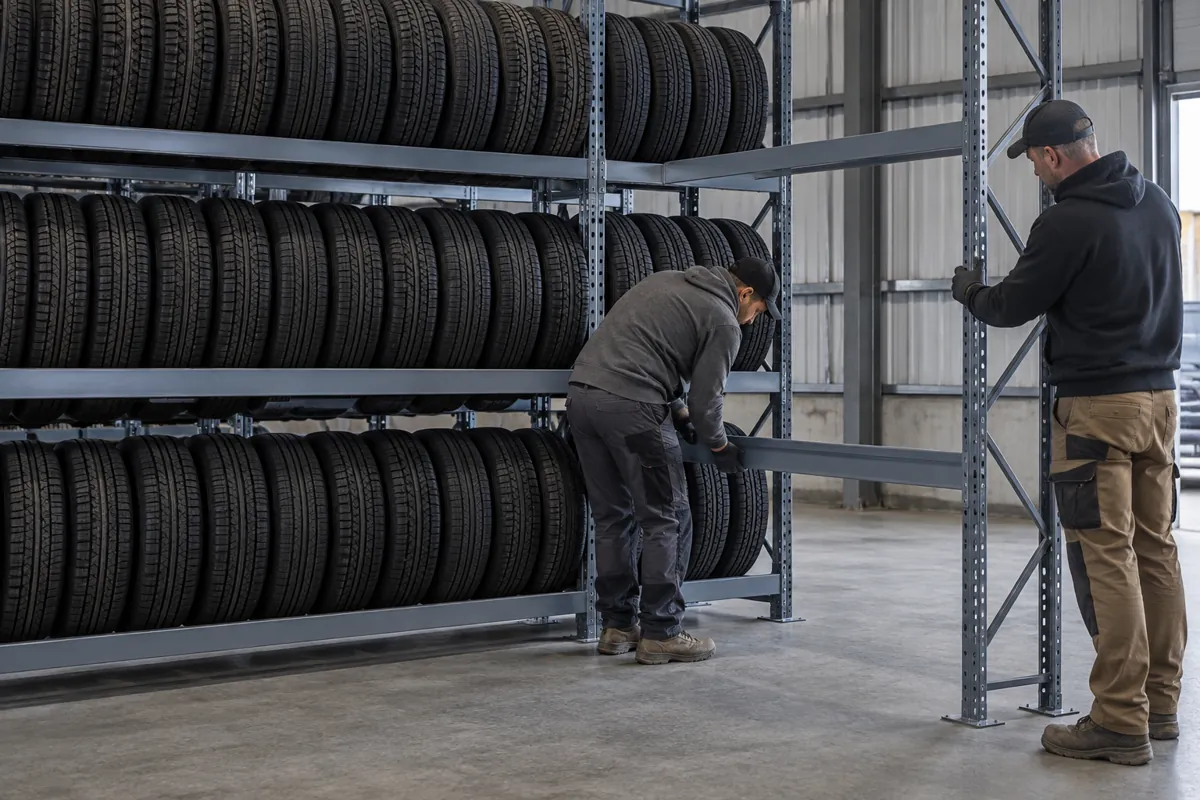
Sectional tire rack is sold as a starter unit (two upright frames plus beams) and add-on units (one frame plus beams) that share a frame with the section beside them. That is what makes a run easy to extend. Once the runs exist, the cheapest way to grow is often to buy frames and beams that match the installed system, which is exactly what the 2021 order did.
Before extending, confirm the new components match the installed frame depth, beam connector style and beam length, check the existing steel for damage, and verify the load rating of the extended configuration. If the run gets taller or heavier, ask whether anchoring or an engineering review is required. Our pallet rack range follows the same starter-and-adder logic at a heavier scale.
Laying out a used-tire retail row
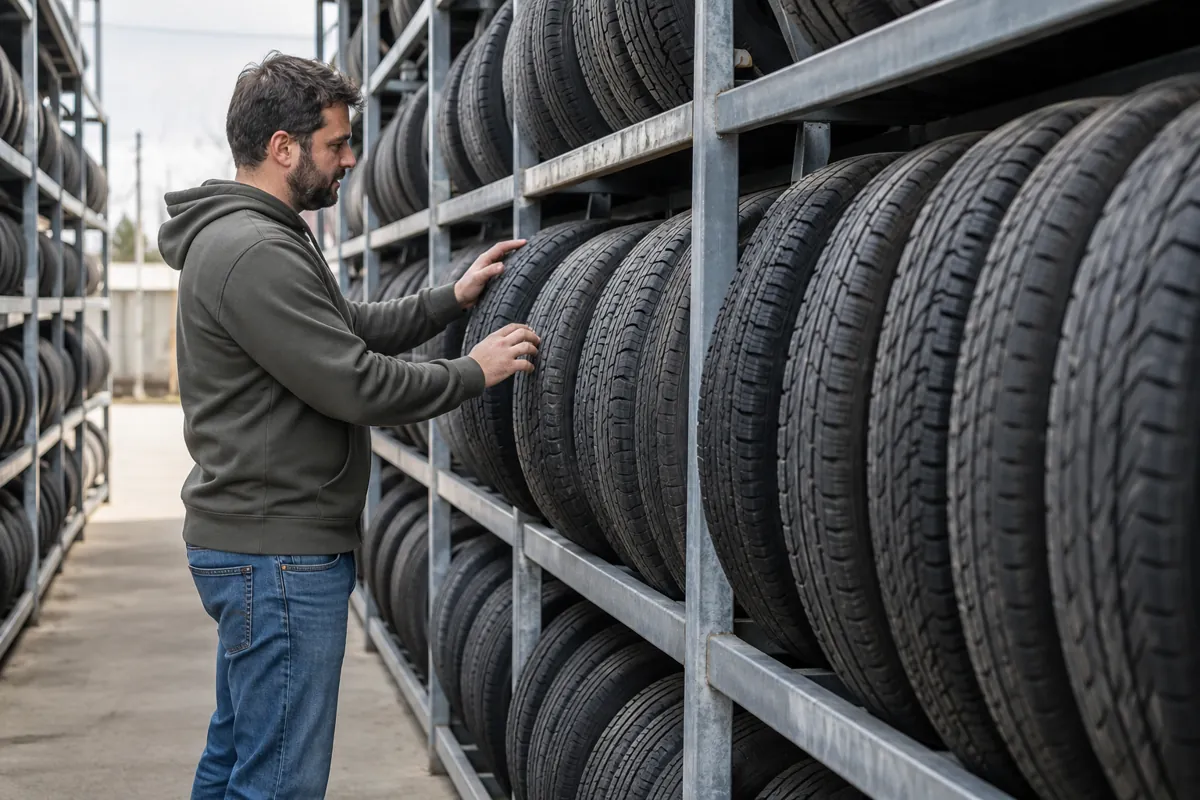
The yard’s rack sits at the retail end of the operation, so the layout questions are as much about customers as about storage. A run along a wall or fence line with a single clear aisle in front is the common pattern. Set beam levels so the largest tire in each size group stands upright with clearance above it, and put the heaviest, largest light-truck sizes on the bottom level where they are lifted the least. Standing tires on the tread, edge-on to the aisle, lets a customer read the sidewall size marking by tipping the tire slightly rather than pulling it off the shelf.
| Planning question | What to decide for a salvage-yard tire rack |
|---|---|
| Indoors, covered or open? | Weather exposure drives finish, drainage and how long a used tire stays saleable. Covered storage is the usual compromise. |
| How many size groups? | Group by the sizes that actually arrive most often; give the busiest groups more bays and leave a flex bay for odd sizes. |
| Who picks the tire? | Customer self-service needs a wider aisle, lower top level and clear size signage; staff-only picking can run taller and tighter. |
| Where do rejects go? | Keep a separate scrap staging area for tires that fail inspection so the retail row stays sellable. |
| How will it grow? | Plan the run so add-on units or new frames and beams can be added in the same direction without moving the aisle. |
| Mounted wheels too? | Wheel-and-tire assemblies are heavier and deeper; store them on separate levels or a separate rack. |
Covered outdoor rack
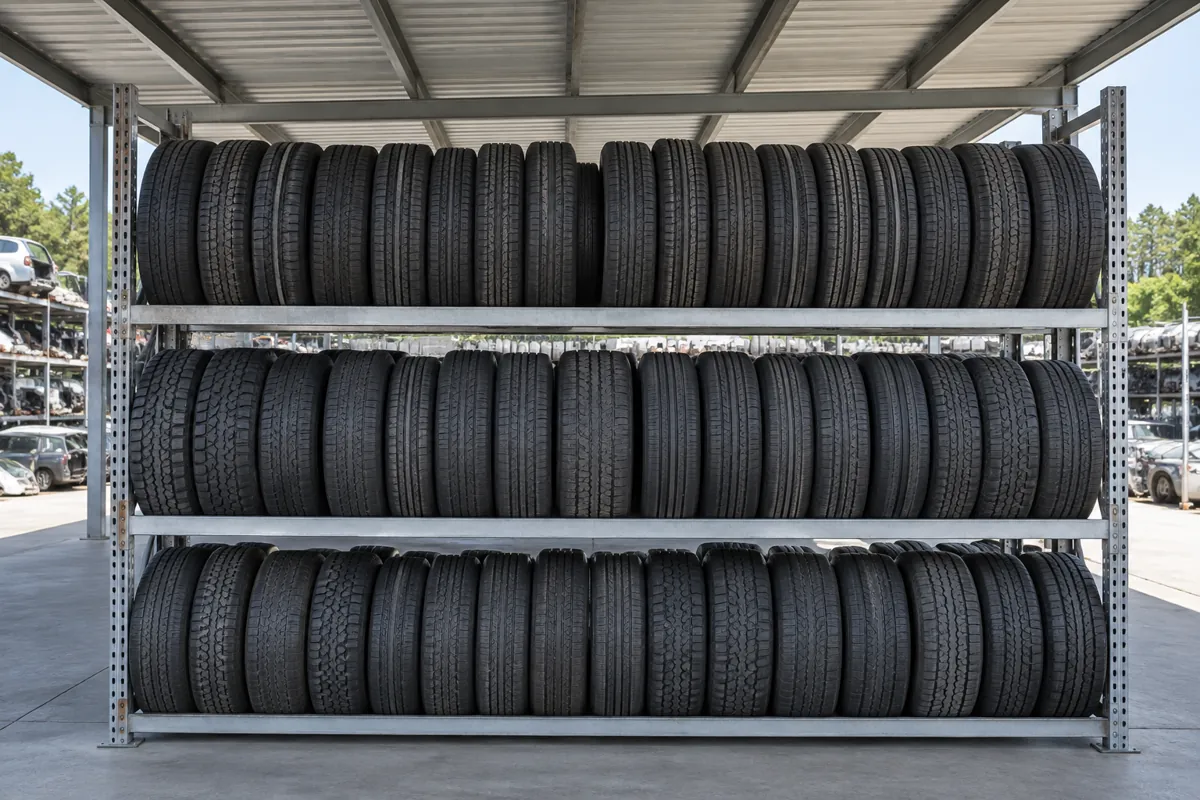
Many yards do not have a building for tires. A rack on a concrete pad under an open-sided canopy keeps tires off the ground, out of direct sun and out of standing water while leaving the retail row open to the yard. Check that the pad is level and sound, use foot plates and appropriate anchors, and confirm the finish is suitable for the exposure. For very large tire counts, compare a conventional run against the denser options in our high-density tire storage guide; for commercial truck tires from heavier vehicles, see heavy-duty truck tire storage racks.
Anchoring, housekeeping and fire protection
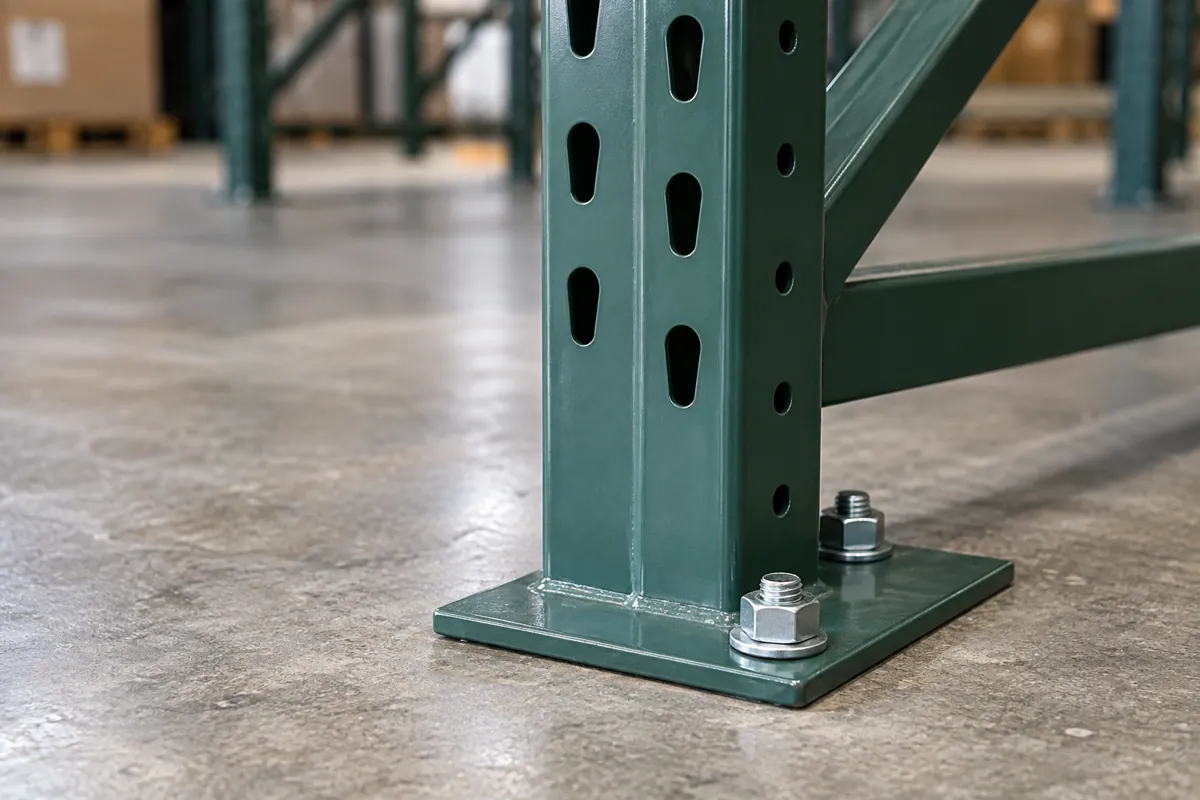
The second 2017 order added foot plates, and that detail matters. Foot plates spread the upright load onto the slab and give you a place to anchor. Whether anchoring is required depends on the rack height, load, configuration and local code, but a rack that customers lean on or bump with a cart should never rely on friction alone. Have the supplier confirm the footing and anchor approach for the actual floor, and have a qualified rack engineer review any run that is tall, heavily loaded or in a seismic area, which includes the Salt Lake Valley.
OSHA’s materials-storage rule requires stored materials to be stable and secure against sliding or collapse, and requires aisles and passageways to be kept clear and in good repair. For a public-facing retail row, that means no tires on the floor in front of the rack, no leaning stacks at the ends of runs, and a defined aisle that stays clear. Tire-industry storage guidance adds the product-care side: keep tires clean, dry, out of direct sun and away from heat and ozone sources, and rotate stock so the oldest sells first.
Fire protection is a project decision, not a rule of thumb
Fire and building codes classify rubber tires as a high-hazard storage commodity. The allowable pile or rack height, separation distances, quantity limits and sprinkler requirements depend on the code edition adopted where you operate, whether storage is indoors or outdoors, the building construction and the existing fire-protection system. Historical figures quoted online are not a design basis. Confirm the current requirements with your fire-protection engineer and the authority having jurisdiction before finalizing the layout, and keep records of how much is stored and where.
Tire-rack planning checklist for auto recyclers
Collect these inputs before asking for a layout or a quote. They separate a small retail row from a bulk tire yard and tell us whether standard sectional rack, a taller configuration or a denser system fits.
Count by size group
Estimate peak on-hand tires in each common size range and note how fast they turn.
Pick the location
Indoors, covered pad or open yard; measure wall length, clear height and the slab or pad condition.
Define the aisle
Customer self-service or staff picking, cart access, and the clear width you can commit to.
Handle rejects
Decide where failed tires stage for recycling pickup so they never enter the retail row.
Check requirements
Ask about anchoring, seismic review and the fire-protection requirements that apply to tire storage at your address.
Plan the extension
Leave room to add sections in one direction and buy components that match the installed system.
If the yard also stores loose parts, batteries or cores, the same upright-and-beam approach scales up: see pallet rack planning and systems for heavier loads and our commercial Tire Storage Rack hub for every tire-specific option, including stackable tire racks for seasonal overflow.
Shop Tire Storage Racks Online
Standard sectional tire rack starters and add-ons in the same product family as this project, priced online. For taller runs, outdoor exposure or a full layout, request a quote.

Frequently asked questions
What did Pull-N-Save order from MH-USA?
Did MH-USA install the tire rack at the salvage yard?
Why do salvage yards use sectional tire rack instead of piles or pallets?
Can a tire rack run be extended years later?
Do used-tire racks belong indoors or outdoors?
What fire-code rules apply to storing used tires?
What should an auto recycler send for a tire-rack quote?
Planning tire storage for a Utah salvage yard or auto recycler?
Tell us where the rack will sit, roughly how many tires you hold by size at peak, and how customers or staff will pick them. We can help lay out a run that starts small and extends cleanly, and flag the anchoring and fire-protection reviews you will need.