
Off-Site Archive Box Storage on Boltless Shelving: Kirton McConkie, Lehi, UT
How a Salt Lake City law firm outgrew its downtown file room and built dense, low-cost archive storage for banker’s boxes on boltless rivet shelving inside a rented self-storage unit.
Lehi, UT
Project location
2026
Completed
Boltless rivet
Shelving type
Archive boxes
Application
The Project: Overflow Archive Storage Off-Site
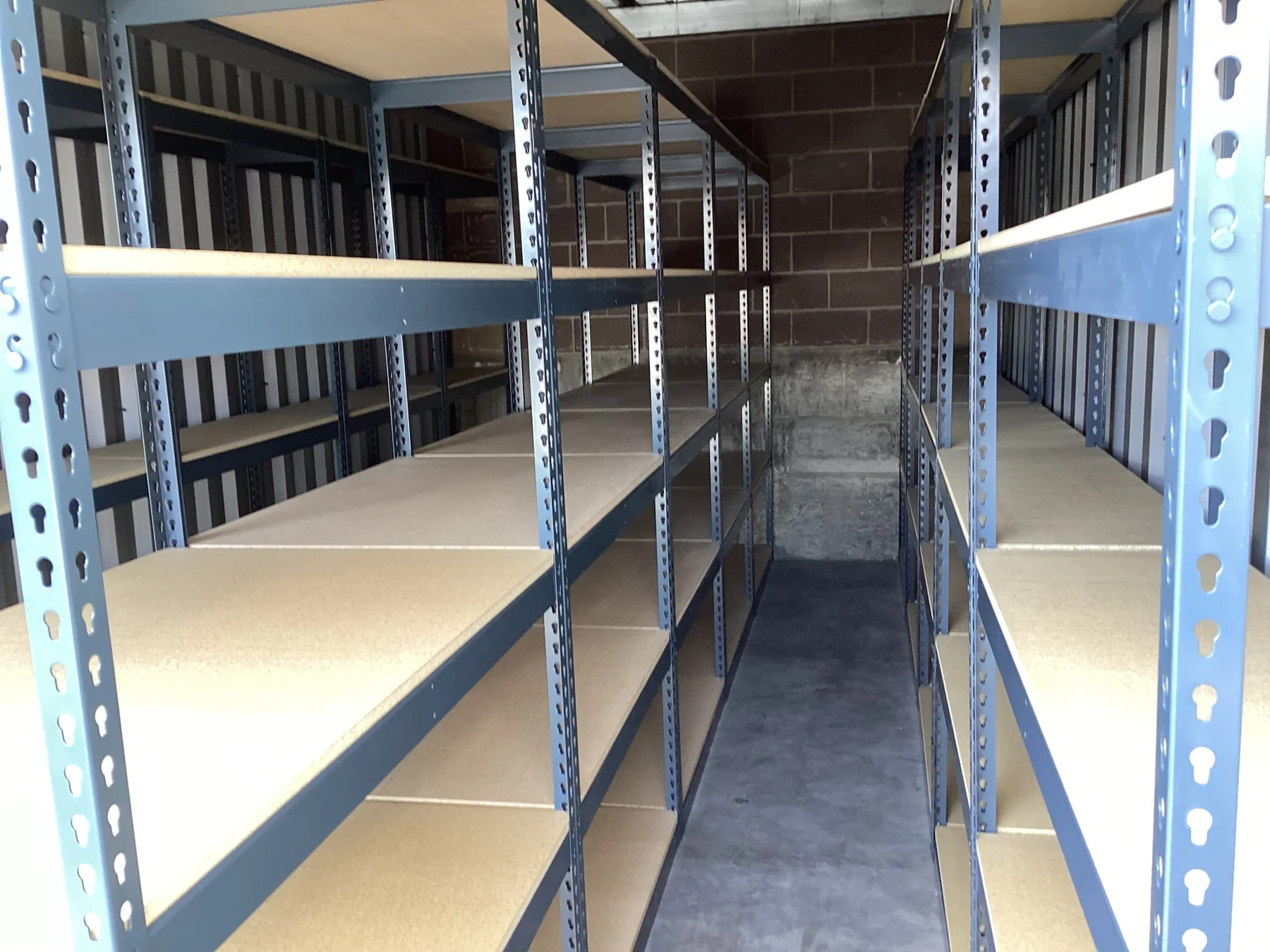
Kirton McConkie is a large law firm based in downtown Salt Lake City. Like most firms with a long practice history, it keeps years of closed matters, corporate records and archived case files that have to stay retrievable but do not need to sit inside expensive downtown office space. Rather than expand its in-office file room again, the firm rented a self-storage unit near Thanksgiving Point in Lehi, Utah, and asked Material Handling USA to fit it out with shelving built to hold banker’s boxes.
Chris Rodgers quoted the project in June 2026: a boltless rivet shelving system sized to the exact dimensions of the rented unit, supplied by Jaken, delivered and installed by our team. The order closed within a day of the quote being accepted, and the shelving was in place within the unit shortly after.
The component set described here is covered in more depth on our boltless shelving overview, which sits under the wider shelving solutions hub.
Why a Law Firm Moves Archives to a Storage Unit

Office real estate in a downtown high-rise costs far more per square foot than a self-storage unit on the edge of town, and archived files do not need conference rooms, natural light or proximity to attorneys’ desks. Once a matter closes and its retention period is documented, the boxes it generates are a classic candidate for off-site storage: infrequently accessed, but legally required to be kept and findable for a defined number of years.
The trade-off is that a rented unit is not built-out office space. It has a fixed footprint, a roll-up door instead of a hallway, and no raised floor or built-in shelving. Getting real capacity out of a space like that means specifying shelving to the unit’s exact dimensions rather than buying an off-the-shelf run and hoping it fits.
This is a pattern we see across professional services: firms that need retrievable, compliant records storage without paying downtown rent for it move the boxes, not the files. The same boltless shelving that works in a warehouse stockroom works just as well bolted into a storage unit.
Sizing Shelving to a Rented Unit, Not a Standard Bay
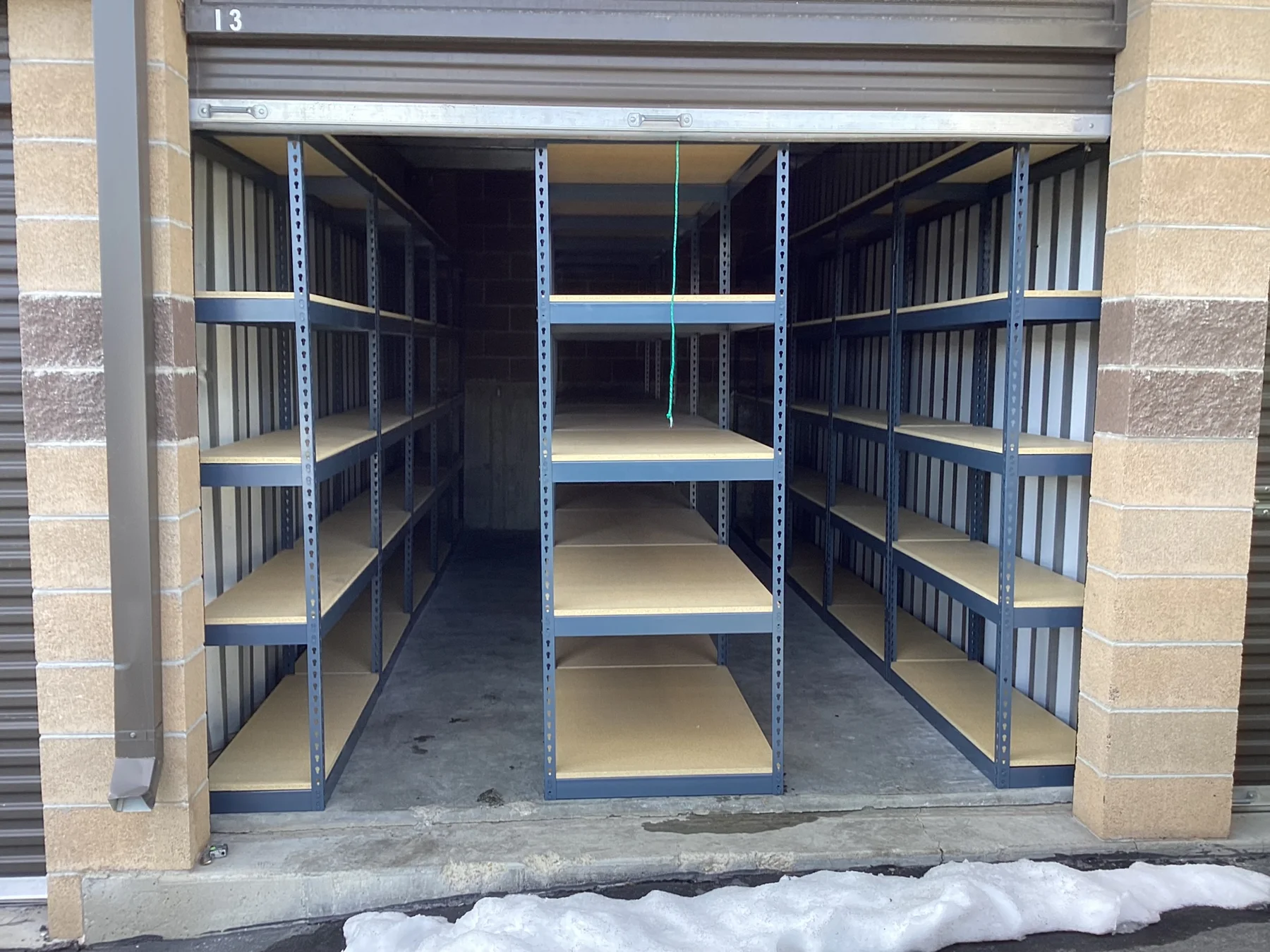
The drawing for this project is labeled with the storage facility’s own name rather than a room number, because the unit itself set every dimension. Three back-to-back runs of Jaken boltless shelving were laid out to use the unit’s depth without blocking the roll-up door, with posts sized to the unit’s 7-foot clear height and a mix of 15-inch and 30-inch deep shelves to match banker’s boxes and larger file cartons in the same run.
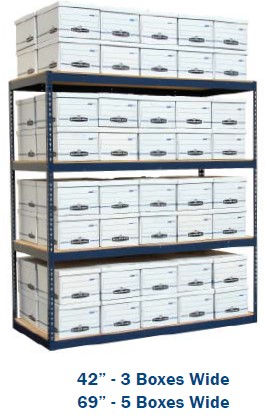
That mix of depths in one layout is a detail worth copying: box archive storage is rarely one size. Standard banker’s boxes need roughly 12 to 15 inches of shelf depth, while larger transfer cases and odd-sized binders want 24 to 30 inches. Specifying both in the same system, rather than picking one depth for the whole unit, is what actually maximizes what a fixed footprint can hold.
If you are fitting out a rented space rather than a purpose-built room, measure the door swing, the clear height under any sprinkler heads or door tracks, and the full usable depth before ordering boltless shelving. There is no do-over once beams are cut to a length that does not fit.
| Storage unit constraint | How the layout handled it |
|---|---|
| Fixed door width | Back-to-back runs on either side of a center aisle, sized to clear the roll-up door |
| 7-foot clear height | Angle posts and beam spacing chosen to use the full height without exceeding it |
| Mixed box sizes | 15-inch deep shelves for standard boxes, 30-inch deep shelves for larger files |
| No raised floor or dock | Shelving delivered and assembled in place, no forklift access required |
Why Boltless Shelving Fits Box Archive Storage
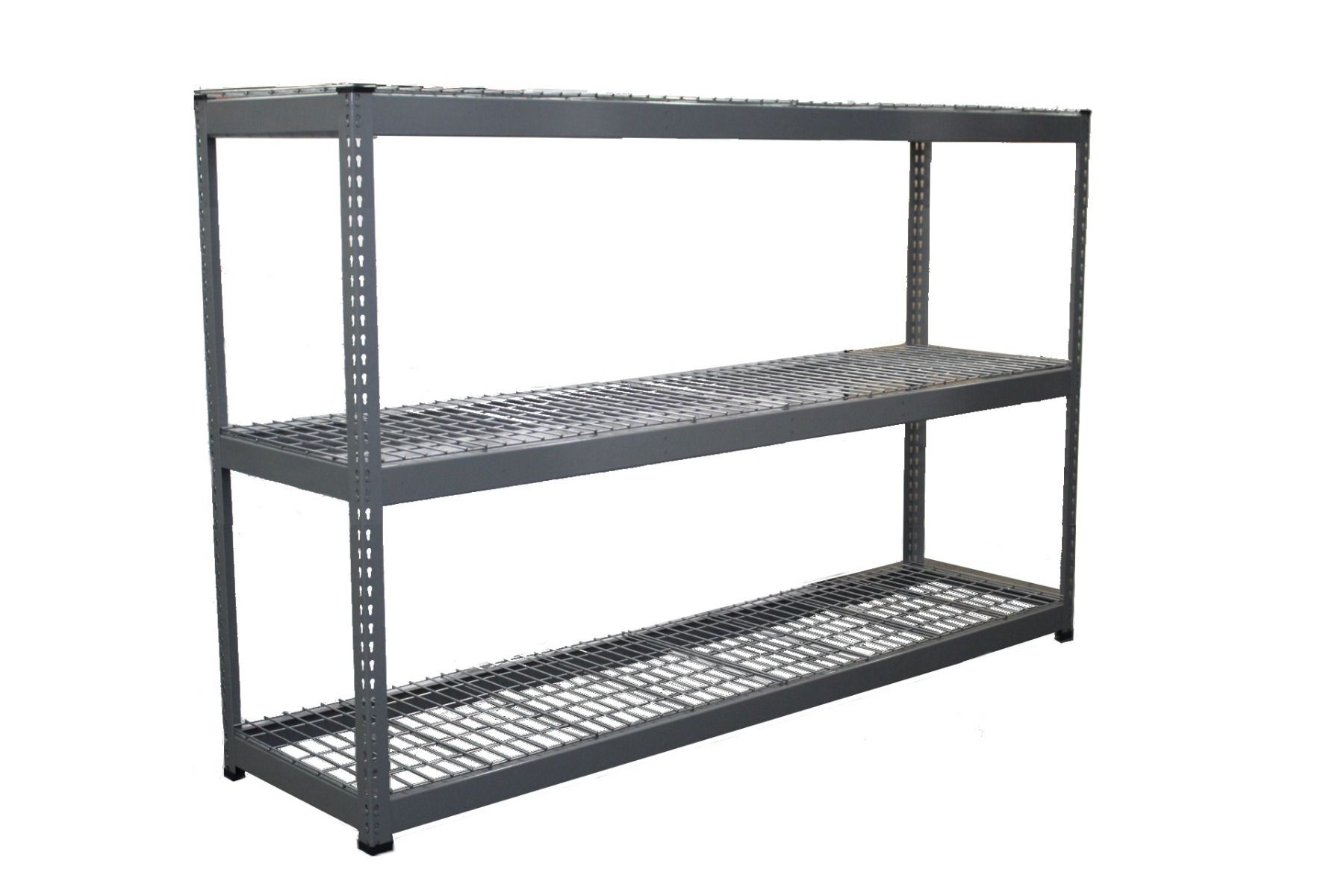
Boltless, or rivet, shelving is the standard answer for dense, low-cost storage of file boxes for one simple reason: it assembles with a rubber mallet, not a wrench. Rivet-ended beams drop into slotted angle posts, a particle board deck sits on top, and a full bay goes together in minutes. For a project like this one, where the shelving has to be built inside a tight, unfinished space with no power tools running, that matters as much as the price.
Particle board decking, used throughout this project, is the right call for box storage specifically: it gives a flat, continuous surface that supports a banker’s box across its whole base rather than at a few points, which is what keeps stacked boxes stable over years of undisturbed storage.
The system is also fully open on capacity later. If the firm’s archive volume grows, additional bays or additional levels can be added to the same posts without replacing anything already installed.
A Small Project That Still Moved Fast
Not every case study on this site involves a large system. This project was a small, single-unit order, and it is included here because the process was identical to a much larger job: identify the space, size the shelving to it, quote the manufacturer that could deliver, and get the crew in to assemble it. The order was accepted and moving within a day of the quote going out, with the vendor shelving PO and the installation PO issued back to back.
Small archive-storage projects like this one are a common add-on for firms that already work with us on larger systems elsewhere. If your archive volume outgrows one storage unit, the same layout approach scales to a second unit or a larger warehouse bay without changing the shelving line.
Planning Off-Site Records and Archive Storage
Whether it is a law firm, an accounting practice or any office that generates paper it must retain but rarely touches, moving archives to a dedicated storage space follows the same planning steps.
- Confirm your retention schedule before you box anything, so you know what actually needs to move off-site.
- Measure the space itself, not a generic unit size: door width, clear height and usable depth all set the layout.
- Plan shelf depths around your actual box and binder sizes rather than picking one depth for everything.
- Choose boltless or rivet shelving for tool-light assembly in a space with no built-in power access.
- Leave room on the posts to add levels or bays later as archive volume grows.
- Keep an index of what is stored where; dense shelving only saves money if boxes stay findable.
For a broader view of the options that sit alongside boltless shelving, see the shelving solutions hub, or the boltless shelving page for the product itself. Firms with an active, frequently accessed file room instead of an archive should also see our law firm file room mobile shelving case study, a separate project for the same firm’s in-office system.
Shop Boltless and Rivet Shelving Online
Buy select items directly from our online store, or request a quote for volume, custom sizes and freight-rated orders.

Frequently Asked Questions
Is boltless shelving good for archive box storage?
Can you size shelving to fit a self-storage unit?
What shelf depth is best for banker’s boxes?
Do you install shelving in rented storage units?
Is off-site archive storage cheaper than expanding an office file room?
Outgrowing Your File Room?
Send us your space’s dimensions and we will design a boltless shelving layout to fit it.