
RiveTier Rivet Shelving for an Auto Parts Store: Tinks Superior Auto Parts, Cedar City, UT
How a southern Utah auto parts business restocked an entire parts room with RiveTier 1 boltless rivet shelving, ordered to its own component list and delivered freight-only for in-house assembly.
Cedar City, UT
Project location
RiveTier 1
Shelving line
Auto parts
Application
2025
Order placed
The Project: Reshelving a Southern Utah Parts Room
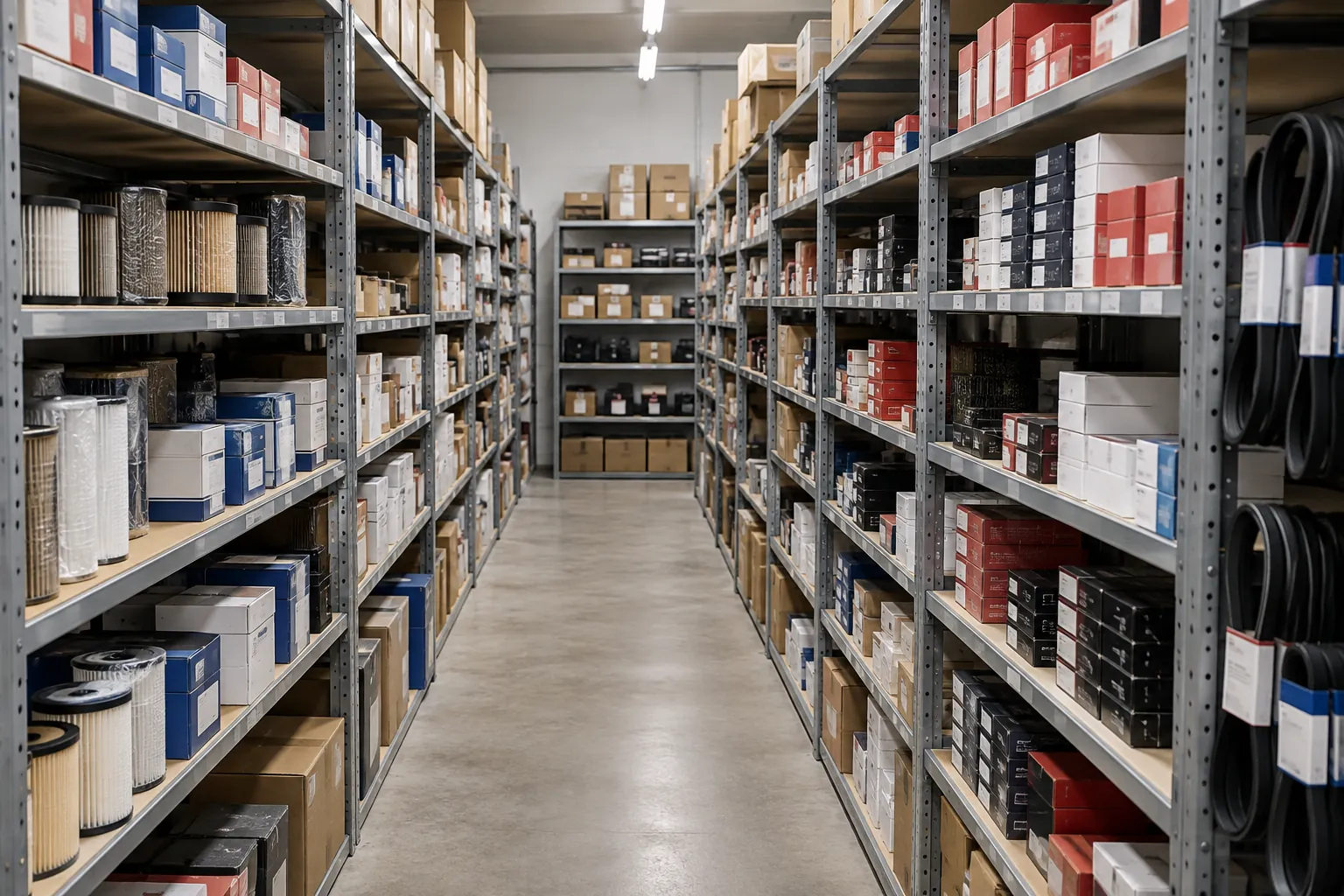
Tinks Superior Auto Parts is an independent auto parts business in Cedar City, Utah, in the southwest corner of the state. Independent parts houses live or die on breadth of stock: the counter has to be able to produce a filter, a belt, a brake component or a sensor for vehicles spanning twenty or more model years, and every one of those part numbers needs a home that a counter person can find without hunting.
In December 2025 the company came to Material Handling USA to buy shelving for that parts room. What made the project unusual is how it arrived. Rather than asking for a design, the buyer sent Chris Rodgers a complete component list for the shelving line he wanted: RiveTier 1 style boltless rivet shelving, itemized down to the post, beam and deck part numbers. He already knew the product and knew exactly how he wanted the room built.
The system he specified is the same boltless rivet family described on our boltless shelving hub, which sits under the wider shelving solutions overview, and is sold here as RiveTier shelving from Western Pacific Storage Solutions.

Why Auto Parts Rooms Run on Rivet Shelving

Walk into the back room of almost any parts store, dealership parts department or independent jobber and you will see the same thing: long runs of grey or tan steel shelving with wood or wire levels, packed with small cartons. There is a reason that pattern repeats. Auto parts inventory is high in variety and low in unit weight. A parts room does not need pallet positions; it needs a very large number of shelf feet at a height a person can reach, at the lowest possible cost per foot.
Rivet shelving answers that better than almost anything else. The uprights are simple steel angle posts punched with keyhole slots. Beams have rivets on each end that drop into those slots and lock with a downward tap. Because the beams carry the load in pairs front to back, the levels can be adjusted anywhere along the post without brackets, clips or hardware, which matters when a store rearranges by product line rather than by shelf height.
Open shelving also keeps the counter fast. With no back panels or side panels, a counter person can see and reach stock from either side of a run, and labels stay visible. For a parts business where a customer is standing at the counter waiting, that visibility is part of the service.
What a RiveTier 1 System Is Made Of
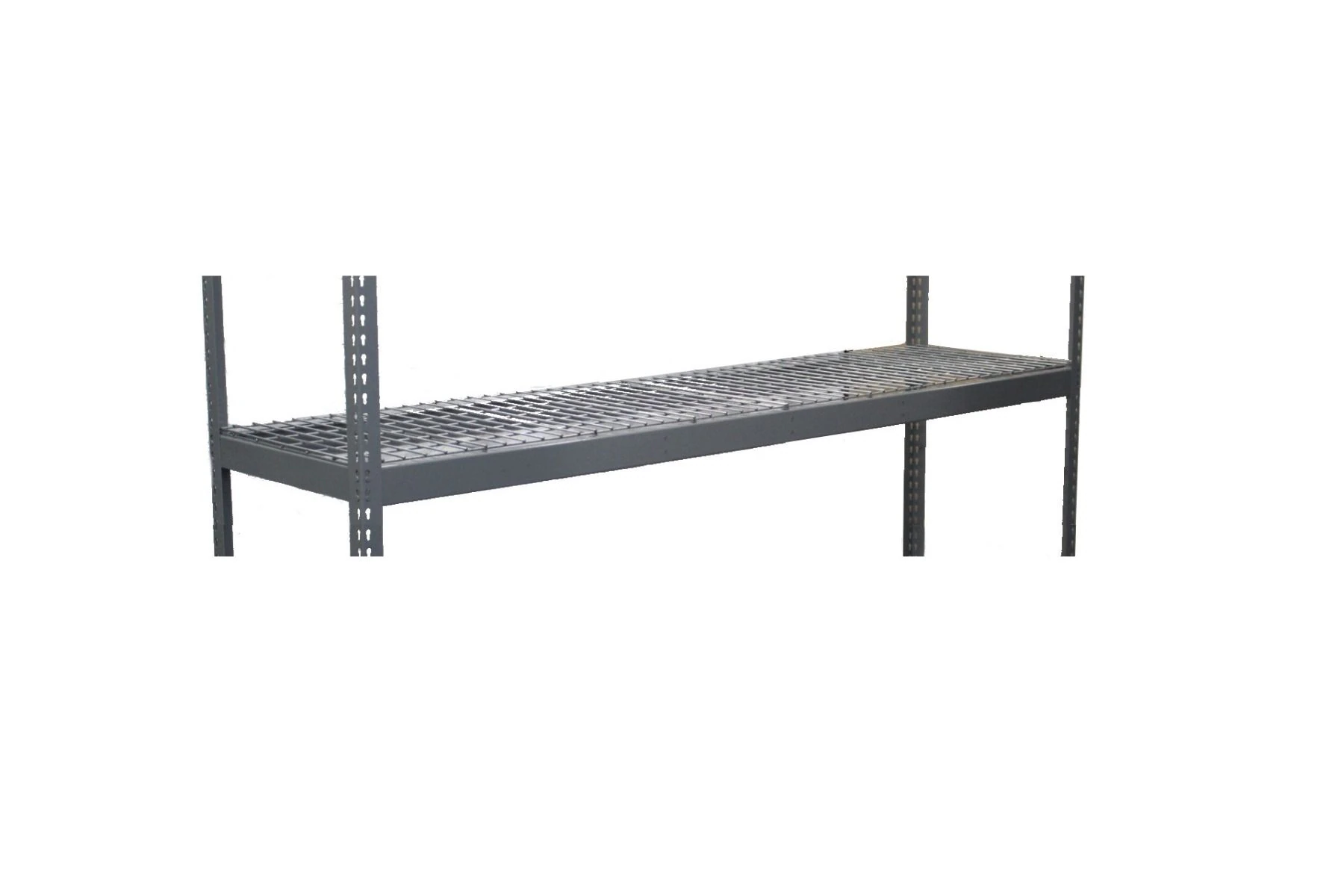
RiveTier 1 is the single-rivet version of Western Pacific’s rivet shelving line. Every unit is built from four kinds of parts and nothing else: angle posts, left-to-right beams that set the bay width, front-to-back beams that set the depth, and a deck that drops onto the beams. The order for this project used seven-foot angle posts, forty-eight inch left-to-right beams, twenty-four inch front-to-back beams and matching particle board decks, repeated across the room.
Seven feet is a deliberate choice for a parts room rather than the tallest option available. It puts the top level within reach of a step stool instead of a ladder, keeps the run under most sprinkler clearances in an older commercial building, and keeps the whole system in the category of shelving rather than rack. A forty-eight by twenty-four inch footprint is the workhorse size for boxed parts: wide enough that a level holds a useful number of cartons, shallow enough that nothing gets buried at the back where it is forgotten.
Because every bay after the first shares a post with its neighbour, a long wall of shelving needs far fewer posts than the bay count suggests. That is the quiet economy of rivet shelving in a large room, and it is why a full parts-room reshelving job stays affordable.
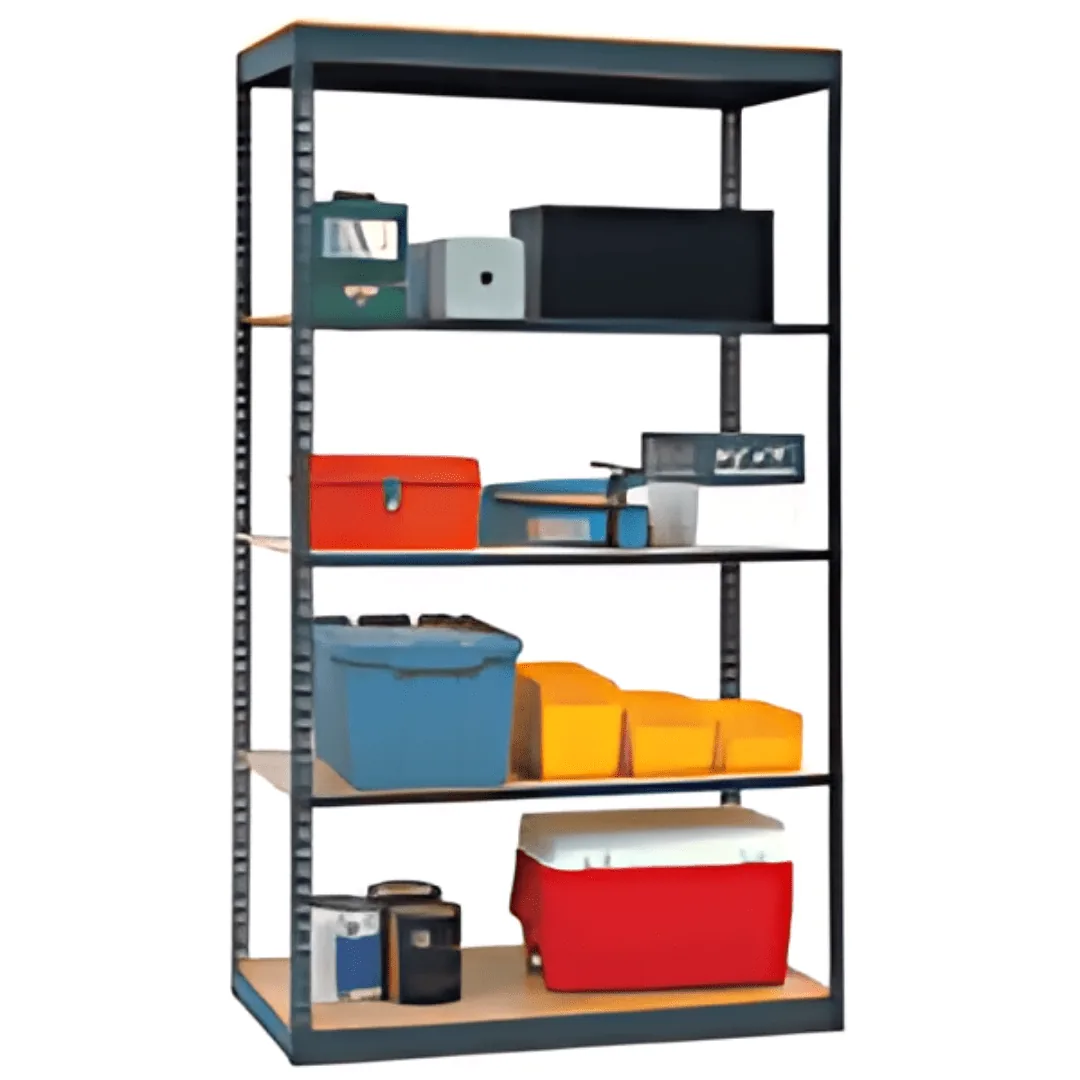
| RiveTier 1 component | What it does |
|---|---|
| Angle post (upright) | Steel angle punched with keyhole slots; sets the height and carries the load to the floor |
| Left to right beam | Sets the bay width and takes the weight of the deck across the front and back |
| Front to back beam | Sets the depth of the unit and ties the front and back beams into a level |
| Particle board deck | Flat shelf surface that drops onto the beams; no fasteners required |
| Shared post between bays | Lets each added bay reuse its neighbour’s post, lowering cost per shelf foot |
Particle Board Decks Versus Wire Decks for Small Parts
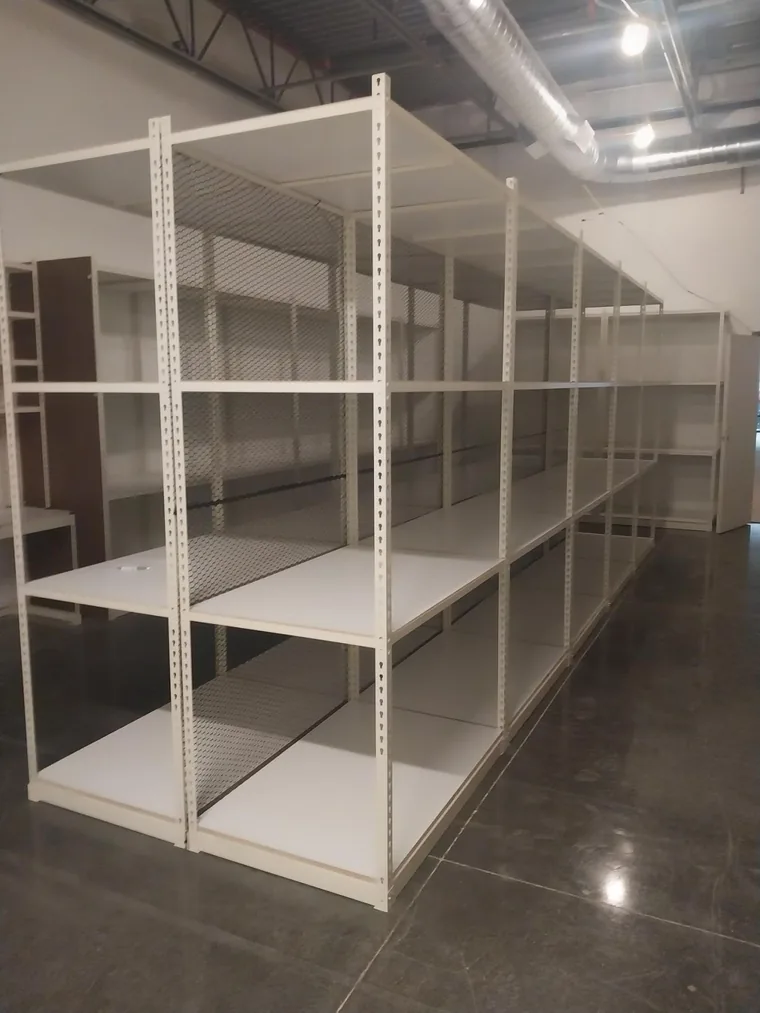
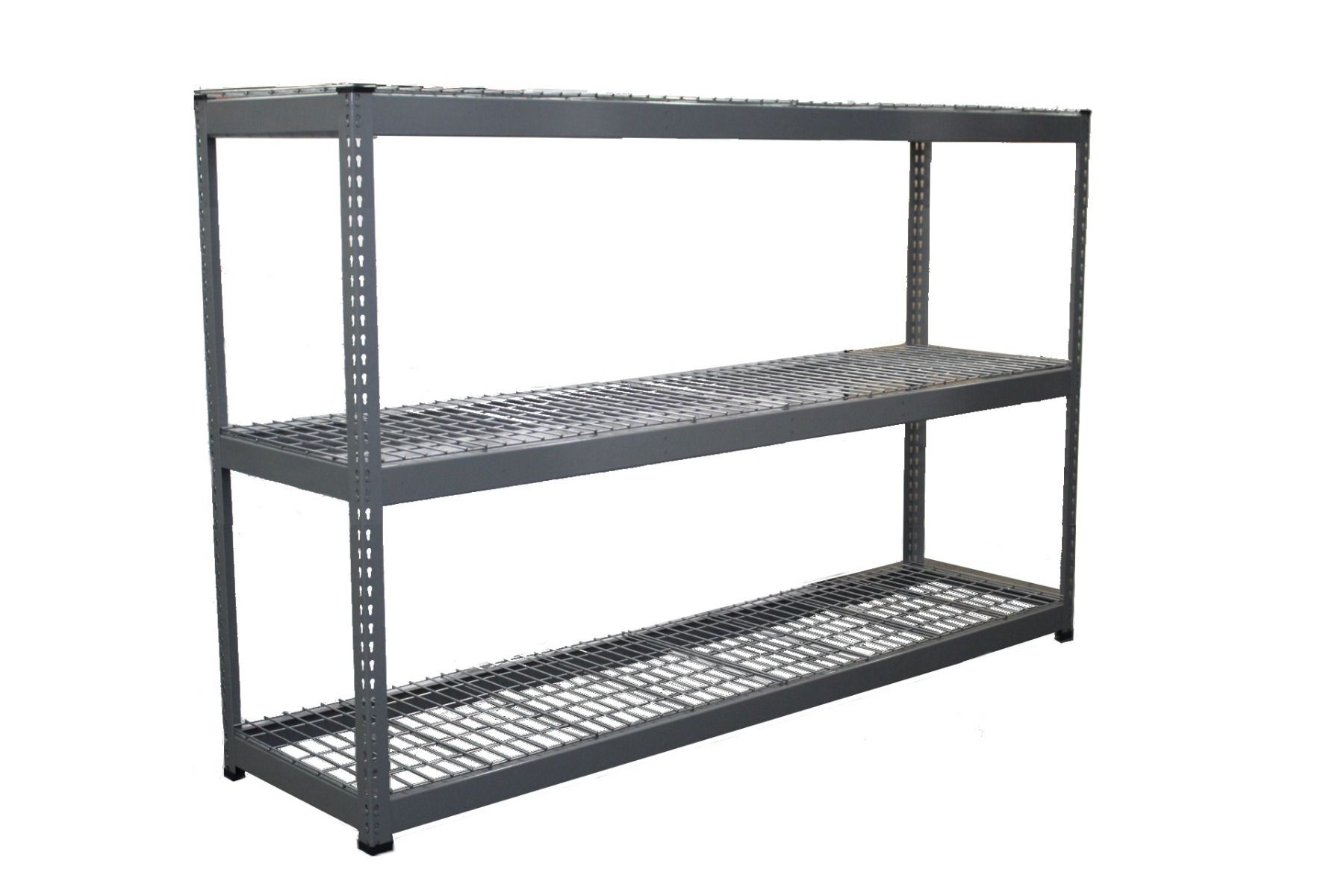
This project used particle board decking on every level, and for a parts counter that is usually the right answer. A solid board gives a flat, continuous surface, so a small carton, a loose bearing or a bagged kit sits where it was put and cannot slip through. Wire decking, by contrast, is the better choice where sprinkler water needs to pass through the level, where the storage is dusty and needs to be swept, or where loads are heavy and point-loaded.
The practical test is what sits on the shelf. Boxed and bagged small parts, literature, bulk hardware in bins and anything that can fall through a wire grid belong on solid decking. Tires, drums, heavy castings and items that come off a forklift tend to belong on wire. Many rooms mix both in the same run, since the deck choice is per level, not per unit.
One more point specific to older buildings: particle board levels are quieter and more forgiving on a concrete slab that is not perfectly flat, and they can be replaced individually years later without touching the steel. A damaged deck is a cheap part, not a rebuilt bay.
| Stored item | Better deck choice |
|---|---|
| Boxed filters, brake and ignition parts | Particle board |
| Bulk fasteners in bins | Particle board |
| Belts, hoses and bagged kits | Particle board |
| Tires and wheels | Wire deck or a dedicated tire rack |
| Heavy castings, cores and drums | Wire deck on heavier duty beams |
Freight Only, Assembled In House
Not every shelving project needs an installation crew, and this one deliberately did not. When Chris confirmed how the shipment would arrive, the customer’s answer was that they had staff and forklifts on hand to unload it. The order was quoted and shipped as material plus freight, and the team in Cedar City built the room themselves.
Rivet shelving is one of the few industrial storage products where that is a realistic decision rather than a gamble. There is no welding, no anchoring required for standard freestanding runs at this height, and no torque spec to hit. Two people with a rubber mallet can stand up a bay in a few minutes once the first one has taught them the pattern, and a store crew can spread the work across slow hours instead of paying for a crew to be on site for a fixed window.
What a self-assembling buyer does need to plan for is the freight itself. A full room of shelving is a heavy, multi-thousand pound shipment of long steel and stacked board. Someone has to be there with equipment and a place to stage it. Confirming that up front, as this customer did in writing before the order was released, is what keeps a delivery from turning into a problem at the dock.
Buyer sends the component list
The customer specified RiveTier 1 parts by part number for the room he wanted.
Quote issued and approved
Material, decking and freight quoted to the Cedar City address and approved the same week.
Factory order placed
Order released to Western Pacific for production of posts, beams and decks.
Freight delivery
Shipment delivered to the store, unloaded by the customer’s own staff and forklifts.
In-house assembly
Store crew assembled the bays and set level heights around actual product lines.
Lead Times Are Part of the Specification
Rivet shelving is a manufactured product, not a shelf item, and a full room of it is a factory run. This order was quoted with an approximate two to four week delivery window, and the customer checked in on the exact date a few weeks later, which is the normal rhythm of a project like this. Some common sizes are in stock at select manufacturers, subject to confirmation, but a large single-colour order built to one component list is generally produced to order.
For a retail parts operation that timing matters more than it might in a warehouse. A store usually wants to reshelve during a slower season, and it has to keep selling from the old shelving until the new steel is on site. Planning the order so the shipment lands at the start of a quiet stretch, rather than mid-season, is worth more than shaving a few days off the lead time.
If a date is firm, say so when you request the quote. We can confirm current production lead times with the manufacturer before an order is released, and where a date cannot be met we would rather re-source the line than promise it.
What we verified for this case study
The details on this page come from the project’s own records: the customer quote and vendor purchase order in the project folder, the factory acknowledgement, and the email thread between the buyer and Chris Rodgers covering the parts list, the approval, the unloading arrangements and the delivery follow-up. Order values, quantities, contact names and the site address are not published.
Planning Shelving for a Parts Counter
Whether you run an independent parts store, a dealership parts department, a fleet shop or a repair facility with its own stock, the same handful of decisions drive how well a parts room works once the shelving is up.
- Set the height to the people, not to the ceiling: a seven-foot run keeps the top level reachable without a ladder.
- Pick a bay width and depth you can repeat everywhere, so levels, decks and labels stay interchangeable.
- Keep depth shallow enough that nothing hides at the back of a level; two shallow runs beat one deep one.
- Use solid decking wherever small, loose or bagged parts are stored, and wire only where you need drainage or heavy point loads.
- Leave open slots on the posts so level heights can be re-cut around new product lines later.
- Plan the aisle for a cart or a hand truck, not just for a person walking.
- Confirm who unloads the freight and with what equipment before the order ships.
Related reading on this site: rivet shelving for the general product, automotive shelving for parts and dealership applications, parts shelving for industrial stockrooms, and boltless shelving in Utah for local supply and delivery. Projects with heavier or palletized stock are usually better served by pallet rack instead.
Shop Rivet and Boltless Shelving Online
Buy select items directly from our online store, or request a quote for volume, custom sizes and freight-rated orders.


Frequently Asked Questions
What is RiveTier shelving?
Is rivet shelving good for auto parts storage?
Should a parts room use particle board or wire decking?
Can we assemble boltless shelving ourselves?
How tall should shelving in a parts room be?
How long does rivet shelving take to arrive?
Do you deliver shelving to southern Utah?
Reshelving a Parts Room?
Send us your room and product mix and we will spec a rivet shelving layout, or price the component list you already have.