
Bus Roof Access Platform for Rogue Valley Transportation District in Medford, Oregon
RVTD’s maintenance team wanted a safer way to work on bus roofs, and it wanted to see the platform in person before buying. Here is how a phone call turned into a site visit, a refined design and a platform the agency’s own crew assembled.

Medford, OR
Project location
Transit
Public bus agency
Mobile
Platform on casters
Self-install
Assembled by RVTD crew
Shop Shop-Floor Ladders Online
Rolling ladders, ships ladders and ladder safety gates you can buy online for everyday reach work in a maintenance shop. These are not bus roof platforms. Full bus maintenance platforms are configured and quoted by our team.


Project Snapshot
Rogue Valley Transportation District (RVTD) runs public bus service in the Rogue Valley of southern Oregon, with its operations and maintenance base in Medford. Transit buses carry a lot of equipment on the roof: air conditioning units, ventilation, antennas and, on newer coaches, battery and fuel system components. Every one of those items needs inspection and service, and the roof of a bus is no place for a ladder and a hope.
| Item | Details |
|---|---|
| Customer | Rogue Valley Transportation District (RVTD) |
| Location | Medford, Oregon |
| Industry | Public transit agency, bus maintenance |
| Product | Mobile bus roof access platform system (bus maintenance scaffolding) |
| Configuration | Two guarded walkway platforms on locking swivel casters, one rolling stair, swing gates at the platform ends and adjustable cross rails |
| Construction | Steel and aluminum, with guardrails and key parts powder coated safety yellow |
| How it started | Phone call to our sales team in July 2025 |
| Order | August 2025, after an in-person site visit |
| Delivery | Early January 2026 |
| Installation | Assembled by RVTD’s own maintenance crew |
| Our role | Quoting, manufacturer sourcing, site-visit arrangements, design questions, approval drawings, order management and delivery coordination |
This case study is based on our quote and order documents, the manufacturer’s approval drawing and our email correspondence with RVTD’s maintenance team. We do not publish pricing, dimensions, contacts or facility details for customer projects.
The Need: Safe, Repeatable Access to Bus Roofs
RVTD’s maintenance department called us in July 2025 asking about bus maintenance scaffolding. We sent a quote letter and a drawing for a mobile platform system the same week. The questions that came back were the questions every careful fleet manager should ask.
Could we share photos of the model in use? Which other transit agencies had bought bus platforms from us? Could the agency speak to one of them? And did the quote include setting the platform up on site? We answered each one: we sent photos of similar units, connected RVTD with Utah Transit Authority, which had bought bus roof platforms through us (see the UTA bus roof platforms case study), and added assembly as a quoted option.

Image: representative AI rendering of a mobile bus roof access platform. Project photos from RVTD will replace these images when they are available.
A roof platform is a large purchase for a public agency, and it is a piece of equipment the crew will climb onto every week for years. RVTD’s maintenance manager told us early that he was very interested in buying, but wanted to see the product in person before issuing a purchase order. That one requirement shaped the rest of the project.
Finding a Platform RVTD Could See in Person
Seeing a bus platform in person is harder than it sounds. These systems are built to order, they sit inside secure maintenance garages, and the nearest installation can be several states away. The manufacturer on our first quote had installations in the East and Midwest, but none on the West Coast. The one reference it could offer had a unit on order that had not arrived yet, so there was nothing to look at.
Rather than ask RVTD to buy without seeing one, we went back to the market. We called other bus platform manufacturers and found one with installations at transit agencies in California. We asked for a second quote, which became Option B, and sent RVTD the new manufacturer’s drawings.
Once RVTD committed to the visit, the manufacturer arranged it with one of its transit customers in Southern California. That agency’s fleet and facilities team was happy to host. RVTD’s maintenance manager made the trip in August 2025 and saw the platform working in a real bus garage.
His verdict after the visit was clear: he was happy with the quality of the platform. He also came back with two specific questions, and those questions improved the design RVTD ordered.
Refining the Design: Gaps, Gates and Stairs
The gap between the platform and the bus
The one thing RVTD did not like at the site it visited was the gap left between the bus body and the platform. A mobile platform has to roll in beside the bus without touching it, so some gap is unavoidable. But the roof of a transit bus curves away at the edge, and a wide gap at roof level is exactly where a dropped tool, a foot or a knee goes. RVTD asked whether the swing gates could be made adjustable to tighten the gap when needed, and whether the gates on the proposed unit latched from the center or from the platform end.
We put both questions to the manufacturer. The answer: the updated design RVTD was quoted already had adjustable cross rails, shown on the drawing. They do not open from the center. Each cross rail is a full railing that locks into a socket on either platform, and it adjusts so the crew can set it to suit the bus. The manufacturer also offered to modify the design further if anything else would make RVTD more comfortable.
One staircase, not two
While reviewing the drawings we noticed that the platform RVTD had seen in California had two staircases, while the system we had quoted had one. We raised it before the order rather than after. RVTD confirmed one staircase was right for its shop, and the manufacturer confirmed that the single-stair drawing was what had been quoted all along.
One rolling stair keeps the system lighter to move and leaves more floor space around the bus. A second stair can make sense in a busy bay where two crews work at once. It is a choice worth making on purpose, not by default.
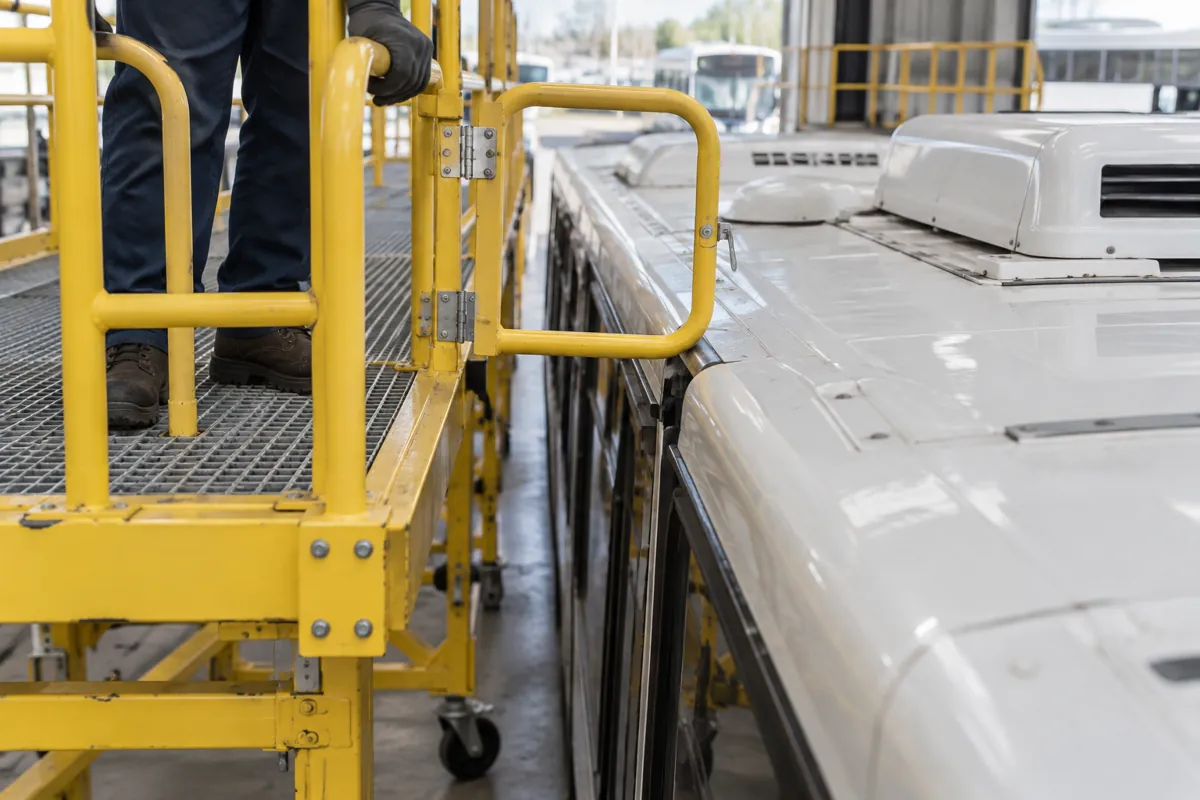
What the system includes
- Two mobile walkway platforms, one for each side of the bus, at roof working height.
- Steel and aluminum construction, with guardrails and key parts powder coated safety yellow.
- Guardrails on the open sides and grip-strut walking surfaces for traction.
- Swing gates at the platform ends and adjustable cross rails that lock in place.
- A rolling stair at a comfortable climbing angle, with wide treads.
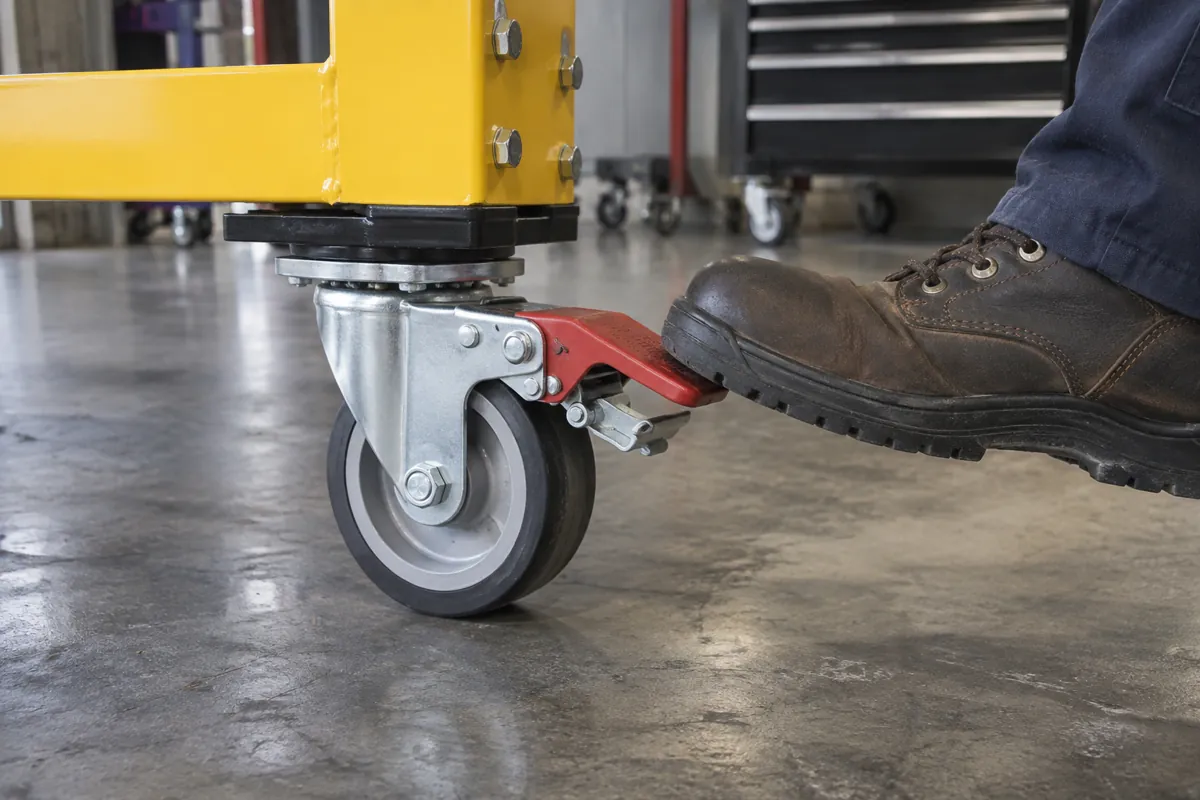
- Heavy swivel casters with total-lock pedals, so the platforms move into place and stay put.
- Alignment brackets to line the platforms and stair up with each other.
- Bumpers on leading edges to protect the bus body.
Order, Approval Drawings and Delivery
Quote and questions
July 2025: phone call, quote letter and drawing, photos, a transit reference and an assembly option.
Site visit
August 2025: second manufacturer sourced, Option B quoted, site visit at a California transit agency.
Order
Late August 2025: design confirmed with one staircase. RVTD signs the proposal and issues a purchase order for the unit and shipping.
Approval drawing
Early September 2025: the manufacturer’s approval drawing is signed and production starts.
Delivery
Early January 2026: the platform ships by freight and arrives at RVTD’s Medford maintenance yard.
Assembly
January 2026: RVTD’s crew assembles the system using the manufacturer’s 3D model of the finished unit.
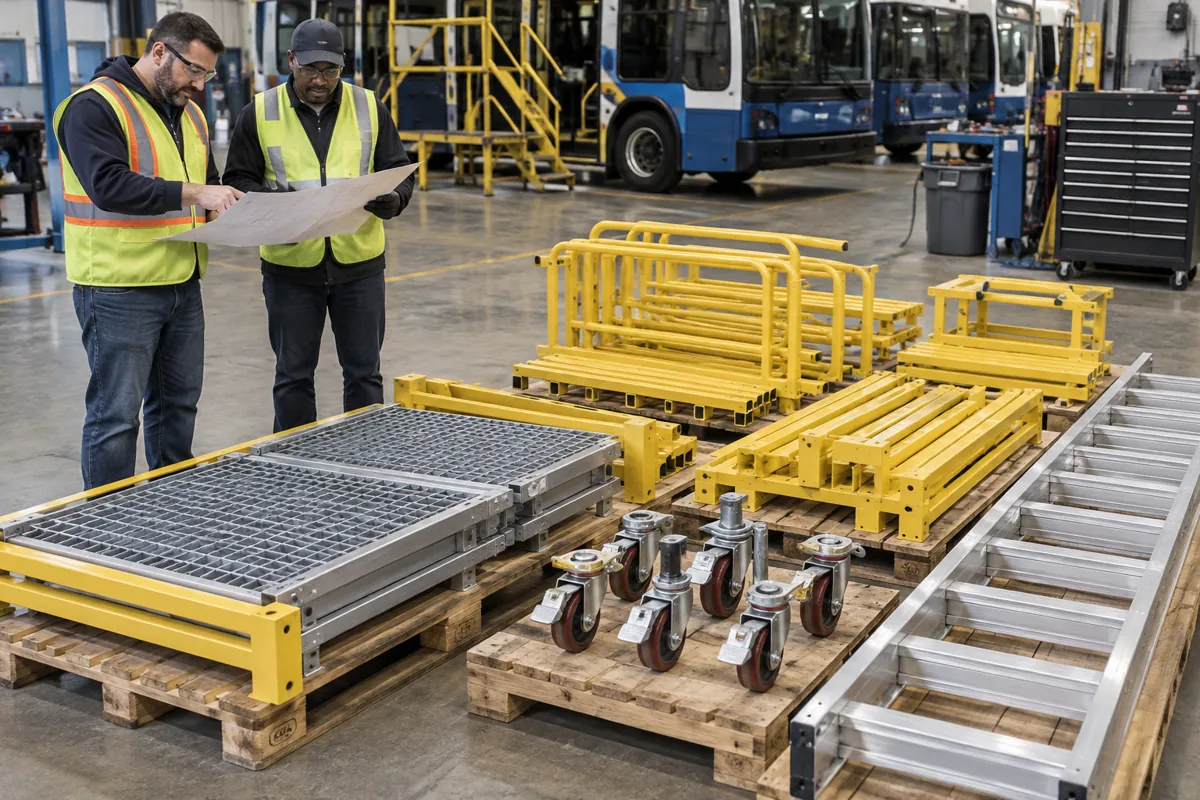
RVTD decided to assemble the platform with its own maintenance crew, so the order covered the unit and freight only. Its team was comfortable with the work, and the platform arrives as bolt-together components rather than a welded structure.
The manufacturer’s quoted lead time was 10 to 12 weeks. Production ran longer than that. The factory fell behind, and we pressed for ship dates and kept RVTD informed until the platform shipped at the end of December. When the crew asked for assembly instructions, we went back to the manufacturer, which supplied a 3D drawing of the assembled system with a free viewer.
Image: representative AI rendering of a mobile bus roof access platform. Project photos from RVTD will replace these images when they are available.
The Result
The platform is installed and in use at RVTD’s Medford maintenance base. When we checked in with the agency in February 2026, its maintenance manager told us he was happy with the bus roof platform, that assembly was easy and that it seemed very well made.
We have not measured time savings or safety statistics for this project, so we are not publishing claims about either. What we can say is that RVTD’s crew now reaches the roof of a bus by walking up a guarded stair onto a guarded platform, instead of climbing a ladder onto a curved roof.
Why mobile, not fixed? A fixed roof dock is a building project. It needs a dedicated bay, structural design and often a permit. A mobile system on locking casters rolls up to the bus in any suitable bay and rolls away when the bay is needed for something else. For an agency that wants roof access without rebuilding a shop, mobile is often the practical answer.
Locking the casters is part of every setup. The crew positions the platforms, sets the gates and cross rails, and steps on each total-lock pedal before anyone climbs.
Lessons for Transit Agencies Buying a Bus Maintenance Platform
The points below are general guidance from our bus scaffolding projects, drawn from the questions RVTD asked. They are the questions we would encourage any fleet to ask.
- Ask to see one in person. If the platform you are quoted has no installation you can visit, ask your supplier about one that does. A site visit answers questions a drawing cannot.
- Look closely at the gap. Check how close the platform edge sits to your bus roof, and how gates and cross rails close it off. Bring your own bus types into the conversation.
- Decide on stairs deliberately. One rolling stair or two depends on bay space, crew size and how often two people work the roof at once.
- Ask for references. Another agency’s maintenance team will tell you how the platform works day to day.
- Decide who assembles it. A capable crew can assemble a bolt-together system. If you want it set up for you, ask for assembly as a quoted option.
- Plan for lead time. These platforms are built to order. Build some buffer into your schedule beyond the quoted lead time.
- Review the approval drawing carefully. It is the last chance to change gates, stairs or options before production.
- Confirm fall protection requirements. Platform guardrails are one part of a fall protection program. Your safety team should confirm the setup against 29 CFR 1910 Subpart D and your own procedures.
For a wider look at the equipment, see our bus scaffolding guide, our transit agency bus scaffolding page for procurement questions, and our bus rooftop access and maintenance platforms page for roof work in particular.
Related Bus Scaffolding Guides
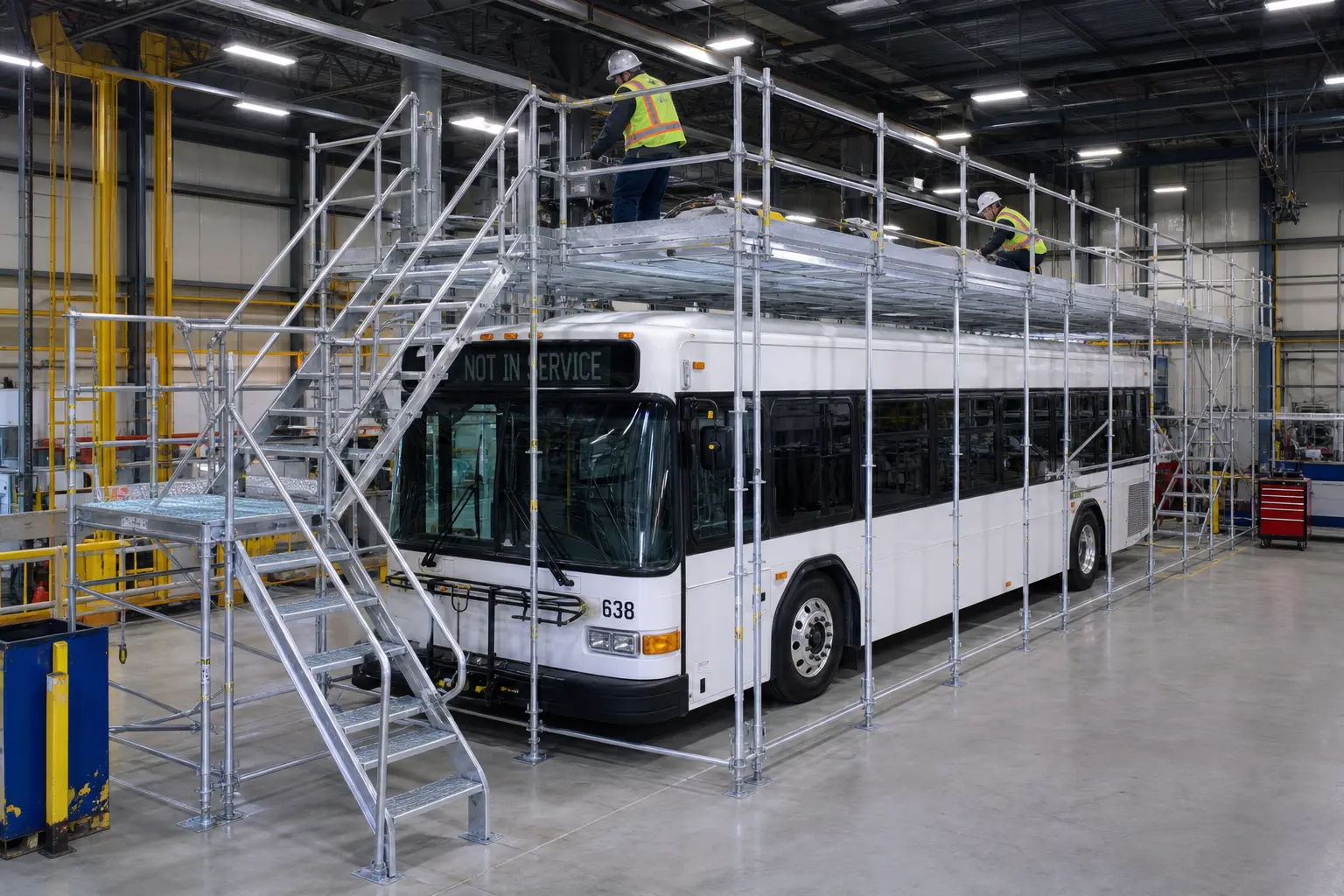 Bus ScaffoldingPlatform types, configurations and planning for bus maintenance.
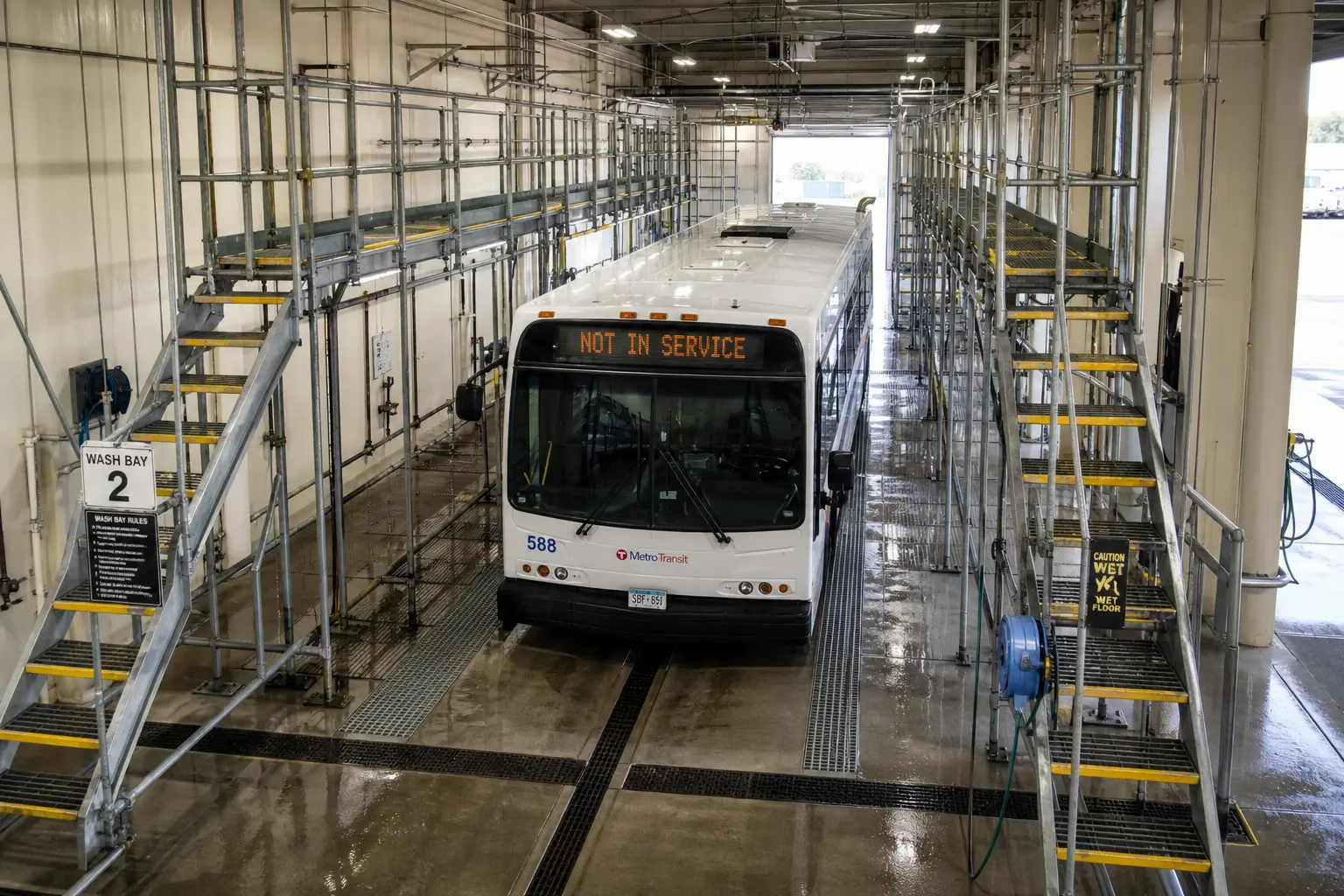 Bus Wash ScaffoldingAccess platforms built for wet wash bays.
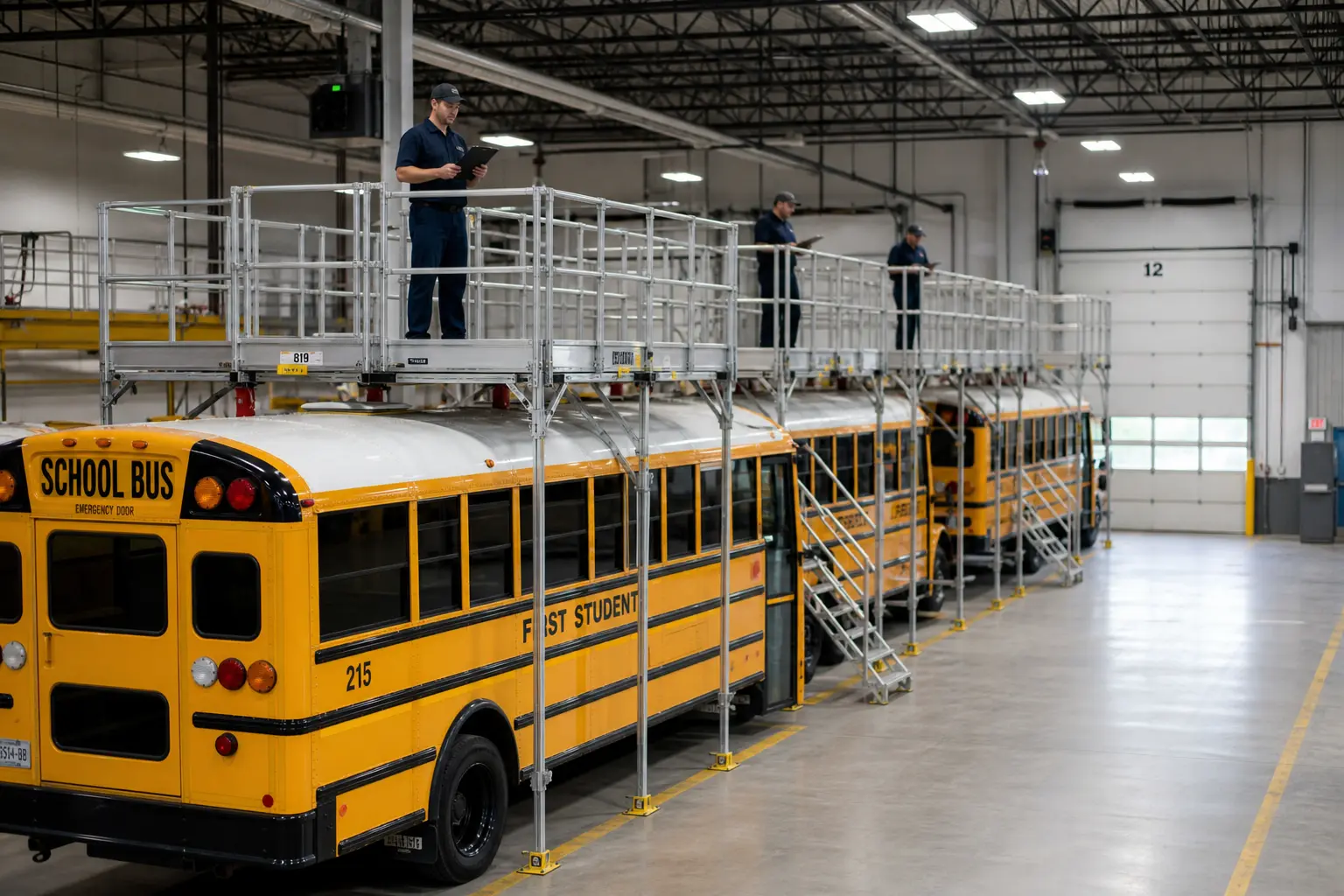 School Bus Fleet MaintenanceRoof access for school bus fleets and contractors.
More resources: Utah Transit Authority bus platform case study, transit bus scaffolding, electric bus maintenance platforms and our case study library.
RVTD Bus Platform FAQs
What did Rogue Valley Transportation District buy?
Why did RVTD visit another transit agency before ordering?
Can a mobile bus platform reduce the gap between the platform and the bus?
Can our own crew assemble a bus maintenance platform?
How long does a bus maintenance platform take to arrive?
Do you supply bus scaffolding to transit agencies outside Utah?
Planning Roof Access for Your Fleet?
Tell us about your buses and your shop. We will help you compare platform options and find an installation you can see in person.