
Rolling Bus Roof Platforms for Utah Transit Authority in Salt Lake City
When Utah Transit Authority built a new bus maintenance facility in Salt Lake City, the equipment specification called for a set of rolling roof work platforms. We supplied them as part of the building’s storage and shop equipment package, and UTA still vouches for us to other transit agencies.

Salt Lake
City, Utah
Transit
Public bus agency
New build
Bus maintenance facility
Set of two
Rolling roof platforms
Shop Shop-Floor Ladders Online
Rolling ladders, ships ladders and ladder safety gates you can buy online for everyday reach work in a maintenance shop. These are not bus roof platforms. Full bus maintenance platforms are configured and quoted by our team.


Project Snapshot
Utah Transit Authority (UTA) runs the bus, light rail and commuter rail network along the Wasatch Front. Its Depot District facility in Salt Lake City was built as a new home for bus maintenance, and like any modern bus garage it needed a safe way for technicians to reach the equipment on bus roofs. MH-USA, a Salt Lake City company, supplied the facility’s rolling bus roof platforms along with a long list of shop storage equipment.
| Item | Details |
|---|---|
| Customer | Utah Transit Authority (UTA) |
| Location | Salt Lake City, Utah |
| Facility | New bus maintenance facility in UTA’s Depot District |
| Industry | Public transit agency, bus maintenance |
| Product | A set of two rolling bus roof work platforms (bus maintenance scaffolding) |
| Bigger scope | The platforms were one line in the facility’s storage equipment specification, which we supplied as a package |
| How we were hired | As the storage equipment supplier to the project’s general contractor |
| Contract | Early 2021 |
| Installation | Late 2022 into early 2023, as the building neared completion |
| Project requirements | Federal Transit Administration Buy America rules and prevailing-wage (Davis-Bacon) installation labor |
| Our role | Submittals, sourcing, delivery, installation crews, owner walkthroughs and punch list |
This case study is based on the project’s equipment specification, our contract and purchase records, our email correspondence and our own site photos. We do not publish pricing, dimensions, contacts or security details for customer projects.
The Need: Roof Access Built Into a New Bus Garage
Transit buses carry a lot on the roof: air conditioning units, ventilation, antennas and, on alternative fuel and electric buses, fuel or battery system components. Every one of those items needs inspection and service. In an older garage that often means a ladder, a harness and a lot of care on a curved roof.
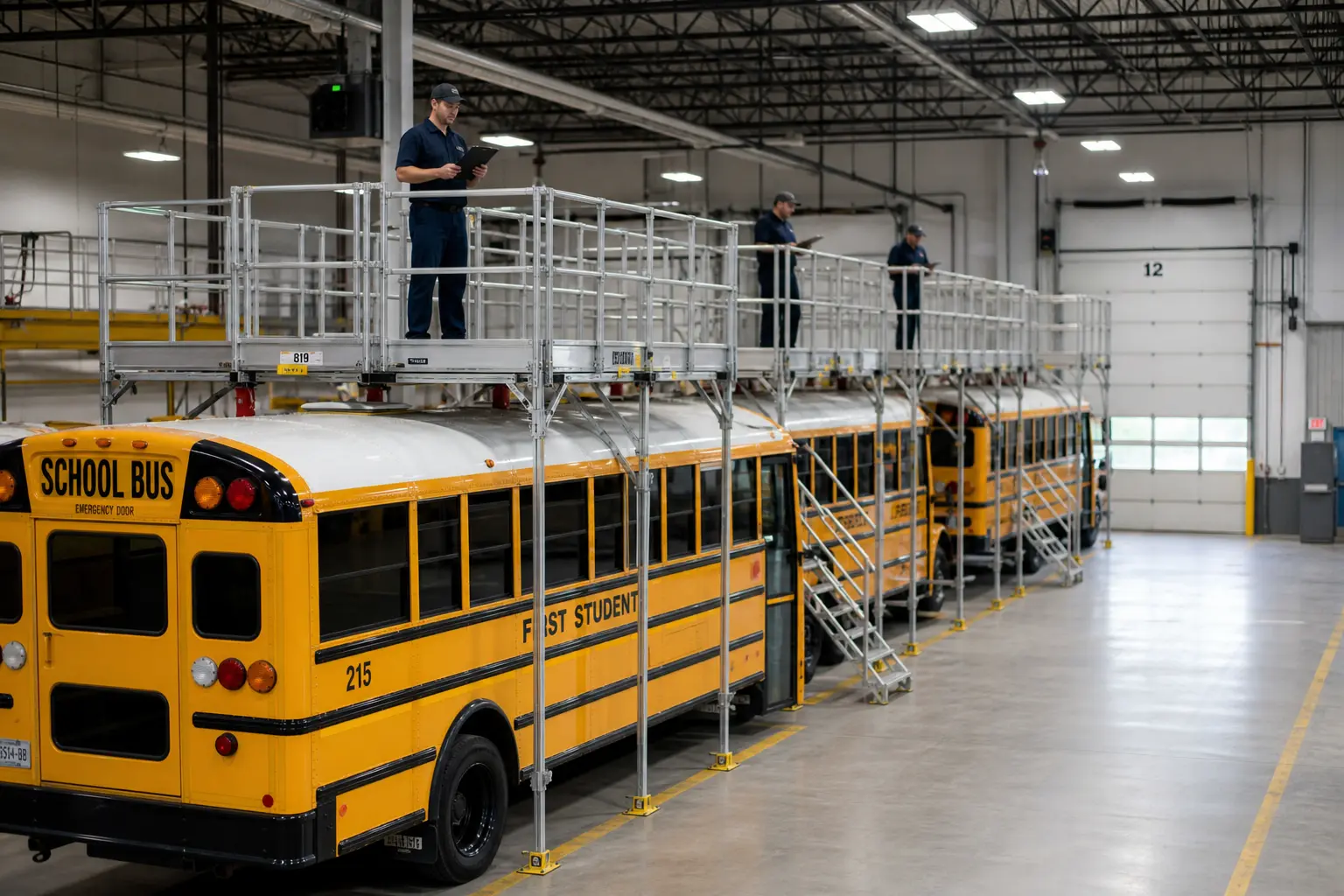
UTA’s project team planned roof access into the new building from the start. The facility’s equipment specification listed a portable roof work platform, supplied as a set of two, alongside the cabinets, racks and shelving the shops would need. The goal written into the spec was clear: platforms designed for working on bus rooftops from a guarded deck, rather than relying on a separate fall protection system.
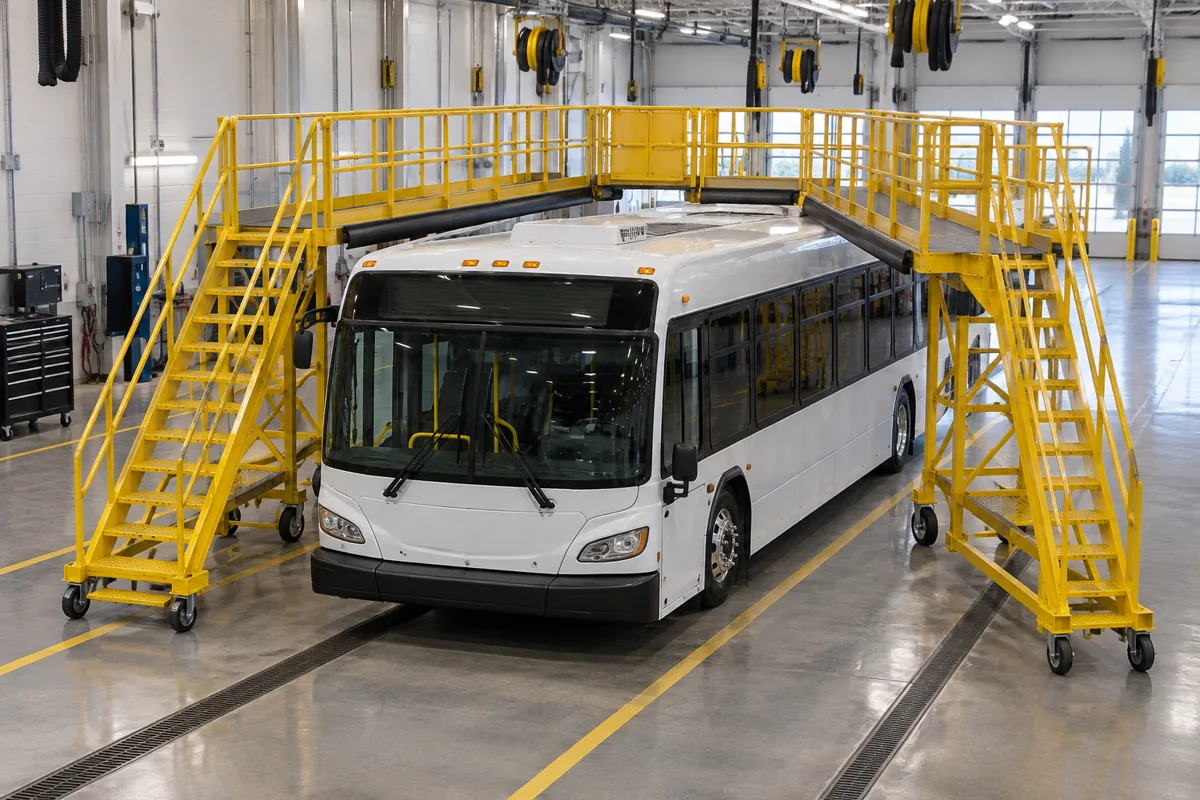
Image: representative AI rendering, not UTA’s installation.
Because the platforms roll, they are not tied to one bay. Crews can move them to the bus that needs work, use them on both sides of the coach and roll them out of the way when the bay is needed for something else. For a new facility that wants flexible bays, that matters as much as the platform itself.
What the Specification Called For
Public projects describe equipment by function and features, then let suppliers submit products that meet them. These are the platform features UTA’s specification required, in plain terms:
- A set of two platforms, so the crew can work from both sides of a bus.
- Guardrails on three sides of each platform, leaving the bus side open for work.
- Toe plates on three sides to keep tools and parts from falling off the deck.
- Gates that connect the two platforms across the roof, creating a protected work area.
- A stairway with handrails on both sides on each platform, not a straight ladder.
- Traction-gripping stair treads for wet or greasy boots.
- Continuous rubber bumpers along the edge to prevent damage to the bus.
- A battery-powered lift on the side of each platform for raising parts and tools.
- A durable enamel finish in the manufacturer’s standard color.
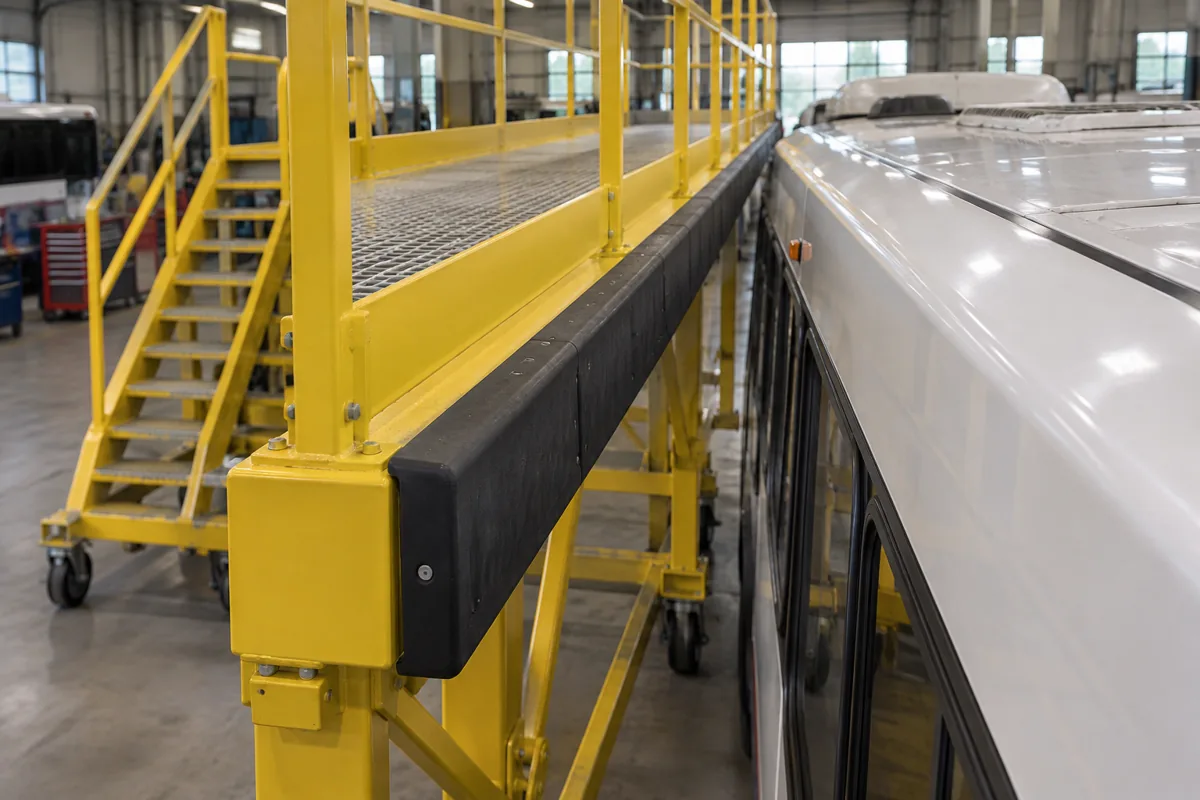
The platforms we supplied are steel units painted safety yellow, each with a grated walking deck, guardrails, a stairway at one end and heavy casters so the crew can roll them into position. The photo at the top of this page (taken by our team during installation) shows one of them in a new maintenance bay at UTA’s facility.
A rubber bumper on the platform edge seems like a small detail until a platform rolls into a bus. The spec required it for a reason: a mobile platform has to sit close to the coach without scuffing paint or denting body panels.
Image: representative AI rendering, not UTA’s installation.
Delivering on a Public Construction Project
Supplying a new public facility is a different job from shipping a platform to a shop. We worked for the general contractor, under the owner’s specification, with federal funding rules attached. That shaped every step.
Contract
Early 2021: we are awarded the storage equipment scope for the new facility by the general contractor.
Submittals
Product data is submitted by equipment identifier for owner and architect review before anything is delivered.
Delivery
2022: equipment arrives and is stored in the building while construction continues.
Installation
Late 2022: installation crews start once the contractor has the building ready.
Walkthroughs
Early 2023: owner and contractor walkthroughs, adjustments and punch list.
Buy America and prevailing wage
Because the facility used federal transit funding, the specification required products to comply with the Federal Transit Administration’s Buy America rules (49 CFR Part 661), and installation was a Davis-Bacon prevailing-wage job. Both have to be planned from the first quote: they affect which products can be submitted, the paperwork that goes with them and the installation crew’s labor cost.
Months on site before installation
On a new building, equipment often arrives well before the space is ready. Much of UTA’s equipment sat in the building for months while other trades finished. When the contractor was ready to move, it wanted installation to start quickly, so we reached out to additional installers rather than make the schedule wait for our original crew to come free.
Walkthroughs and the punch list
During the owner walkthrough, UTA asked for a number of shelving runs to move a foot or two from where they had been set. Because nothing had been anchored yet, that was a simple change. At the same walkthrough, the contractor flagged the factory paint finish on the rolling platforms as not acceptable for a new building. Rather than argue for touch-ups, we had the platforms partly taken apart and moved to a shop to be stripped and resprayed. It was not the easy option, but on a public project the owner’s standard is the standard.
Part of a Full Shop Equipment Package
The bus platforms were one of 18 equipment items in the facility’s storage equipment specification. Supplying the section as a package meant the contractor had one submittal set, one delivery schedule and one installation partner for the whole scope.
Alongside the platforms, the package covered pegboard tool walls, modular drawer cabinets, shop storage cabinets, cantilever arm racks, bulk storage racks, a gravity-flow battery rack, a hose reel rack, clip shelving with many shelf levels, steel-top receiving tables, shop workcenters with chairs, flammable materials cabinets and self-tipping hoppers.
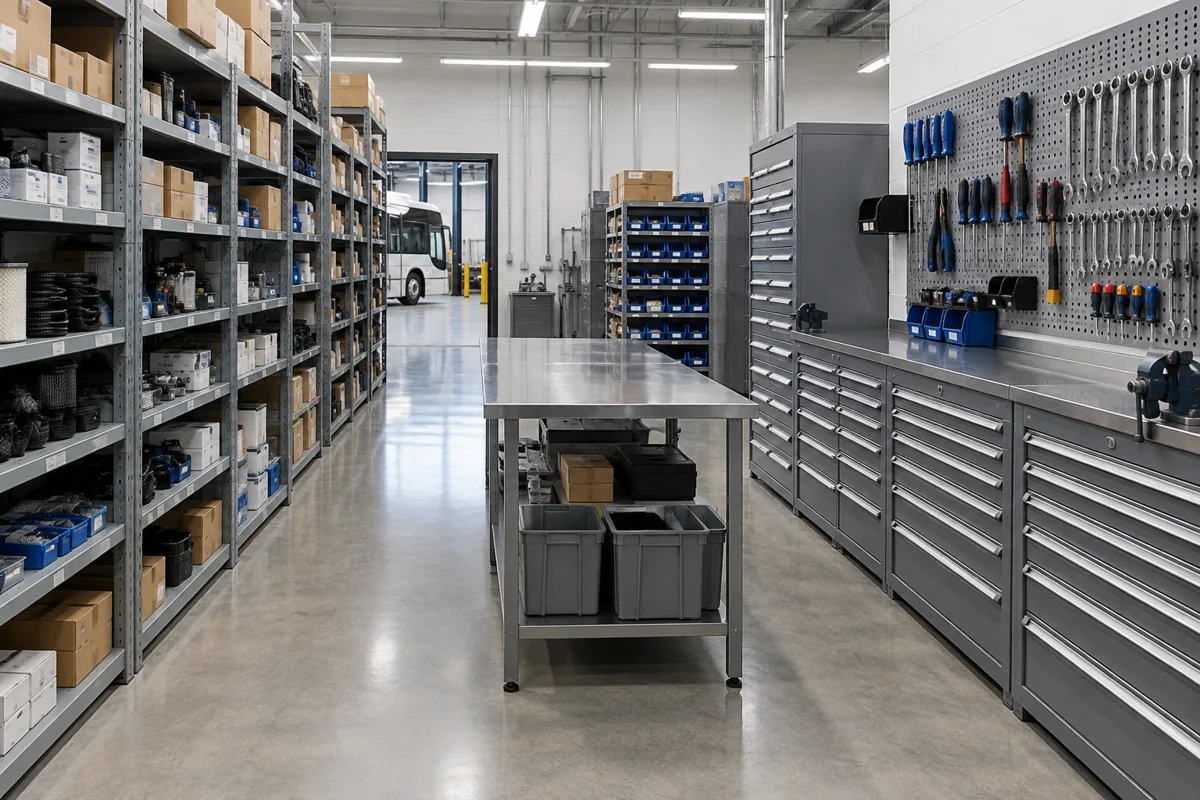
Image: representative AI rendering, not UTA’s facility.
For a transit agency, that matters. A bus maintenance facility needs roof access, parts storage, tool storage and long-stock storage to all arrive and work together on opening day. Our transit authority shelving page covers the storage side of these projects in more detail.
The Result: A Long-Term Transit Customer and a Reference
The rolling roof platforms went into service in UTA’s new bus maintenance bays, and the relationship did not end at closeout. UTA has come back to us several times since:
- 2025: parts warehouse storage. UTA hired us for pallet rack, wire shelving and a security cage for a fleet parts operation in Salt Lake City. Read the UTA parts warehouse racking case study.
- 2025 and 2026: follow-on orders. Additional shelving components and bulk shelving for the same agency.
- 2025: a new bus platform quote. UTA asked us to quote another bus maintenance platform, coming to us as a past customer.
- 2025: a reference for another agency. When a transit district in Oregon asked which agencies had bought bus platforms from us, UTA’s capital design and construction leadership agreed to speak with them, and the two agencies talked about the platforms directly.
That Oregon agency went on to buy a mobile bus roof access platform from us. Read how Rogue Valley Transportation District chose its bus maintenance platform after an in-person site visit.
One honest note for buyers: the manufacturer that built UTA’s platforms is no longer in business. We now source bus maintenance platforms from other manufacturers, and we tell agencies that up front when they ask about UTA’s units. We have not measured time savings or safety statistics for this project, so we are not publishing claims about either.
Lessons for Agencies Building a New Bus Maintenance Facility
The points below are general guidance drawn from this project. They apply to any transit agency or fleet planning roof access in a new or renovated garage.
- Put roof access in the equipment spec early. Listing the platforms in the facility specification puts them in the budget, the schedule and the submittal review with everything else.
- Specify by function. Guardrails, toe plates, gates between platforms, stairs with handrails, traction treads and bumpers describe what crews need without locking out good suppliers.
- Plan for Buy America and prevailing wage. If federal transit funds are involved, make sure your supplier can document compliance and price prevailing-wage installation from the first quote.
- Protect equipment stored on site. Equipment can sit in a new building for months. Inspect finishes and parts on delivery and again before installation, including anything under covers.
- Walk the layout before anchoring. An owner walkthrough before anchors go in makes layout changes cheap and quick.
- Ask about the manufacturer behind the product. Platforms last for years. Ask who builds them, how parts are supported and what happens if a manufacturer changes.
- Use references. Another agency’s maintenance or facilities team will tell you how a platform works day to day.
- Confirm fall protection requirements. Platform guardrails are one part of a fall protection program. Your safety team should confirm the setup against 29 CFR 1910 Subpart D and your own procedures.
For a wider look at the equipment, see our bus scaffolding guide, our transit agency bus scaffolding page for procurement questions, and our transit scaffolding and bus rooftop access platforms page for roof work in particular.
Related Bus Scaffolding Projects and Guides
 RVTD Case Study, Medford, ORA transit district saw its platform in person, refined the design and assembled it with its own crew.
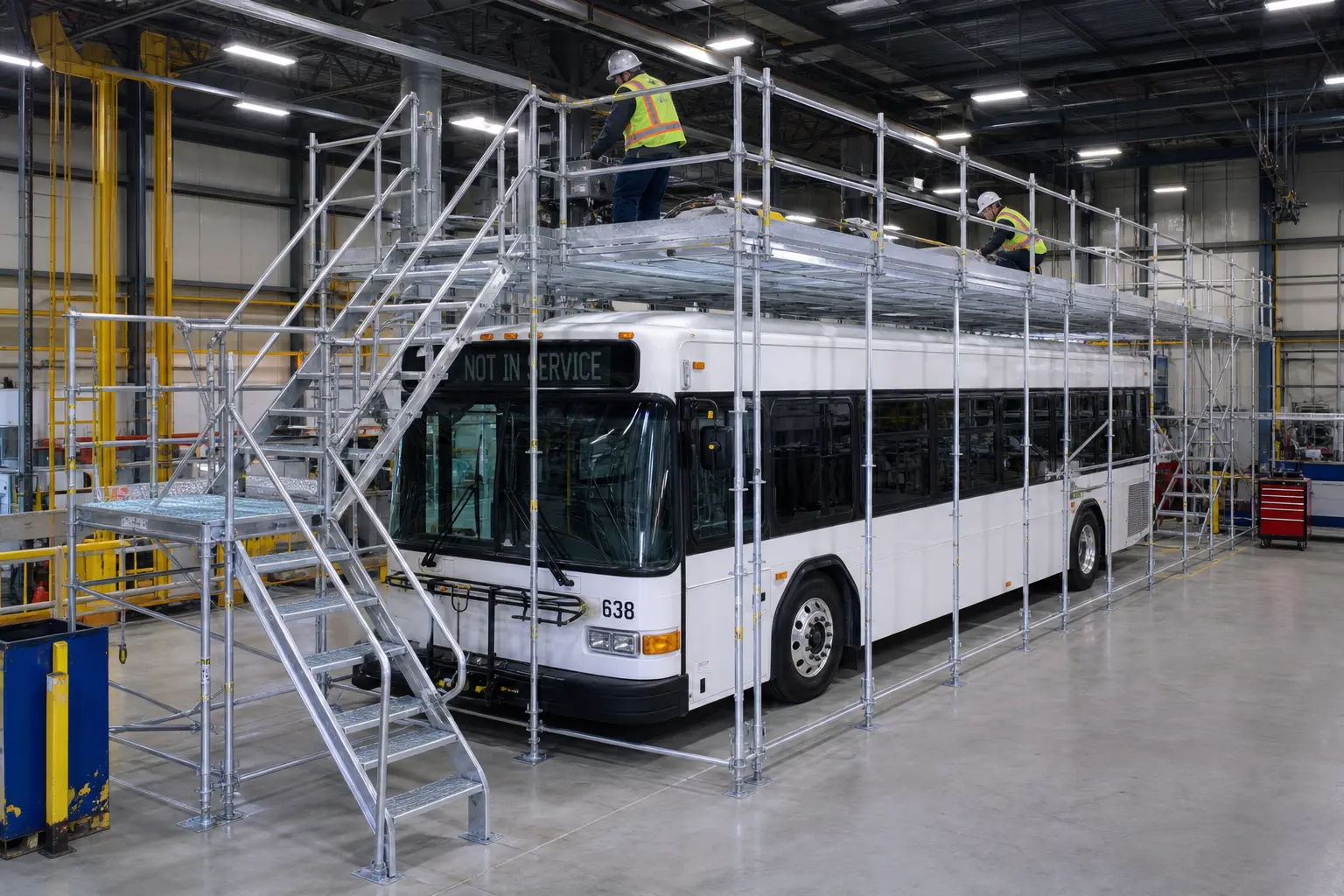 Bus ScaffoldingPlatform types, configurations and planning for bus maintenance.
 Fleet Maintenance ScaffoldingRoof and side access for mixed fleets and municipal garages.
More resources: transit bus scaffolding, electric bus maintenance platforms and our case study library.
UTA Bus Platform FAQs
What did MH-USA supply to Utah Transit Authority?
What features did UTA’s bus roof platforms need?
Do bus maintenance platforms qualify for FTA-funded projects?
Can we talk to UTA about its platforms?
Are UTA’s platforms still available from the same manufacturer?
Do you supply bus maintenance platforms outside Utah?
Planning a Bus Maintenance Facility in Utah?
Tell us about your buses, your bays and your specification. We will help you plan roof access and shop storage as one package.