
Museum Storage Cabinets for Collection Planning
Museum storage cabinets organize collections, limit unnecessary handling and provide a defined enclosure for objects that need protection from the surrounding room. Selecting them requires more than choosing a cabinet size. The collection, supports, access pattern, environment and handling procedures all influence the right configuration.
Material Handling USA helps translate collection requirements into an equipment discussion. Start with the objects and the staff who care for them, then compare cabinets, drawers, shelves and mobile arrangements against those requirements. Conservation decisions should guide the storage specification throughout the project.
Build a collection profile before specifying cabinets
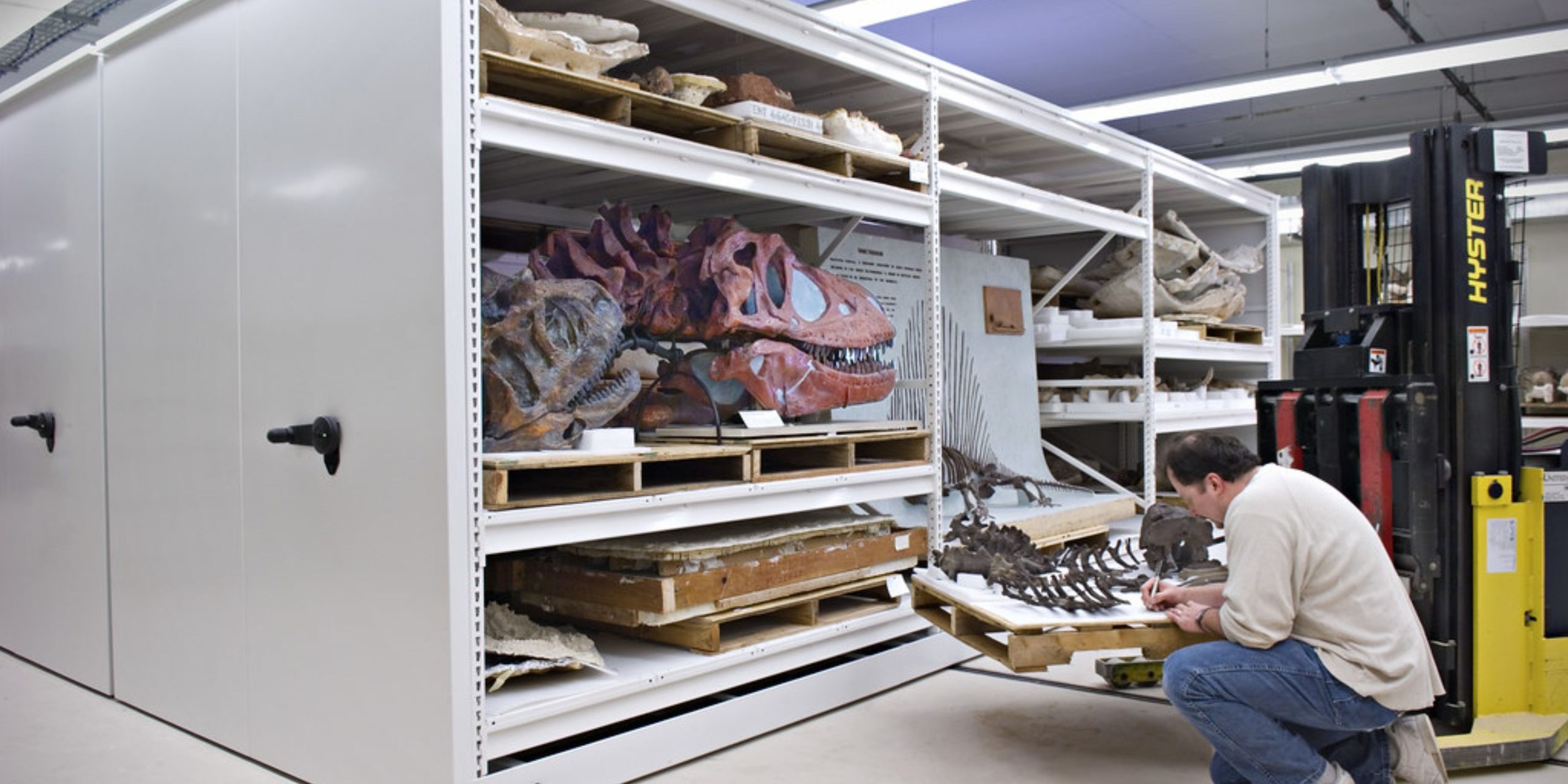
An inventory count alone does not describe a museum collection's storage needs. A hundred small boxed objects and a hundred large irregular objects may require entirely different cabinet interiors. Record the outer dimensions of the supported object, including its tray, box, mount or wrapping, rather than measuring only the object itself.
Group objects according to handling and preservation requirements that the collections team has established. Consider weight, fragility, shape, frequency of access and the need to keep related components together. Note objects that need a separate storage approach, such as oversized material or items with special environmental or hazard considerations.
Measure the storage unit staff actually handle
A tray may need room for hands on both sides. A box may require clearance to lift its lid or remove it without tilting. A framed work may need separation from neighboring surfaces. These working dimensions can make a nominally generous cabinet less useful than expected.
Record the present location and the proposed location using a consistent identifier. During a move, staff should be able to connect an object record with its container and cabinet position. Storage equipment supports that process, but it does not replace the museum's collections-management records.
Document uncertainty rather than hiding it in an average. If part of the collection has not been measured, identify that group and allow a later review before finalizing its cabinets. A sample-based estimate can help early planning, but unusually large or heavy objects deserve individual attention.
Invite conservators, collections managers and handlers to review the inventory profile. Their different observations can reveal a support or access requirement that would otherwise appear only after the new cabinets arrive.
Match the cabinet interior to the objects

Shelves, drawers and trays serve different retrieval tasks. Open shelf space inside a cabinet can accommodate boxed material and larger objects. Shallow drawers can organize flat or smaller material when appropriate supports are provided. Pullout elements may improve access, but their loading and operating requirements must be confirmed for the selected configuration.
Choose interior dimensions from the supported object outward. Include shelf adjustment increments, drawer clear openings and hardware that reduces usable space. A cabinet's exterior width does not establish the width of a tray that can pass through its door.
Compare practical arrangements
| Interior arrangement | Planning use | Detail to verify |
|---|---|---|
| Adjustable shelves | Boxed or varied-height objects | Clear opening and shelf rating |
| Shallow drawers | Small or flat supported material | Usable drawer dimensions |
| Deep compartments | Larger supported objects | Access and lifting method |
| Dividers and supports | Separation within a storage position | Material compatibility |
Ask for ratings for both the individual component and the complete cabinet arrangement. A drawer rating cannot be added across every drawer without checking the total unit limit and installation conditions. Similarly, a cabinet rating does not establish that one shelf can carry the entire load.
Review hardware movement with the staff who will retrieve material. Door swing, drawer extension and adjacent work space all matter. A cabinet should not require an object to be carried through a tight turn or held while another person rearranges neighboring storage.
Where an open shelving approach is also under consideration, the four-post shelving specification guide helps frame questions about dimensions, loads and installation. The collection's enclosure requirements should determine whether that alternative is appropriate.
Specify enclosure performance without overstating protection
Enclosure
Request documented construction and seal details.
Environment
Review room conditions with conservators.
Access
Define locks, keys and authorized users.
An enclosed cabinet can reduce exposure to dust and provide controlled physical access. Its actual performance depends on construction, closures, seals, installation and use. Do not equate an enclosed cabinet with a climate-controlled room or assume that a seal establishes a particular airtightness rating.
Aurora Storage describes its museum collections cabinets with compression locking handles, multiple locking points and silicone gaskets intended to help limit dust and insect intrusion. Those are manufacturer-described features of that product family. The final selection should identify the exact cabinet and options included in the proposal.
Ask for documented properties
The Explore our related solutions is a useful starting point for product review. Ask the supplier for current details covering construction, finishes, seals, accessories and care instructions. Let the museum's conservation team evaluate compatibility with its collection.
Do not treat a cabinet as providing automatic temperature or humidity control unless the complete proposed system specifically includes and documents that function. Room conditions, opening frequency and stored materials still matter. Any microenvironment strategy needs its own conservation review and monitoring plan.
Clarify the required level of access control. A lock can limit casual access, but the museum must decide who holds keys, how access is recorded and what happens when a credential is lost. Avoid describing a standard cabinet as burglary-resistant or fire-rated without documentation for the exact assembly.
Review cleaning products and methods before introducing the cabinets into service. Instructions suitable for the exterior may not be appropriate near sensitive collections. Coordinate equipment care with collection-care procedures rather than leaving each team to infer the other's requirements.
Plan the room around careful retrieval

Cabinet dimensions are only one part of the room layout. People need space to open doors, extend drawers, use handling equipment and transfer objects to a stable work surface. Show those movements on the drawing before comparing storage capacity.
If cabinets will sit on carriages, see our museum mobile storage planning guide for aisle tiers, motion control and floor loading before you finalize the layout.
Map the path from the collection room to examination, photography, preparation or exhibition areas. Identify narrow doors, changes in floor level and corners that affect carts or large objects. An efficient cabinet arrangement can still create difficult handling if the route beyond the room is overlooked.
Include temporary work positions
Provide a planned place for objects awaiting examination or return to storage. That position should remain connected to the collection record and the staff responsible for the object. Avoid allowing temporary staging to become an undocumented overflow area.
Consider access frequency when assigning locations. Frequently retrieved material may benefit from positions that reduce repeated reaching or moving of other objects. Heavy or awkward material should be reviewed with the intended handling method in mind, rather than assigned solely by available shelf height.
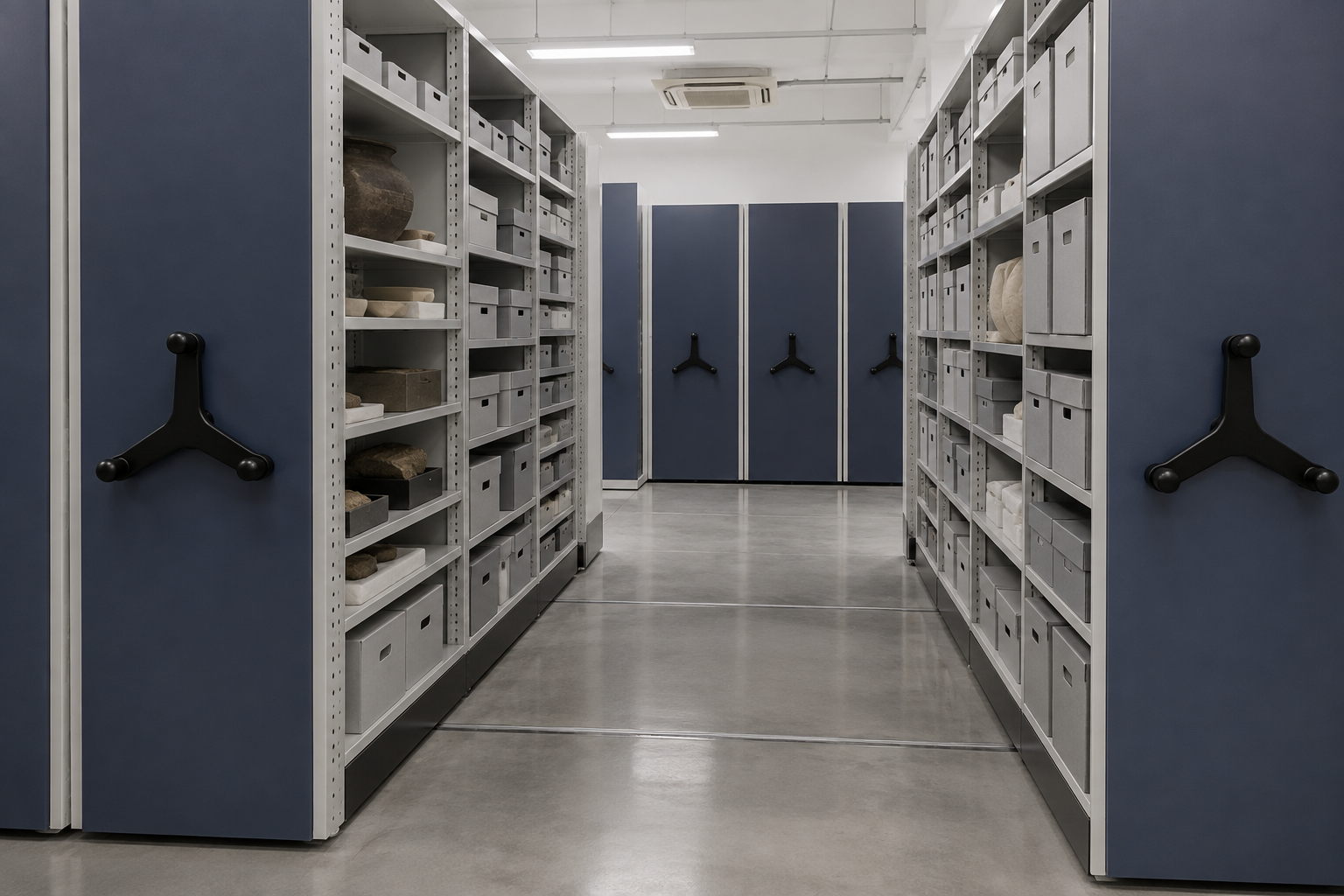
Mobile storage can reduce the number of permanently open aisles, but it changes how people share access. Assess simultaneous users, movement controls, aisle protection and the collection's handling sensitivity. It is an option to evaluate, not an automatic improvement over fixed cabinets.
Keep access to building services and required routes visible on the plan. The responsible design team should review floor loading, anchoring, fire protection and applicable requirements for the actual site. A supplier's cabinet drawing does not replace that building review.
Planning a collections room in Utah? Our guide to artifact and collections storage shelving for Utah museums covers NPS aisle widths, seismic restraint, and how cabinets, open shelving and flat files work together.
Coordinate supports, labels and collection records
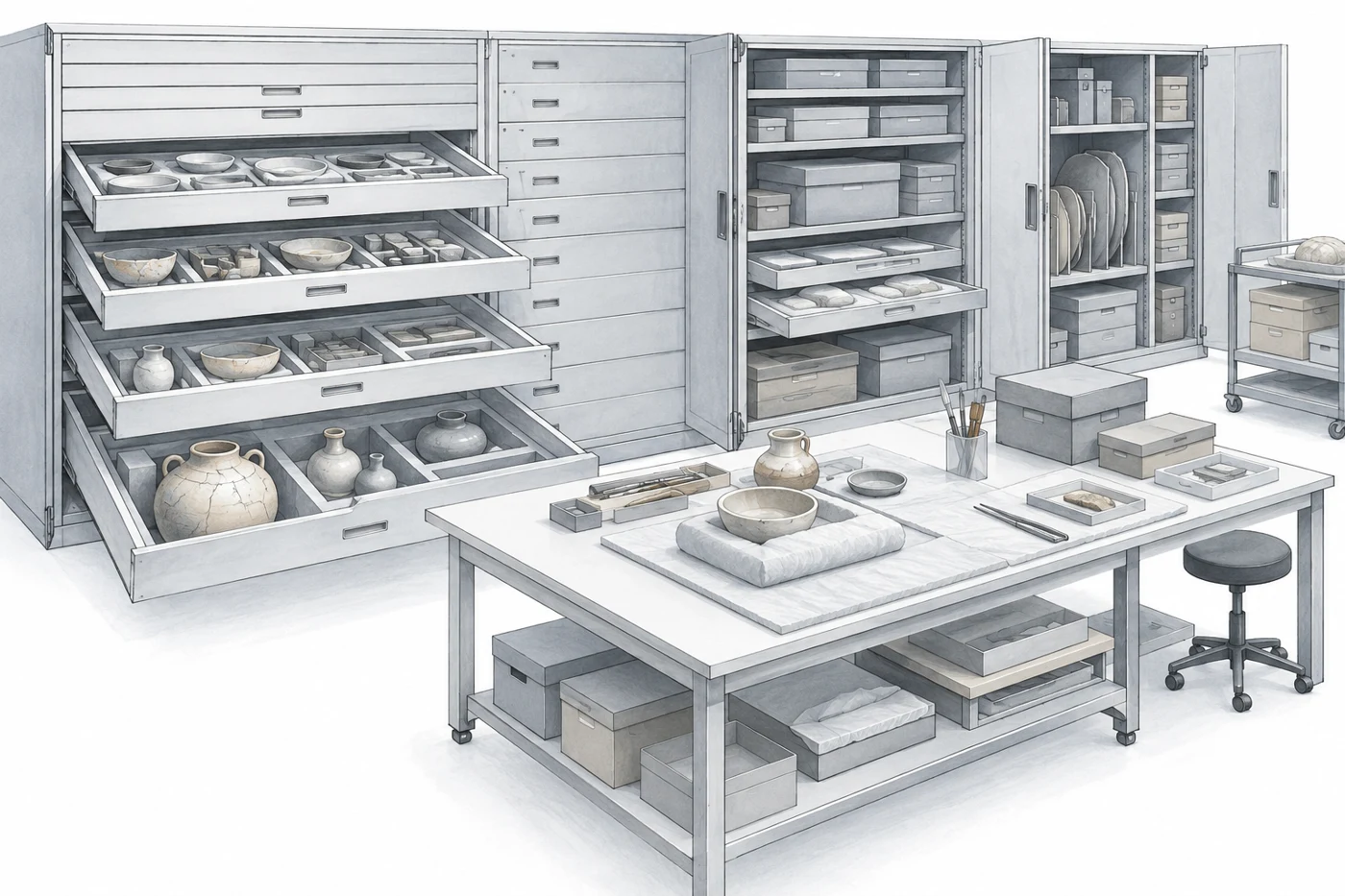
A cabinet is the outer storage system; trays, boxes, mounts and separation materials create the object's immediate support. Their selection belongs with the collection-care team. Confirm that the proposed interior arrangement accommodates those supports without compressing them or forcing staff to remove protection during retrieval.
Use location labels that staff can read from the normal approach. Establish a consistent hierarchy for room, cabinet, shelf or drawer and position. Connect those identifiers to the museum's records before moving material, and decide how a changed location will be recorded.
Keep labels useful without crowding the object
Place equipment and location identifiers where they can be maintained without disturbing stored material. Avoid applying labels to collection objects or supports without the museum's approved method. The storage project should follow established documentation practice rather than inventing a new marking system casually.
Review how associated components remain connected. An object, its detachable parts and its handling instructions may need linked records even when they occupy separate positions. Clear identifiers can prevent a storage improvement from making those relationships harder to follow.
Plan for collection growth by identifying where additional supported objects could fit and which interiors could be reconfigured. Preserve information about the approved component arrangement and ratings so future staff can assess changes accurately. Adjustable equipment should not be treated as permission to rearrange loads without review.
Photograph completed cabinet interiors where that supports the museum's working procedures. Useful reference images show the intended arrangement and support positions. They should complement maintained records and approved access policies, especially when images reveal sensitive collection information.
Prepare a controlled move and installation sequence
Sequence
Separate equipment work from collection handling.
Accept
Check doors, drawers and approved attachments.
Load
Verify representative supports and clearances.
Moving collections and installing storage equipment are separate activities that need coordination. Identify who will pack, track and transport objects, and who will assemble and secure the cabinets. Keep collection handling under the museum's approved procedures throughout the project.
Review delivery access before equipment is ordered. Confirm the largest component, door openings, lifts, turns and temporary holding space. Determine whether cabinets arrive assembled or require work in the room, and identify any activities that could introduce dust, vibration or other disruption near collections.
Define the room handover point
The installation team should complete its work and documentation before collection staff begin loading the new arrangement. Establish who checks cabinet placement, leveling, doors, drawers, locks and specified attachments. Resolve defects before objects make access more difficult.
If the project is phased, create a location plan for each phase. Temporary storage must have defined capacity, access and recordkeeping. Avoid relying on spare floor space that also serves as the installer route or collection transfer area.
Compare proposals using the complete scope: equipment, interiors, freight, unloading, assembly, building coordination, protection of occupied areas and handover. Clarify whether removal of existing equipment is included and how reusable components will be identified.
At acceptance, test representative supports and containers without putting irreplaceable material at unnecessary risk. Confirm that doors and drawers operate as intended and that staff can retrieve a supported item using the planned method. Record any limitation that affects how the cabinet will be loaded.
Maintain a storage system that staff can understand
Inspect
Report changes in equipment operation.
Record
Keep cabinet locations connected to collection records.
Review
Check new objects against storage assumptions.
Good storage remains usable because the collection arrangement and equipment records are maintained together. Assign responsibility for reporting damaged hardware, a door that no longer closes properly or a drawer that operates differently. A small change in operation can be a reason to review the component before it is used further.
Follow the manufacturer's inspection and care instructions while respecting collection-care requirements. Staff should know which activities they can perform and which require service personnel. Do not introduce lubricants, cleaners or replacement materials into collection space without the appropriate review.
Review changes before adding material
New acquisitions can change the load and dimensional assumptions behind a cabinet arrangement. Check the supported object's size and weight, the available opening and the component ratings before assigning a position. Record changes so later staff can understand the basis of the layout.
A periodic review can also identify locations that have become difficult to use. Look for repeated handling of neighboring objects, crowded drawers, unclear labels or temporary staging that never returns to normal. These observations may point to a need for different interiors or a revised workflow.
The stockroom planning guide offers general questions about receiving, assigned locations and transitions between tasks. Museum collections require additional conservation and documentation controls; apply only the operational ideas that the collection team considers appropriate.
To begin a cabinet project, send Material Handling USA a room plan, representative supported-object dimensions, expected loads and access requirements. Include the conservation team's material and enclosure criteria. A clear brief makes it possible to compare equipment without substituting generic claims for collection-specific decisions.
Frequently asked questions
Do museum cabinets control humidity automatically?
Not ordinarily. An enclosure is not the same as an active environmental-control system. Any required microenvironment or monitoring arrangement should be specified and reviewed by the collection-care team.
Should every collection use drawers?
No. The supported object's shape, size, weight and handling method determine whether drawers, shelves or another arrangement is appropriate. Compare usable openings and retrieval space before selecting interiors.
What dimensions should we measure?
Measure the complete supported object, including its tray, box or mount, and the space needed to handle it. Cabinet exterior dimensions alone do not establish usable storage space.
Can museum cabinets be installed on mobile carriages?
Some systems support mobile arrangements, but compatibility, loads, controls and collection handling must be reviewed for the proposed assembly. Do not assume any existing cabinet can be placed on any carriage.
Are locking cabinets fire-rated?
A lock does not establish a fire rating. Require documentation for the exact assembly if a particular protective rating is part of the project specification.
What helps start a museum storage proposal?
Provide the room layout, supported-object dimensions and weights, access frequency, growth assumptions and the conservation team's requirements for materials, enclosure and handling.
Start with the collection, then specify the cabinet
Share your application details, photographs and requirements with Material Handling USA to start a focused project discussion.