
Vidir Dual-Tower Sheet Metal VLS
Automated sheet metal storage that puts two storage towers around one central elevator and brings any sheet pallet down to a loading cart at floor level. Up to 68 positions rated at 6,600 lb each.
Authorized Vidir dealer · compare single vs dual tower
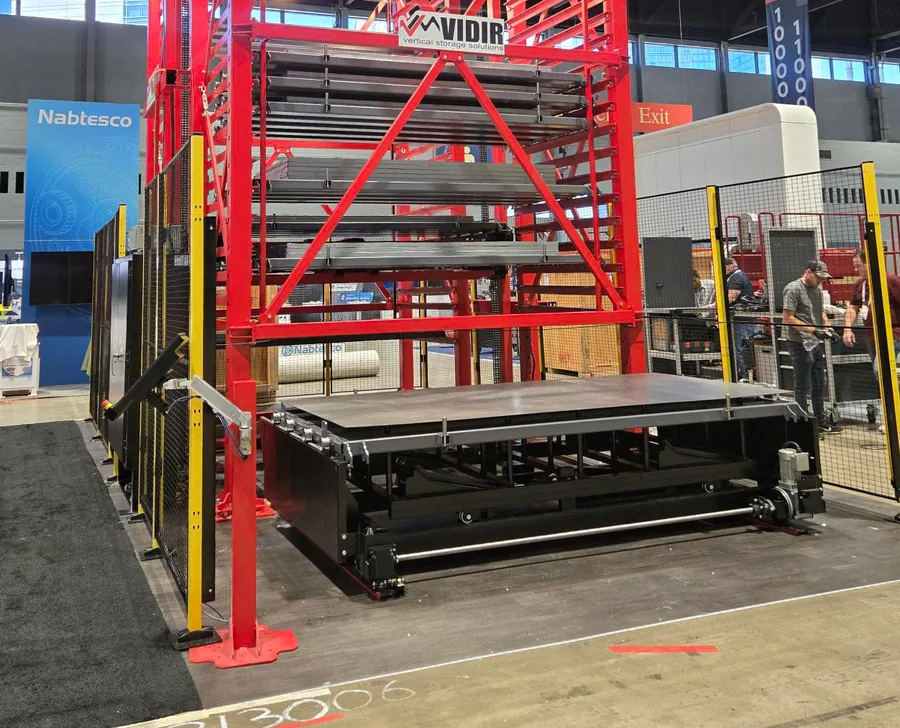
Up to 68
Sheet pallet positions
6,600 lb
Rated load per position
448,800 lb
Largest configuration, per Vidir
280 sq ft
Footprint of that configuration
What the Dual-Tower Sheet Metal VLS Is
A sheet metal vertical lift system stores full sheets flat on steel pallets stacked inside a tall frame. An elevator pulls the pallet you call for and lowers it to a loading cart at floor level, so nobody drives a forklift into a rack or digs through a stack to reach the sheet at the bottom.
Vidir’s dual-tower model puts a storage tower on each side of one central elevator. The operator still works at one loading point, but the machine holds about twice as many pallets as a single tower. Vidir lists up to 68 positions, each rated at 6,600 lb, and says its largest configuration holds roughly 448,800 lb of sheet on about 280 square feet of floor.
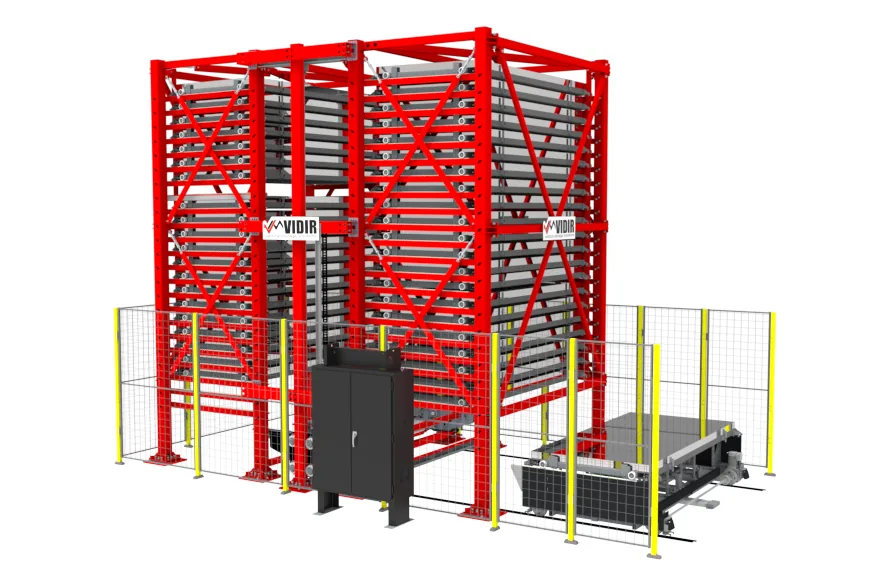
The dual-tower sheet metal VLS is the flat-stock sibling of the Dual-Tower Bar Stock VLS, which uses the same two-tower layout for bar, pipe and tube. Both sit in the vertical lift systems family alongside the tray-based vertical lift module.
Single-Tower vs Dual-Tower Sheet Metal VLS
Vidir sells both. The single tower is the original machine and suits shops with a smaller sheet inventory or a lower ceiling. Vidir positions the dual tower for customers who need more than 32 storage positions and would otherwise buy two separate units.
| Spec | Single-Tower Sheet Metal VLS | Dual-Tower Sheet Metal VLS |
|---|---|---|
| Layout | One tower with its own lift | Two towers sharing one central elevator |
| Storage positions | Standard models 12 to 27 pallets at 5″ spacing, 14 to 22 at 3.5″ | Up to 68 |
| Load per position | Confirmed on the quote | Up to 6,600 lb |
| Sheet sizes | Standard pallet 120″ x 60″ (5 x 10 ft sheet) | 4 x 8, 5 x 10, 6 x 12 ft and 2 x 4 m |
| Pallet spacing | 3.5″ or 5″ | 3.5″ or 5″ |
| Footprint | About 15′8″ W x 15′9″ D on standard models | From about 280 sq ft |
| Height | About 11′10″ to 22′6″ on standard models | Set by the number of positions and your clear height |
| Loading options | Fixed loading table, front, lateral and rear input/output stations | Front and lateral input/output stations, single or dual side access |
| Safety and warranty | Light curtains, fencing, cCSAus mark, 2-year warranty | Light curtains, fencing, redundant brake, cCSAus mark, 2-year warranty |
| Best fit | Lower-volume shops or limited ceiling height | More than about 32 positions, or several static racks replaced by one machine |
Figures are Vidir’s published specifications. Final positions, heights, capacities and electrical requirements are confirmed on your layout drawing and quote.

When two towers make sense, and when they don’t
Price the dual tower when your sheet list needs more than about 32 pallets, when you are replacing several cantilever or drawer racks and the forklift aisles between them, or when you keep many alloys and gauges that each need their own pallet. You get one elevator, one control system and one service contract instead of two machines.
Stay with a single tower when the stock list fits in one tower or the building cannot take the height. If the count is small or automation will not pay back, a static sheet rack is usually the better value, and we will say so.
Sheet Sizes, Pallet Spacing and Capacity
Three numbers decide how a sheet metal VLS is configured: the sheet size, the pallet spacing and the weight on each pallet.
- Sheet size. Vidir builds the dual tower for 4 x 8, 5 x 10 and 6 x 12 ft sheet and for 2 x 4 m metric sheet. The pallet is sized to the largest sheet you stock, so mixed sizes share a pallet size.
- Pallet spacing. Each pallet gets either 3.5 or 5 inches of height. Tighter spacing fits more pallets in the same tower height; wider spacing lets each pallet hold a taller stack. On Vidir’s single-tower model table, a tower about 15′8″ tall holds 21 pallets at 3.5-inch spacing or 17 at 5-inch.

Count pallets, not sheets, and plan for the heaviest stack
Every dual-tower position is rated at 6,600 lb, so check your heaviest stack against that figure, not the average one. Most shops give us a sheet count. What actually sizes the machine is how many separate pallets you need: one per alloy, gauge and size combination you keep, plus room to grow. Send the list and we will turn it into a pallet count and a tower height.
Feeding Lasers and Press Brakes
The loading side is where a sheet metal VLS earns its place in a fab shop. Vidir offers several ways to get sheet in and out, and the right one depends on where your laser, punch or press brake sits.
A front input/output station is a self-propelled cart that runs on floor tracks in front of the machine. It can receive material from the VLS or carry sheet out toward a laser. A lateral station loads and unloads from the side, so a forklift delivering new stock never enters the front work area. Vidir says the dual tower offers six access points across its front and side carts, with up to two carts on each tower.
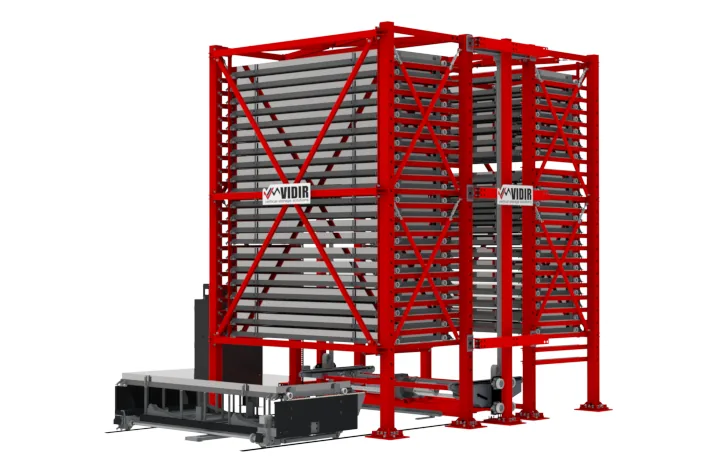
Vidir’s own video of its Vertical Lift System bringing stored material down to the operator.
Standard Safety and Controls
Every dual-tower sheet metal VLS ships with the same standard package, per Vidir. Options change how material moves in and out; they do not remove any of these.
| Standard feature | What it does |
|---|---|
| Automatic controls with pallet selection | The operator calls a pallet by location; the elevator retrieves it |
| Emergency stops | Located on the left and right of the towers |
| Safety light curtain | Stops the machine immediately if the curtain is crossed |
| Perimeter fencing | Fencing and light curtains keep people out of the lift area during operation |
| Process brake plus redundant brake | The second brake engages with the safety system |
| Pallet position locks | Each pallet stays locked in place until the elevator releases it |
| Overload sensing | The lift returns to its home position when an overload is detected |
| Motors | Two 5 HP motors and one 3/4 HP motor |
| Listing and warranty | cCSAus mark; 2-year manufacturer’s warranty |
Dual-Tower VLS vs Cantilever, Drawer and Floor Sheet Storage
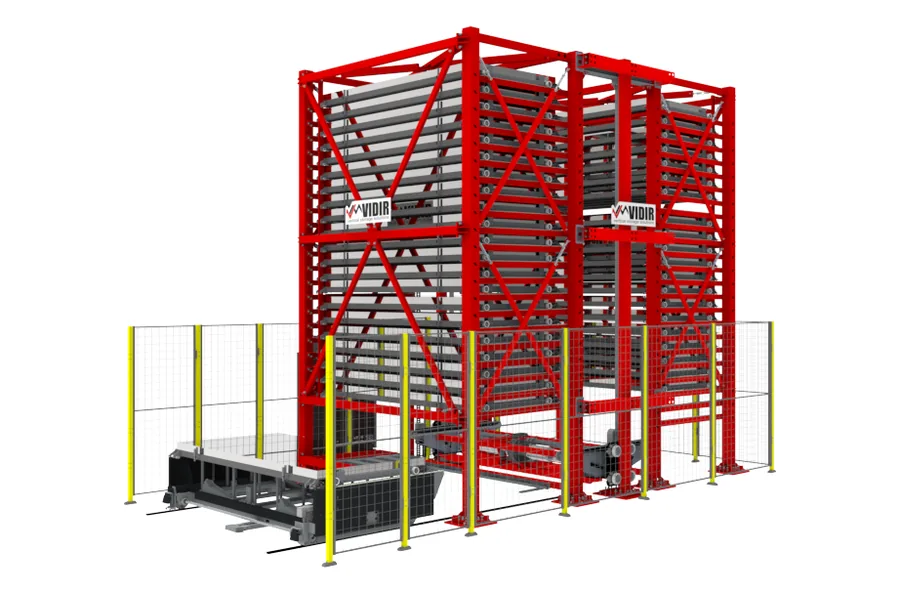
Most shops looking at a sheet metal VLS store sheet on cantilever racks, roll-out drawer racks or simply on the floor. Each works, but each needs a forklift, a wide aisle or both.
Vidir estimates that a high-volume sheet inventory on conventional cantilever racks takes 1,200 to 1,500 square feet once the 12 to 14 ft forklift aisles are counted, against about 280 square feet for its largest dual-tower configuration. Your own number depends on how much sheet you keep, so we lay out both options on your floor plan before you decide.
| Static sheet racks (cantilever, drawer, A-frame) | Dual-Tower Sheet Metal VLS | |
|---|---|---|
| Retrieval | Forklift or overhead crane, or manual handling from drawers | Elevator brings the pallet to a floor-level cart |
| Floor space | Rack footprint plus forklift aisles | Compact footprint; height does the storing |
| Bottom-of-stack sheet | Move the sheets above it first | Each pallet retrieved on its own |
| Up-front cost | Low; many racks ship ready to assemble | Significant; quoted per project |
| Best for | Small inventories, low budgets, occasional use | Large or growing inventories feeding a laser or brake line |
If a rack is the right answer, we sell those too: see the sheet racks and carts below or our sheet, panel and bar handling category. To compare static options for flat stock (vertical, horizontal and roll-out racks), see our guide to sheet metal storage racks. For budget ranges on automated systems, read the vertical storage cost and pricing guide.
Planning a Dual-Tower Sheet Metal VLS
Send us the items below and we can lay out single and dual tower options side by side, with the floor space each one frees up.
- Clear height to the lowest overhead obstruction, including lights, sprinklers and crane rails
- Sheet sizes you stock (4 x 8, 5 x 10, 6 x 12 ft or metric) and how many of each
- Heaviest stack per pallet, to check against the 6,600 lb rating
- Number of separate alloy, gauge and size combinations, today and in 3 to 5 years
- Where the laser, punch or press brake sits, and which side material should come out
- How new stock arrives: forklift, crane or truck, and where it should be loaded
- Floor condition and slab details at the planned location
- Available power near the install location (requirements confirmed on the quote)
Send your sheet list
Sizes, counts, heaviest stacks and ceiling height.
Layout drawing
We work with Vidir on single and dual tower options drawn in your space.
Quote
Machine, loading options, freight and installation scope, itemized.
Vidir machines are built to order and quoted per project; we do not stock them. Other Vidir systems for metal fabricators are on our manufacturing vertical storage page and the main Vidir vertical storage hub.
Need Static Sheet Racks Instead? Shop Online
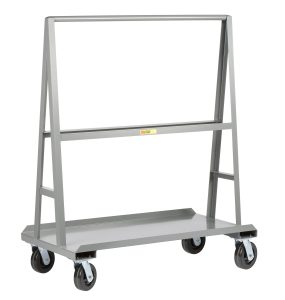
Vidir vertical lifts are quoted per project and are not sold through our online store. If your sheet count or budget points to conventional racking, these are genuine sheet racks and sheet carts we sell online at current prices. Freight is calculated at checkout, and some common sizes are in stock at select manufacturers, subject to confirmation.


Get a free quote
Tell us what you are storing, the room size and your timeline. A project specialist will follow up with layout options and pricing. Prefer to talk? Call (800) 326-4403.
Dual-Tower Sheet Metal VLS FAQs
What is the Vidir Dual-Tower Sheet Metal VLS?
How is it different from the single-tower Sheet Metal VLS?
What sheet sizes does it hold?
How much floor space does it save?
Can it feed a fiber laser or press brake?
What safety features are standard?
What does a dual-tower sheet metal VLS cost?
Planning Automated Sheet Metal Storage?
Send your sheet list and ceiling height. We will lay out single and dual tower options with Vidir and show the floor space each one frees up.