
Vertical Lifts: Automated Vertical Lift Storage Systems
Vertical lift modules, bar stock and sheet metal lift systems, hospital bed lifts and equipment lifts — machines that store inventory in the empty air above your floor and deliver it back to an operator at waist height.
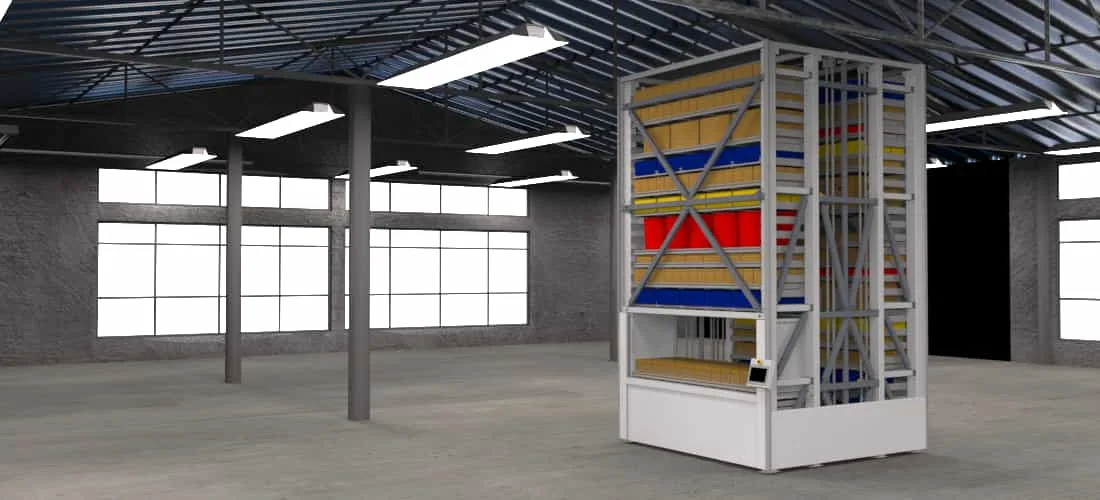
Floor space recovered
Up to 85% versus static shelving
Pick height
Everything delivered at waist level
Load range
Small parts to 6,600 lb sheet packs
Coverage
Nationwide supply, delivery and installation
What is a vertical lift?
Quick answer: a vertical lift is an enclosed automated storage and retrieval machine (ASRS) that holds trays, cartridges or carriers in two vertical columns and uses a central elevator to bring the one you asked for down to a ground-level access opening. Nothing rotates: the elevator travels straight up and down, so the machine can be built as tall as the ceiling allows without changing its footprint.
That single design idea covers a surprisingly wide family of machines. The same elevator-between-two-towers layout that stores bins of fasteners in a manufacturing parts crib also stores 24-foot lengths of steel bar, 6-foot by 12-foot sheet metal packs, hospital beds and wheeled athletic equipment trunks. What changes is the carrier: a tray, a cartridge, a pallet or a bed bay.
The reason companies buy them is almost always floor space. Conventional shelving and pallet rack can only be used to the height a person can safely reach or a lift truck can safely serve, which leaves most of the air in a building empty. A vertical lift uses that air — typically recovering 75–85% of the floor area the same inventory occupied before — and hands the material back at an ergonomic working height instead of at the top of a ladder.
Moving Materials Between Floors? Choose a VRC
Automated storage lifts and floor-to-floor material lifts solve different problems. A storage system retrieves inventory at an operator opening; a vertical reciprocating conveyor (VRC) moves an approved load between building levels.
Use a VRC when pallets, carts or stock must reach a mezzanine or upper-level work area. Plan the load envelope, landing space, peak trips and guarding together. VRCs carry materials only, never people.
MH-USA is an authorized PFlow dealer. Compare PFlow material lift configurations for this transfer application, separately from the storage systems below.
Photo: PFlow Industries.

The types of vertical lift we supply
Vertical lift modules (VLM)
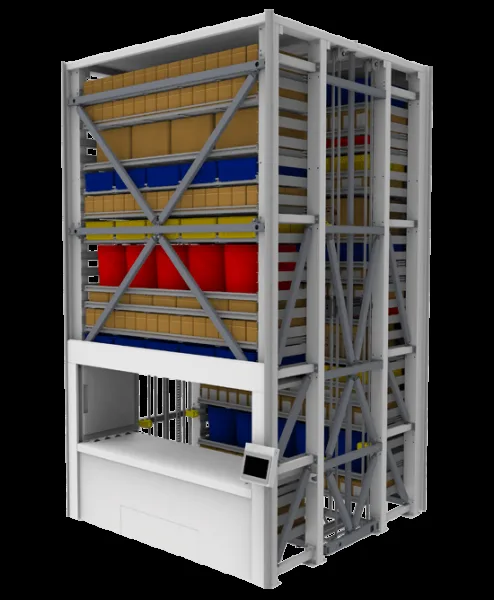
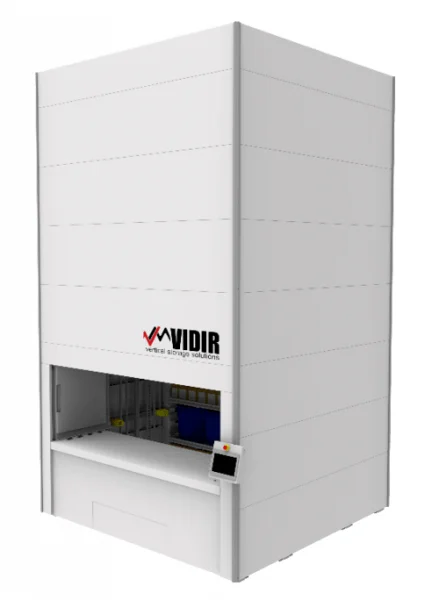
The vertical lift module is the machine most people mean when they say “vertical lift.” Trays sit in two towers; a central elevator delivers the requested tray to a pick window; software tracks what is on every tray and where.
The detail that separates a good VLM from an average one is height detection. Laser sensors measure the actual height of the load on each tray as it is stored, and the machine then places that tray in the tightest slot that fits instead of a fixed-pitch shelf position. In a typical parts crib that alone is the difference between storing three and storing four times the inventory in the same tower.
A VLM belongs in a parts crib, a maintenance storeroom, a hospital supply room, an electronics assembly line or any operation where staff spend their day walking aisles and searching bins. Retrieval time typically falls by around two thirds because the operator stops travelling entirely.
See our full vertical lift module page for tray sizes, capacities, software integration and configuration options.
Software, integration and accessories
A vertical lift is only as good as the inventory control behind it. Every machine we supply can be ordered with an operator touchscreen, barcode scanning, badge-reader login and integration into an existing ERP or WMS, so a pick is a logged transaction rather than a note on a clipboard.
Common additions:
- Pick-to-light — an alphanumeric display or LED strip points to the exact position on the tray.
- Barcode scanner — builds long pick and stock lists in seconds and removes keying errors.
- Power drawer — extends the tray out in front of the machine for easier loading of awkward items.
- Security gate — restricts the access opening so only authorized staff can reach controlled inventory.
- Badge reader and user permissions — per-operator login and audit trail.
- Preventive maintenance package — scheduled annual inspection to keep a machine that runs every shift in service.
Bar stock vertical lift systems
Long material is the hardest thing in a fabrication shop to store well. Horizontal cantilever racks need 12 to 16 feet of aisle for forklift access, bars get bent and scratched on every touch, and finding the right alloy and remaining length usually means a person walking the rack with a tape measure.
A bar stock vertical lift system stands that inventory up. Material lives in enclosed cartridges inside a tower — lengths from 10 feet to 24 feet and beyond, over 5,000 lbs per position, from 1-inch rounds to 12-inch structural shapes — and the requested cartridge comes to ground level in about a minute. A retrieval that used to take eight to twelve minutes with a lift truck becomes a single-operator task at waist height.
Set beside a CNC saw or laser, the tower feeds the machine directly, which removes the staging area, the double handling and most of the forklift traffic around the cutting cell. For shops running certified alloys, the enclosed cartridges also keep heat lots separated and protected, with an access log to match.
Dual-tower bar stock configurations double the position count for high-mix shops without widening the footprint.


Sheet metal vertical lift systems
Flat sheet has the same problem in a worse form: a stack of sheets is only accessible from the top, so getting to the third sheet down means moving the two above it.
A sheet metal vertical lift system stores each sheet pack on its own cartridge and presents any one of them at ground level on demand. The single-tower system handles up to 32 positions and suits lower-volume shops or buildings with limited clearance; it replaces several static sheet racks and typically recovers about 80% of the floor they occupied.
Standard formats include 4′ x 8′, 5′ x 10′, 6′ x 12′ and 2m x 4m, in steel, aluminum, stainless and specialty alloys. Cartridge spacing is configurable at 3.5 inches or 5 inches, so a shop running thin gauge in volume is not paying for air.
Input and output stations — front, lateral or fixed loading tables — decide how the system hands material off to a laser or press brake, and are worth settling early in the layout rather than after the concrete is poured.
Dual-tower sheet metal: double the capacity, same floor
When a shop needs more than 32 sheet positions, the answer is a second tower rather than a second machine. The dual-tower sheet metal VLS puts two towers either side of one central elevator.
| Specification | Dual-Tower Sheet Metal VLS |
|---|---|
| Storage positions | Up to 68 |
| Total capacity | Up to 448,800 lbs |
| Capacity per position | 6,600 lbs |
| Floor footprint | Approximately 280 sq ft |
| Sheet formats | 4′ x 8′, 5′ x 10′, 6′ x 12′, 2m x 4m |
| Cartridge spacing | 3.5″ or 5″ per cartridge |
| Retrieval time | Under 60 seconds to ground level |
| Floor space recovered | Up to 80% vs. cantilever racks and floor stacking |
| Access | Front and side positions for simultaneous load/unload |
| Materials | Steel, aluminum, stainless and specialty alloys |
For comparison, storing the same sheet inventory in conventional cantilever racks with 12- to 14-foot forklift aisles generally consumes 1,200 to 1,500 square feet. The trade is roughly a thousand square feet of production floor for a machine and a control cabinet.
Aerospace and defense fabricators tend to buy these for a second reason: the enclosed cartridges plus logged access keep material traceability intact from receiving through cutting, which is difficult to demonstrate with an open rack anyone can pull from.
Hospital bed lifts
Hospitals run out of bed storage long before they run out of beds. Unused beds end up parked in corridors, which blocks egress, creates a fire-code problem and puts JCAHO accreditation at risk.
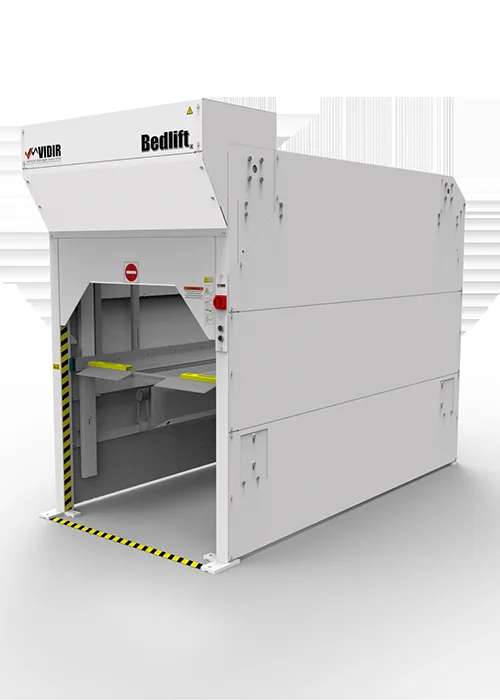
A bed lift stacks beds vertically in a single bay and returns any bed to floor level at the push of a button, on a last-in first-out basis, with one operator and no lifting. Corridors clear, the storage room stops being a maze, and turnaround on an available bed gets faster.
Four series cover effectively every bed and crib in a hospital, in front-load and side-load configurations, so the machine can be matched to the shape of the room you actually have.
More detail on healthcare applications is on our healthcare bed lifts page.
Bed lift and crib lift series
| Series | Vertical pitch | Capacity per position | Loading |
|---|---|---|---|
| Bedlift R (regular duty) | 27″ (686 mm) | 600 lbs (272 kg) | Front load — fits 80–90% of hospital beds |
| Bedlift X (extra capacity) | 33″ (838 mm) | 900 lbs (408 kg) | Front load — for the remaining 10–20% of beds |
| Bedlift S (side load) | 27″ (686 mm) | 600 lbs (272 kg) | Side load — for tight or unusually shaped rooms |
| Criblift C | — | Up to 600 lbs (272 kg) | Front load — sized for hospital cribs |
The R series covers most of a typical fleet; the X series exists for heavier bariatric and specialty beds, and the S series loads across the width of the bed when there is not enough room in front of the machine to load lengthwise.
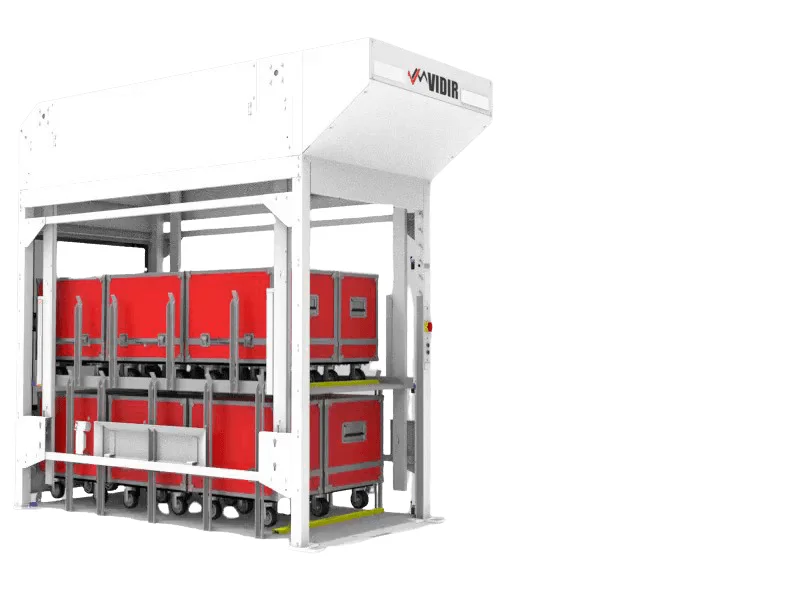
Equipment and trunk lifts
The same engineering that lifts a hospital bed lifts a loaded athletic equipment trunk. College and professional programs, high schools, bands and cheer programs all store large wheeled travel trunks that otherwise occupy hallways, laundry rooms and locker room floor.
A trunk lift raises those trunks into organized bays and brings the one a manager needs back down to waist height in seconds. On a game-day schedule, that removes the dig-through-everything step and the two-person lift that goes with it.
Because the machine is configured to the room, it also works for uniform bins, tool chests, stage cases and other bulky wheeled containers that do not fit any standard shelving unit.
Vertical lift or vertical carousel?
Both machines deliver goods to the person instead of sending the person to the goods, and plenty of buyers look at both. The honest answer is that they suit different inventory.
| Vertical lift | Vertical carousel | |
|---|---|---|
| Motion | Elevator travels up and down between two towers | Carriers rotate around a continuous loop |
| Height | Built to the ceiling — taller is simply more trays | Practical limit is lower than a lift |
| Storage density | Height-sensed trays, no wasted gap | Fixed carrier pitch |
| Best inventory | Mixed heights, long material, sheet, beds, bulky items | High-count small parts of consistent size |
| Retrieval speed | Fast to any single position | Very fast on short rotations, slower across the loop |
| Footprint | Two towers plus elevator | Single enclosed loop |
| Typical uses | Parts cribs, fabrication, hospitals, aerospace | Tool cribs, wire and cable, textiles, tire storage |
If your inventory is thousands of small, similar items, look at vertical carousels first. If the items vary in height, are long, are heavy or are simply large, a vertical lift will store them better. We also publish a direct vertical carousel vs. vertical lift module comparison if you want the detailed version.
Need a storage fixture that lowers from the ceiling instead of a floor-based lift machine? Compare Lift and Store overhead storage systems for bicycles, kayaks, garments, compatible security cages and other commercial storage applications. MH-USA is an authorized dealer; suspended overhead systems require a different structural and clearance review from the freestanding machines described here.
How to specify a vertical lift
Five numbers determine what you can install, and it is worth having them before the first conversation:
- Clear ceiling height. Measure to the lowest obstruction — steel, sprinkler heads, lights, ductwork — not to the deck. This sets the number of positions you get.
- Floor loading and slab condition. A loaded lift concentrates a lot of weight into a small footprint, and the machine is anchored to the slab.
- What you are storing. Item dimensions, weight per tray or cartridge, and how much the heights vary — the more variation, the more a height-sensing machine pays off.
- Throughput. Picks per hour at peak, and how many operators need access at the same time. This decides single versus dual access openings and tower count.
- Power available. Most units run on three-phase service; confirm voltage and amperage at the intended location early.
Beyond that, the questions that change the layout are where material enters and leaves, whether the machine feeds a specific production cell, and whether inventory needs restricted access.
Budgeting comes next — our vertical storage cost and pricing guide explains what drives the number — and installation is handled by factory crews with freight, rigging and commissioning coordinated as one job.
Most of the machines on this page come from Vidir, and our Vidir vertical storage solutions section carries the model-by-model detail and real project case studies.
Vertical Lift Applications and Related Guides
Model pages, industry applications and automation guides for planning a vertical lift or VLM project.
Vertical lift FAQs
What is the difference between a vertical lift and a vertical lift module?
How much floor space does a vertical lift actually save?
How tall can a vertical lift be?
What power does a vertical lift need?
Can a vertical lift connect to our ERP or WMS?
What can we store in a vertical lift?
How long does installation take?
Do you install vertical lifts outside Utah?
Shop Packaging and Shipping Boxes
Separate warehouse supplies, not lift components. Engineered lifting and storage systems are quoted for your application; the boxes below are available online.


Find out how much floor space you would get back
Send us your ceiling height, what you store and how often you pick it, and we will size the right vertical lift and quote it — machine, freight and installation in one number.