Material handling equipment is the machinery and systems used to move, store, control, and protect materials in warehouses, factories, and distribution centers. The category is already a major industrial base, with the global market valued at USD 261.71 billion in 2025 and still expanding Fortune Business Insights.
What is material handling equipment? It's the set of tools that keeps product flowing without turning your floor into a traffic jam. If you're responsible for a site, that usually means deciding which functions need help first, transport, storage, positioning, unit-load formation, or protection.
What Material Handling Equipment Really Means
Material handling equipment, or MHE, is the broad class of machinery, tools, and systems used to move, store, control, and protect materials through manufacturing, warehousing, distribution, and disposal MHI guidelines. A facility manager can usually spot the need for it in a simple way. If product is slowing down because people are carrying, staging, lifting, or wrapping it by hand, MHE is the equipment that takes over those jobs.
The first mistake many teams make is narrowing the category to forklifts alone. A forklift is only one tool in the set. Racks, conveyors, lift tables, cages, palletizers, and automated storage systems all belong in the same conversation because they support the same flow of work, even if they do it in different ways.
A useful way to frame MHE is as the physical layer behind inventory flow. Software may show where product should go, but equipment is what moves it, holds it, and keeps it organized within the facility. That is why MHE sits at the center of site design, not at the edge of it.
Market analysts treat the category as a large and durable industrial segment. One major forecast places the global market at USD 261.71 billion in 2025, with growth to USD 489.65 billion by 2034 at a 7.30% CAGR Fortune Business Insights. Another independent forecast places it at USD 262.9 billion in 2025, rising to USD 421.8 billion by 2033 at a 6.1% CAGR Grand View Research. The point is not the exact forecast. The point is that the category keeps expanding because nearly every operation needs a better way to move product without wasting labor or space.
A good working definition is simple. Material handling equipment helps you move, store, position, group, and protect materials with less manual effort. Keep that in mind when you compare products, because it gives you a stable way to judge whether a tool fits the job in front of you.
Training belongs in the same discussion. If your site uses powered trucks, review forklift license requirements as part of equipment planning, because the machine and the operator rules have to work together.
Practical rule: if a product stays in one place, it is usually storage. If it moves product around the building, it is handling, transport, or positioning.
The Five Functions Every Piece of Equipment Performs
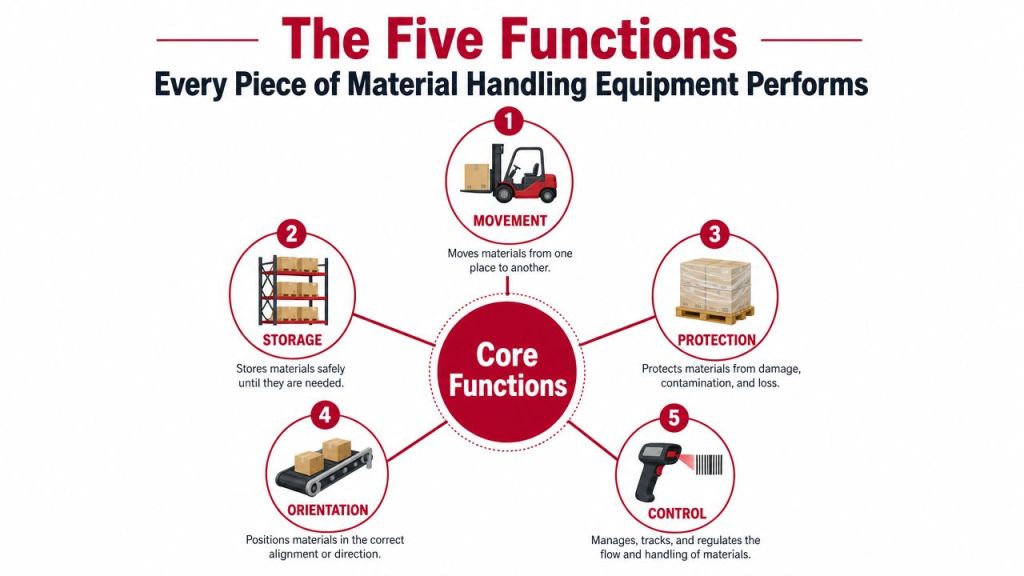
Movement and storage
Every piece of MHE does one or more of five jobs. Movement covers transport from one point to another. Storage covers keeping goods in place until they're needed. That's why racks, mezzanines, forklifts, pallet jacks, and conveyors can all live in the same conversation even though they look completely different.
Positioning, unit-load formation, and protection
Positioning puts material at the right height or angle for handling. Unit-load formation groups smaller items into one manageable load, often with pallets, wrap, or shipping supplies. Protection keeps that load safe during storage or transit, which is where cages, enclosures, and packaging come in.
A useful way to sort the equipment is by the job it performs, not by the brand or shape. A pallet rack and a mezzanine solve storage problems. A lift table solves positioning problems. A conveyor solves movement problems. That mental model holds up even when you add automation later. For a category-by-category rundown, see our material handling equipment list.
A smart purchase starts with the job, not the product name.
| Function | What it does | Common examples | Why it matters |
|---|---|---|---|
| Movement | Moves product through the facility | Forklifts, pallet jacks, conveyors | Reduces travel time and manual carrying |
| Storage | Holds product between touches | Racks, shelving, mezzanines | Improves space use and access |
| Positioning | Places material at a workable height or angle | Lift tables, carts, hoists | Cuts strain and awkward handling |
| Unit-load formation | Groups items into one transportable load | Pallets, wrap, shipping supplies | Makes handling more efficient |
| Protection | Shields material from loss or damage | Cages, enclosures, packaging | Supports security and product integrity |
The Equipment Categories Most Buyers Ask About
Conveyors are the clearest example of movement equipment. They keep cartons, totes, or other loads moving with less repeated lifting, which is why they fit facilities that need steady flow between receiving, packing, or sortation areas. For a closer look at layout options, see the warehouse conveyor systems page on MH-USA.
Forklifts and pallet jacks handle unit loads over short distances. Forklifts make sense when you need lift, travel, and stack capability. Pallet jacks fit simpler moves, especially on docks, in staging zones, and inside tighter aisles. A good match depends on load weight, turning space, and how often the load changes hands.
Racks and shelving solve storage. Pallet racking works for palletized reserve stock, while shelving fits smaller parts, bins, and hand-picked items. If you're comparing rack to shelf, think about whether the load comes in on a pallet or gets picked by hand. That simple question usually tells you which direction to start.
Carts, lift tables, and similar tools sit in the positioning group. They're easy to overlook because they don't look dramatic, but they often remove the most annoying part of the job, bending, reaching, or transferring material between heights. In many facilities, that makes them one of the most useful purchases on the floor.
Secure cages, enclosures, and packaging supplies support protection and unit-load formation. A cage protects high-value or restricted items. Wrap, straps, and cartons keep a load together and stable. For packaging decisions that touch both handling and shipping, the hydraulic power unit guide is a helpful technical reference for buyers who want a broader equipment vocabulary, even though it covers a different product family.
| Category | Primary Function | Typical Load | Space Needs | Best-Fit Industries |
|---|---|---|---|---|
| Conveyors | Movement | Cartons, totes, mixed units | Long, linear runs | Warehousing, e-commerce, manufacturing |
| Forklifts | Movement | Pallets, heavy unit loads | Maneuvering room and clear aisles | Distribution, manufacturing, yards |
| Pallet jacks | Movement | Pallets | Compact dock and aisle space | Storage, retail backrooms, docks |
| Pallet racking | Storage | Palletized inventory | Vertical storage footprint | Warehousing, manufacturing |
| Shelving | Storage | Small parts, hand picks | Moderate footprint, easy access | Labs, stockrooms, healthcare |
| Carts and lift tables | Positioning | Loose or staged goods | Flexible, floor-level space | Assembly, packing, maintenance |
| Security cages | Protection | Controlled or valuable items | Enclosed footprint | Government, healthcare, IT, evidence rooms |
| Packaging supplies | Unit-load formation | Mixed products, outbound orders | Minimal storage, high usage flow | Shipping, fulfillment, retail |
How Different Industries Use Material Handling Equipment
Warehousing and distribution usually depend on a simple mix, racks for reserve storage, forklifts for pallet moves, and conveyors when the building needs smoother flow. The goal is not to own every machine possible. It's to keep receiving, putaway, picking, and shipping from competing for the same aisle space.
Manufacturing often uses conveyors and lift tables because parts need to move between stations without slowing production. A plant may also rely on carts and mobile staging so workers can keep assembly moving without walking product back and forth. In that environment, the right handling system is part of the process, not just support equipment.
Healthcare and laboratories care about access, cleanliness, and control. Mobile shelving, secure cages, and enclosed storage are common because items must be organized and protected without wasting space. Government and evidence storage has a similar need for control, especially where secure cages and wire partitions support chain-of-custody practices.
E-commerce and retail stockrooms need fast picking and easy replenishment. Pick modules, packing stations, shelving, and small conveyors often show up together because order flow changes quickly. Education uses a different mix, usually modular storage and stockroom equipment that helps staff organize supplies without overbuilding the space.
The U.S. market reflects how embedded this category is. It generated USD 44.6 billion in revenue in 2023 and is projected to reach USD 66.0 billion by 2030, a rise of about 48% with a 5.8% CAGR Grand View Research. That scale points to a deep supplier base and long-term demand across industries.

Choosing the Right Equipment for Your Facility
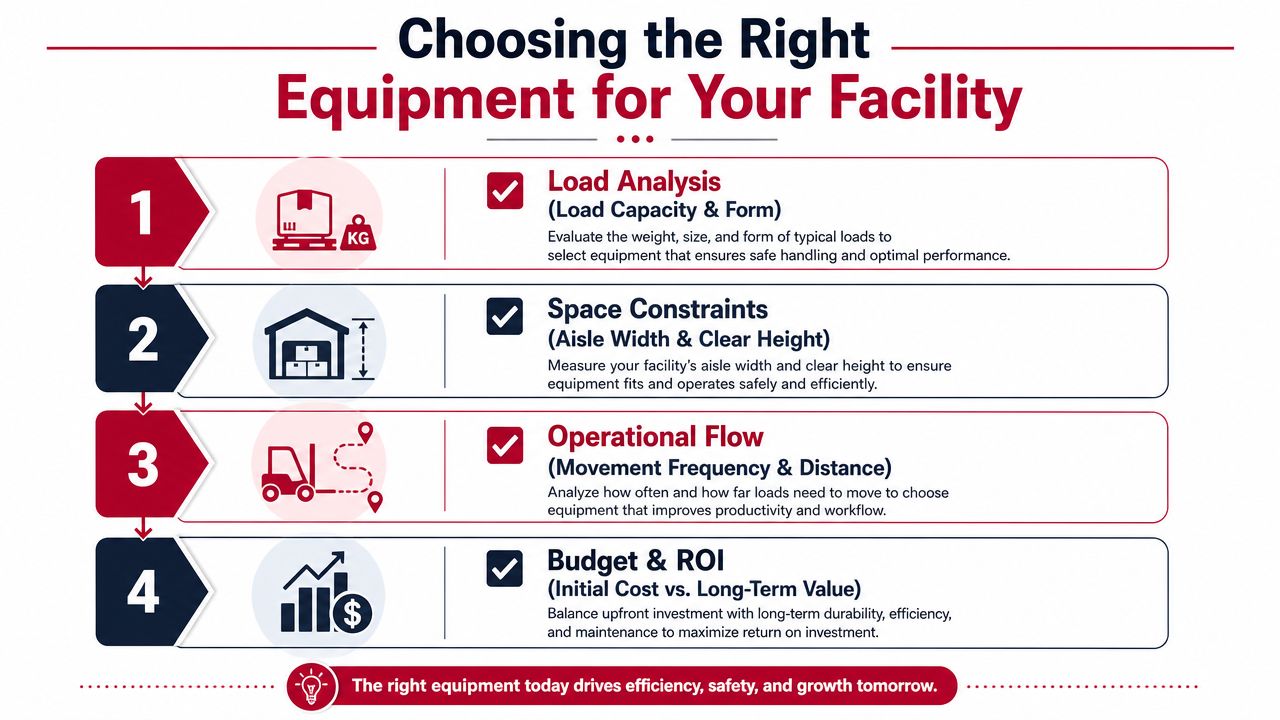
Start with the load, not the catalog. Weight, shape, pallet size, and fragility tell you more than a brochure ever will. If the load is irregular or needs special care, the equipment choice changes fast.
Then check the building. Aisle width, clear height, and floor conditions can rule out a product before price even enters the conversation. A tall rack system or a powered truck that can't turn cleanly in your space turns into a daily problem, not a solution.
The short buying checklist
- Load profile: What's the weight, size, and unit type.
- Traffic flow: Where does the material enter, wait, move, and leave.
- Space limits: What are the aisle widths, clear heights, and floor conditions.
- Environment: Does the area need washdown resistance, chemical resistance, or secure storage.
- Integration needs: Will the new equipment have to fit with existing conveyor, rack, or software systems.
Budget matters, but only after fit. The cheapest option can cost more if it wastes space, slows picking, or needs replacement sooner. Buyers who compare total value instead of sticker price usually get a clearer answer.
For planned layouts, MH-USA offers a warehouse design and layout solutions resource that fits well when a facility needs more than one item and wants the floor plan reviewed before purchase. Free layouts and designs with no obligation can save a lot of back-and-forth when the space is tight.
Maintenance, Safety, and Long-Term ROI
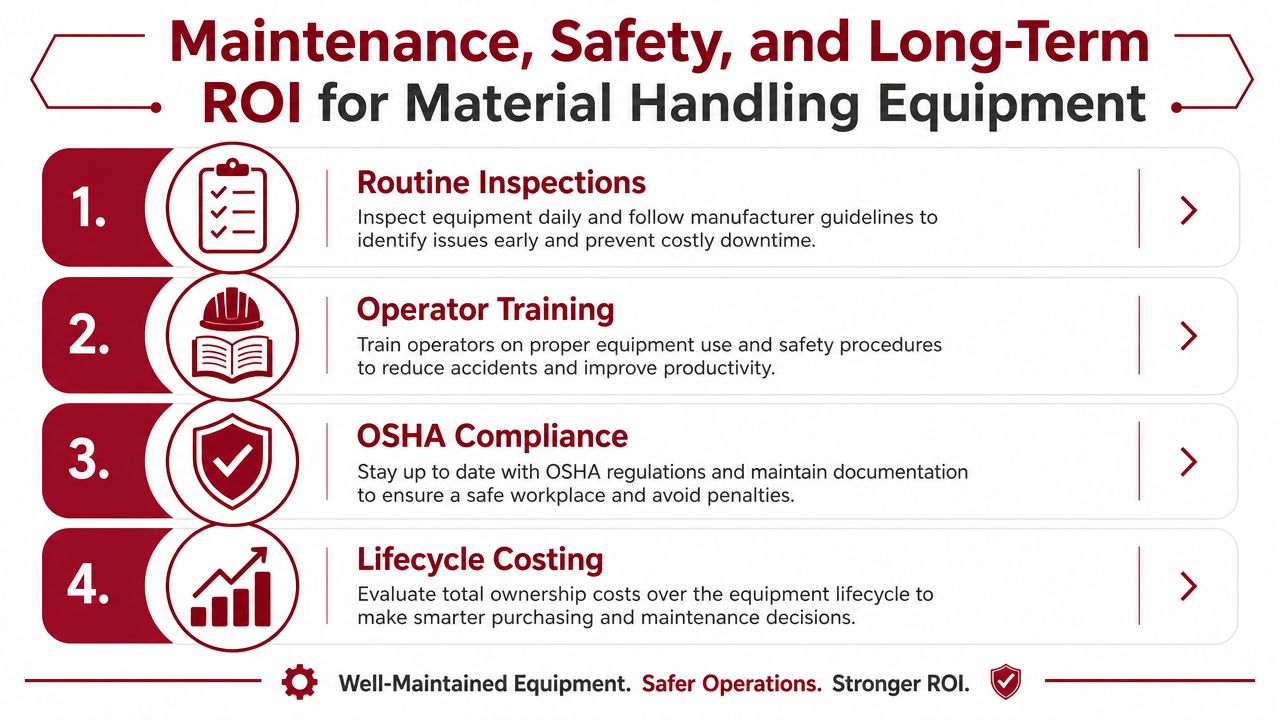
A rack, conveyor, or lift table is only as good as the care it gets. Routine checks catch loose fasteners, worn rollers, damaged uprights, and hydraulic issues before they interrupt the shift. That's the point where maintenance stops being an admin task and starts protecting uptime.
Safety training matters just as much as the equipment itself. Operators need clear rules for inspection, loading, and traffic patterns, and managers need to back those rules with consistent enforcement. If the team treats equipment like a shortcut, the floor usually pays for it later.
A simple maintenance cadence
- Daily: Visual checks for damage, debris, leaks, or blocked movement.
- Weekly: Confirm labels, guards, load placement, and access paths.
- Monthly: Review wear points, fasteners, and any recurring operator complaints.
- Quarterly: Recheck equipment use against current workflow, not last year's plan.
Equipment failures often start as small habits, not sudden breakdowns.
A better way to think about cost is total ownership, not just purchase price. Installation, upkeep, and operational fit all matter. In many operations, well-specified MHE can show measurable returns within 12 to 18 months through better space use, reduced labor, and improved inventory accuracy, which is why waiting for a “perfect” time can create its own delay.
Automation, AMRs, and Knowing When Not to Automate
Automation belongs in the conversation, but it isn't the answer to every handling problem. AMRs move independently, AGVs follow defined routes, ASRS store and retrieve items automatically, and sortation systems route product by destination. Each one can help, but each one also adds maintenance, integration, and planning demands.
That caution matters because automation is everywhere in the market discussion right now. The International Federation of Robotics reported 541,302 global industrial robot installations in 2023, a record level, and the World Economic Forum's 2023 Future of Jobs survey found employers expect about 44% of workers' skills to be disrupted in the next five years. Those figures help explain the interest, but they don't tell you whether your building is ready.
Low-volume and variable-demand facilities often do better with simpler equipment first. A well-placed rack, a better cart path, or a more logical staging zone can beat a costly system that's overbuilt for the workload. That's especially true when uptime, training, and change management are still unsettled.
If you're reviewing automated storage, the ASRS resource is a useful starting point for understanding where automation fits and where it doesn't. The right question is not “Can we automate?” It's “Does this flow justify the complexity right now?”
Planning Your Project and Getting a Custom Quote
A good project usually moves in three steps. First, the team defines the needs. Then the layout gets built around those needs. After that, quotes and delivery timing turn the plan into something the floor can use.
That sequence keeps buyers from guessing. It also gives you a cleaner way to compare options, because you're not looking at one random product, you're looking at how the full setup supports your space and workflow. For larger jobs, permits and code review can matter early, especially with mezzanines, enclosed rooms, and modular structures.
Three questions buyers usually ask
- How long does planning take? It depends on the scope, but a clear needs list speeds things up.
- Is installation included? Ask early, because some projects need coordination beyond delivery.
- What about permits and code? Larger systems may need review before purchase, so planning ahead helps avoid delays.
Material Handling USA supports that process with competitive pricing, fast shipping, quality materials, free layouts and designs with no obligation, and free quotes. The company also works as a nationwide supplier for products like racks, mezzanines, modular buildings, cages, shelving, and packaging supplies, which gives buyers one place to compare more than one answer.
For a closer look at products and pricing, Shop Now at Material Handling USA. If you're still mapping the space or want a free layout consultation, Contact Us or Request a Quote at Material Handling USA, call (800) 326-4403, or email Sales@MH-USA.com so the team can help shape a practical plan before equipment gets ordered.