
Distribution Warehouse Security Cage: The Durkin Company
How a facility-supplies distributor uses welded wire mesh enclosures to control access to high-shrink inventory — and how to plan a caged area inside a working distribution warehouse without slowing picking down.
2023–2026
Years The Durkin Company has ordered security cage and wire partition product from MH-USA
Billerica, MA
New England facility-supplies distributor, family owned since 2003
Welded wire
Panel type that keeps a caged area visible, sprinkler-friendly and inspectable
OSHA 1910.176
Federal standard governing storage, clearance and aisle access
The project
The Durkin Company is a family-owned distributor of janitorial, safety and facility supplies based in Billerica, Massachusetts, serving businesses, schools, municipalities and property managers across New England. Material Handling USA has supplied the company with security cage and wire mesh partition product repeatedly since 2023, including several orders in 2026.
That repeat pattern is the reason this project is worth writing up. A distribution warehouse almost never gets its secured area right in one purchase. A first enclosure goes up around the inventory that is disappearing fastest; it works; and then the caged footprint grows as new product categories, new regulations or new customers arrive. Planning for that from the beginning — modular panels, a door that can be relocated, a layout that does not fight the pick path — is what separates a cage that lasts a decade from one that has to be cut apart in year two.
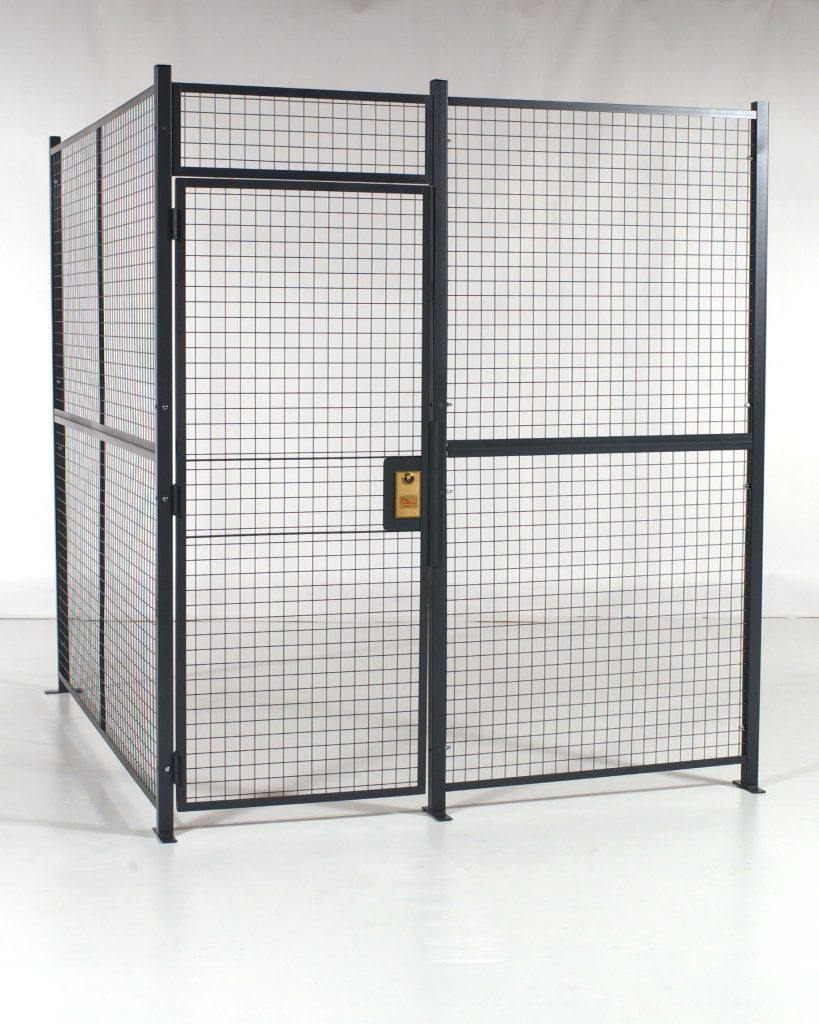
This page pairs the verified facts of that customer relationship with the planning and engineering detail that applies to any distribution warehouse. The full range of systems we design and install is on our security cages and wire partitions hub; the configuration discussed here belongs to the welded wire mesh partition family.
What we publish
We publish only what we can verify: the client, the period we have worked together, and the product category supplied. We never publish a customer’s room dimensions, facility layout, order value, inventory counts, lock specifications or anything else about how a site is secured. Everything else on this page is general planning guidance, not a description of this customer’s building.

Why distribution warehouses cage inventory in the first place
Distribution is a margin business, and shrink comes out of margin directly. In a facility-supplies or consumables operation the loss almost never looks like a break-in. It looks like a case of gloves that was never scanned, a drum of specialty cleaner that walked out on a pallet jack, a carton of batteries that is in the system but not on the shelf. Small, repeated, and invisible until a cycle count says otherwise.
A wire enclosure does not stop a determined thief with time and tools. What it does — reliably and cheaply — is remove opportunity and create accountability. When the only way to reach a product category is through one controlled door, the question “who had access?” has a short answer. That is why a caged area usually pays for itself long before anyone can quantify the theft it prevented: it changes behaviour, tightens counts and gives supervisors a defensible process.
The second driver is contractual. Distributors who serve municipalities, schools and regulated industries increasingly carry product that their own suppliers require them to store under controlled access — controlled chemicals, DEA-adjacent items, calibration equipment, high-value electronics. A warehouse security enclosure is often the cheapest way to satisfy a supplier audit without building a hard-walled room.
What actually goes inside the cage
Before drawing anything, write down what the enclosure is protecting. In a facility-supplies distribution warehouse the caged inventory usually falls into five groups, and each one drives a different design decision.
Sizing the cage and placing it in the building
The two mistakes we see most often are sizing the enclosure to today’s inventory and placing it wherever there happens to be an empty corner. Both are expensive to undo.
Size for growth, not for the current shelf count
A caged area that is exactly full on day one is full forever, and the first response to that is people propping the door open or staging “temporarily” outside it — which defeats the entire control. Plan the footprint against the categories you expect to add, not the ones you have. Modular welded wire partitions are bolted panel systems, so extending a run later is genuinely practical, but only if the surrounding aisle and rack layout left room for it.
Place it against the flow, not across it
Every trip into a secured area costs time. If the cage sits at the far end of the building from receiving and shipping, the operation quietly pays that cost on every order. In most distribution layouts the right position is adjacent to the pick path but off the main travel aisle, with the door facing the direction pickers approach from, and with enough apron space in front of the door that a pallet jack can be set down without blocking traffic.
Decide early whether the cage uses the rack
If the protected inventory already lives in pallet rack, enclosing the rack itself is often cheaper and faster than building a freestanding room around it. That is a different product family — see pallet rack security enclosures — and it changes the panel heights, the door type and the anchoring. If the inventory lives on shelving or on the floor, a freestanding wire mesh partition room is usually the better fit.
Our security cage sizing guide walks through measuring an area and converting it into a panel schedule, and the online cage configurator is a fast way to sanity-check a footprint before asking for a quote.
| Decision | What drives it | Common mistake |
|---|---|---|
| Footprint | Categories you expect to secure in 3–5 years | Sizing to today’s shelf count |
| Position | Distance from receiving, shipping and the pick path | Whatever corner is empty |
| Height | Ceiling clearance, sprinkler heads, lighting, whether a ceiling is required | Ordering full height before checking obstructions |
| Door type | Equipment that must pass through, frequency of use, apron space | A single hinged man door on a pallet-traffic cage |
| Mesh opening | Smallest item being protected and reach-through risk | Standard mesh over small pocketable goods |
| Anchoring | Slab condition, seismic requirements, whether panels may move later | Anchoring to a slab nobody checked |
Panels, doors, locks and the parts that decide whether people use it properly
A security enclosure fails operationally long before it fails structurally. The failure is almost always a door: too small, too slow, in the wrong place, or so awkward that staff leave it open.
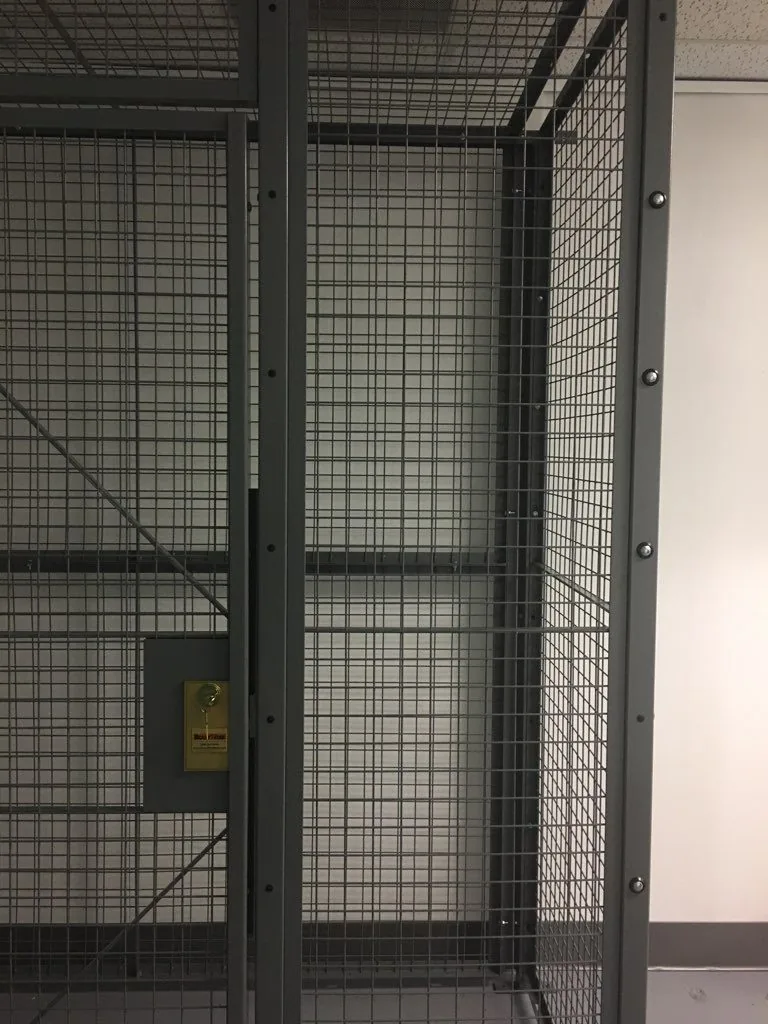
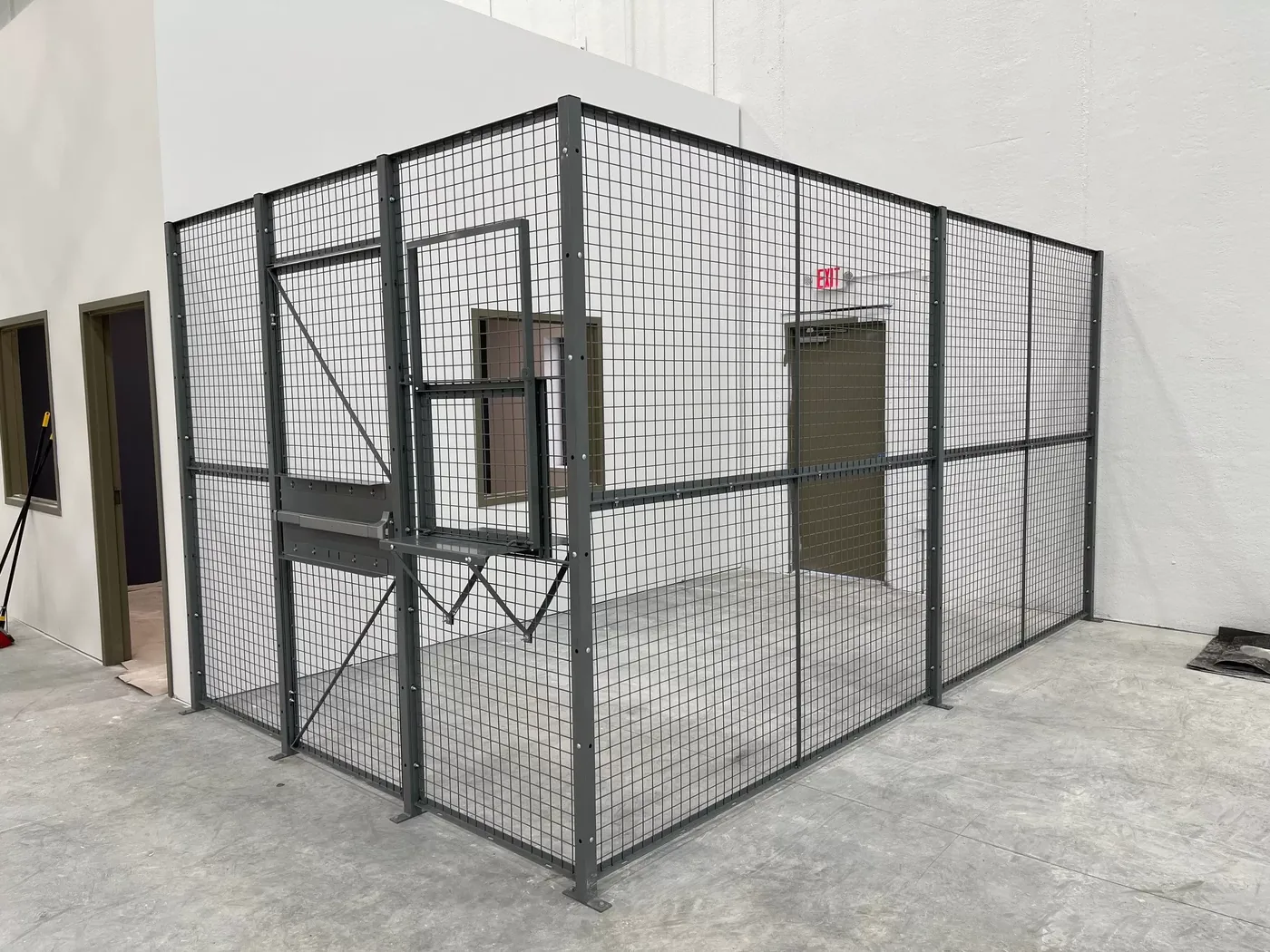
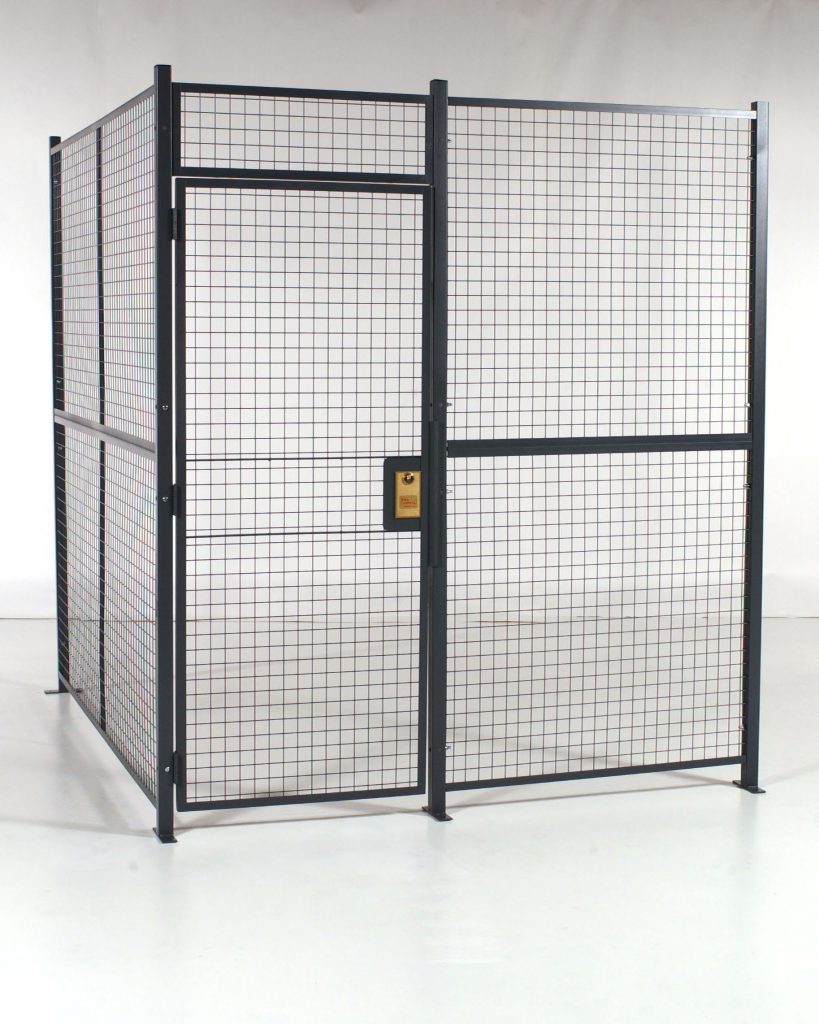
Panels. Welded wire mesh is the default for interior distribution work: it is rigid, it is see-through so supervisors and cameras retain sightlines, it lets sprinkler water and light through, and damage is obvious at a glance. Mesh opening and wire gauge are chosen against the smallest item being protected — the review of wire mesh panel options covers the trade-offs. Where the requirement is a straightforward, economical enclosure for bulk goods, a chain link storage cage can be the more sensible build.
Doors. Match the door to the traffic. Hinged man doors are fine for hand-picking. Anything that receives palletized product wants a sliding or double door sized to the equipment plus clearance, because a door that a pallet jack barely fits through will be propped open within a week. The range and the sizing rules are on the security cage doors page.
Locks and access. We supply cylinder locks, padlock hasps, keypads and electric strikes and integrate with a building’s existing access control — see security cage locks and access control. What matters more than the hardware is the policy: one accountable keyholder group, a written issue procedure, and no personal padlocks appearing on a company cage.
Service openings. Where most transactions are “hand me that item” rather than “let me in,” a service window or issue counter keeps the door closed and the count clean.
Fire protection, egress and code — get this reviewed before you order
A security cage is a fixed obstruction inside an occupied building, and three code questions follow it everywhere. None of them are optional, and none of them should be answered by a salesperson.
Sprinkler coverage. A solid or closely spaced top on an enclosure can obstruct sprinkler distribution. Open welded wire tops are generally the preferred approach precisely because they interfere far less, but obstruction rules are specific to the sprinkler design and the commodity being stored, and NFPA 13 requirements have to be applied by the people responsible for the fire protection system. If a cage is going under existing sprinklers, ask the fire protection contractor before ordering — not after installation. Our cage ceiling and top panel page explains the practical options.
Egress. A cage must never block, narrow or lengthen an exit route, and doors on an egress path have their own hardware requirements. OSHA’s exit route maintenance standard (29 CFR 1910.37) is the plain-language starting point; the building code and the local authority having jurisdiction decide the rest.
Storage and aisle clearance. OSHA’s materials handling and storage standard (29 CFR 1910.176) requires that storage areas be kept free from hazards and that aisles and passageways be kept clear and in good repair. A caged area that squeezes an aisle below what your equipment needs creates a new problem while solving an old one.
Nothing on this page is a compliance determination, and no enclosure is automatically code compliant. Confirm sprinkler, egress and permitting requirements with your fire protection contractor and your local authority having jurisdiction before installation.
Installation and phasing inside a running warehouse
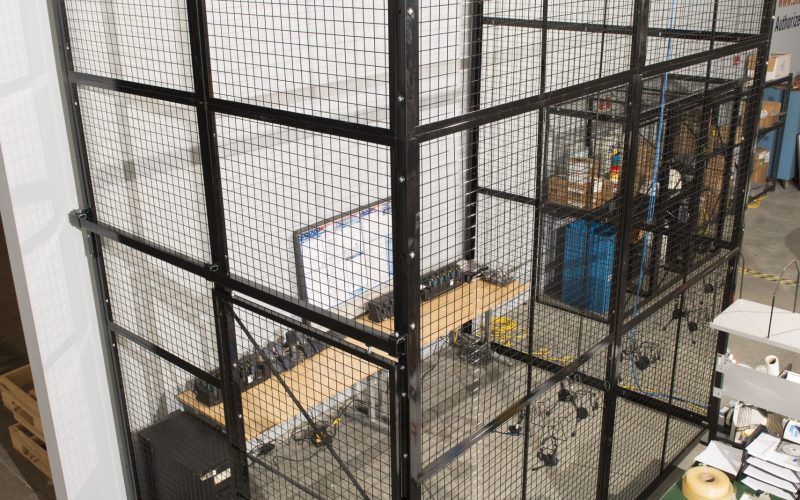
The distribution warehouses we work in do not shut down for a cage. The install has to happen around inbound trailers, pick waves and cycle counts, which makes sequencing as important as the product.
A typical phased approach looks like this: verify the slab and the overhead obstructions; lay out and mark the panel line before anything is unloaded; set and anchor the corner and door posts first so the opening geometry is fixed; run panels away from the door in both directions; hang the door and adjust; then add the top or ceiling last, once nothing else needs crane or lift access from above.
Two site conditions cause most of the delays we see. The first is floor flatness — a slab that slopes or has a construction joint under the panel line changes how posts are shimmed and anchored. The second is what is above the cage line: conduit, ductwork, sprinkler branch lines and light fixtures rarely appear on the drawing anyone hands the installer. Both are cheap to find during a site visit and expensive to find on install day. Details of how we run these projects are on the security cage installation page, and a repeat customer relationship like this one is usually a series of small phases rather than one large project.
Define what is being protected
List the categories, their physical form and their growth. This drives mesh, shelf vs pallet storage and footprint.
Walk the site
Slab condition, overhead obstructions, sprinkler heads, lighting, egress paths, equipment clearances.
Lay out the footprint
Position against the pick path, size for growth, fix door location and apron space.
Specify panels and hardware
Mesh opening, panel height, ceiling or open top, door type and size, lock and access method.
Get code review
Sprinkler obstruction, egress and permitting confirmed with the fire protection contractor and the AHJ.
Install in phases
Anchor posts, run panels, hang and adjust doors, fit tops last, then hand over keys and procedure.
Running the cage after it is installed
The enclosure is the easy part. The habits around it decide whether shrink actually falls.
Keep the door shut. Every propped-open door is a sign that the design is fighting the work — wrong door type, wrong location, or too few authorized pickers on shift. Fix the cause, not the symptom.
Issue, do not browse. High-value categories work best on an issue model: a named person retrieves, records and hands over. A service window makes this practical without a dedicated attendant standing by the door.
Count what is caged more often than what is not. The point of segregating inventory is that the count is now meaningful. A short weekly cycle count inside the cage catches problems while they are still small.
Inspect the enclosure. Panels get hit by pallet jacks, hinges sag, hasps loosen. A quarterly walk-through with the same checklist keeps a cage in service for decades — the maintenance and inspection guide has a usable version. Damaged panels should be replaced, not bent back.
Revisit the footprint annually. If the categories inside the cage have changed twice since it went up, the layout probably should too. Because these are bolted modular systems, extending or reconfiguring an existing run is normal work, not a rebuild — and it is exactly what a custom security cage configuration is for.
Planning a secured area in your distribution warehouse?
Send us your footprint, ceiling height and what you need to protect. We will come back with a panel layout, door recommendation and budget — and flag the sprinkler and egress questions your fire protection contractor needs to answer.
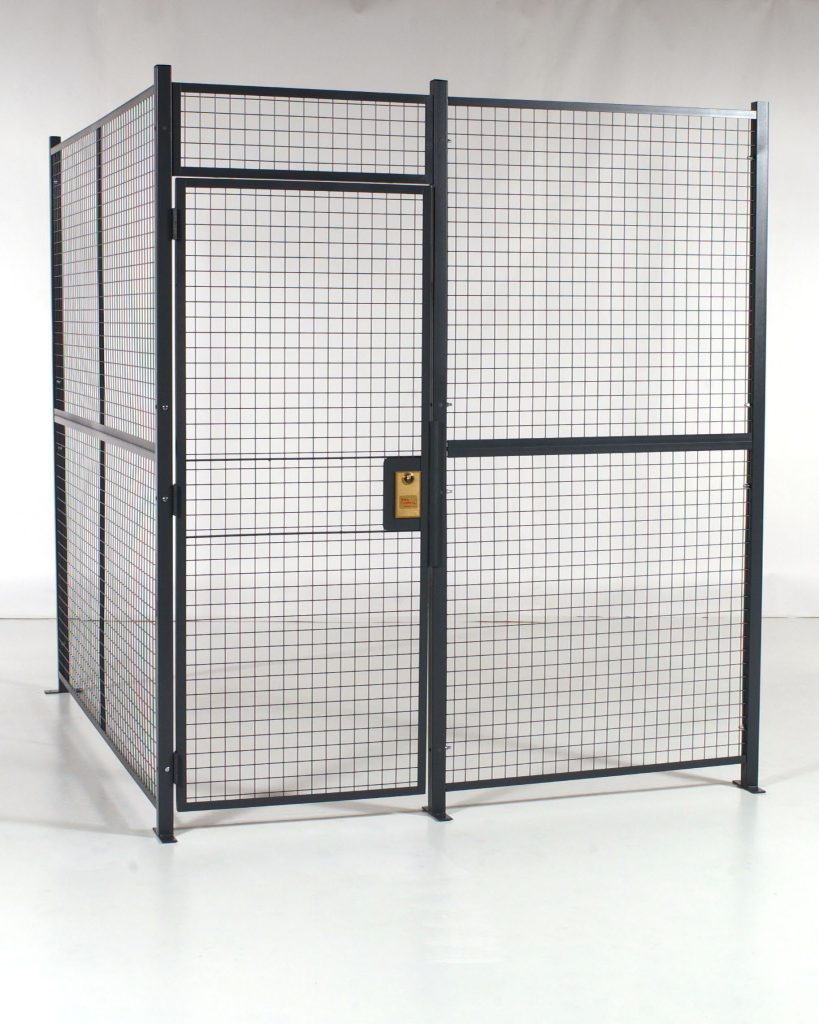
Shop Pre-Configured Wire Mesh Cage Kits Online
Standard-size welded wire cage kits, priced online, for smaller storage needs. Every kit still needs to be anchored to sound concrete — for tall, braced or engineered enclosures, request a quote with your building location and floor details.
Frequently asked questions
How big should a distribution warehouse security cage be?
Welded wire mesh or chain link for a warehouse cage?
Will a security cage interfere with our sprinklers?
Can a cage be installed while the warehouse keeps operating?
What kind of door should a caged area have?
Does a security cage actually reduce shrink?
Secure the inventory that is costing you margin
Material Handling USA designs, supplies and installs welded wire security cages and partitions for distribution warehouses nationwide.