Most buyers start with a tire count. That question skips the gap. A tire storage carousel for Utah tire shops fails when saleable stock, customer snow sets, repair holds, and scrap share one machine with no rules between them.
Utah counters don't only hold tires you can sell today. Mounted seasonal sets, warranty returns, and casings waiting on a hauler land on the same slab. Floor piles look cheap until a tech can't reach a bay, a sprinkler head, or the set booked for the first appointment.
This guide is for owners, service managers, facilities leads, and buyers who need a layout they can price. Sort the inventory, compare setups, measure loads, and see which fire and waste rules change the drawing before you request a quote.
Why Utah Tire Shops Run Out of Floor Space
The U.S. Environmental Protection Agency estimated that 6.53 million tons of vehicle tires were generated in 2018, about 2.2% of municipal solid waste. Those figures cover passenger-car, truck, and motorcycle tires. They're a national benchmark, not a count of your bays. Measure the shop you run.
That volume shows up as mixed jobs, not one neat rack of new rubber. Removed sets, seasonal inventory, repair holds, returns, and product waiting on recycling all compete for aisle space. A carousel can lift mixed inventory off the floor and speed access by size, brand, season, or customer order. The category still decides the setup, because a saleable tire and a waste tire don't follow the same handling rules.
Five groups that fight for the same slab
| Category | Typical handling | Carousel fit | Compliance check |
|---|---|---|---|
| Saleable new tires | Sold from stock, sorted by size and brand | Strong fit with size-sorted carriers | Standard fire, aisle, and sprinkler review |
| Customer seasonal sets | Stored between changeovers and retrieved by appointment | Strong fit with a reservation-linked retrieval queue | Confirm ownership and written storage consent |
| Repair hold or returns | Waiting on repair, warranty, or approval | Fits a dedicated exception zone | Document condition before storage |
| Removed tires awaiting pickup | Held until authorized transport | Fits only a separate, verified zone | Check whether waste tire rules apply |
| Scrap or waste tires | Accumulated for recycling or disposal | Storage only after permit review | Permit, fire lane, and financial assurance review |
Count each row over a typical week, then mark the peak month. The row that takes the most room is the one that should drive the quote, not the average tire on the floor.
Practical rule: If scrap is the bulky group, finish the permit question before you draw carriers. If customer sets dominate, build the retrieval queue first.
Storage Configurations Compared for Tire Shops
Score the setup against a peak week, not a quiet Tuesday. These five options cover what most Utah shops can install.
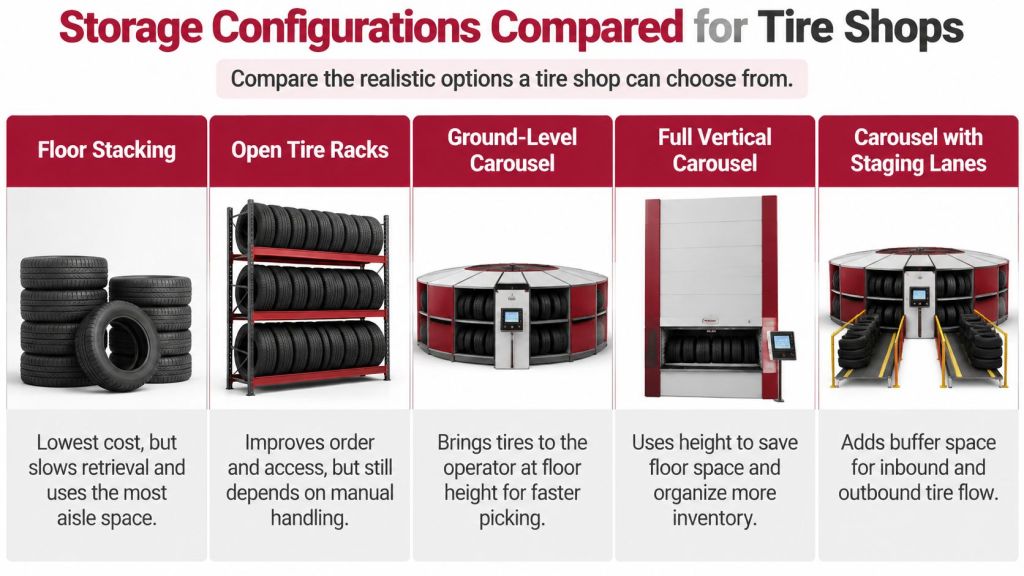
| Configuration | Floor space use | Retrieval pattern | Best fit | Main trade-off |
|---|---|---|---|---|
| Floor stacking | High, spreads across aisles | Manual search | Very low volume | Blocks aisles and sprinkler clearance |
| Open tire racks | Moderate to high | Manual, sizes visible | Mixed sizes at low to mid volume | Footprint grows with volume |
| Ground-level tire carousel | Low | Motorized to operator access point | Mid to high volume with many sizes | Needs layout, power, and a clear operator zone |
| Full vertical carousel | Lowest floor use per tire stored | Motorized to operator access point | High volume with limited floor | Highest height and install planning |
| Carousel with staging lanes | Low to moderate | Fast for scheduled appointments | Seasonal peaks with reservations | Needs unused capacity by design |
What each option gives up
Floor stacking costs the least up front. It also eats the aisle a car needs and can sit under sprinkler heads that were never meant to cover a rubber pile.
Open racks keep sizes visible, which helps a small counter. As SKUs grow, you buy more floor, not more height. Techs still walk, bend, and hunt.
A carousel puts tires on rotating carriers. The selected carrier turns to an operator access point, so staff stop walking every bay. You trade that speed for power, ceiling height, guarding, and a clear standing zone. The Utah tire carousel planning page walks through how those configurations sit in a local shop. Background on how a motorized loop works is on the tire carousel and vertical storage guide.
Staging lanes keep near-term appointment sets at floor level while the machine holds the rest. That buffer only works if you leave slots empty on purpose.
A carousel is the wrong tool when volume is very low, you stock only a handful of sizes, or the building has no room for the operator opening. In those shops, labeled open racks usually beat a machine you can't reach.
Sizing a Carousel From Tire Size and Load
A headline tire count misleads buyers. How many tires fit depends on diameter, width, mounted or loose condition, assembly weight, and how you group sets. Published commercial data from Southwest Solutions show one design at up to 352 tires, diameters from 28 to 44 inches, 18,000 pounds total, carrier ratings of 1,000 to 2,000 pounds, and retrieval at 21 feet per minute. Another published system lists 13,000 pounds overall and about 26.5 feet per minute. A separate tire carousel product range lists heights from 9 feet 1 inch to 24 feet, widths from 4 to 18 feet, depth of about 6 feet 7 inches, 12,000 pounds listed capacity, and a 2,000-pound maximum out-of-balance load.
Measure in this order
- List every size with its largest diameter and width.
- Weigh the heaviest mounted set you expect on one carrier.
- Count how many of those sets fit by width and diameter.
- Add the out-of-balance allowance when a carrier is only partly loaded.
- Compare total gross load with the system rating and each carrier rating.
- Check overall height against ceiling, sprinkler heads, and lights.
| Specification | Published reference range | What to measure in your shop |
|---|---|---|
| Tire diameter | 28 to 44 inches across published designs | Largest and smallest diameter in the SKU list |
| Overall height | 9 feet 1 inch to 24 feet | Ceiling clearance, sprinkler heads, and lighting |
| Overall width | 4 feet to 18 feet | Usable floor width and aisle widths on each side |
| Depth | About 6 feet 7 inches | Operator access point and approach path |
| Listed capacity | 12,000 to 18,000 pounds overall | Heaviest combined carrier load, not average set weight |
| Carrier rating | 1,000 to 2,000 pounds per carrier | Heaviest mounted set multiplied by tires per carrier |
| Out-of-balance allowance | Up to 2,000 pounds in one published model | Partial carrier loading pattern |
| Retrieval speed | About 21 to 26.5 feet per minute | Peak appointments handled per hour at the service counter |
Depth and the access opening decide where the unit can sit. A machine sized on average tire weight overloads the day a carrier holds the heaviest mix.
Size the heaviest carrier you will actually load, then apply the maker's gross-load and off-balance limits. Average weight is a planning shortcut that fails at the bolt pattern.
Send the supplier your SKU list, peak inventory by size, the heaviest carrier scenario, ceiling height, and power (voltage and phase). If open rack is still in the running, a commercial tire rack builder is a useful check on footprint before you lock a motorized layout. Retrieval speed is a workflow question once the load math holds.
Utah Fire and Waste Tire Rules to Plan For
A carousel doesn't erase fire rules. Utah's fire-code framework, as summarized in the Utah IFC tire storage chapter, regulates tire storage alongside NFPA 13. It limits individual tire-storage piles to 5,000 square feet of continuous area, 50,000 cubic feet of volume, and 10 feet in height, and it calls for 40 feet of separation between piles in the applicable tire-storage context. Confirm whether your indoor storage type falls under those limits. A vertical machine can cut floor spread. It doesn't cancel sprinkler, aisle, fire-access, or local authority review.
Waste tires add another layer
Utah Admin. Code R315-314-3 requires a permitted waste tire facility to keep tires in designated areas, control access with fencing, keep a 40-foot fire lane between piles, maintain working fire-control equipment, display an emergency procedures plan approved by the local fire department, and establish financial assurance of $150 per ton of tires stored. A retail shop doesn't meet that definition in every case. Utah Code 19-6-804 generally limits an individual, including a transporter, to transferring no more than 12 whole tires at one time to a landfill or other authorized temporary-storage location, unless board rules say otherwise.
| Requirement | Ordinary retail storage | Waste tire facility | What to confirm |
|---|---|---|---|
| Pile size | 5,000 square feet continuous area, 50,000 cubic feet, 10 feet high, where the fire code applies | Same pile limits in the applicable context | Whether pile limits apply to your storage type |
| Separation between piles | 40 feet in the applicable tire-storage context | 40-foot fire lane between piles | Aisle and fire lane layout on the drawing |
| Fire-control equipment | Sprinkler and fire-access review | Working fire-control equipment required | Sprinkler clearance and hydrant access |
| Emergency procedures | Local fire authority requirements | Plan approved by the local fire department | Plan on file and posted on site |
| Site access | General business access | Fencing and controlled access | Access control design for the building |
| Financial assurance | Not set for ordinary retail storage | $150 per ton of tires stored | Cleanup and closure cost estimate |
| Waste tire transfer | Not applicable to saleable inventory | Up to 12 whole tires at one time unless board rules allow otherwise | Separate waste stock from saleable stock |
Work the sequence with the local fire official. Classify the stock. Separate saleable, customer-owned, repair, and scrap tires onto different carriers. Request a sprinkler-obstruction review. Draw the emergency-access zone before you approve a footprint. This planning note doesn't replace legal review or the authority having jurisdiction. Treat retail pile limits as unconfirmed until that official says they apply to your storage type.
Layout, Retrieval and Seasonal Surge Capacity
How much room will your shop need when the first storm brings a surge of tire-change appointments? Utah drivers may need snow tires or other traction devices in severe winter conditions, and road restrictions can apply when conditions warrant them, according to UDOT's snow tire and chain requirements. Use your appointment history to identify the changeover peaks and reserve capacity for them.
A carousel can look half full in July and still run short in November. Average utilization does not show whether enough tires will be accessible during the busiest week.
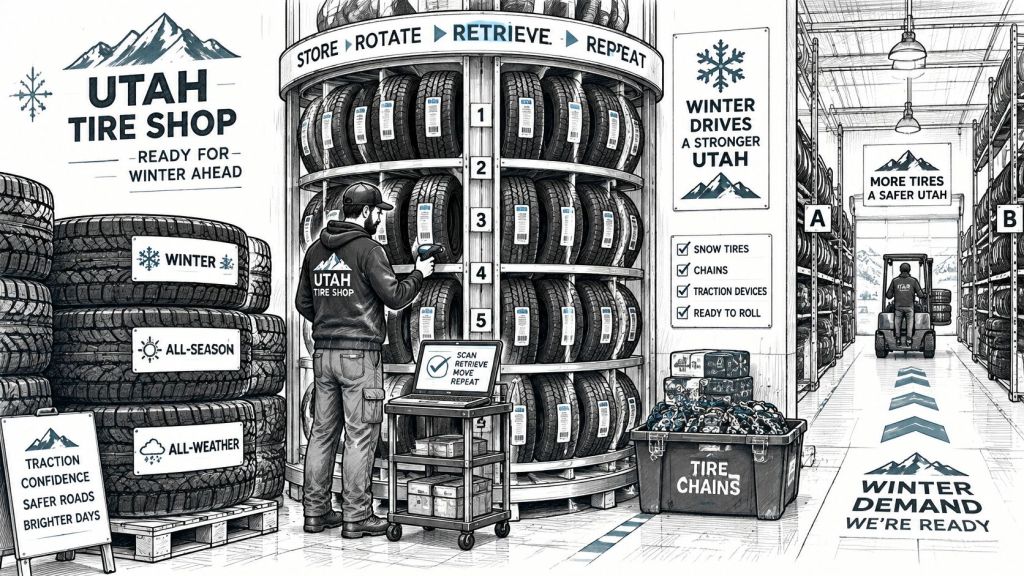
A six-step capacity plan
- Log each stored set by vehicle, tire size, and appointment date.
- Reserve capacity for both seasonal changeover peaks.
- Place sets with near-term appointments in a fast-access zone.
- Keep an exception area for damaged, unclaimed, oversized, or loose tires.
- Connect reservations to a retrieval queue.
- Mark a storm-day overflow lane for same-day calls.
Index carriers by tire size and keep the map current. Mixed, unindexed carriers bring back the search time the carousel is meant to reduce. Leave room for the operator to access the machine, and keep that path serviceable and clear of the emergency route.
Spread heavy sets across carriers within the machine's load limits. Filling every slot removes surge capacity; putting unverified removed tires in the fast-access zone risks retrieving the wrong set. A labeled tire-rack layout at a Utah dealership shows how static storage can sit alongside higher-density equipment where the building layout calls for both. Shops that maintain logistics assets with Forge Reliability can apply the same serviceability principle to the operator access path.
Empty slots are working capacity when they let the shop complete storm-week appointments without creating a floor pile.
Installation, Condition Records and Lead Time Questions
Climate control doesn't fix the dispute that shows up in spring. Weak chain of custody does. When tires come back after months in storage, the fight is usually about cracks that were already there, bead damage, a mismatched set, or the wrong vehicle. Local storage notes, including Wheel Werks tire storage practices, mention labeling and a controlled environment, but they don't set temperature, sunlight, moisture, or stacking numbers for your machine. Get those limits in the supplier's writing. Don't invent them.
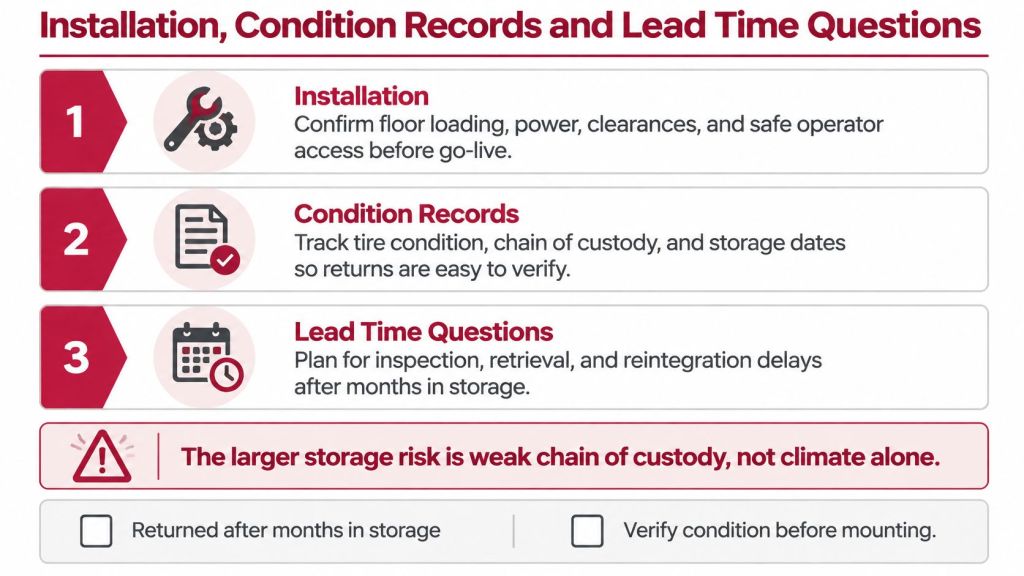
Records that prevent the argument
- Layout first: Confirm floor path, power, and access before the truck arrives.
- Service access: Schedule installation and a clear path for later maintenance.
- Photo or scan: Capture each set at drop-off so later damage has a starting point.
- Condition line: Record tread depth, visible defects, and wheel position.
- Identity: Tie a barcode or RFID tag to the customer and the vehicle.
- Quarantine slot: Park questionable tires where they can't be mounted by mistake.
- Consent: Collect written storage terms before the set goes up.
Retrieval slots should keep tires from rubbing. Ask, in writing, for lead time, the installation window, training, parts supply, and what happens to stored sets if the machine is down. Verbal estimates don't hold a bay schedule.
Common Questions About Utah Tire Carousels
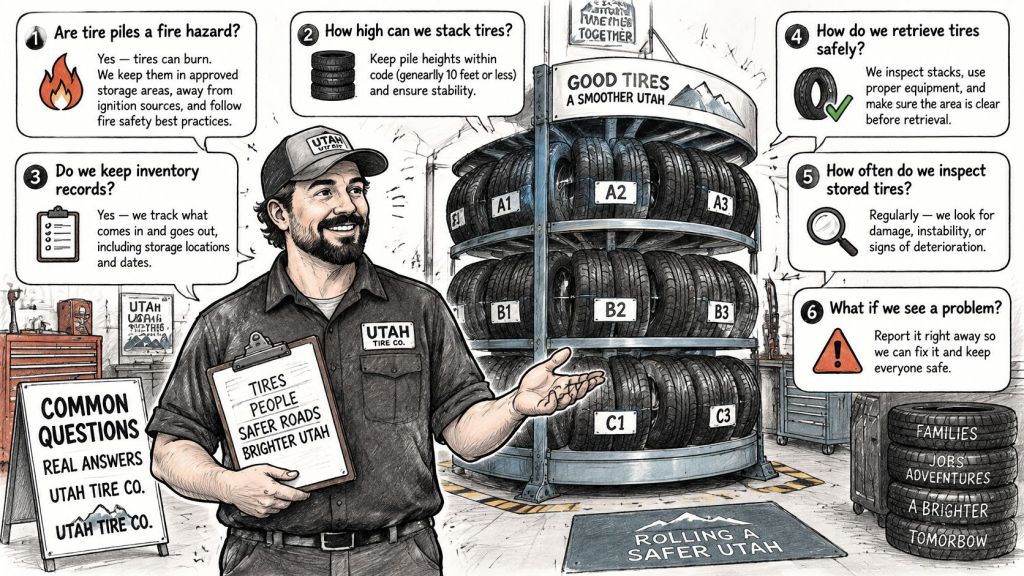
Does a carousel remove fire separation requirements? No. Confirm pile limits, fire lanes, and sprinkler clearance with the local fire official before you freeze the layout.
How much capacity should a shop hold back? Model peak-week appointments and leave open slots for both changeover peaks plus a storm-day lane. Filling every carrier removes that buffer.
Does a tire carousel need climate control? Ask the supplier to define acceptable temperature, sunlight, moisture, and stacking in writing. Records of condition matter as much as the room.
Can removed or scrap tires share a carousel with saleable stock? Only after classification and any permit review, and never on the same carriers as saleable or customer sets.
Can a shop store customer snow tires? Yes, when you record condition, tag each set to the vehicle, and keep written consent.
How long does a project take from quote to install? This guide sets no fixed timeline. Ask for a written lead time, an installation window, and a service response time.
Choosing the Right Setup and Requesting a Quote
Which setup fits the shop's inventory, floor space, and busiest weeks? A small counter with few sizes can start with labeled open racks. A busy shop with many sizes and limited floor area can compare ground-level and full vertical carousels. Shops facing seasonal peaks should plan staging lanes and a reservation queue alongside carousel capacity.
Keep removed or scrap tires in a separate, classified zone, and complete permit review before finalizing carrier drawings. For a multi-bay remodel or new build, settle fire and sprinkler requirements before choosing a configuration.
What to send with the quote
Provide the SKU list, heaviest carrier scenario, ceiling height, and power details. Include the sprinkler layout, operator access point, waste or scrap status, peak appointment volume, and target installation window. These inputs help the supplier assess the layout and reduce the chance of redraws after the bays are full.
Material Handling USA's in-house specialists provide layout and permitting support for facility projects. They can review your SKU list, ceiling height, and peak-week volume as a starting point for a customized layout and quote. Call (800) 326-4403 or email Sales@MH-USA.com to discuss the project.
Before requesting a quote, decide which inventory categories need dedicated space, which configuration suits peak-week volume, and how much unused capacity to reserve for storm-day demand. Share those choices with the supplier so the proposal can account for day-to-day storage and seasonal surges.
A tire storage carousel for Utah tire shops works best when its layout reflects tire categories, loads, and local fire requirements, rather than catalog capacity alone. Visit Material Handling USA or call (800) 326-4403 to start a customized solution.