
Home › Commercial Foodservice Equipment › Underbar Equipment
Underbar Equipment & Bar Workstations
Spec-Bar, 1800 and 2200 Series underbar equipment from Eagle Group — cocktail stations, ice chests, glass rack storage, blender modules, commercial bar sinks and glass rinsers, specified and quoted by MH-USA.

125 lb
Max modular ice bin capacity
1800/2200
Modular underbar series
1947
Eagle founded
50
States shipped
Underbar Equipment Is a Layout Problem Before It Is a Product List

A bartender on a Friday night works inside a box roughly three feet wide and two feet deep. Everything that box contains — ice, speed rail, glassware, rinse water, waste — gets reached for hundreds of times before last call. That is why underbar equipment is sold as modules instead of as furniture: the point is to arrange the well around the motion, not to fill a length of bar with cabinetry.
The industry answer is a modular system. Eagle’s 1800 and 2200 Series and the Spec-Bar line are built from standard-width components — cocktail units, ice chests, glass rack storage units, blender modules, sinks, drainboards, workboards and cover plates — that bolt together into one continuous run with a common top line and a common front edge. A 12-foot service bar and a 40-foot front bar are the same parts in a different order. That modularity is also what makes an underbar package repairable: if the ice chest gets beaten up in five years, it is a module swap, not a demolition project.
MH-USA represents Eagle Group, the Clayton, Delaware manufacturer that has built stainless foodservice equipment since 1947 and publishes more than 17,000 standard models. We have been laying out and quoting bar packages from Salt Lake City since 1997 for restaurants, hotels, breweries, stadiums, country clubs and event venues, and we ship nationwide. Call (800) 326-4403 with a bar drawing and we will walk the well with you.
How a Bar Well Is Laid Out
Every well is assembled from the same handful of module types. Get the order right and a bartender never turns their back on the guest; get it wrong and every drink costs an extra pivot.
Design the well around the pour, then the plumbing
The most common layout mistake we correct is putting the sink where the drain already is instead of putting the sink where the bartender needs it. Drains can be moved during rough-in for a fraction of what a slow bar costs over a decade of service. Fix the module order first, then hand the plan to the plumber.
Spec-Bar, 1800 Series and 2200 Series: How to Choose
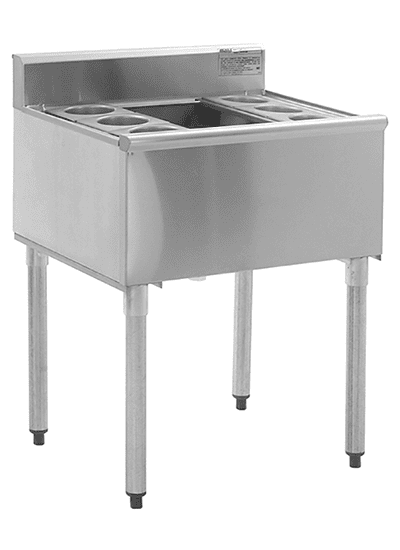
The two modular series look nearly identical on a plan — same bullnose front edge, same 22 gauge type 304 stainless front, same galvanized bottom, back and end panels, same brushed stainless finish, same six- or eight-bottle capacity and 1½″ drain. The difference is depth and duty.
The 1800 Series is the economy, shallower-depth line. It is the right call when the bar structure is narrow, when the program is beer-and-wine forward, or when a secondary station simply does not see the same volume as the main well.
The 2200 Series runs a full 24″ front-to-back and uses insulated fabricated ice bins. That extra depth buys real work surface in front of the ice, and the insulation buys hold-over time — which is the difference between one ice run per shift and three. For a high-volume cocktail program, a hotel lobby bar or anything running seven nights, specify 2200.
Spec-Bar is the broader branded family: cocktail stations with overshelf and double speed rails, ice chests, blender stations with a T&S faucet, glass rinsers, dump sinks, four-compartment sinks and portable bars. Spec-Bar units mix into an 1800 or 2200 run when a module needs a heavier build or a feature the modular series does not carry.
| Attribute | 1800 Series | 2200 Series |
|---|---|---|
| Front-to-back depth | Shallower — economy / light-duty depth | 24″ front-to-back |
| Ice bin | Fabricated ice bin | Insulated fabricated ice bin |
| Ice capacity by bin depth | 63 lb (8″), 94 lb (12″), 125 lb (16″) | 63 lb (8″), 94 lb (12″), 125 lb (16″) |
| Front edge & finish | Bullnose front edge, 22 ga type 304 stainless front, brushed finish | Bullnose front edge, 22 ga type 304 stainless front, brushed finish |
| Panels | Galvanized bottom, back and end panels | Galvanized bottom, back and end panels |
| Bottle capacity | Six- or eight-bottle | Six- or eight-bottle |
| Blender module ice capacity | 75 lb | 63 lb |
| Best for | Narrow bar structures, moderate volume, secondary stations | High-volume main wells, cocktail-forward programs, longer ice hold-over |
Cocktail Units, Cocktail Stations and Ice Chests
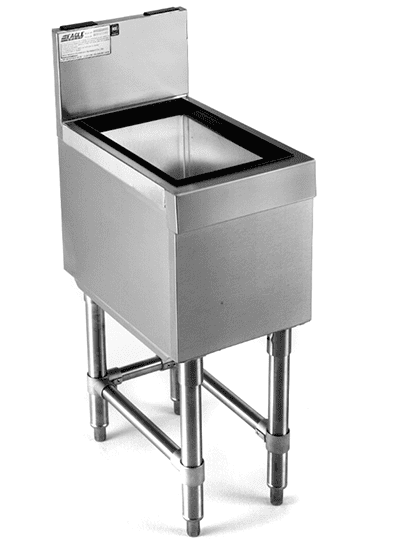
A cocktail unit is the modular building block: an ice bin with bottle wells and a speed rail, dropped into an 1800 or 2200 run. A cocktail station is the fully-featured Spec-Bar version — an overshelf with removable perforated inserts, a tubing chase for soda and beer lines, a work surface, a blender shelf, double speed rail steps, bowls and ice bins in 20 gauge stainless, with 14 gauge stainless blender shelf ends and double speed rails, laminated wood front and end panels, and a T&S faucet on 4″ centers accepting 3/8″ sink leads. Hot and cold water connections are required. The rotation of the station depends on which side the ice bin lands on, so left-hand and right-hand versions are real ordering decisions, not options you can flip in the field.
A standalone Spec-Bar ice chest is the answer where you need cold in a spot that does not need a full cocktail station — a beer station, a wine service point, the far end of a long bar. Body, legs and crossbracing are type 304 stainless. The interior ice bin runs 10½″ deep in standard models and 14½″ deep in extra-deep models, insulated with foamed-in-place insulation, with a non-metallic breaker strip that prevents heat transfer into the bin. A two-piece type 304 stainless sliding cover is included and lifts out for cleaning.
Three details decide whether an ice bin performs: insulation (foamed-in-place versus an uninsulated fabricated bin), the breaker strip that stops the cold from bleeding into the surrounding stainless, and the drain. Every bin drains, and where that 1½″ line goes — indirect waste to a floor sink, ideally — needs to be on the plumbing drawing before the slab is poured.
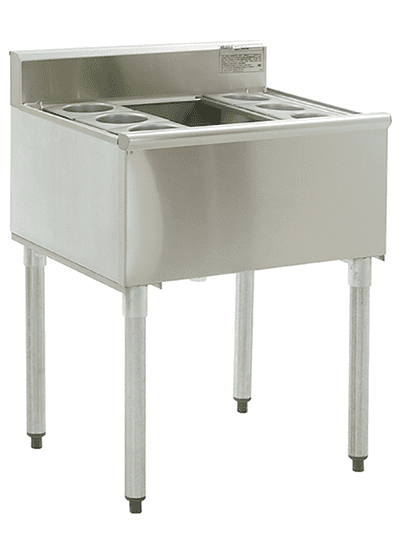
Underneath the feature list, the modular cocktail unit is the part most bars actually buy in quantity. The 1800 and 2200 versions both give you a bullnose front edge, a 22 gauge type 304 stainless front, six- or eight-bottle capacity and a 1½″ drain, with fabricated ice bins in 8″ (63 lb), 12″ (94 lb) or 16″ (125 lb) depths. Bottom, back and end panels are galvanized because they are normally buried inside the run — call out finished stainless or laminated panels for any end that will be seen.
Bottle wells and speed rails are what turn a cold box into a station. Well liquor belongs in the rail inside the bartender’s pivot, garnish and mixers within one step, and call brands on the back bar where a reach is acceptable because the pour is less frequent. Double speed rails on a Spec-Bar cocktail station buy you a second tier of bottles without adding a foot of bar length — usually the cheapest capacity you can add to an existing footprint.
Blender Modules and Blender Stations

A blender sitting on the bar top is a noise complaint and a spill waiting to happen. A blender module drops the base into a recess so the pitcher clears the overshelf, the motor noise stays below the bar line, and the frozen-drink mess has somewhere to go.
Both series are type 304 stainless bodies with a 12″-wide blender recess that can be located on either side — 14″ wide on the 50″ and 62″ models. Each includes a 15-amp, 120-volt receptacle mounted for field wiring (NEMA 5-15R on the 2200), a liquid waste chute with a 1½″ drain, strainer, faucet and tail piece, a fabricated ice bin, and high-impact corrosion-resistant fully adjustable bullet feet. 1800 Series modules carry 75 lb of ice; 2200 Series modules carry 63 lb and add the bullnose front edge. On 1800 modules, ice-bin models are available with or without a sealed-in 7-circuit post-mix cold plate.
The Spec-Bar blender station with T&S faucet is the standalone version, designed to align with the single speed rail on adjoining equipment so the top line stays flat across the run. Body, legs and adjustable crossbracing are type 304 stainless. Every unit includes a 9¼″ x 11½″ x 6″ sink bowl with a hot and cold T&S gooseneck faucet on 4″ centers with ½″ NPT inlets, plus a lift-out stainless perforated sink strainer. Hot and cold water connections are required — a detail that gets missed when a blender station is added late to a bar that was roughed in for cold water only.
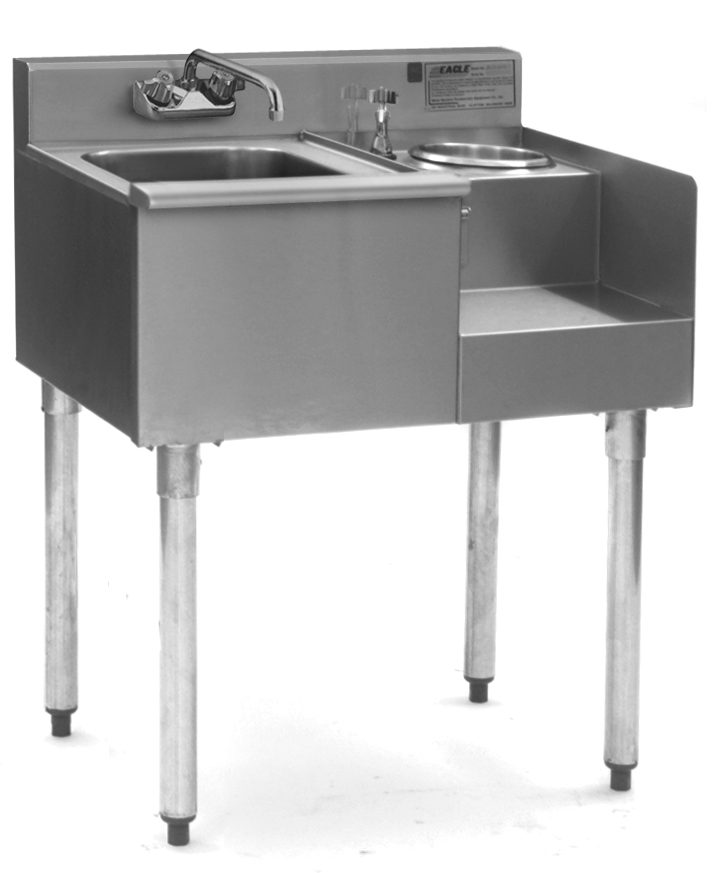 1800 Series Blender Modules75 lb ice capacity, 12″ blender recess either side (14″ on 50″ and 62″ models), liquid waste chute with 1½″ drain, optional sealed-in 7-circuit post-mix cold plate.
 2200 Series Blender Modules63 lb ice capacity, NEMA 5-15R receptacle for field wiring, bullnose front edge, strainer, faucet and tail piece, adjustable bullet feet.
Glass Rack Storage, Glass Rinsers and Bottle Fillers
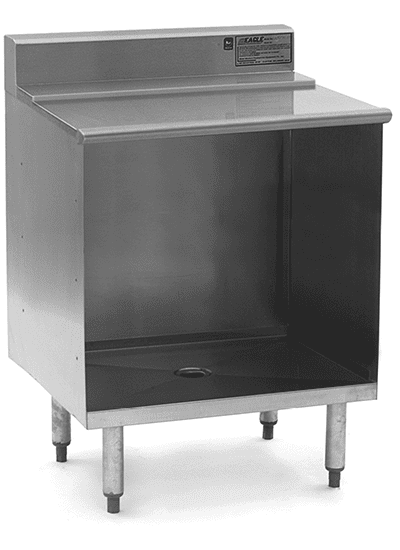
Glass rack storage units are where clean glassware lands. Both the 1800 and 2200 versions are stainless all-welded construction in 12″, 18″ or 24″ side-to-side widths, and the 24″-long units are designed to accept a nominal 20″ x 20″ full-size glass rack — so a rack comes out of the dish machine and slides straight into the well without anyone touching a glass. Tops are ordered three ways: flatboard, recessed workboard with a removable stainless perforated insert and 1½″ stainless drain, or open top. The 2200 units use heavy-duty galvanized legs.
Match the top to the job. A recessed workboard belongs where wet glassware and shakers land, because the perforated insert lets drips reach the drain instead of pooling. A flatboard top belongs where the module doubles as a garnish or ticket surface. An open top belongs where racks stack two or three high and speed matters more than surface.
Glass rinsers are a small line item with outsized effect on drink quality. Eagle’s bar top and underbar rinsers are 300 series stainless with a 4½″-diameter actuation disk, a ½″ FNPT stainless drain fitting welded to the pan and a removable stainless trough cover. Turn a glass upside down, press it on the disk, and jets rinse it in seconds — from a narrow champagne flute to a wide wine bowl. The drop-in glass rinser trough is the flush-mount version: it sits level with the countertop, comes in four sizes, and uses the same removable cover for cleaning.
Bottle filler stations handle water service without a case of single-use plastic. All 300 series stainless, one or two touch-free electronic-eye T&S faucets with battery backup, an anti-splash grate standard, a fully enclosed skirt with an access panel, and a space-saving 12″ front-to-back footprint that fits where nothing else will.
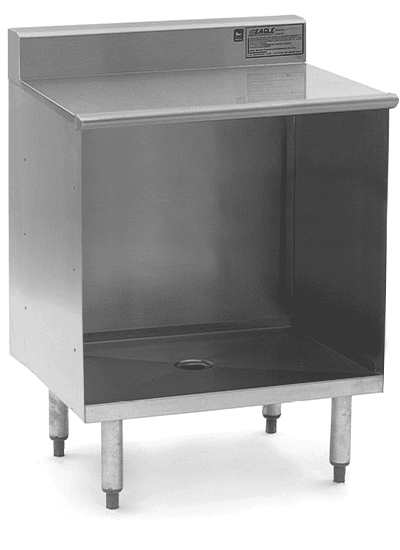 1800 Glass Rack StorageAll-welded stainless, 12″/18″/24″ widths, flatboard, recessed workboard or open top; 24″ units take a full-size glass rack.
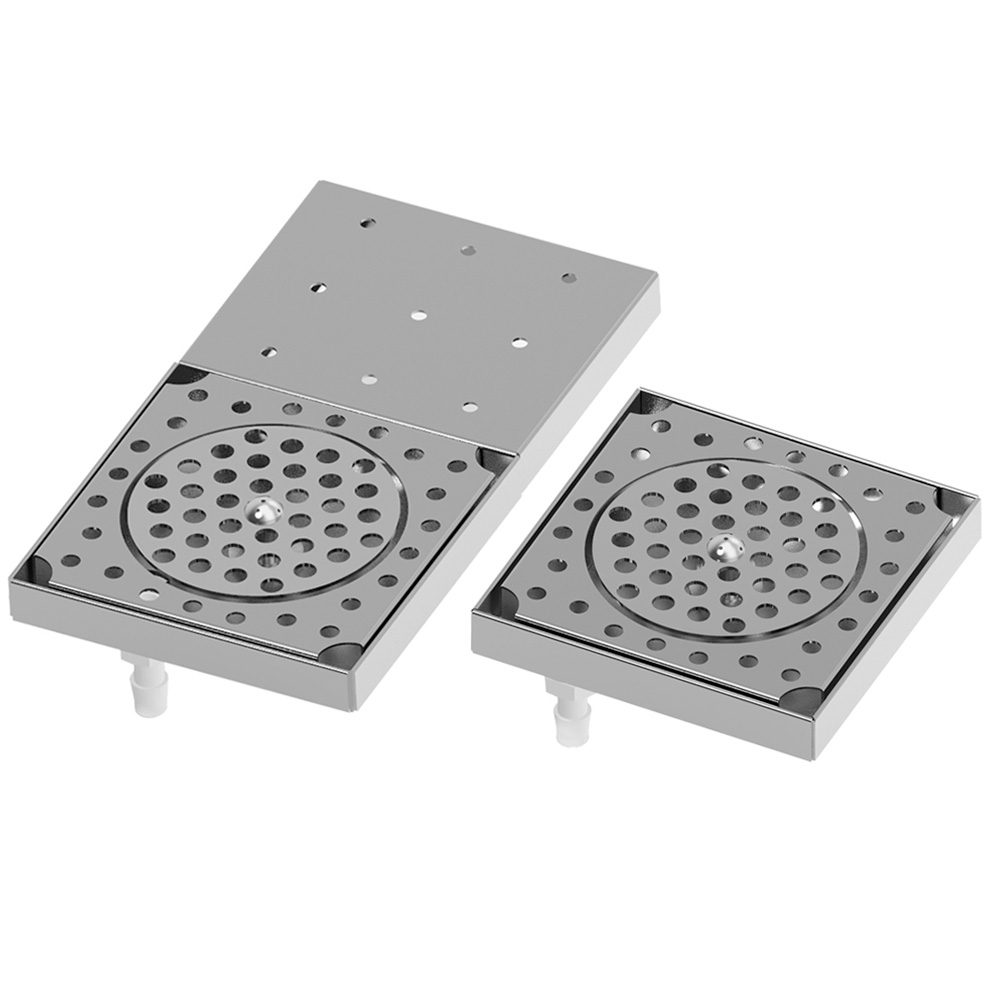 Bar Top & Underbar Glass Rinsers300 series stainless, 4½″ actuation disk, ½″ FNPT welded drain fitting, removable trough cover.
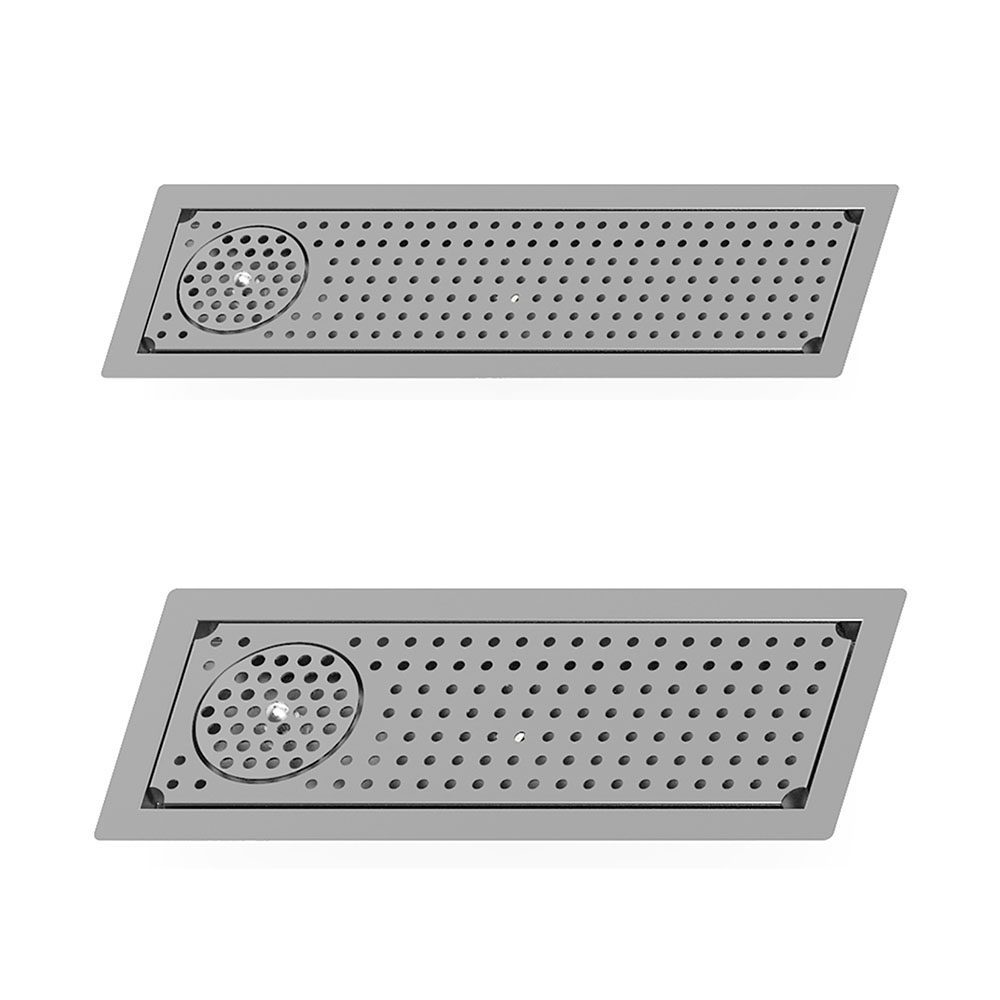 Drop-In Glass Rinser TroughsFlush-with-the-countertop drop-in design in four sizes, removable stainless trough cover, powerful jets that rinse in seconds.
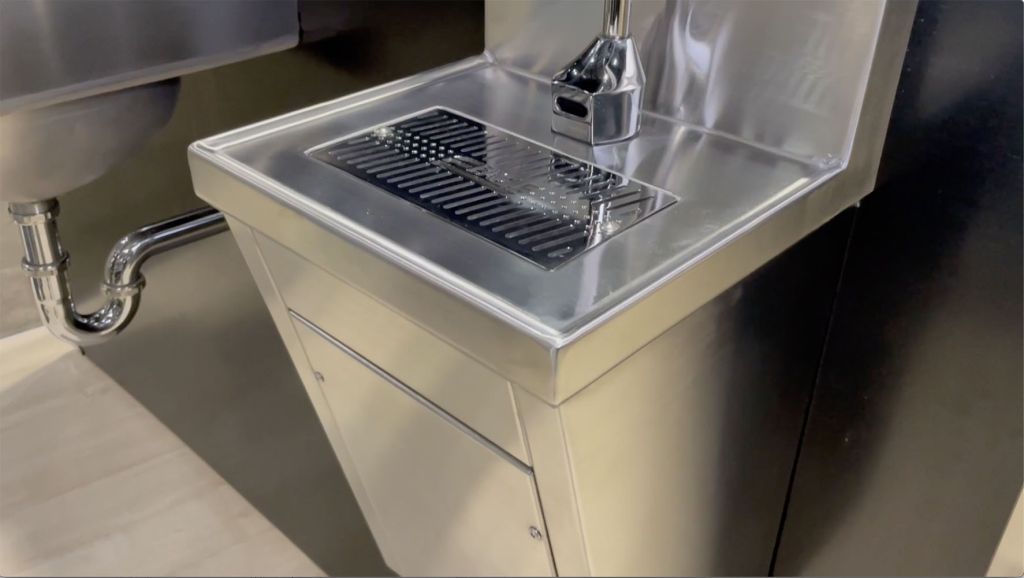 Bottle Filler StationOne or two touch-free electronic-eye faucets with battery backup, anti-splash grate, enclosed skirt with access panel, 12″ front-to-back.
Underbar Sinks, Hand Sinks and Dump Sinks
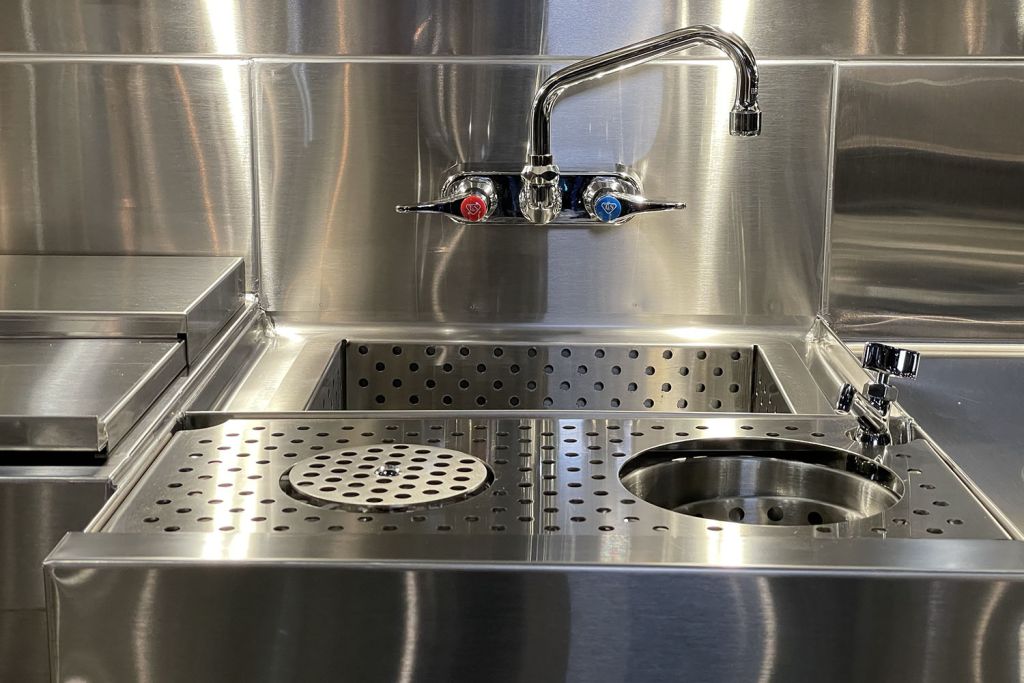
Bars need more sinks than people expect, and they need them in specific places. A wash sink for glassware, a dedicated hand sink the inspector can see, and a dump sink where waste liquid goes are three different fixtures — combining them is how a bar fails a plan review.
1800 and 2200 underbar sinks are modular and configure with the rest of the run. Bowls are 10″ x 14″ x 10″, one-piece and deep-drawn, with a 1½″ drain and removable standpipe, and a splash-mount 4″ center faucet with a 10″ spout. Lengths run from 3 to 8 feet in two-, three- or four-compartment configurations; the 2200 version is 24″ front-to-back. Spec-Bar four-compartment sinks are the heavier standalone build: type 304 stainless body, legs and crossbracing, 20 gauge backsplash, sides, bottom, front panel, drain pans, perforated inserts and bowls, 16 gauge leg channels and crossbracing, 1⁵/₈″ diameter stainless legs with bullet feet, 10″ x 14″ x 9½″ compartments and a T&S hot and cold faucet.
The Spec-Bar dump sink is the multipurpose unit worth adding to almost every bar: 300 series stainless throughout, a bowl with a 1½″ stainless IPS drain, a T&S faucet mounted to a 9″-tall backsplash, stainless legs and crossbracing, and a built-in glass rinser in the 12″-wide model. One module handles waste liquid and glass rinsing in the width most bars can actually spare.
For bar hand sinks, wall-mount hand sinks, sinks with eyewash and the rest of the sink catalog, see our commercial sinks and hand sinks page — those are the models most jurisdictions want within reach of the bartender’s station.
| Sink type | Bowl / build | Where it goes |
|---|---|---|
| 1800 underbar sink | 10″ x 14″ x 10″ one-piece deep-drawn bowls, 1½″ drain with removable standpipe, splash mount 4″ center faucet with 10″ spout, 3′–8′ lengths | Shallower runs, moderate-volume wells |
| 2200 underbar sink | Same bowl and faucet package at 24″ front-to-back, two-, three- or four-compartment | Main wells where drainboard space matters |
| Spec-Bar four-compartment sink | 10″ x 14″ x 9½″ compartments, 20 ga bowls and panels, 16 ga leg channels, 1⁵/₈″ stainless legs with bullet feet, T&S faucet | Standalone glass-washing station in a service bar |
| Spec-Bar dump sink | 300 series stainless, 1½″ IPS drain, T&S faucet on a 9″ backsplash, optional built-in glass rinser | Directly in the bartender’s pivot, next to the ice |
| Underbar hand sink | Dedicated hand-wash fixture — never the glass sink | At the end of the run, visible and unobstructed |
Die-Wall, Back-to-Back and Keeping the Floor Cleanable

Die-wall installation is the standard front-bar arrangement: the underbar run sits against the bar’s structural die wall with the guest-facing side finished by the millwork, so the modules only need finished ends where they are exposed. Back-to-back installation pairs two runs sharing a common centerline — typically a front bar and a service bar for the dining room — which doubles the station count in the same footprint but demands that the tubing chase and drain routing be worked out before anything is set.
Panel finishing is where budgets get surprised. Modular series units use galvanized bottom, back and end panels because those faces are usually buried in the run; every exposed end needs a stainless or laminated finished panel called out on the order. Cover plates and filler strips close the joints between modules and around structural columns, and they are what turns a bolted-together assembly into something that reads as one counter.
Then the floor. Bar floors get mopped nightly and flooded occasionally, so the underbar has to be liftable and cleanable underneath. Adjustable bullet feet — high-impact, corrosion-resistant and on the blender modules by default — hold the unit off the deck, let you level a module across an out-of-flat slab, and leave enough clearance for a mop head. The alternative is a fully enclosed base, which looks tidy but seals a space you cannot inspect. Where the bar sees real water volume, put a stainless floor drain under the wet modules; 14 gauge type 304 with polished coved corners, a perforated drain that inverts to double as a bee hive strainer, up to a 4″ waste pipe, with subway-style stainless or yellow fiberglass grating.
- Coved interior corners on bowls and drain pans, so there is no square corner to trap product
- Welded seams rather than lapped and fastened joints anywhere liquid can sit
- One-piece deep-drawn bowls with removable standpipes for fast, complete draining
- Removable perforated inserts in workboards and overshelves that lift out for the dish machine
- No exposed fasteners in the splash zone — fastener heads are a cleaning problem, not a hardware preference
- Adjustable bullet feet that lift the run off the floor and level it on an imperfect slab
Certification is confirmed per model, in writing
Sanitation and electrical listings are issued model by model, not line by line, and they change over time. We do not publish blanket certification claims. Send us the model list and we will confirm the current listing status of each item in writing before the order goes in.
Service Bar, Front Bar, Portable Bar — and How to Plan One
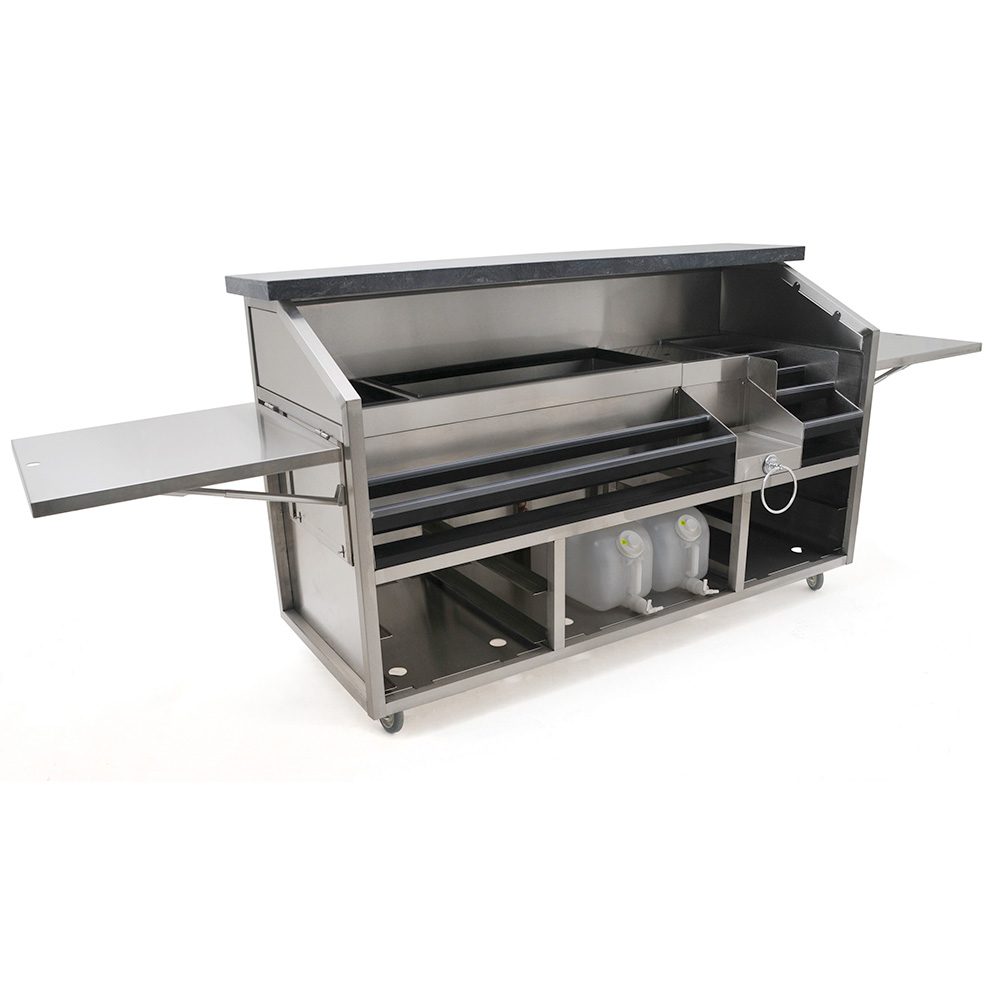
A front bar serves guests seated at the rail. It needs guest-facing finish, wider glass storage because guests order in bursts, and enough drainboard that wet glassware never lands on the bar top in front of someone. A service bar serves servers ringing in dining-room tickets. Nobody sees it, so spend the money on throughput instead of finish: deeper ice, more speed rail, a dump sink in the pivot. A banquet or portable bar shows up where there is no plumbing at all.
Eagle’s indoor portable bars ship fully assembled on 4″ x 1″ plate casters, two with brakes, in black, white or vintage melamine with a matching formica top and a stainless interior working surface, a 15⁵/₈″ x 19¾″ x 8″ ice bin with a 1½″ drain, corner guards, 63″ length, and an optional 7-circuit sealed-in post-mix cold plate. The Spec-BAR Deluxe Portable Bar is the heavier build: welded 1½″ type 300 stainless square tubular base, a 12″ blender station with workboard and blender shelf, an ice bin with a six-compartment bottle rack, a five-shelf 12″-wide liquor display and a double speed rail. Custom branding, decals, laser-cut logos, custom laminate front panels and signage are available for either.
Whichever bar type you are building, the planning numbers are the same five. Get them on paper before anyone picks model numbers.
| Planning input | What to measure | What it decides |
|---|---|---|
| Linear feet of bar | Finished inside dimension of the underbar cavity, wall to wall, minus finished end panels | How many modules fit and where the filler plates land |
| Drinks per hour at peak | Peak-hour ticket count, not the daily average | Number of stations and how deep the ice bins need to be |
| Ice consumption | Roughly a pound-plus per drink once shaking, chilling and soda are counted | 8″ (63 lb), 12″ (94 lb) or 16″ (125 lb) bin depth, and whether you need a second bin |
| Drain location and type | Distance to the nearest floor sink, and whether it is indirect waste | Where wet modules can sit and whether a floor drain is required |
| Remote vs local ice | Whether ice is machine-made at the bar or carried from the kitchen | Bin insulation, hold-over time, and whether a cold plate makes sense |
| Soda and beer line routing | Where the syrup rack and keg cooler live | Tubing chase requirements and cold plate circuits |
Send us your bar drawing
Email the bar plan, an elevation, or just the inside dimension and your drink program. We come back with a module-by-module layout, model numbers, spec sheets, lead times and freight — and we flag the reach and drain conflicts while we are still on paper. Eagle’s Spec-BAR Select service can produce a plan view and elevation drawing for your installer, and SpecFAB fabricates the modules the catalog does not cover. Call (800) 326-4403 if it is faster to talk it through.
Get a free quote
Tell us what you are storing, the room size and your timeline. A project specialist will follow up with layout options and pricing. Prefer to talk? Call (800) 326-4403.
Frequently Asked Questions
What is underbar equipment?
What is the difference between the 1800 Series and the 2200 Series?
How much ice does a bar station need?
What is a cold plate and do I need one?
Do you carry glass rinsers for the bar top and for the underbar?
Can the bar be installed back to back or against a die wall?
Is Eagle underbar equipment sanitation listed?
Can you lay out a whole bar for me?
More Underbar Modules We Quote
 1800 Underbar SinksTwo-, three- and four-compartment modular sinks from 3′ to 8′ with one-piece deep-drawn 10″ x 14″ x 10″ bowls.
 2200 Underbar SinksThe 24″ front-to-back version, with the same bowls, standpipes and splash mount faucet package.
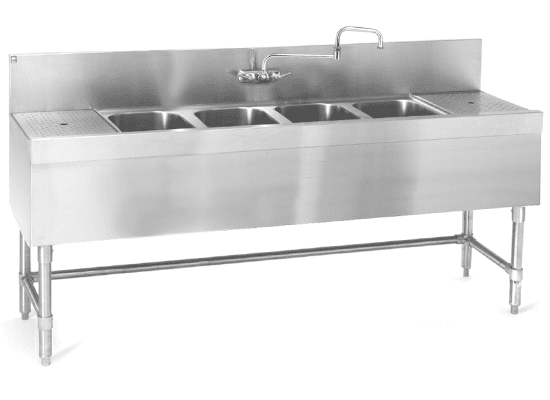 Spec-Bar Four-Compartment SinksHeavier standalone glass-washing sink with 16 gauge leg channels, 1⁵/₈″ stainless legs and a T&S faucet.
 Indoor Portable Bars63″ fully assembled bars on braked casters, melamine exterior, stainless interior surface and an optional post-mix cold plate.
Get Your Underbar Equipment Quote
Send the bar dimension, the drink program and where the plumbing lands. We will lay out the modules, catch the reach and drain conflicts, and get the package to your site.