
Relocatable Jobsite Security Cage: Saunders Construction Case Study
How a commercial general contractor controls tools, materials and owner-furnished equipment on active construction projects — with an enclosure that can be taken apart and moved to the next job.

2021
Year Material Handling USA supplied security cage and wire mesh partition product
1972
Year Saunders Construction was founded
Colorado
Employee-owned commercial contractor serving the Rocky Mountain region
Relocatable
Bolted panel systems come apart and follow the next project
The project
Saunders Construction is an employee-owned commercial contractor founded in 1972, providing construction management, general contracting and design-build services across the Rocky Mountain region. Material Handling USA supplied welded wire security cage and partition product to the company in 2021.
This page sits under our security cage hub and describes the general storage-control problem a general contractor faces on an active project, and how we approach it. It contains no site layout, no dimensions, no equipment schedules and no security specifics for this customer.
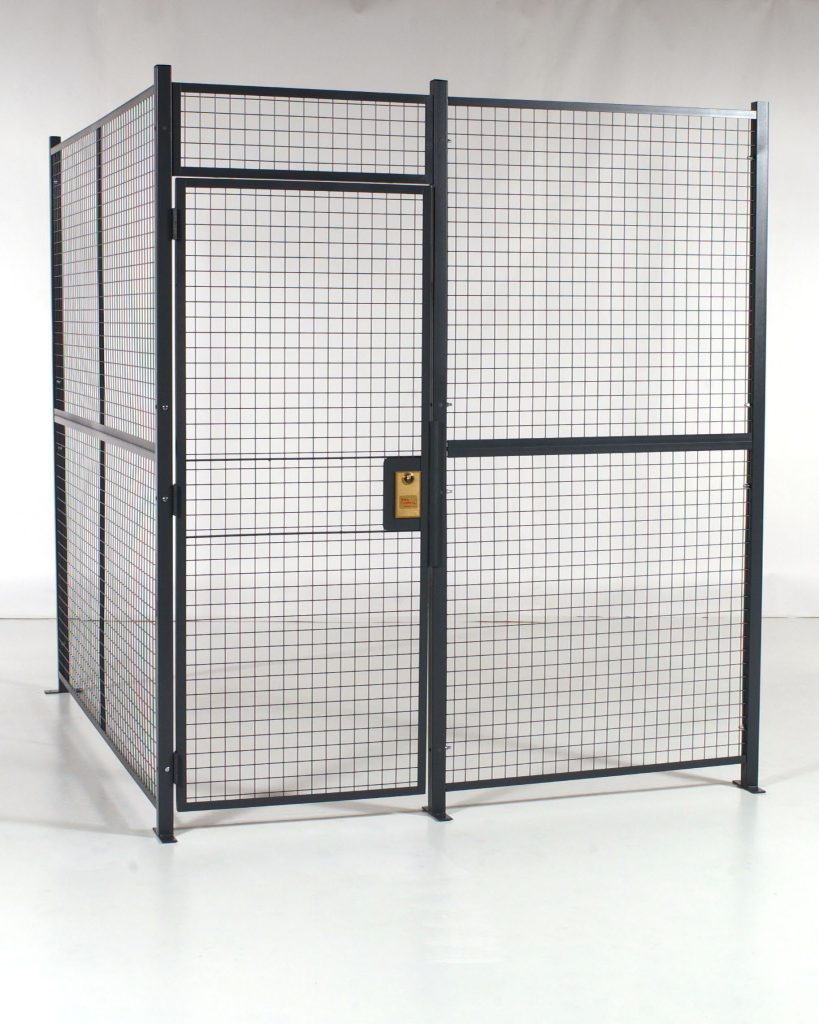
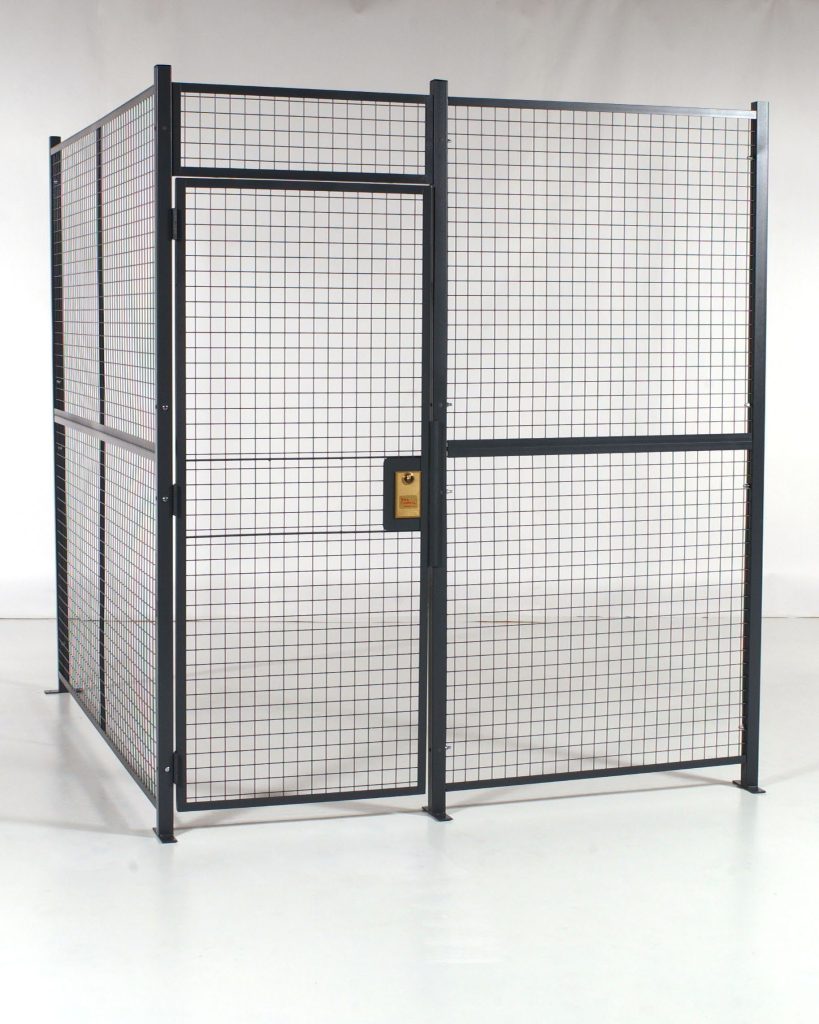
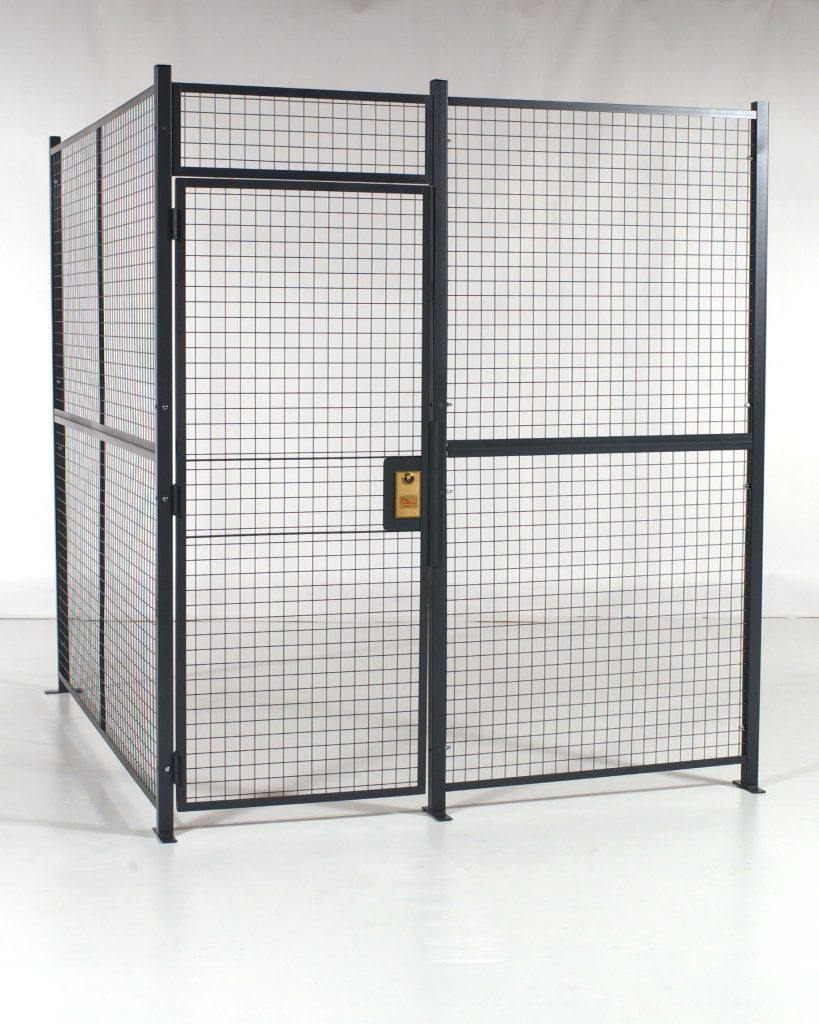
A construction project is the hardest storage environment there is. The building changes weekly, the people on site change daily, dozens of subcontractors need legitimate access, and the “warehouse” is whichever slab happens to be poured and dry. Anything designed for a permanent facility is the wrong tool; what works is a barrier that can be set fast, moved as the work fronts move, and taken to the next job.
Why material walks off a jobsite
Everyone has a reason to be there. On a busy commercial project, dozens of trades, delivery drivers, inspectors and vendors move through the same space. Access control by observation stops working once nobody recognizes everybody.
The valuable material is the portable material. Cordless tools, copper, wire, fittings, fasteners, specialty hardware, controls and finish materials — all small, all generic, all easy to carry out with a legitimate load.
Deliveries land before the space is ready. Long-lead material shows up because the supply chain says so, not because the project is ready for it, and then sits in a corridor for weeks.
The building has no doors yet. For much of the schedule there is no lockable envelope. The only security that exists is the security the contractor brings.
The real cost is schedule, not replacement. Losing a box of fittings is cheap. Losing a day because a crew cannot start is not, and equipment theft losses across the construction industry are estimated in the hundreds of millions of dollars annually by insurance and law-enforcement data compilations, according to the National Insurance Crime Bureau.
Choosing the right barrier for a temporary condition
Contractors have several options, and the mistake is usually reaching for the same one every time. Each solves a different part of the problem:
Most projects end up with a combination: a fenced yard, a container outside, and a bolted mesh enclosure inside the structure once the slab is available. The contractor’s own shop and warehouse is a separate problem — our electrical contractor security cage case study covers that side.
Where the cage goes, and when it moves
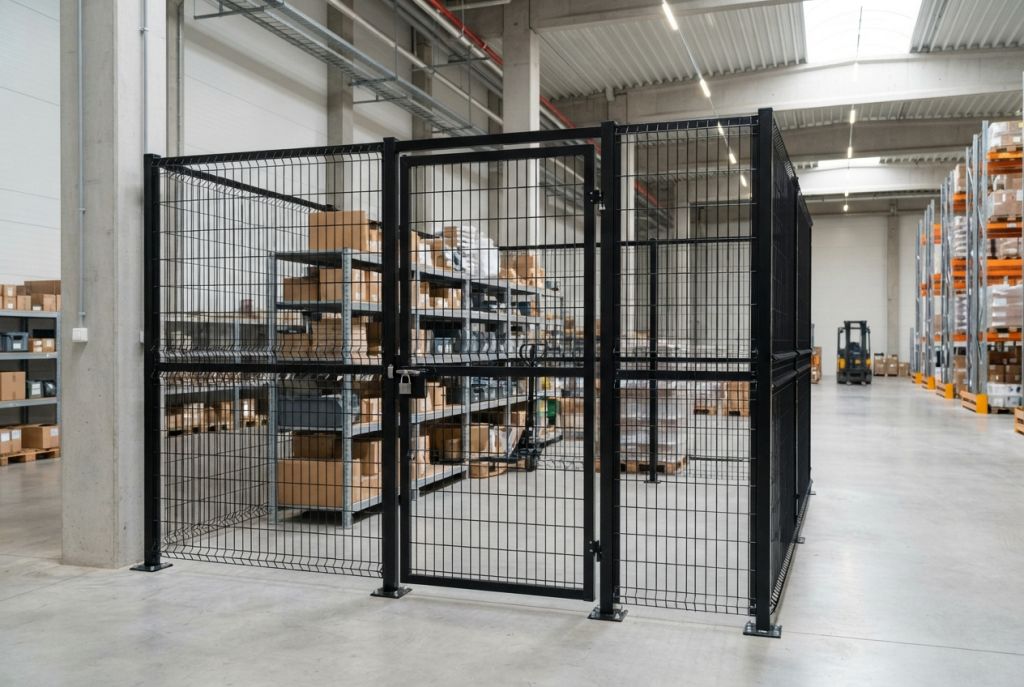
Placement on a jobsite is a scheduling decision as much as a security decision. The enclosure has to be near the work without being in the way of the next trade.
- On a slab that is not scheduled for finishes soon. A loading bay, a future mechanical room or a corner of a parking level typically stays rough long enough to be useful.
- Where material can actually be delivered. If a pallet cannot reach it, the enclosure will be bypassed within a week.
- Out of the crane and lift path. Anything in the swing or travel path will eventually be struck; freestanding panels are not impact protection.
- Away from egress and fire routes. Temporary construction conditions still require usable exit paths, and the general storage and stacking requirements in 29 CFR 1926.250 apply to how material inside is stacked.
- Planned to move at least once. Assume the enclosure gets relocated when the work front moves. Bolted systems are designed for it; welded-in-place ones are not.
- Sited for light and sightlines. An enclosure a superintendent can see from the trailer window or a walking route is worth more than a stronger one hidden behind stacked material.
Specifying an enclosure that will be taken apart
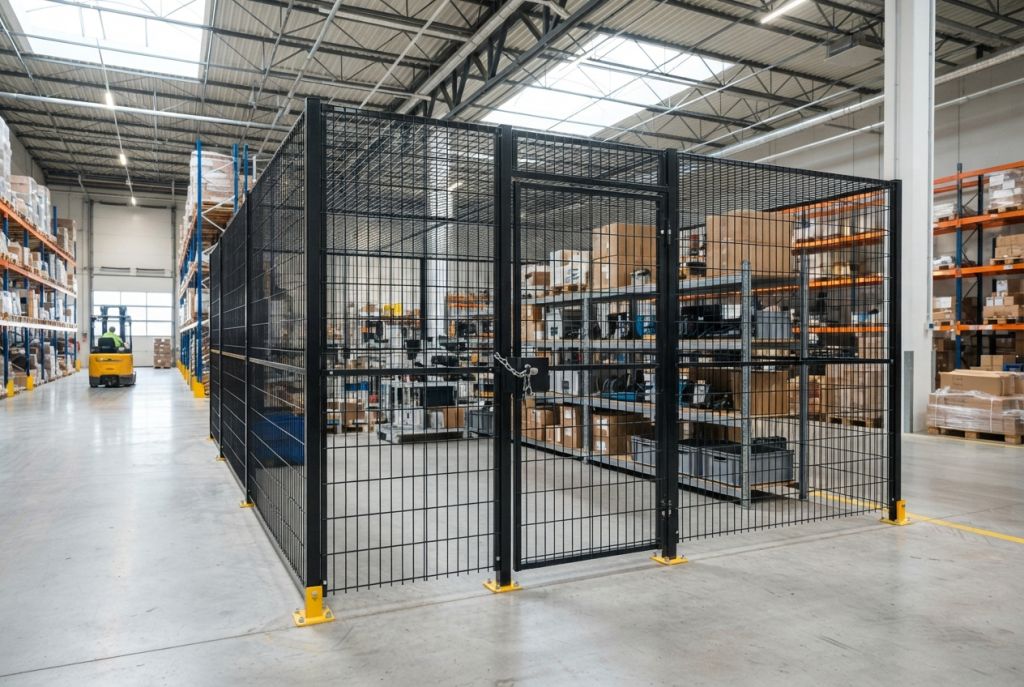
A jobsite enclosure is specified around handling and reuse. Panels are carried up stairs, set on imperfect slabs, dismantled by whoever is available, and stored on a truck between projects.
Material choice matters if the enclosure will live outdoors between phases — see steel vs aluminum security cages and outdoor cages and equipment protection. Layout is drawn from a survey; our sizing guide lists what to record.
Owner-furnished equipment and the handover problem
The highest-consequence storage on many commercial projects is not the contractor’s own material. It is owner-furnished equipment: appliances, AV and IT hardware, medical or lab equipment, furniture, fixtures and specialty finishes delivered under someone else’s purchase order.
- Custody is contractual. Once owner-furnished material is accepted on site, someone is responsible for it. A defined controlled area makes that responsibility physical instead of theoretical.
- It arrives at the worst time. Deliveries land during finishes, when the site has the most trades, the most access and the least free space.
- It is rarely replaceable on schedule. Long-lead equipment cannot be re-ordered without moving the completion date.
- It needs an access list, not just a lock. A small number of named people should be able to open it, and the record of who opened it should be simple enough that people actually keep it.
- Punch-list and attic stock too. Spare tile, paint, filters and keys owed to the owner at closeout have a habit of disappearing in the last two weeks of a project.
Install, move, reuse
The value of a jobsite enclosure is measured over several projects, not one.
Decide the phase it serves
Structure phase, rough-in phase or finishes phase. Each has a different storage problem, a different available floor and a different set of people on site.
Survey the actual slab
Floor condition, anchoring restrictions, clear height, delivery route, crane and hoist paths, and where temporary power and lighting run.
Set it up and put material behind it
A bolted enclosure goes up quickly; the discipline that matters is moving loose material behind it immediately rather than waiting for the next delivery. See cage installation.
Run one access list and one issue point
Named holders, one opening, and a simple record. Two doors and three key holders produce no record at all.
Dismantle, inspect, palletize
Panels, posts and hardware get checked for damage and bent frames before storage — the same checks in our maintenance and inspection guide — then stacked for the next project.
Material Handling USA supplies and installs enclosures for contractors across the Mountain West and nationwide, including security cages in Denver, or start from the security cages hub. General storage and passageway requirements for the receiving side of the operation are in 29 CFR 1910.176.
Shop Pre-Configured Wire Mesh Cage Kits Online
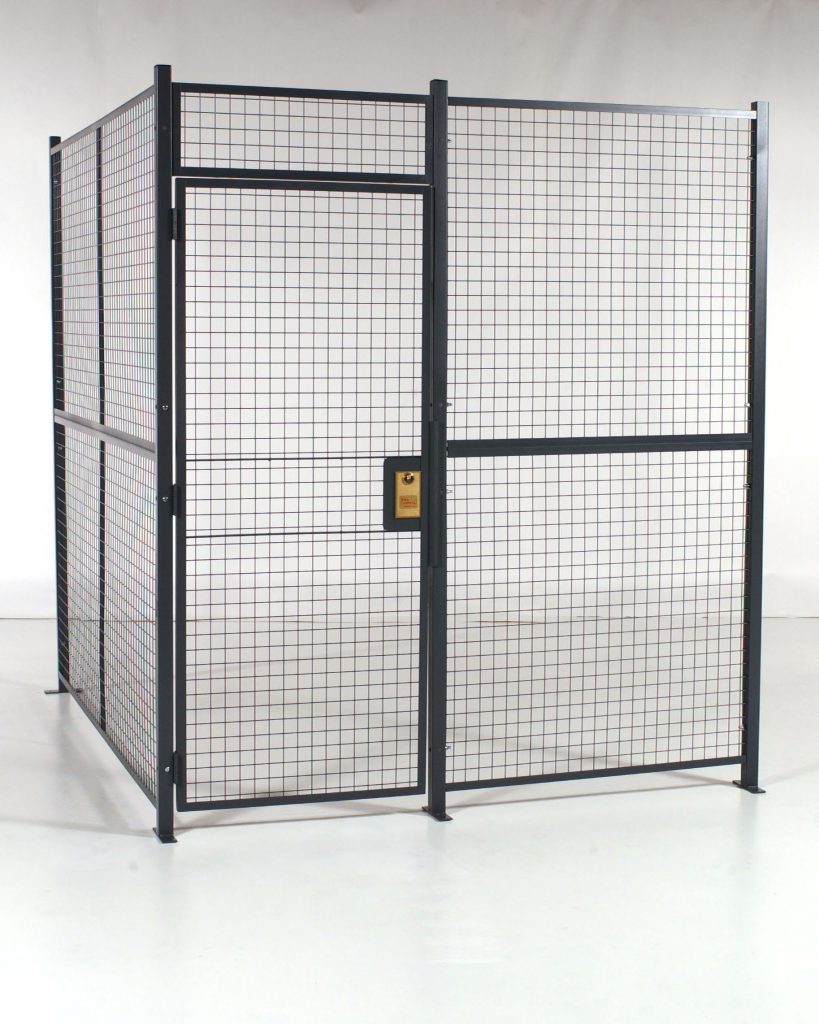
Standard-size welded wire cage kits, priced online, for smaller storage needs. Every kit still needs to be anchored to sound concrete — for tall, braced or engineered enclosures, request a quote with your building location and floor details.
Frequently asked questions
Can a security cage be moved from one jobsite to another?
Is a wire mesh cage better than a shipping container on a jobsite?
What should be stored in a jobsite cage first?
Does the enclosure need to be anchored to the slab?
How do you handle access when a dozen subcontractors need material?
Can a cage be installed before the building is enclosed?
What about owner-furnished equipment delivered early?
Does a jobsite enclosure need a mesh roof?
How long does it take to install?
Looking for a project like yours? Browse more contractor and fleet security cage case studies, see all security cage case studies.
Protect the material that drives your schedule
Material Handling USA designs, supplies and installs relocatable welded wire security cages, jobsite tool cribs and contractor storage enclosures nationwide.