
Electrical Contractor Security Cage: Lynco Electric
How an electrical contractor secures wire, copper, cordless tools and staged project material in a shop and warehouse — and how to design caged storage that speeds up crew load-out instead of slowing it down.
2022
Year Material Handling USA supplied security cage and wire partition product to Lynco Electric
50+ years
Length of time the contractor has served southern New Mexico and west Texas
Shop + warehouse
One facility that has to serve every crew, every morning
Modular panels
Bolted enclosures added inside an existing building without construction
The project
Lynco Electric Co. Inc. is an electrical contractor serving southern New Mexico and west Texas, working for owners, architects, engineers and general contractors for more than 50 years. The company’s office, shop and warehouse have operated from the same location for decades, with forklift-ready unloading, weather-tight storage and a large equipment and tooling inventory kept on hand so crews can deploy quickly.
Material Handling USA supplied welded wire security cage and partition product to Lynco Electric in 2022. Contractor facilities are a distinct application: unlike a distribution warehouse, almost everything in the building is going to leave in a truck, most of it early in the morning, carried by people who are in a hurry. Storage that is secure but slow gets propped open by the second week.
This page sits under our security cage hub and describes the general design problem an electrical contractor faces and how MH-USA approaches it. It includes no facility layout, no dimensions, no inventory detail and no security specifics for this customer.
What actually disappears from a contractor shop
Electrical contractors carry a uniquely attractive inventory. Copper wire and cable have a standing resale market that does not care whose reel it came from. Cordless tools, batteries and chargers are valuable, portable and interchangeable. Test equipment — meters, testers, thermal cameras — is expensive and easy to carry. Fittings, breakers, gear components and specialty devices for a specific job are hard to replace on short notice at any price.
Loss almost never looks like a break-in. It looks like drift: material issued to a job and never reconciled, a tool that went home in a personal truck, a reel that got cut into and never recorded, spares returned to the shop and put down somewhere that is not where they belong. By the time anyone notices, no one can say when it happened.
The real cost is again the schedule. When a crew arrives at a job and the gear is not there, the loss is a crew-day, not the price of the part. That is the number that justifies an enclosure, and it is why the design goal is a fast, disciplined issue process rather than the strongest possible barrier.
What contractors put behind mesh
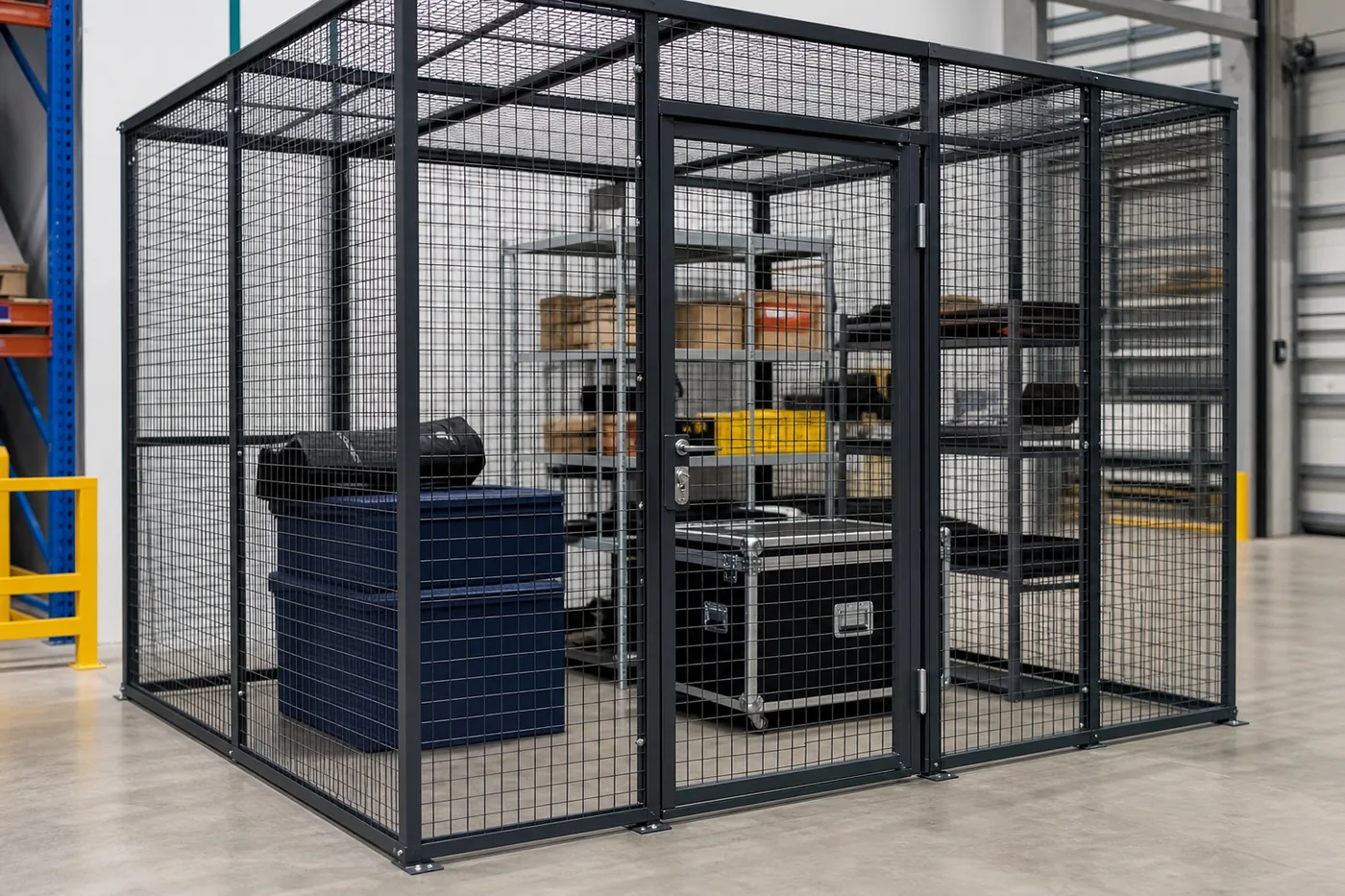
As with plants and warehouses, several small enclosures beat one large one — different material, different access lists, different traffic:
Interior fit-out — shelving, reel storage, bins and a workbench — is the same kit used for any tool crib, sized for contractor material.
Design for the 6 a.m. load-out
The single design test for a contractor enclosure is what happens at the start of the day, when several crews load out at once. If the caged area cannot serve that rush, it will be defeated — propped open, key copied, latch taped — and the investment is gone.
- Issue window, not open access. A service window or dutch door lets one person hand out tools and material while the enclosure stays closed. It is the difference between a crib that is used and a crib that is unlocked at 6 a.m. and relocked at 5 p.m.
- Put it on the path people already walk. Between the parking area and the truck bays, not in the far corner. Storage that adds a detour gets bypassed.
- Stage the night before. A separate small caged area for kitted, job-assigned material lets crews pick up and go without anyone entering the main stores.
- Short key lists. Two or three enclosures with three keyholders each control far more than one enclosure with fifteen. Lock options range from padlock hasps to keyed cylinders to access-control-ready hardware.
- Keep the aisle legal. Load-out congestion is exactly when clear aisles matter; OSHA’s storage and passageway requirements at 29 CFR 1910.176 apply in a contractor warehouse the same as anywhere else.
Wire, reels and heavy material
Cable is the awkward part of a contractor enclosure, because it is heavy, round, and handled by machine. A few practical rules:
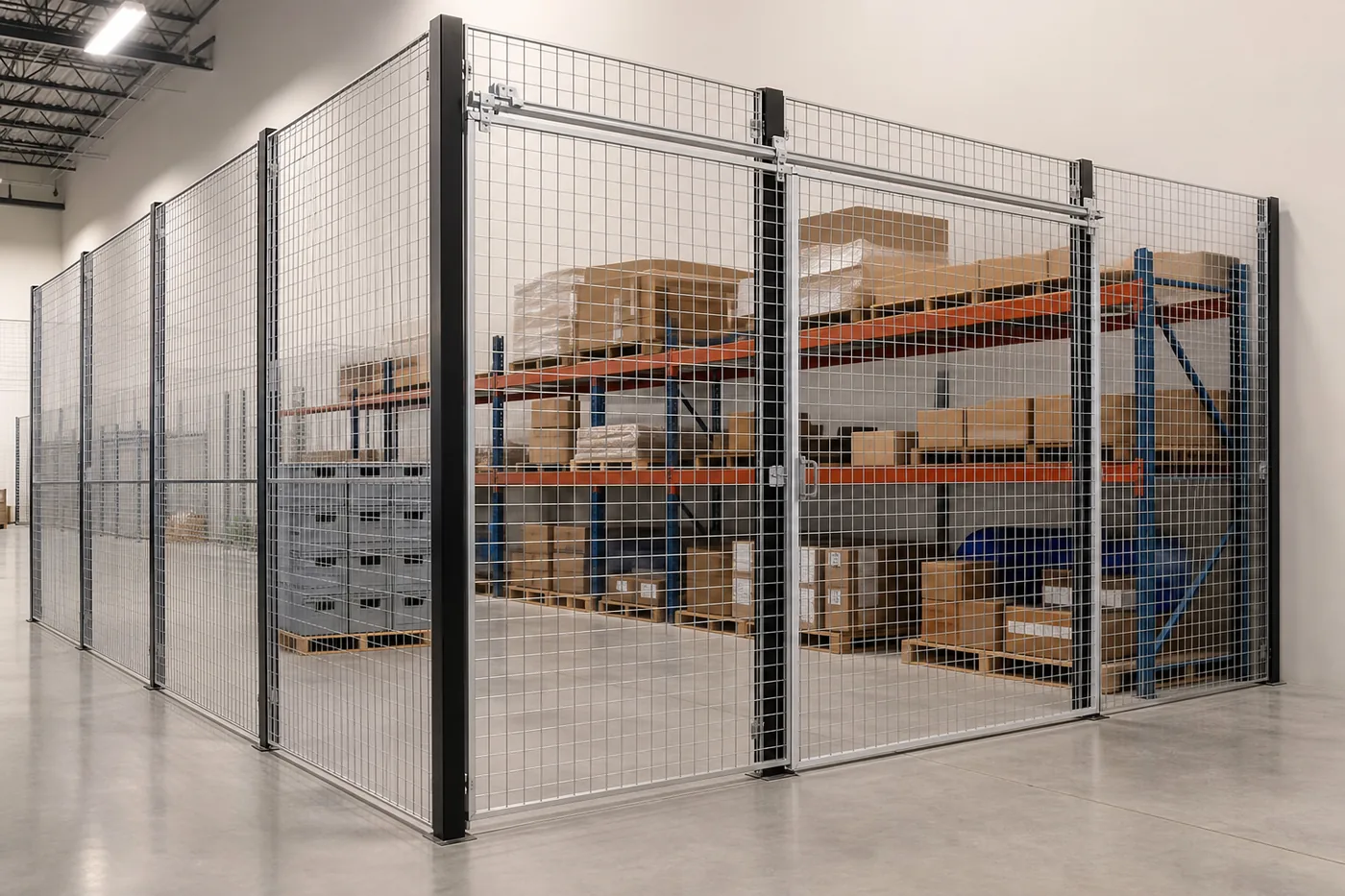
- The rack carries the load, not the cage. Reels stored on pallet rack are a rack engineering question first. Mesh panels are a barrier only. Where a caged area is formed around rack bays, we use pallet rack security enclosures so the enclosure attaches to the rack correctly instead of fighting it.
- Deck the levels you are enclosing. Wire mesh decking keeps small items, cut lengths and odd-shaped material from falling through beams into the caged aisle below.
- Size openings for the handling equipment. A forklift with a reel on a shaft needs markedly more opening and approach than the reel itself. Sliding doors avoid the swing clearance a fork truck cannot give up.
- Protect the corners. Where trucks turn, put guard posts or base channel in front of the panels. Panels are repairable, but a post taken out by a loaded truck costs a day.
- Track cutting, not just storage. Most cable loss is unrecorded cutting rather than theft. Locating the cut station at the enclosure opening, with the reel inside, makes the record a byproduct of the work.
For wider caged rack areas in a contractor warehouse, see warehouse security enclosures.

Yard, outdoor and jobsite storage
Contractors store more outside than most businesses: conduit, strut, reels, trailers, lifts, compressors and material that will not fit indoors. Outdoor enclosures are specified differently from shop cages:
- Finish is the first decision. Galvanized or high-durability finishes are used where weather, UV and ground moisture are real. A powder-coated interior panel put outside will show it within a season.
- Anchoring and base condition. Slab, asphalt and compacted-gravel bases each need a different base detail; anchoring into deteriorated asphalt is a common failure.
- Wind and site exposure. Enclosures in exposed yards, and anything with solid infill or covers, are checked against local wind requirements and the authority having jurisdiction. Open mesh is far less wind-sensitive than a solid panel, which is one of the reasons it is used.
- Visibility works for you outside. An open barrier lets patrols, cameras and neighbors see the yard; a solid fence provides concealment for anyone already inside it.
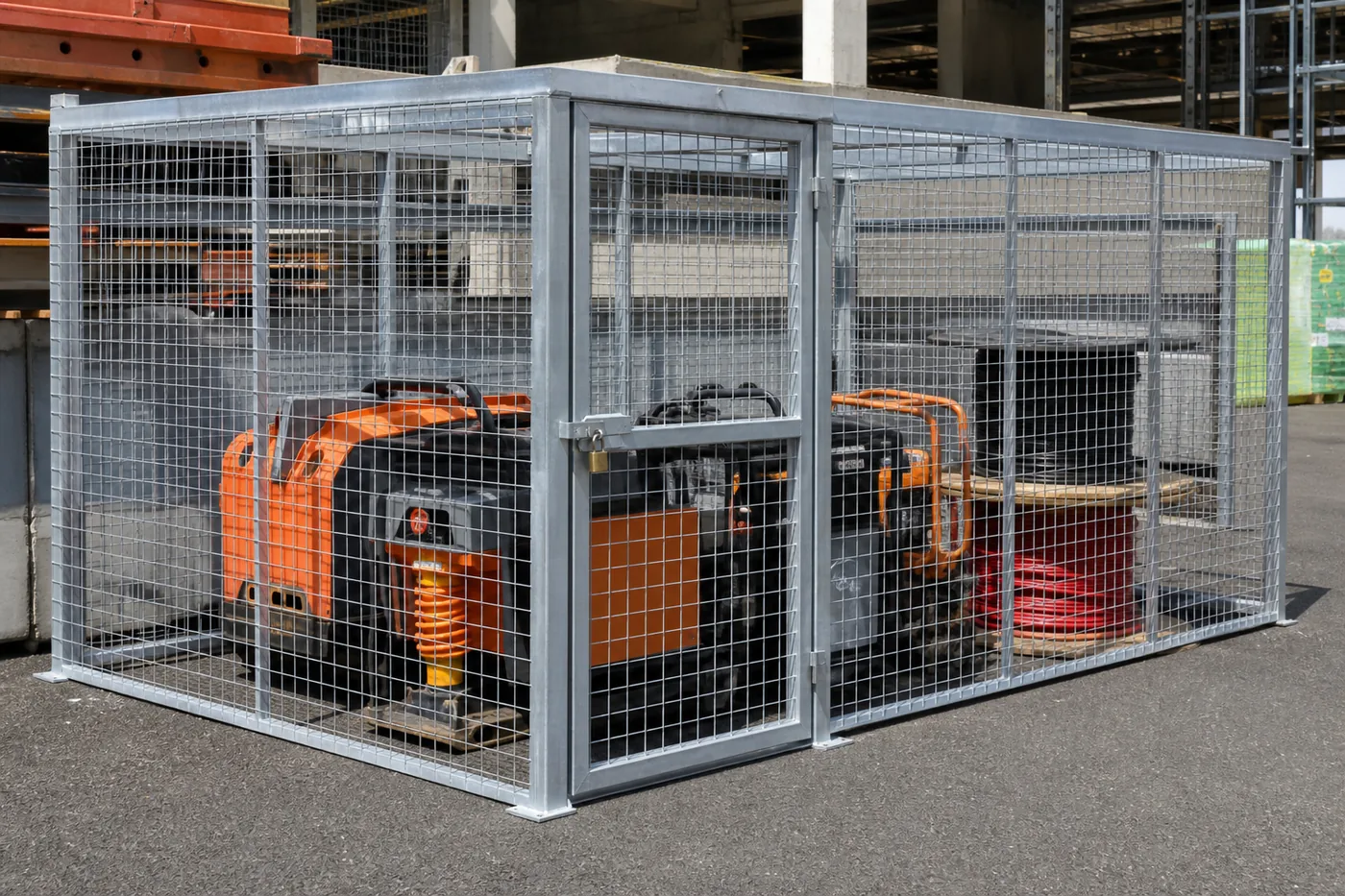
- Cost tier. For bulk, low-risk yard material a chain link storage cage is often the better economic choice than welded wire, and MH-USA supplies both.
More on this application is on our outdoor security cages and equipment protection page. Site-installed enclosures also have to respect temporary power, lighting and clearance requirements for construction work under 29 CFR 1926.416 when they are placed at an active jobsite.
Panels, doors and access
The specification for a contractor shop is short and driven by traffic and abuse tolerance:
- Welded wire panels in steel frames. Visible, ventilated, repairable panel by panel, and far more tolerant of cart and truck contact than drywall. Mesh opening and wire diameter are chosen for the control level needed — see wire mesh panel options.
- Height and top. Partial height suits supervised shop areas; full height with a mesh top is used where reach-over or climb-over is realistic, especially against rack.
- Doors. Sliding doors where aisles are tight or fork trucks approach; hinged doors for personnel openings. Options are on security cage doors.
- Issue window. The highest-value single feature in this application, as above.
- Modularity. Contractor storage needs change with the job mix. Bolted wire mesh partitions can be extended or moved; framed walls cannot.
Installing in a working shop
A contractor cannot lose the shop for a week, and the crews using it will not tolerate a half-finished storage area. Installation is sequenced accordingly.
Measure and photograph first
Field-verified openings, ceiling and obstruction clearances, floor condition and the actual truck used in the aisle. Our sizing guide lists what to record before ordering.
Clear and lay out one area at a time
Material is relocated once, not repeatedly. One enclosure is completed and put back into service before the next area is opened up.
Anchor on the shop’s schedule
Drilling is noisy and dusty; it is scheduled around load-out and around any coating or clean work happening nearby.
Hand over with the process, not just the panels
Key list, who issues, where the window is, where kitted material lives. An enclosure that arrives without an agreed process reverts to an open room within a month. Walk it periodically per the maintenance and inspection guide.
Installation detail is on the security cage installation page. Material Handling USA designs, supplies and installs contractor storage nationwide — start at the security cages hub, or tell us which bay you are trying to control.
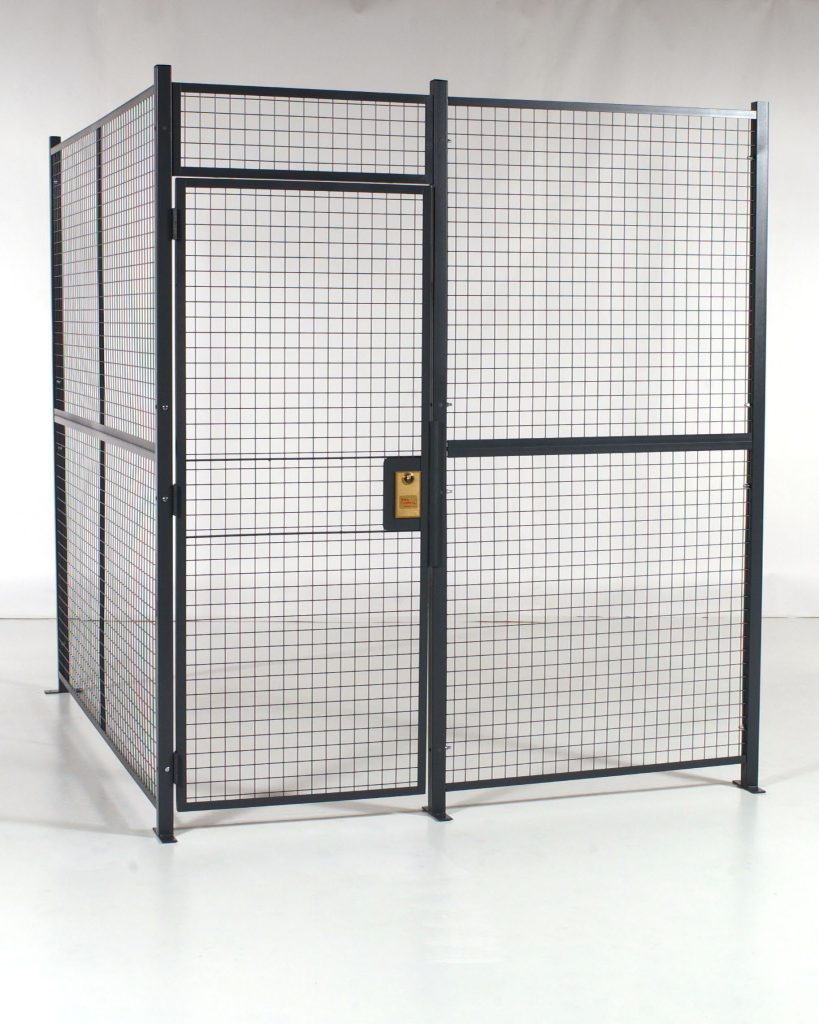
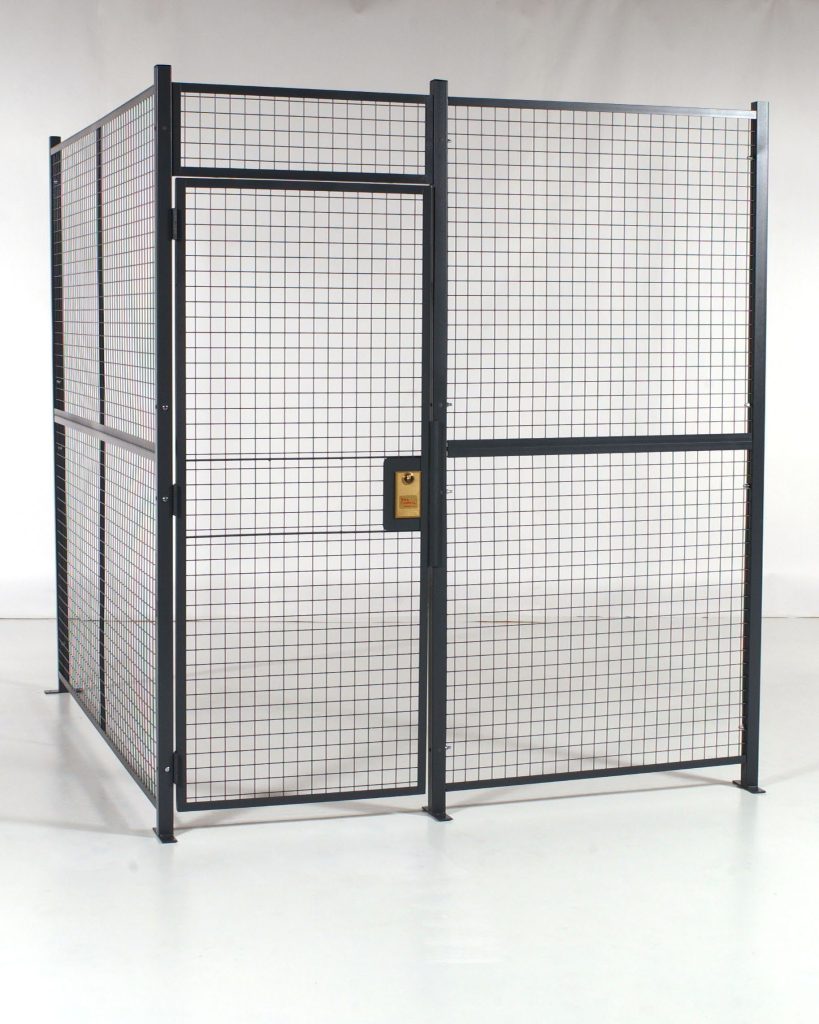
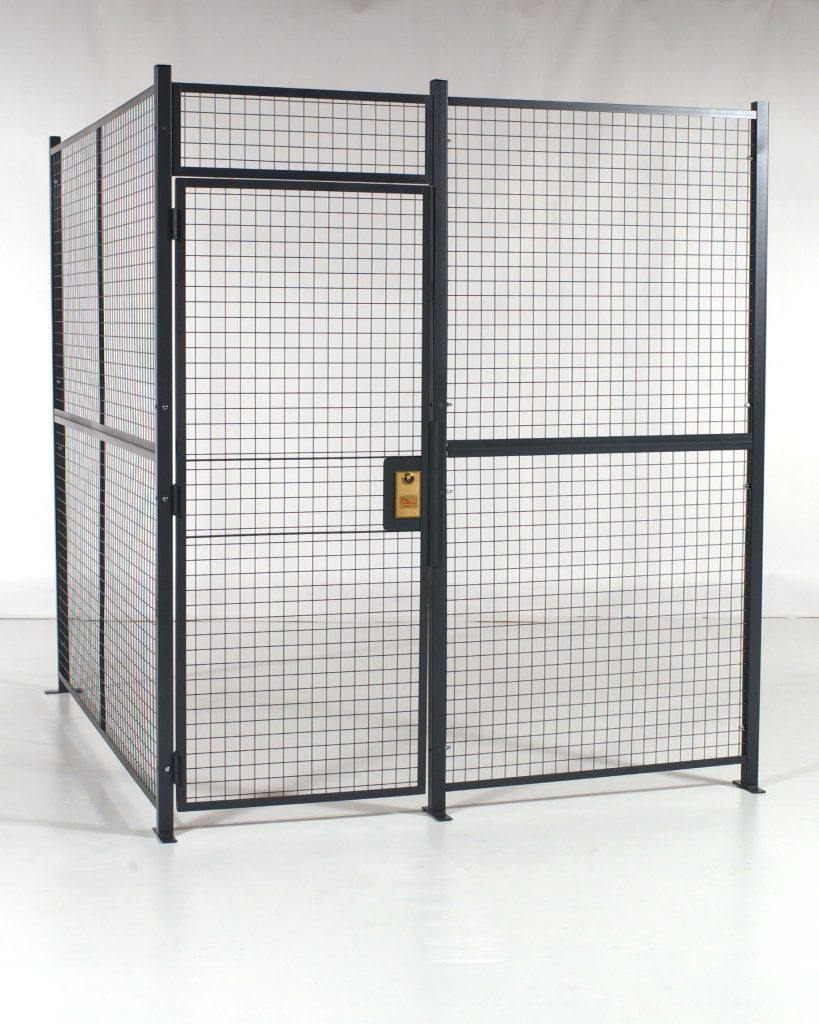
Shop Pre-Configured Wire Mesh Cage Kits Online
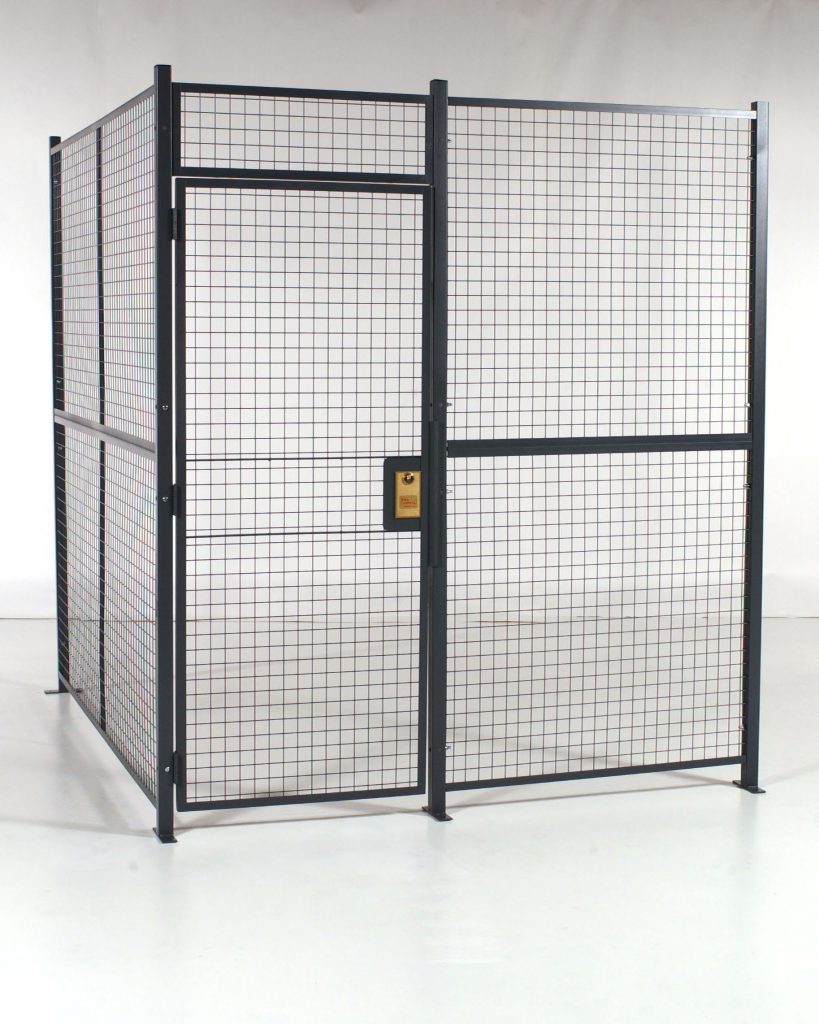
Standard-size welded wire cage kits, priced online, for smaller storage needs. Every kit still needs to be anchored to sound concrete — for tall, braced or engineered enclosures, request a quote with your building location and floor details.
Frequently asked questions
How do you stop copper and wire loss in a contractor warehouse?
Won’t a locked crib slow down morning load-out?
Welded wire or chain link for a contractor yard?
Can an enclosure be built around existing pallet rack?
What finish should an outdoor contractor cage have?
Do outdoor enclosures need engineering review?
How many separate cages does a contractor shop need?
Looking for a project like yours? Browse more contractor and fleet security cage case studies, see all security cage case studies.
Secure the shop without slowing down the crews
Material Handling USA designs, supplies and installs welded wire security cages, tool cribs and yard enclosures for electrical and specialty contractors nationwide.