
Semi-Automatic Stretch Wrap Machines
Turntable and orbital semi-automatic pallet wrappers that replace hand wrapping with tighter, more consistent loads, less film and far less strain on your crew. Vestil turntables online, TAB Wrapper Tornado orbital units by quote, delivered and set up nationwide.
15-35
Loads per hour, typical
1 operator
Starts, tends, cuts
2 types
Turntable or orbital
Nationwide
Quote, freight, setup
Shop Semi-Automatic Stretch Wrap Machines
Vestil semi-automatic turntable wrappers in 50, 54, 60 and 70 inch turntable sizes ship from our online store. Need a scale, a different size or an orbital machine for long loads? Request a quote and we add freight.


What Is a Semi-Automatic Stretch Wrap Machine?
A semi-automatic stretch wrap machine does the part of pallet wrapping that wears people out: it walks the film around the load. An operator still brings the pallet in by forklift or pallet jack, tucks the film tail into the load, starts the cycle and cuts the film at the end. The machine handles rotation, film tension and the up-and-down travel of the film carriage.
Hand wrapping puts every lap on a worker walking backward. Fully automatic needs no operator but needs conveyor and a bigger budget. Semi-automatic sits between them, the usual first machine for steady pallet volume.
For the full family, including automatic and conveyorized systems, see our guide to stretch wrap machines.

Signs your operation is ready for one
- You hand wrap more than roughly 10 to 15 pallets a day, or one person spends hours a week on it.
- Loads arrive at the customer leaning, shifted or with torn film, and freight claims follow.
- Film use is high and nobody can say how many feet go on each pallet.
- Workers complain of back, shoulder or dizziness issues from circling pallets.
- Wrap quality depends on who is on shift that day.
Turntable vs. Orbital (and Rotary Arm) Semi-Automatic Wrappers
Every semi-automatic machine wraps in one of three ways. The right one depends on the shape, weight and stability of what you ship, not on price alone.
| Type | How it wraps | Best for | Watch-outs |
|---|---|---|---|
| Turntable (vertical) | The pallet sits on a powered round deck that spins while a film carriage rides up and down a mast | Standard, stable pallets of cartons, cases and bagged goods; the most common and lowest cost style | Load weight limit of the deck; tall, top-heavy or light loads can sway as they spin; needs a ramp or pit for pallet jacks |
| Rotary arm (vertical) | The pallet stays still and an overhead arm carries the film around it | Very heavy, unstable or fragile loads that should not spin | Higher cost; arm needs a frame or wall mount and overhead clearance |
| Orbital (horizontal) | A ring carries the film around and under the load as it passes through, often still on the forks | Long, flat or irregular loads: pipe, tubing, lumber, sheet metal, doors, bundled stock; ties the load to the pallet | Wraps along the length rather than top to bottom; machine footprint is set by the load cross-section |
 TurntableA powered deck spins the pallet. Simple, compact and the default for boxed goods.
 OrbitalThe ring passes film around and under the load, so long products stay locked to the pallet.
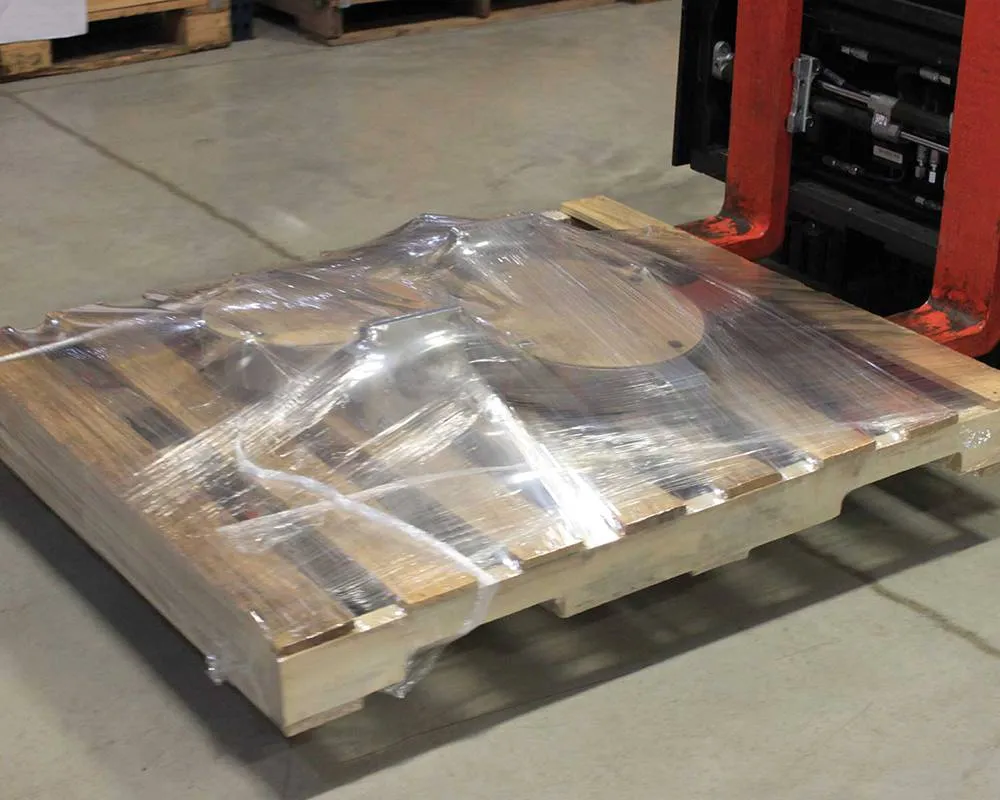 Irregular loadsOdd shapes that would wobble on a turntable are wrapped while held steady on the forks.
Orbital and irregular-load photos: TAB Industries
Semi-Automatic vs. Hand Wrapping: Where the Savings Come From

Hand wrapping looks free because the film dispenser costs a few dollars. The real cost is hidden in labor, film and damaged freight. A person wrapping by hand has to walk backward around the load 10 to 20 times, bend to reach the bottom and stretch to reach the top, and they tend to either over-wrap to feel safe or under-wrap to save time.
A machine applies the same number of wraps at the same tension on every pallet. Most semi-automatic turntables pull film against a brake or a powered prestretch roller, so each foot of film is stretched before it touches the load. Hand film is typically stretched only a little, so the same pallet takes more film to hold less tightly.
Orbital Semi-Automatic Wrapping: TAB Wrapper Tornado
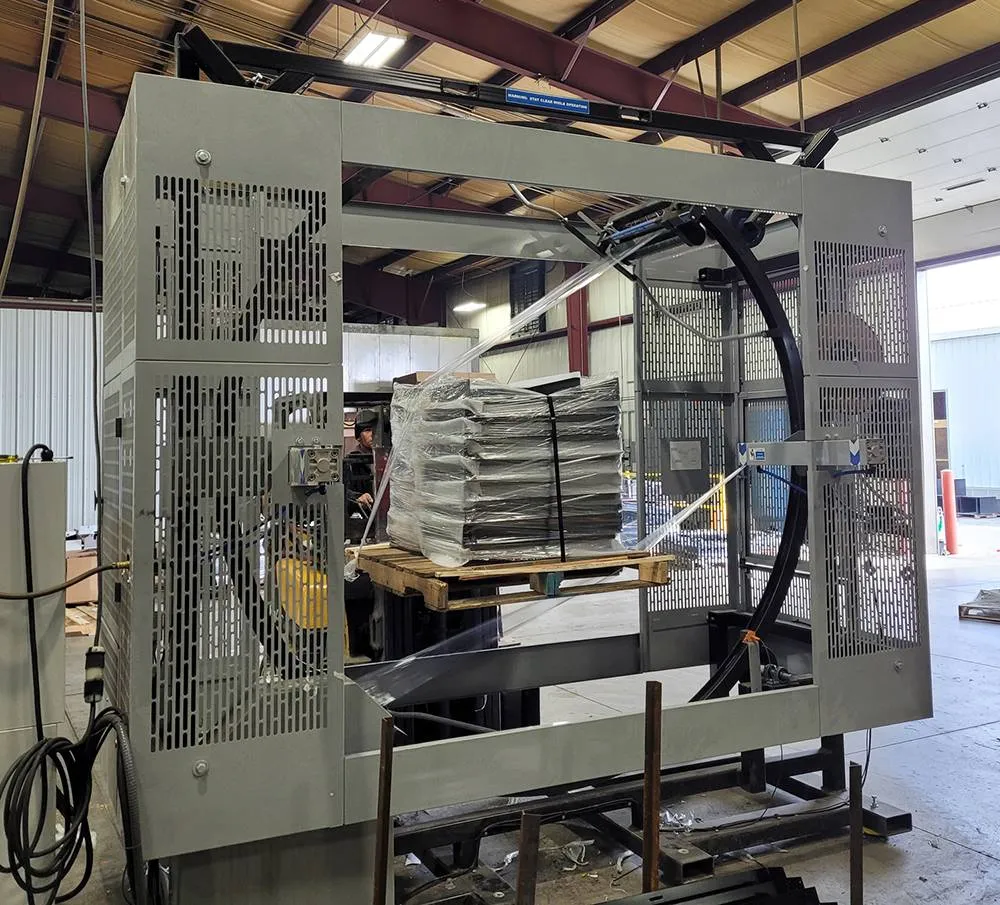
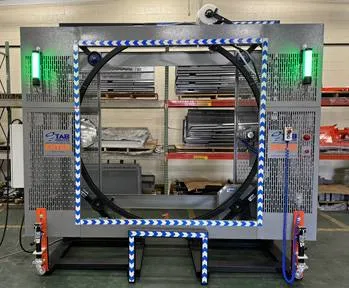
MH-USA is an authorized dealer for TAB Industries, maker of the TAB Wrapper Tornado line of orbital (horizontal) stretch wrappers. Instead of spinning the load, the Tornado sends film through a ring that circles the load and the pallet together. The forklift driver usually stays on the truck and eases the load through the opening, so long or awkward items are wrapped without being set down on a deck.
Tornado Standard
The Standard model is the entry point. The operator ties film to the pallet base, then runs the wrap from a corded remote while the ring circles the load. When the button is released, the operator cuts the film and the load is ready to go.
- TAB lists three Standard sizes: 80 in. (skids up to 48 x 48 in.), 100 in. (up to 60 x 60 in.) and 115 in. (up to 50 in. wide x 95 in. tall).
- TAB states a single operator can wrap a pallet in under one minute.
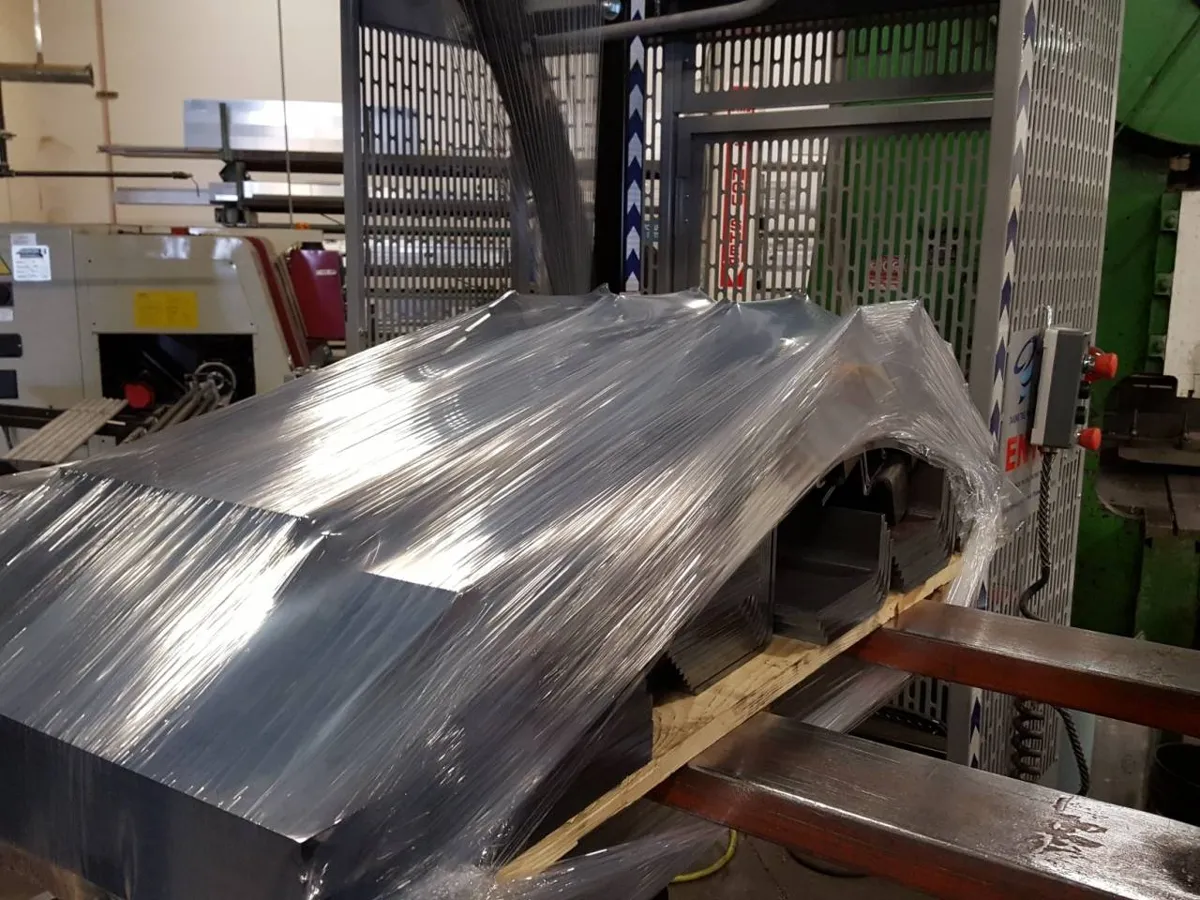
- Film goes around and under the pallet, which helps keep long or shifting loads from sliding off it.
Photo: TAB Industries
Tornado with Smart Controls
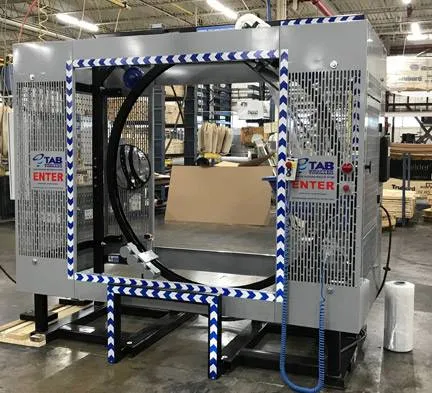
Smart Controls keep the machine semi-automatic but take the button-holding out of the job. One press starts continuous wrapping, and the system positions the film dispenser on its own.
- One-button start instead of holding a remote for the whole cycle.
- Prime/Home returns the dispenser to its start point for the next load.
- Auto-cut cuts the film when the wrap is done.
- Emergency stop and safety relays, with optional safety scanners and a wireless remote so drivers can stay seated.
Photo: TAB Industries
When orbital beats a turntable
If your loads are longer than the pallet, flexible, top-heavy or mostly air (frames, doors, bundles of tube), a turntable will either fling them or need hand finishing. Orbital wrapping holds them on the forks and ties film under the skid. Send us a photo and dimensions and we will tell you which style fits. More detail: orbital stretch wrappers.
Film, Prestretch and Wrap Settings
Semi-automatic turntables take machine film, usually 20 in. wide on a 3 in. core. Vestil’s semi-automatic units accept rolls from 10 to 20 in. tall, so you can run narrower film for short loads. Machine rolls hold far more film than hand rolls, which means fewer changeovers.
- Friction brake carriages (like the Vestil semi-auto line) add tension by resisting the roll. Simple and low maintenance.
- Powered prestretch carriages stretch film between two rollers before it reaches the load, often 200% or more, so each roll covers more pallets.
- Cast vs. blown film: cast is clear, quiet and cling-friendly; blown is tougher against puncture on sharp corners.

Settings that matter most
- Start with three or four base wraps to lock the load to the pallet; this is where most loads fail.
- Overlap each spiral pass by about 50% on the way up and down.
- Add a top band or top sheet for dusty, outdoor or stacked loads.
- Set turntable speed slow enough that tall or light loads do not sway.
- Test a few settings, then write them down so every shift wraps the same way.
Throughput: How Many Loads per Hour?
Cycle time on a semi-automatic machine is the wrap itself plus the human steps: driving the pallet on, tying film, cutting, and driving off. Published figures from the major manufacturers put most semi-automatic turntables at roughly 15 to 35 loads per hour, with rotary arm and orbital machines sometimes faster because the load never has to be set down and picked back up.
| Daily pallets | Typical fit | Why |
|---|---|---|
| Under 10-15 | Hand wrap or a basic semi-automatic | Low volume; a machine pays back mostly through film savings and safety |
| 15-150 | Semi-automatic turntable or orbital | The sweet spot: big labor and film gains without conveyor |
| 150-300 | Semi-automatic with auto-cut, photo-eye height sensing, or two machines | Operator time per load starts to dominate |
| 300+ or a continuous line | Fully automatic with conveyor | Unattended cycles keep up with production |
These are planning ranges, not hard rules. Shift length, how far the wrapper sits from the dock and whether the same driver also loads trucks all change the answer.
Footprint, Power, Scales and Other Options
Vestil scale option: view in the store. Mast guard: power mast chain guard.
When to Step Up to a Fully Automatic Wrapper
Semi-automatic is right for most buyers, but there is a point where the operator becomes the bottleneck. Consider an automatic machine, or a semi-automatic with automation features, when the signs listed below apply.
Middle-ground models such as Vestil’s Auto-Wrap turntable add programmable wrap patterns, photocell height sensing and a start button, so the operator ties on, presses start and walks away until the cycle ends. See the Vestil Auto-Wrap 60 in. TAB also offers Genius Controls and Perfect Storm versions of the Tornado for more automated orbital lines.
Photo: TAB Industries
- You wrap more than a few hundred loads a day, or pallets come off a production line on conveyor.
- Drivers are waiting in line at the wrapper during peak hours.
- You want each pallet weighed, labeled and wrapped with no one touching it.
ROI: A Simple Way to Estimate Payback
You do not need a spreadsheet model to see whether a wrapper pays off. Plug your own numbers into these four lines:
Labor saved
Minutes saved per pallet x pallets per year x loaded hourly wage. Saving 3 minutes on 40 pallets a day is about 500 hours a year.
Film saved
Current film spend x expected reduction. Even a 25-40% cut on a high-use dock adds up fast.
Damage avoided
Last year’s load-related freight claims, refused shipments and reshipments.
Injury risk
Strain claims and lost days tied to hand wrapping. Hard to price, easy to feel.
Worked example (illustrative)
40 pallets/day, 250 days, 3 minutes saved each at $25/hour = about $12,500/year in labor. Add a 30% film cut on $8,000/year of hand film = $2,400. On a semi-automatic turntable in the $4,000 to $8,000 range, payback is usually measured in months, not years. Your numbers will differ; we are happy to run them with you.
Buying Checklist for a Semi-Automatic Pallet Wrapper
| Question | Why it matters |
|---|---|
| Largest pallet footprint and overhang? | Sets turntable diameter or orbital ring size |
| Tallest load height? | Sets mast or ring height; Vestil masts suit typical pallet heights, tall loads need checking |
| Heaviest load? | Turntable capacity rating; very heavy loads may suit rotary arm or orbital |
| Stable or irregular load? | Irregular, long or top-heavy loads point toward orbital |
| Pallets per day and per peak hour? | Decides basic vs. auto-cut / photo-eye / automatic |
| Forklift or pallet jack loading? | Low-profile deck or ramp needed for jacks |
| Power available at the spot? | Single-phase vs. dedicated circuit |
| Need weight on every load? | Specify a scale deck up front |
| Indoor, cold or dusty area? | Film type and motor protection |
| Who services it? | Parts, film supply and a contact who knows the machine |
Delivery, Installation and Training
Size it
Send pallet sizes, heights, weights and daily volume, plus a photo of the area. We recommend turntable or orbital and a size.
Quote with freight
You get the machine, options, film and freight to your dock in one number.
Set up
Vestil semi-auto units ship with the mast folded; it stands up and clamps in place. Orbital units are placed and leveled to suit your forklift path.
Train
Operators learn tie-on, base wraps, settings and safe film cutting in one short session.
Support
We help with film reorders, spare blades and adding options like a scale later.
Get a free quote
Tell us your pallet size, load height and weight, and how many loads you wrap a day. A specialist will recommend a turntable or orbital machine and send pricing with freight. Prefer to talk? Call (800) 326-4403.
Semi-Automatic Stretch Wrapper FAQs
What is a semi-automatic stretch wrap machine?
How is semi-automatic different from fully automatic?
Turntable or orbital: which do I need?
How many pallets per hour can a semi-automatic wrapper do?
What size turntable do I need?
Does a stretch wrapper save film?
Can I get a stretch wrap machine with a scale?
What power does a semi-automatic stretch wrapper need?
Do you install and train?
Ready to Stop Hand Wrapping?
Send pallet sizes and daily volume for a free recommendation and a freight-included quote.