Packages don't just arrive at the mailroom anymore. They show up at reception, side entrances, loading areas, and sometimes straight at an employee's desk after a courier asks around for help. That creates clutter, interruptions, and a chain of custody that's often hard to prove later.
For many offices, the primary problem isn't package volume alone. It's the mix of employee deliveries, department transfers, visitor drop-offs, legal documents, IT assets, and sensitive items that all move through the same front desk workflow. A parcel locker system for offices solves that by turning package handling into a controlled process instead of a daily interruption.
A well-planned system gives carriers one secure handoff point, gives employees self-service pickup, and gives facility teams a cleaner record of who placed, received, and retrieved each item. That matters for productivity, security, and the day-to-day image of the workplace.
The Modern Solution to Office Package Management
Reception desks were never designed to be mini distribution centers. Yet in many offices, that's exactly what they've become. Staff sign for boxes, stack parcels behind the desk, answer “Has my package arrived?” questions, and deal with couriers during the busiest part of the day.

A parcel locker system for offices replaces that ad hoc routine with a secure, automated pickup hub. Carriers access the system electronically, place the package in an assigned compartment, and the recipient gets a notice by text, email, or app. That approach removes the need for staff to manually manage package intake, as outlined in this overview of smart locker delivery workflows for offices.
What changes in daily operations
The biggest shift is simple. The package no longer sits in a public or semi-public area waiting for someone to remember where it was placed.
Instead, the office gets:
- Controlled intake that directs couriers to one delivery point
- Self-service retrieval so employees can pick up items without stopping reception
- Clear accountability through digital records tied to each drop-off and pickup
- Less visual clutter in lobbies, mailrooms, and admin spaces
Many office leaders also tie locker planning into broader physical security reviews. If you're looking at package handling as part of a wider workplace risk strategy, this guide to security in the office is a useful companion resource.
Offices usually treat package handling as a small admin issue until it starts affecting front desk staffing, internal security, and employee time.
Why Your Office Needs a Parcel Locker System Now
The business case is stronger than often anticipated. Parcel lockers aren't just a convenience feature. They remove repeat labor, shorten courier dwell time, and reduce the number of manual touchpoints in the building.
Field evidence from the United States found that installing parcel locker systems produced a 78% reduction in delivery times within a building and cut facility manager workload by about 90% after installation by automating receipt and distribution of goods, according to the Urban Freight Lab field study.
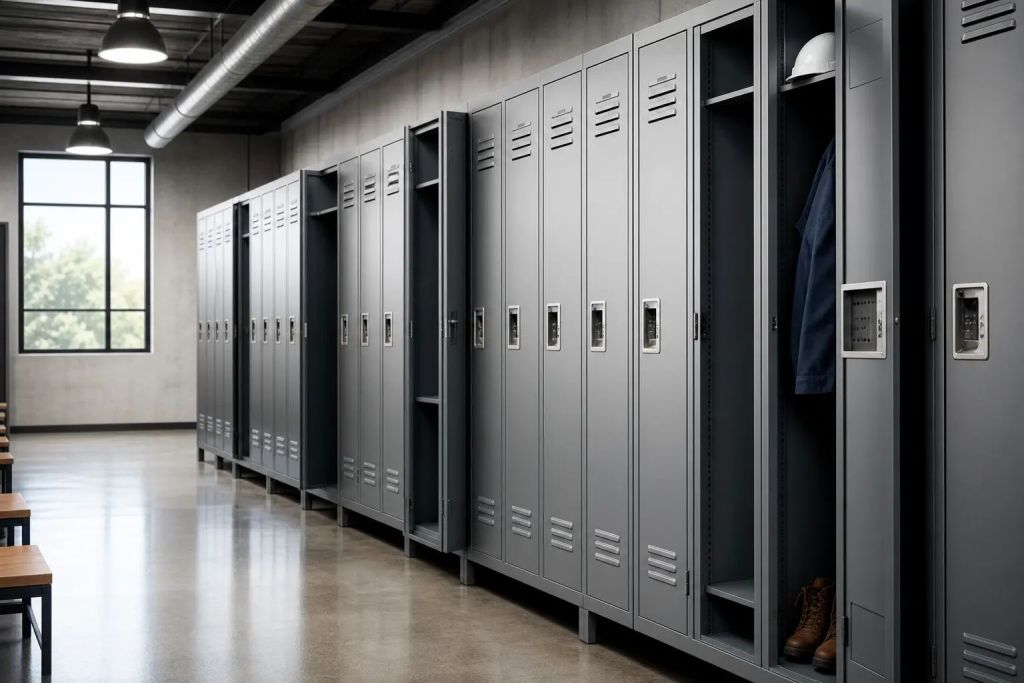
The operational payoff
That kind of change affects more than package handling. It reduces interruptions across the office.
When packages flow through lockers instead of people, teams spend less time on:
- Front desk triage as reception stops acting as a storage counter
- Manual notifications because the system alerts recipients automatically
- Package searching when employees ask admin staff to locate deliveries
- Exception handling for mislaid items with no record trail
There's also a planning advantage. As more facilities adopt automated delivery systems, buyers who start layoutsand approvals earlier usually have more flexibility around placement, electrical prep, and rollout timing. Waiting doesn't always raise costs, but it can narrow optionsand create scheduling friction with IT, facilities, and contractors.
Security matters inside the office too
External theft gets most of the attention. In offices, internal handling can be just as risky. If too many people can touch or move incoming parcels, it becomes harder to prove custody and easier for sensitive items to go missing.
That matters for:
- legal departments receiving confidential files
- HR teams handling employee records
- IT teams receiving hardware
- executive offices receiving priority deliveries
Practical rule: If reception can't answer who handled an item, when it moved, and where it was placed, the process is too loose for a modern office.
Employee Package Delivery Solutions for Growing Offices
Search interest around an employee package delivery solution usually comes from one of three starting points: reception is overloaded, a mailroom process has broken down, or leadership wants a documented chain of custody for business deliveries. Each starting point points toward a different mix of hardware and policy.
Most offices land on one of these three approaches:
- Reception-managed intake, where staff sign for every package and notify recipients by phone or email
- Mailroom sorting, where a dedicated space and staff member batch-process deliveries on a schedule
- Locker-based self-service, where carriers place items directly into an assigned compartment and the system notifies the recipient
Reception and mailroom models both depend on a person being available at the right moment. Locker-based delivery removes that dependency, which is why it tends to be the solution offices move to once package volume or sensitivity increases.
Reception Parcel Handling vs. Lockers
Comparing reception parcel handling vs. lockers comes down to staffing, security, and the employee experience:
| Factor | Reception Handling | Locker System |
|---|---|---|
| Staff time | Ties up front desk staff for intake, storage, and notification | Notifications are automatic once a package is placed |
| Chain of custody | Depends on manual logs or memory | Digital record of drop-off, notification, and pickup |
| Employee experience | Employees must time pickup around reception availability | Self-service pickup on the employee’s own schedule |
| Scalability | Gets harder to manage as volume grows | Compartment count and software scale with the office |
| Sensitive items | Visible at a shared desk, harder to restrict | Role-based access can restrict who opens a given compartment |
Reception handling still works for very low package volume. Once a front desk is fielding repeated “has my package arrived” questions, a locker system usually pays for itself in reclaimed staff time alone.
Comparing Locker System Typesand Configurations
Not every locker setup fits an office. Some systems work well for simple employee pickup. Others are built for deeper integration, outdoor placement, or multi-department workflows.
Smart versus basic systems
The first decision is whether you need a basic locker bank or a networked smart locker system.
Basic lockers can work for low-risk storage, but they usually fall short in corporate settings because they don't provide the software layer needed for notifications, audit records, routing rules, and role-based access.
Smart systems are better suited to offices that need delivery management, employee convenience, and security documentation.
Parcel Locker System Comparison
| Locker Type | Mechanism | Best For | Key Benefit |
|---|---|---|---|
| Basic keyed lockers | Physical key access | Low-volume internal storage | Simple hardware with minimal setup |
| PIN or code lockers | Shared or assigned code entry | Small offices with limited package traffic | Better control than open shelving |
| Smart indoor lockers | Networked software, digital notifications, electronic access | Corporate offices, mixed-use buildings, admin-heavy environments | Automated intake and pickup with tracking |
| Smart outdoor lockers | Weather-rated smart system with secure compartments | Campuses, exterior building access, after-hours pickup | Flexible access outside the main office |
| Mixed-size locker banks | Multiple compartment sizes in one system | Offices receiving varied parcel sizes | Better fit for daily package mix |
| Specialty compartments | Configured for oversized or controlled-use items | IT assets, records, department transfers | Supports nonstandard workflow needs |
For outdoor placement, locker hardware should meet IP65/IP66 weatherproofing standards, support wide operating temperature ranges, and can deliver validated 12 to 15 year lifespans with payback periods of 4 to 24 months, based on this review of outdoor parcel locker costs, specs, and ROI.
What worksand what doesn't
What works in offices:
- Mixed compartment sizes for envelopes, cartons, and larger shipments
- Software-based access so couriersand employees don't rely on manual handoff
- Indoor placement near traffic flow for controlled accessand easy pickup
- Outdoor units only when exterior access is part of the delivery strategy
What usually doesn't work:
- One-size-only compartments that force overflow handling
- Reception-adjacent placement without queue space
- No power or data planning until late in the project
- Residential-style thinking that ignores department routing and security policy
If you're comparing options, start with dedicated parcel locker solutions for commercial facilities and narrow the shortlist by workflow first, not just hardware price.
Key Features to Evaluate for a Corporate Environment
A corporate locker system isn't just a metal cabinet with software. Its core value comes from how well the hardware, access controls, and business systems work together.
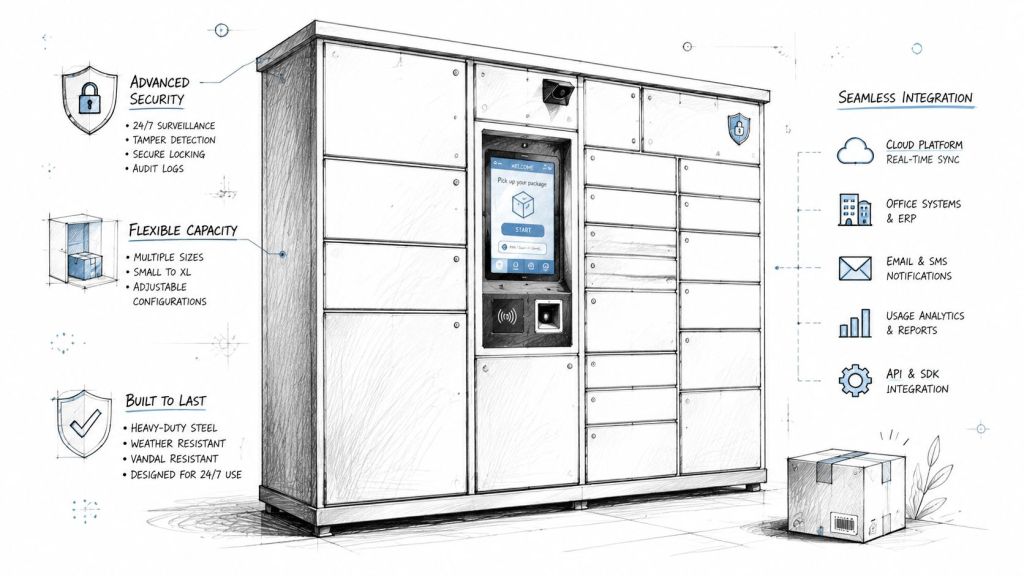
Integration should be reviewed early
A common mistake is choosing the locker hardware firstand asking software questions later. That creates problems when the office wants the system to work with employee directories, badge access, ERP workflows, or department-level permissions.
A significant number of office deployments run into integration trouble because of incompatible API standards with legacy ERP systems such as SAP or Oracle, as noted in this guide on setting up a parcel locker system.
That's why buyers should ask early about:
- API compatibility with current business systems
- User directory sync for employee onboarding and offboarding
- Access control links for badge or identity-based use
- Reporting exports for audit and compliance needs
Security features that matter in offices
Offices often need more than package pickup. They need controlled transfer of sensitive items across departments.
Look for systems that support:
- Audit trails that log delivery, access, and pickup events
- Role-based access for facilities, HR, legal, or IT teams
- Tamper awareness through alerts or visible exception records
- Routing rules so sensitive deliveries go totheright group
Some buyers evaluating smart locker systems for officesand secure facilities also need modes for non-parcel use, such as internal document transfer, badge issue, device exchange, or controlled storage.
In a corporate setting, software limitations usually cause more frustration than the locker doors themselves.
Accessibility and user experience
The best system is still a poor fit if people struggle to use it. Placement, screen height, reach range, lighting, and clear instructions all affect adoption. Courier workflows matter too. If drivers can't complete a drop quickly, they'll improvise, and that defeats the purpose.
Locker Services for Hospitals and Mixed-Use Office Buildings
Hospital administration wings, medical office buildings, and other mixed-use office locker services have to account for shared lobbies, multiple tenants, and visitors in addition to staff. The planning questions are the same as a standalone office, with a few added items:
- Shared versus tenant-specific compartments when multiple departments or practices use one lobby
- Visitor and vendor access for supply deliveries that are not addressed to a single employee
- Facility rules coordination with building management or property staff when the locker sits in common space
- Non-clinical use only for general package handling, kept separate from any clinical supply chain or chain-of-custody process the facility already runs
None of this changes the core sizing and security steps above. It just means the location and access review needs to include building management and, where relevant, more than one department.
Planning Your Locker Sizing Layout and Installation
A locker bank that looks right on a floor plan can still fail in daily use. In offices, the common problems are predictable: couriers queue at reception, employees stop in high-traffic corridors to collect items, and sensitive deliveries end up too close to public access points. Good planning starts with traffic flow, security zoning, and package mix.

How to Evaluate Locker Size and Capacity for Your Office Package Volume
To evaluate locker size and capacity for your office package volume, count what moves through the building on a typical day and on your busiest day, then match that mix to compartment sizes and total door count before you shortlist hardware.
Count what moves through the office before choosing compartment sizes. That means inbound carrier deliveries, inter-office transfers, IT device exchanges, legal or HR document handoffs, and any recurring oversized items. A corporate office often needs a different mix than a residential site, with fewer small personal parcelsand more medium lockers for boxed equipment, records, and department-to-department transfers.
Review these factors first:
- Daily and weekly delivery patterns across standard operationsand peak periods
- Parcel size distribution so small, medium, and oversized compartments match real demand
- Internal transfer needs for departments that exchange devices, documents, or controlled items
- Carrier approach paths including where drivers enter, unload, and wait
- Exception handling for oversized, signature-sensitive, or misrouted items
That assessment usually answers two expensive questions early. How many doors are needed on day one, and where should future expansion go?
Choose a location that fits office operations
The best placement reduces labor without creating a new bottleneck. In most office deployments, that means keeping lockers close enough for courier efficiency but outside reception choke pointsand away from informal public access. For companies using touchless locker systems to improve office efficiency, screen access, approach clearance, and pickup flow matter just as much as footprint.
A practical site review should cover:
- Power and network availability at the proposed location
- Clearance in front of locker doors for safe loading and pickup
- Lighting and camera visibility for user safety and incident review
- ADA access considerations including reach range and approach width
- Proximity to secure departments if HR, legal, finance, or IT will use dedicated compartments
- Space for overflow or phased expansion so the installation does not hit capacity too early
If the locker project also affects secured entries, staff circulation, or restricted delivery zones, review guidance on installing modern access control so locker placement and access permissions are coordinated from the start.
A poor location creates workarounds. Staff hold packages behind the desk, couriers leave items outside the system, and the locker loses part of its value.
Material Handling USA supports this stage with custom layout planning tied to facility workflow, space constraints, and compliance requirements. That is useful when an office needs to balance employee pickup convenience with departmental security, especially in mixed-use areas where public visitors, staff, and carriers share the same entrance.
Creating a Seamless Workflow and Company Policy
Installing the hardware is only half the job. The office also needs a clear policy for how packages move through the system.
Data shows that a significant percentage of office package theft happens during internal retrieval by unauthorized staff, and standard residential guides often miss the need for package routing to secure departments such as legal or HR, according to this office-focused analysis of smart parcel locker use in workplaces.
Policy decisions to make before launch
A practical office policy should define:
- Holding times for packages left unclaimed
- Oversized item handling when a parcel won't fit a compartment
- Misaddressed deliveries and who resolves them
- Abandoned package procedures including escalation steps
Use lockers for internal routing too
Office deployments differ from apartment use. A good system can support controlled handoff between departments, not just carrier-to-employee delivery.
Examples include:
- HR document routing with restricted pickup rights
- Legal file transfer that limits access to named users
- IT asset exchange for issued devicesand returns
- Visitor credential pickup under controlled conditions
If your office wants a lower-contact workflow for both package handling and internal exchange, touchless locker systems for efficiency-focused facilities are worth evaluating as part of the policy discussion.
Understanding Costsand Calculating Your Return on Investment
Parcel locker costs usually fall into four buckets. Hardware, software, installation, and ongoing support. The right way to judge them is against the labor and risk they remove.
The market direction also supports the long view. The smart parcel locker market was valued at USD 1,140 million in 2025 and is projected to reach USD 2,970 million by 2034 with a 11.10% CAGR, according to Fortune Business Insights. That projection reflects a broader move toward automated self-service systems in commercial environments.
A simple ROI framework
Estimate return by reviewing:
- Admin labor reduction from less manual intake and fewer employee interruptions
- Loss prevention value from better custody recordsand secure storage
- Space improvement from removing parcel overflow at reception or in mailrooms
- Workflow improvement from cleaner department routing
Cost trade-offs worth discussing
Lower upfront cost can be attractive, but it often means giving up the features that justify the project in the first place. In offices, the weak point is usually software capability, not steel construction.
Buyers should compare:
| Cost Area | Lower Cost Option | Higher Value Option |
|---|---|---|
| Hardware | Fixed simple locker bank | Modular mixed-size system |
| Access | Manual or shared-code access | User-specific digital access |
| Software | Basic notifications | Integration, routing, reporting |
| Deployment | Minimal site prep | Planned layout with future expansion in mind |
Facilities that plan sooner also tend to avoid redesign delays tied to IT review, electrical coordination, and approval cycles. That doesn't create false urgency. It makes implementation smoother.
Frequently Asked Questions About Office Parcel Lockers
| Question | Answer |
|---|---|
| Are parcel lockers only useful for large offices | No. Smaller offices can benefit if reception handles frequent deliveries, if employees receive regular packages, or if the office manages sensitive internal transfers. The value comes from reducing manual touchpointsand improving control. |
| Should lockers be placed indoors or outdoors | Indoor placement usually offers better control, comfort, and security for corporate offices. Outdoor placement makes sense when after-hours access or exterior carrier access is important, but the hardware must match environmental conditions. |
| Can a parcel locker system handle internal department transfers | Yes, if the software supports user permissionsand routing rules. That's one of the biggest differences between office use and residential use. Legal, HR, IT, and executive teams often need controlled internal handoff. |
| What questions should I ask vendors when evaluating office package locker systems | Ask about compartment mix, software features, access control, reporting, API compatibility, indoor or outdoor ratings, power and data requirements, and expansion options. Also ask who supports onboarding for carriersand users, and how the vendor handles service after installation. |
| How do I evaluate security features when comparing parcel locker vendors | Compare audit trail depth, role-based access options, tamper alerts, and how each vendor routes sensitive deliveries to restricted compartments. Ask for a walkthrough of what a security review or incident lookup actually looks like in the software, not just a features list. |
| What locker services fit a hospital or mixed-use office building | The same sizing and security steps apply, with extra planning for shared lobbies, multiple tenants, and visitor or vendor access. Coordinate placement and access rules with building management, and keep general package handling separate from any clinical supply process. |
| Is free package storage or a paid locker system the better fit | Unmanaged free storage, such as shelving behind a desk, has no real cost until packages are lost, misdelivered, or pile up during peak periods. A paid locker system has upfront and ongoing costs but adds accountability, notifications, and a real audit trail. The right choice depends on package volume and how much risk the office is willing to carry. |
| How does staff cost compare with locker automation ROI | Estimate staff cost by adding up the time reception or mailroom staff spend on intake, storage, notification, and answering pickup questions. Compare that against the admin labor reduction, loss prevention value, and space improvement a locker system delivers, using the ROI framework above. |
A short buyer checklist
Before moving forward, confirm these points:
- Workflow fit and who will use the system
- Location fit with traffic, power, and visibility
- Security fit for office-specific handling needs
- Software fit with current systemsand reporting needs
- Growth fit so the layout can scale if deliveries increase
Conclusion Streamline Your Office Today
Monday at 9:15 a.m., the front desk is already juggling carrier drop-offs, employee pickups, and internal handoffs between departments. A parcel locker system brings that traffic under control with a clear chain of custody, faster distribution, and less interruption to reception and facilities staff.
For corporate offices, the payoff goes beyond package storage. The right setup supports secure inter-department routing, cleaner accountability for business deliveries, and tighter alignment with badge access, directories, and other business systems. That is what turns lockers from a convenience feature into an operations tool.
Good results depend on planning. Teams that define ownership, software requirements, access rules, and growth capacity early usually avoid the retrofit problems that add cost later.
If you are comparing options, Request a Quote for a custom layout and pricing review. If you want to talk through site constraints, user volume, or integration requirements first, Contact Us or call (800) 326-4403.
Material Handling USA works with offices, government buildings, healthcare facilities, and other commercial sites to plan secure storage and delivery workflows. To discuss a parcel locker project, call 800-326-4403 or email Sales@MH-USA.com.