
Sheet Metal Storage Racks
Vertical, horizontal, roll-out and cantilever sheet racks that get steel, aluminum and stainless sheet off the floor, protect the finish and put every gauge one forklift trip or one pull away. Vestil racks ship from our store; TAB Stacker and custom systems by quote, installed nationwide.
6 types
Vertical to automated
90,000 lb
TAB Stacker rating
5′ x 10′
Full sheets, on pallets
Nationwide
Quote, freight, install
Shop Sheet Metal Storage Racks
Vestil vertical and horizontal sheet racks and a Little Giant mobile sheet rack ship from our online store. Need full 5 x 10 ft sheets, forklift slots or roll-out drawers? Request a quote and we size it to your stock.


Why Sheet Metal Needs Its Own Storage Rack
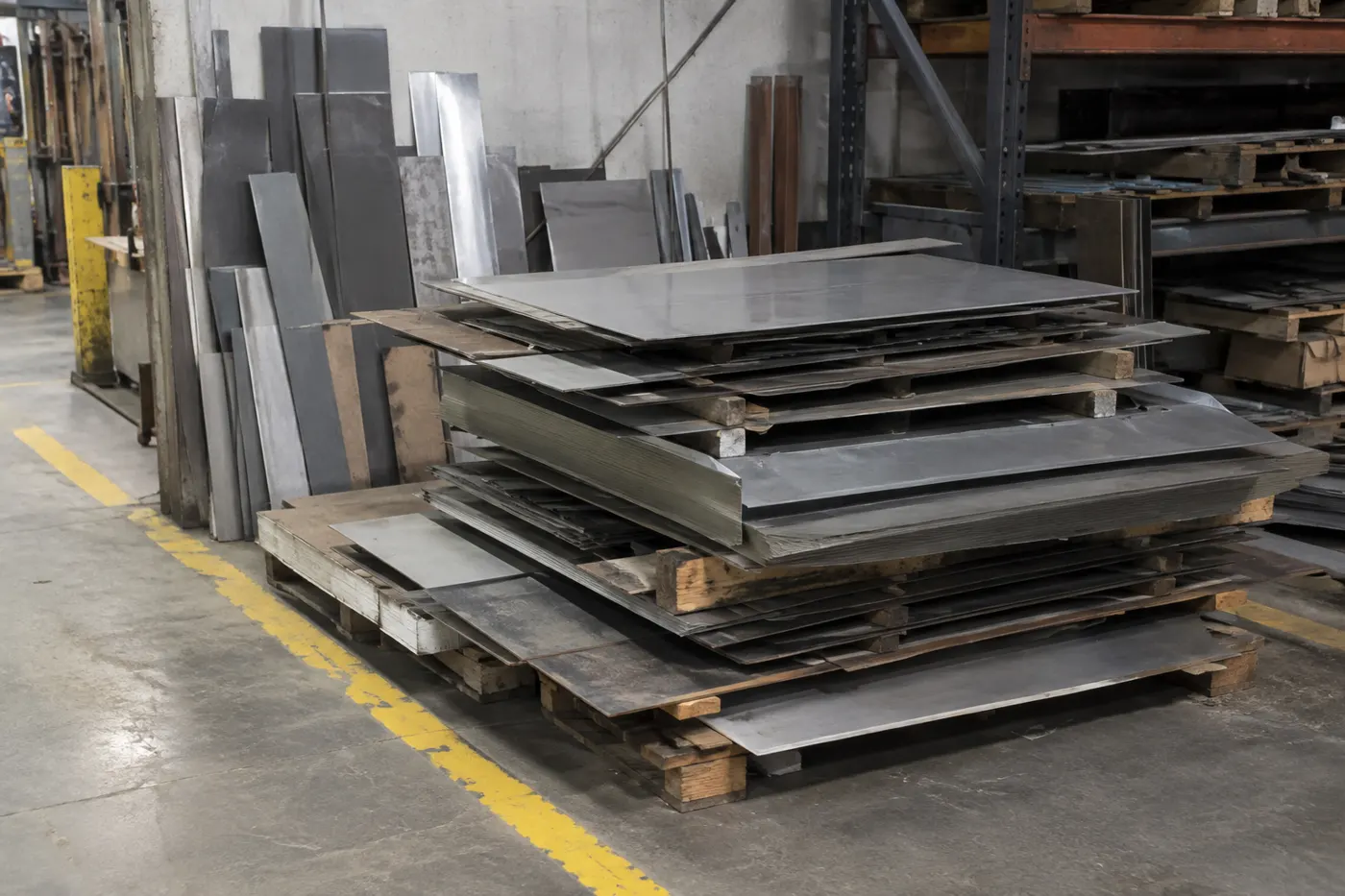
Most shops start the same way: sheets arrive banded on a skid, the skid goes on the floor, and the next delivery goes on top of it. Within a year the 16 gauge you need is under three skids of 11 gauge and a stack of aluminum, and someone is spending twenty minutes and two forklift moves to get one sheet to the laser.
Floor stacking also costs material. Sheets slide and scratch, corners get bent by forks, coated and brushed finishes get scuffed, and offcuts end up leaning against a wall until they are scrapped. A sheet metal storage rack gives every alloy, gauge and size its own slot, so you can see what you have, pull it in one move and stop buying stock you already own.
Signs it is time for a sheet rack
- Operators routinely move one or more skids to reach the sheet they need.
- You have reordered a gauge or alloy and later found it buried in the stack.
- Scrap from bent corners, scratched faces or forgotten remnants keeps growing.
- Sheets or offcuts lean against walls, columns or racking where they can tip.
- Your laser, punch or press brake waits on material more often than it waits on programs.
Types of Sheet Metal Storage Racks Compared
Buyers usually compare six designs. The right one depends on how many sizes and gauges you stock, how heavy a full stack is, and whether material moves by hand, by forklift or by overhead crane. Many shops end up with two: a bulk rack for full sheets and a small vertical rack for remnants near the machine.
| Rack type | How sheets sit | Loaded by | Best for | Trade-offs |
|---|---|---|---|---|
| Vertical (on-edge) sheet rack | Standing on edge between upright dividers | Hand, cart | Lighter gauges, aluminum, remnants and partial sheets near the machine; fast visual pick | Heavy plate is unsafe to handle on edge; sheets can bow if bays are half empty |
| Horizontal pallet-slot rack (e.g. TAB Stacker) | Flat on pallets or skids, one per slot, slots stacked high | Forklift | Full 4 x 8 to 5 x 10 ft sheets in bulk by gauge and alloy; small footprint | Needs a forklift aisle in front; one pallet per slot means planning slot count |
| Roll-out (drawer) sheet rack | Flat on drawers that pull fully out of the frame | Overhead crane, vacuum lifter, hand | Shops that pick single sheets by crane; heavy gauges without a forklift | Needs clear floor in front for the open drawer; higher cost per position |
| Cantilever arms | Bundles flat across arms, no front posts | Forklift, side loader, crane | Long sheet, plate and banded bundles in service centers and yards | Arm length and spacing must match sheet size to stop sag and tip loads |
| A-frame rack | Leaning on edge against a sloped center frame | Hand, forklift with care | Mixed panel and sheet stock, double-sided access, mobile versions for moving stock | Less dense than dedicated sheet racks; lean angle has to be respected |
| Automated vertical lift (e.g. Vidir) | Flat on pallets inside a powered tower | Built-in elevator to an I/O station | High sheet counts, many SKUs, laser cells that want material delivered | Highest investment; needs power, foundation review and planning |
Every one of these can be combined with long-stock storage. If you also store bar, pipe or extrusions, see our cantilever rack systems and plan the two together.
Vertical Sheet Racks: Fast Picks for Lighter Sheet and Remnants
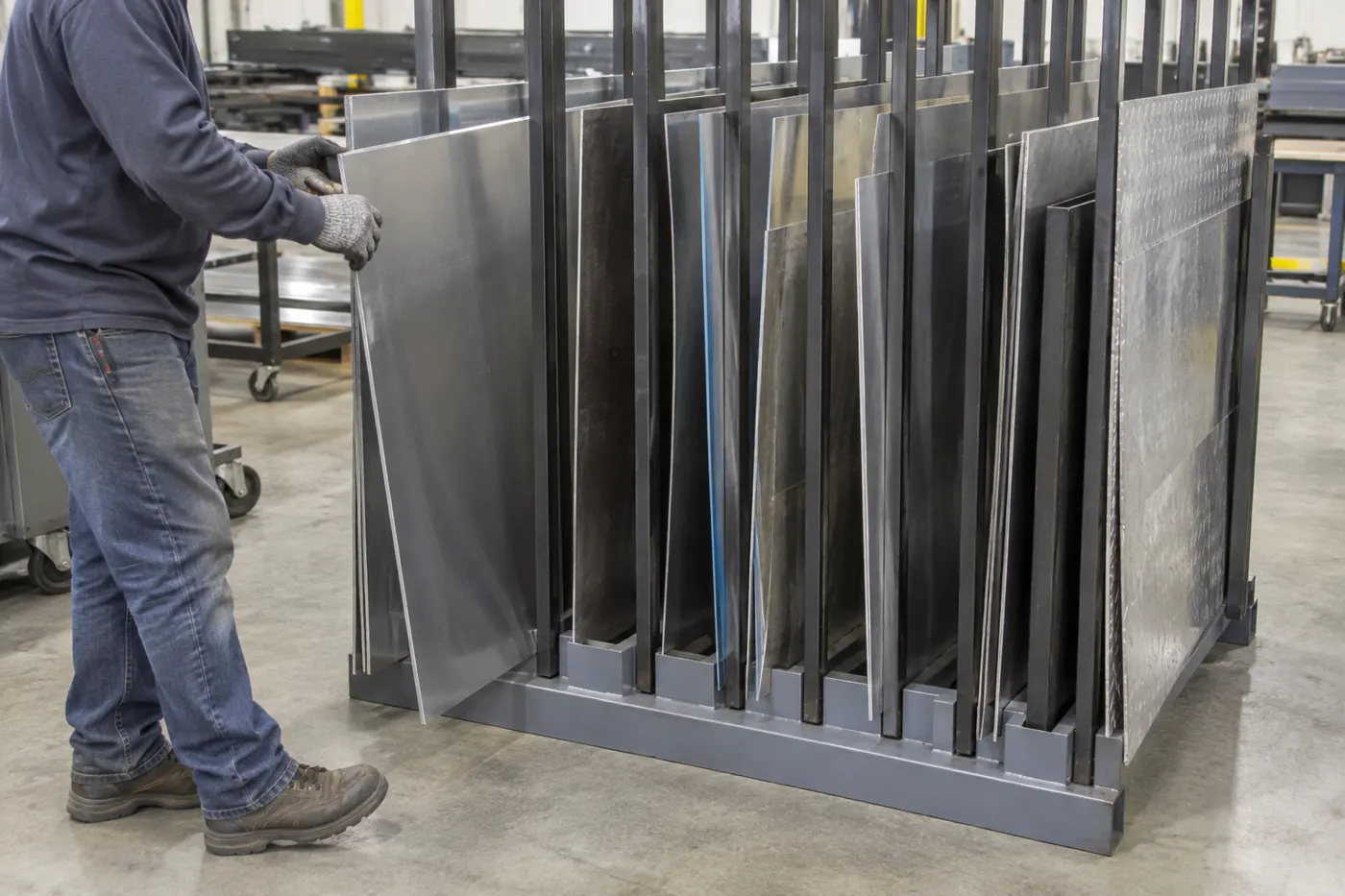
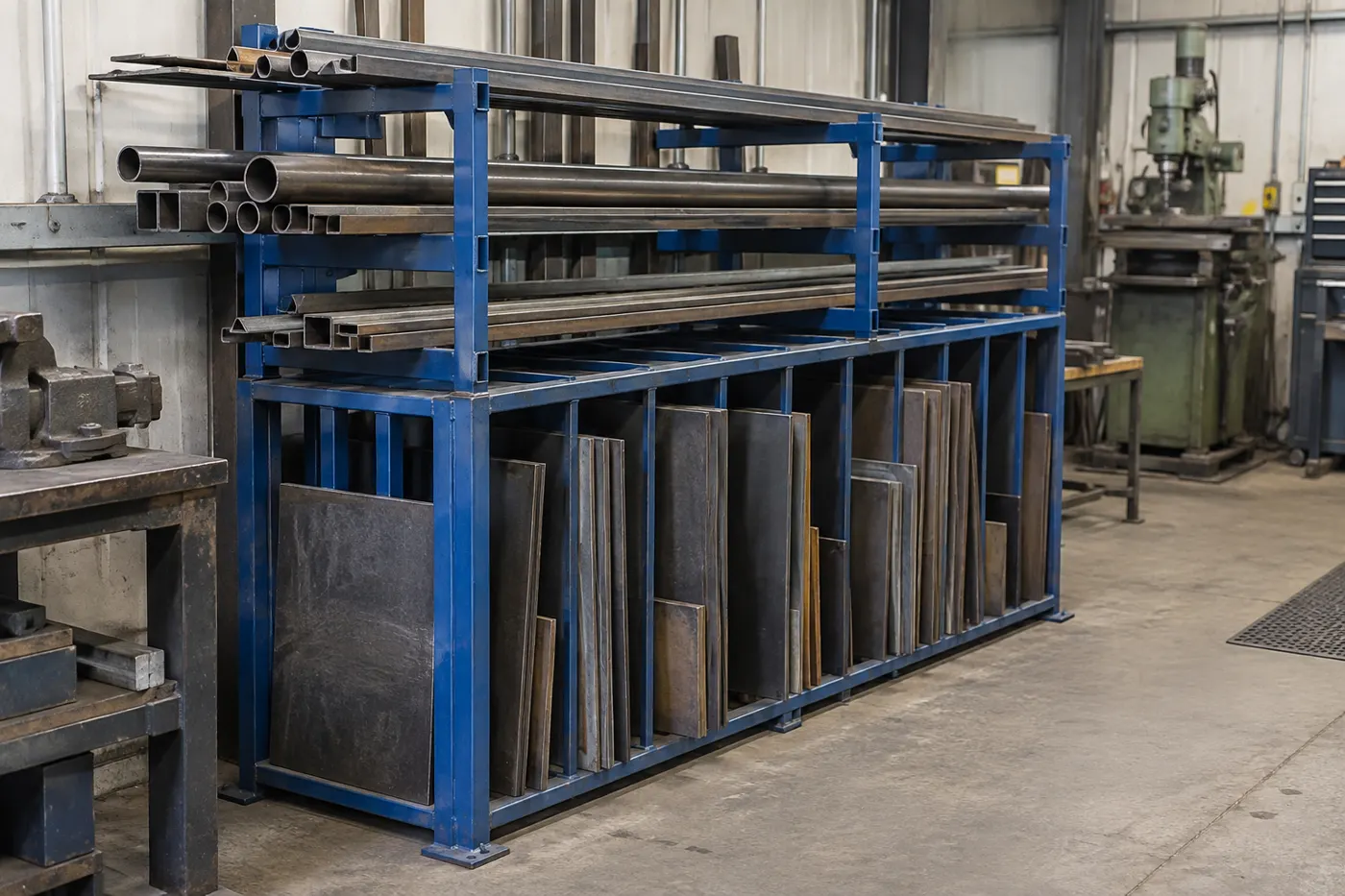
A vertical sheet rack stores sheets standing on edge in narrow bays separated by steel dividers. You see every sheet edge at a glance, walk up, and slide out the one you need without lifting anything off the top. That speed is why vertical racks sit next to shears, brakes and lasers in sheet metal, HVAC and sign shops.
The trade-off is weight. Standing a heavy sheet up and walking it out is a two-person job, and a partly empty bay lets thin sheets bow or slump. Vertical racks work best for 22 to 10 gauge steel, aluminum, stainless, polycarbonate and the remnants your nesting software keeps calling for.

What to look for in a vertical sheet rack
- Variable-height bays so short remnants and full sheets both stay visible; Vestil’s variable height sheet rack steps the dividers down from back to front.
- Bay width to fit a full stack of one gauge without a gap that lets sheets fall over.
- Floor channel or raised base that keeps edges off a wet or dirty floor.
- Lag-down points so the rack cannot walk or tip when sheets are pulled.
- Casters if you want to roll stock to the machine, like the mobile sheet rack in our shop row.
Horizontal Sheet Racks and the TAB Stacker
Horizontal sheet racks store sheets flat, which is how mills ship them and how they stay straightest. Small horizontal racks, like the Vestil 5-shelf unit in our store, hold 4 x 8 sheets on open shelves you can reach from all four sides. Bulk horizontal racks go further: each level holds a full skid of one gauge, and the levels stack high so dozens of sizes share the footprint of a couple of floor stacks.
TAB Stacker: 18 forklift slots in one frame
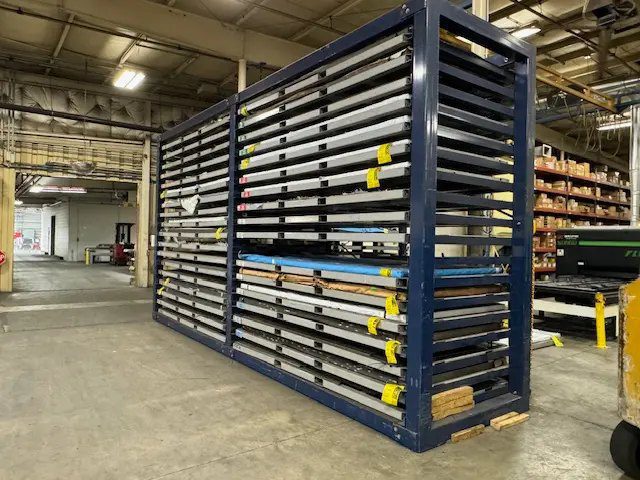
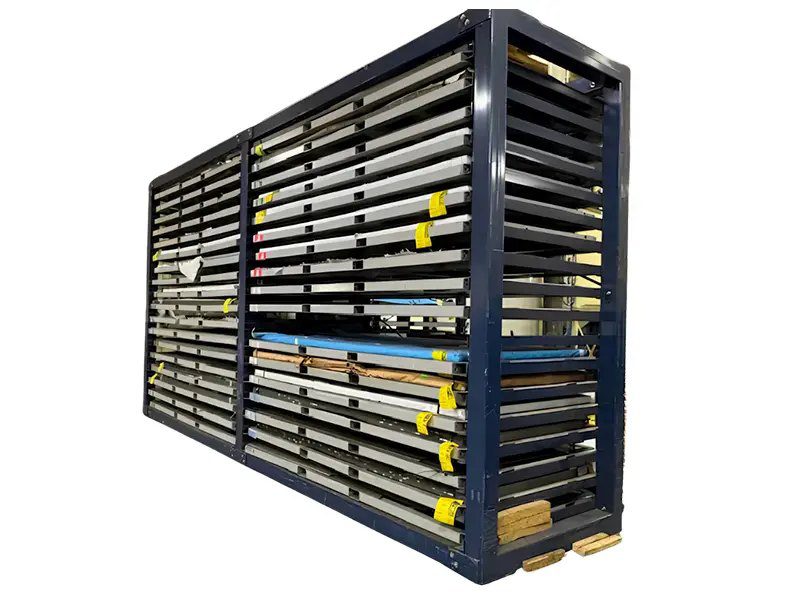
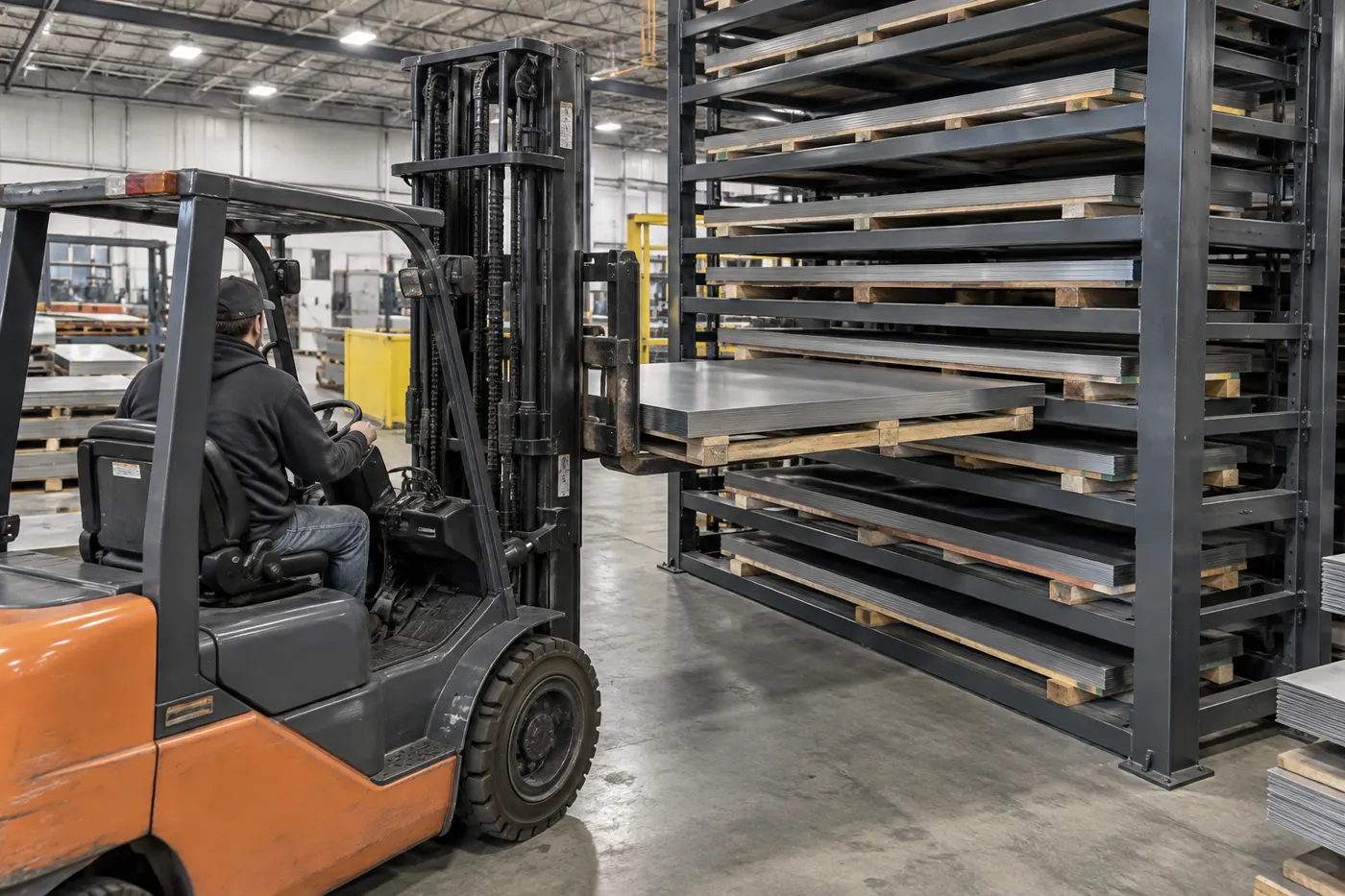
MH-USA is an authorized TAB Industries dealer. The TAB Stacker is a tall welded steel frame with 18 horizontal pallet slots, one above the other. Each slot holds a pallet of flat sheet, so the stock lies flat while the rack builds upward. A forklift drives up, picks the slot it needs through oversized fork tubes and carries one pallet to the machine.
TAB states the frame is built from heavy-duty welded steel, powder coated, and made in Reading, PA. No special attachment is needed on a standard forklift.
Photo: TAB Industries
| TAB Stacker spec (as stated by TAB Industries) | Value |
|---|---|
| Pallet slots | 18 |
| Rated load per pallet | 5,000 lb |
| Total rated capacity | 90,000 lb |
| Sheet size | 60 x 120 in. (5 x 10 ft) |
| Forklift entry | Oversized fork tubes, standard forklift |
| Construction and finish | Heavy-duty welded steel, powder coated |
When a forklift-loaded horizontal rack wins
Choose a pallet-slot rack when full sheets arrive by the skid and leave by the skid. Service centers, laser job shops and truck-body plants that run full 4 x 10 or 5 x 10 sheets through a cutting table usually fit this profile: the forklift drops a pallet at the table, the operator loads the machine, and the remainder goes back in its slot.
Plan the aisle as carefully as the rack. A counterbalance truck typically needs about 12 to 13 ft of clear aisle to square up with a slot, and the forks should be long enough to support the pallet without tipping the sheets.
Watch: TAB Stacker in a working shop
Video: TAB Industries
Roll-Out Sheet Racks: Crane and Vacuum-Lifter Access
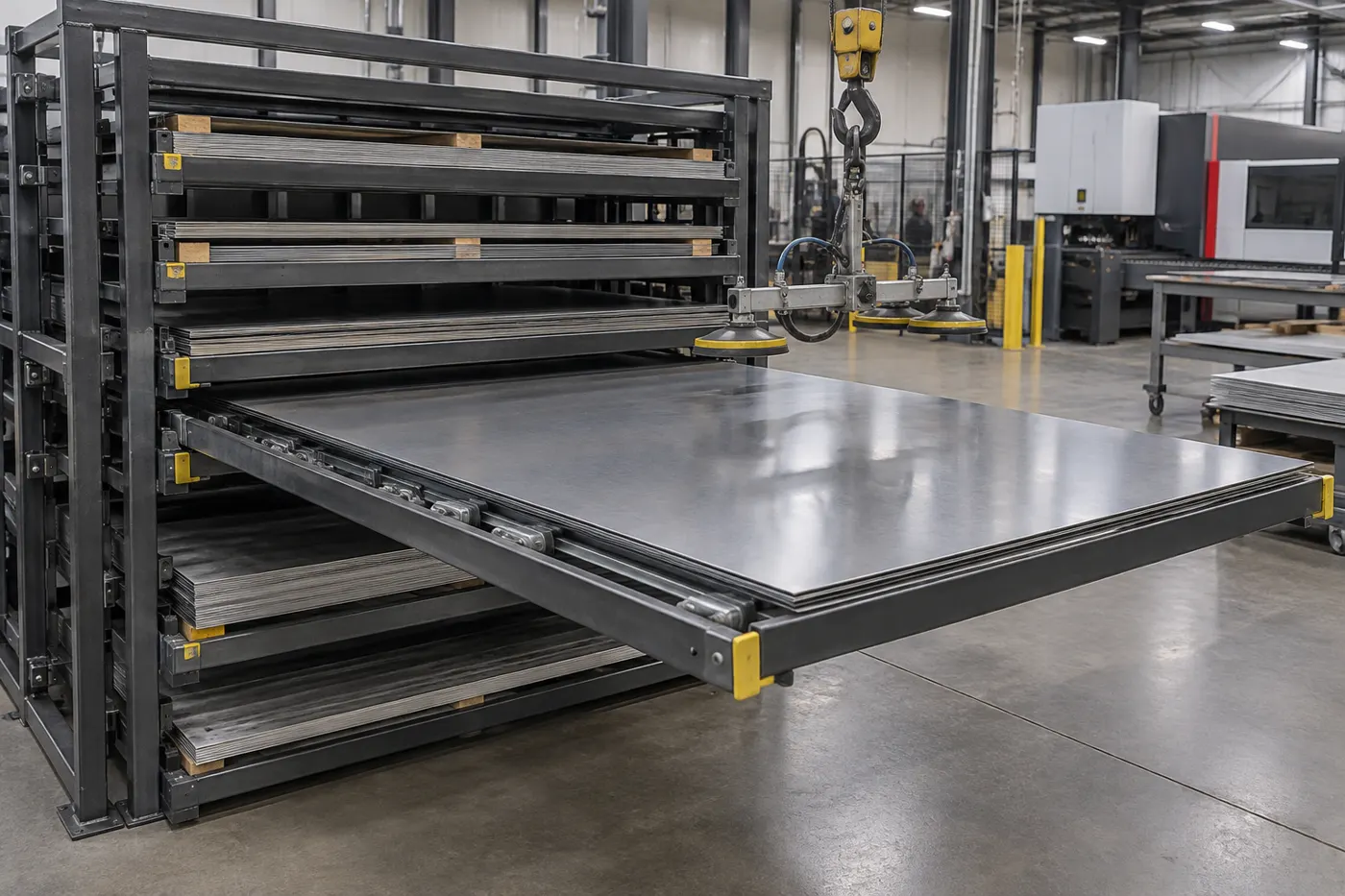
A roll-out sheet rack stores sheets flat on drawers that run on heavy rollers and pull fully out of the frame. With the drawer extended, nothing is above the stack, so an overhead crane or jib with a vacuum lifter can drop straight down and take the top sheet. One person can pick a single heavy sheet without a forklift and without touching the others.
Roll-out racks shine in shops that already run cranes or vacuum lifters at the cutting table. Most are built so only one drawer opens at a time, which keeps the frame stable, and many add a manual crank or powered drive for heavy drawers.
Drawer-style racks for smaller sheet, blanks and dies
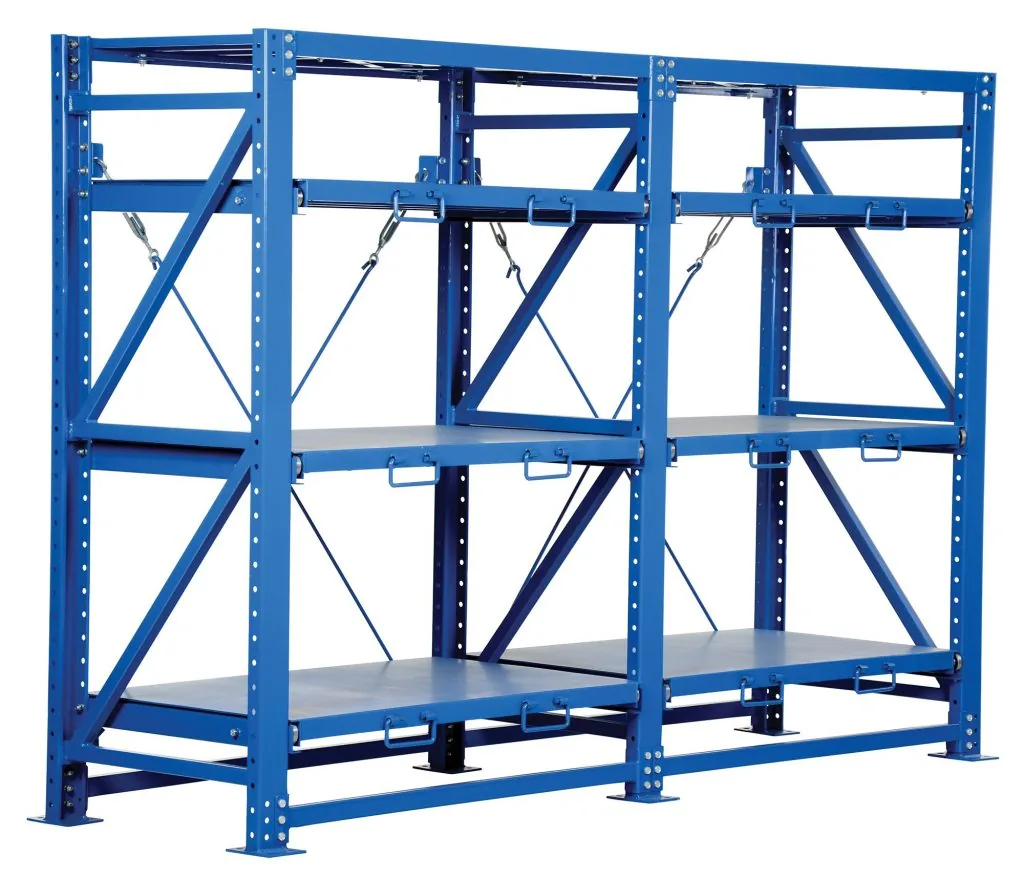
Not every shop needs a full 5 x 10 drawer. For cut blanks, small sheet, tooling plates and press dies, heavy-duty roll-out shelving does the same job at a smaller size. The Vestil heavy-duty roll-out shelving in our store pulls each shelf out so a hoist can lift straight down, with add-on bays to grow the run.
Plan the floor in front. A full-extension drawer needs roughly its own depth again as clear space, so a rack that is about 11 ft deep closed needs about 20 ft or more open. Mark that zone on the floor and keep it clear.
Cantilever Arms for Sheet Bundles and Plate
Cantilever rack is the bulk option when sheets are long, banded in bundles, or heavy enough to be called plate. With no front posts, a forklift, side loader or crane can set a bundle across the arms from any point along the run. Steel service centers often keep plate and sheet bundles on structural cantilever and lighter gauges in dedicated sheet racks.
Sheets are less forgiving than bar stock. Arm length should match the sheet width so nothing hangs past the tip, arm spacing must be close enough that thin sheets do not sag between arms, and decking on the arms helps with mixed sizes. Our guide to cantilever racking for metal and steel storage covers arm ratings and spacing in detail.
Photo: Interlake Mecalux (authorized use)

Cantilever or a sheet rack?
If one bundle weighs several thousand pounds and you move whole bundles, cantilever is usually the better value. If you pick single sheets of many gauges every day, a pallet-slot or roll-out sheet rack keeps each gauge separate and reachable. Plenty of shops use both side by side.
A-Frame Racks and Sheet Carts
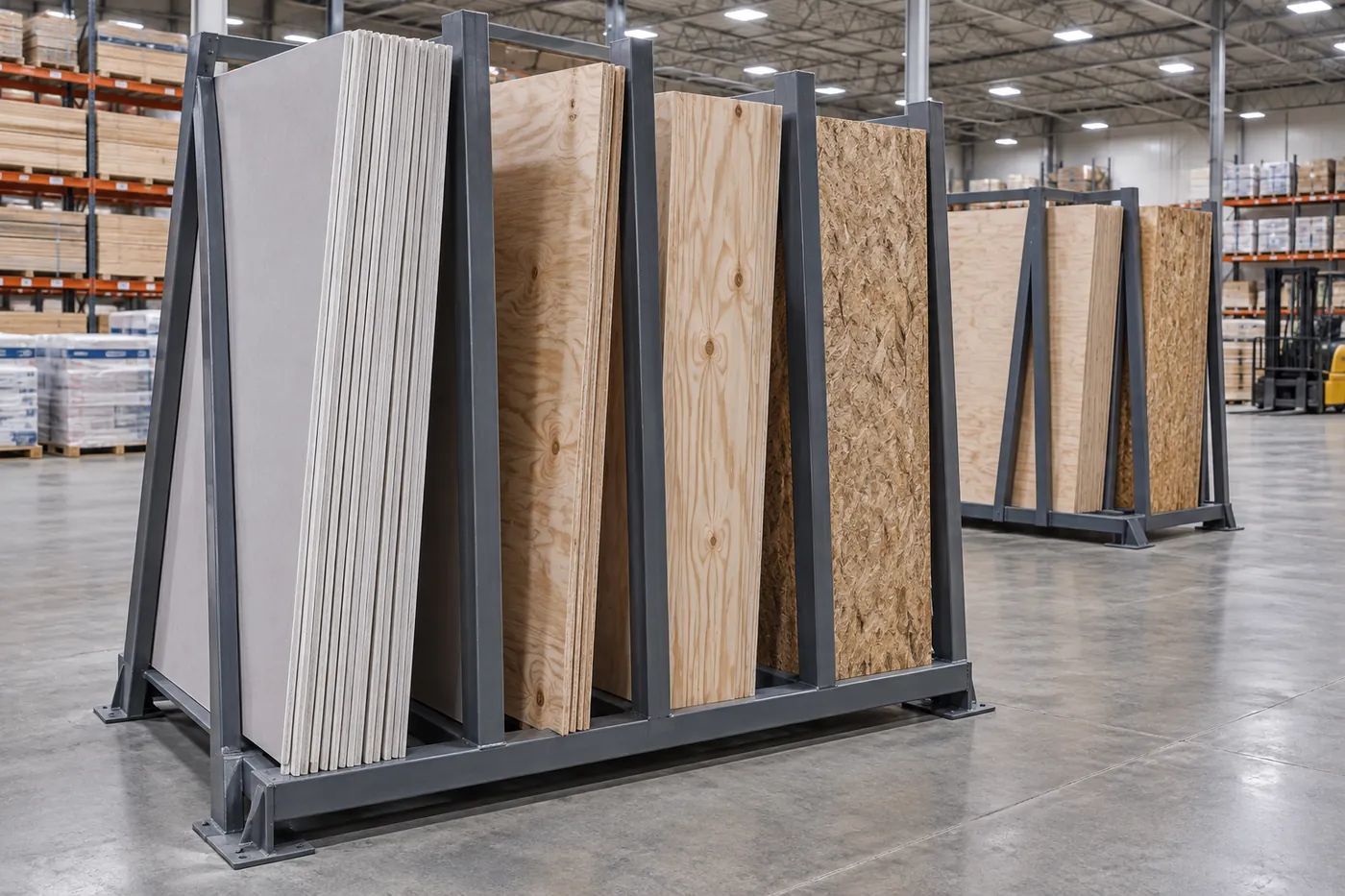
An A-frame rack leans sheets on edge against a sloped center spine, with a ledge or channel at the foot. Both sides load, so one frame can hold two families of stock, and the lean keeps sheets from falling forward. A-frames are common for mixed panel and sheet inventories, architectural metal and composite panels, and wherever a dedicated sheet rack would be overkill.
For wood-based panels on arms, our sheet goods cantilever rack guide covers plywood, MDF and drywall in detail. The photo here shows panel stock; the same frame works for metal sheet when the base and lean angle suit the weight.

Move sheets safely between rack and machine
A rack only solves half the problem if sheets are still carried by hand across the shop. A-frame and adjustable sheet and panel trucks carry several sheets on edge with a ledge and rails to hold them, and they park beside a vertical rack or the brake as mobile storage.
Browse sheet, panel and bar handling carts in our store, including Little Giant A-frame and adjustable panel trucks in several sizes.
Combination Bar and Sheet Racks
Machine shops, maintenance departments and school CTE shops rarely have room for a separate rack for every material. A combination rack puts vertical sheet slots in the base and horizontal arms or shelves on top for round bar, flat bar, tube and angle. One footprint, everything in sight.
Size the sheet section for your most common sheet and remnant sizes, keep the heaviest bar at the lowest arm level, and anchor the frame. If long stock is the bigger share, a dedicated vertical bar rack or a short cantilever run is the better base; see vertical bar and pipe racks.
When to Automate: Vertical Lift Systems for Sheet Metal
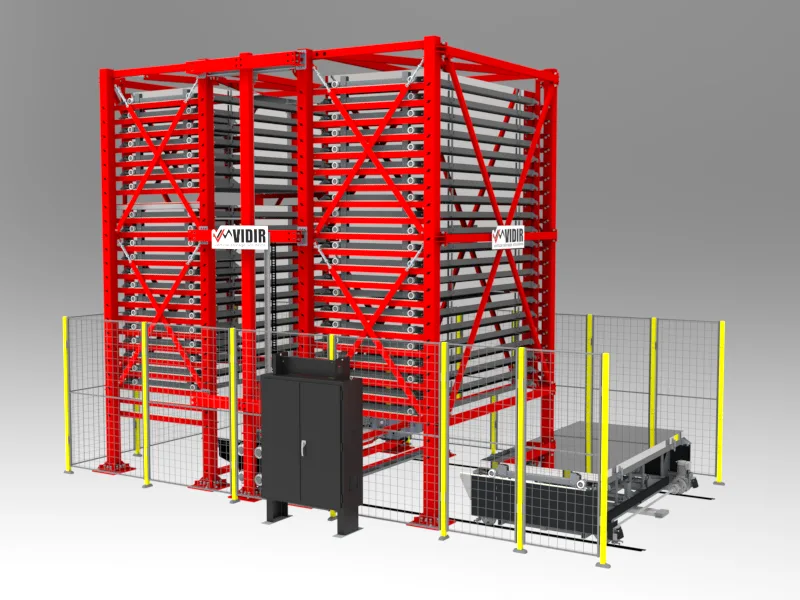
Past a certain number of sizes and alloys, even a well-organized rack means a lot of forklift time. An automated sheet metal vertical lift system stores pallets of sheet inside a powered tower and delivers the pallet you call up to an input/output station at working height, often right beside the laser.
MH-USA sells and installs Vidir vertical storage. The dual-tower sheet metal system pairs two storage towers with a central elevator. Read the details on our Vidir dual-tower sheet metal VLS page, or ask us to compare it with a TAB Stacker or roll-out rack for your volume.
Image: Vidir
Capacity: How Much Does a Stack of Sheet Weigh?
Rack ratings are given per level, per drawer or per slot, and a stack of sheet gets heavy faster than most people expect. Steel weighs about 40.8 lb per square foot per inch of thickness, so you can estimate any stack. The table uses common gauges and a 5 x 10 ft sheet (50 sq ft); aluminum is roughly one third the weight of steel at the same thickness.
| Material and thickness | Approx. lb per sq ft | One 4 x 8 sheet | One 5 x 10 sheet | 5 x 10 sheets per 5,000 lb slot |
|---|---|---|---|---|
| 16 ga steel (0.060 in.) | 2.5 | 80 lb | 125 lb | about 40 |
| 14 ga steel (0.075 in.) | 3.1 | 100 lb | 156 lb | about 32 |
| 11 ga steel (0.120 in.) | 5.0 | 160 lb | 250 lb | about 20 |
| 1/4 in. steel plate | 10.2 | 327 lb | 510 lb | about 9 |
| 0.125 in. aluminum | 1.8 | 56 lb | 88 lb | about 56 |
Figures are rounded planning estimates; stainless runs slightly heavier than carbon steel, and your mill certs give exact weights. Always compare the heaviest stack you plan to store with the rated load of one level, and remember that the rack’s total rating is not a license to overload a single level.
Floor Space Math: Floor Stacks vs. a Sheet Rack
The value of a rack is easiest to see in square feet. Here is an illustrative comparison for a shop that keeps 12 different gauges and alloys of 5 x 10 ft sheet.
Floor stacks
Each size gets its own skid so nothing is buried: about 12 skids at roughly 5 x 10 ft, plus 3 ft of walking and fork access around each. That is on the order of 1,000 sq ft, and it still grows the day a 13th size arrives.
Pallet-slot rack
One frame a little larger than the sheet holds every size in its own slot, with one forklift aisle in front. Frame plus aisle typically comes to a few hundred sq ft, with slots to spare.
Roll-out rack
Similar frame size but you add the open-drawer zone in front instead of a forklift aisle. Good when that zone doubles as the crane path to the cutting table.
Vertical rack
For remnants and light gauge, a 4 x 8 ft vertical rack can hold dozens of partial sheets in the space of one floor skid, right beside the machine.
Do your own math in five minutes
Count your sizes and gauges, multiply by the floor area each stack really uses including access, then compare with the rack footprint plus its loading zone. Send us the list and a photo of the area and we will lay out the options to scale.
Forklift, Crane or Hand Loading?
How material moves in your building decides the rack more than anything else. Match the rack to the equipment you already run, or budget for the equipment the rack needs.
Sheet Metal Storage Safety
Sheet edges cut, stacks shift and racks tip if they are loaded wrong. OSHA’s general rule for material storage, 29 CFR 1910.176(b), says stored material must be stacked, blocked, interlocked and limited in height so it is stable and secure against sliding or collapse. In practice:
- Anchor every rack to the slab per the manufacturer, and check the slab can carry the loaded frame.
- Post the rated load per level, drawer or slot on the rack and never exceed it.
- On roll-out racks, use the interlock so only one drawer opens at a time, and close drawers after each pick.
- Keep vertical bays full or use restraint bars so thin sheets cannot fall out sideways.
- Wear cut-resistant gloves and sleeves; edge guards on carts protect hands and the sheet.
- Never climb a rack or stand under a load on a crane or vacuum lifter.
- Inspect for bent arms, damaged slots and loose anchors after any forklift impact.
Applications: Who Uses Sheet Metal Storage Racks
Storing wood panels instead? See how a shop handled plywood and sheet goods in our Premier Woodworking sheet goods racking project (wood panels, not metal, but the same organize-by-size logic).
Sheet Metal Rack Buying Checklist
| Question | Why it matters |
|---|---|
| Largest sheet size (4 x 8, 4 x 10, 5 x 10, 5 x 12)? | Sets slot, drawer or bay size; plan for the biggest, not the most common |
| How many sizes, gauges and alloys? | Sets the number of slots or bays; add 20% for growth |
| Heaviest stack per position? | Compare with rated load per level or slot |
| Full sheets, remnants or both? | Often means one bulk rack plus one small vertical rack |
| Forklift, crane, vacuum lifter or hand? | Decides pallet-slot vs. roll-out vs. vertical |
| Clear height and aisle space? | Top slot height, mast height, drawer extension zone |
| Slab thickness and condition? | Loaded frames concentrate weight on the base plates |
| Finish-sensitive material? | Coated, brushed or polished sheet may need liners or flat storage |
| Will stock move to machines? | Mobile sheet racks and carts reduce hand carrying |
| Future automation? | Leave room near the laser for a vertical lift system later |
How We Quote and Install a Sheet Storage System
Send your stock list
Sheet sizes, gauges, alloys, stack weights and how material moves today, plus a photo of the area.
Layout and options
We compare vertical, horizontal, roll-out, cantilever and automated options to scale.
Quote with freight
Rack, accessories, anchors, freight to your dock and installation in one number.
Install
Placement, leveling and anchoring, coordinated with your forklift and crane paths.
Support
Add slots, carts or a remnant rack later as your inventory changes.
Get a free quote
Tell us what you are storing, the room size and your timeline. A project specialist will follow up with layout options and pricing. Prefer to talk? Call (800) 326-4403.
Sheet Metal Storage Rack FAQs
What is the best way to store sheet metal?
Vertical or horizontal sheet rack: which is better?
How much weight can a sheet metal rack hold?
What size sheets will a sheet rack hold?
What is a roll-out sheet rack?
Can I store sheet metal on cantilever rack?
Do sheet metal racks need to be anchored?
How much floor space does a sheet rack save?
Do you sell the TAB Stacker?
Get Your Sheet Metal Off the Floor
Send your sheet sizes, gauges and how you handle material for a free layout and freight-included quote.