
Installed Boltless Shelving for an Apartment Building: Ogden Housing Authority, Ogden, UT
How a Utah public housing agency outfitted storage rooms across several floors of an Ogden apartment building with boltless shelving, received, delivered and installed for them because the building had no way to take a freight delivery.
Ogden, UT
Project location
Public housing
Industry
14 gauge boltless
Shelving line
Received and installed
Service scope
The Project: Storage Rooms in an Ogden Apartment Building
Ogden Housing Authority, the Housing Authority of the City of Ogden, owns and manages affordable housing in Ogden, Utah. Like any property owner, it needs back-of-house storage that works: rooms where supplies, linens, clothing and building stock can be sorted and found again instead of piling up on the floor.
In January 2025 the authority asked Material Handling USA to shelve storage rooms on several upper floors of one of its Ogden apartment buildings. Jessica Ferguson, our director of material handling sales, planned the shelving floor by floor and quoted it with installation included. Chris Rodgers, our director of sales, answered the authority’s technical questions and released the order on January 31, the same day the purchase order arrived.
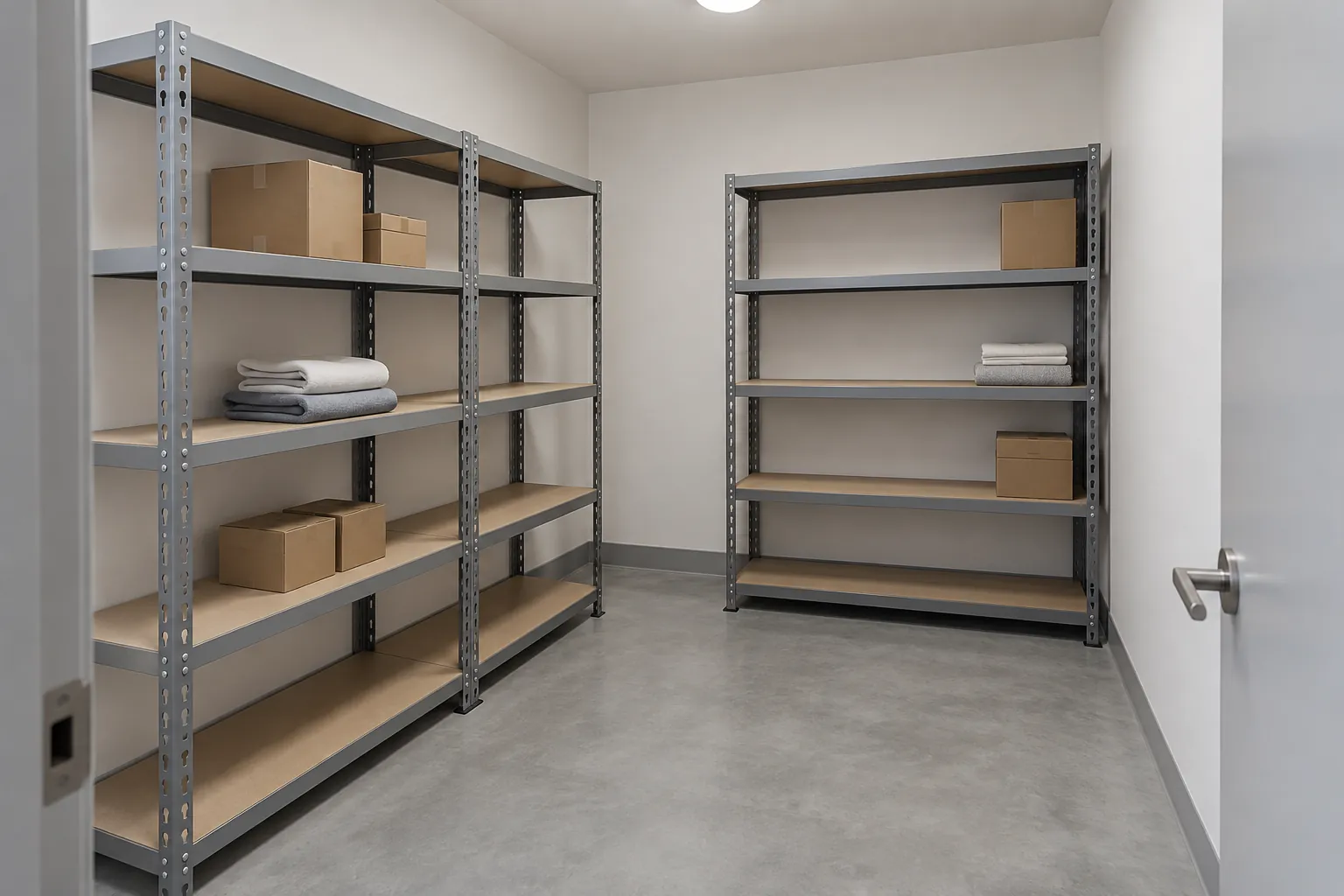
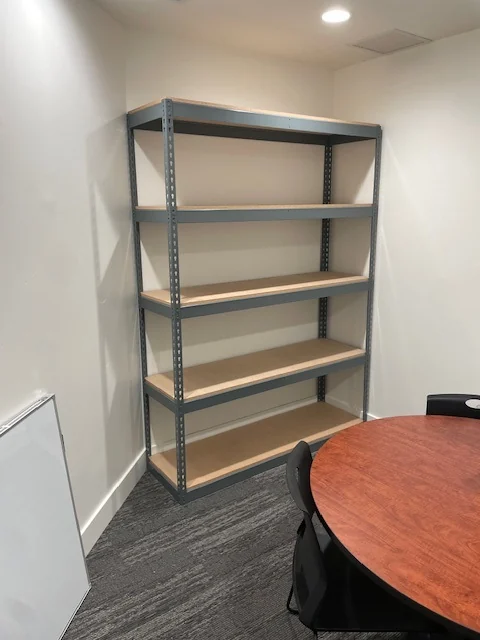
The photos on this page were taken by the installation crew on the day of the install. They show the finished shelving in several rooms, some already stocked with folded clothing. The equipment is plain, grey, 14 gauge boltless shelving with particle board decks. What makes the project worth writing up is everything around the steel: the questions a public buyer asked before signing, how the delivery was handled for a building with no loading dock, a unit added after the order was placed, and a short punch list that was closed out properly.

This is one of the Utah projects behind our boltless shelving in Salt Lake City service page, alongside carpenter shop shelving for Granite School District, archive box storage for Kirton McConkie and RiveTier shelving for Tinks Superior Auto Parts. The product family is covered in depth on our boltless shelving hub, part of our wider shelving solutions range.
The Questions a Public Buyer Asked Before Signing
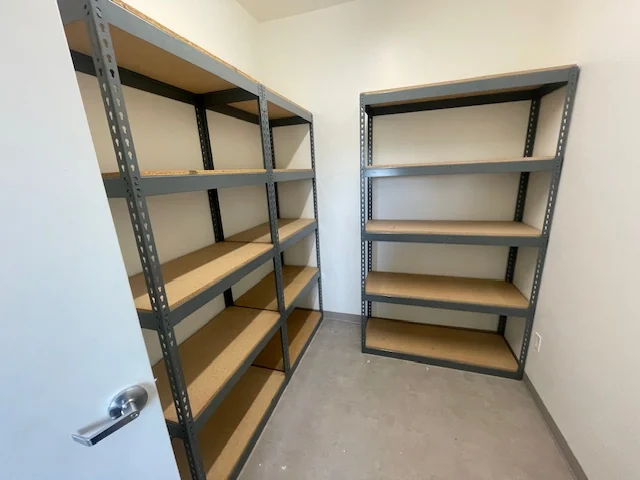
Before issuing a purchase order, the authority’s leadership asked for a submittal or cut sheet and listed exactly what it wanted to know: the type of construction, the thickness of the particle board and the steel, how much weight the shelving could hold, and whether it would be secured to the walls. Those are the right questions, and every facilities or property manager should ask them before buying shelving for a building that residents and staff use every day.
Our answers went back the same morning, and the purchase order followed within the next two hours. The table below records what was confirmed in writing for this system. It is worth noting how the anchoring question was answered: boltless shelving of this type is designed to stand on its own foot plates and is not normally fastened to the wall. Where a unit does need to be secured, the foot plates are where that happens, at the floor.
| Buyer question | Answer confirmed for this system |
|---|---|
| Type of construction | Boltless rivet shelving: steel angle posts with keyhole slots, rivet beams that lock in without nuts and bolts, particle board decks |
| Deck thickness | 5/8 inch particle board |
| Steel thickness | 14 gauge posts and beams |
| Weight capacity | Rated at 900 lb per shelf level for this system |
| Secured to the walls? | Not typically. Units stand on foot plates, and any securing is done at the floor through the foot plates |
Capacity is system-specific
The 900 lb figure is the rating given for this particular shelving line and these unit sizes. Ratings change with beam length, beam type and manufacturer, so ask for the rating of your exact configuration on your own quote rather than borrowing a number from another project.
Scoping the Order: What Came Off and What Went Back On
The first proposal included storage bins as well as shelving. When the authority reviewed it, the answer was clear: the shelving and installation were right, but the bins were not needed at that time. The quote was revised to shelving, freight and installation only. In the revision the installation line briefly dropped off; the buyer caught it, and the corrected quote went back the same morning with installation restored. Lead time was about two weeks for material and closer to three weeks with installation, and the purchase order was issued that day.
Plan by floor
The shelving was drawn up floor by floor, with a mix of shelf depths and widths to suit each storage room.
Answer the technical questions
Deck thickness, steel gauge, capacity and anchoring were confirmed in writing before the PO.
Revise the scope
Bins removed, installation confirmed, freight included in one landed quote.
Release the order
The component order went to the manufacturer and the install order to the installation crew the same day.
Install and close out
The crew received, delivered and installed the shelving, then returned to finish a short punch list.
Tip for property and facilities managers
Keep optional items such as bins, labels or dividers as separate lines on the quote. You can approve the shelving now and add accessories later without re-pricing the whole order. Our boltless shelving buying guide walks through the other decisions to make before you order.
What Was Specified: A Component-Level Look
The customer quote described the job simply as boltless shelving to match an attached drawing. Behind it, the order to the manufacturer, Maverick Manufacturing, was written as a list of parts. Reading that list is the quickest way to understand how a multi-room boltless project goes together, and it is the same list you would use to reorder, extend or repair the shelving later.
| Component on the order | What it does |
|---|---|
| 84 inch angle posts, 1-1/2 x 1-1/2 inch, 14 gauge, grey | The uprights. Keyhole slots along the full height let the beams lock in at any level. |
| Double rivet beams | Carry each shelf level. Used across the widths and depths on this job for a stiff, square frame. |
| Single rivet beams | A lighter beam used on some levels in the two most common widths, where the load and span allowed. |
| Tie plates | Join the posts of neighboring units so a run of shelving shares posts and stands as one rigid assembly. |
| Single left and right foot plates | Fit under the end posts of each run to spread the load and protect the floor. |
| Double foot plates | Fit under shared posts where two units meet inside a run. |
| 5/8 inch particle board decks | The shelf surface, in depths chosen room by room. |
Two details on that list are worth explaining. The first is the tie plates and double foot plates. They show that much of this shelving was built as continuous runs of connected units that share posts, rather than a row of separate freestanding units. A connected run uses fewer posts, looks tidier along a wall and is more stable, because each unit braces its neighbor.
The second is a note from the manufacturer on its quote: it does not stock short single rivet beams for the front-to-back direction, and they are typically not required. In practice that means the short end beams on a unit are double rivet, even when the long front and back beams on a lighter level are single rivet. Knowing that saves a round of substitutions when you order.
For a deeper comparison of the two beam types, see our low-profile boltless shelving case study for Source Energy Company, which was built around the single versus double rivet decision. Replacement posts, beams and decks are listed on our boltless shelving accessories page, and the wider product family is explained on our rivet shelving page.
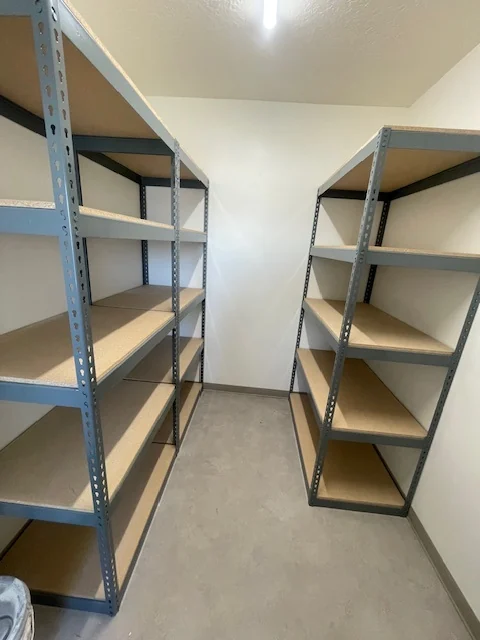

Particle board was the right deck for these rooms. It gives a solid, continuous surface that folded clothing, linens and small boxes cannot fall through, it is quiet and easy to wipe down, and a damaged deck is inexpensive to replace. Wire decking suits rooms where sprinkler coverage or airflow matters, and steel decking suits damp areas or heavy point loads. Our boltless shelving decking options page compares all three.
Most of the units in the photos carry five shelf levels, spaced evenly from the floor to the top of the posts. For soft goods and boxed supplies, five levels on a tall post is a good balance: the lowest level keeps items off the floor for cleaning, and the top level is still reachable for most staff.
Receiving Shelving When the Building Has No Loading Dock
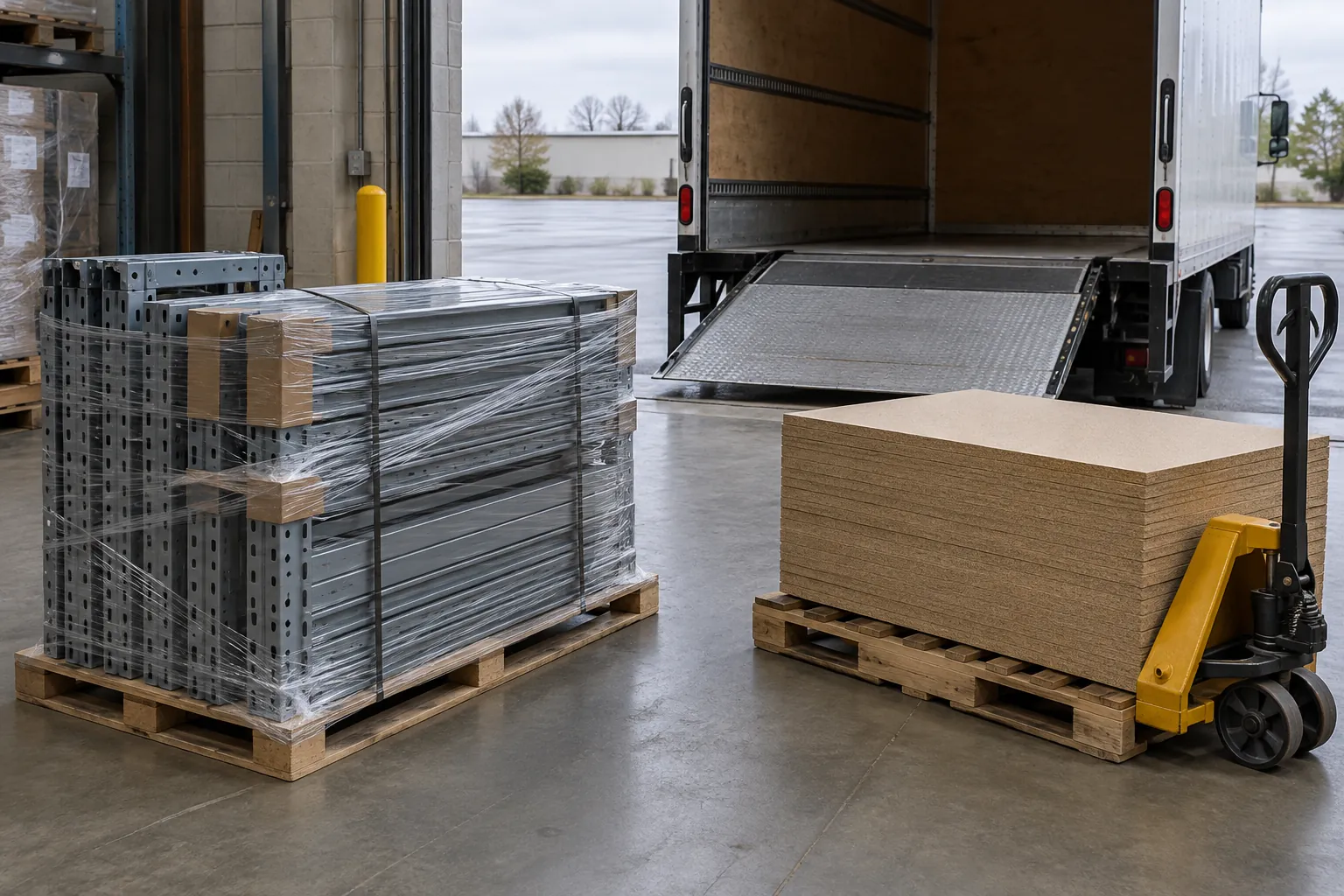
Boltless shelving ships as long bundles of posts and beams plus heavy stacks of decks on pallets, usually on an LTL freight truck. That works well for a warehouse with a dock and a forklift. It does not work for an occupied apartment building, and this building had no practical way to receive a freight delivery.
The answer was to make receiving part of the installation scope. The shelving shipped to our installation partner’s warehouse in West Valley City instead of the building. The crew received and checked it there, then delivered it to the Ogden building and installed it floor by floor. The authority never had to schedule a freight appointment, find someone to sign for pallets, or store loose steel in a hallway.
This receive, deliver and install arrangement is the model we recommend for apartment buildings, offices, schools and clinics without a dock. It costs more than freight to the curb, but it removes the risks that tend to cost even more: refused deliveries, liftgate surcharges, damaged floors and components left sitting for days. Our boltless shelving installation page explains the service in more detail.
Adding a Unit After the Order Was Placed
About a week after the order was released, the authority called to add one more section of shelving: a wider unit with five particle board levels. By then the manufacturer had already processed the first order, so the extra unit could not simply be added to it. It went on a second, small order instead.
To keep the project on one delivery and one installation visit, the add-on was priced on the basis of shipping and installing with the main order, and the authority was asked to approve it by the end of that day. It approved the same morning, and the second order was released to ship together with the first. The installation date was confirmed in the same exchange.
The lesson for buyers is simple. Late additions are easy with boltless shelving, because a new unit uses the same posts, beams and decks as the rest of the system. What costs time and money is a separate shipment and a second trip for the installers. If you think you may need one more unit, say so before the order ships.
The Punch List, and How It Was Closed Out
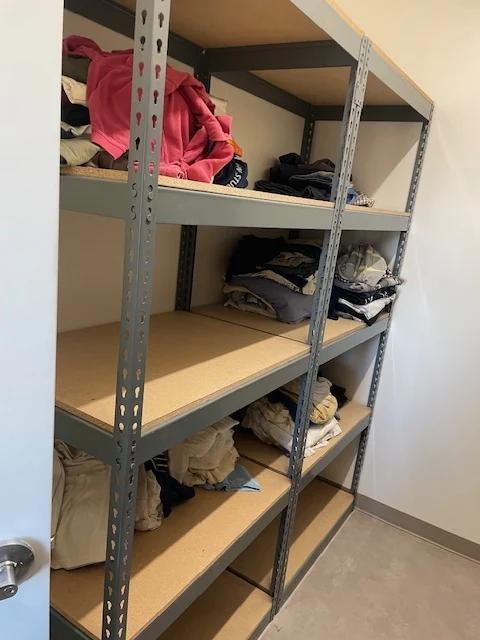
The installation took place in late February 2025. At the end of the day the crew’s lead installer sent photos and a signed work order that listed a small punch list: a handful of beams were short for two units on the top floor. The rest of the shelving was complete, and the remaining parts were left on site at the customer’s request.
The shortage was on our side. The beam count on our component order had come up short for those units, and we owned it the day it was found. A replacement parts order went to the manufacturer, our project manager coordinated the freight once the parts shipped, and the installation crew returned to finish the last units. When the authority asked for an update on the top floor, we told it when the parts would arrive and when the crew would be back.
We include this because it is what actually happened, and because it is the most useful planning lesson on the page. On a multi-room, multi-floor job, the beam count is the easiest thing to get wrong: every level needs four beams, the mix of single and double rivet beams varies by level, and shared posts change the post and foot plate counts. Counting beams per room from the drawing, and labeling the components by floor before they leave the warehouse, catches most shortages before install day.
| Count check | How to verify it |
|---|---|
| Beams | Four per shelf level, per unit. Split the count by beam length and by single or double rivet. |
| Posts | Four per freestanding unit, two fewer for each unit that joins an existing run. |
| Foot plates | One per post: single plates at the ends of a run, double plates under shared posts. |
| Tie plates | Where posts of neighboring units meet, per your manufacturer’s instructions. |
| Decks | One per level, per unit, in the correct width and depth for each room. |
Planning Checklist for Housing Authorities and Property Managers
If you manage apartment buildings, affordable housing or other occupied properties in Ogden, Salt Lake City or anywhere along the Wasatch Front, these are the steps that make a shelving project like this one go smoothly.
- Ask for a cut sheet or submittal before the PO: construction type, deck thickness, steel gauge and the capacity of your exact configuration.
- Decide how the shelving will be secured, and confirm that foot plates are included on every post.
- Plan room by room and floor by floor, and choose shelf depth for what each room actually stores.
- Keep optional accessories such as bins as separate quote lines so the shelving can be approved on its own.
- If the building cannot take a freight delivery, make receiving, delivery and carry-in part of the installation scope.
- Add any extra units before the order ships so everything arrives and installs in one visit.
- Ask for components to be labeled by floor or room, and check beam counts per room against the drawing.
- Get a signed work order and photos at the end of the install, with any punch list items written down.
For Utah projects, start with our Salt Lake City boltless shelving page or the statewide Utah boltless shelving overview. If your buildings also need secure tenant storage, our apartment and condo storage cage guide covers that side. And if you already know exactly what you need, you can order boltless shelving directly.
What we verified for this case study
This page is built from the project’s own records: the two Zoho deals, the customer quotes, the manufacturer’s quote and invoice, our component and installation purchase orders, the installer’s estimate, invoice, signed work order and photos, and the email correspondence with the authority and the installer. Order values, quantities, unit and room dimensions, the building name and address, the floor plan and all contact names are deliberately not published.
Shop Boltless and Rivet Shelving Online
Buy select items directly from our online store, or request a quote for volume, custom sizes and freight-rated orders.


Frequently Asked Questions
What gauge steel is boltless shelving?
How much weight can a boltless shelf hold?
Does boltless shelving need to be anchored to the wall?
Can you install boltless shelving in a building without a loading dock?
Can I add another shelving unit after I place the order?
What are tie plates on boltless shelving?
Do you install boltless shelving in Ogden and northern Utah?
Shelving an Apartment Building or Housing Property in Utah?
Tell us the rooms and what they store. We will plan the shelving floor by floor and quote it with receiving, delivery and installation included.