
Evidence Lockers: Pass-Through, Refrigerated and Temporary Evidence Lockers
Steel evidence lockers that lock the moment an officer closes the door, so only your property and evidence staff can open them. Compare pass-through and non-pass-through lockers, refrigerated and electronic options, compartment sizes and wall requirements, then get a free locker layout and quote for your station.

2-24
Doors per locker bank
16 ga
All-welded steel
36-46°F
Refrigerated range
72 hrs
Short-term storage
What Evidence Lockers Do
Evidence lockers are temporary, self-locking compartments where officers deposit packaged evidence and property at the end of a call or shift. Once the door closes and the latch is thrown, the officer can no longer open it. Only the property and evidence custodian can, usually from inside the secure evidence room.
That one-way handoff is the point. It documents the first transfer in the chain of custody without a second person on duty at 3 a.m., and it keeps evidence out of desks, patrol cars and personal lockers. Evidence lockers are short-term storage: items move to long-term shelving, cages or refrigerators once they are logged.

| Evidence locker type | What it solves | Typical use |
|---|---|---|
| Pass-through (pass-thru) | Officer loads from the hallway; custodian empties from inside the evidence room | Main station intake wall |
| Non-pass-through | Loads and empties from the same side with a key, keypad or override | Substations, garages, rooms with no shared wall |
| Refrigerated | Holds wet or biological evidence cold until it is logged | Blood kits, urine, DNA swabs, wet items |
| Electronic / smart | Keypad, card or fob access with an audit trail of every door event | Agencies tracking every deposit digitally |
| Long-item and mixed banks | Tall, wide and small doors in one bank for long guns, bags and small items | Rifles, clothing, phones, bulky items |
| Digital evidence | Locking compartments sized for phones, laptops and drives | Digital forensics units |
Evidence lockers are one part of a full evidence room. For long-term shelving, cages, refrigerators and room layout, see our evidence storage solutions guide.
Pass-Through vs. Non-Pass-Through Evidence Lockers
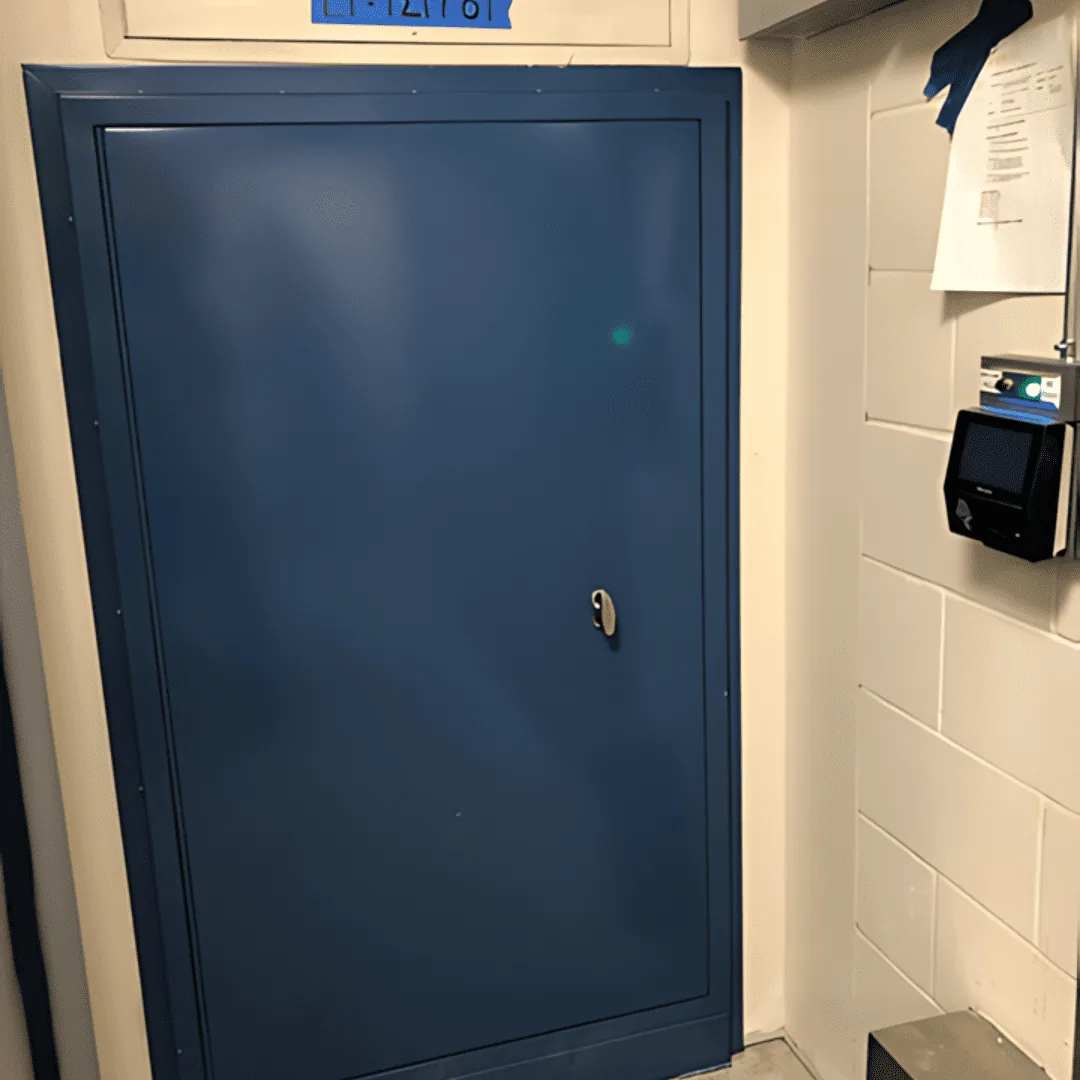
Pass-through evidence lockers are built into the wall between the officer processing area and the secure property room. The front doors face the officers. On the evidence room side, a large rear access door (one per column or one for the whole unit) lets the custodian collect items and reset each compartment.
Because nobody without evidence room access ever enters the room, pass-through lockers give the cleanest chain of custody. The International Association for Property and Evidence (IAPE) describes an assortment of lockers in a common wall between the property room and the packaging room as the most convenient form of temporary storage.
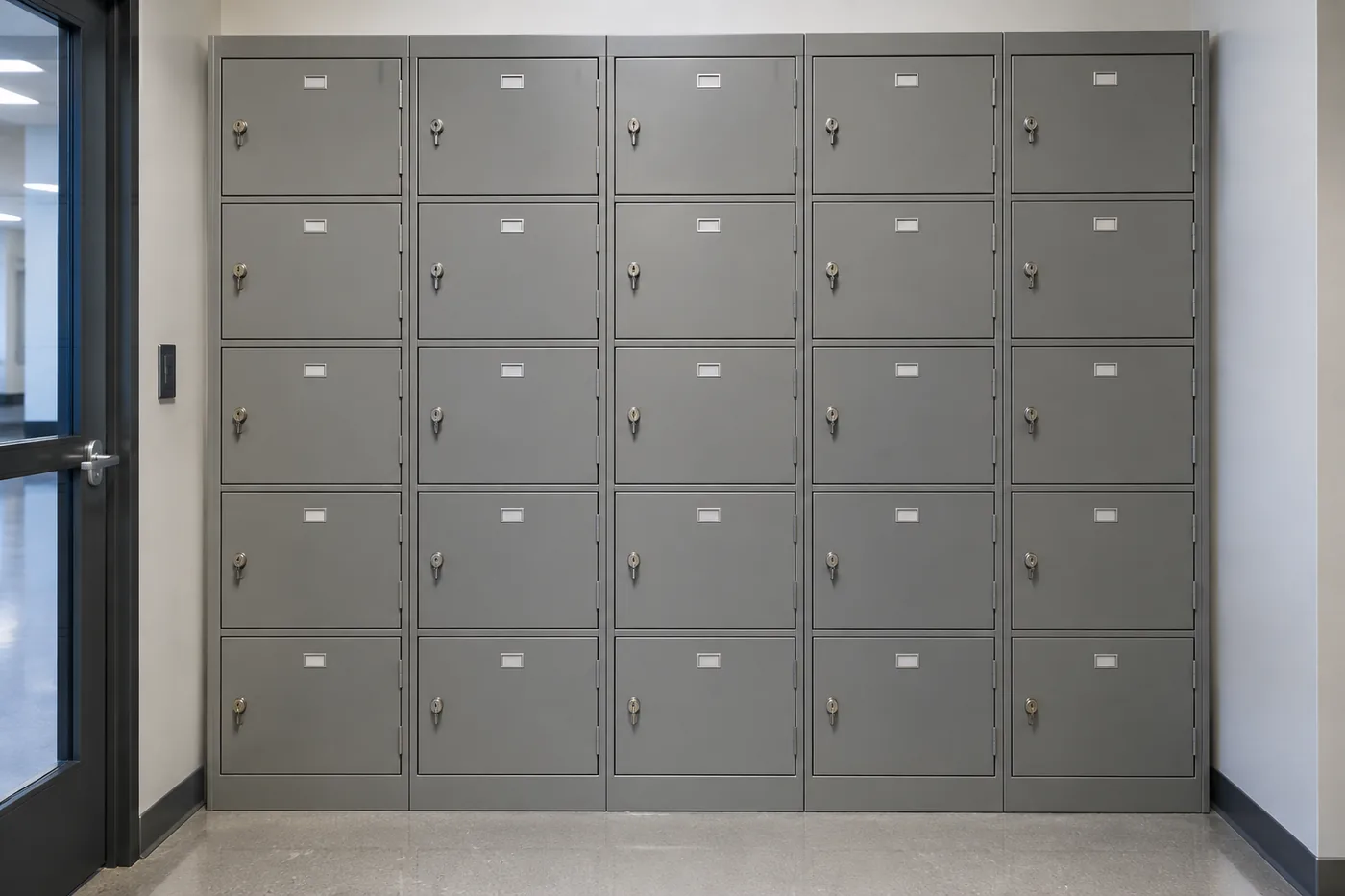
Non-pass-through evidence lockers stand against any wall. The officer deposits and locks; the custodian later opens the compartment from the same side with a master key, keypad code or override, then carries the item into the evidence room.
They cost less and need no wall opening, so they suit substations, satellite offices, remodels where the evidence room has no shared wall and overflow banks. The trade-off is an extra walk with the evidence in hand, so log the transfer the same way you would for a pass-through locker.
| Pass-through | Non-pass-through | |
|---|---|---|
| Access | Load from the front, unload from the evidence room side | Load and unload from the front |
| Installation | Set into a framed wall opening, trimmed on both faces | Freestanding or wall-mounted against any wall |
| Lock on deposit | One-way latch; rear release inside the evidence room | One-way latch, then key, keypad or fob to reopen |
| Chain of custody | Strongest: custodian never leaves the secure room | Good, with a logged walk to the evidence room |
| Cost and work | Higher: wall framing and both-side trim | Lower: no wall opening |
| Best for | Main station intake | Substations, garages, overflow |
Most agencies use both: a pass-through bank at headquarters intake and non-pass-through units at substations. Many also add a separate refrigerated unit and one long locker for rifles and shotguns.
How a Pass-Through Evidence Locker Works
Package and label
The officer seals and labels the item in the processing room: case number, item number, date and name.
Deposit and lock
The officer picks an open compartment, places the item, closes the door and turns the one-way handle.
Locked from the front
Once latched, the door cannot be reopened from the officer side. A key or code is not needed to deposit.
Custodian retrieves
Inside the evidence room, the custodian opens the rear door, logs the item and resets the compartment.
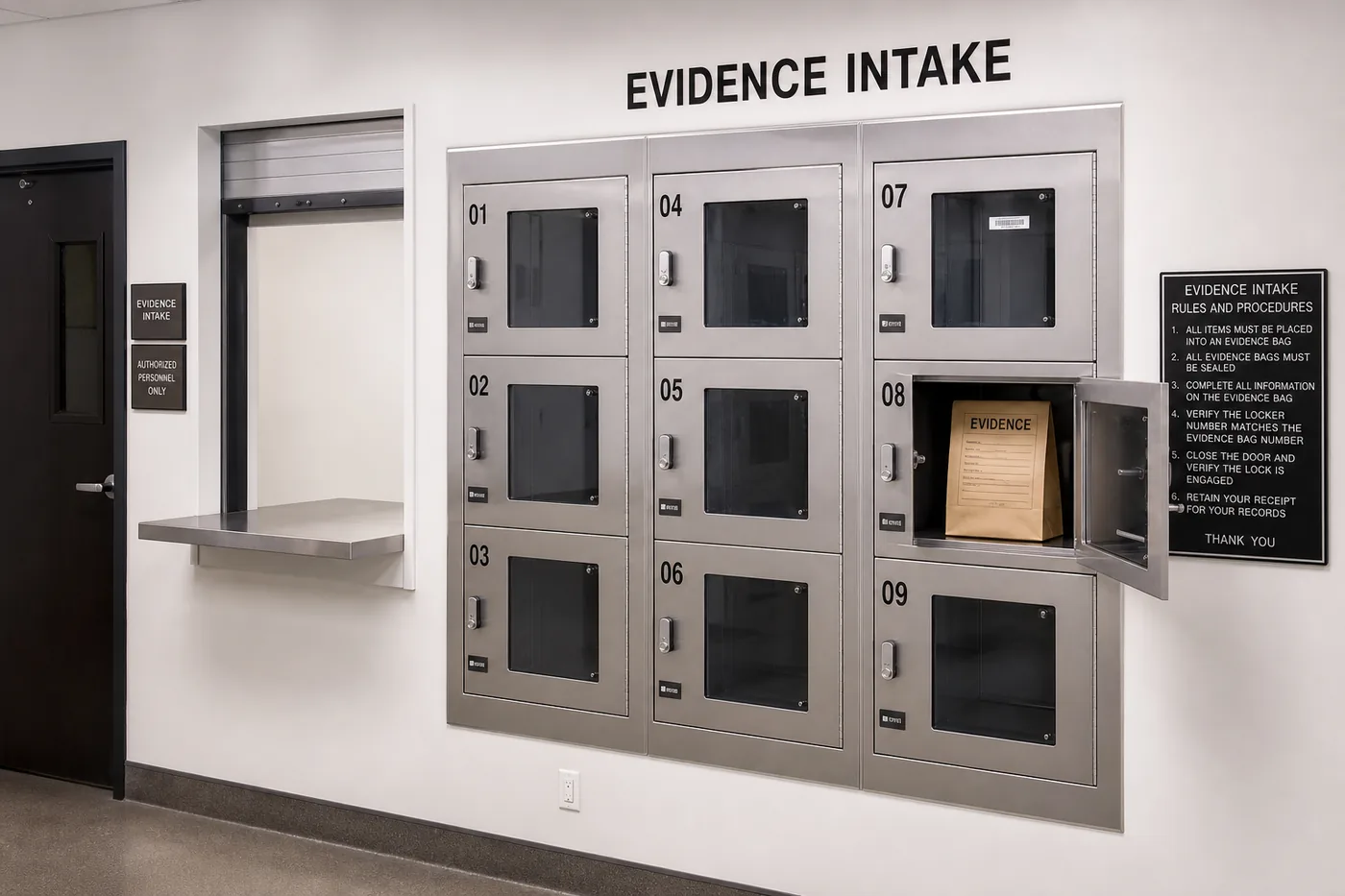
Put the lockers right next to a dedicated packaging room. IAPE and state property-room guides recommend a processing area near the temporary lockers with counter space, packaging supplies, water and an eyewash station, so officers package correctly before the door closes.
- Drop slot: one locker with a mail or drop slot takes small items such as cards, discs and latent print cards without using up a whole compartment.
- Trouble locker: keep one compartment for items that arrive with the wrong packaging or paperwork until the officer fixes them.
- Out of service: a damaged or sticking locker should be taken out of use until it is repaired.
Refrigerated Evidence Lockers
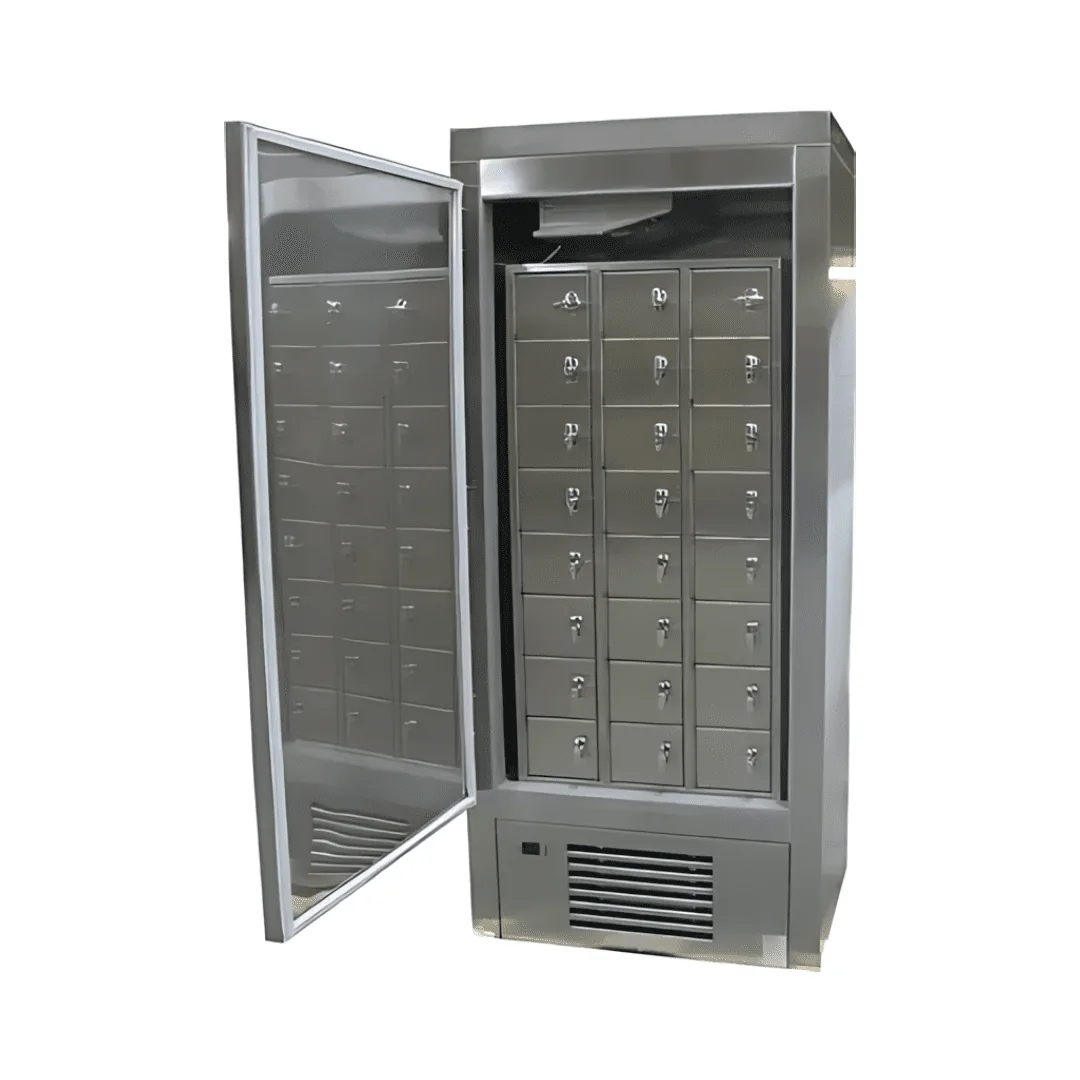
Refrigerated evidence lockers keep biological evidence cold between deposit and logging. NIST’s Biological Evidence Preservation Handbook defines refrigerated storage as 2 to 8°C (36 to 46°F) with less than 25% humidity, and frozen storage as −10°C (14°F) or colder.
Two builds are common. A stand-alone refrigerated locker is a stainless steel unit with its own compressor and small locking compartments. Fasco’s ELRI-004, for example, has a 14-gauge stainless body, 12-gauge stainless doors, a digital temperature gauge and one-way keyless locks with an internal release on 115 V power. A refrigerator insert fits in one large door of a standard bank; Fasco’s spec calls for 38 to 42°F with a digital temperature display and an audible alarm.
- Liquid blood and urine: NIST lists refrigeration as best for short-term storage of liquid blood and frozen for urine; never freeze liquid blood.
- Wet items: if wet clothing cannot be dried right away, NIST says to hold it in a sealed, non-porous container in a 2 to 8°C refrigerator until it can be dried.
- Drying first: most wet evidence should be air dried before packaging. See our forensic evidence drying cabinets.
- Alarm and power: pick a unit with a temperature alarm, plan a dedicated outlet or hard-wired circuit, and decide who responds to an after-hours alarm.
Evidence Locker Construction and Specifications
Evidence lockers look like heavy box lockers, but they are built to resist prying and tampering. When you compare quotes or write a bid spec (CSI section 10 51 13, metal lockers), check these points. The figures below come from the Fasco EL-772 evidence locker specification and the Aurora Storage evidence locker sell sheet.
| Feature | What to look for | Example from manufacturer specs |
|---|---|---|
| Body | All-welded steel, no bolts, screws or rivets in the body | 16-gauge cold rolled steel sides, partitions, shelves and back (Fasco) |
| Doors | Formed, double-bent doors with welded corners and an inner panel over the lock | 16-gauge doors with hat-channel stiffener (Fasco) |
| Latch | Multi-point latch that engages the frame at several points | 3-point latch, 3/8″ plated rods, stainless lock bar (Fasco) |
| Hinges | Full-length piano hinge with non-removable pins | 16-gauge continuous hinge; stainless optional (Fasco) |
| Standard size | Full-height bank sized to the wall opening | 36″ W × 24″ D × 82″ H, custom sizes available (Fasco ELP/ELN-772) |
| Door count | Mixed small, medium and full-height compartments | 2 to 24 doors per unit (Aurora) |
| Base and trim | Closed base, filler trim to the wall on both faces | 4″ base with 2″ kick; 2-1/2″ trim (Fasco) |
| Finish | Baked powder coat in standard colors | 28 standard colors with no VOCs (Aurora) |

Options worth asking about:
- Perforated rear doors with small holes so the custodian can see which compartments hold items before opening the rear door.
- Mail or drop slots cut into any door at the factory.
- Refrigerator insert in one large door, on the same one-way locks as the rest of the bank.
- Number plates on every door, in your agency’s numbering sequence.
- Left- or right-hand swing so doors open away from the processing counter.
Aurora evidence lockers are made in the USA with a limited lifetime warranty; Fasco’s spec section calls for a five-year warranty on materials and workmanship.
Evidence Locker Locks: Keyless, Keyed and Electronic
The lock decides how the deposit and the release happen. Common options:
- One-way keyless latch (pass-through): turn the handle and the door locks; it releases only from a lever inside the evidence room.
- Key lock and drop: the key is left in the open door; locking it captures the key, which drops into the locker for the custodian.
- Slam lock (non-pass-through): the door locks on closing and opens with the custodian’s key.
- Electronic keypad, card or fob: each deposit and release is logged by user, time and door.

Electronic lockers add an audit trail and can link to evidence-management software, but they need power, network planning and a plan for outages. Keyless mechanical latches never need batteries and are simple to maintain. If you use padlocks anywhere, IAPE recommends securing them to the locker frame, removing the key code stamped on the padlock and never leaving keys in empty lockers. Our Dasco electronic evidence locker page shows one keypad system.
Evidence Locker Sizes and How Many You Need
Evidence arrives in every shape, so one door size never works. IAPE’s temporary-storage standard calls for lockers of various shapes and sizes. Plan the bank around what your officers actually book.
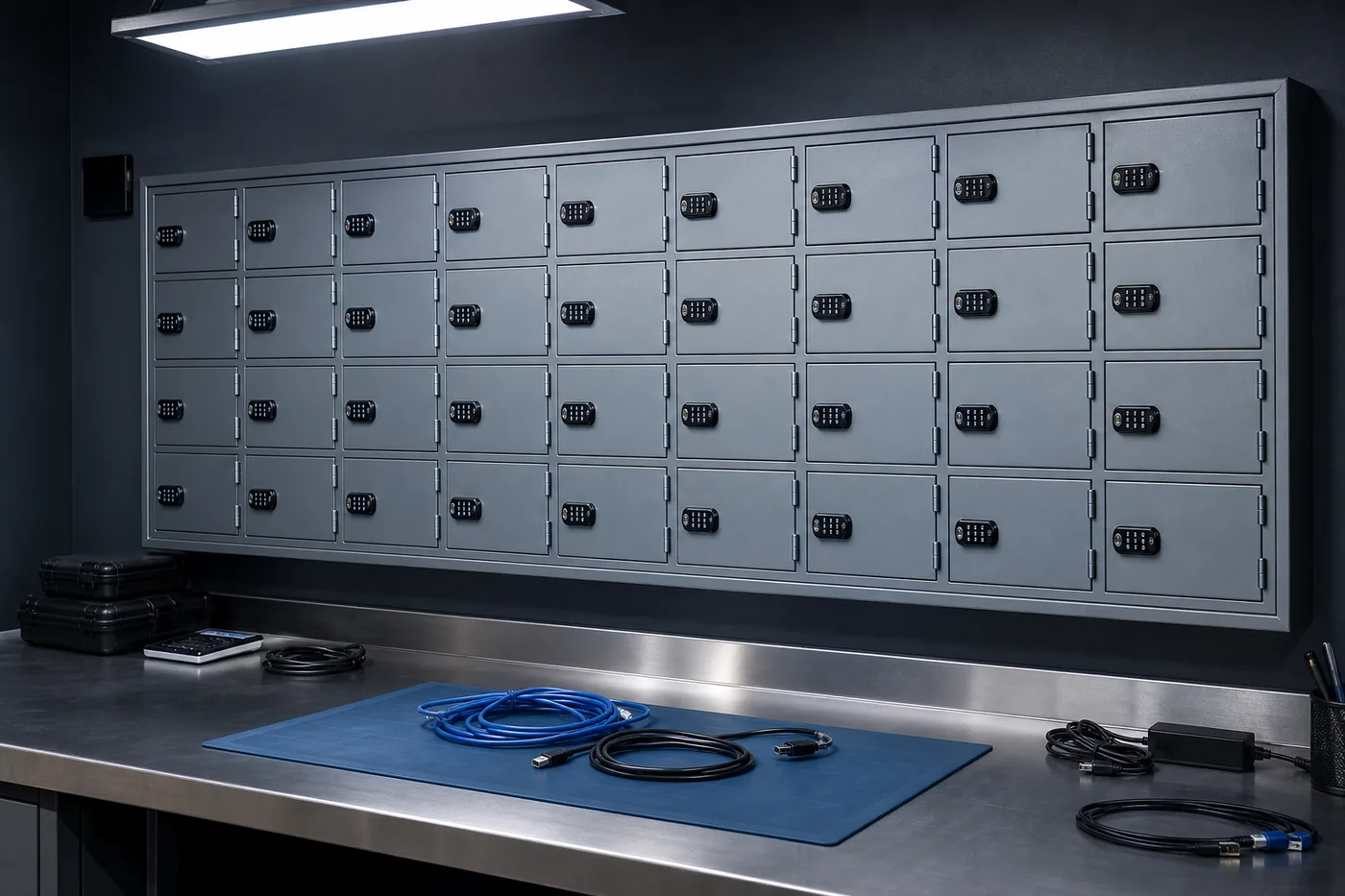
How many lockers? Count your peak, not your average. Pull a month of booking records and find the busiest overnight or weekend stretch between custodian pickups, then count items by size. Add a few spare doors for out-of-service lockers and a trouble locker. Agencies of the same size can need very different counts depending on whether evidence is collected seven days a week.
Locker makers’ planning guides note that two banks with mixed compartment sizes cover many smaller departments; larger stations and regional facilities often run a full wall of pass-through banks plus a non-pass-through unit at each substation.
Planning the Wall, Installation and Lead Time
Pass-through lockers are part of the building. Coordinate the rough opening with your architect or contractor early: the wall must be framed to the locker bank size plus clearance, and it needs trim on both the officer side and the evidence room side. Specs commonly call for lockers to be delivered only once the building is enclosed, anchored to the wall or floor, bolted to adjacent units and adjusted after install so every latch works.
- Keep the evidence room side clear for the rear doors to swing fully open.
- Put the packaging counter, supplies and camera coverage on the officer side.
- Plan power for refrigerated or electronic lockers before the wall closes.

Send your counts
Booking volume, item types, wall length and whether a shared wall with the evidence room exists.
Layout and spec
We return a locker layout with door sizes, lock type, refrigerated doors and wall opening sizes.
Quote and submittals
Pricing with freight, plus product data and shop drawings for your architect or purchasing.
Deliver and install
Delivery when the building is ready, anchoring, trim on both faces and a latch check on every door.
Evidence lockers are built to order, so allow production time in the construction schedule. We confirm lead time on every quote. For the rest of the room — long-term shelving, cages and high-density storage — see our evidence room design service and a real police evidence storage project.
See how a U.S. Army installation chose non-pass-through units in our McAlester Army Ammunition Plant evidence locker case study.
Where Evidence Goes After the Locker
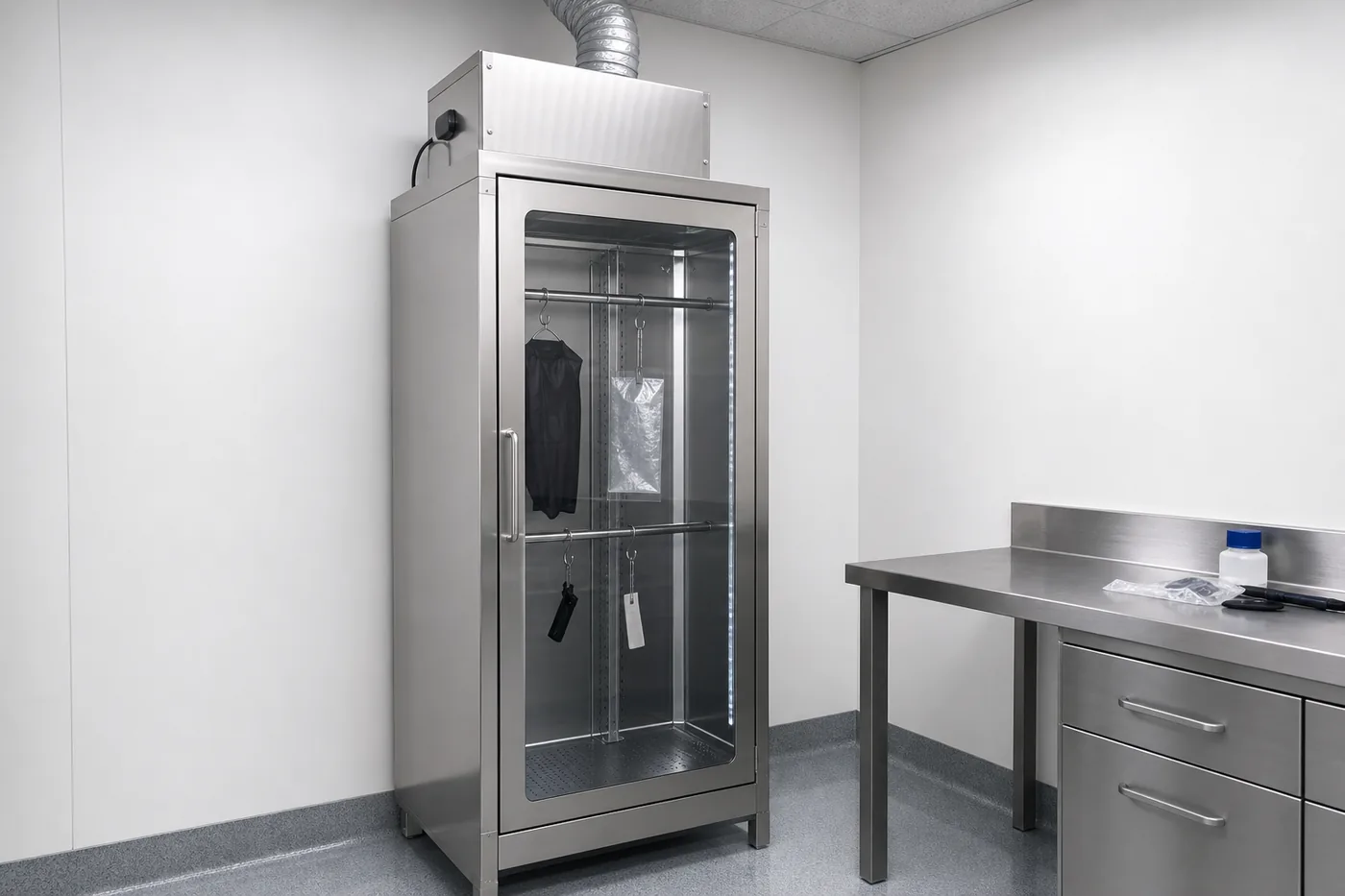
Temporary lockers only work if the next step has room. NIST’s working group treats any location that holds evidence for up to 72 hours as short-term storage; after that, items belong in long-term storage matched to their type.
- Wet items: evidence drying cabinets before packaging.
- Boxes and bags: evidence storage shelving or high-density mobile shelving.
- High-value items, guns and drugs: locked evidence cages inside the room.
- Officer gear: duty lockers belong elsewhere; see police station lockers.
How Much Do Evidence Lockers Cost?
Evidence lockers are quoted per unit because door count, lock type and options change the price a lot. As a reference point, public price listings in 2026 show a small four-door evidence locker at roughly $1,400 and an 8-compartment, 82″ tall pass-through unit at roughly $7,600 to $10,700 before freight. Refrigerated and electronic units cost more.
| What changes the price | Lower cost | Higher cost |
|---|---|---|
| Access | Non-pass-through | Pass-through with rear doors |
| Locks | Keyless mechanical or keyed | Electronic keypad / card with audit trail |
| Doors per unit | Few large doors | Many small doors (more latches and hinges) |
| Refrigeration | None | Insert or stand-alone stainless refrigerated unit |
| Installation | Freestanding against a wall | Framed wall opening, trim both sides, after-hours work |
Freight is significant because lockers ship fully welded and assembled. Budgeting a pass-through bank? Ask for wall trim, anchoring and installation on the same quote so nothing is left for the contractor to guess. We quote evidence lockers from manufacturers including Aurora, Fasco and Dasco.
Shop Lockable Evidence Room Security Units
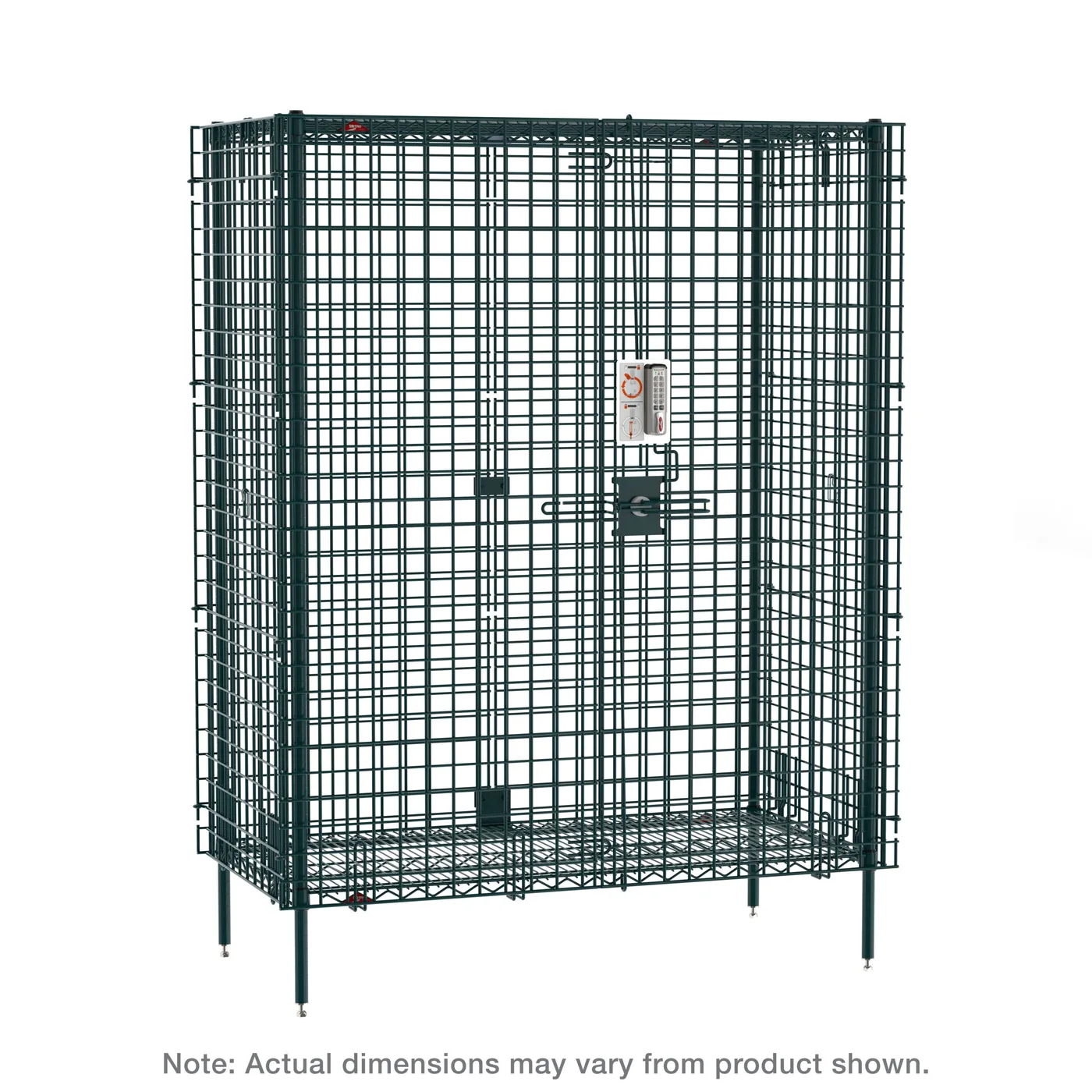
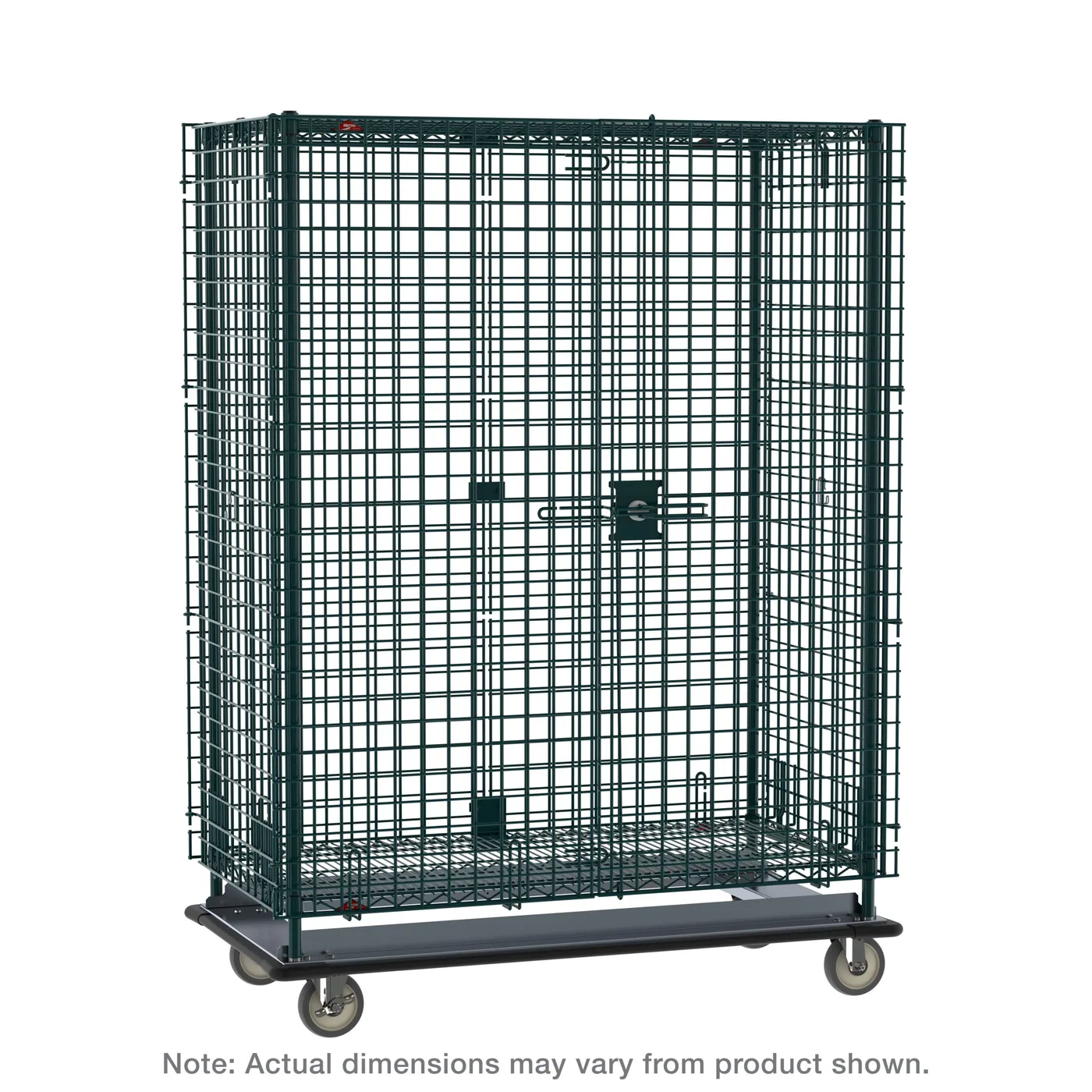
Evidence lockers are quoted per project, so they are not sold online. For long-term storage of high-value or sensitive evidence inside the room, these lockable Metro wire security units are available online now. Some common sizes are in stock at select manufacturers, subject to confirmation.

Evidence Locker FAQs
What is a pass-through evidence locker?
What is the difference between pass-through and non-pass-through evidence lockers?
What temperature should refrigerated evidence lockers hold?
How long should evidence stay in a temporary locker?
How long does a police department keep evidence?
How much do evidence lockers cost?
How many evidence lockers does a police station need?
Can evidence lockers be added to an existing evidence room?
What size is a standard evidence locker?
Do evidence lockers need keys to deposit evidence?
Get an Evidence Locker Layout and Quote
Send your booking volume and wall dimensions and we will lay out pass-through, refrigerated and long-item lockers with a free quote.