
Steel Catwalks
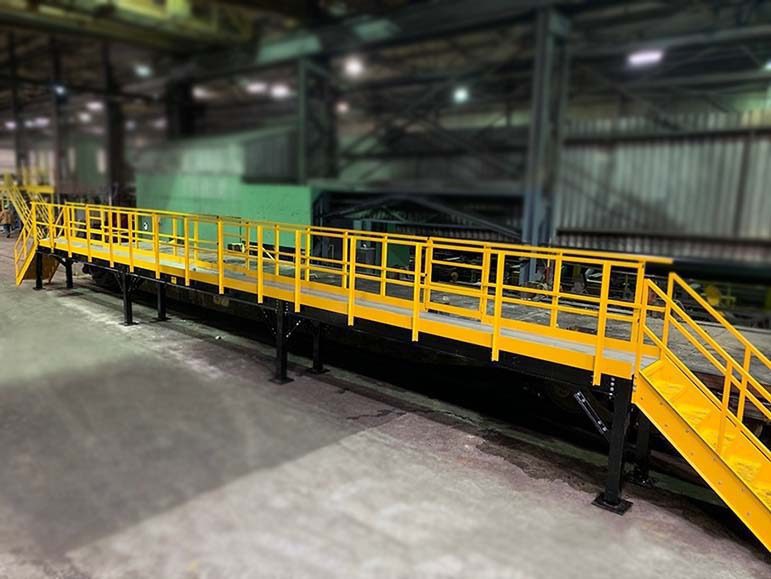
Galvanized and coated steel catwalks with bar, perforated or expanded metal grating, OSHA guardrails and stairs. Choose modular Equipto sections or an engineered walkway sized to your plant, supplied and installed by MH-USA.
Shop Steel Catwalk Components Online
Equipto modular steel catwalk sections, OSHA stairways, crossover bridges and perforated steel grating panels. Freight, installation and engineering are quoted separately.


Browse all: catwalk modules · stairways & crossovers · steel grating & flooring
What Is a Steel Catwalk?
A steel catwalk is an elevated walkway built from structural steel framing, a steel walking surface and steel guardrails. It gives people a defined, guarded route above the floor: along a conveyor, between tanks, across a machine line or out to valves, motors and gauges that would otherwise need a ladder or a lift.
Steel is the default material for industrial catwalks because it carries heavy loads over long spans at a sensible cost, takes bolted or welded connections easily, and can be galvanized or coated for wet, outdoor and washdown areas.
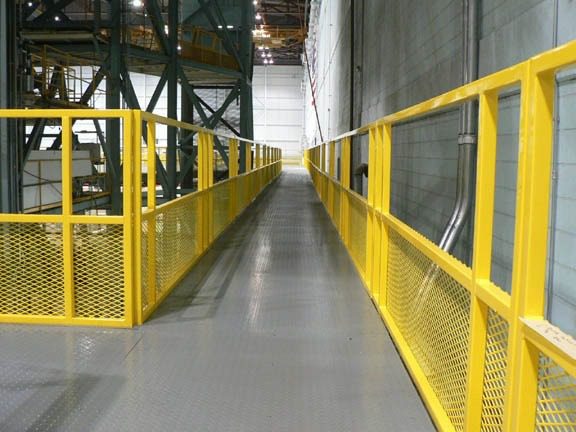
Every steel catwalk combines the same building blocks: support framing (columns, stringers and cross members, or brackets off existing steel), a deck of grating or plate, guardrails with a top rail, midrail and toe board, and access by stair, ship stair or fixed ladder. The decisions that matter are which deck to use, which finish will survive the environment, how the walkway is supported and which code path applies. This page walks through each one, then shows how we size and quote a steel catwalk.
Steel Catwalk Grating Options
The deck is the part people feel every day, and it drives slip resistance, drainage, cleaning and what can fall through. These are the steel walking surfaces we specify most often:

Welded bar grating
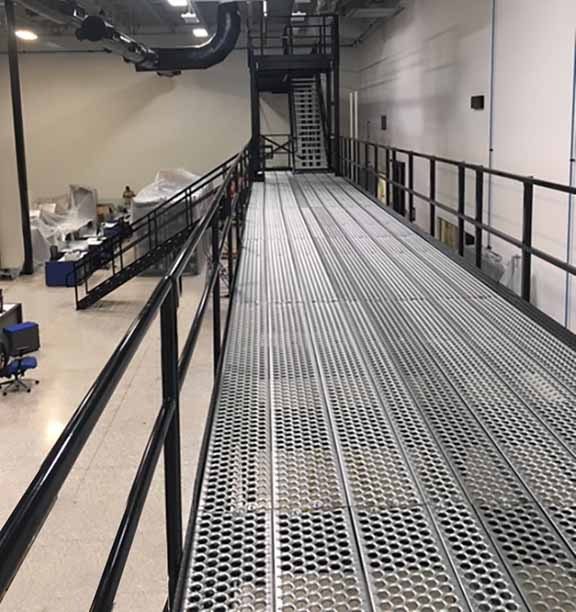
Parallel bearing bars on edge, welded to cross bars, form open rectangles that shed water, light and debris. It is the workhorse catwalk deck: strong for its weight and easy to cut around columns and pipes. Grating is often described by a code such as 19-W-4 (bearing bars 19/16 inch apart, welded, cross bars 4 inches apart). Bearing bar depth and thickness are chosen from the span and load tables.
Serrated bar grating has notched top edges that add grip where oil, water or ice are present.
Photo: Equipto (authorized use)
Perforated plank grating
Formed steel channels with raised, punched openings give aggressive slip resistance in all directions and a smaller opening than bar grating, so fewer tools and parts drop through. Planks are light, quick to install on simple supports and common on maintenance catwalks, conveyor walkways and stair treads.
Equipto’s perforated steel grating panels, for example, are one-piece formed channels with 1-1/2 inch flanges, made to sit on supports at 7-1/2 inch centers.
Press-locked and swage-locked grating
Bars locked together mechanically instead of welded. They give a cleaner, more uniform look and are often chosen where the walkway is visible to visitors.
Expanded metal
One sheet slit and stretched into diamond openings. Economical and light for light-duty walkways, ramps and treads; check the span chart and orientation before relying on it.
Diamond (checker) plate
Solid steel with a raised pattern. Nothing falls through, but it holds water, oil and dust, so use it only where drops below are the bigger risk.
Close-mesh and add-on toe plates
Where people or equipment work underneath, use a smaller opening or add solid kick plates and mesh panels so small parts cannot fall onto workers below.
Matching stair treads
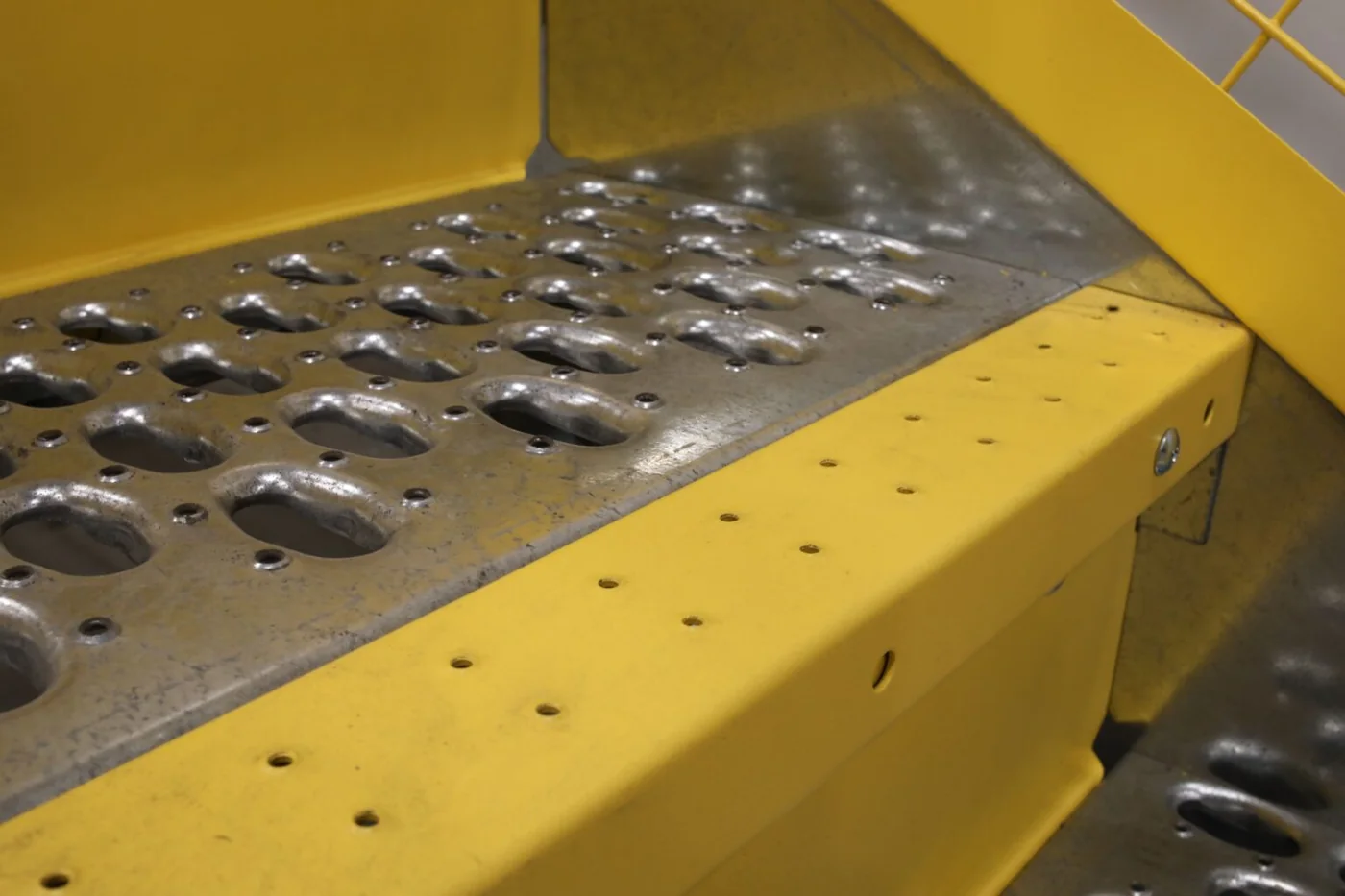
Use the same family of walking surface on the stairs so the change from tread to deck does not surprise anyone. Look for non-skid nosings with a high-visibility front edge, and a flush top step so the last tread is level with the deck rather than a trip point.
Photo: Equipto (authorized use)
Galvanized, Painted or Powder-Coated Steel?
Bare carbon steel rusts, so every steel catwalk needs a finish matched to its environment:
- Hot-dip galvanized (ASTM A123): the steel is dipped in molten zinc, which coats inside corners and cut edges. It is the standard choice outdoors, in wastewater and chemical plants, and anywhere the walkway gets wet.
- Powder coat or industrial paint: a clean, colored finish for dry indoor warehouses and plants. Safety-yellow rails make the walkway easy to see from the floor.
- Galvanized plus coat: a galvanized deck with powder-coated rails and frames combines corrosion resistance with high visibility.
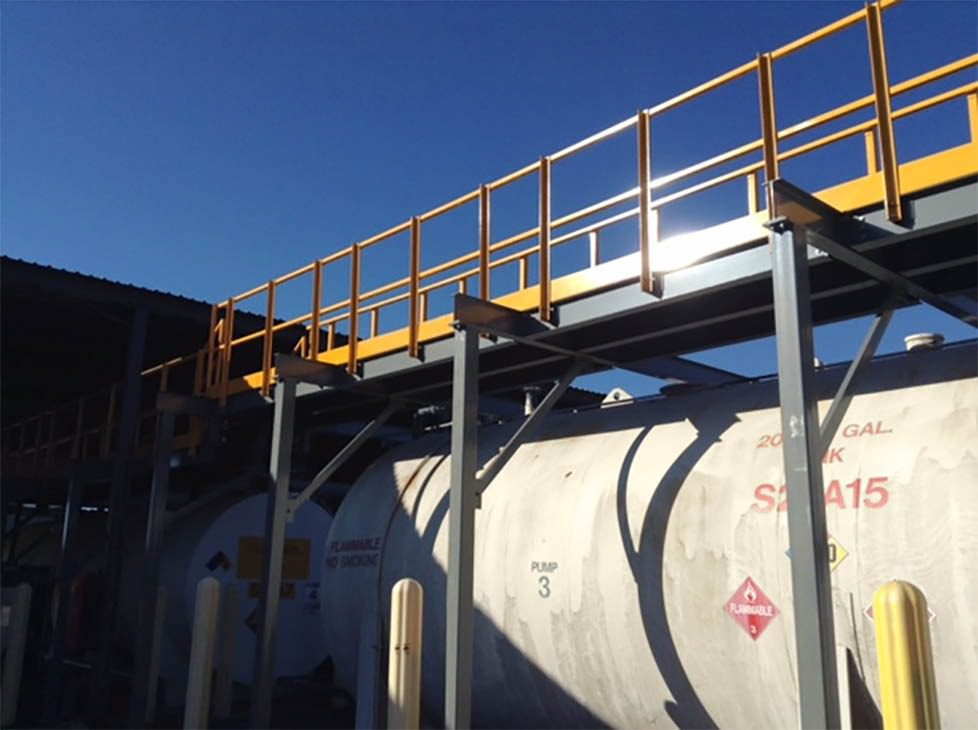

Stainless steel is used for food, pharmaceutical and washdown areas where the catwalk is part of the sanitary design, or where chemicals would attack zinc. It costs more, so it is often limited to the deck and rails directly above open product.
Tell us what the walkway is exposed to: rain and snow, process water, caustic cleaners, salt air, heat from ovens or furnaces. That decides the finish before anything else.
Steel vs Aluminum vs Fiberglass Catwalks
Steel is not the only option. Here is how the three common catwalk materials compare, so you can confirm steel is the right fit before you price it:
| Factor | Steel (galvanized or coated) | Aluminum | Fiberglass (FRP) |
|---|---|---|---|
| Strength and span | Highest stiffness; long spans and heavy loads | Lighter loads or shorter spans for the same depth | Moderate; deeper sections for the same load |
| Weight | Heaviest; needs a lift or crane for long sections | Roughly one-third the weight of steel for the same size section | Light; easy to handle by hand |
| Corrosion | Needs galvanizing, paint or stainless | Naturally corrosion resistant | Excellent chemical resistance |
| Electrical | Conductive; bond and ground as required | Conductive | Non-conductive |
| Fire and heat | Non-combustible | Non-combustible; loses strength at lower temperatures than steel | Check the resin’s fire rating |
| Typical cost | Usually the lowest cost per square foot | Higher material cost, lower install weight | Higher material cost |
| Best fit | Plants, warehouses, conveyors, heavy-duty and long runs | Light-duty, portable or rooftop walkways | Chemical, marine and electrical areas |
Many projects mix materials: a steel frame with an FRP deck over a chemical bath, or steel stairs feeding an aluminum roof walkway. For custom-engineered and aluminum walkways, see our custom catwalk systems page.
How Steel Catwalks Are Supported
The support method shapes cost, lead time and how much floor space you lose. Most steel catwalks use one of these approaches:
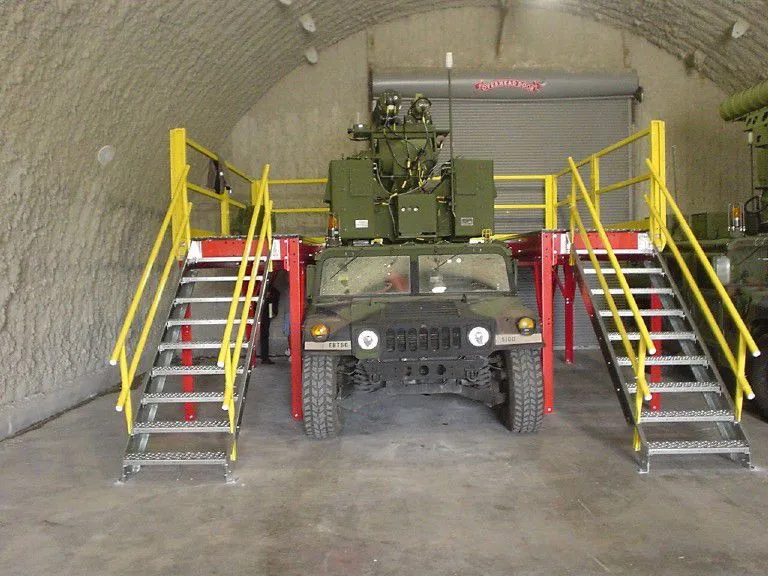
Freestanding modular catwalks and platforms
Pre-engineered steel sections on their own legs (shown: modular Equipto access platforms in a vehicle bay), bolted together in a straight run or around corners. Equipto’s catwalk modules, for example, come as 4-foot-wide walkways in lengths from 2 to 20 feet, in 6, 8 and 10 foot unit heights, with 42-inch safety railing and 4-inch kickplates. They ship as standard parts, so they are the fastest route to an elevated walkway.
Photo: Equipto (authorized use)
Floor-supported (column) catwalks
Steel columns with base plates anchored to the slab carry the stringers. Best for long runs and heavier loads; the slab and anchors are checked during design.
Structure-supported catwalks
Hung from or bracketed to building steel, tanks or equipment frames. Saves floor space but needs the host structure checked by an engineer.
Mezzanine-connected walkways
Catwalks that join mezzanine levels or extend a mezzanine to a remote door or machine. See our mezzanines.
Rack-supported walkways
In pick modules and multi-level rack systems, the pallet rack or shelving frames carry the grated walkways between pick faces. This turns cube above the floor into staffed pick levels without a separate structure. The rack design must account for the walkway and people loads.

OSHA Rules That Shape a Steel Catwalk
OSHA’s walking-working surfaces standard (29 CFR 1910 Subpart D) sets the minimum for employee walkways. The points that most often shape a steel catwalk design are:
| Requirement | OSHA reference | What it means on a catwalk |
|---|---|---|
| Fall protection at 4 feet | 1910.28 | Open sides of a walkway 4 feet or more above a lower level need guardrails or another fall protection system |
| Guardrail height and strength | 1910.29 | Top rail 42 inches (±3 in.), withstands 200 lb; midrail withstands 150 lb |
| Toe boards | 1910.29 | At least 3.5 inches tall and withstand 50 lb where people work or pass below |
| Standard stairs | 1910.25 | 30–50° slope, risers 9.5 in. max, treads 9.5 in. min, 22 in. min width, landings at least 30 in. deep |
| Ship stairs | 1910.25 | 50–70° slope, risers 6.5–12 in., treads at least 4 in. deep and 18 in. wide |
| Fixed ladders | 1910.23 / 1910.28 | Rungs 10–14 in. apart with 16 in. clear width; ladders over 24 feet need a ladder safety or personal fall arrest system |
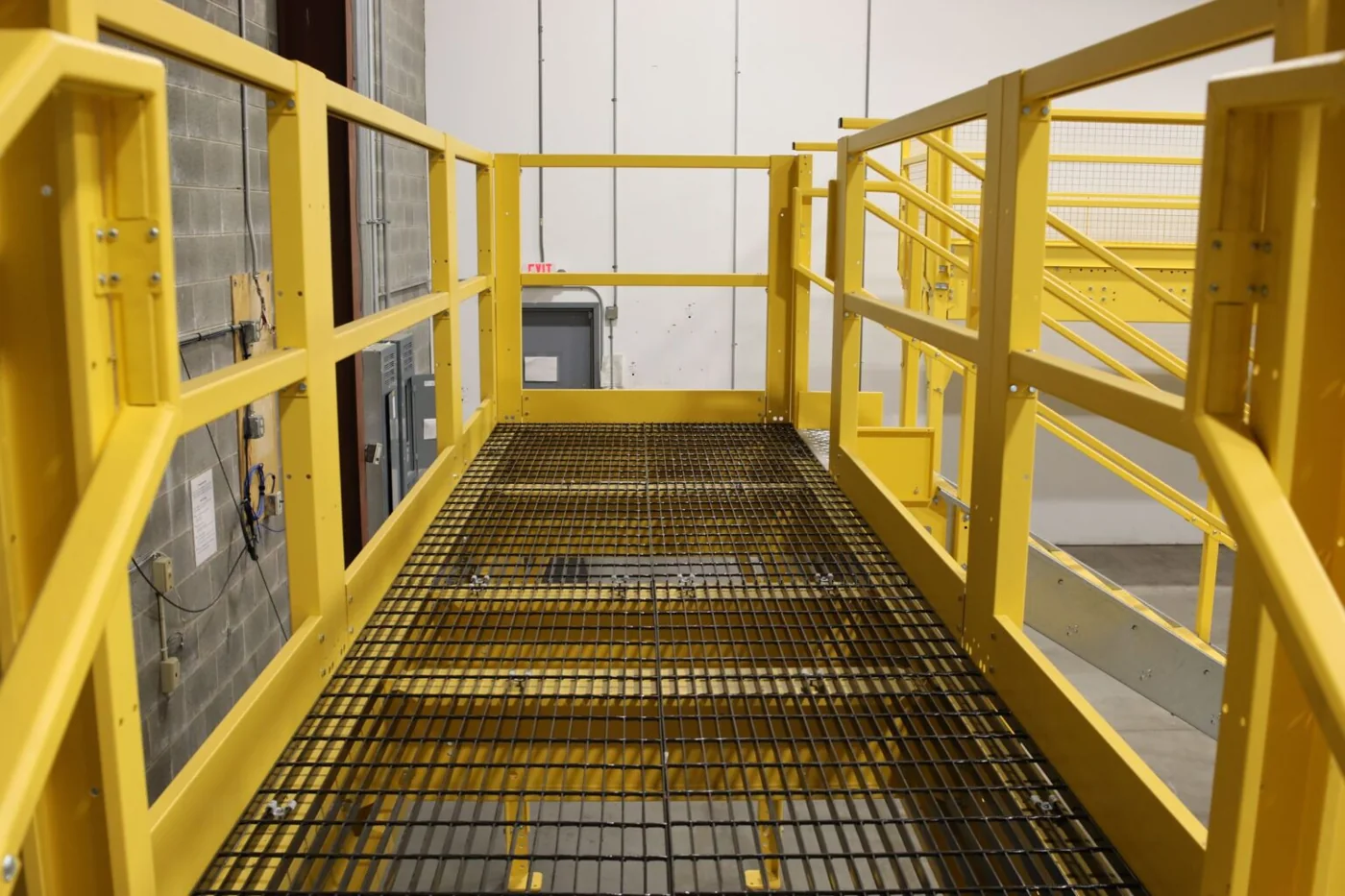
Openings where people step onto the catwalk from a stair or ladder should be protected by a self-closing gate or an offset so the edge is never left open. Handrails on stairs run 30 to 38 inches high, and stair rail systems installed after January 17, 2017 must be at least 42 inches.
If the walkway is part of an exit route or the building department reviews it, the locally adopted building code also applies and can be stricter. We match the design to your permit drawings; the authority having jurisdiction has the final say. More detail: our OSHA catwalk requirements guide and OSHA’s walking-working surfaces resources.
Photo: Equipto (authorized use)
How to Plan and Size a Steel Catwalk
Most catwalk redesigns come from measuring the destination but not the route. Gather these details before you request a quote:
| Planning item | Why it matters | What to send us |
|---|---|---|
| Deck height and route | Sets column height, stair count and where landings fall | Floor-to-deck height at each end, a plan sketch or CAD |
| Clear height underneath | Fork trucks, carts and product must pass below | Tallest equipment or load that travels under the walkway |
| Walkway width | Traffic, carts and whether people pass each other | How many people use it and what they carry |
| Design load | Sizes the grating, stringers and columns | Foot traffic only, tools and parts, or stored material |
| Environment | Chooses galvanized, coated or stainless | Indoor or outdoor, wet, washdown, chemicals or heat |
| Obstructions | Columns, sprinklers, ducts and lights in the route | Photos and a list of anything in the way |
A note on loads: building codes commonly reference ASCE 7, which lists catwalks used for maintenance access at 40 psf uniform and a 300 lb concentrated load. Walkways that carry stored material, carts or exit traffic are designed to higher loads. The project’s engineer of record sets the final design load, and we never quote a capacity we have not confirmed with the manufacturer.
Share the route
Send heights, the route sketch, photos and what the walkway is for.
Pick the system
We recommend modular Equipto sections or an engineered steel catwalk, plus grating and finish.
Drawings and quote
You get layout drawings and a written quote for equipment, freight and optional installation.
Install and inspect
Our crews set, level and anchor the catwalk to the approved drawing so it is ready for inspection.

Installation details that save time: adjustable post footers absorb uneven floors; bolted connections let the walkway be extended or moved when the line changes; and confirming slab thickness early avoids surprises at anchoring. Lead time depends on the system and the manufacturer’s schedule, so we confirm it with your quote.
Photo: Equipto (authorized use)
Where Steel Catwalks Are Used

- Manufacturing plants: walkways above machine lines, presses and ovens for maintenance and inspection.
- Food and beverage: catwalks over mixers, kettles and fillers, often galvanized or stainless with open grating for washdown.
- Water and wastewater: long galvanized runs over basins and clarifiers.
- Chemical and process plants: access to tank tops, valves and instruments.
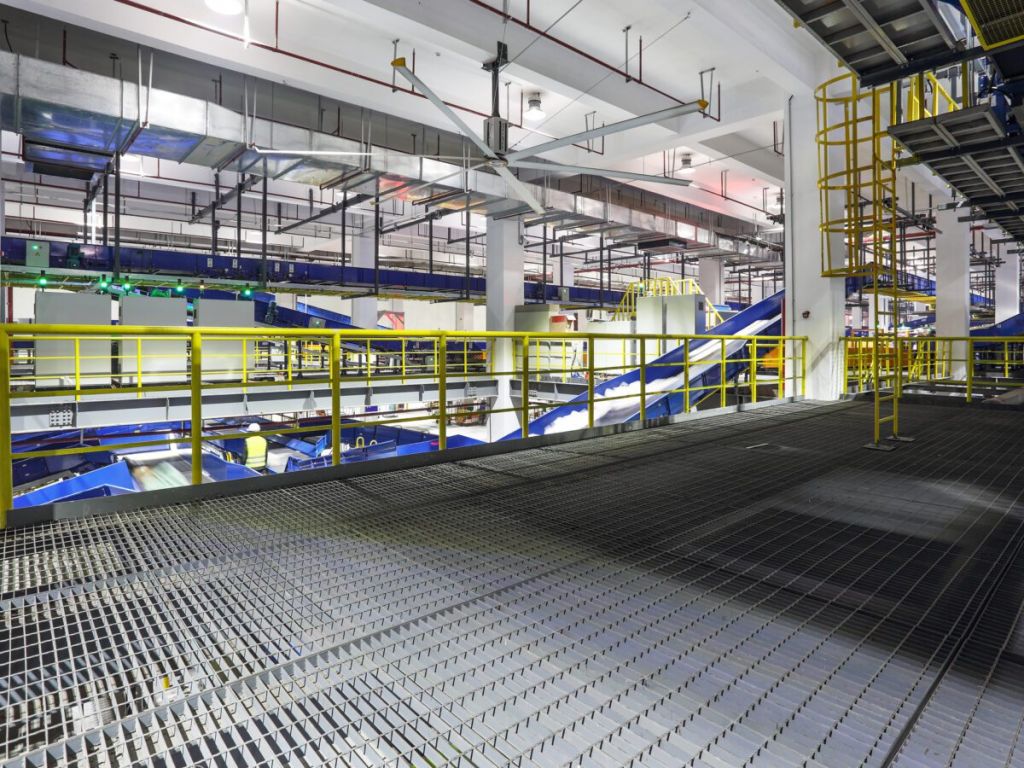
- Distribution and fulfillment: catwalks along conveyor and sortation lines for jam clearing and motor access. To cross a line rather than run beside it, see conveyor crossovers.
- Warehouses: walkways to upper rack bays, mezzanine doors and roof hatches.
- Equipment access: stair-and-landing platforms at single machines. See industrial stairs and work platforms.
Request a Steel Catwalk Quote
Send the deck height, route, what the walkway must carry and the environment it sits in. Photos or a drawing help us recommend modular Equipto sections or an engineered steel catwalk quickly.
Steel Catwalk FAQs
What is a steel catwalk?
What grating is best for a steel catwalk?
Should a steel catwalk be galvanized?
Is a steel or aluminum catwalk better?
How high do catwalk guardrails need to be?
How wide should a steel catwalk be?
Can you supply modular steel catwalks?
Do you install steel catwalks?
Plan Your Steel Catwalk
Send us your route and heights and we will recommend the right steel catwalk, quote it and install it.