
Conveyor Crossovers & Crossover Platforms
Get people safely over, onto and around conveyor lines. Equipto stair crossovers, bridges and access platforms for one to four conveyors, sized to your line and supplied and installed by MH-USA.

Shop Equipto Conveyor Crossovers Online
Standard Equipto single and double conveyor crossovers, multi-stair crossovers and maintenance access platforms. Freight, installation and code review are quoted separately.
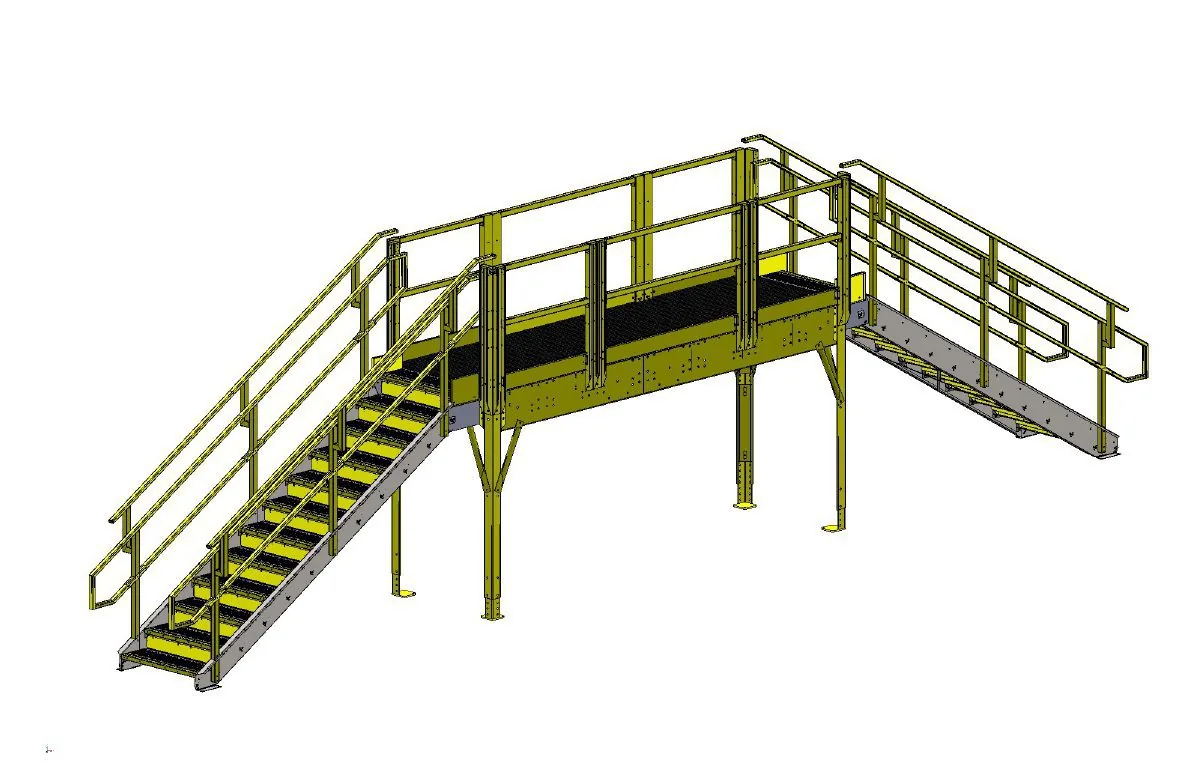


Browse all 70+ Equipto crossover and platform configurations →
What Is a Conveyor Crossover?
A conveyor crossover is a stair-and-platform structure that lets employees walk over a conveyor line instead of around it, under it or, worst of all, across it. A typical unit has a stairway on each side, a guarded platform or bridge that spans the conveyor, and handrails sized for regular foot traffic.
In a busy distribution center, conveyor lines can split a building into islands. Without a crossover, people take long detours to reach pick modules, packing stations, restrooms and exits, or they start stepping over moving equipment. A properly sized crossover removes that temptation and gives everyone a defined, guarded path.
Photo: Equipto (authorized use)
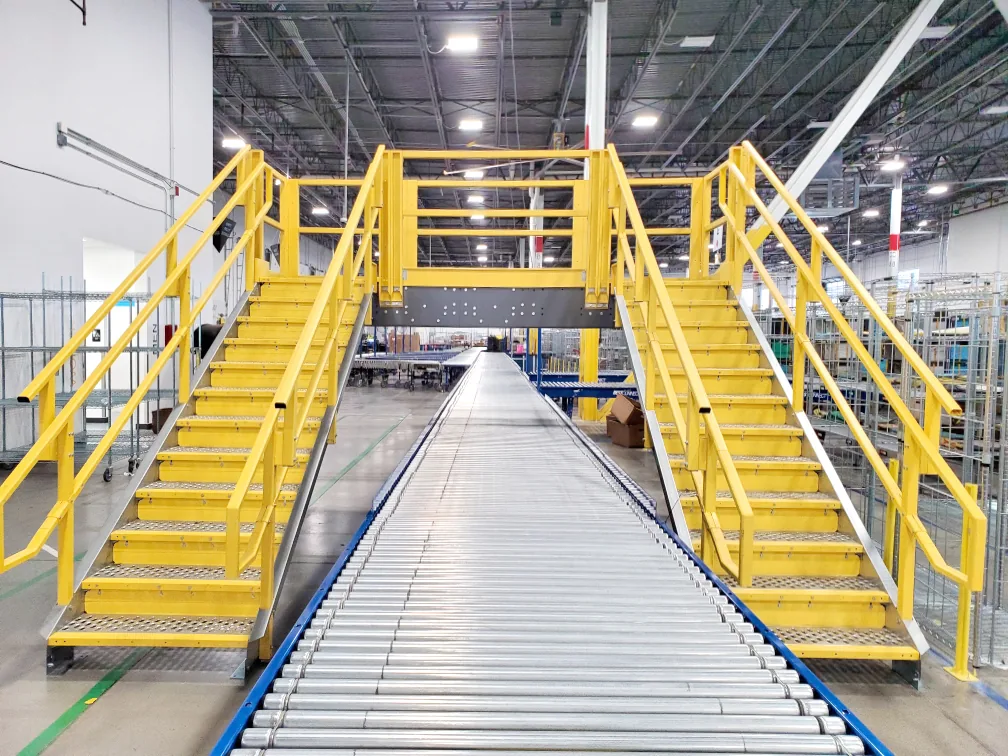
Crossovers are also called conveyor bridges, stair crossovers, step-overs or crossover platforms. They range from a two-step platform over a low belt to a long, extended-height bridge that clears several elevated lines and the obstructions between them. MH-USA supplies the Equipto conveyor crossover line, which is built in the USA from modular galvanized and powder-coated steel components. It sits alongside our wider range of industrial work platforms.
Types of Conveyor Crossovers
Start by asking what the structure must do: carry people across a line as part of a regular route, put a worker at a working height beside the conveyor, or give maintenance staff access to equipment overhead. Each need points to a different type.
IBC-compliant crossovers
These are built for routes that may form part of a building’s means of egress, or for any project where the building official expects commercial-stair geometry. Equipto’s IBC line comes in standard height, extended height and extended length. It covers single and double conveyor models, plus two-to-four-conveyor configurations with triple or quad stairs. The extended versions can also bridge columns and other building obstacles between lines.
Photo: Equipto (authorized use)


OSHA-compliant crossovers
When a crossover is used only by trained employees and is not part of the egress path, the workplace rules in OSHA’s walking-working surfaces standard usually govern the design. These units can be more compact than IBC models, so they suit smaller spaces and induct areas where floor area beside the conveyor is limited. Equipto offers an induct-type OSHA crossover that builds in the same I, L, U and Z shapes as its larger models.
Photo: Equipto (authorized use)
Low-height platforms
A low-height platform is a landing that raises a worker to the right height beside a conveyor or work surface instead of carrying them over it. It is a common choice for sortation and induction stations. Equipto builds them in several lengths, with stairs at one end, at both ends, or on the left or right side, and with one or two railings.
Photo: Equipto (authorized use)
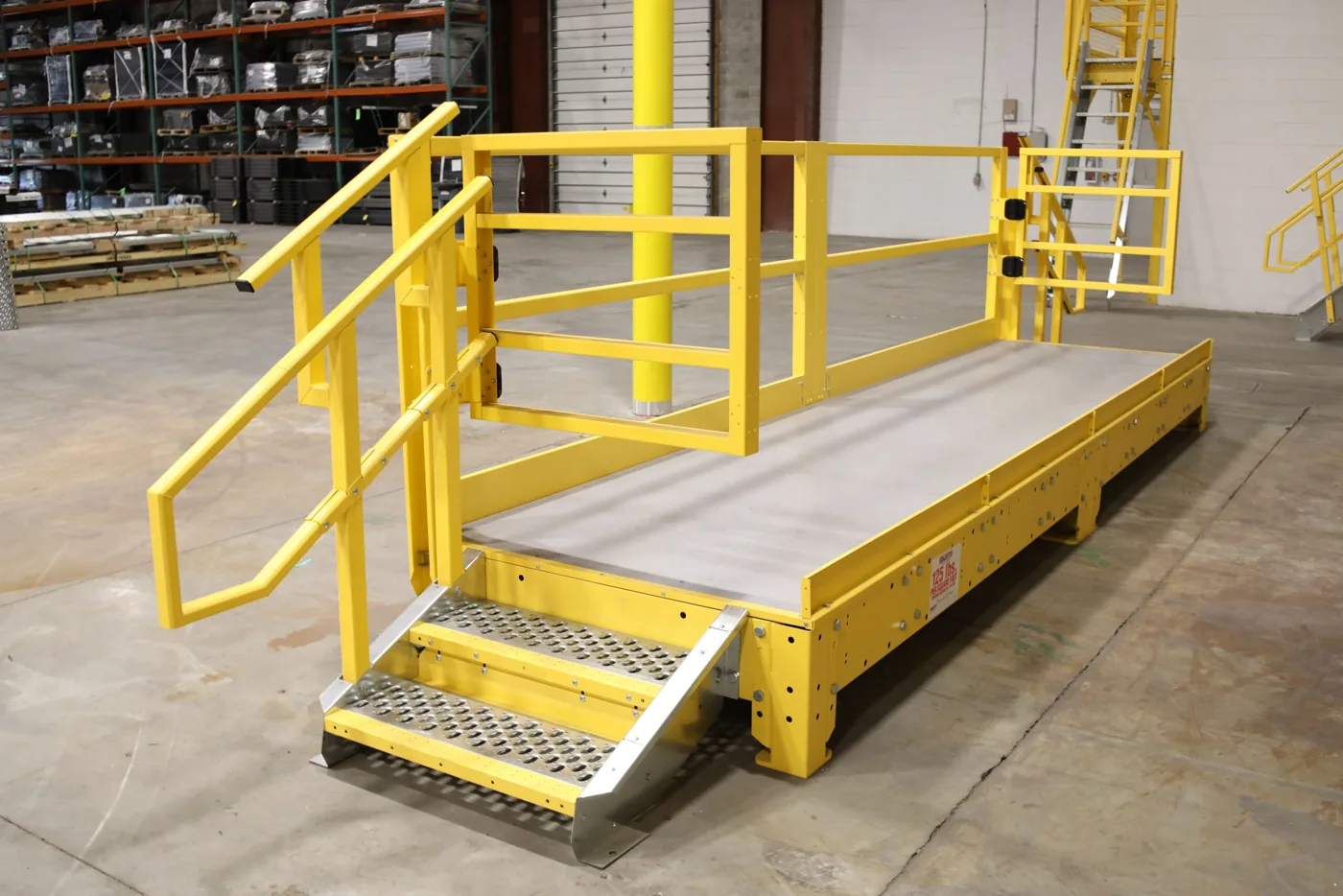

Elevated platforms
Elevated platforms give regular access to hard-to-reach elevated conveyors, for example to clear jams, run quality checks or tend merge points. Equipto’s elevated platforms use a single stairway, which saves floor space. They can be fitted with low-rise 21-inch wire-grid rails that fit under the conveyor while still protecting against falls and dropped parts.
Photo: Equipto (authorized use)
Maintenance access platforms
Maintenance access platforms are designed for engineers and technicians who service elevated conveyors, motors and drives. They use a ship stair, which is steeper than a standard stair, to cut the footprint in tight spots. Because a ship stair is meant for occasional use by trained staff, these platforms are not a substitute for a general-traffic crossover.
Photo: Equipto (authorized use)

How to Size a Conveyor Crossover
Most sizing problems come from measuring the conveyor but not the space around it. Collect these measurements before you request a quote and we can match a standard Equipto configuration or flag the need for an extended model:
| Measure | Why it matters | Tip |
|---|---|---|
| Top of conveyor height | Sets the platform deck height and the number of risers | Measure the highest point, including guides, photo-eyes and product on the belt |
| Clear height under the bridge | Product, totes and maintenance carts must pass beneath it | Add the tallest product plus a working margin |
| Overall conveyor width | Sets the minimum bridge span | Include side guards, motors, drives and cable trays |
| Number of lines and gaps | Decides single, double, triple or quad stair layouts | Note columns, sprinkler risers and panels between lines |
| Floor space at each landing | Stairs need a run plus clear landing area | Mark aisles, dock doors and fork-truck lanes nearby |
| Who uses it and how often | Drives the IBC-vs-OSHA choice and the stair type | Tell us if the route leads toward an exit |
Standard vs extended height and length
Equipto separates its catalog into standard and extended heights and lengths. A standard-height model suits most floor-level conveyors. Extended-height models clear elevated or stacked lines, and extended-length models span wider gaps or obstacles such as a building column between two conveyors. When a project falls between catalog sizes, the modular parts kit can usually be reconfigured; we confirm this from your drawing before ordering.
Stair vs ship stair vs step-over
Standard stairs are the right choice for daily foot traffic and anyone carrying items. Ship stairs save floor space but are steeper and are generally reserved for maintenance access platforms. Very low belts may only need a short step-over platform. Consider how often the crossing is used, whether people carry anything, and whether visitors or new hires will use it.
IBC vs OSHA: Which Rules Apply to Your Crossover?
The question is not which standard is better. It is which standard applies to this crossover. In simple terms, the International Building Code (IBC) is adopted by your state or city and enforced by the local building department. It governs the building and its exits, so it applies whenever the crossover forms part of a required exit route or the building official reviews it as a stair. OSHA 29 CFR 1910 Subpart D (walking-working surfaces) covers employers and their employees. Its stair, ladder and fall-protection rules apply to employee-only access whether or not a building permit is involved.
Photo: Equipto (authorized use)

When IBC usually governs
The crossover is on a route toward an exit, it serves a general occupant load, or the permit and occupancy review includes it. Commercial-stair limits on riser height, tread depth, handrails and guards then apply, as adopted locally.
When OSHA usually governs
The crossover is an employee-only work route, such as an induct area, a maintenance platform or a sort station landing. OSHA allows standard stairs, ship stairs and ladders for different uses, each with its own angle and rail requirements.
Why it matters at opening
Equipto notes that egress crossovers are often part of occupancy approval. A non-compliant unit found at final inspection can hold up a building opening while it is replaced or modified.
Who decides
Your local authority having jurisdiction (AHJ) makes the final call. The adopted code edition and any local amendments vary, so share your permit drawings and we will match the crossover type to them.
We do not make code determinations for your building. We supply equipment that Equipto designs to meet IBC or OSHA requirements and help you choose the right model for the role your project’s designer or building official assigns to it. Equipto also designs its crossovers for high-seismic zones. If your site needs stamped calculations or anchoring details, raise this early in the quote process. For general guidance, see OSHA’s walking-working surfaces resources.
Materials, Decking & Safety Features

Steel construction and finish
Equipto crossovers are built from hot-dipped galvanized and powder-coated steel. Galvanizing resists corrosion and wear, and the yellow powder coat on rails and frames keeps the structure visible in a busy building. The platforms are rated for 125 pounds per square foot. The walkways have been widened and reinforced so more people can use the crossover at the same time during shift changes.
Decking options: bar grating (shown), perforated steel, solid steel and ResinDek anti-skid panels. Choose by traffic, dropped-parts risk, cleaning and cart use.
Photo: Equipto (authorized use)
Stairs and treads
A flush top stair keeps the final step level with the platform deck, which removes a common trip point. The two-piece safety treads have full-height closure panels, non-skid surfaces and a galvanized finish with a high-visibility yellow front edge, so each step is easy to see. Contoured handrails and posts help guide users and protect them along the full stair.
Photo: Equipto (authorized use)


Gates, rails and grids
A self-closing safety gate can be fitted at the top of the stairs so that the platform edge is never left open. Optional 2×2-inch wire grids on stairways and platforms stop small items falling through onto people or equipment below. Low-rise 21-inch rails are available on elevated and maintenance access platforms.
Photo: Equipto (authorized use)
Adjustable posts
Adjustable post footers let the deck height be fine-tuned to the conveyor and to uneven floors. They are available on all models except the low-height platforms. Because the systems bolt together, they can be dismantled and rebuilt in another location when the conveyor layout changes, so the crossover can move with your operation.
Photo: Equipto (authorized use)

Other materials: some projects ask about aluminum or stainless crossovers for washdown, food or corrosive environments. These are specialty builds rather than part of the standard Equipto line, so tell us about your environment and we will quote the right construction. For a walkway that runs alongside a conveyor instead of over it, see our steel catwalks.
U, Z, L & I Crossover Layouts
Equipto builds every crossover from a modular kit that can be set up as an I, L, U or Z shape without extra parts. The company lists four models and more than 140 standard orientations. This flexibility lets you fit the crossover around columns, racking and work cells. It also lets you reconfigure it if you re-route the conveyor later.
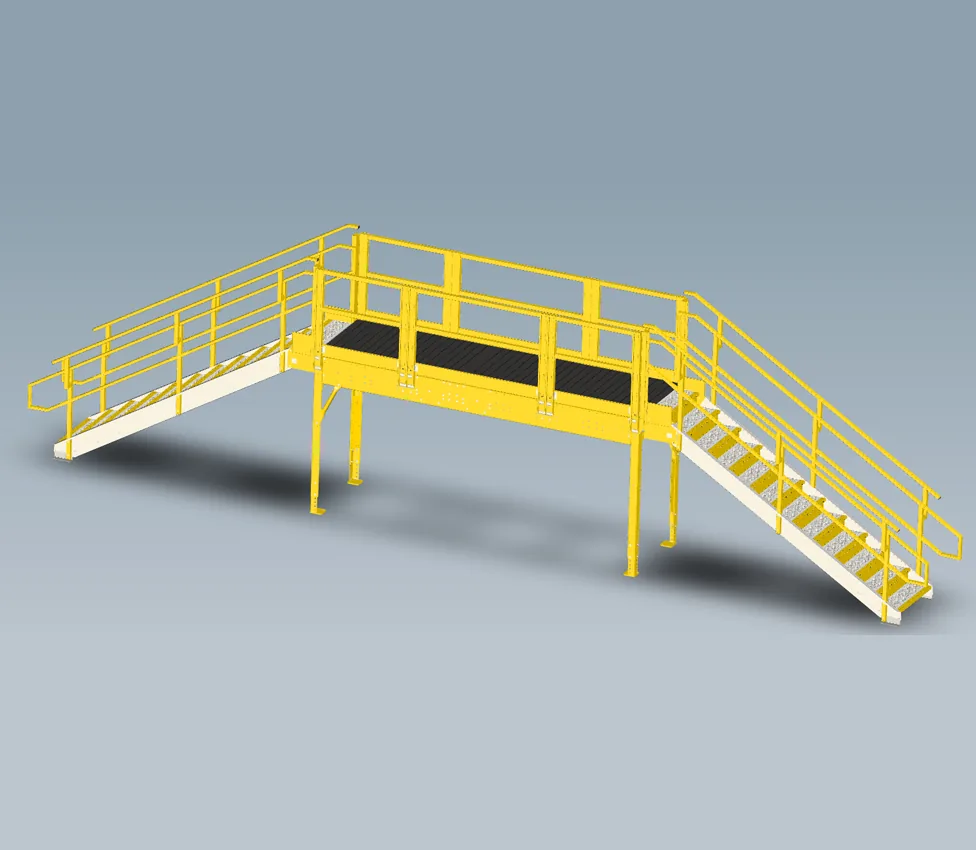
I-shape
Stairs on opposite ends in a straight line. The simplest route over a single line in an open aisle.
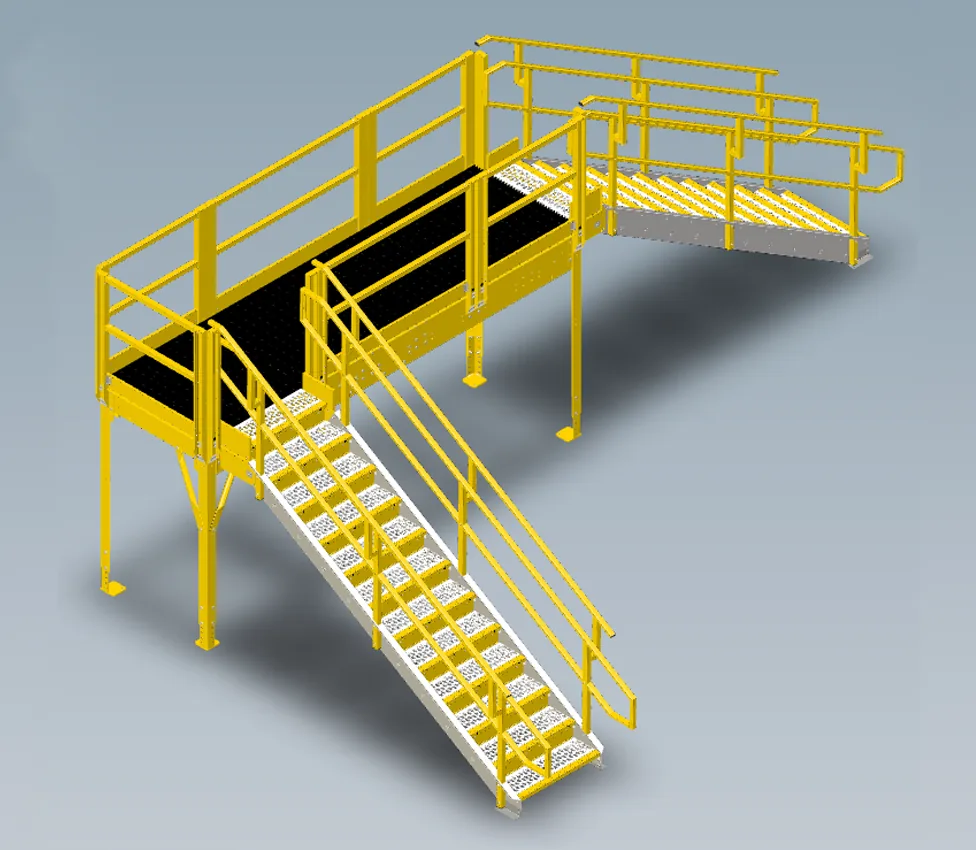
L-shape
One stair turns 90°. Useful where a wall, rack or column blocks a straight run.
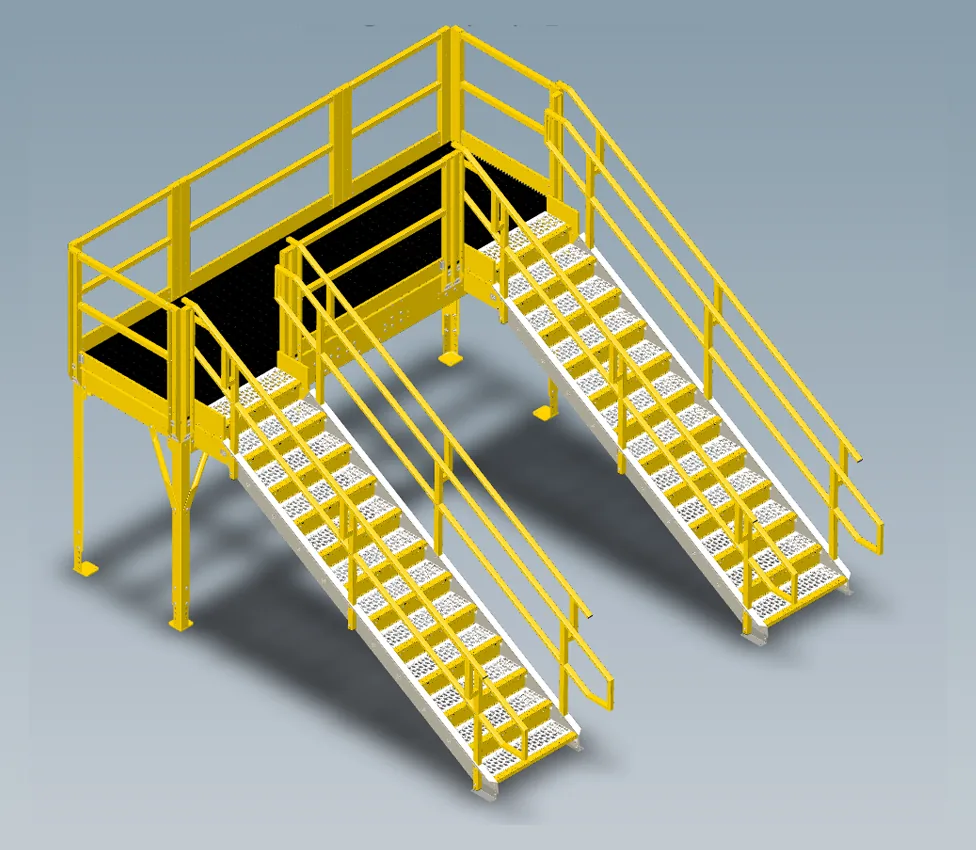
U-shape
Both stairs land on the same side. Good when the far side of the line has no floor space.
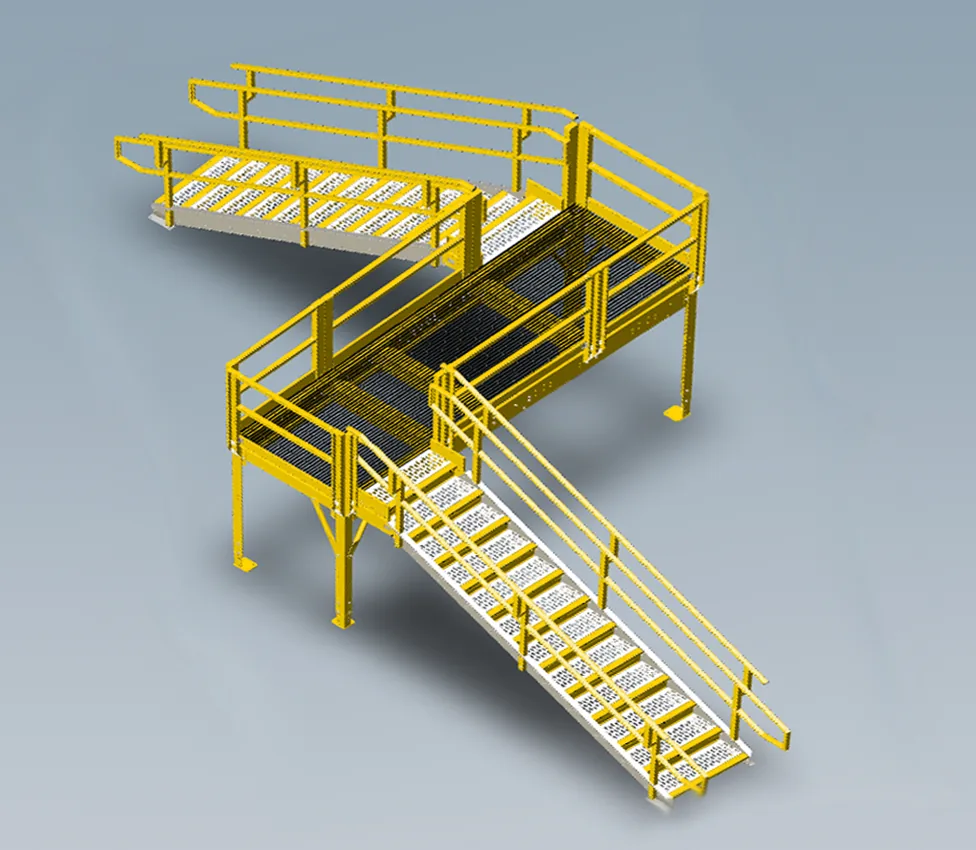
Z-shape
Offset stairs in opposite directions. Fits staggered aisles and keeps landings clear of traffic.
Layout renderings: Equipto (authorized use)
When you send a layout, mark where people come from and where they need to go on each side. The best shape is usually the one that lands stairs in an existing aisle rather than across a pick face or a fork-truck lane.
Where Conveyor Crossovers Are Used
Multi-conveyor sites. Facilities running parallel lines often use triple- or quad-stair crossovers. These let people step down between lines as well as cross all of them, which cuts walking distance for workers who staff several stations.
Fast-track openings. New hubs earn revenue from day one. Specifying the right code type early avoids last-minute swaps at final inspection. If your facility uses conveyor systems or is still being laid out through our warehouse design service, add crossovers to the plan before the conveyor is installed. For general stair and platform needs beyond conveyors, see industrial stairs and work platforms and industrial catwalks.
How MH-USA Delivers Your Crossover
Share the layout
Send conveyor heights, widths, the number of lines and a sketch or CAD of the area, plus photos.
Choose the model
We match an Equipto standard, extended or multi-stair configuration and confirm the IBC or OSHA type with you.
Quote and approve
You receive a written quote covering equipment, freight and optional installation, and drawings for your review.
Deliver and install
Our installers set, level and anchor the crossover to your approved drawing so it is ready for inspection.
Lead time depends on the configuration and Equipto’s production schedule, so we confirm it with your quote. Where a standard size fits, buying from our online catalog can shorten the process.
Other Crossover Options
Equipto is our main conveyor crossover line because its modular, code-focused design suits most distribution and manufacturing projects. For lighter-duty jobs, such as stepping over pipes, ductwork or a short run of equipment rather than a production conveyor, we can also quote Cotterman crossover bridges if they suit your needs better. Tell us what you need to cross and we will recommend the right product rather than force a fit. For pipes, ducts, rooftop equipment and other non-conveyor obstacles, see our crossover stairs guide.
Request a Conveyor Crossover Quote
Tell us how many conveyors you need to cross, their height and width, and whether the route is employee-only or part of an exit path. Photos or a drawing help us recommend the right Equipto configuration quickly.
Conveyor Crossover FAQs
Who sells industrial crossovers for conveyor systems?
What is the difference between an IBC and an OSHA conveyor crossover?
How much weight can an Equipto crossover hold?
Can a crossover span more than one conveyor?
Should I use a stair or a ship stair?
Can a conveyor crossover be moved later?
What information do you need for a quote?
Do you install conveyor crossovers?
Get Your Team Safely Across the Line
Send us your conveyor layout and we will recommend the right Equipto crossover, quote it and install it.