
OSHA Catwalk Requirements
What federal OSHA actually requires for industrial catwalks and elevated walkways: guardrail height and strength, midrails, toe boards, width, stairs and ladders, gates, surfaces and inspections. Each rule is cited to 29 CFR 1910 so you can check it yourself.
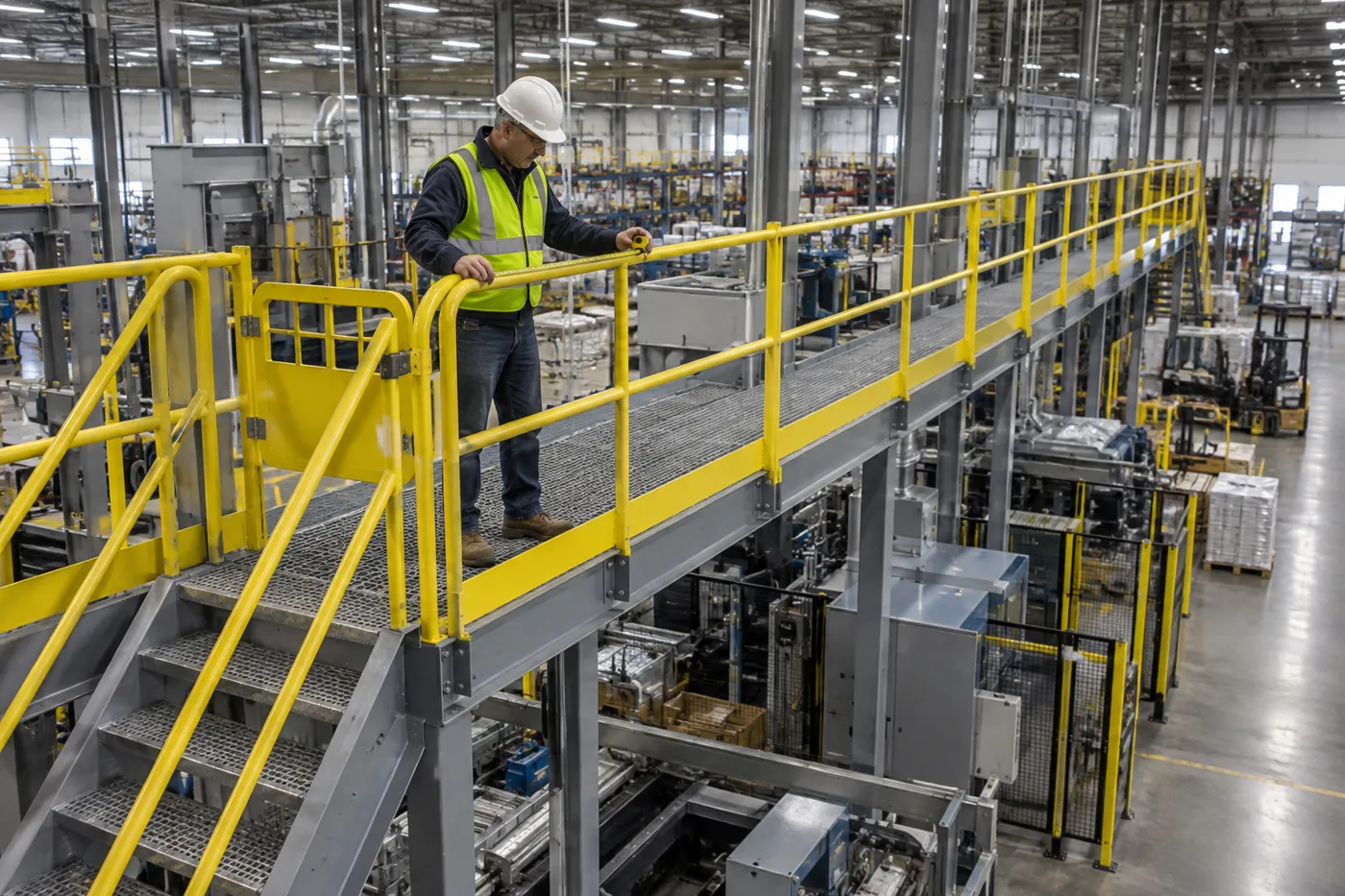
Shop OSHA-Style Catwalks, Stairs and Grating
Prefabricated Equipto catwalk modules with 42-inch railings and 4-inch kickplates, galvanized OSHA stairways and ship's stairs, and non-skid perforated grating. Freight, installation and a site review are quoted separately.


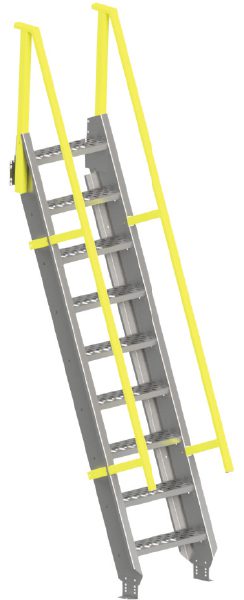

Browse all: catwalk modules · OSHA stairways & crossovers
Which OSHA Rules Apply to Catwalks?
OSHA does not have a stand-alone catwalk standard. A catwalk is a walking-working surface, so it falls under 29 CFR 1910 Subpart D for general industry. The definitions section names it directly: a runway is “an elevated walking-working surface, such as a catwalk, a foot walk along shafting, or an elevated walkway between buildings” (29 CFR 1910.21).
That means the rules for a plant or warehouse catwalk come from a handful of sections: general surface and load rules (1910.22), ladders (1910.23), stairs (1910.25), when fall protection is required (1910.28) and how guardrails, gates and toe boards must be built (1910.29).
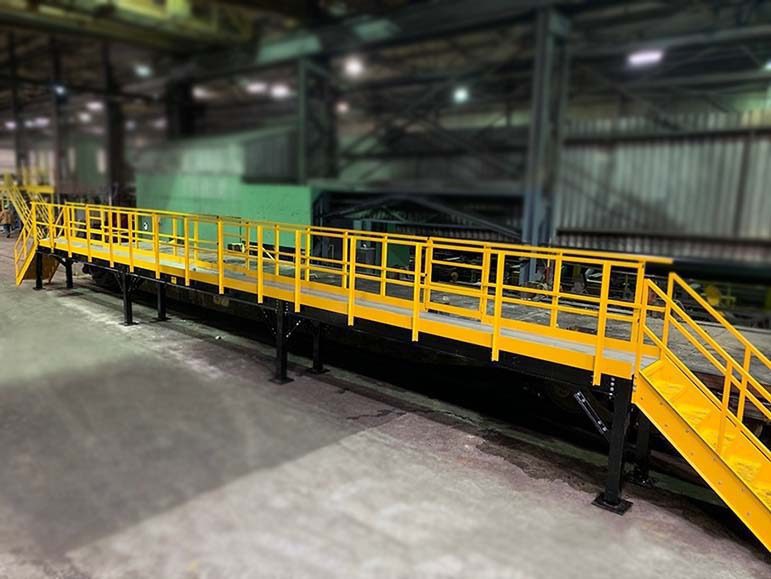
Three things sit on top of the federal rules. State-plan states run their own OSHA programs, which must be at least as effective as federal OSHA and can be stricter. Your building code, usually the IBC as adopted locally, applies when a catwalk is a permanent structure, part of an exit route or under a building permit. Construction work is covered by 29 CFR 1926, not 1910. This guide covers the federal general-industry rules that shape most industrial catwalks. It is a planning summary, not legal advice; your safety professional and the authority having jurisdiction have the final word.
OSHA Catwalk Requirements at a Glance
These are the requirements that most often decide how a catwalk is designed and built, with the exact section for each.
| Requirement | What the rule says | Source |
|---|---|---|
| Load | Each walking-working surface must support its maximum intended load. | 29 CFR 1910.22(b) |
| Safe access | Employers must provide, and employees must use, a safe means of access and egress. | 29 CFR 1910.22(c) |
| When guardrails are needed | Each employee on a runway or similar walkway must be protected from falling 4 feet or more to a lower level by a guardrail system. | 29 CFR 1910.28(b)(5) |
| Guardrails on which sides | Guardrail systems on ramps and runways go along each unprotected side or edge. | 29 CFR 1910.29(b)(14) |
| Top rail height | 42 inches, plus or minus 3 inches, above the walking surface. | 29 CFR 1910.29(b)(1) |
| Top rail strength | Withstands at least 200 lb applied down or out within 2 inches of the top edge, and must not deflect below 39 inches. | 29 CFR 1910.29(b)(3)-(4) |
| Midrails | Midway between the top rail and the walking surface (unless a wall or parapet at least 21 inches high), 150 lb strength; other intermediate members leave openings no wider than 19 inches. | 29 CFR 1910.29(b)(2), (b)(5) |
| Toe boards | At least 3.5 inches tall, no more than 0.25-inch gap at the deck, no opening over 1 inch, 50 lb strength, where people below are exposed to falling objects. | 29 CFR 1910.29(k) |
| Dangerous equipment | Guardrails or travel restraint even below 4 feet when an employee could fall into or onto dangerous equipment. | 29 CFR 1910.28(b)(6) |
| Stairs to the catwalk | Standard stairs 30–50°, risers 9.5 in. max, treads 9.5 in. min, 22 in. min width; landings at least as wide as the stair and 30 in. deep. | 29 CFR 1910.25 |
| Ladderway openings | A self-closing gate that swings or slides away from the opening, or an offset entry. | 29 CFR 1910.29(b)(13) |
| Inspection | Inspect regularly and as necessary; fix hazards before reuse; a qualified person handles structural repairs. | 29 CFR 1910.22(d) |
Is There an OSHA Minimum Catwalk Width?
This is the most misquoted catwalk rule. Many articles say OSHA requires every catwalk to be at least 18 inches wide. The federal general-industry text does not say that. The 18-inch figure comes from an exception: when guardrails on both sides of a runway used exclusively for a special purpose are not feasible, the employer may omit the guardrail on one side, but only if the runway is at least 18 inches wide and each employee uses a personal fall arrest or travel restraint system (29 CFR 1910.28(b)(5)(ii)).
| Width question | What OSHA 1910 says | What it means for design |
|---|---|---|
| Catwalk with guardrails on both sides | No single federal minimum width in 1910 Subpart D | Size it for the task: people, tools, carts and passing traffic |
| Special-purpose runway with one guardrail | At least 18 in. wide, plus personal fall arrest or travel restraint | An exception for tight retrofits, not a design target |
| Standard stairs serving the catwalk | At least 22 in. between vertical barriers | The stair often sets the narrowest point of the route |
| Landings and platforms at stairs | At least the width of the stair and 30 in. deep | Plan a landing wherever the stair meets the walkway |
| Door or gate opening onto a stair platform | Swing may not reduce usable depth below 22 in. (platforms installed on or after Jan. 17, 2017) | Check gate swing on the drawings |
In practice most industrial catwalks are much wider than any minimum. Equipto’s prefabricated catwalk modules, for example, use 4-foot-wide walkways. Building codes and egress rules can require more width when the catwalk is part of an exit path, so confirm with your local building department.
Catwalk Guardrail Requirements
- Top rail: 42 in. ± 3 in. above the deck; holds 200 lb and stays above 39 in. under load.
- Midrail: about halfway between top rail and deck; holds 150 lb.
- Openings: balusters, mesh or panels leave no gap wider than 19 in.
- Toe board: at least 3.5 in. tall, gap at deck 0.25 in. max, holds 50 lb.
Guardrails are the main fall protection on a catwalk. OSHA requires them along each unprotected side of a runway that is 4 feet or more above a lower level, and the system has to meet the build criteria in 29 CFR 1910.29(b):
- Top rail at 42 in. ± 3 in. above the deck. It may be higher than 45 in. if the system meets all other criteria.
- 200 lb load capacity at the top rail, applied downward or outward, and the rail may not deflect below 39 in. under that load.
- Midrail midway between the top rail and the deck, or screens, mesh, balusters or panels with openings no wider than 19 in., each rated for 150 lb.
- Smooth surfaces that will not cut skin or snag clothing; rail ends may not overhang posts where they create a projection hazard.
- Top rails and midrails at least 0.25 in. thick or in diameter. Steel or plastic banding may not be used as rails.

Check rails on existing catwalks
Measure from the walking surface to the top edge of the top rail at several posts, especially where grating panels were replaced or the deck was overlaid. Look for loose or missing midrails, rails bent below 39 inches, and gaps at corners and stair heads. Under 29 CFR 1910.22(d) hazards must be fixed or guarded before the catwalk is used again, and structural repairs need a qualified person.
Handrails on stairs are different from guardrails on the walkway. Stair handrails sit 30 to 38 inches above the tread nosing, and stair rail systems installed on or after January 17, 2017 must be at least 42 inches high (29 CFR 1910.29(f)).
Toe Boards and Falling Object Protection
When people work or walk under a catwalk, OSHA requires protection from falling objects: head protection plus toe boards, screens or guardrail systems, canopies, or barricading the area below (29 CFR 1910.28(c)). On most catwalks over aisles, conveyors and workstations, toe boards are the practical answer.
Toe boards used for falling object protection must (29 CFR 1910.29(k)):
- Run along the exposed edge for a length that protects the people below.
- Stand at least 3.5 in. tall from the deck to the top edge.
- Leave no more than a 0.25 in. gap above the deck.
- Be solid or have no opening larger than 1 in.
- Withstand 50 lb applied down or out at any point.
If tools or materials are stacked higher than the toe board, add paneling or screening up to the midrail (and higher if items are piled above it).
Stairs, Ship’s Stairs and Ladders to the Catwalk

Every catwalk needs a safe way on and off (29 CFR 1910.22(c)). OSHA expects standard stairs where people travel between levels regularly and routinely, including to operating platforms for equipment (29 CFR 1910.25(b)(7)). Ship’s stairs, alternating tread stairs and ladders are for tighter spaces and less frequent access.
For catwalk access stairs, see our crossover stairs guide and the full industrial ladders range.
Photo: Equipto (authorized use)
| Access type | Key OSHA dimensions | Source |
|---|---|---|
| Standard stairs | 30–50° angle; riser 9.5 in. max; tread 9.5 in. min; width 22 in. min; 6 ft 8 in. headroom; uniform risers and treads; support 5× the normal live load and never less than a 1,000 lb concentrated load | 29 CFR 1910.25(b)-(c) |
| Ship’s stairs | 50–70° angle; open risers 6.5–12 in.; tread 4 in. min deep, 18 in. min wide | 29 CFR 1910.25(e) |
| Stair rails and handrails | Flights with at least 3 treads and 4 risers need stair rails and handrails; stairs under 44 in. wide with one open side need a stair rail with handrail on the open side | 29 CFR 1910.28(b)(11) |
| Fixed ladders | Rungs 10–14 in. apart, 16 in. min clear width; ladders extending more than 24 ft installed on or after Nov. 19, 2018 need a personal fall arrest or ladder safety system | 29 CFR 1910.23, 29 CFR 1910.28(b)(9) |
Gates, Openings and Holes
The places where a catwalk opens up are where falls happen: the top of a ladder, a gap left for a hoist, an opening in a wall along the walkway, or a hole in the deck.
- Ladderway openings: a self-closing gate that slides or swings away from the opening, with a top rail and midrail, or an offset entry so no one can walk straight into the hole (29 CFR 1910.29(b)(13)). Our self-closing safety gates guide covers gate types, sizing and fitting one to an existing rail.
- Hoist areas: a removable guardrail section, or chains or gates proven equivalent, across the opening when not hoisting (29 CFR 1910.29(b)(10)).
- Openings in walls: where the bottom edge is less than 39 in. above the walkway and 4 ft or more above a lower level, guard it (29 CFR 1910.28(b)(7)).
- Holes in the deck: covers that support at least twice the maximum intended load and are secured against displacement, or guardrails on all exposed sides (29 CFR 1910.28(b)(3), 29 CFR 1910.29(e)).
Photo: Equipto (authorized use)
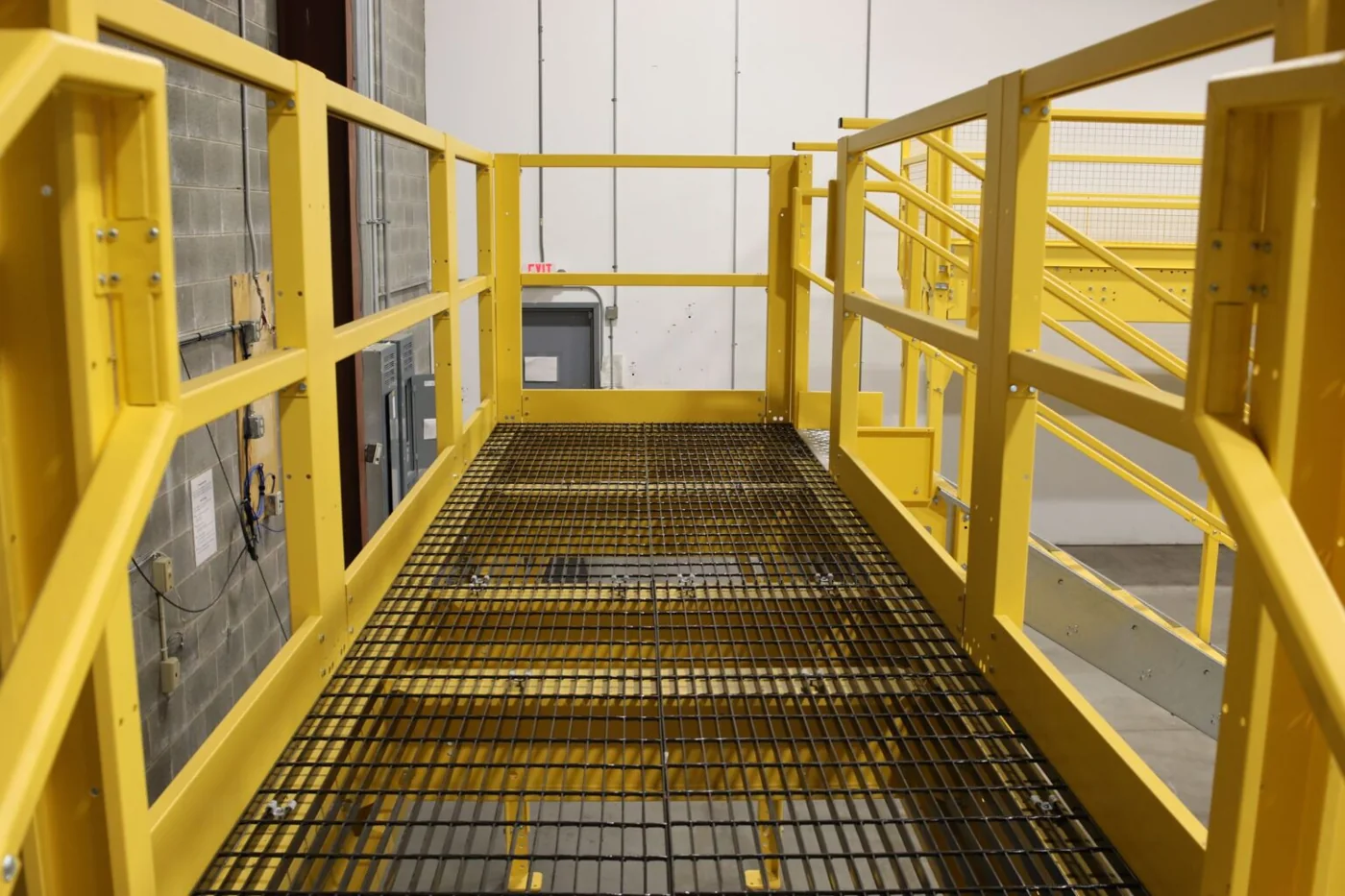
Decking, Surfaces and Inspections
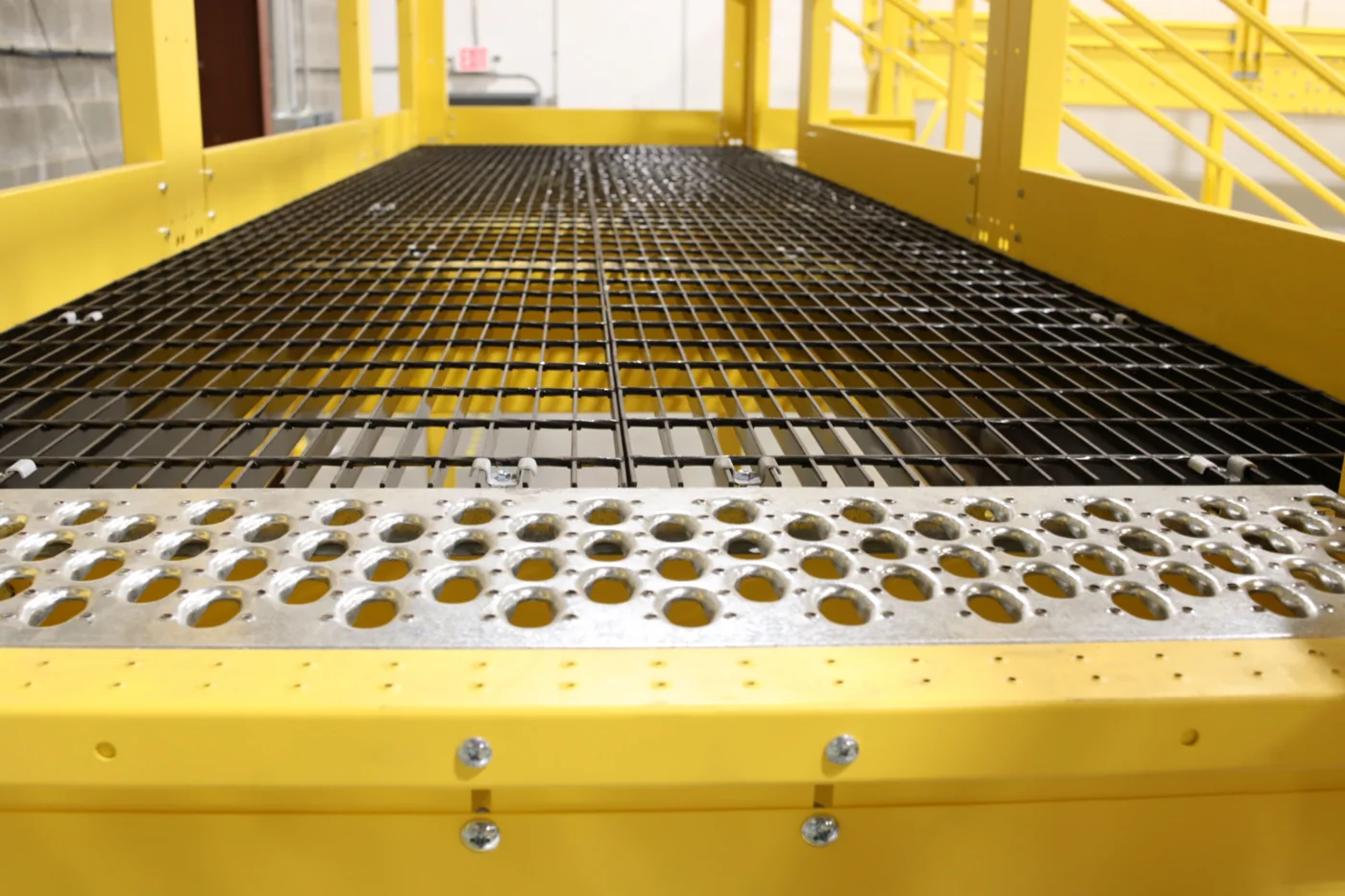
OSHA’s general rules in 29 CFR 1910.22 apply to the catwalk deck itself:
- Keep it clean, orderly and, where feasible, dry. Where wet processes are used, maintain drainage.
- Keep it free of sharp or protruding objects, loose boards, corrosion, leaks, spills, snow and ice.
- Make sure it supports the maximum intended load, including people, tools, parts and any equipment staged on it.
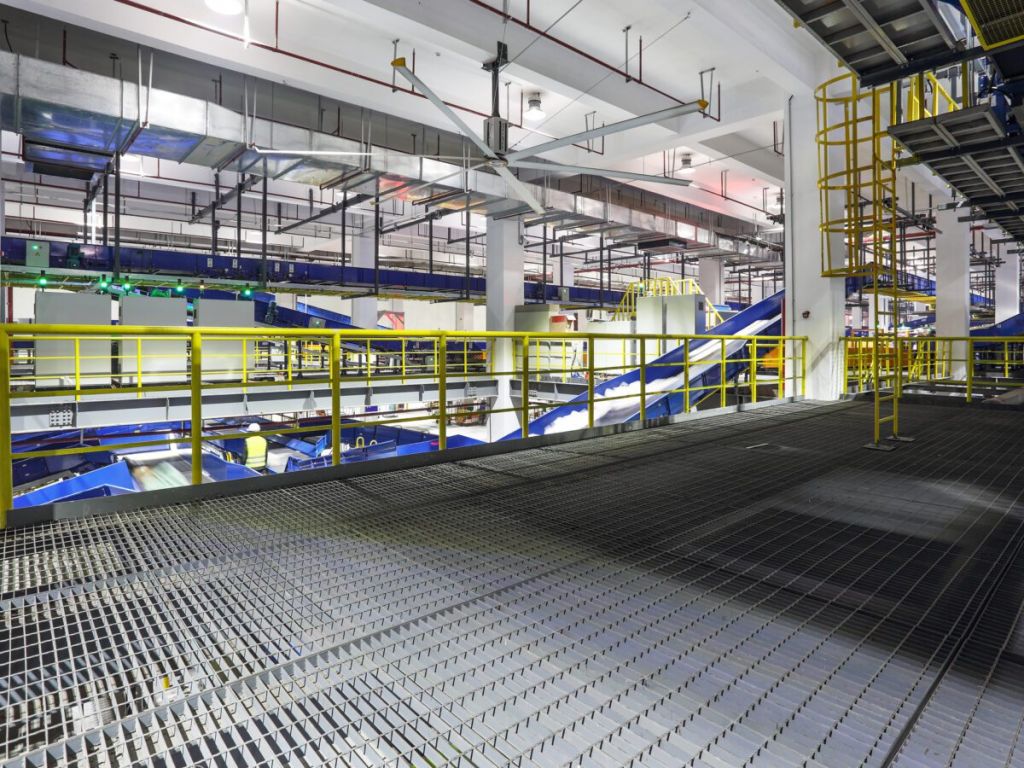
That is why most industrial catwalks use open bar grating or perforated plank: water, oil and debris drain through and the serrated or raised surface keeps traction. Galvanized decking resists corrosion outdoors and in wet areas. See steel catwalks for grating types and finishes.
Photo: Equipto (authorized use)
Inspection and repair
Walking-working surfaces must be inspected regularly and as necessary and kept in safe condition. Hazards must be corrected before employees use the surface again, or guarded until they are. Any repair that involves structural integrity must be performed or supervised by a qualified person (29 CFR 1910.22(d)).
Outdoor and wet catwalks deserve closer attention: check grating clips, anchor bolts, base plates and rail welds for corrosion, and check that drainage still works.

OSHA Catwalk Compliance Checklist
Use this list when you plan a new catwalk or walk down an existing one. It summarizes the federal rules above; add any state-plan, building code and insurer requirements for your site.
Fall protection
Guardrails on every open side 4 ft or more above a lower level, and wherever someone could fall into dangerous equipment.
Guardrail build
Top rail 42 in. ± 3 in. and 200 lb; midrail or 19 in. max openings at 150 lb; smooth, no banding.
Toe boards
3.5 in. min, 0.25 in. max gap, 50 lb, wherever people or equipment are below.
Width
Sized for the task; 18 in. only under the one-side guardrail exception with personal fall protection.
Access
Standard stairs for routine travel; ship’s stairs or ladders only where they fit the use and meet their own rules.
Openings
Self-closing gates or offset entries at ladderways; covers rated 2× the load over holes.
Load
Deck, supports and stairs rated for the maximum intended load, including staged parts and tools.
Upkeep
Regular inspections, hazards fixed before reuse, structural repairs by a qualified person.
Share the site
Photos, heights, the route, what is underneath and how often people use it.
Layout and code review
We lay out the catwalk, stairs, gates and toe boards to the 1910 Subpart D criteria above.
Quote
Equipment, freight and optional installation in one written quote.
Install
Our crews set, level and anchor the catwalk, or ship prefabricated modules ready to bolt together.
Where These Rules Come Up Most
Conveyor and sortation access
Walkways and crossovers over moving lines need toe boards and gates at every opening. See conveyor crossovers.
Equipment maintenance
Platforms beside machines, tanks and HVAC units, often with ship’s stairs. See maintenance access platforms.
Mezzanine and rack walkways
Catwalks tied into storage structures. See mezzanines and rack-supported mezzanines.
Water, wastewater and process plants
Galvanized catwalks over basins and pipe galleries. See wastewater treatment plants.
Pipes, ducts and rooftops
Short crossovers where workers would otherwise climb. See crossover stairs.
Engineered routes
Long spans, odd heights and heavy loads. See custom catwalk systems.
Request an OSHA-Compliant Catwalk Quote
Tell us where the catwalk goes, how high it is, what is underneath and how people will get on and off. Photos of an existing catwalk help us spot missing midrails, toe boards or gates and quote the fix.
OSHA Catwalk Requirements FAQs
What are the OSHA requirements for a catwalk?
What is the minimum width of a catwalk under OSHA?
How high does a catwalk railing have to be?
At what height does a catwalk need guardrails?
Does a catwalk need toe boards?
Do catwalk stairs have to meet OSHA?
Are catwalks covered by building codes too?
Can MH-USA build an OSHA-compliant catwalk?
Build It Right the First Time
Send us photos and a few measurements and we will lay out a catwalk with the rails, toe boards, stairs and gates it needs.