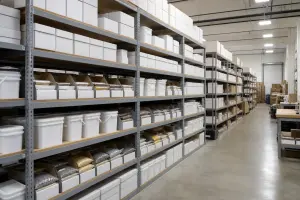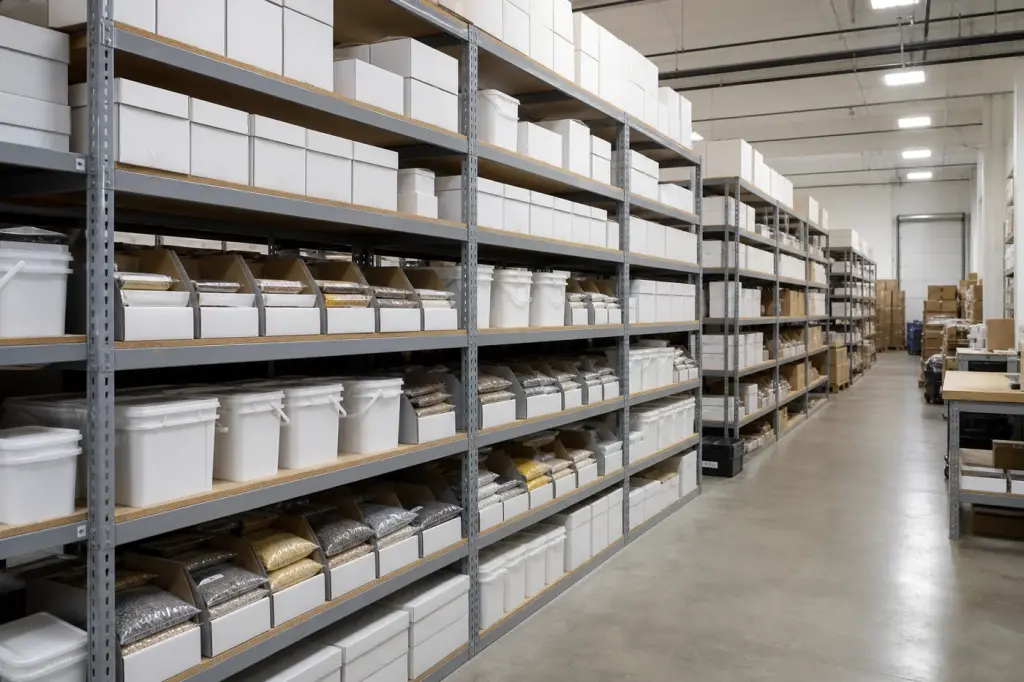
An ecommerce seed and sprouting supply company in Salt Lake City needed more storage capacity for a
growing catalog of seed packets, bulk seed, and sprouting supplies, without leasing more square feet.
The answer was boltless rivet shelving with particle board decking, sized to the
warehouse’s existing aisle and rack footprint. Read the full seed storage boltless
shelving case study for the details, or keep reading for the buyer-side lessons from that project.
The Problem: Growing SKU Count, Fixed Floor Space
Seed inventory does not behave like typical warehouse freight. A single packet weighs almost nothing, a
case of packets weighs a little more, and a bucket of bulk seed weighs a lot more, all sitting on the same
few square feet of floor. The customer’s catalog kept expanding every season, but the building was not
getting bigger. Pallet rack wastes floor space on light, low-density inventory. Wire shelving opens up
storage but does not hold small packets and envelopes cleanly. The company needed a system built around pick
locations, not pallet positions.
Why Boltless Rivet Shelving Fit This Warehouse
Boltless (rivet) shelving with solid particle board decks solves the pick-location problem directly. Shelf
levels slot into the frame without bolts, so a level can be added, dropped, or raised in minutes as a product
line changes size or the catalog grows. Solid decks keep small, lightweight packets contained the way an open
wire shelf cannot, while still giving each SKU its own defined, labeled location. For a full comparison of
options, see our boltless shelving page, or the head-to-head breakdown on
boltless shelving versus
pallet racking.
Sizing a Run for a Catalog That Keeps Changing
The project used long connected runs rather than a string of freestanding units, so the whole aisle acts
as one structure and future add-on sections match what is already standing. That decision matters more for a
seed company than most: the catalog this year is not the catalog next year, and a shelving system that
cannot be extended without buying a whole new footprint becomes a bottleneck instead of a solution. Runs that
share posts also anchor into the slab together, which keeps the layout stable as more sections get added over
time.
Storing Seed Inventory Well on Open Shelving
Seed does not store like most warehouse goods. Extension and research guidance on seed storage
consistently points to a few practical rules that shaped the layout of this project:
- Keep inventory off the floor and off the top shelf. Floor-level stock is exposed to
moisture and pests, and top-shelf stock near ceiling lights and HVAC runs warmer than the rest of the
warehouse. - Leave air space around stored seed. Airtight stacking against a wall or another pallet
traps humidity; a shelf face with airflow around it does not. - Rotate stock on a first-in, first-out basis. Viability drops over time even in good
conditions, so older lots need to sit where pickers reach them first.
These practices are consistent with guidance from
Utah State University Extension and the
USDA Agricultural Research Service on seed storage conditions. A
shelving layout that ignores them can look efficient on paper and still cause slow-moving, poor-condition
inventory in practice.
What This Means for Other Utah Businesses
The same logic applies to any Salt Lake City business storing many small, light SKUs against a fixed
footprint: distributors, ecommerce fulfillment operations, parts counters, and specialty retailers all run
into the same wall pallet rack and wire shelving cannot solve on their own. See our
boltless shelving in Salt Lake City page for local project details, or read the
full True Leaf Market case study for how this specific project came together from
first quote to installed shelving.

extend as the catalog grows.
Get a Quote for Boltless Shelving in Salt Lake City
If your warehouse is running out of pick locations rather than square feet, boltless rivet shelving is
worth pricing before adding pallet rack or leasing more space. Call (801) 328-8788 or
request a quote through our boltless shelving page to talk through your layout.
Frequently Asked Questions
Why not just add more pallet rack instead?
Pallet rack is built for palletized freight. Light, small-SKU inventory like seed packets wastes most of a pallet position’s height and depth, so boltless shelving with more, smaller pick faces uses the same footprint far more efficiently.
How is boltless rivet shelving different from wire shelving?
Both are common shelving formats, but rivet shelving uses solid particle board decks that contain small, loose, or lightweight items, while wire shelving leaves an open grid that works better for larger, more rigid packaging.
Can a boltless shelving run be extended later?
Yes. Levels and additional bays can be added without disturbing the existing structure, which is why connected runs are common for businesses with growing or changing SKU counts.
Does this project ship outside Salt Lake City?
Boltless shelving projects like this one are available throughout Utah and nationally; the Salt Lake City project reflects local delivery and installation service.
What should I check before ordering shelving for small, light inventory?
Confirm shelf span and deck load rating for your heaviest items, deck material for the smallest items, and whether the run needs to anchor to the slab given your local seismic requirements.