
Truck & Van Upfitter Equipment and Hardware Storage
Shelving and staging for ladder racks, shelving kits, partitions, brackets and hardware in a truck and van upfit shop — organized around a kitting workflow instead of a general parts room layout.

Upfitting can trigger certification duties
Adding a body or equipment to an incomplete chassis can make the installer a final-stage or alterer manufacturer under federal vehicle safety rules
Hardware volume is the hidden load
Brackets, fasteners, wiring clips and mounting hardware for a single upfit line can run into hundreds of distinct SKUs
Kits move as a set
Ladder racks, shelving units and partitions are typically staged and installed as a matched kit, not picked piece by piece
Every install is different
Vehicle-specific reinforcement and mounting requirements mean generic storage has to support many configurations, not one
Why upfit storage is not standard parts storage
A truck and van upfit shop stores two very different kinds of inventory at once. One side is bulk hardware:
brackets, fasteners, wiring clips, weld nuts and mounting kits, often SKU-heavy and small enough to disappear
into a drawer. The other side is bulky finished equipment: ladder racks, shelving units, partition panels and
drawer systems that are staged, matched to a specific vehicle order, and moved to the bay as a set.
Treat both sides like a generic parts room and the shop loses time two ways: technicians hunt through
disorganized small hardware for the three brackets a job needs, and staged kits get mixed up or damaged sitting
against a wall because nothing was built to hold their shape. This page covers storage and staging built around
that two-sided reality, inside our broader automotive parts storage systems plan. It pairs
with our fleet and municipal garage parts storage page, which covers the parts-room side of a
fleet shop that also does upfit work.
The compliance layer that shapes how work gets staged
Before storage layout, it is worth understanding why upfit work is treated differently from a standard
repair. The National Truck Equipment Association (NTEA), the trade association for the truck equipment and
upfit industry, publishes guidance on when installing a body or equipment on an incomplete chassis makes the
installer a final-stage manufacturer or alterer under federal motor vehicle safety rules.
| Consideration | What NTEA guidance addresses | Why it affects storage and staging |
|---|---|---|
| Final-stage manufacturer status | Completing a vehicle from an incomplete chassis (adding a body or major equipment) can make the installer a final-stage manufacturer with duties to complete the vehicle in accordance with the incomplete vehicle manufacturer’s instructions and submit required certification information. | Jobs at this stage need every component and hardware kit staged and verified before installation begins, since certification responsibility follows the completed vehicle, not just the installed part. |
| Multistage vehicle certification | NTEA’s multistage vehicle certification guidance walks through the documentation and identification duties across manufacturing stages. | Paperwork and physical kit staging need to move together — a kit staged without its documentation is a compliance gap, not just a workflow inconvenience. |
| Re-certification on used vehicles | NTEA guidance notes that adding a body or equipment to an already-titled, in-service used vehicle generally does not require the same multistage manufacturer certification as new-chassis upfits. | Shops doing both new-chassis and used-vehicle upfit work benefit from physically separating those job types in staging so the different paperwork paths do not get crossed. |
This is a compliance signpost, not legal guidance
Whether a specific job triggers final-stage manufacturer or alterer status, and what certification is required, depends on the vehicle, the equipment installed and current federal requirements. Use NTEA’s published guidance and your own compliance program to make that determination — this page addresses only the physical storage and staging that supports the work.
Storing hardware for a high-SKU, kit-based shop
The fastener and bracket side of an upfit shop behaves like a small distribution operation: dozens of vehicle
platforms, each with its own mounting hardware, reinforcement brackets and wiring hardware, all needed in exact
kit quantities at the start of a job.
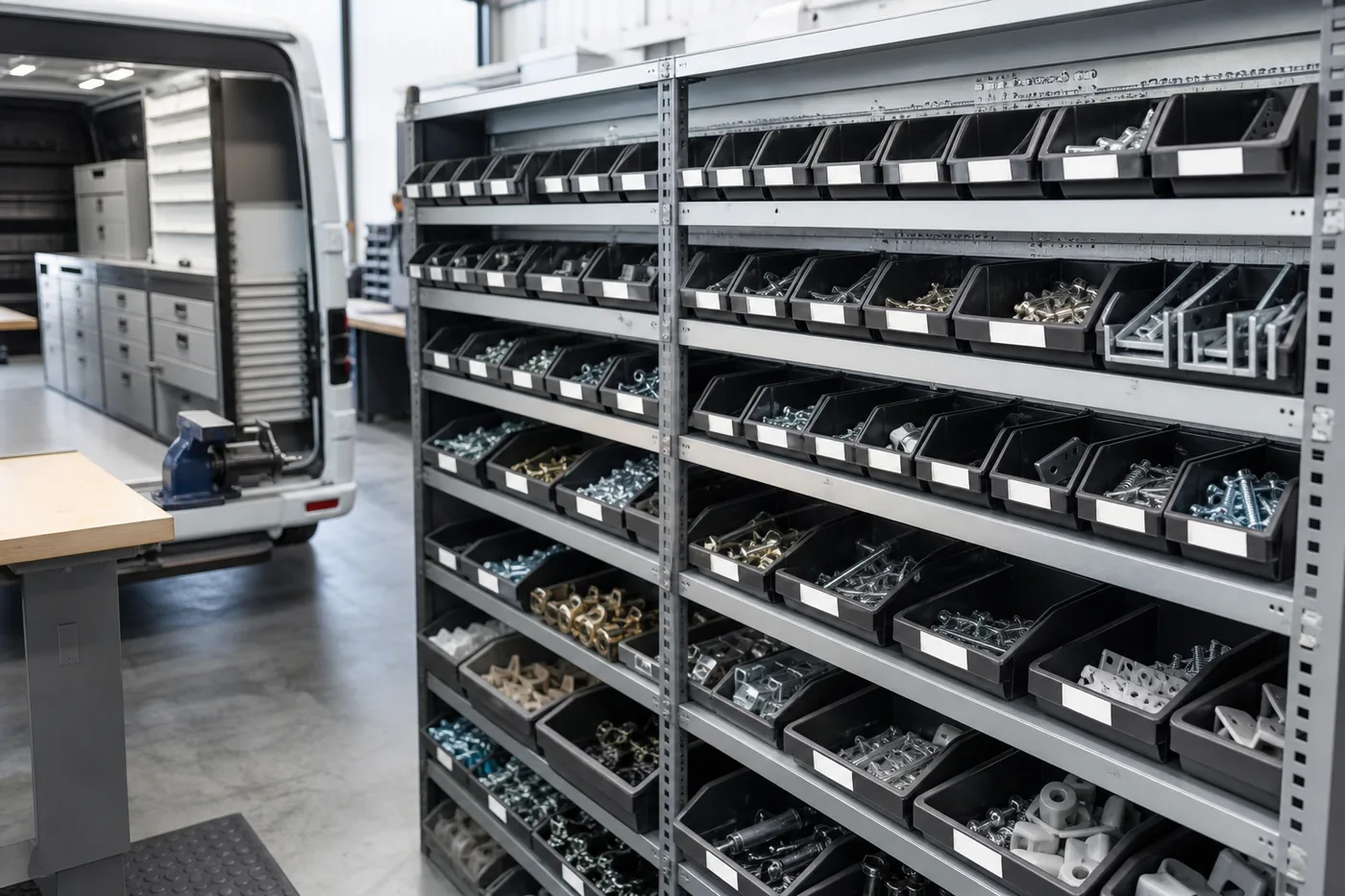
- Bin by kit, not just by part type. Grouping hardware by the vehicle platform or kit it
serves — in addition to a part-type index — means a job can be pulled as one stop instead of a
scavenger hunt across bins organized purely by fastener size. - Use labeled, divided bin shelving for small hardware. Clear bin fronts and location labels
let anyone on the floor restock or pull correctly, not just the person who set the system up. - Reserve drawer cabinets for high-value, easily lost items. Connectors, sensors, small
electrical hardware and anything easily misplaced or pilfered belong in a lockable modular drawer system rather
than open bins. - Set min/max levels per platform. Because kits are pulled as a set, running out of one
bracket stops a whole job, not just one line item — min/max review needs to happen at the kit level, not
just the individual SKU level. - Keep reinforcement hardware separate from cosmetic hardware. Structural brackets and
reinforcement kits — sometimes required by the vehicle manufacturer before mounting racks or shelving
— should never be shelved next to purely cosmetic trim hardware where a technician could grab the wrong
one under time pressure.
Our bin shelving and modular drawer cabinets pages cover the systems that
handle these two hardware tiers.
Staging bulky equipment without damaging it
Setting up or reorganizing an upfit shop?
MH-USA lays out hardware bins, drawer cabinets and staging racks for truck and van upfit shops across Utah, Idaho, Nevada and the Mountain West, sized to your platform mix and kit volume.
Receiving equipment and hardware into the right storage from day one
Upfit shops receive equipment two ways: bulk hardware shipments that need to be broken down into bins, and
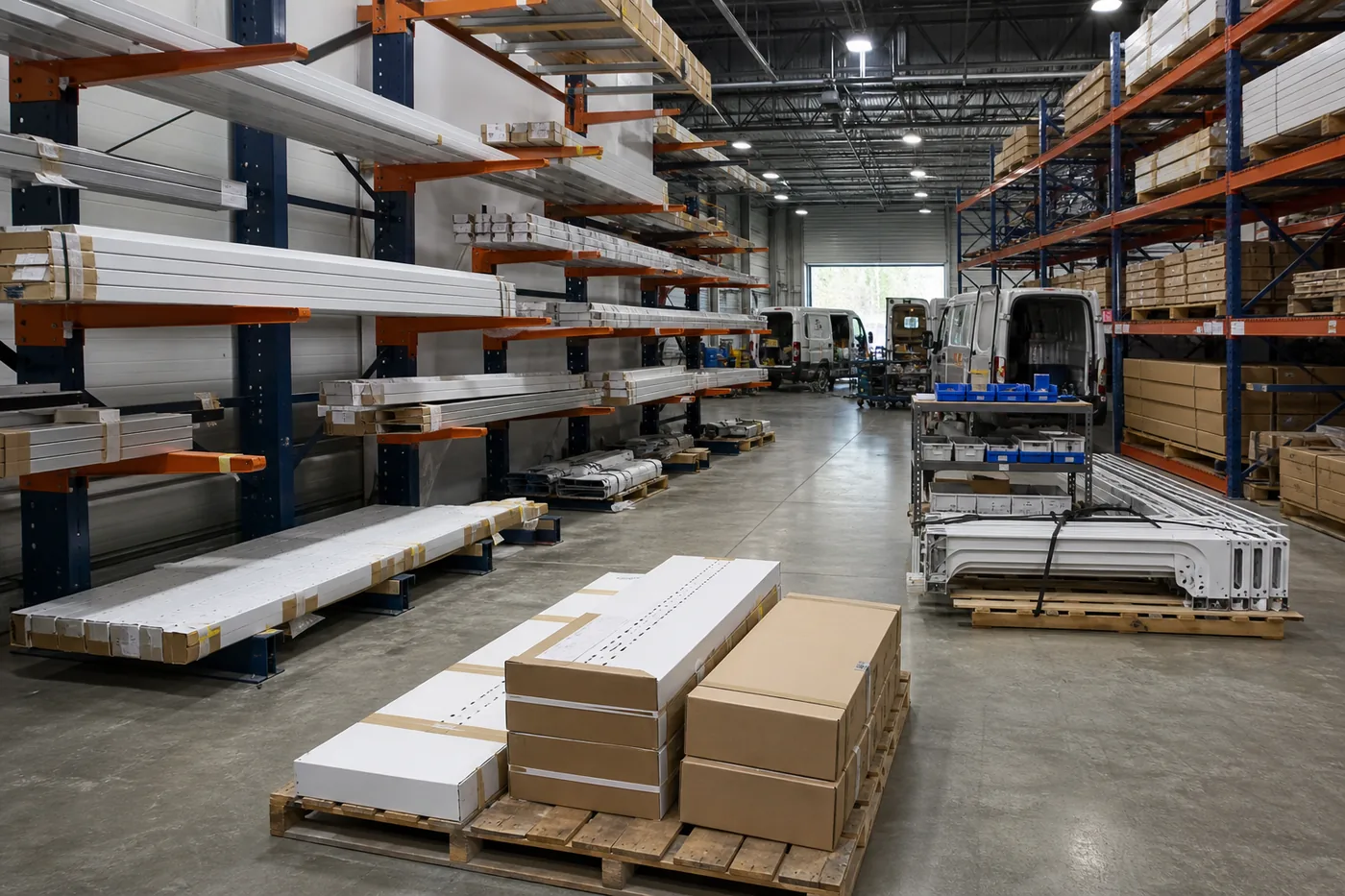
palletized or crated finished equipment — racks, shelving kits, partitions — that needs to move
straight into staging without being unpacked onto the floor first. Building a receiving process that routes
each type correctly, covered in general terms on our parts receiving and put-away storage
page, keeps the shop floor from becoming the default staging area by accident.
Planning storage for a growing upfit line
Upfit shops usually grow one platform at a time — a new fleet contract, a new van model, a new
equipment line — and storage that worked for three platforms often breaks down at eight. A few planning
habits keep the storage system scaling with the business instead of becoming the bottleneck.
Audit hardware by platform before adding shelving
Before buying more bins, map which vehicle platforms actually drive the SKU count. A handful of platforms usually account for most of the hardware volume, and that should drive where the densest bin storage goes.
Separate active platforms from discontinued ones
Hardware for a platform the shop no longer upfits should move out of prime bin locations the same way dead parts stock does elsewhere in a dealership or distributor — it still has value, but it should not compete with active kits for the best locations.
Build in staging capacity before it is needed
Adding one more vehicle platform typically adds a full staging lane’s worth of bulky kit storage, not just a few more bins. Plan spare cantilever or wide-span capacity ahead of a new contract, not after kits start stacking on the floor.
Standardize the labeling scheme across platforms
A consistent bin and location labeling convention across all platforms means a new technician or a seasonal hire can find hardware correctly on day one, without platform-specific training.
Revisit min/max levels after a volume change
A new fleet contract or seasonal upfit surge changes the right stocking level for that platform’s hardware; min/max levels set at launch should be reviewed once real volume is known, not left at initial estimates.
What makes upfit shop storage different from a regular parts room?
Does installing a ladder rack or shelving kit require special certification?
How should upfit hardware be organized to speed up kitting?
Where should staged ladder racks and shelving kits be stored before installation?
Is there a weight limit for what can be mounted on a ladder rack?
Do commercial truck upfits need different storage than van upfits?
Organize your upfit shop’s hardware and staging storage
Send us your platform mix, kit volume and current storage layout. MH-USA will lay out bin, drawer and staging systems sized to how your upfit shop actually works.