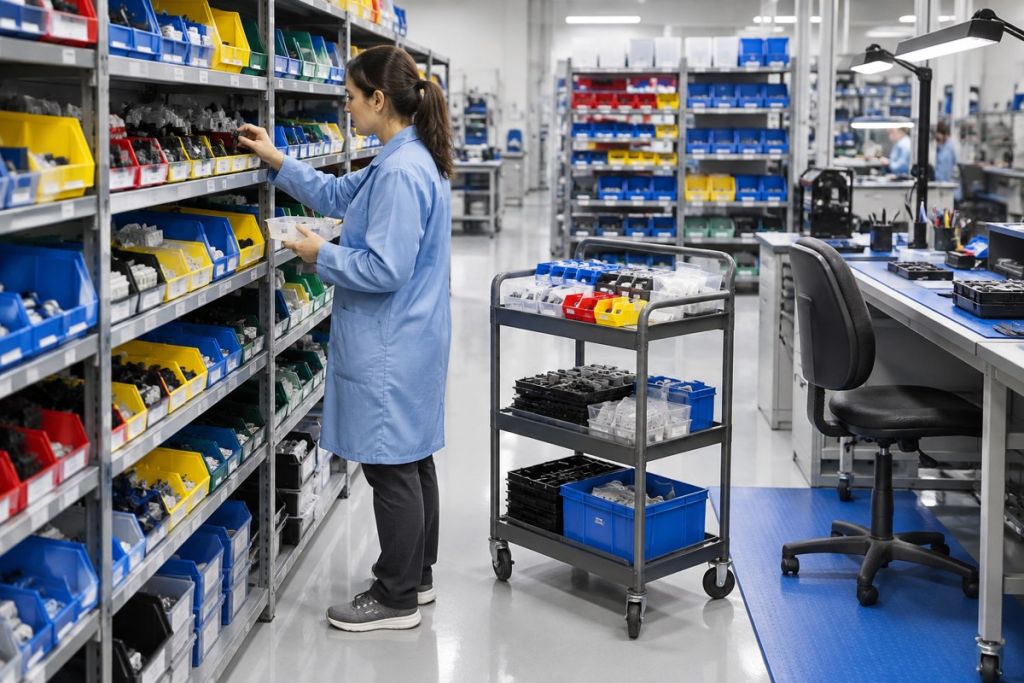
A kitting cell runs out of a connector at mid morning. The reserve case sits on the floor across the aisle, the work order waits, and the picker spends six minutes hunting a part that should have been at arm's reach. That scene is why bin shelving for Utah electronics assembly kitting areas is a layout decision, not a furniture purchase.
Good shelving does three jobs at once. It keeps small parts visible and countable. It supports the static and traceability controls your quality system already requires. And it puts the parts an operator touches every few minutes inside a reach zone that doesn't cost a bend or a step.
This is written for the facility, operations, maintenance, and procurement people who have to specify that shelving, size it, budget it, and defend the choice. The Utah bin shelving hub covers the product range. This page covers the application: what a kitting area stores, which configuration fits which condition, what to measure, what Utah code adds, and what belongs in a quote request.
The first question isn't which shelf. It's how many times each part gets picked, and how heavy the bin is when it's full.
What Utah Electronics Kitting Areas Store and Handle
Most kitting areas in the state hold the same mix: component bins, reels and trays, cable assemblies, fasteners, and work order kits in progress. Before anyone compares a boltless unit with a wire unit, the buyer should be able to answer three questions. What is stored, how often is each item picked, and what does a full bin weigh. Those three answers rule out more options than any catalog page.
The scale behind the demand isn't in question. Utah Department of Workforce Services data lists 26,030 manufacturing jobs and 1,018 manufacturing establishments in 2023, and computer and electronic product manufacturing accounted for 2,453 jobs in the industry breakdown (Utah Department of Workforce Services). That's a lot of buildings where one missing part stops a build. Where the area is static controlled, the in-plant room next to it usually follows the same rules (electronics assembly ESD in-plant office).
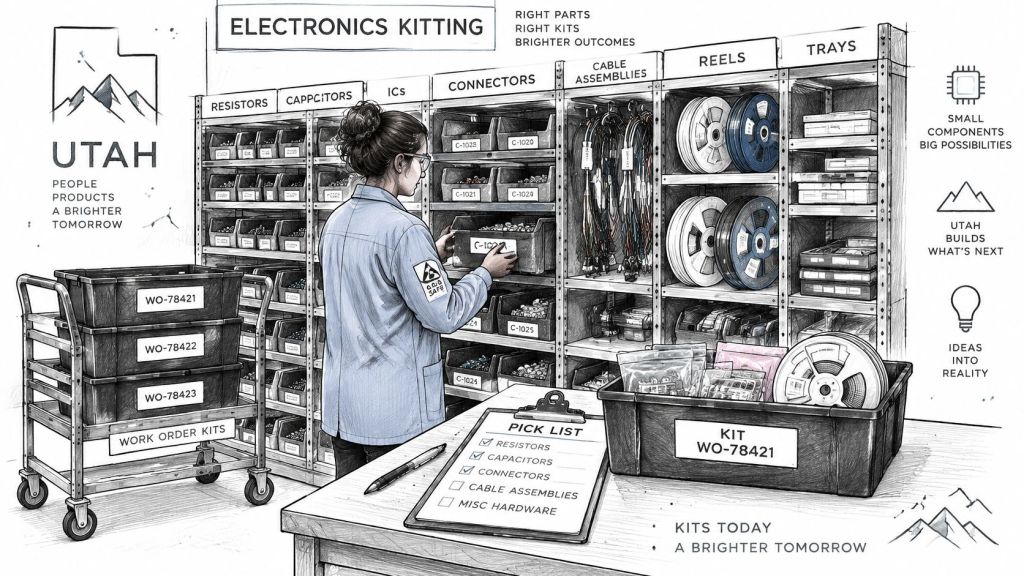
Follow the part, not the catalog. Material moves in a fixed order in a working kitting area:
- Receiving and put-away. Cartons arrive, get counted, and the first broken case gets decanted into a labeled bin.
- Replenishment. The line bin drops to its minimum and gets topped up from reserve stock.
- Pick to kit. The kitter pulls listed quantities into a tote or kit cart against a work order.
- Kit to line. The complete kit travels to the cell and the empty tote comes back.
- Returns and quarantine. Leftovers, suspect material, and failed boards go to a separate, labeled location.
Four conditions make the space hard:
- Many part numbers in a small footprint. One cell can run dozens of part numbers inside a few square feet of bench.
- A wide range of pick frequency. Some parts come out every few minutes, others once a shift.
- Packaging that shouldn't be opened early. Parts arrive in moisture-barrier bags that stay sealed until point of use.
- Lot traceability. A returned board has to connect back to component lots and work order steps.
Say a cell builds kits for 60 part numbers. Eight of them move every few minutes and the rest move once a shift or once a week. Storage that treats all 60 the same slows down the eight that matter and buries the 52 that don't.
Utah Code, Load and Seismic Rules to Check
A tall bin shelf loaded with components needs a stable, reviewed installation. Plan for the building and the intended load before ordering, since changes after an inspection or seismic event can require costly rework.
Utah employers generally work under the Utah State Plan, which adopts most federal OSHA standards and may add requirements. Before finalizing a layout, review it against federal general-industry rules and current Utah Occupational Safety and Health requirements (Utah State Plan, OSHA).
Keep storage out of electrical working space
Electrical equipment needs clear access and working space for safe operation and maintenance. Keep bins, totes, and replenishment cartons out of that space. Mark the area on the floor and keep it clear.
State loaded weight, not empty capacity
A shelf rating applies to the shelf under its specified conditions. For planning, state the maximum loaded weight for each level, including bins and their contents. Place heavier kits on lower or middle levels, keep containers from sliding, and stay within the rated capacity. After an impact, overload, or relocation, inspect the unit and isolate any damaged shelving.
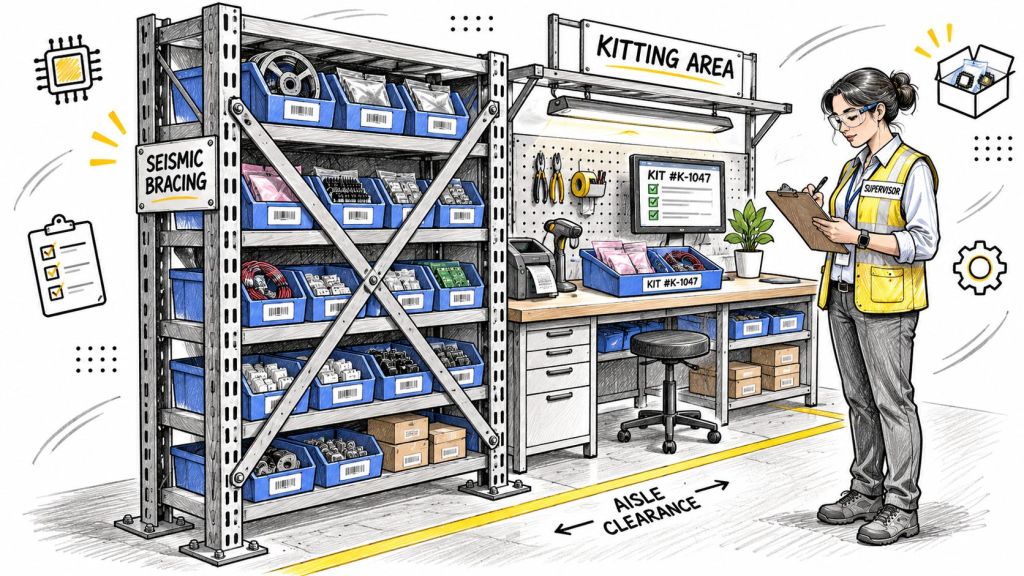
Get a seismic review before the order
For tall or heavily loaded systems, have a qualified designer review anchorage, bracing, and height-to-depth ratio against the adopted Utah code and site seismic criteria. Salt Lake City building guidance points to ASCE 7-22 for seismic design of storage racks and RMI ANSI/MH 16.1 for the design, testing, and use of steel storage racks (Salt Lake City Building Services). Retain upper-shelf bins with lips, dividers, or other suitable restraints, and coordinate anchorage with the slab, aisles, sprinklers, egress, and permits.
A shelving product is not compliant by default. Ask for documentation for the exact configuration being purchased, with requirements tied to the building and site. For projects that also include an exterior structure, industrial storage shed selection criteria can help frame separate questions about shed selection.
Bin Shelving Configurations Compared for Kitting Work
Scan the table first. Each row is a configuration you can request, with what it suits and what it costs you in flexibility. The national bin shelving range shows the frame, shelf, and bin combinations behind these rows.
| Configuration | Best fit | Main trade-off | ESD fit | Reconfiguration |
|---|---|---|---|---|
| Boltless steel shelving with bins | Mixed component bins and heavier trays | Bins must be sized to shelf depth and need a stable fit | Use conductive or dissipative bins and bond the rack as the site plan requires | Shelf levels reset easily |
| Open wire shelving with wire bins | Fast-moving small parts at waist to shoulder height | Loose parts can fall through and bins can shift | Wire and bins need documented grounding and ESD-rated finishes | Easy to move, but bins must be re-secured |
| Rivet shelving with bins | Light to medium kits and stable reserve stock | Shelf levels are less adjustable than boltless | Verify finish, bonding, and grounding for each bay | Level changes require disassembly |
| Modular drawer cabinets | Fasteners, connectors, and small parts kept clean and separated | Fewer visible bins and slower searching | Plastic drawers need dissipative liners or ESD-rated units | Drawers re-divide as part families change |
| Tall boltless rack for reserve cartons | Bulk reserve stock kept off the line | Needs a seismic and anchorage review before install | Keep ESD packaging intact and store reserve stock in its zone | Relocation requires a new anchorage check |
Boltless steel shelving wins most mixed kitting areas because part families change and shelf levels move with them. Open wire shelving makes stock visible and lets light through, which helps in a small cell, but small hardware migrates through the gaps and bins drift without a retaining lip.
Rivet shelving is the stable, cost-effective answer for a layout that won't change, and the penalty is that level adjustments mean taking the bay apart. Drawer cabinets keep connectors and fasteners clean and separated, but they hide stock, and hidden stock gets reordered. A tall reserve rack above the line solves carton storage and creates the one thing an inspector will ask about: anchorage.
ESD is a system, not a shelf color
Metal shelving is not automatically static safe. ANSI/ESD S20.20 applies to organizations that assemble, inspect, package, transport, or store electronic items vulnerable to discharge, including devices rated at or above 100 volts human-body-model and 200 volts charged-device-model sensitivity (ANSI/ESD S20.20). Your site plan decides whether racks and bins must be conductive or dissipative, how components are bonded or grounded, and how resistance gets verified.
The failure mode to design out: a grounded workstation fed by an ungrounded shelf and ordinary plastic bins. Charge accumulates during picking, and the bench never sees it coming.
Ask a supplier for documented finishes and grounding methods before you order, and keep lot control separate from static control. ESD protection never replaces FIFO. For the small-part side of the layout, the small parts storage systems range covers dividers, drawer units, and bin rails that fit inside these frames.
Most well-run cells end up mixed: drawers for the small, clean, high-count parts, open bins for active picks inside the reach zone, and a reserve rack for sealed cartons and overstock.
Sizing, Reach Zones and Aisle Layout
Sizing is a measurement exercise, not a guess. Work through these eight steps before you ask for pricing, and bring the numbers with you.
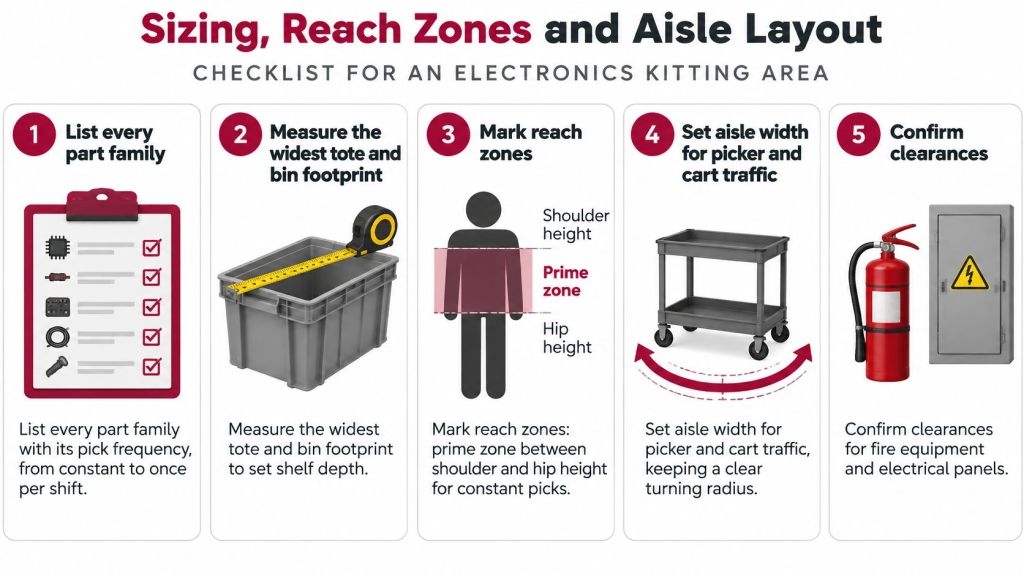
- List every part family with its pick frequency, from constant to once per shift. Frequency decides who sits at eye level and who moves to reserve.
- Measure the largest empty bin and the heaviest full bin. You need both numbers. Volume sets shelf depth and loaded weight sets the rating.
- Set shelf depth to bin depth plus a small clearance. An overhanging bin catches sleeves and gets pulled off the shelf.
- Set shelf spacing for the tallest bin plus hand clearance. If you can't lift the bin out with a straight wrist, the spacing is wrong.
- Put high-frequency bins between roughly knee and shoulder height. This is the primary reach zone, and it's where most handling happens.
- Keep heavy reels, trays, and full kits at waist height or lower. Weight belongs low, where lifting is strongest and dropping is shortest.
- Keep reserve cartons out of the reach zone and out of aisles. Reserve stock is a different job from line-side picking.
- Mark permanent aisles and confirm carts and totes fit. Measure the loaded cart, not the empty one.
OSHA's ergonomics guidance backs this directly. It advises changing shelf height to reduce hazardous motion, minimizing the distance between workers and the objects they handle, and setting work surfaces near waist height, and it names bending the upper body and spine to reach into a bin as highly undesirable (OSHA ergonomics). The suggested fixes are practical: raise or tilt bins, use collapsible-sided containers, move bins closer to the point of use, and store heavy items at waist level.
Capacity is the least interesting number on the drawing. A shelf rated for a load nobody lifts is worth less than a shelf the operator can reach without twisting.
A 12 inch deep shelf that's fully visible beats a 24 inch shelf where the front row sells and the back row ages. Shallow and tall usually beats deep and short in a kitting cell.
Installation, Lead Time and Service Planning
Treat the purchase as a six phase project. Each phase has an owner and a document, and skipping one is how a two day install turns into a month of workarounds.
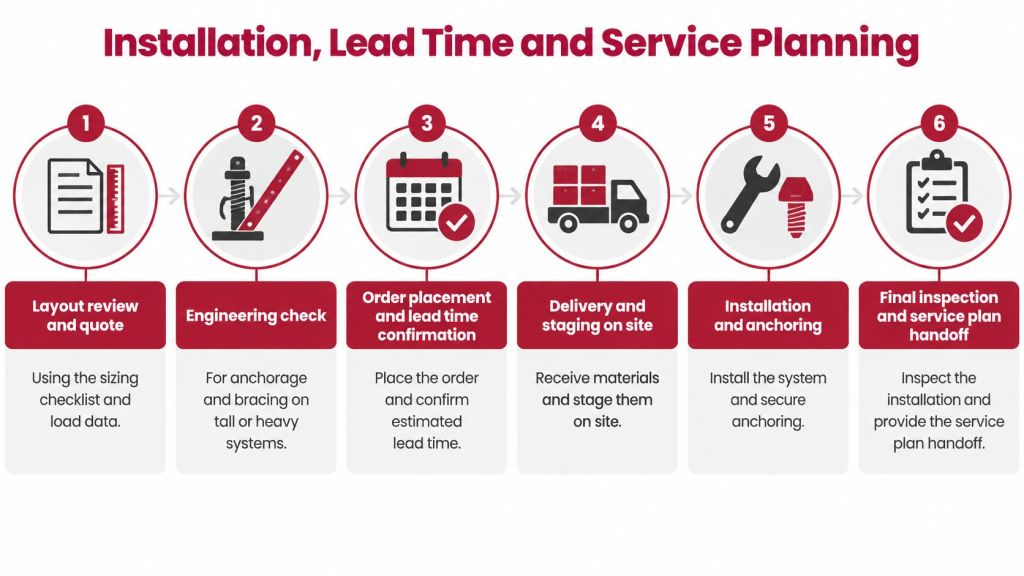
- Layout review and quote. Send the sizing checklist, loaded weights, and aisle widths. A layout built on real numbers needs fewer revisions.
- Engineering check. Tall or heavy systems go to a designer for anchorage and bracing before anything is ordered.
- Order confirmation. Get the lead time in writing, including the delivery window and who receives it on site.
- Delivery and staging. Stage where a forklift can reach without blocking a marked aisle or a panel's clear space.
- Installation. Anchor the units, bond them to the ESD ground where your plan requires it, and label bins with machine-readable location IDs as they go up.
- Verification and handover. Check resistance readings, load labels, and aisle markings, then hand the area to operations with the paperwork.
On availability, some common sizes are stocked at select manufacturers, subject to confirmation at the time you ask. Custom sizes and non-standard finishes need a confirmed lead time on the quote, and that date should drive your install schedule rather than the other way around.
Service items worth calendaring:
- Inspection routine. Check anchors, shelf condition, and bin damage on a set schedule, and after any impact.
- Re-anchor after any move. A relocated unit needs a fresh anchorage check, even if the footprint looks the same.
- Label updates. Refresh location IDs whenever a part family moves, or the location system no longer matches the floor.
- ESD retesting. Repeat resistance and grounding checks at the intervals your site program defines.
Start the review early and you get more room in the install window, avoid tearing up a cell during peak production, and give the engineer time to check anchorage before volume grows.
Choosing a Setup by Buyer Scenario
Most buyers recognize their situation in one row. Use the table as a lookup, then apply the mixed case rule at the end.
| Scenario | Recommended setup | First measurement |
|---|---|---|
| Small line with few part numbers and a steady pick rate | Boltless shelving with standard bins | Bin footprint and heaviest full bin |
| High-mix kitting with many small parts | Drawer cabinets plus open bins for active picks | Pick frequency for each part family |
| ESD area with moisture-sensitive parts or traceability needs | Dissipative shelving and bins with separate zones for unopened stock, active picks, quarantine, and completed kits | Site ESD plan and its grounding requirements |
| Tall reserve storage above the line | Anchored boltless rack | Loaded weight per level and a seismic review |
| Cell that changes layout often | Modular shelving re-leveled after moves | Aisle and cart widths |
The mixed case rule is simple. When two scenarios apply to one area, the stricter requirement sets the specification for the whole space. A cell with mostly plain fasteners but one moisture-sensitive component family gets the ESD-rated shelving, the sealed-stock zone, and the dwell time limits, because the loose standard leaks into the sensitive work the moment a bin gets swapped.
Common Mistakes That Cause Rework
Almost every rework story traces back to a missing measurement or an unverified requirement, not to defective shelving. Here are the five that show up most.
- Assuming metal or plastic is automatically ESD safe. Fix: confirm your site plan, get documented finishes and grounding methods, and verify resistance before you load the unit.
- Overloading upper shelves or exceeding bin capacity. Fix: state loaded weight per level in the quote and keep heavy kits at waist height or lower.
- Using shelving as overflow storage in aisles or in electrical clear space. Fix: define a reserve zone and mark the floor before installation day.
- Leaving moisture-sensitive parts in open bins with no dwell limit. Fix: keep the moisture-barrier packaging and desiccant controls aligned with JEDEC J-STD-033 practice, and record exposure time.
- Mixing lots or skipping FIFO when bins are refilled. Fix: label bins with machine-readable location IDs and segregate quarantine stock physically, not just in the system.
That last one is a labeling problem more than a shelving problem. A location system costs very little next to the frames, and it's what turns shelving into inventory you can count. The labeling and bin location systems approach maps straightforwardly onto a kitting row.
Common Questions About Bin Shelving for Utah Kitting Areas
Do all kitting bins need ESD protection?
Not automatically. Your site plan decides which surfaces and bins must be conductive or dissipative, and how they're bonded and verified. Decide from the plan, not from the color of the plastic.
Is seismic anchoring needed for bin shelving in Utah?
Tall or heavily loaded units need a review against the adopted code and your site criteria. Light, low shelving may need less. Height-to-depth ratio and loaded weight per shelf are the first two numbers a designer asks for.
Can shelving double as overflow storage?
No. Reserve stock belongs in a designated reserve zone. Aisles and electrical working clearances aren't storage, and boxed overstock staged beside the line is the usual cause of a blocked route.
How do we stop operators decanting moisture-sensitive parts into open bins?
Keep parts sealed until point of use, set a maximum dwell time for opened packages, and give opened stock its own labeled zone. If a bin makes decanting easier than keeping the bag, the layout loses.
Can the shelving move when a cell relocates?
Yes, and that's the main argument for modular units. Check anchorage, labels, and aisle markings again after the move, because the footprint can look identical while the anchors are gone.
How long does a layout review take?
Scope drives the schedule, so ask for a date when you submit the request. Come with the sizing checklist filled in and the review moves faster.
Request a Layout Review and Quote
If the pick sequence, bin loads, and operator reach are clear, a layout review can focus on the shelving and floor plan that fit the cell. Include part families, loaded bin weights, aisle widths, and a floor sketch so the designer can assess the request.
Material Handling USA is headquartered in Salt Lake City and serves customers nationwide. Its design services include warehouse and stockroom layouts, in-plant offices, and specialized storage rooms. The company supports both individual product orders and full facility projects.
Submit a quote request through the Utah bin shelving hub, or contact Material Handling USA to discuss the project. Call (800) 326-4403 or email Sales@MH-USA.com.
Lead time depends on the selected configuration and manufacturer. Ask for a confirmed schedule as part of the quote, especially if installation must fit around production.
Material Handling USA supplies shelving and storage systems for warehouses and facilities. To start a review, visit Material Handling USA or call (800) 326-4403.