
Cantilever vs Four-Post Shelving on Mobile Carriages
Two shelving constructions ride on the same carriages and rails — and they behave differently once the collection, the depths and the end panels are decided. Here is how to choose.

2
Shelving families that mount on carriages: bracket and case-type
1 in.
Vertical adjustment increment on library-grade cantilever uprights
Nominal ≠ actual
Cantilever shelf depth is listed one inch over the real surface
Base detail
The part that decides whether a range can go mobile at all
You are choosing two products, not one
Buyers researching high-density mobile shelving usually start with the moving part: manual, mechanical-assist or powered carriages running on rail. That is only half the system. The other half is the shelving that rides on those carriages, and it comes from an older, quieter argument in the storage industry between two constructions — cantilever bracket shelving and four-post case-type shelving.
The distinction matters because it survives the whole life of the installation. It sets how the bay looks, how a book or box is handled, how deep the range is, what accessories exist, how end panels attach and what happens when you want to reconfigure in ten years. Carriages are relatively interchangeable engineering. Shelving is the part your staff touch every day.
This page explains both constructions in plain terms, compares them honestly, and gives a decision path for choosing between them when the shelving is going on a mobile carriage rather than standing still.

Cantilever, or bracket-type, shelving
Cantilever shelving is built around a welded upright frame. Two vertical columns are welded to top and bottom spreaders, and the columns are slotted the full height. Shelves hang on brackets that engage those slots, so each shelf projects forward from the frame with nothing across the front of the bay.
This is the construction described in the library literature as bracket-type metal library bookstack, and it is why open library stacks look the way they do: an unbroken run of book spines, no corner post interrupting the reading line, and shelves that can be moved one at a time on one-inch centers. Our Estey cantilever library shelving page carries the manufacturer’s published component detail if you need to specify it precisely.
Practically, the character of cantilever shelving comes from three properties. The face of the bay is clear, so long call-number runs read continuously. Individual shelves adjust independently on each side of a double-face unit. And accessories — sloping display shelves, divider shelves, work shelves, periodical units — hang from the same slotted frame, so a range can mix functions without new frames.
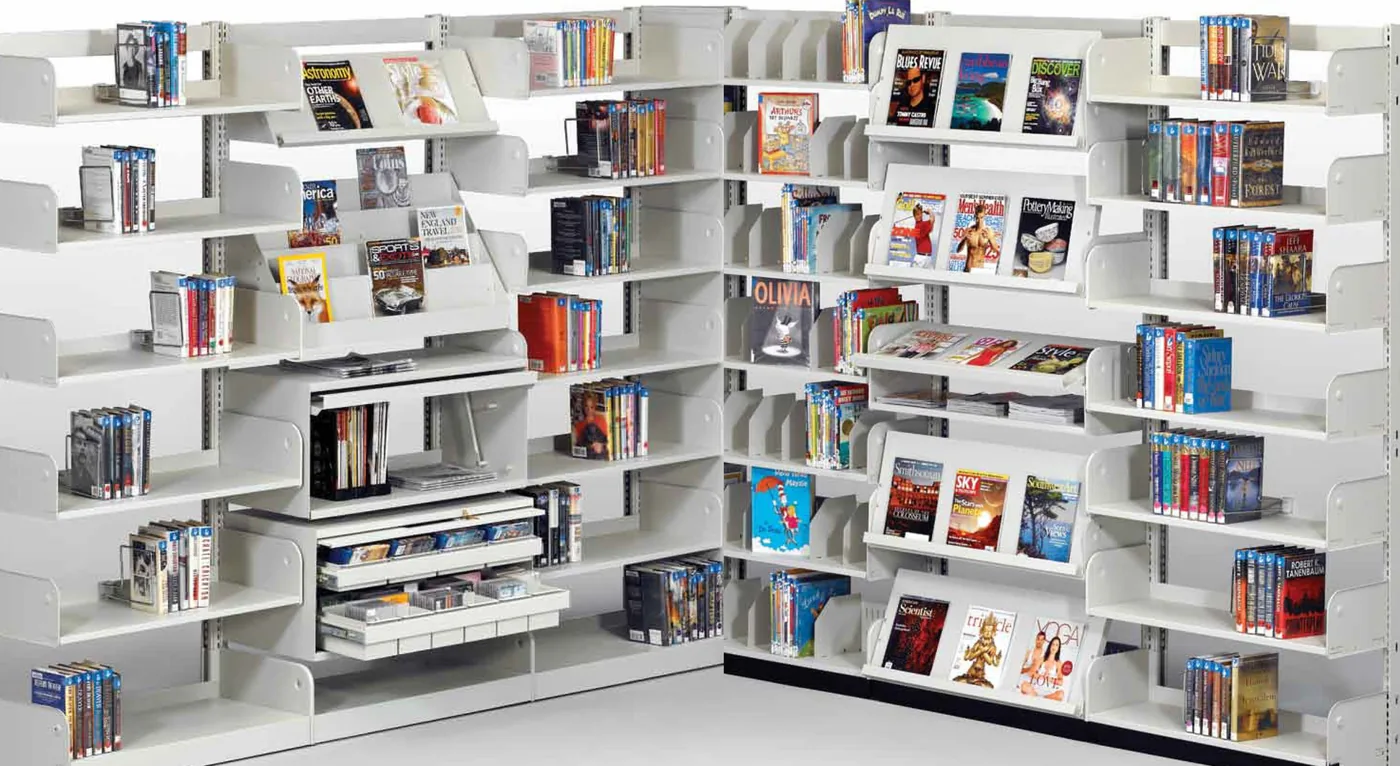
- Welded upright frames with slots punched full height, giving one-inch vertical adjustment
- No front corner post, so the full bay opening is usable and visible
- Shelves adjusted individually per side on a double-face unit
- Wide accessory family: sloping shelves, dividers, work shelves, periodical and display units
- Base choice — fixed closed base or adjustable base with kickplate — governs mobile suitability
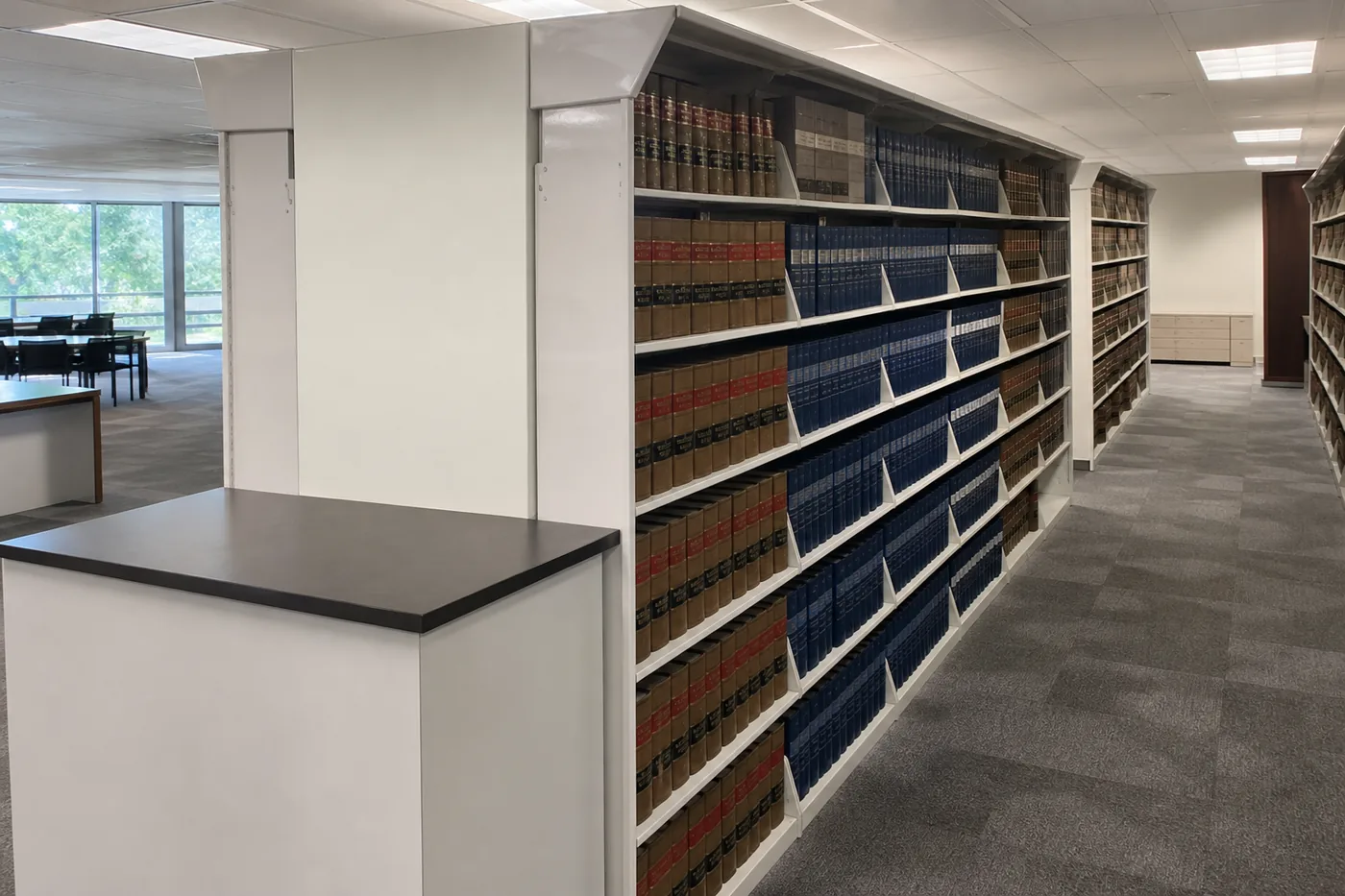
Four-post, or case-type, shelving
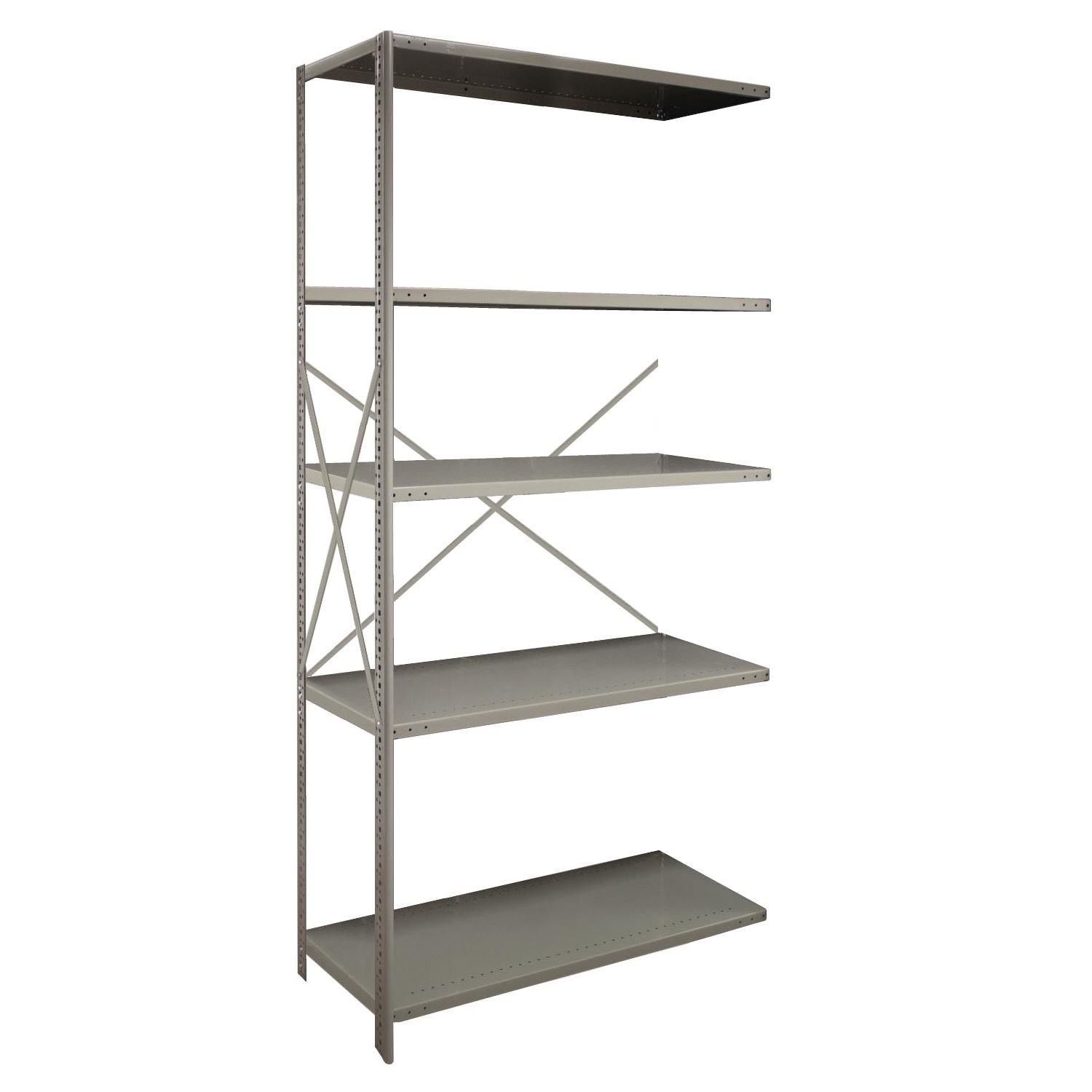
Four-post shelving supports each shelf on posts at the four corners of the unit. Front and back posts are joined by welded spacers that hold them apart and stiffen the assembly, and shelves either clip into keyhole slots or rest on supports engaged inside the post. Row-end and intermediate posts differ, which is why the style is often called L&T — an L-shaped post at the ends of a run and a T-shaped post shared between adjacent sections.
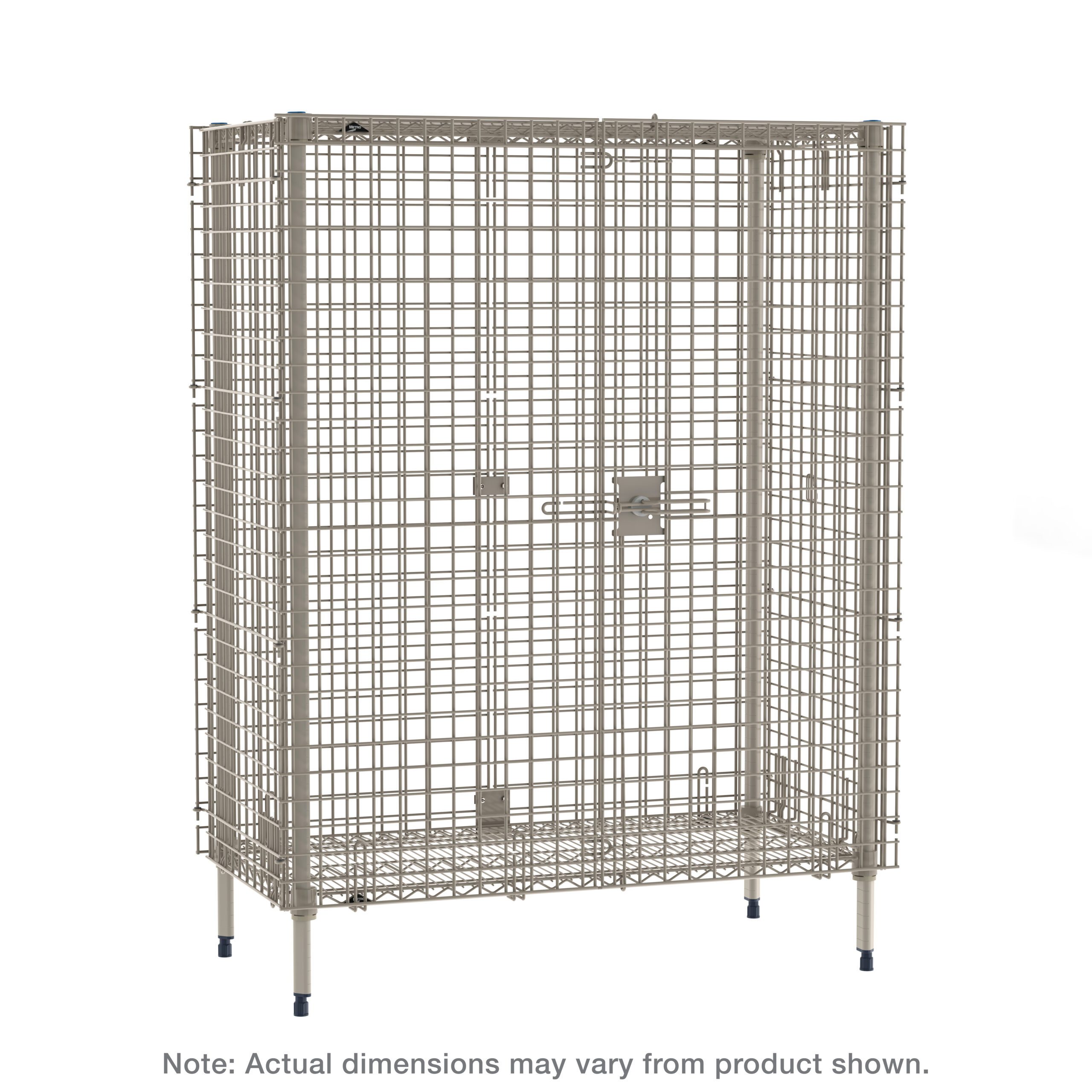
Because the shelf sits inside a frame rather than hanging off one, four-post units tend to feel rigid on their own and are comfortable carrying dense, heavy, uniform loads: bound volumes, transfer cartons, parts, x-ray film, lateral file media. Closed uprights, back panels and canopy tops are standard options on most lines, so a four-post range can be closed in for dust, light or containment far more simply than an open bracket range.
Four-post is also the construction most industrial and records-room buyers already own. If your existing rows are steel shelving with visible corner posts, you are looking at case-type shelving — which matters when you start asking whether it can be reused on carriages.
How the two compare on the things that actually matter
Manufacturer literature on both sides is written to win the argument. The comparison below is limited to differences that are structural rather than promotional, and it deliberately leaves capacity out: capacity is a property of the specific shelf you buy, not of the family.
| Consideration | Cantilever (bracket) | Four-post (case-type) |
|---|---|---|
| Bay face | Open — no front corner post across the opening | Corner posts define the opening at each end of the section |
| Shelf adjustment | Slots on one-inch centers; each shelf moves independently, per side | Clip or keyhole increments set by the post; both sides usually adjust independently too |
| Enclosure options | Back panels and end panels available; open by default | Closed uprights, back panels and canopy tops are common catalog items |
| Accessory range | Broad in library lines: sloping, divider, work, periodical and display shelves | Broad in records and industrial lines: dividers, carton stops, file bars, drawer inserts |
| Where you see it | Public and academic library stacks, reading rooms, reference collections | Records rooms, archives, evidence rooms, parts rooms, industrial storage |
| Dimensioning habit | Nominal shelf depth listed one inch over actual usable surface | Unit dimensioned around the frame; check overall depth including posts |
| Mobile mounting | Base support and gusset detail per manufacturer; base shelf choice matters | Bottom spacers commonly pre-punched for anchoring to floor or mobile base |
What the comparison is not
Neither construction is inherently stronger, safer, more seismic-ready or more space-efficient. Both are manufactured in mobile-rated versions, both are anchored and braced to the same building codes, and both are sold by manufacturers we represent. Treat anyone who tells you one family is simply better as a salesperson rather than an engineer.
How each construction meets the carriage
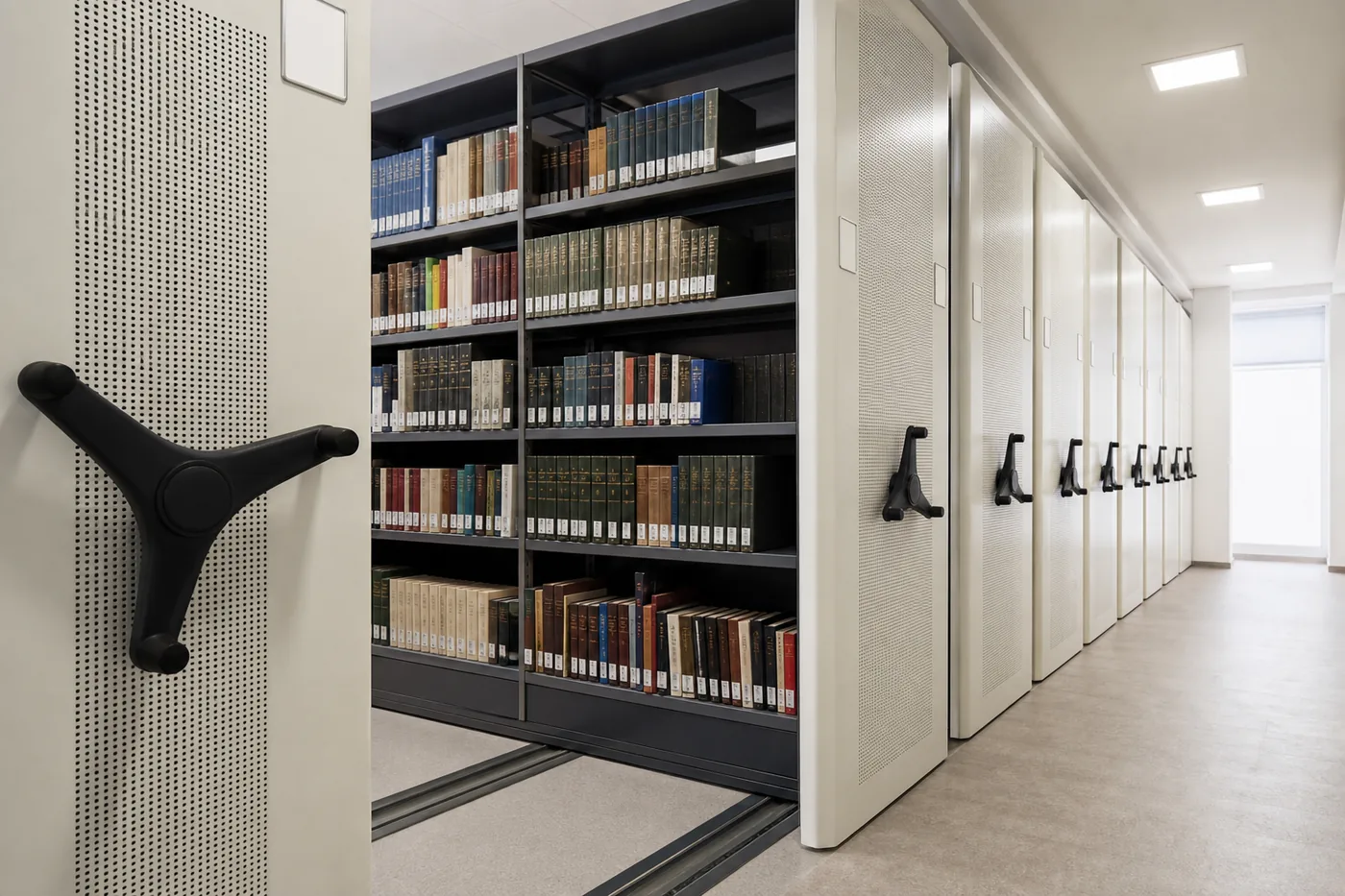
A carriage is a steel platform on wheels running a fixed rail. The shelving does not simply sit on it; it is fastened to it, and that fastening is the detail that decides whether a shelving line is mobile-ready.
On cantilever lines, the base of the frame does the work. Manufacturers publish a fixed closed base shelf for stationary installations and an adjustable base with kickplate as an alternative, and they publish reinforcing gussets specifically for units mounted on mobile carriages. Choosing a base is therefore not cosmetic — it determines whether the range can be carried at all, and which gusset you have to order.
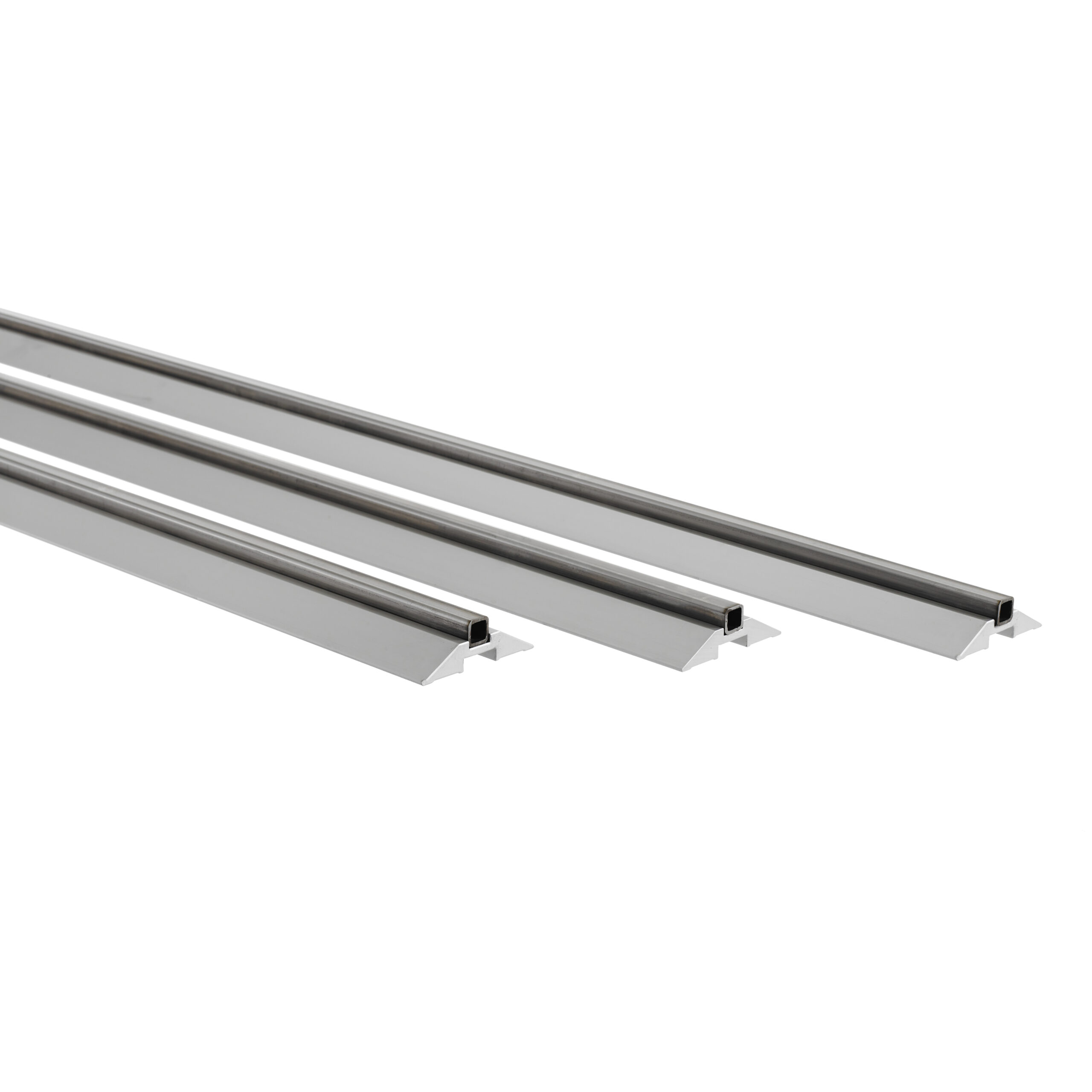
On four-post lines, the bottom spacers of the uprights typically carry stiffening flanges with holes for securing the unit to a floor or to a mobile base. The unit is bolted down through those holes to the carriage deck at the spacing the carriage manufacturer requires.
In both cases three things have to agree before anything is ordered: the shelving footprint has to match the carriage deck, the fastener pattern has to be one the carriage accepts, and the loaded weight has to be inside the carriage, wheel and rail ratings. That load schedule then flows straight into the floor-load review for the room.

Depth is where plans go wrong
Depth is the single most misread dimension in this category, and it bites hardest on mobile systems because every inch of unit depth multiplies across the ranges on a rail run.
Cantilever library shelving is conventionally listed with a nominal depth one inch greater than the actual shelf surface, so a ten-inch nominal shelf gives about nine inches of usable surface. Single-face and double-face depths are published as separate series, and base supports are specified left or right on single-face runs. Four-post units are dimensioned around the frame, so the overall depth you must plan for includes the posts, not just the shelf.
Plan the collection against actual usable surface, and plan the room against overall unit depth. Then check the result against the guidance on shelf depth and level spacing and, if you are still sizing the collection, the method on the capacity and sizing page.
Choosing by what you actually store
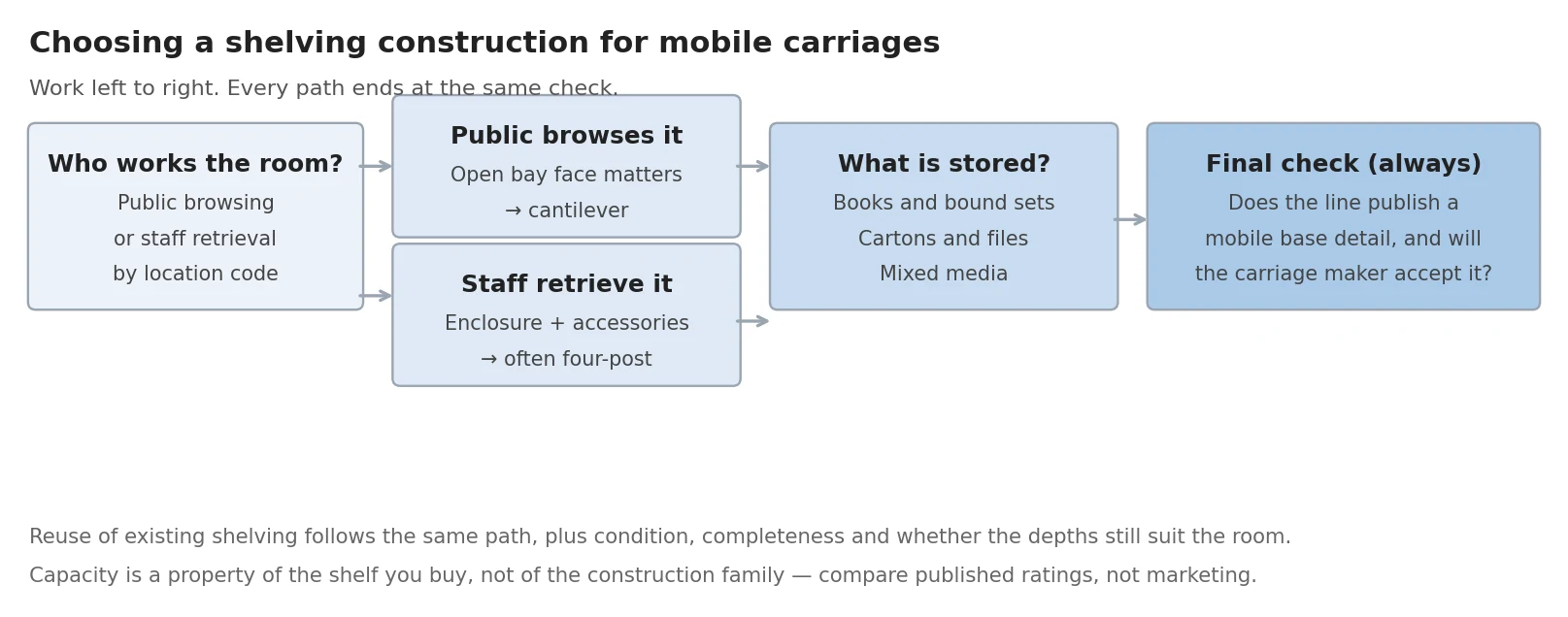
The honest decision rule is simple: pick the construction whose standard shelves, depths and accessories fit the media you hold, then confirm that line has a published mobile base detail. Below is how that usually resolves.
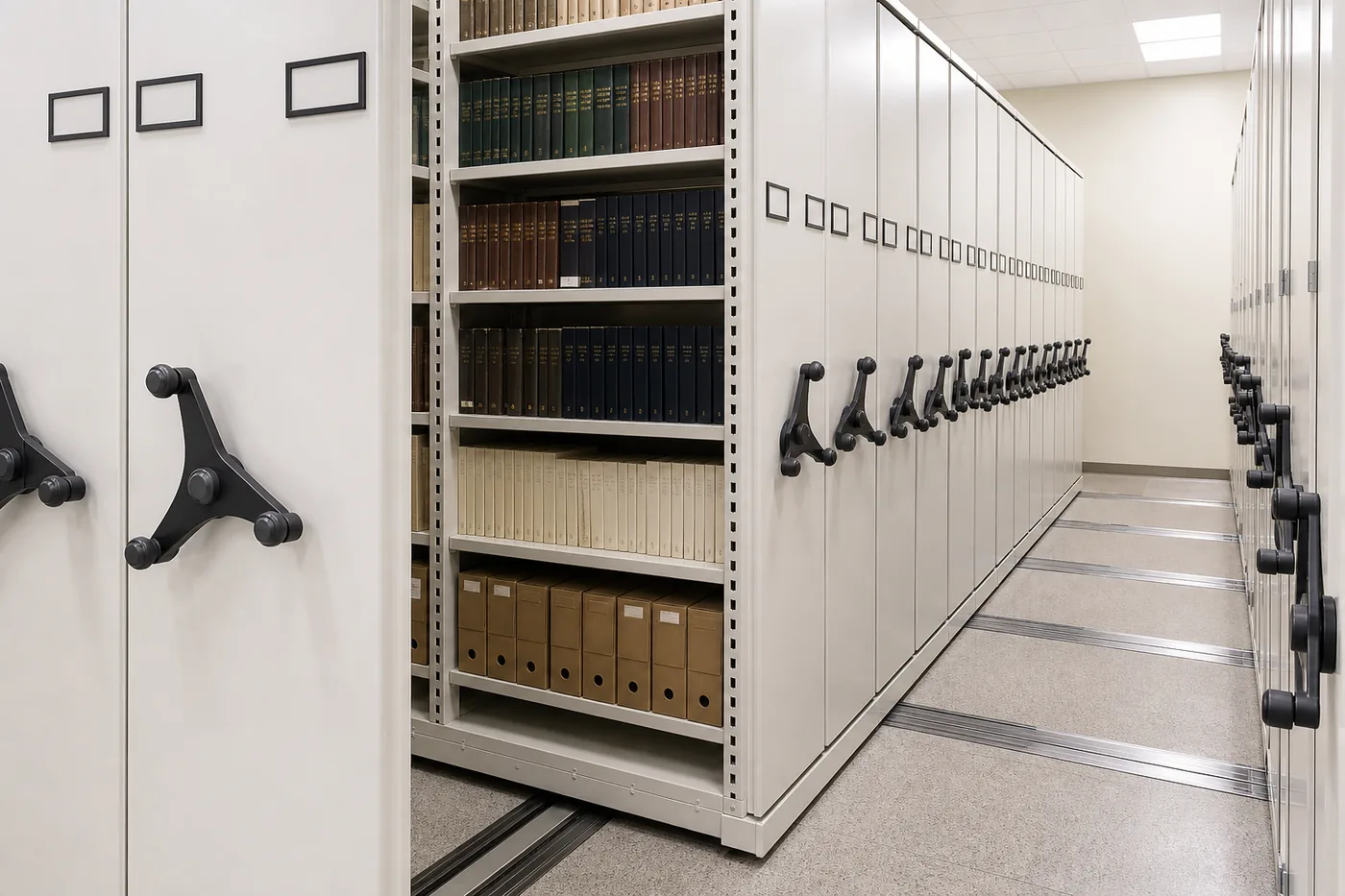 Circulating and closed-stack book collectionsCantilever is the traditional answer: continuous call-number runs, one-inch adjustment for varying trim sizes, and an accessory family built for library work. Case-type is still viable in closed stacks where nobody browses.
 Bound volumes and reference setsEither works. Decide on finish, end panels and reference-shelf accessories, which is usually where cantilever library lines are stronger and where the visible quality of the room is decided.
 Records cartons, files and archive boxesFour-post is the common choice: closed backs, canopy tops and carton-friendly depths, with dividers and file bars that keep folders upright when a range is moved.
One question that settles most arguments
Ask who works the room. If the public browses it, the open bay face of cantilever shelving earns its keep. If staff retrieve from a closed room by location code, the enclosure and accessory options of case-type shelving usually matter more than the bay face.
Reusing shelving you already own
The cheapest shelving is the shelving already in the building, and the question comes up on almost every retrofit: can our existing ranges go on new carriages? Sometimes they can. The evaluation is specific:
- Does the shelving line have a published detail for mounting to a mobile base, or a gusset kit for that purpose?
- Are the sections square, undamaged and complete — including spacers, base supports and shelf hardware?
- Do the depths and heights suit the new room, or are you carrying an old constraint into a new system?
- Will the carriage manufacturer accept that shelving on its carriage and stand behind the assembled system?
- Is there enough matching stock to finish the run, and is the finish acceptable next to new end panels?
Where the answer is yes, reuse can take real money out of a project. Where it is no, forcing it produces ranges that rack out of alignment as they travel and a system nobody will warrant. The practical steps for moving and re-erecting an existing system are covered on the page about relocating and reusing existing mobile shelving.
Getting it right in the specification
Most of the trouble this page describes is avoidable at specification stage, when the shelving and the carriage are still words on a page. Name the construction, name the base detail, and require the two manufacturers to agree in writing before shop drawings are approved.
Name the construction and the line
State bracket-type or case-type shelving explicitly, with the manufacturer and product line, rather than leaving the bidder to substitute the cheaper family.
Specify base and gusset detail
Require the manufacturer’s published mobile base support and reinforcing gusset for every unit mounted on a carriage, and state fixed or adjustable base.
Publish depths as actual and overall
Give actual usable shelf surface and overall unit depth for every unit type, so nobody plans a room against a nominal number.
Require an agreed load schedule
The shelving supplier states loaded weights; the carriage supplier confirms carriage, wheel and rail capacity and issues the anchorage and bracing design.
Fix end panels and finishes early
End panels are the working face of a mobile range. Decide material, finish and signage before shop drawings, not during installation.
The full document set — submittals, seismic calculations, floor requirements and closeout — is listed on the specification and submittal checklist. Drive type is a separate decision covered on the manual, mechanical-assist and powered comparison, and the structural work is on the seismic anchoring page. Shelf decking choices sit on the wire versus solid shelf decks page, and library-specific planning on the library book stacks page. Powered library and archive systems from our carriage manufacturers are described on the Aurora mobile shelving page.
Frequently asked questions
What is the difference between cantilever and four-post shelving?
Which type works better on a mobile carriage?
Can I put my existing shelving on new carriages?
Does cantilever shelving hold less weight than four-post?
Why does shelf depth get confusing between the two?
Is one type better for archive cartons than the other?
Do I need end panels?
Shop Shelving Online
Static steel and boltless shelving units ship from our online store. Shelving mounted on mobile carriages is engineered and installed to your room — request a quote for those.

Not sure which shelving belongs on your carriages?
Send us your collection, your room and any shelving you already own. We will tell you which construction fits, what can be reused, and what the carriage manufacturer will accept.