
Boltless Shelving for a Youth Cycling League Warehouse: Utah High School Cycling League, American Fork, UT
How a statewide youth mountain bike league shelved its American Fork warehouse unit with tall boltless shelving in three orders over one year: a spring build, a quick add-on of shelf levels, and a fall expansion on the same components.
American Fork, UT
Project location
Youth sports nonprofit
Industry
10 ft and 8 ft boltless
Shelving heights
3 orders, 1 system
How it was bought
The Project: A Warehouse Unit for a Statewide Youth League
The Utah High School Cycling League is a 501(c)(3) nonprofit, organized in 2011 and affiliated with the National Interscholastic Cycling Association. It supports middle school and high school mountain bike teams across Utah, trains and licenses coaches and volunteers, and runs a series of races every fall. The league’s office and warehouse unit is in American Fork, in Utah County.
A league like this owns a lot of gear that is used hard for a few months and then has to be put away until next season. Race operations equipment, team and event supplies, signage and the rest of the kit has to live somewhere that volunteers and staff can find it quickly, pack it for a race weekend and return it afterwards. In a small light-industrial unit, that means building storage upward.
In April 2018 the league asked our Salt Lake City team for boltless shelving. Chris Rodgers, our director of sales, quoted it, and over the next six months the league placed three separate orders on the same shelving system. Read together, those orders tell a practical story about buying storage the way most growing organizations actually do: start with what you need now, see how the space works, and add to it without replacing anything.
This is one of the Utah projects behind our boltless shelving in Salt Lake City service page, alongside installed shelving for Ogden Housing Authority, carpenter shop shelving for Granite School District and RiveTier shelving for Tinks Superior Auto Parts. The product family is covered in depth on our boltless shelving hub, part of our wider shelving solutions range.
A note on what we know
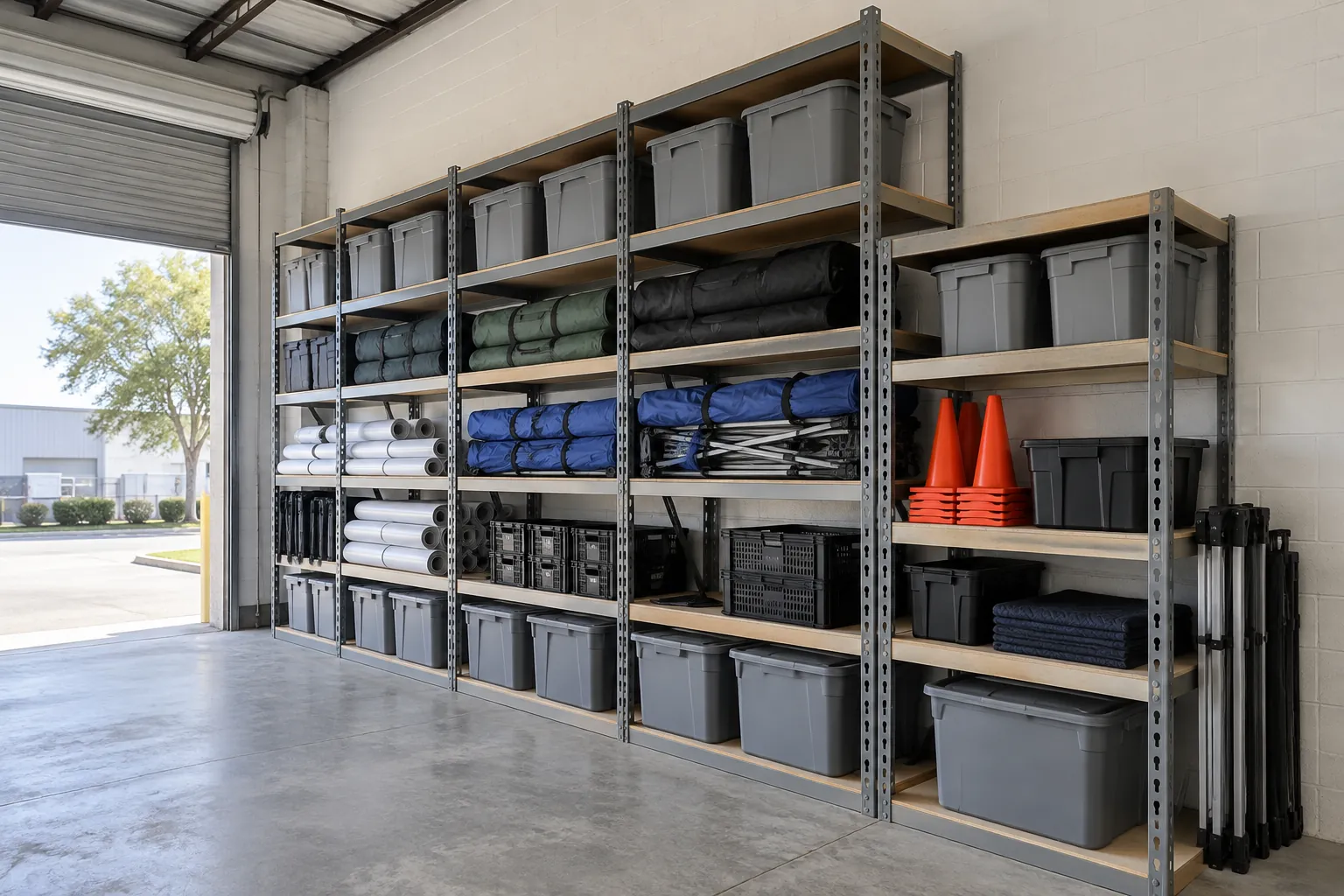
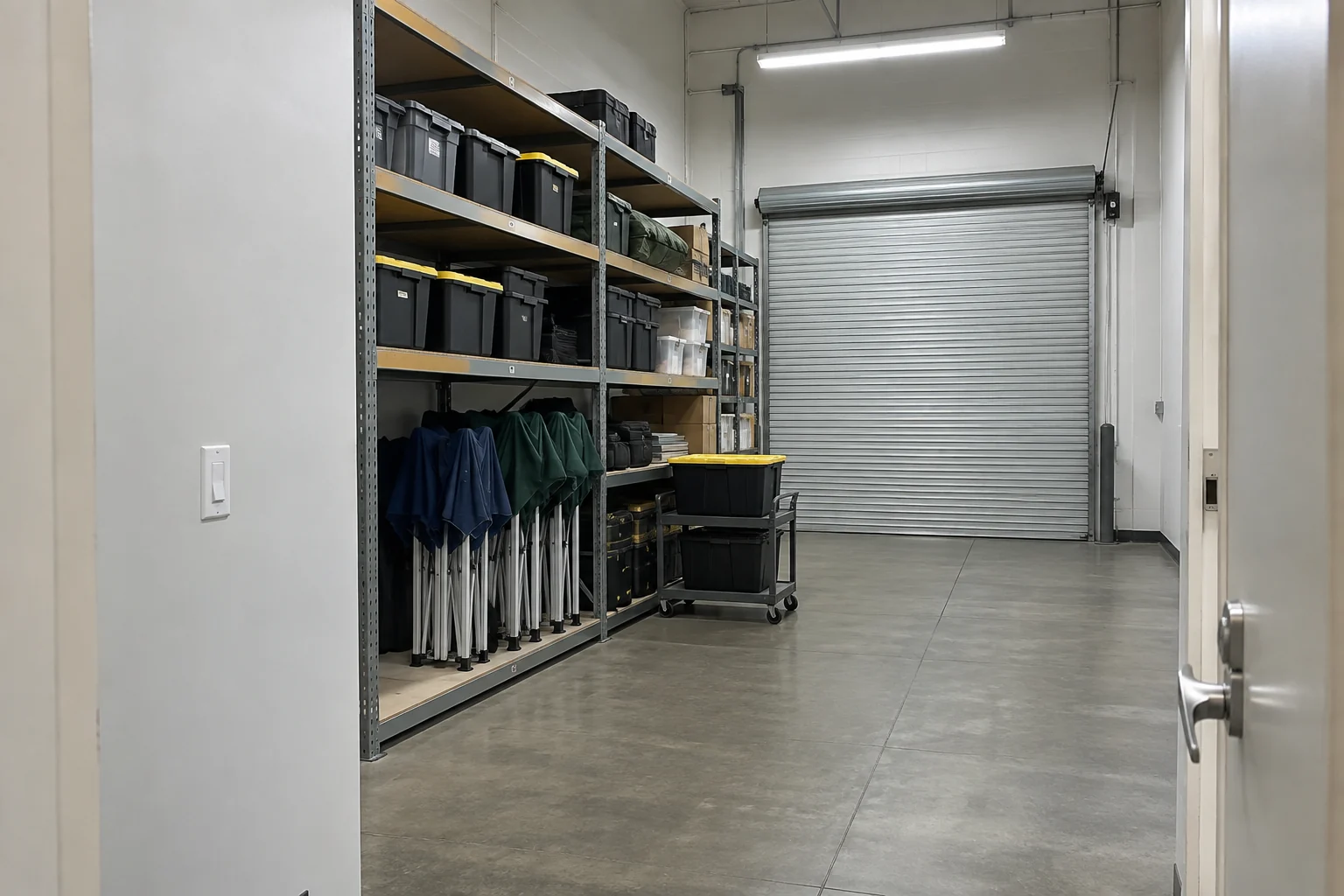
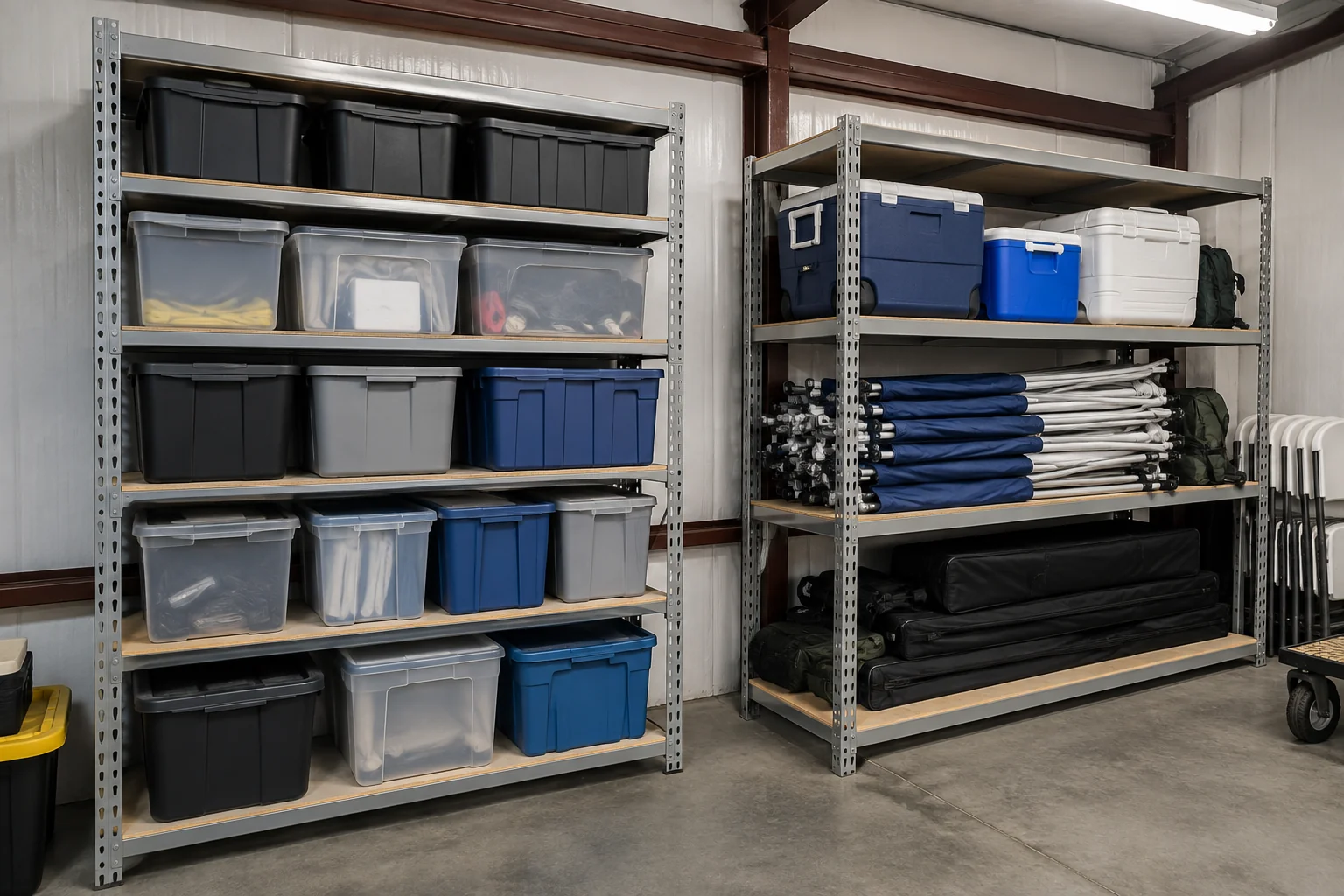
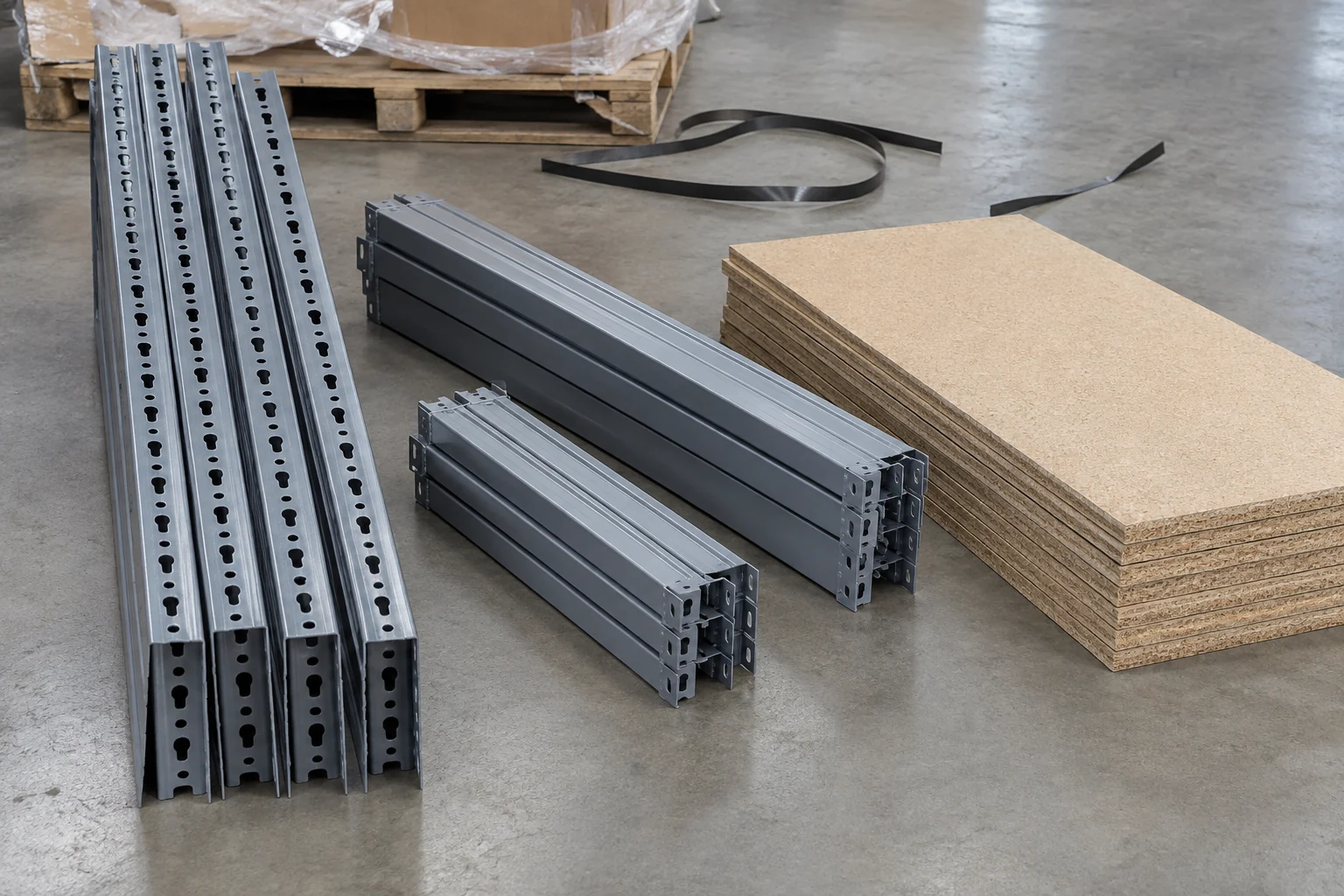
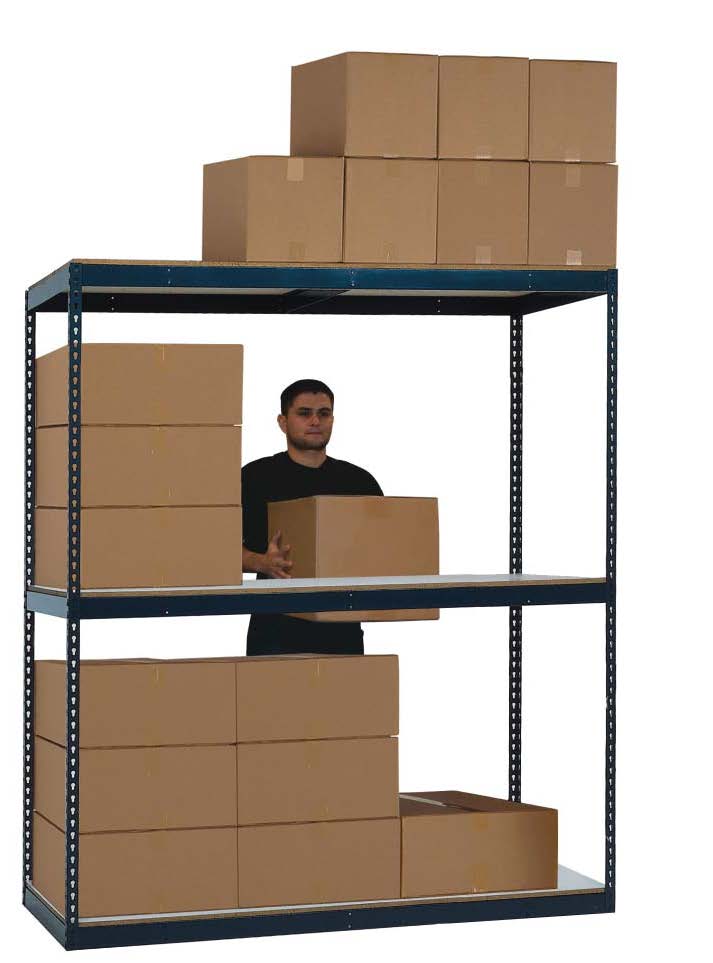
We supplied the shelving; we did not record what went on each shelf. The photos on this page are illustrations, not photos of the league’s warehouse. Everything said about the shelving itself (heights, components, shelf levels, order sequence and delivery) comes from the project’s quotes, invoices and manufacturer paperwork.
The Spring Build: Tall Sections First, Then a Second Line
The first proposal, dated April 13, 2018, covered one thing: tall boltless shelving sections, ten feet high, with four shelf levels each, 3/4 inch particle board decks and freight included. By the time the league placed the order three days later, it had grown. The final order kept the tall sections and added a second line of eight foot sections with five shelf levels each, on the same shelf footprint and the same decks.
That change is common, and it is usually a good sign. A first quote tends to answer the question “how much storage can we fit on the main wall?” Once a buyer walks the space again with a price in hand, the next question is “what about the rest of the room?” In a warehouse unit there are usually spots where a ten foot section does not belong: under a lower ceiling area, beside a door, near a light fixture or where staff need a lower top shelf they can reach without a step ladder.
Because both lines were quoted on the same footprint and the same deck, the league ended up with one shelving system rather than two. Every beam and every deck in the building is interchangeable between the tall and short sections. Only the posts differ. That decision, made in the first week, is what made the next two orders so simple.
| Order | Date | What it added |
|---|---|---|
| Spring build | April 2018 | Ten foot sections with four shelf levels plus eight foot sections with five shelf levels, particle board decks, freight |
| Add-on levels | May 2018 | Extra pairs of long and short double rivet beams plus matching decks only. No posts. |
| Fall expansion | October 2018 | More ten foot sections, this time with six shelf levels, plus an eight foot section with five levels |
Why Mix Ten Foot and Eight Foot Sections
Boltless shelving posts come in a range of heights, and the post height is the one decision that is hard to change later. Beams and decks can be moved up and down in the keyhole slots in minutes; a post is a post. The league’s orders used both of the two most useful warehouse heights, and each has a clear job.
Check the ceiling before choosing ten foot posts
Measure to the lowest obstruction, not just the roof deck: lights, heaters, sprinkler heads, door openers and ductwork. Your fire marshal or building official may also require clearance between the top of stored goods and sprinkler heads. Confirm that requirement for your building before you settle on post height.
If you are still deciding on beams as well as heights, our guide to single rivet vs double rivet boltless shelving beams explains how the beam, not the post, sets the capacity of each level.
Two Weeks Later: Adding Shelf Levels Without Adding Shelving
The spring shelving shipped from the manufacturer’s warehouse in late April. On May 2, about two weeks after the first order, the league came back with a very specific request: more long beams, more short beams and more particle board decks. No posts. The quote went out and was signed electronically the same day.
An order like that has only one purpose: adding shelf levels to sections that are already standing. The tall sections had been ordered with four levels on ten foot posts, which leaves generous openings of roughly two and a half feet between shelves. Once the league started loading them, it clearly found that much of what it stores does not need that much height, and that it could get more out of the same sections by splitting some openings in two.
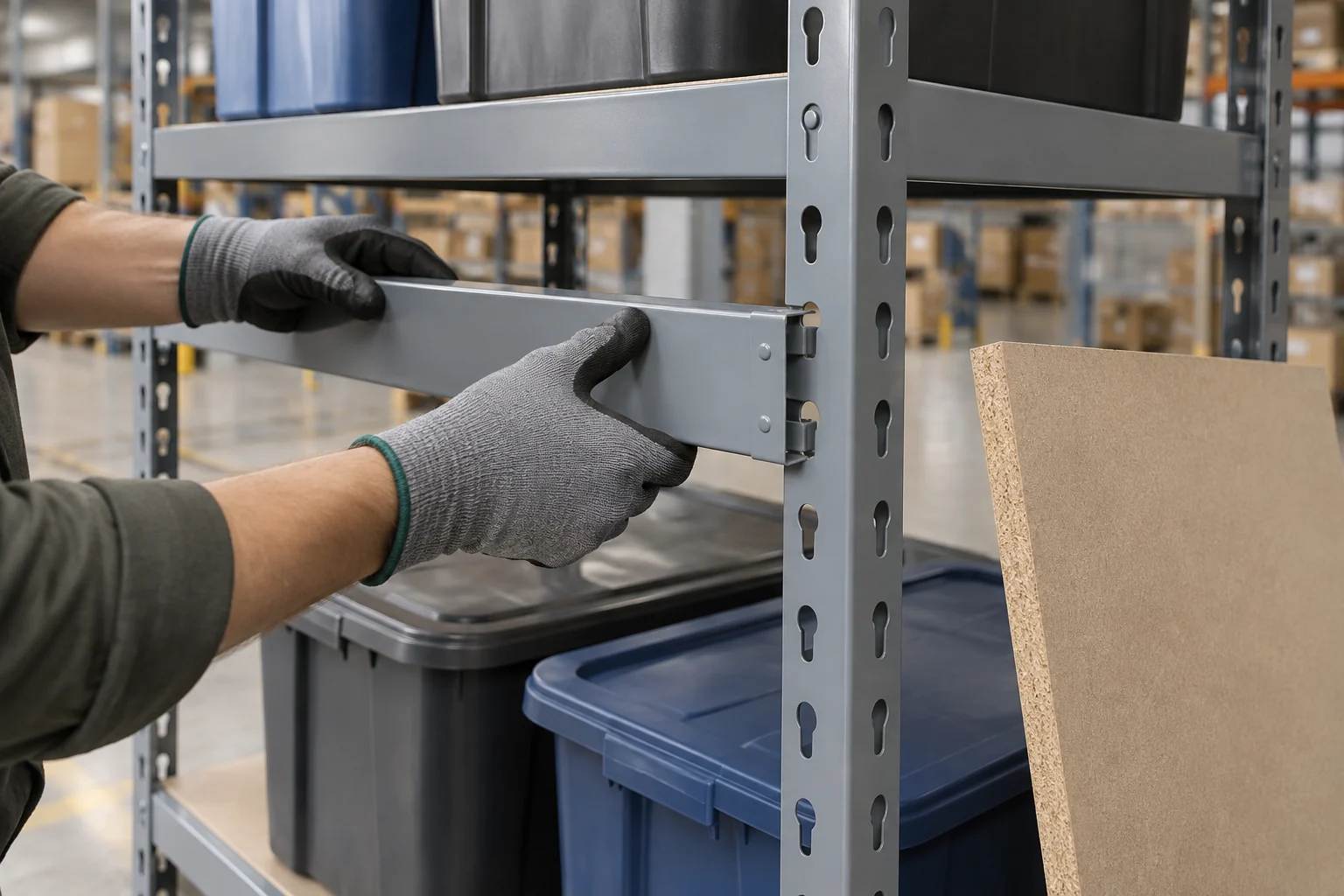
This is the single most useful feature of boltless shelving, and it is why we often suggest starting tall sections with fewer levels than you think you need. Each extra level is just two long beams, two short beams and a deck. The beams drop into the keyhole slots on the existing posts, the deck lays in, and the section gains a shelf without being unloaded or moved.
| To add one shelf level to a section | You need |
|---|---|
| Long beams | Two, one front and one back, in the section’s width and the same beam type as the existing levels |
| Short beams | Two, one on each end, in the section’s depth |
| Deck | One, in the same width, depth and material as the other levels |
| Center deck supports | Only if the section’s depth or deck type calls for them. The league’s shallow particle board levels were ordered without them. |
| Posts | None. The new level uses the existing keyhole slots. |
Keep the add-on on the same system
An add-on level must match the posts it hangs on. Beams from a different manufacturer or series may not seat correctly in the keyhole slots. Keep the original quote or invoice, which lists the exact series, and order add-on parts against it. Replacement beams, posts and decks are listed on our boltless shelving accessories page.
The Fall Expansion: Same Components, Denser Sections
In October 2018, during the league’s fall season, a new member of the league’s staff asked for another round of shelving. The proposal went out on October 11 and the order was placed on October 15. It added more ten foot sections and one more eight foot section, again with 3/4 inch particle board decks, on the same footprint as the spring shelving.

One detail changed, and it reflects what the league learned in the spring. The new ten foot sections were ordered with six shelf levels from the start, not four. The eight foot section kept five. Six levels on a ten foot post gives openings of roughly a foot and a half to two feet, a good height for standard storage totes and boxed supplies, and far less wasted air than the original spacing.
In other words, the fall order built in the add-on that the spring order had needed. That is exactly how a well-run phased buildout should evolve: the first round of shelving teaches you how your stock really stacks, and every later round is specified from that experience instead of from a guess.
It also shows why a consistent system matters when people change. The fall order came from a different staff member than the spring orders, and it did not matter. The shelving footprint, beam type and deck were already on record, so the new sections matched the existing ones without anyone having to measure the old shelving or identify its parts.
Recording your system saves a site visit
When you buy shelving, file the quote with the post height, beam type, shelf footprint and deck material written on it. Anyone in your organization can then order matching sections or levels years later, even after the person who bought the first round has moved on.
For another phased buildout on the same principle, see our low-profile boltless shelving case study for Source Energy Company, where a Colorado aerospace company bought its stockroom shelving over six smaller orders.
What Was Specified: A Component-Level Look
The customer quotes described the shelving in sections and levels. Behind them, each order to the manufacturer, Jaken, was written as a list of parts from its Series 200 boltless line. The same five part types appear on every one of the league’s orders, which is the whole point.
| Component on the orders | What it does |
|---|---|
| Series 200 angle posts, 10 foot | Uprights for the tall sections. Keyhole slots run the full height so levels can go anywhere. |
| Series 200 angle posts, 8 foot | Uprights for the shorter sections, same profile and slot pattern as the tall posts. |
| Long double rivet beams | Front and back beams of each level. Double rivet beams are the stiffer, general-purpose choice for loaded shelves. |
| Short double rivet beams | End beams that tie the front and back together and square the section. |
| 3/4 inch particle board decks | The shelf surface, one per level, a solid top that small items cannot fall through. |
Two choices on that list are worth explaining. The first is double rivet beams throughout. For light items, single rivet beams are sometimes enough, but a mixed stock of totes, boxed supplies and heavier equipment is easier to manage when every level carries the same, stronger beam. It also means there is only one kind of beam to reorder.
The second is 3/4 inch particle board rather than wire. Particle board gives a continuous flat surface for small parts and odd-shaped items, it is inexpensive to replace if a deck is damaged, and it is the standard deck for most boltless shelving. Wire decking is the better choice where sprinkler coverage or airflow matters, which is worth checking with your building official for tall sections. Our boltless shelving decking options page compares particle board, wire and steel.
The product family is explained on our rivet shelving page, and if you need a work surface in the same space, our boltless workbenches use the same post and beam construction.
Delivery: Freight Included, Assembled In-House
Every one of the league’s orders was quoted as a landed price with freight included, and each shipped on an LTL freight truck from the manufacturer’s warehouse to the league’s American Fork unit. Delivery was quoted at about one week. The spring order was released on April 16 and shipped within about a week and a half; the fall order was invoiced by the manufacturer three days after it was placed. None of the orders included installation. Boltless shelving is designed to be assembled by the customer with a rubber mallet, and a small team can build a section in well under an hour once the first one is up.
Plan the unit
Choose post heights by area of the room, then fix one shelf footprint and deck for the whole system.
Quote landed
Ask for freight to be included so the price covers delivery to your door.
Prepare to receive
LTL freight arrives on pallets. Have a forklift or pallet jack, or ask for liftgate service if you have no dock.
Assemble in-house
Build one section, confirm your level spacing, then repeat. Keep spare beams and decks together.
Add when you learn
Order extra levels or sections on the same system as your stock and space settle down.
Installed instead?
If your organization does not have hands to assemble shelving, or the building cannot take a freight delivery, installation can be added. Our boltless shelving installation page explains how, and our Ogden Housing Authority case study shows a fully installed project.
Planning Checklist for Leagues, Clubs and Event Organizers
Youth sports leagues, clubs, race organizers and other nonprofits that store seasonal event gear along the Wasatch Front face the same questions the league did. These steps make the first order right and every later one easy.
- Measure to the lowest overhead obstruction before choosing ten foot posts, and ask about sprinkler clearance.
- Use tall sections for bulk and seasonal gear, shorter sections where people pull items every week.
- Pick one shelf footprint, one beam type and one deck for the whole room so parts are interchangeable.
- Start tall sections with fewer levels. Adding a level later is two long beams, two short beams and a deck.
- Load a section with real gear before ordering more, then specify the next round from what you learned.
- Keep the quote on file with post height, beam type, footprint and deck so anyone can reorder to match.
- Ask for a landed price with freight included, and plan how you will unload an LTL pallet delivery.
- Keep aisles wide enough to carry a race-day load out without moving other gear.
For other sports storage, see how the National Ability Center stores adaptive sports equipment on pallet rack in Park City. For Utah projects, start with our Salt Lake City boltless shelving page or the statewide Utah boltless shelving overview, read the boltless shelving buying guide, or, if you already know what you need, order boltless shelving directly.
What we verified for this case study
This page is built from the project’s own records: the three Zoho deals, the customer quotes and invoices, and the manufacturer’s purchase orders, invoices and ship notice. Email correspondence from 2018 is not archived, so no buyer quotes or design discussion are included, and the league’s reasons are described from what it ordered rather than from what it said. Background on the league comes from its public website. Order values, part and section quantities, shelf widths and depths, the street address and all contact names are deliberately not published.
Shop Boltless Shelving Components Online
Buy select items directly from our online store, or request a quote for volume, custom sizes and freight-rated orders.
Frequently Asked Questions
Can you add shelf levels to boltless shelving later?
How tall can boltless shelving be?
How many shelf levels should a ten foot boltless section have?
Can I mix different heights of boltless shelving in one room?
Is freight included when you ship boltless shelving?
Is boltless shelving easy to assemble without installers?
Do you supply boltless shelving in Utah County and American Fork?
Storing Seasonal or Event Gear in Utah?
Tell us about the space and what you store. We will plan post heights, shelf levels and a system you can add to as your organization grows.