
Mobile Shelving Finish, Material and End-Panel Options
Steel gauge, powder-coat color, laminate vs. solid-steel end panels, and corrosion resistance for labs, coastal sites and humid rooms — how to choose a finish that holds up in the room it’s actually going in.
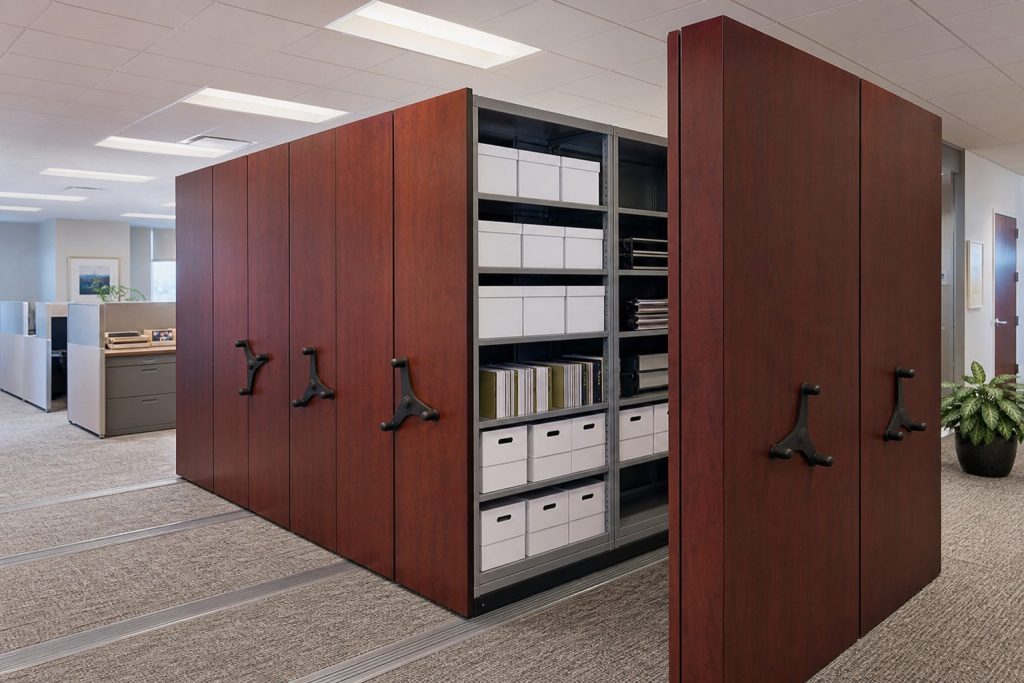
Structure
Frame and carriage gauge set capacity, not the finish
Surface
Powder-coat steel or laminate over a panel core
Color
Manufacturer standard chart; custom match varies
Exposure
Coating and hardware resistance matter most in labs and coastal sites
Finish and material are a separate decision from capacity and drive type
Choosing a track-mounted mobile shelving system usually starts with capacity, drive type and rail layout — how much needs to be stored and how the carriages move. Finish and material are a separate decision layered on top: what the end panels look like, what they’re made of, and how well the exposed surfaces hold up in the room they’re actually installed in. Two systems with identical capacity and the same manual or powered drive can look completely different and perform differently over years of use depending on this choice alone.
This matters for two different reasons. First, appearance: an end panel finish is the only part of a mobile shelving system most visitors to the room ever see, so it needs to fit the space — a finished office matches better with laminate, while a lab or industrial stockroom is usually better served by painted steel. Second, durability: the finish is the first line of defense against moisture, chemical exposure and daily wear, and the wrong choice for the environment can shorten the system’s useful life well before the mechanical components wear out.
Steel gauge and structure: what actually carries the load
Before comparing finishes, it helps to separate the structural steel from the cosmetic surface. The carriage frame, uprights and shelf decks are the load-bearing components, and manufacturers typically specify heavier steel for these structural parts than for trim and accessory pieces. The end panel itself, by contrast, is a finished face bolted or clipped to the front of the carriage — it carries the drive control and a label holder, but it carries none of the shelving load. That load path is covered in the parts and components glossary, which walks through the carriage, rail and drive mechanism in detail.
Because the end panel is not structural, it can be finished in a wider range of materials than the frame ever could be — including laminate over a non-metal core — without changing how much weight the system holds. What the finish does affect is how the panel resists impact, moisture, and wear at the point people actually touch the system every day.
Powder-coat finishes and colors on steel end panels
Most steel mobile shelving components, including end panels, are finished with a thermoset powder coating: a dry polyester or epoxy-polyester powder is applied electrostatically and then cured under heat, which fuses it into a continuous, durable film that resists chipping better than liquid paint. It is the standard finish across most industrial and institutional shelving because it holds up to repeated cleaning, minor impact, and years of daily handling.

- Color selection is generally from a standard chart. Manufacturers publish a set of standard powder-coat colors; picking from that chart is the fastest and most predictable path to a delivered finish that matches the sample.
- Custom or near-match colors are sometimes available but typically add lead time, may carry a minimum order requirement, and should be confirmed as an actual capability — not assumed — before it is written into a specification.
- Ask for a physical color chip, not a screen or printed swatch. Powder-coat colors, especially metallics and textures, render inconsistently on monitors and in print; a physical sample is the only reliable way to approve a color before an order ships.
- Gloss level is a separate spec from color. The same color can typically be ordered in different sheen levels (for example matte, satin or gloss), which affects how scuffs and fingerprints show over time — worth deciding deliberately rather than defaulting to whatever the sample happens to be.
Laminate vs. solid-steel end panels
Laminate end panels are typically a high-pressure or thermally fused laminate sheet bonded over a panel core (often particleboard or MDF), finished in wood-grain or solid-color patterns that match office furniture and architectural interiors. They are a common choice where the mobile shelving system sits in a finished, visible space — a records room adjoining an open office, a reception area, or a library reading room — and needs to read as furniture rather than industrial equipment.
Where each material tends to fit best
Laminate end panels generally make sense where the room is finished, foot traffic is light to moderate, and the priority is matching adjacent furniture and interior design. They are not typically the first choice where the system will be exposed to heavy impact, moisture, or chemical cleaning agents, since the panel core is not inherently as impact- or moisture-resistant as solid steel.
Powder-coated steel end panels are the more common choice for labs, evidence and forensic storage, industrial stockrooms, warehouses, and any space cleaned with harsh chemicals or exposed to rough daily handling. They cost less to replace if damaged in isolation and hold up better to the kind of abuse a finished laminate surface is not designed for.
Corrosion resistance for labs, coastal sites and humid environments
In most interior office and records environments, standard powder-coat steel holds up for the system’s full service life with no special corrosion consideration. Three environments change that calculus and are worth flagging at the specification stage rather than after installation.
When corrosion resistance matters, ask the manufacturer for the coating’s tested performance against a recognized salt-spray exposure standard such as ASTM B117, rather than relying on a general description like “corrosion resistant.” That standard measures how long a coated sample resists corrosion under controlled salt-fog exposure, and it is a common, independently verifiable way manufacturers report coating durability — ask for the actual reported result, not just the standard’s name.
Accessory and specialty end-panel options
Beyond color and material, some projects specify functional accessories built into or mounted on the end panel itself, in addition to the drive control and label holder every carriage needs.
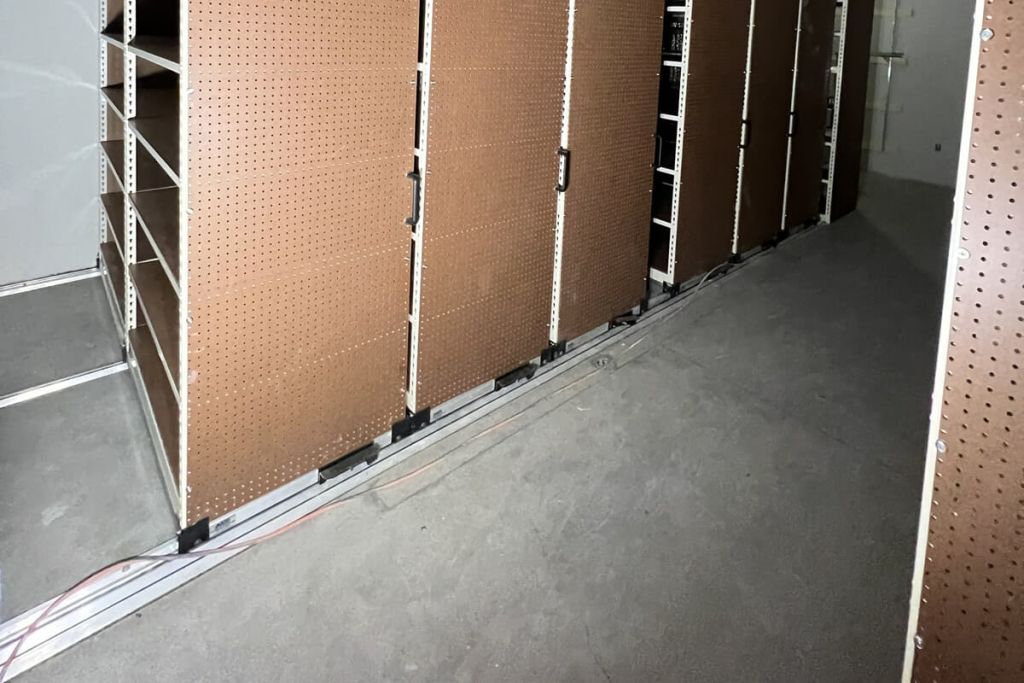
- Pegboard end panels add hook-mountable storage on the exposed carriage front, useful in stockrooms and shops where the end panel space would otherwise be unused.
- Label holders and signage frames beyond the standard carriage label, for facilities using a detailed location or coding scheme — see labeling and location coding for how that scheme is typically laid out.
- Whiteboard, corkboard or magnetic panel inserts on select end panels in staff work areas, where the request is for the panel to double as a communication surface rather than pure finish.
These are functional add-ons layered onto a standard end panel, not a substitute for choosing the base material and finish — confirm with the manufacturer which base finishes a given accessory can be mounted on before specifying both together.
Matching finish to the room, not just the price list
The lowest-cost standard powder-coat finish is often the right answer for a back-of-house stockroom or warehouse, and an upgraded laminate finish is often the right answer for a space clients or staff see every day. Neither is a universally correct default. A useful way to frame the decision is to ask what the finish actually needs to do in that specific room: blend into finished office furniture, survive chemical cleaning, resist salt air, or simply be the most economical option in a space nobody but staff ever sees.
| If the room is… | Finish direction that usually fits |
|---|---|
| A finished office, reception area or reading room | Laminate end panels matched to existing furniture |
| A lab, evidence room or space cleaned with chemicals | Powder-coated steel with confirmed chemical resistance |
| A coastal or consistently humid building | Powder-coated steel plus corrosion-resistant hardware/rail |
| A warehouse, stockroom or back-of-house storage area | Standard powder-coat color from the manufacturer’s chart |
| A museum, archive or preservation-focused collection | Confirm finish materials are inert/non-reactive — see the museum and archival guide |
Preservation-focused collections have their own material considerations beyond color and gauge; see museum and archival collections storage for how finish and material choices intersect with preservation requirements specifically.
Specifying finish and material in the project documents
Add finish and material as their own line items in the project specification, alongside capacity and drive type, using the general specification and submittal checklist as the base document.
- End-panel material specified explicitly — powder-coated steel, laminate over panel core, or another material — not left as an assumed default.
- Color and gloss level specified from the manufacturer’s standard chart, with a physical sample approved before the order is placed.
- Any custom or near-match color confirmed as an actual manufacturer capability, with lead time and minimum order requirements documented.
- Corrosion resistance requirements stated for coastal, humid or chemical-exposure environments, including hardware and rail materials, not just the visible panel.
- Any accessory end-panel features (pegboard, signage frames, communication surfaces) specified as add-ons to a named base finish, confirmed compatible by the manufacturer.
Coordinate this with the rest of the project the same way drive type and layout are coordinated: see manual vs. mechanical-assist vs. powered for how drive choice interacts with the end panel’s control layout, and cost and budget drivers for how finish upgrades typically factor into an overall project budget. If you are still comparing manufacturers or installers, choosing a mobile shelving company covers what to verify beyond the finish sample itself.
Frequently asked questions
Does the end-panel material affect the carriage’s storage capacity?
Is laminate or solid steel the better choice?
Can end panels be color-matched to a specific paint chip or brand standard?
What should coastal or high-humidity facilities specify?
Do labs need a different finish than a typical office or records room?
Does a premium finish affect maintenance?
Tell us where the system is going, and we’ll help pick the finish
Office, lab, warehouse, coastal site or archive — the right finish and material depend on the room. Send us your project details and we will walk through the options that fit.