
How to Evaluate Mobile Shelving Companies Before You Buy
High-density storage is bought once and lived with for decades. This is how to compare mobile shelving companies on scope, engineering, installation and service instead of on price per shelf.

Scope
Bids diverge on scope far more than on price per shelf
By component
Read warranties per component — frames, shelving and electrics differ
One owner
Insist on one accountable party from survey to commissioning
Year 3
Ask who services the system after the install crew leaves
The system is only as good as the company that plans it
Two organisations can buy nearly identical high-density mobile shelving and end up with completely different results. One gets a room that holds what it was supposed to hold, moves easily on the tenth year, and gets serviced when a wheel goes flat. The other gets a system that fits the drawing but not the building, a slab that was never checked, an aisle that fails accessibility review, and a phone number that stops being answered.
The difference is almost never the steel. It is the work around the steel: measuring the room honestly, sizing capacity from real inventory, checking the floor, carrying the engineering, sequencing the installation around an operating department, commissioning the safety devices, and being there in year five. Those are services, and they are what you are actually buying.
This page is a buyer’s framework for judging that. It is deliberately written so you can use it on any supplier, including us.
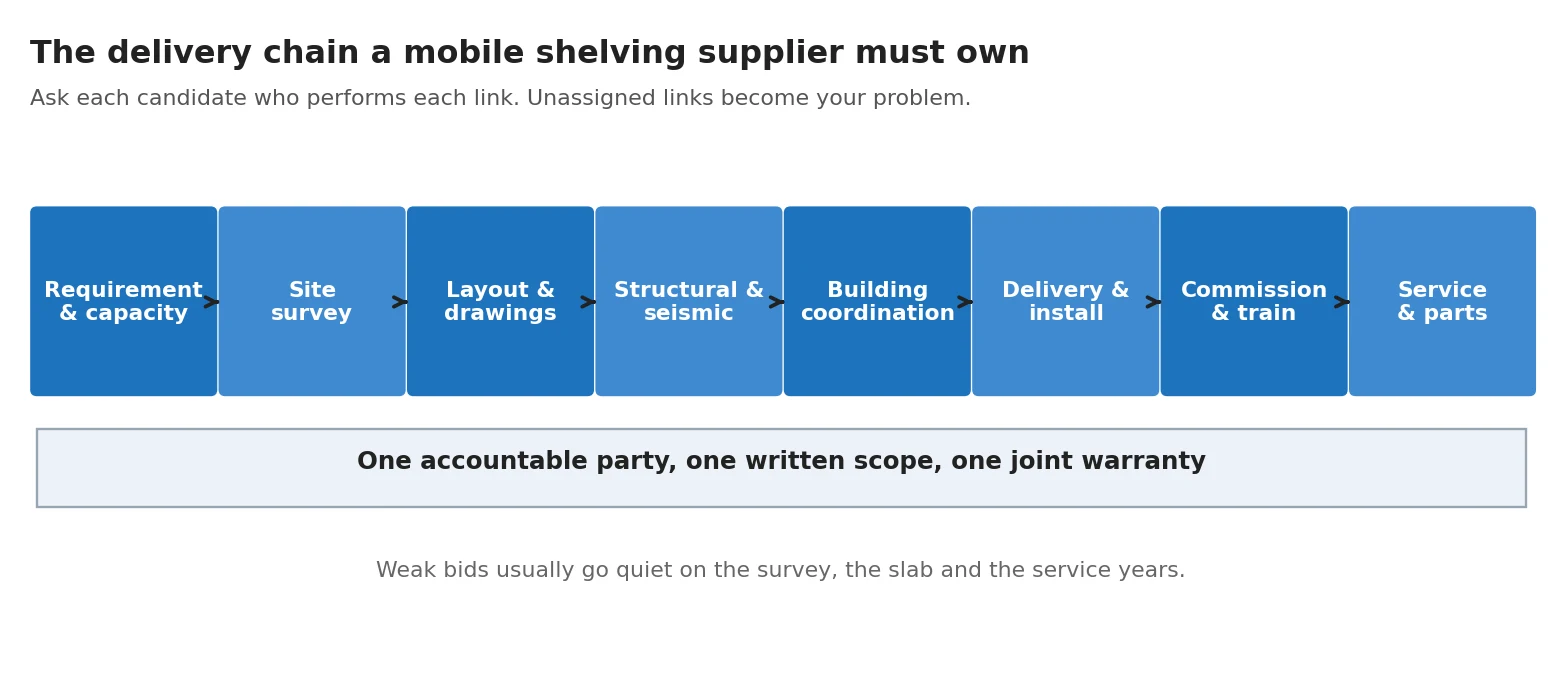
What a competent mobile shelving supplier actually has to do
Before comparing companies, get specific about the work. A high-density project is roughly eight jobs, and a credible supplier can tell you who performs each one.
| Stage | What good looks like | How it fails |
|---|---|---|
| Requirement and capacity analysis | Capacity derived from your inventory, growth rate and retention, expressed in linear or cubic measure with a stated fill rate | A shelving count copied from your existing room, which locks in today’s shortage |
| Site survey | Measured room, obstructions, columns, doors, slab condition and levelness observed, ceiling and services noted | A layout drawn from a floor plan nobody verified on site |
| Layout and drawings | Scaled layout showing ranges, rail runs, open aisle width, egress and clearances, issued for your review | A quantity list with no drawing, or a drawing that ignores egress and accessibility |
| Structural and seismic engineering | Named responsibility for floor loading review, anchoring and seismic bracing calculations, stamped where required | “The manufacturer handles that” with nothing in writing |
| Coordination with the building | Rail and floor finish detail, sprinkler and lighting clearances, HVAC, power for powered systems, permit support | Discovering the sprinkler clearance problem after the ranges are standing |
| Delivery and installation | Sequenced plan, access route, protection of finishes, phasing around occupied operations, clean handover | A pallet drop with no plan for how material moves out of the way |
| Commissioning and training | Every lock, stop and detection device proved; operator familiarisation; documentation handed over | Keys left on a shelf and an invoice |
| Service and parts | Named service arrangement, parts availability, response expectation, planned maintenance visits | No answer to “who fixes this in year five?” |
Several of these have their own guides: capacity and sizing calculation, floor load requirements, seismic anchoring, the installation process and maintenance intervals. Send them to a candidate supplier and see how comfortable they are with the detail.
Manufacturer, dealer or general contractor: what each means for you
Buyers often assume that buying “direct from the manufacturer” removes a margin and therefore a risk. In this product category that is rarely how it works, because the manufacturer does not perform the local work. What matters is where accountability sits.

Ask who is standing behind the whole thing
The clean test is the warranty document. Published mobile shelving specifications commonly require a written warranty executed jointly by the contractor, the installer and the manufacturer. When one document carries all three signatures, nobody gets to redirect you.
The second test is references from installations like yours — not a client list, but two or three comparable rooms you could call. Specification language in this industry routinely requires manufacturers to have produced the product type continuously for a stated minimum number of years and to supply references on request, which tells you the industry itself treats longevity and references as the baseline check.
The questions that expose a weak bid
These are ordered so the answers are informative even when the supplier is trying hard to be reassuring.
About your room
- What did you measure on site, and what did you assume? Ask for the list of assumptions in writing.
- What do you believe the slab will carry, and who confirms it? A supplier who has never raised floor capacity on a records project has not done many.
- Is the floor level enough for this rail type, and what happens if it is not? Grinding, shimming and levelling are real costs; find out whose they are.
- Show me the open aisle width on the drawing, and how somebody in a wheelchair uses this room.
- Where does egress go when the aisle is closed?
About the system
- How did you calculate the capacity, and what fill rate did you assume?
- What drive type are you proposing and why? Ask them to argue against their own choice.
- Which safety devices are included, which are options, and what does the option cost?
- Is anti-tip included? In a seismic region the answer should not be “if you want it”.
- What is the expansion path when we need 20 percent more in five years — more carriages on this rail, or a new system?
About delivery and afterwards
- Who physically installs — your employees or a subcontractor you have used before?
- How long is the room unusable, and can the work be phased or done out of hours?
- What is commissioned and proved before handover, and what documentation do we receive?
- Who services this system, from where, and what is a realistic response time?
- What parts are stocked, and are the carriages and drive components still in production?
A useful trick: ask for the problem list
Ask any serious candidate what could go wrong on your project and what they would want to check first. A supplier who has installed many systems will name the floor, the access route, the sprinkler clearance and the change-over logistics within a minute. A supplier who says it will be straightforward has told you something too.
Reading a mobile shelving warranty properly
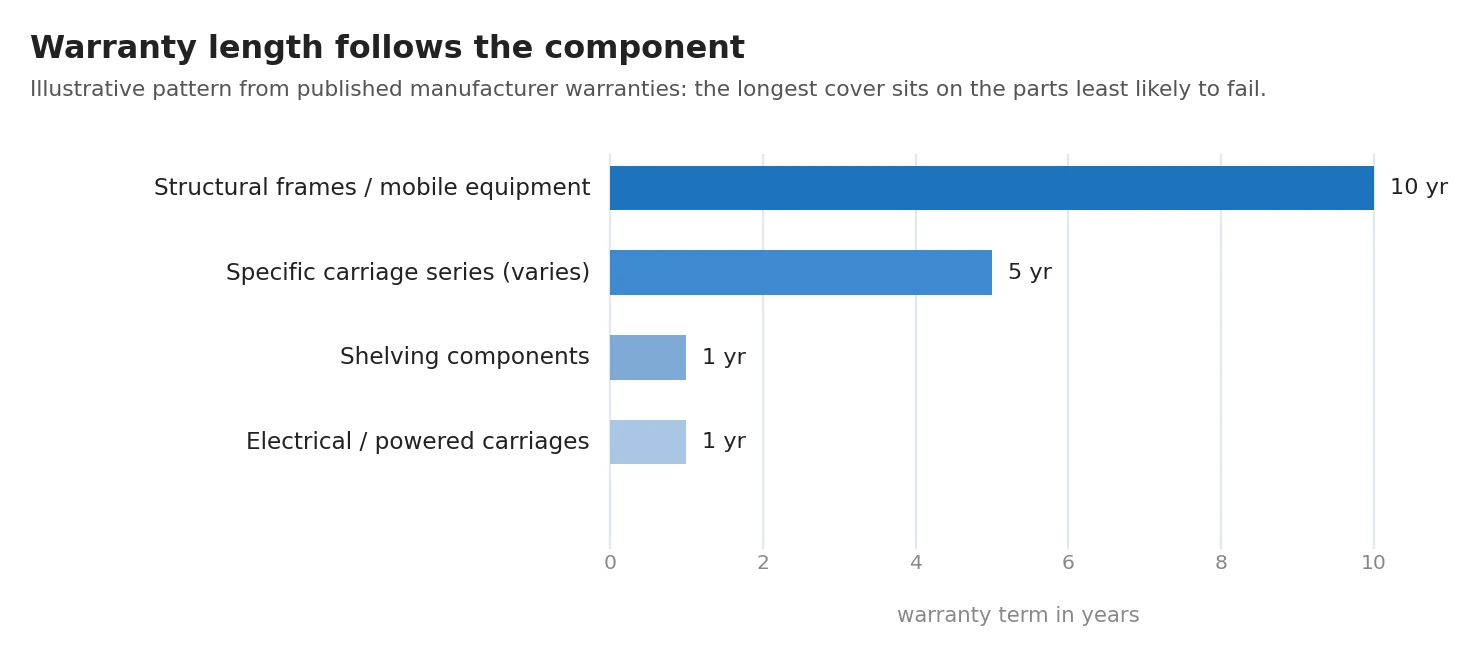
Warranty headlines in this industry are frequently long and frequently misread, because the long term applies to the part least likely to fail. Read every warranty as a set of layers.
| Layer | What it usually covers | What to check |
|---|---|---|
| Structural frames / mobile equipment | Carriages and structural steel, often for a long term. The published warranty of one manufacturer we represent runs ten years on mobile equipment supplied to the original buyer. | Whether “structural frames” explicitly excludes moving parts, controls and guides |
| Shelving components | The shelves and uprights themselves, commonly on a shorter term — one year in the same published warranty | That the shelving you are buying is covered on the term you were told |
| Electrical and powered carriages | Motors, drives and controls, usually the shortest term — one year in that same published document, with specific carriage series treated separately | Whether labour is included, and for how long, as distinct from parts |
| Installation workmanship | The installer’s own work | Who carries it, in writing, and whether it is joint with the manufacturer |
| Service response | Not a warranty at all — a commercial arrangement | Whether planned maintenance is offered locally and what it costs |
Two practical points. First, the parts that decide whether staff still like the system in year eight are the moving parts, and those carry the shortest cover; that is an argument for buying a well-engineered drive rather than for extending a warranty. Second, warranties are conditional on use and maintenance, which is why the service interval discipline is worth agreeing at purchase rather than discovering in a claim. Product-level warranty and option detail for the lines we represent is on the Pipp mobile storage systems page.
Comparing quotes that are not comparable
The most common cause of a bad buying decision here is comparing three quotes that describe three different scopes. The fix is boring and effective: issue one written specification and require pricing against it. The specification and submittal checklist exists for exactly this, and the cost and budget drivers guide explains where the money actually goes.
These are the line items that most often differ silently:
- Rail and floor work. Surface-mounted rail with ramps versus recessed rail in a poured or ground slab is a large cost difference and a large performance difference.
- Floor preparation. Levelling, grinding, patching and finish repair after rail installation.
- Engineering. Seismic calculations, anchoring design and stamped drawings where the jurisdiction requires them.
- Safety devices. Number and type of detection devices, anti-tip provisions, dual-end locking.
- Logistics. Delivery method, access route, lift or stair handling, protection of finishes, after-hours or weekend labour.
- Transition work. Removing and disposing of existing shelving, moving and re-shelving contents, temporary storage.
- Commissioning and training. Proving devices, adjusting travel, operator familiarisation, documentation.
- Contingency for the unknown. Who pays if the slab is worse than assumed, and how that is priced up front.
Retrofit projects deserve extra attention on the last two: an occupied building multiplies logistics, as set out in the guide to retrofitting mobile shelving into an existing building.

Want a proposal you can compare line by line?
Send us your room, your inventory and your growth expectation. You will get a capacity calculation, a scaled layout, a scope list with nothing hidden in the notes, and a service arrangement in writing.
Public agencies, schools and institutions
Public buyers have an extra dimension: the procurement route can change who you may buy from and how much competition you must run. Federal schedule ordering procedures and cooperative purchasing programmes let many agencies place orders against contracts that were already competitively awarded, which is why an otherwise excellent supplier can be unusable on a given project — and why contract vehicle should be one of your first questions rather than one of your last. The routes, and their real limits, are covered in the guide to GSA and cooperative contract purchasing for mobile shelving.
Two further points apply to institutional work. Records-storage and archival projects often inherit federal or state facility standards that dictate bracing, posted floor load limits and how compact shelving must be arranged for air circulation and fire protection, so the supplier needs to be fluent in them. And where a design team is involved, the specification is usually written before suppliers are shortlisted — the architects’ and specifiers’ page covers what belongs in that document.
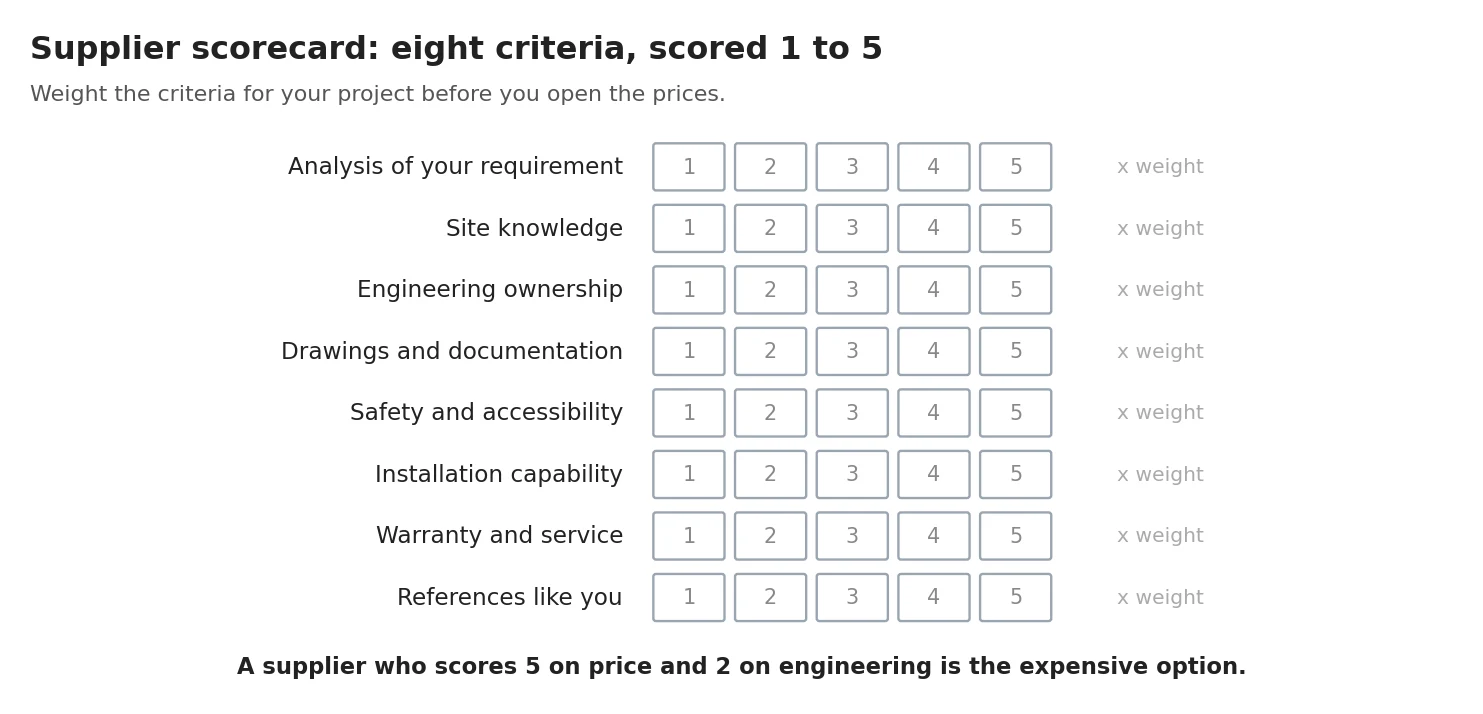
A scorecard for comparing companies
Score each candidate one to five on these eight criteria, weight them for your project, and the decision usually stops being about price. The point is not the arithmetic; it is that the conversation moves onto the things that determine whether the room works.
| Criterion | What a 5 looks like | What a 1 looks like |
|---|---|---|
| Analysis of your requirement | Capacity calculated from your data, with assumptions stated | A quote for the shelving list you sent |
| Site knowledge | Surveyed, raised the slab and access issues unprompted | Never visited |
| Engineering ownership | Named responsibility for loading, anchoring and seismic, in writing | Deferred to an unnamed third party |
| Drawings and documentation | Scaled layout, aisle widths, egress, submittal package | A price and a product photo |
| Safety and accessibility | Devices and clear widths specified as requirements | Options list with no recommendation |
| Installation capability | Own or long-standing crews, phased plan for an occupied room | Unknown subcontractor, no sequencing |
| Warranty and service | Joint warranty, local service, parts availability, planned maintenance offer | Headline warranty number and nothing else |
| References like you | Comparable installations you can contact | A logo wall |
Warning signs worth acting on
- No site visit. A layout produced from a plan and a phone call will meet the drawing and not the building.
- Silence on the slab. Floor capacity and levelness are the two most common causes of change orders on this product.
- Safety devices priced as afterthoughts on a powered system.
- Capacity with no method. If they cannot explain how they got the number, it is a guess and you will inherit it.
- No named installer. Installation quality decides how the system feels for its entire life.
- No service story. Ask where the nearest technician is based. A long pause is the answer.
- Discount pressure with a deadline. The scope you did not read is where the discount came from.
- Reluctance to put assumptions in writing. Everything above becomes arguable later; written assumptions do not.
None of this requires expertise in storage equipment. It requires asking the same eight questions of every candidate and noticing who answers them without being pushed. If you want the same discipline applied to the installation stage specifically, the installation and service page describes what a properly run install includes.
Get a free quote
Tell us what you are storing, the room size and your timeline. A project specialist will follow up with layout options and pricing. Prefer to talk? Call (800) 326-4403.
Frequently asked questions
Should we buy from a manufacturer or from a dealer?
What questions separate a strong bid from a weak one?
Does the lowest quote usually stay the lowest?
How long should a mobile shelving warranty be?
What qualification language do good specifications use?
Do public agencies have to run a full bid?
Can we evaluate suppliers before we know exactly what we need?
Put us through your own evaluation
We have designed, installed and serviced high-density mobile systems for records rooms, evidence rooms, libraries, laboratories and stockrooms since 1997. Send us your room and score our proposal against every criterion on this page.