
Pallet Rack / Mobile / Cold Storage
Cold Storage Mobile Pallet Racking
Heavy-duty pallet rack on powered mobile bases for coolers and freezers — so the aisles you are paying to refrigerate turn into pallet positions instead.

Why Mobile Racking Belongs in a Cold Room
A cold storage building charges rent twice. You pay to build the insulated envelope, and then you pay every hour to keep the air inside it at temperature. An aisle inside that envelope is floor you are refrigerating and not storing anything on. In an ambient warehouse that is a nuisance; in a freezer it is a permanent operating cost.
Mobile pallet racking answers that directly. The rack rows sit on powered mobile bases running on rails in the floor. The block closes up, and an aisle opens only where the operator asks for it. Instead of an aisle between every pair of rack rows, the block is served by one working aisle that moves. The conditioned volume you were already paying for now holds pallets rather than air — or, on a new build, the same pallet count fits inside a smaller and cheaper refrigerated envelope.
Interlake Mecalux lists refrigerated storerooms as a core application of the Movirack mobile racking system, and it is the application where the trade-off is easiest to justify: cold rooms usually hold slower-rotating pallets than an ambient pick face, and slow rotation is exactly what mobile racking suits.
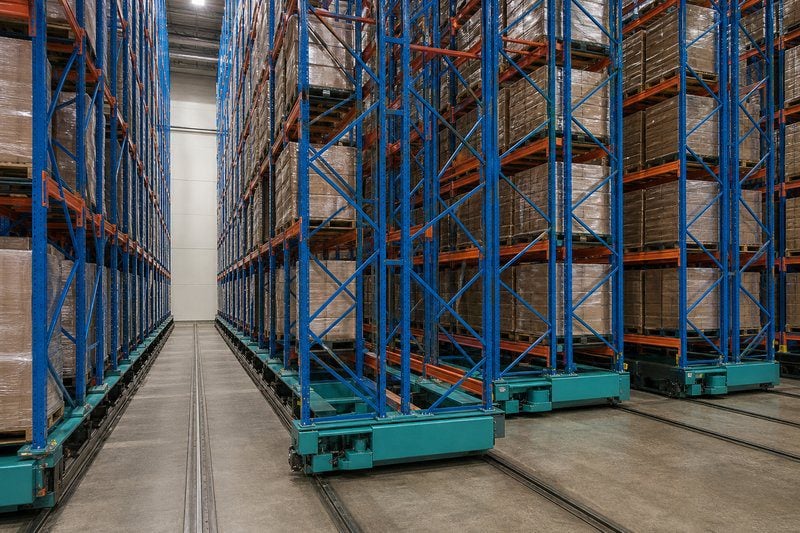
This page covers heavy-duty mobile pallet racking — pallet loads, lift trucks, powered bases, embedded rails. It is a child of our mobile pallet racking page and shares that engineering. Component behaviour described here follows the Interlake Mecalux Movirack brochure we hold in our own literature library. Refrigeration design, floor design, structural capacity, seismic requirements and fire protection are set by your engineers and local code.
What Actually Changes Below Freezing
The layout logic of a mobile block is the same in a freezer as in an ambient warehouse. Everything around it changes. These are the areas where a cold-room specification diverges from an ambient one, and the questions worth asking before anyone draws a layout.
| Area | What is different in a cooler or freezer | What to settle before layout |
|---|---|---|
| Design temperature | A cooler, a freezer and a space next to a blast cell are three different environments for mechanical equipment, not one. | State the design temperature and the realistic range, including defrost swings and any planned future change of use. |
| Drives and mechanics | Motors, gearboxes, lubricants, bearings, rollers and guide wheels are selected for low-temperature duty. | Confirm the low-temperature specification of every moving component with the supplier for your actual room temperature. |
| Electrics and controls | Cabling flexibility, cable management, enclosures, sensors and safety devices all behave differently cold, and condensation appears whenever equipment crosses temperature boundaries. | Decide where panels live — inside the cold envelope or outside it — and how service access works without warming the room. |
| Finish and corrosion | Moisture, defrost water and cleaning regimes are harder on steel than dry ambient air. | Agree the finish for rack, bases and rails against your washdown and sanitation routine. |
| Floor build-up | Freezer slabs carry insulation, vapour barriers and, in low-temperature rooms, sub-slab heating against frost heave. | Get the floor engineer to confirm how rails can be installed without compromising that build-up. |
| Frost and ice | Frost accumulates at floor level, on steel and around doors; ice in a track stops a row from travelling cleanly. | Plan door management, defrost scheduling, drainage and a written track housekeeping routine. |
| People | Operators work in insulated PPE with restricted movement and limited exposure time. | Design controls, aisle width, lighting and access so an aisle change is quick and does not require dismounting. |
| Fire protection | Sprinkler design in freezers is its own discipline and interacts with rack layout and flue spaces. | Involve the fire protection engineer at layout stage, not after the rack is ordered. |

Frost accumulation on rack steel and location labels is normal in a freezer — the design question is how it is managed at floor and rail level.
Frost, Airflow and Defrost
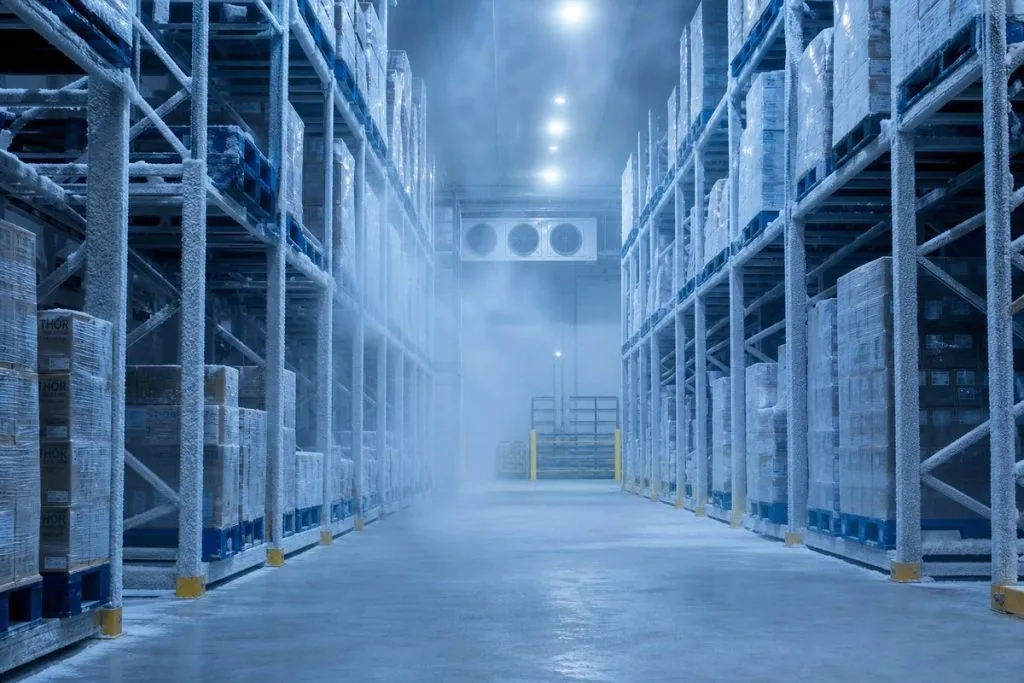
Moisture is the freezer’s real problem, and it arrives from the same few places every time: door and dock openings, warm product and pallets coming in, personnel traffic, and the defrost cycles themselves. Once inside, it lands as frost on cold steel and as ice on the floor. In a mobile block, ice in a track is the failure mode you care about, because a row that cannot travel cleanly is a row that is not storing anything.
None of that is solved by the racking. It is solved by the room: vestibules, air curtains and disciplined door management; evaporator placement and throw that suits a block whose aisle moves; defrost scheduling that matches your operating windows; drainage and floor detailing that gives melt water somewhere to go; and a housekeeping routine that treats the tracks as equipment.
The Movirack brochure also describes a parking arrangement in which the rows sit spread apart rather than fully closed during downtime, which improves air circulation while the room is idle. Where the space allows, those gaps can also be used to pick individual items from lower levels. In a cold room, whether you park and when is worth designing deliberately alongside your refrigeration engineer instead of leaving it to whoever is on shift.
The airflow questions to put to your refrigeration engineer
- Where do the evaporators sit relative to a block whose open aisle moves, and does any position leave a dead zone when the block is closed?
- How is air expected to move through a closed block overnight, and does that change your product temperature tolerance?
- Does the parking arrangement improve circulation enough in this room to be worth the floor it consumes?
- How does defrost timing line up with the hours the block is actively worked?
- Where does defrost and melt water drain, and does any of it cross a rail?
- What is the plan for door and dock openings that admit the most moisture?
Freezer Floors and Rail Installation
Mobile racking is a floor product, and freezer floors are the most demanding version of that problem. Below a low-temperature room the slab typically carries insulation, a vapour barrier and, where the design requires it, sub-slab heating to stop the ground beneath from freezing and heaving. Rails have to be installed into or onto that assembly without compromising any layer of it, while staying level enough for rows to travel and stop repeatably, and flush enough for a loaded truck to cross.
| Installation method | Applies when | Cold-room consideration |
|---|---|---|
| Rails set into a new concrete subfloor | New build, or a new slab poured for this project. | The cleanest option for a freezer, because rails and the insulated floor build-up are coordinated in one design rather than retrofitted around each other. |
| Rails on an existing floor with a topping poured afterwards | Existing floor has adequate strength and a new wearing surface is going in. | Adds concrete work, cure time and a warming/re-cooling cycle to the programme, and raises finished floor level — check door thresholds and dock heights. |
| Rails on an existing floor using channels | The existing floor can carry the system without compromising its strength. | Least disruptive retrofit route, but depends on a cold-room slab that surveys well and on knowing what is beneath it. |
| Rails on channels plus spreader beams | Floor strength is insufficient or undetermined. | Keeps older cold rooms in play by spreading load, and is usually the method that moves floor work up the budget. |
Before anyone prices a cold-room mobile block, get answers to: slab construction and insulation build-up, whether sub-slab heating exists and where its elements run, measured flatness across the intended footprint, joint and drain locations, the load the floor can take from rails plus a loaded truck, and how the room can be emptied and worked in during installation.
Working a Cold Mobile Block
In a freezer, every second an operator spends not moving a pallet is expensive twice over — in throughput and in exposure. That makes the operating detail of a mobile block more important cold than it is ambient.
- Open the aisle from the truck. Remote aisle opening means the operator does not dismount, walk to a panel in insulated PPE, walk back and remount for each aisle change.
- Sequence the pick list by aisle. A route that jumps between aisle positions pays the travel penalty repeatedly; a route grouped by aisle pays it once.
- Match the truck to the aisle. The open aisle is a working aisle and is sized by the truck. Freezer duty also affects battery or fuel behaviour and cycle planning.
- Keep tracks clear. Shrink wrap, broken pallet boards, spilled product and ice belong to the maintenance plan, not to whoever notices.
- Plan service access. Decide in advance how a technician reaches drives and panels, and whether that requires a planned access window.
- Rehearse the safety devices. Exterior and interior safety barriers, the proximity photocell, reset buttons and emergency stops are part of daily operation, not a commissioning formality — train and test them on a schedule.
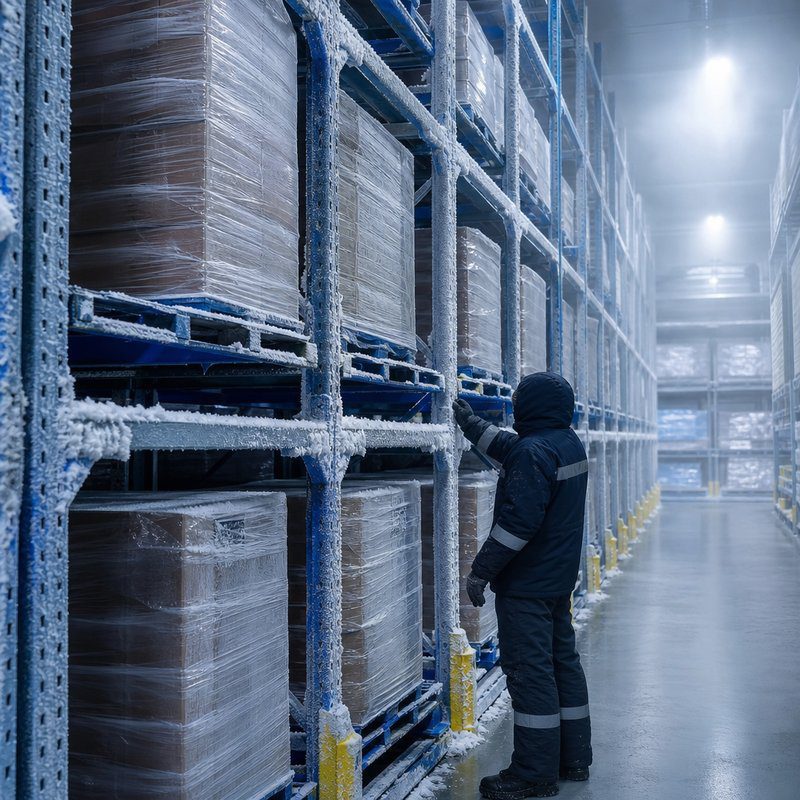

The open aisle in a cold mobile block is a normal working aisle: its width is set by the truck that has to work it, and every aisle change costs travel time.
Mobile Racking Against the Other Cold-Storage Options
Density in a freezer can be bought several ways, and mobile racking is not automatically the right one. The choice usually falls out of your SKU-to-pallet ratio, your date-code discipline and your peak picking rate rather than out of a density figure.
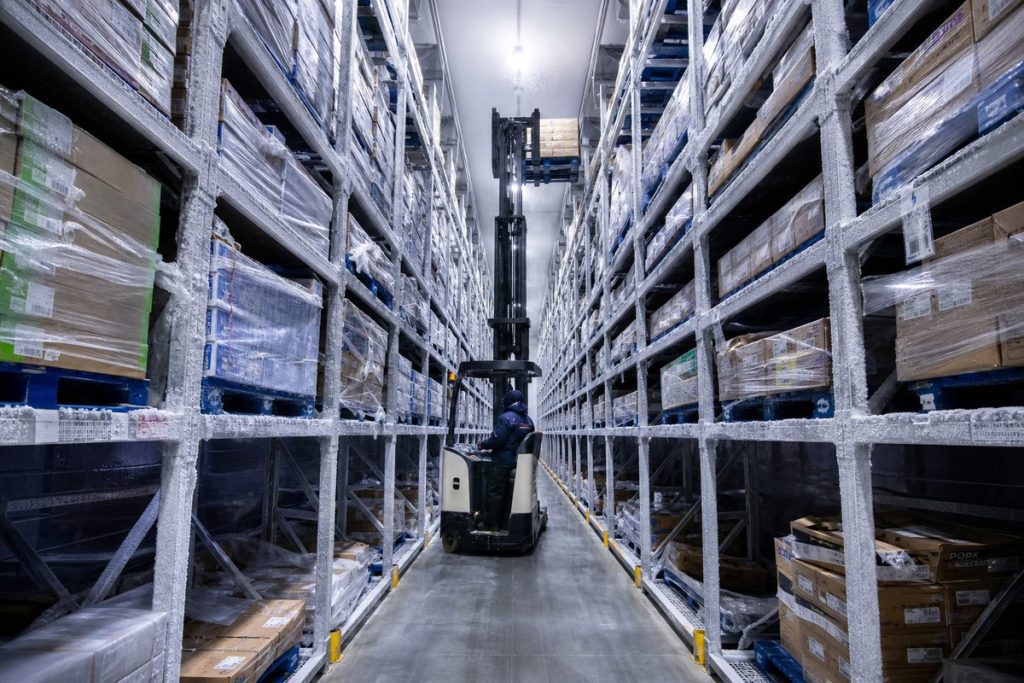 Narrow-aisle rackKeeps fixed aisles but makes them narrower with specialised trucks. Full selectivity, no moving structure, higher demands on floor flatness and truck fleet. Compare on narrow-aisle rack.
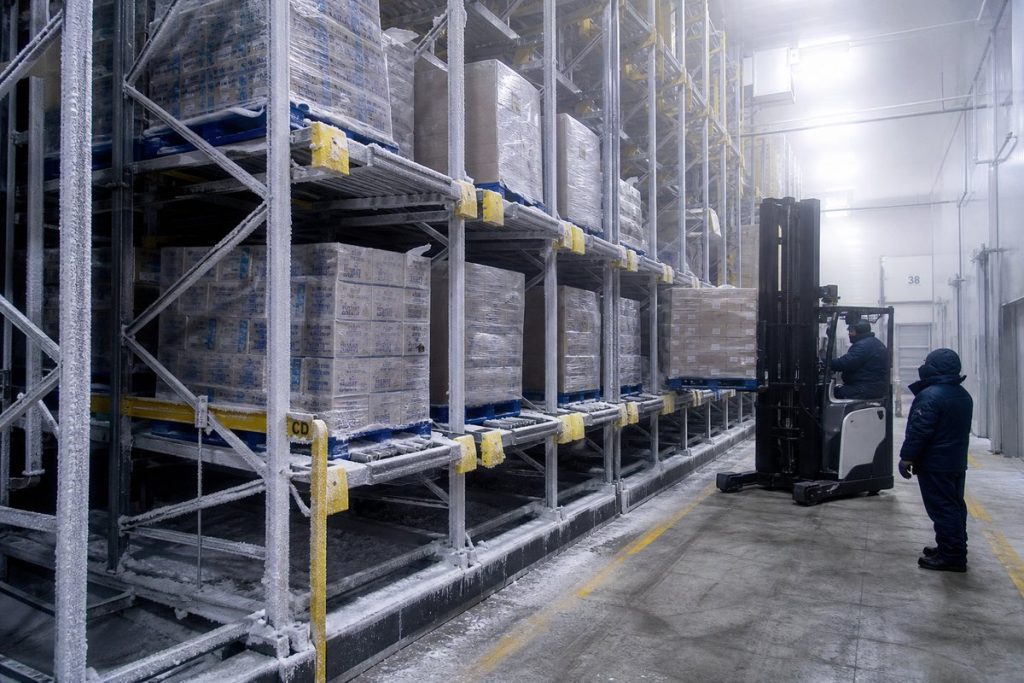 Pallet flow rackGravity lanes give first-in/first-out handling and high throughput for date-sensitive product, with selectivity by lane rather than by pallet. See pallet flow rack.
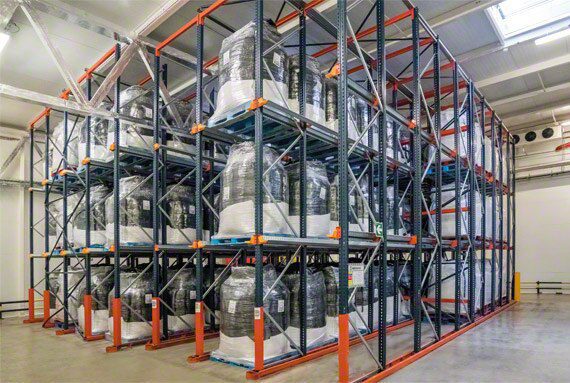 Drive-in and push-backDeep lanes for few SKUs with many identical pallets, at the cost of last-in/first-out handling. See drive-in and push-back rack.
Two rules of thumb hold up well in cold rooms. First, if you have many SKUs with only a few pallets each, systems that bury pallets behind other pallets will cost you more in handling than they save in floor. Second, if your peak hour needs several operators working the same footprint at once, a single moving aisle will constrain you — in that case, consider a hybrid: a mobile block for reserve and slow-moving stock, static rack at the pick face. Food and beverage operations weighing the whole picture can start from our food and beverage storage solutions.
What Drives Cost on a Cold-Room Mobile Project
We do not publish prices, and any cold-storage price you find without a floor survey behind it is a guess. These are the variables that actually move the number, so you can build a credible internal budget request before asking for a scoped quote.
- Block size. How many rows travel and how long each one is — this sets most of the mechanical scope.
- Low-temperature specification. Drives, lubricants, cabling, sensors, enclosures and finishes selected for the room’s design temperature.
- Installation method and floor work. New subfloor, poured topping, channels, or channels with spreader beams — plus any repair or levelling the survey turns up.
- Freezer floor complexity. Insulation, vapour barrier and sub-slab heating make the floor scope of a cold-room project unlike an ambient one.
- Electrical and controls. Feeding and controlling the block, panel location inside or outside the envelope, and condensation management.
- Rack structure. Sizing for your pallet weights and levels, the additional bracing mobile units require, and rack protection.
- Working in a live cold room. Product relocation, temperature holds, phased or off-hours installation, and re-commissioning the room.
- Coordination trades. Refrigeration, sprinkler, lighting and door works that have to move around a new layout.
- Commissioning, training and service. Startup, operator training in PPE conditions, spares, and the inspection interval you want to hold.
On cold-room retrofits the two items that most often blow a budget are the floor scope and the cost of emptying and holding the room during installation. Survey both before you commit to a layout.
How to Specify a Cold Storage Mobile Racking System
Describe the room
Design temperature and range, envelope dimensions and clear height, refrigeration plant and evaporator layout, doors and dock openings, sprinkler design and floor construction.
Describe the inventory and duty
Pallet dimensions and weights, SKU count and pallets per SKU, rotation and date-code rules, moves per hour at peak, truck fleet and shift pattern.
Survey the floor
Slab construction, insulation and any sub-slab heating, measured flatness, joints, drains and in-slab services, and load capacity for rails plus a loaded truck.
Engineer, install, support
Block layout and aisle count, low-temperature component specification, rail installation method, control and safety scope, commissioning and operator training, and a scheduled inspection plan.
Bring us in at the feasibility stage. The decisions that determine whether a cold-room mobile block works — the floor, the aisle, the refrigeration interaction and the way the room is worked — are all cheaper to change on paper.
Related Boxes & Packaging Supplies
These are boxes and packaging supplies, not shelving, mobile carriages, or storage-system equipment. See each product page for current price and ordering details.




Cold Storage Mobile Racking FAQs
Why is mobile racking used in cold storage at all?
Does mobile racking reduce refrigeration cost?
Can pallets be reached individually in a freezer mobile block?
What is the parking option and why does it matter in a cold room?
How is frost managed at the rail line?
Do the controls and electrics change below freezing?
Does the freezer floor need special treatment?
Is mobile racking a good fit for a fast-moving freezer?
How does it compare with drive-in or pallet flow in a freezer?
What maintenance does a cold-room mobile block need?
Can this be retrofitted into an existing freezer?
Turn refrigerated aisles into pallet positions
Send us your room temperature, pallet data and floor information and we will tell you whether a mobile block is the right answer for your cooler or freezer — or whether it is not.