
Security Cages for a Licensed Cannabis Product Manufacturer: Golden Hanuman
How a state-licensed cannabis manufacturer in Connecticut uses a welded wire mesh enclosure to satisfy a written “separate locked caged area” storage requirement inside an existing building.
Licensed cannabis facilities nationwide from our Salt Lake City headquarters — call (800) 326-4403.
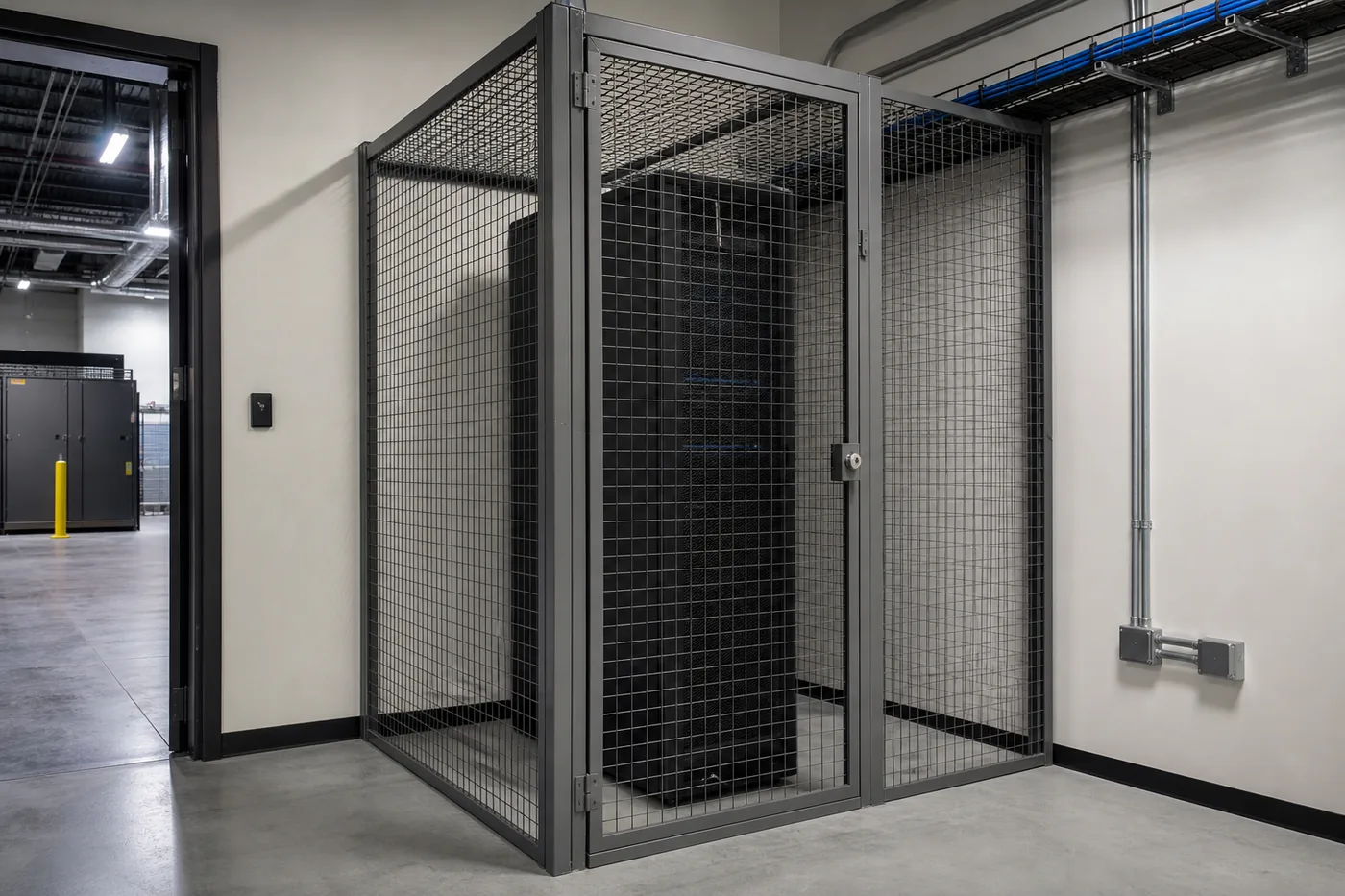
Golden Hanuman
Licensed cannabis product manufacturer — Middletown, Connecticut
The driver
A state rule that names a locked caged area as an approved secure location
The constraint
A written cage construction specification, not a preference
The answer
A fully enclosed welded wire mesh room built to the state’s spec
A licensed cannabis manufacturer does not buy a cage to stop theft
In 2026 Golden Hanuman, a state-licensed cannabis product manufacturer in Middletown, Connecticut, bought a welded wire mesh security enclosure from us for finished-product storage. The purchase record describes the use simply as storage of THC products.
This page publishes the problem class, not the project. No address, no room, no layout, no quantities, no hardware schedule, no alarm or camera detail and nothing about this customer’s security posture appears below, and none of it would be appropriate to publish. Everything that follows about requirements comes from Connecticut’s own published guidance to licensees and from the statute and regulation it cites.
What makes a licensed cannabis facility different from every other buyer of a welded wire security enclosure is that the enclosure is not a business decision. A distributor decides how much shrink it is willing to tolerate and sizes an enclosure accordingly. A cannabis licensee is told, in writing, that product must be returned to a defined “secure location” at the end of every business day — and the regulator names exactly three things that count as one. A cage is one of them, and it comes with a construction specification.
That changes the conversation from “how big and how strong” to “does this match the written requirement, and can our licensing agent see that it does.” It is the same shift we see with DEA registrants and with government custody storage, and it is why a cannabis enclosure should be specified from the rule text outward rather than from a catalog page inward.
The regulator already chose the product category
Most buyers arrive asking whether mesh is strong enough. Cannabis licensees in states that model their rules on controlled-substance regulation arrive with the opposite question: the rule already says a caged area is acceptable, so the work is proving the cage in front of them is the cage the rule describes.
Practically, that means gauge, post size, reinforcement spacing, attachment method, mesh opening size relative to the smallest container stored, and complete enclosure on every side including the top. Those are specification items a supplier can document. Whether your particular build satisfies your particular license is your regulator’s call, not ours.
What the rule actually says about caged areas
Connecticut reaches its cage requirement by reference. State statute requires a cannabis establishment to store all cannabis so as to prevent diversion, theft or loss, to make it accessible only to the minimum number of specifically authorized employees needed to operate, and to return product to a secure location at the end of each scheduled business day. It then defines “secure” by pointing at the state’s existing controlled-substance regulation for Schedule III, IV and V stock.
That regulation gives three options: an approved vault; an approved safe with a separate effective electrical alarm system; or a separate secure locked caged area, room or enclosure with a separate effective electrical alarm system. Where a caged area is used, it must be completely enclosed, and construction must be of heavy gauge wire mesh with openings smaller than the smallest container of product stored inside.
The Department of Consumer Protection then publishes guidance for licensees remodeling or building a facility with a secure location that turns “heavy gauge” into numbers. That document is the single most useful thing a Connecticut licensee can hand a supplier, and states that have borrowed the same controlled-substance framework tend to read similarly. Two cautions: the guidance is explicit that each location is evaluated on its own circumstances with the licensee’s assigned Drug Control agent, and rules differ materially between states. Specify from the document your regulator gives you, not from ours or anyone else’s.
Cage, vault or safe — how licensees actually choose
All three options are legitimate. They fail in different ways, and the choice usually comes down to volume, building conditions and how often people need to get to product during the day.
| Option | Works well when | Runs into trouble when |
|---|---|---|
| Approved safe | Small volumes, a retail day’s stock, high-value concentrates | Volume grows, staff queue at one door, or pallets and totes will not fit through the opening |
| Constructed secure room | You are building out anyway, want climate separation, and own the space long term | Leased space, tight schedule, or the wall has to be opened again to mesh-fortify it to spec |
| Welded wire caged area | Case, tote and pallet volumes; fast installation; a documented specification; the ability to expand or relocate later | The rule or your agent expects contents not to be visible, or a specific container rating is required |
One detail catches people out. Connecticut’s guidance says the inside of the secure location should not be visible from outside, or should be limited as far as possible. Open mesh is the opposite of that by design, which is why cannabis cages are usually specified with a visual screen — positioning inside a windowless limited-access room, backing panels to solid walls, or adding sheet or perforated infill on exposed elevations. It is a solvable requirement, but it has to be solved at quoting time, not discovered at inspection.

Why mesh still wins for manufacturers
Manufacturing moves material in cases, totes and trays, not by the jar. A cage is the only one of the three options you can walk a pallet jack into, size to the room you actually have, and extend next year when a second production line comes online.
It is also the cheapest of the three to document. Panel gauge, post diameter, reinforcement spacing and attachment method are catalog facts with drawings behind them — which is exactly the form a regulator’s written requirement takes.
Make the physical zones match your inventory record
Every licensed operator runs a seed-to-sale inventory system, and every unit of product sits in a state within it: in process, on hold or quarantined, released and packaged, returned, or destined for destruction. Enforcement problems rarely start with a missing pallet. They start when the record says one thing and the shelf cannot show it — released product and held product on the same rack, waste awaiting destruction mixed in with finished goods.
The cheapest fix is physical. When each record state has its own defined space, a count is a walk rather than an investigation, and a new employee cannot put something in the wrong place without noticing. For a manufacturer we normally end up with some version of:
The construction specification, item by item
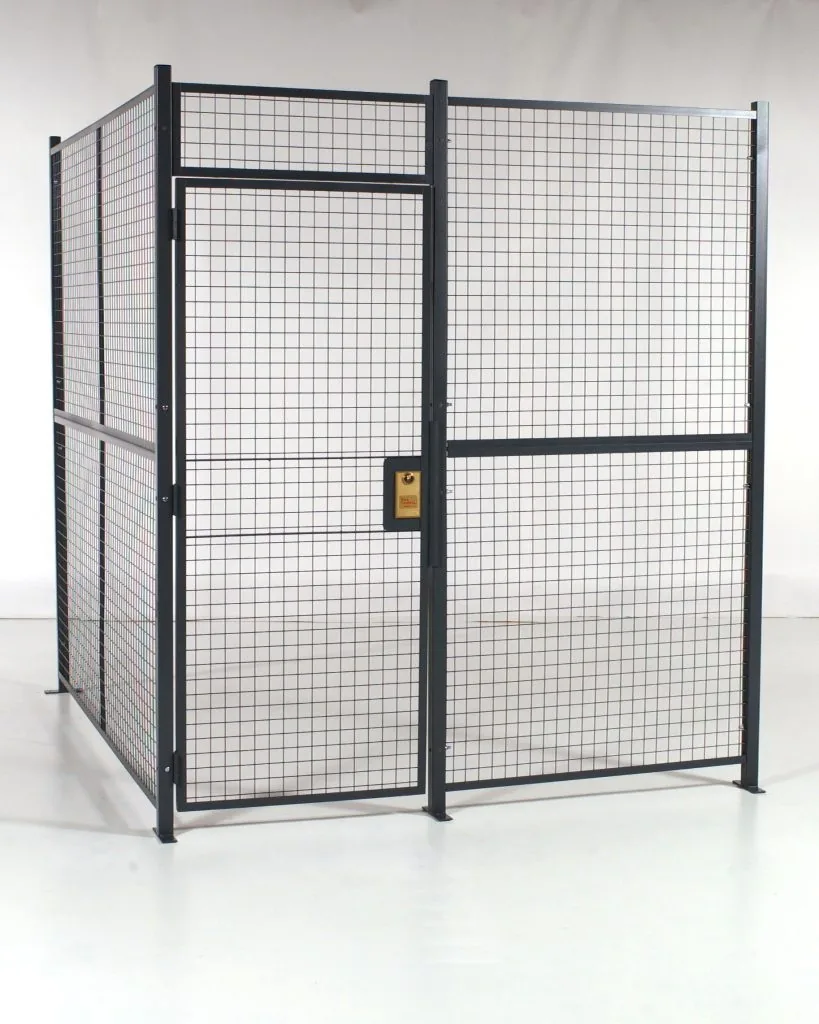
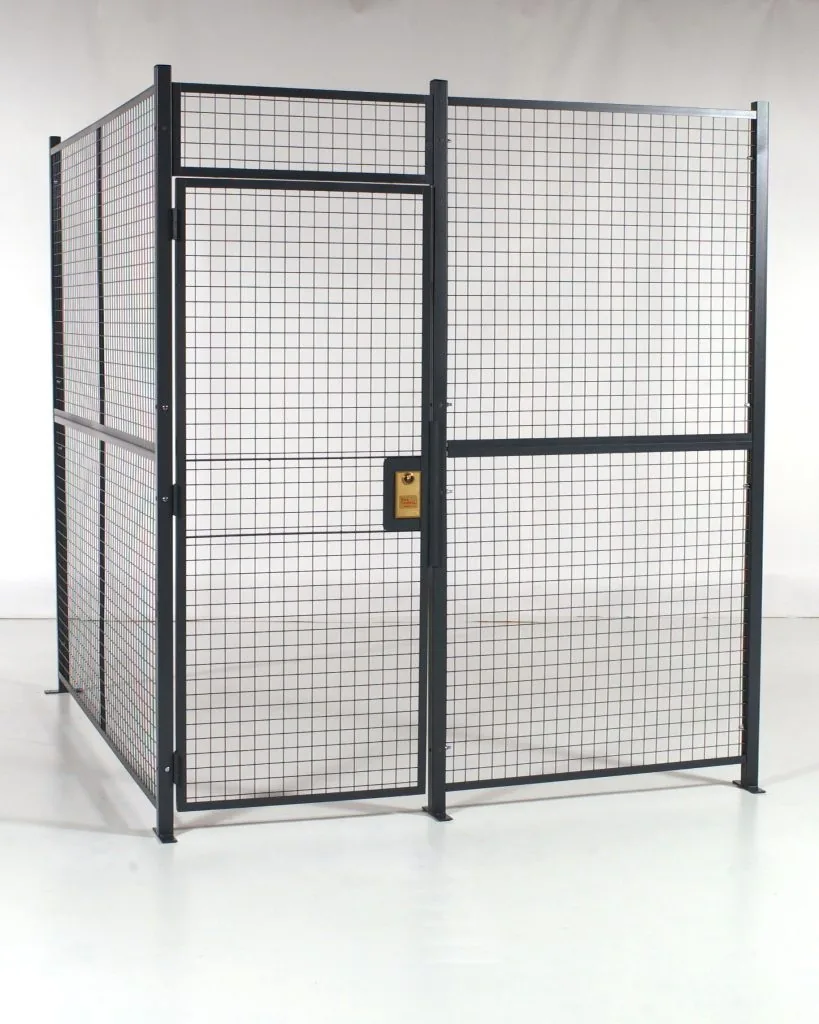
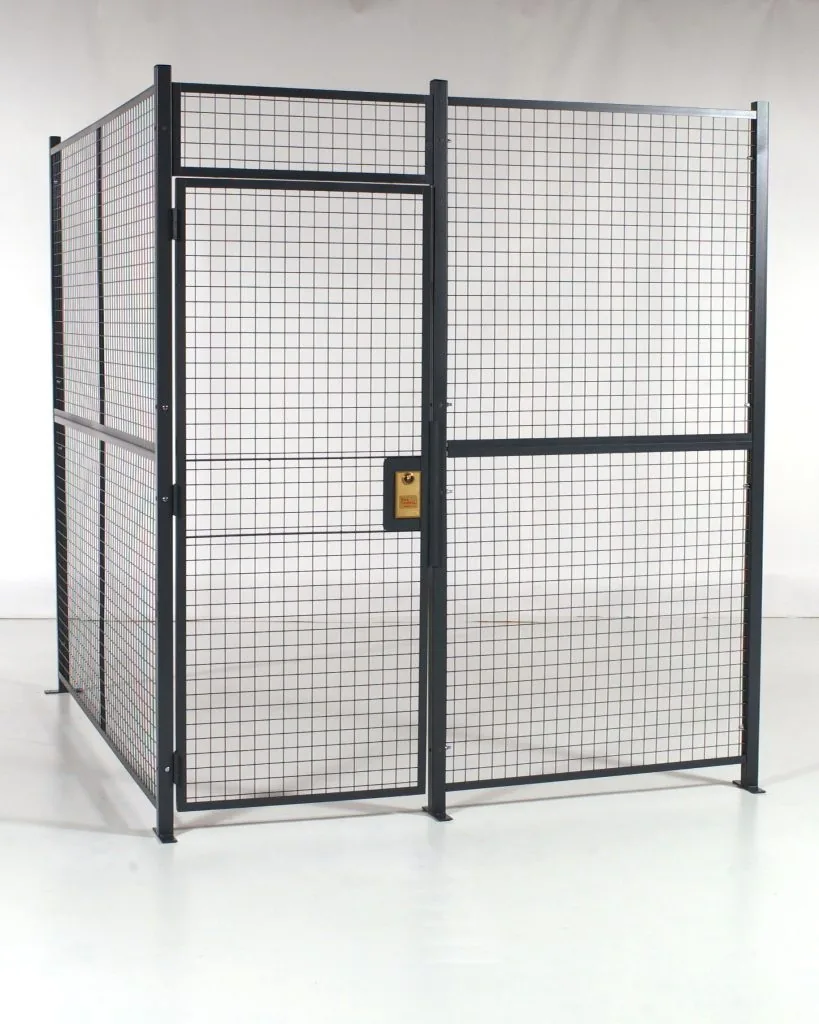
Connecticut’s published guidance is unusually concrete for free-standing caged areas, and it reads like a supplier specification because it effectively is one. For sides of the cage or enclosure it calls for 10-gauge wire mesh or thicker, or the structural equivalent in another material; steel posts no less than one inch in diameter spaced no more than ten feet apart; one-and-a-half-inch steel horizontal reinforcement no more than five feet apart; and attachment points secured against disengagement by brazing, pinning or an equivalent method. Mesh openings must be smaller than the smallest container stored inside, with larger openings possible depending on placement and other security features.
Three of those items decide whether a standard product works or a custom build is needed:
- Gauge. Plenty of general-purpose partition on the market is lighter than 10-gauge. Confirm the wire gauge of the panel being quoted, in writing, before anything is ordered — not the frame gauge, the mesh.
- Opening size versus smallest container. This is a decision about your product, not the cage. If the smallest thing stored is a single vape cartridge in a small carton, a woven pattern with generous openings may not qualify on its own. Licensees usually resolve it by specifying a tighter mesh, storing the smallest items in a lockable cabinet inside the enclosure, or accepting a placement condition such as backing to solid walls.
- Attachment integrity. The requirement is that panel and post connections cannot be disengaged — ordinary bolted hardware plus a positive anti-tamper method. This is a detail to ask about explicitly, because it distinguishes a compliant build from a quick one.
The general design decisions behind panel selection — welded versus woven, wire and frame gauge, finish, and where solid infill belongs — are covered on our wire mesh panel options page, and our cannabis storage cages page covers the category at a level above this case study.
Bring the document, not the dimensions
The fastest cannabis projects we quote start with two attachments: the written secure-storage guidance or condition the licensee has been given, and a sketch of the room with the door, sprinkler heads, columns and ceiling height marked.
With those, a layout, panel specification, drawing and price take days. Without them, the first quote is a guess that gets revised the moment a licensing agent reads it — and revisions after panels are cut are the expensive kind.

Ceilings, floors and the six-sided test
“Completely enclosed” is the requirement most often missed, and Connecticut states it in a way worth borrowing regardless of where you operate: a secure location is considered to have six sides, each evaluated individually. For a free-standing cage that means either a ceiling built to the same specification as the sides, or sides that run all the way up to the building’s structural ceiling.
A cage stopping at eight feet under an open deck, or under a suspended ceiling with an accessible plenum above it, is not enclosed — it is a tall fence. This is the single most common defect we are asked to correct on enclosures somebody else built.
The floor and the space below it count too. If there is occupied or accessible space above or below the secure location, the guidance expects the licensee to be able to say who owns that space, who can get into it inside and outside operating hours, and what detects access. That is a building question rather than a cage question, but it is decided at the same time — and it is a good reason not to put a secure location on a floor above a tenant you do not control, or against an exterior wall if it can be avoided.
Practical ceiling choices — flat mesh ceiling panels, clear-span versus tube-supported spans, and coordination with sprinkler coverage and lighting — are covered in detail on our security cage ceilings page. Whichever way it goes, get the fire protection review done before panels are ordered: a mesh ceiling under sprinkler heads is a life-safety item, and it is the one element most likely to be changed by an authority having jurisdiction.
Doors, day gates and pass-throughs
Doors are where a cannabis enclosure differs most from an ordinary storage cage, because the rule cares about entries as events, not just as openings. Connecticut’s guidance expects the secure location to be limited to one egress point unless otherwise approved, with no window access; access logged individually by swipe or equivalent technology; and every entry point — including any pass-through window — fitted with a door that closes and locks automatically on release and is not propped open during operation. A day gate is contemplated for operating hours, but it is not the overnight condition.
If a pass-through window is installed it is treated as an entry point in its own right and must be no larger than reasonably necessary to do business. That is worth planning for rather than avoiding: a small pass-through is how a production team moves product without adding a person to the access record every time, which keeps the log short enough to actually be reviewed.
Mechanically, the things that decide whether a compliant door is also a workable one:
- Swing and clearance. A door that opens into a rack aisle or a pallet lane gets blocked, and a blocked door is how a propped-open door happens. Give it clear floor space, or use a sliding leaf where floor space is tight.
- Self-closing hardware. Automatic closing and latching on release is a rule item, so the closer and strike are part of the specification rather than an accessory.
- Access control interface. We provide the prepared door, frame and hardware coordination; your integrator provides the credential system and the log. Decide who owns that boundary before install day.
- Door size versus what moves. Size the opening for the loaded pallet jack or cart, not for a person. Undersized openings are the most common cause of damaged panels.
Door types, frames and hardware options are covered on our security cage doors page, and counter and transaction openings on our service window page.
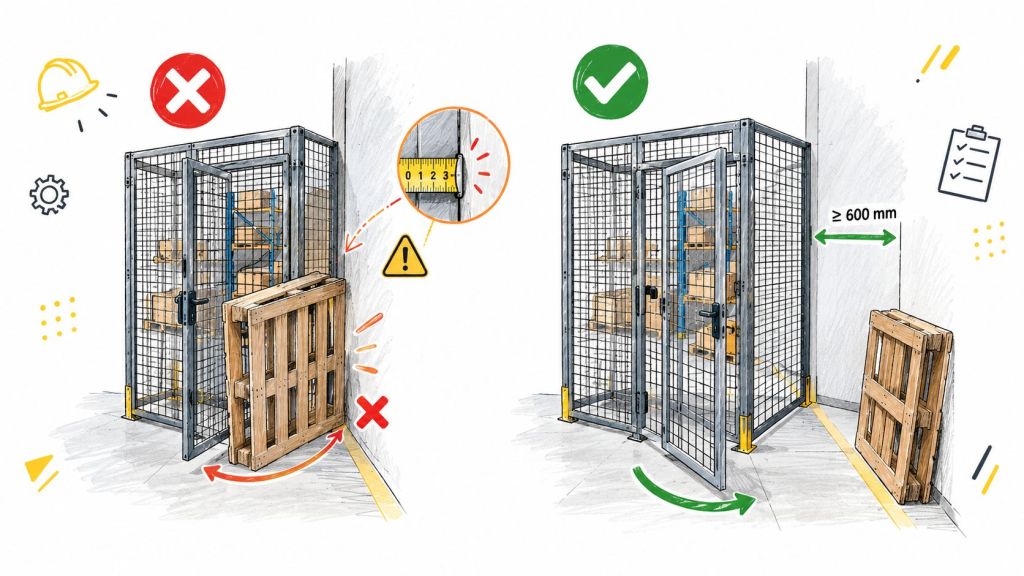
The propped-open door problem
Nearly every access-control failure we see in production environments has the same cause: the compliant door made a necessary task slow, so someone defeated it. The fix is layout, not discipline.
Put the enclosure where material naturally flows, give the door clear swing space, add a small pass-through for routine handoffs, and keep the large opening for scheduled movements only. Then the rule and the workflow want the same thing.
Where the enclosure goes inside the building
Placement carries as much regulatory weight as construction. The guidance asks licensees to site the secure location away from entrances and exits where possible, to think about shared walls — an exterior shared wall may need reinforcement — and to keep the inside out of view. It also notes that the regulator considers the facility footprint and the volume of product handled when judging whether a secure location is sufficient.
Translated into layout work, that means:
- Inside a limited-access room, not opening onto a corridor. Layered separation — building, then limited-access area, then enclosure — is what narrows the set of people who could have reached product, and it solves the visibility expectation at the same time.
- Not on the shipping wall. Adjacency to a dock or an exit shortens the path between product and the outside. Where it cannot be avoided, expect to add compensating measures.
- Interior walls where possible. Exterior walls invite the reinforcement conversation; interior placement usually avoids it.
- Room to grow. Licensees add SKUs and lines faster than they move buildings. A bolted panel system can be extended along a wall — but only if the wall is still there, so leave a run of it unobstructed.
- Aisle and egress geometry. The enclosure cannot block a required exit path or a sprinkler pattern, and its own internal aisles need to work for the equipment that enters it.
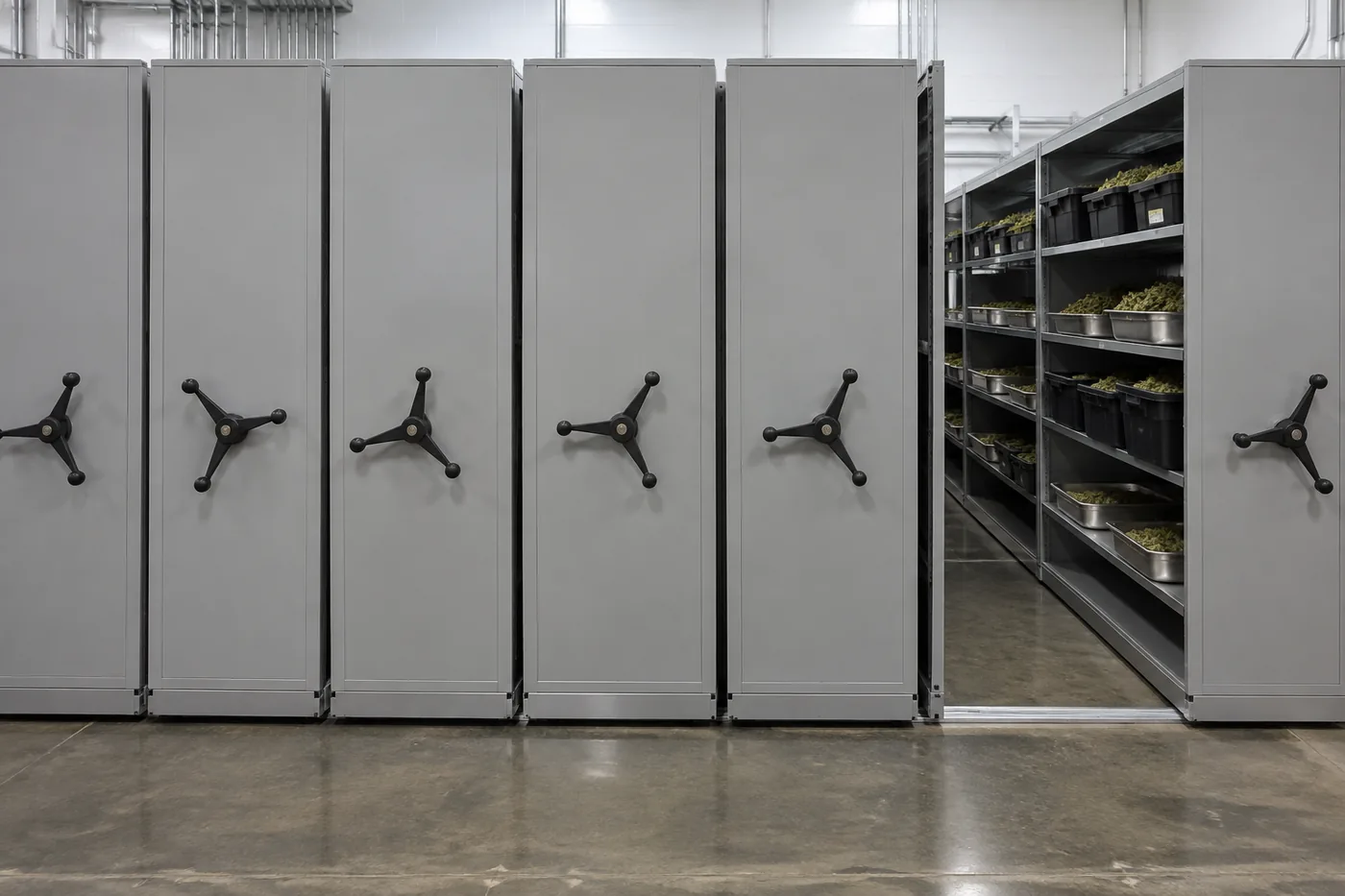
Sizing method — translating pallet, tote and shelf counts into panel runs with the right internal clearances — is covered in our security cage sizing guide. If storage density inside the enclosure is the binding constraint, high-density shelving on carriages stores far more in the same enclosed footprint than static shelving does, which is often cheaper than enlarging the cage.
Retrofitting an existing building
Very few licensed manufacturers occupy purpose-built space. Most are in older industrial or commercial buildings, frequently leased, and that shapes the enclosure more than any product preference does. Four conditions come up again and again:
- Floors that are not flat or not what you think. Anchoring is part of the attachment-integrity requirement, and old slabs vary in thickness, flatness and reinforcement. Shim allowances and anchor selection are site conditions, established by survey rather than assumption.
- Structure overhead that is not level or not clear. Timber decks, exposed joists, low beams, ductwork and sprinkler mains all interfere with a run-to-structure design, which is often what pushes a project toward a mesh ceiling instead.
- Lease limits. A bolted panel enclosure is equipment, not construction: it goes in, comes out and leaves a patchable floor. That is usually a far easier landlord conversation than framing a permanent room, and it is why leased-space licensees favor cages.
- Getting panels into the room. Tight docks, freight elevators, stair turns and narrow doors decide panel sizes. Measure the delivery path, not just the destination.
None of this is specific to cannabis — it is the same survey work behind any warehouse security enclosure. What is specific to cannabis is that the answers end up in a regulatory file, so they need to be recorded rather than solved informally on install day.
Installing inside an operating licensed facility
Installing in a licensed cannabis facility is an access-control exercise as much as a construction one. Licensees control who enters restricted areas, log visitors, and generally require escorts; some states impose registration or background-check expectations on people working in certain areas. The practical consequences for scheduling:
- Plan for escorted, badged access and for the possibility that crews cannot be left alone in a restricted area. That affects crew size and duration, not just paperwork.
- Product should not be in the space. The cleanest sequence is to build the enclosure before product moves in, or to relocate product to an approved alternative while work is done. Decide that with your licensing agent rather than improvising.
- Sequence the alarm and access-control work. The enclosure is a prerequisite for the alarm and credential work that the rule also requires; the integrator needs the door and frame in place before it can finish.
- Ask for the documentation package. Drawings, panel and hardware specification and an installation record are what let you evidence the build later. For a regulated facility they are as important as the steel.
Our general sequence, site prep expectations and timelines are on the security cage installation page. We install nationwide from Salt Lake City, including on the East Coast.
Build it before you need it
The worst time to build a secure location is after a licensing inspection has flagged the one you have. Panels are made to order, fire protection review takes time, and the alarm and access-control trades have to follow the steel.
If a licence condition, a build-out or a volume increase is on your horizon, start the enclosure conversation at the same time as the equipment conversation — not after the room is full.

What a wire mesh cage is not
We would rather lose a sale than have an enclosure fail an inspection. Mesh is not:
- An approved vault or safe. Where a rule or a condition calls for a vault or a rated safe, the cage is the room around it, not a substitute for it. Read which of the three options your condition actually names.
- Solvent or flammable storage. Extraction and processing bring flammable liquids and compressed gases with their own separation, ventilation, containment and electrical-classification requirements. Those belong in listed cabinets and properly designed rooms — never inside a product cage because it happens to be lockable.
- Fire-rated. A welded wire enclosure provides no fire resistance rating and no spill containment, and a mesh ceiling has to be reviewed against sprinkler coverage rather than assumed compatible.
- An alarm, a camera system or an access-control system. Every rule we have read pairs the caged area with a separate alarm and with individual access logging. The cage is the boundary those systems monitor.
- A compliance determination. We build to the written specification your compliance staff or your licensing agent provides, and we document what we built. No supplier can certify your licence — be skeptical of any that offers to.
- Attack-rated. Mesh defeats casual and opportunistic access, which is most real loss. Where a threat model requires forced-entry resistance, the enclosure is one layer of a system.
Where the requirement is simpler — bulk material that just needs to be locked and visible rather than regulated — a lighter enclosure is the cheaper right answer, and our chain link storage cage page covers that end of the range.
Planning a secure location for your licensed facility
Bring three things and this moves quickly: the written secure-storage requirement or licence condition you have been given, a sketch or floor plan of the room with the door, columns, sprinkler heads and clear height marked, and a description of what gets stored — including the smallest container, because that decides mesh opening size. We will come back with a layout, a panel and hardware specification, a drawing and a price, and we will tell you plainly if what you are describing needs a vault, a safe or a constructed room instead.
For budgeting, our security cage cost guide explains what actually drives the number — panel count and gauge, ceiling, door type, anchoring conditions and site access — so an early figure is a range rather than a guess. Regulated projects should add review and approval time, which is schedule rather than cost but is the thing most likely to move a completion date.
We supply and install nationwide from our Salt Lake City headquarters, and we have built enclosures for cannabis licensees, DEA registrants, pharmacies, law enforcement agencies and federal customers. Compare enclosure types on the security cages and wire mesh partitions hub, read the category overview on our cannabis storage cages page, or request a quote and we will start with your room and your rule rather than a part number.
Shop Pre-Configured Wire Mesh Cage Kits Online
Standard-size welded wire cage kits with and without a mesh ceiling, priced online for straightforward storage applications. Regulated secure locations built to a written construction specification are quoted by layout — request a quote for those, and confirm gauge and mesh opening against your own requirement before ordering anything off the shelf.
Frequently asked questions
Does a wire mesh cage satisfy cannabis secure storage requirements?
What mesh gauge is required for a cannabis storage cage?
Do the mesh openings matter?
Does the cage need a ceiling?
Can people see into the cage? Is that a problem?
How many doors can a secure location have?
Can work-in-progress material stay in the secure location?
Can you install in a leased building without permanent construction?
Can extraction solvents be stored in the same cage?
Do you work with cannabis licensees outside Connecticut?
Looking for a project like yours? Browse more pharmaceutical, medical and laboratory security cage case studies, see all security cage case studies.
Building a secure location for a licensed cannabis facility?
Send us your written storage requirement, a sketch of the room and what gets stored inside. We will return a layout, a panel and hardware specification and a price — installed nationwide from Salt Lake City.