
Wire Mesh Security Cage for a Medical Device Manufacturer: SurGenTec Case Study
How a spine and orthopedic device company separates released stock, quarantined product, consignment sets and returned loaner trays — with an enclosure that supports the quality system instead of fighting it.
2021
Year Material Handling USA supplied wire mesh security cage product to SurGenTec
Boca Raton
SurGenTec is a privately held spine and orthopedic device company based in Boca Raton, Florida
Segregation
Physical separation of released, quarantined and returned product is a quality-system expectation
Traceability
Lot and expiry control depend on knowing exactly where product sat and who touched it
The project
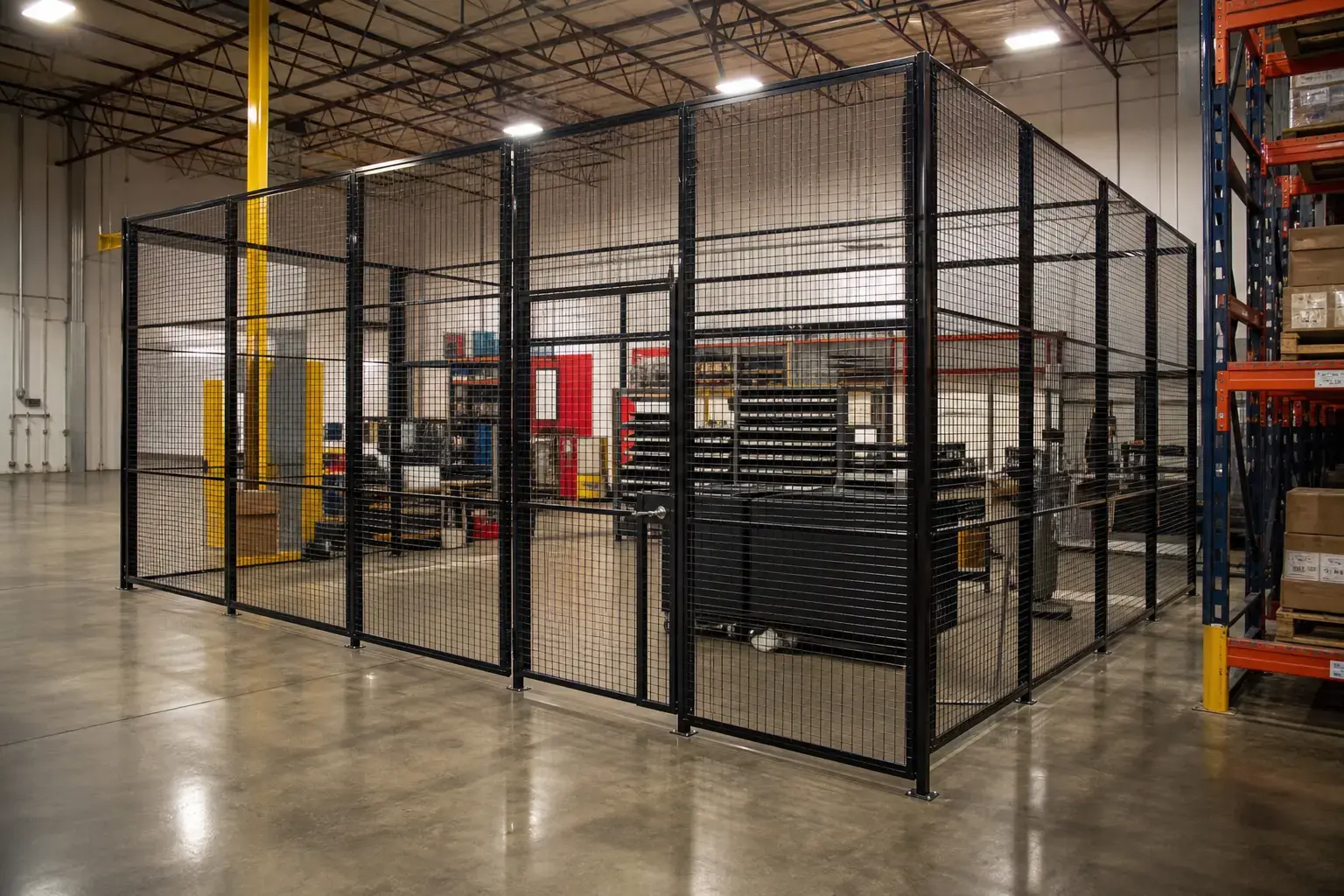
SurGenTec is a privately held medical device company based in Boca Raton, Florida, developing and manufacturing spine and orthopedic products including bone graft delivery devices and synthetic graft materials. Material Handling USA supplied welded wire security cage product to SurGenTec in 2021.
This page sits under our security cage hub and describes a problem class — using wire mesh enclosures to create controlled storage zones in a device operation — rather than one company’s building. It contains no facility layout, no dimensions, no product or inventory values, and no security detail specific to this customer.
Device companies do not usually cage their warehouse because they expect theft. They cage it because their quality system requires that product in different states is not confused, and because auditors ask how that separation is enforced when the warehouse is busy. “We use different shelves” is a weaker answer than a locked boundary with a defined access list.
Why physical separation, not just a status field
Software states are invisible on a shelf. An inventory system can flag a lot as quarantined, but the carton looks exactly like the released one next to it. Under time pressure, the label is what gets read — if anyone reads it.
Returned product is the hardest category. Consignment sets, loaner trays and field returns come back with unknown handling history. Until they are inspected, they cannot be anywhere near sellable stock.
Expiry and lot control depend on discipline. Sterile-barrier packaged product has a shelf life. Stock rotation only works when nobody is picking from a pile that was never supposed to be pickable.
Audits look for enforcement. FDA’s Quality System Regulation in 21 CFR Part 820, now aligned with ISO 13485 under the Quality Management System Regulation, expects controls that prevent mix-ups and unauthorized use. Reviewers ask to see how the separation is actually enforced.
Small companies grow into the problem. A separation that worked with three people in the warehouse stops working at fifteen, and the failure shows up as a deviation rather than as a slow decline.

The zones a device warehouse usually needs
An enclosure is worth building only if the zones inside it are defined first. In a device operation the recurring list looks like this:
The design mistake that shows up most often is a single large enclosure with every category inside it. One boundary around six states is only marginally better than none; the useful version is a main controlled area with a smaller, separately locked quarantine and returns enclosure inside or beside it.
Making the enclosure support the quality system
The enclosure is not a compliance control by itself. It is the physical half of a control whose other half is written down. What auditors ask about, and what should be decided before ordering panels:
- Who is authorized to enter each zone, and where that list lives.
- How disposition is recorded when product moves from quarantine to released, or from returns to nonconforming.
- How labeling and signage inside the enclosure match the states in the inventory system, so a carton’s location and its record agree.
- How the boundary is verified — a periodic check that the door is locked, the access list is current and the contents match the record.
- What happens during a recall or field action, when a defined hold area has to absorb returning product quickly.
A cage that is not written into a procedure will be propped open within a month. A cage that is written into a procedure and audited quarterly changes how the warehouse behaves.
Specifying the enclosure
Device warehouses are cleaner and quieter than a plant floor, and the specification reflects that: the enclosure is chosen for cleanability, visibility and clear separation rather than for impact resistance alone.
| Decision | Typical answer in a device operation | Why |
|---|---|---|
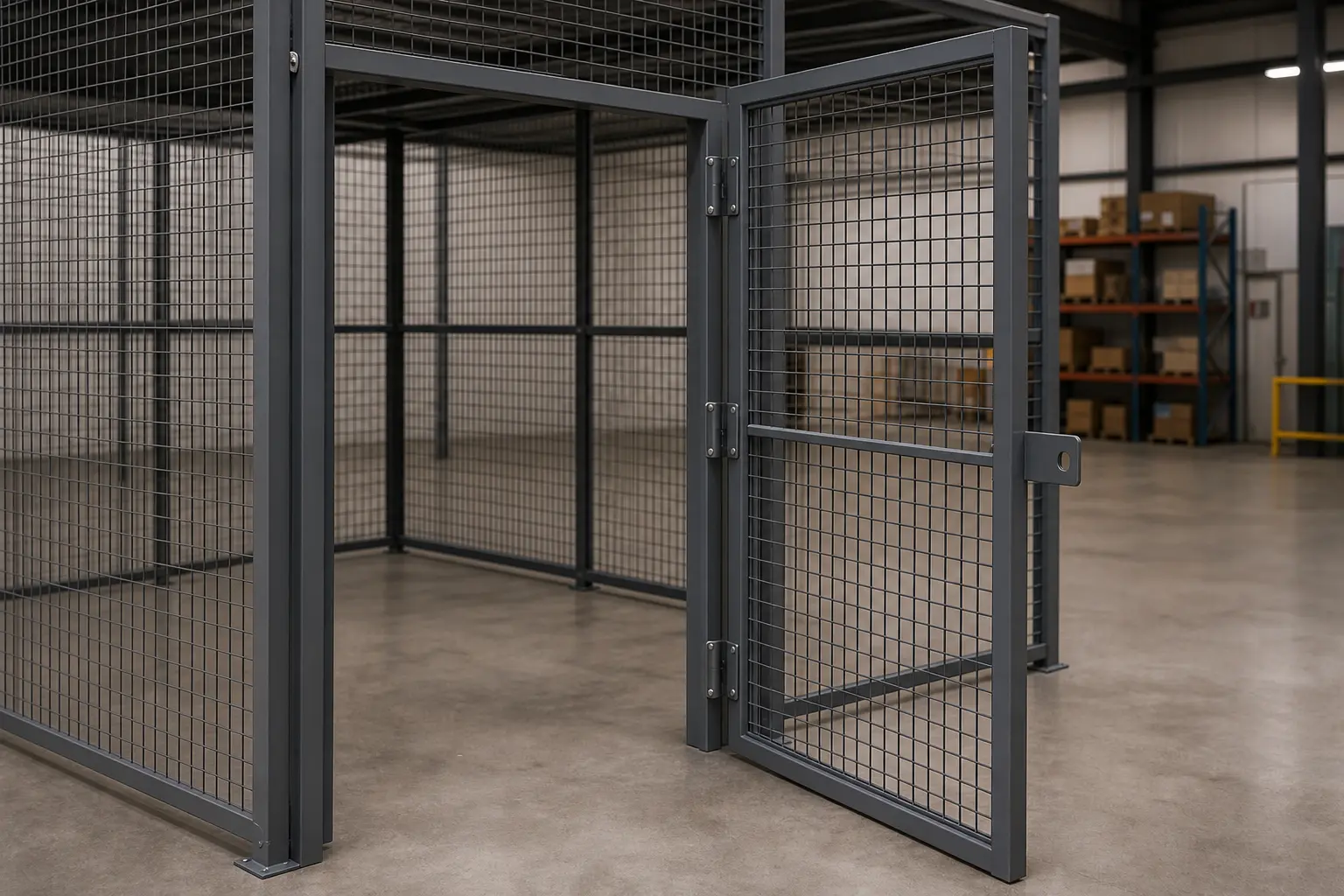
| Panel system | Bolted welded wire mesh panels in a steel frame | Modular, reconfigurable as the operation grows, and installed without construction |
| Mesh opening | Smaller openings around small cartons and kits | Reach-through is the realistic risk; small sterile-barrier cartons pass through large mesh |
| Height and top | Full height, or a mesh top where racking is adjacent | An open-topped enclosure beside racking is not a boundary |
| Sub-enclosures | A separately locked quarantine or returns cage | One boundary around every product state does not create separation |
| Doors | Personnel door plus a wider door where pallets enter | A single narrow door guarantees the enclosure gets propped open on receiving days |
| Finish and cleanability | Powder-coated steel, smooth frames, floor clearance that allows cleaning | Housekeeping is part of a controlled storage area, and inspectors notice |
Mesh and gauge choices are compared on our wire mesh panel options page. For enclosing rack bays rather than partitioning floor area, see pallet rack security enclosures, and for tightly controlled pharmaceutical storage requirements, our DEA drug storage cage page covers a stricter class of enclosure.
Access control and the record it produces
The access decision is a quality decision. Hardware only implements it, and the useful hardware is whatever produces a record the company will actually review.
Keyed locks are simple and adequate when the authorized list is genuinely short and keys are controlled. They produce no record.
Keypads avoid shared keys but only help if codes change when people change roles or leave.
Badge readers tied to the building system give a per-person record of who entered a controlled area and when — which is the answer auditors are usually looking for. Wire enclosure doors accept the same hardware as any other door; options are covered on our security cage doors page.
Whatever is chosen, egress comes first: anyone inside must be able to get out without a key, and the enclosure must never restrict a required exit route.

Building and code constraints
An enclosure inside a leased warehouse or manufacturing suite interacts with the building’s systems. These are settled at survey, before panels are ordered:
- Sprinkler coverage. A mesh top or added shelving changes how water reaches storage below. NFPA 13 and the building’s fire protection design govern, and OSHA has addressed the familiar 18-inch clearance to sprinkler deflectors in its interpretation of 29 CFR 1910.159(c)(10). The site’s fire protection contractor makes the determination.
- Egress and exit access. The enclosure cannot block a required exit, a door swing or the path to one.
- Fire equipment and electrical clearance. Extinguishers, alarm panels, disconnects and eyewash stations all have required clear access.
- Air distribution. In a temperature- or humidity-controlled room, panels should not sit where they block a supply or return path.
- Lease terms. Most device companies lease. A bolted enclosure is equipment rather than construction, but any restriction on anchoring into the slab needs to be known before the layout is finalized.
Industry-by-industry compliance considerations are summarized on our security cage regulations and compliance page.
Installation, handover and what happens next
The build itself is short. The decisions around it are what make the enclosure hold up under an audit two years later.
Our installation page describes the sequence in more detail, and the maintenance and inspection guide covers what to check on the enclosure itself over time.
Shop Pre-Configured Wire Mesh Cage Kits Online
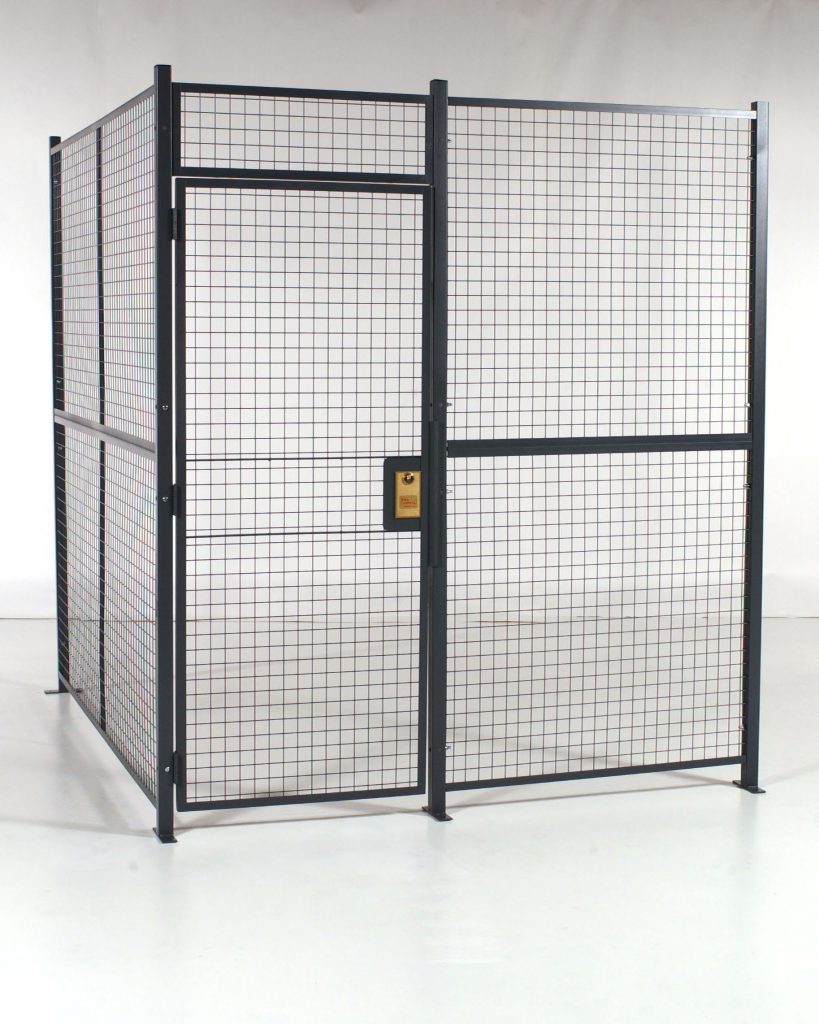
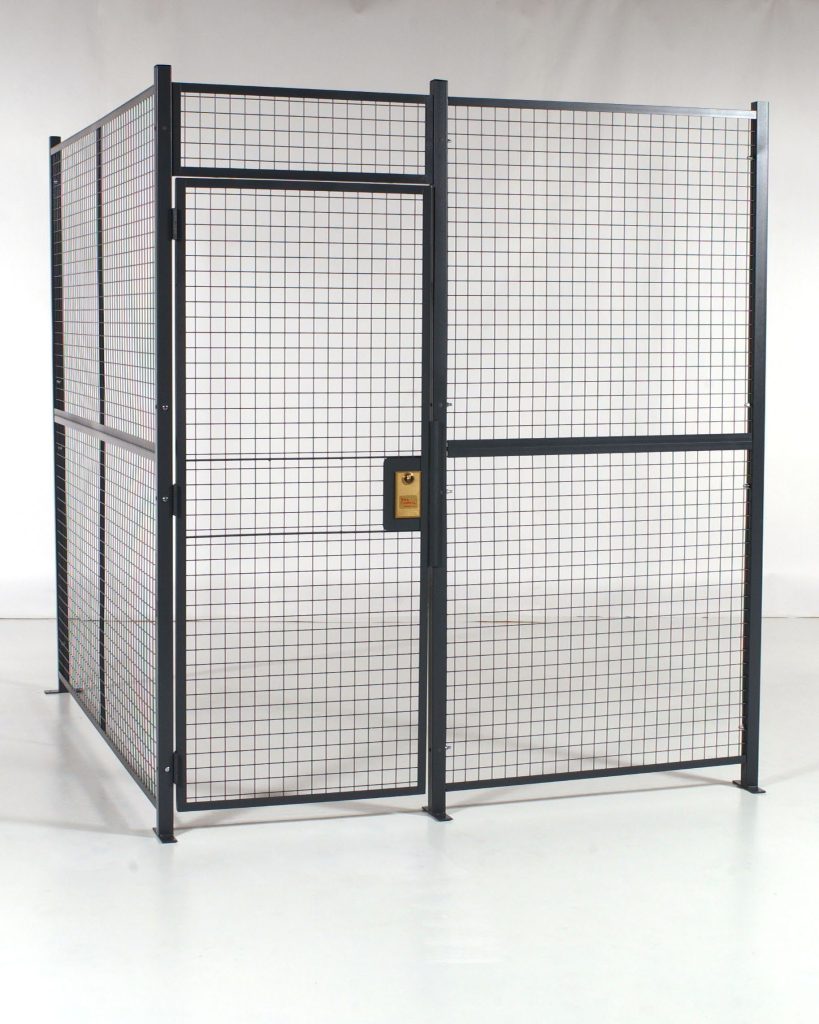
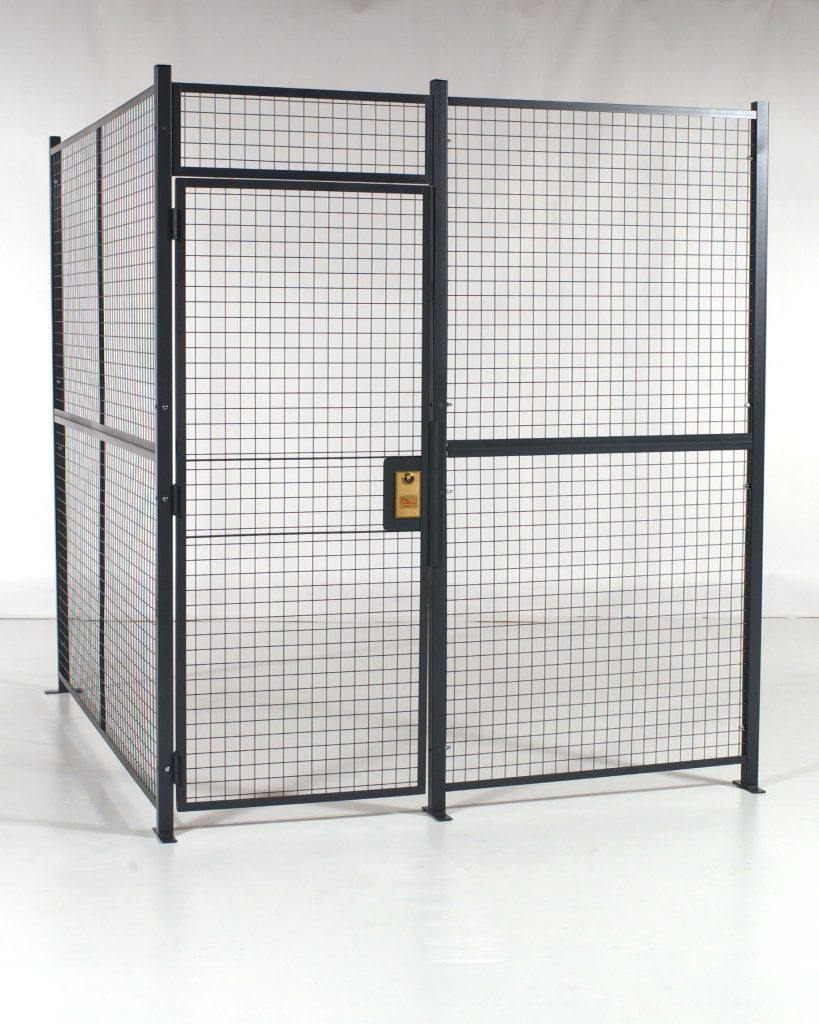
Standard-size welded wire cage kits, priced online, for smaller storage needs. Every kit still needs to be anchored to sound concrete — for tall, braced or engineered enclosures, request a quote with your building location and floor details.
Frequently asked questions
Why would a medical device company need a security cage?
Does a wire mesh cage satisfy FDA requirements?
Should quarantine be inside the main cage or separate?
Can wire mesh be used in a temperature-controlled room?
What access hardware gives the best audit trail?
How does a cage affect sprinklers?
Can the enclosure be installed in a leased building?
Can it be expanded as the product line grows?
Looking for a project like yours? Browse more pharmaceutical, medical and laboratory security cage case studies, see all security cage case studies.
Separation you can show an auditor
Material Handling USA designs, supplies and installs welded wire security cages, quarantine enclosures and rack enclosures for medical device, life science and regulated operations nationwide.