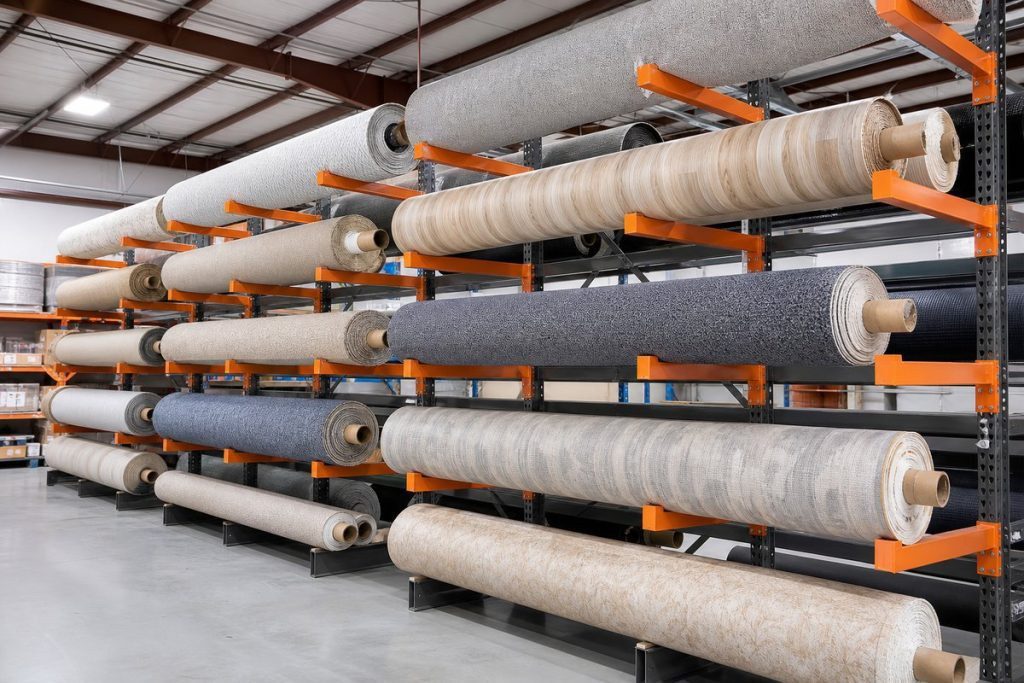
Carpet storage racks are heavy duty industrial racks built for long, dense rolls, not general purpose shelving. The right system comes down to four things: roll length and weight, storage height, fire protection, and how the forklift reaches the roll. Most projects settle into one of three formats, a horizontal carpet roll rack, a cantilever layout, or a vertical storage unit that brings the roll to the operator.
This guide walks through how each format behaves, what to measure before you ask for pricing, and where fire code quietly reshapes the layout.
What a Carpet Storage Rack Is

A carpet storage rack gives rolled flooring a stable place to sit without crushing edges, blocking aisles, or turning open floor into storage. The parts list looks familiar to anyone who has bought pallet rack: uprights, load beams, row spacers, decking and floor anchors. What changes is the geometry.
A carpet rack is deep instead of wide. A common way to build a 12 ft deep bay is to set two uprights back to back and tie them together with a row spacer, so the beams run front to back and carry the roll along its length. Each level usually gets four load beams so the roll is supported at several points instead of sagging between two. Decking can be corrugated metal, wood, punch deck or wire deck, and the choice is worth checking with the local fire marshal before you order, because decking affects how water reaches a fire inside the rack.
Roll width is one reason carpet rack dimensions look similar across the industry. Broadloom carpet is made in a few standard widths, most commonly 12 ft, with 13 ft 6 in and 15 ft also in use. Roll length and weight still vary by product, so both have to be measured on site.
Handling is the other difference. Carpet rolls are not picked with forks. The forklift carries a carpet pole, also called a ram, that slides through the hollow core tube at the center of the roll. That single detail drives aisle width, rack depth and how much clear space the operator needs in front of the bay. A 12 ft roll on a 12 ft pole needs room to swing.
Rolled flooring is also easy to damage. A roll that sits unsupported can flatten on one side, crease, or pick up scuffs that show up when the installer opens it on a job site. Outside the warehouse, the same sensitivity shows up in how finished floors are protected during a move or a remodel, which is why a drugget carpet protection guide spends so much time on surface contact. In storage, support along the length is the equivalent of that protection.
Practical rule: if the roll is long, heavy, or handled often, treat carpet storage as a handling and protection problem first, and a space problem second.
Carpet Racking Systems: The Parts of a Complete Setup
People shop for “carpet racking systems” and “carpet storage racking” expecting a single product, but a working system is really a set of parts chosen to match your roll mix. Knowing the pieces makes it easier to compare quotes and spot where one is thin.
- Uprights (frames). The vertical towers that carry the load down to the floor. Height and capacity are set by your storage height and the heaviest roll.
- Load beams. Horizontal members that carry each level. Carpet levels often use four beams front to back so a long roll is supported at several points instead of two.
- Row spacers. Ties that hold two uprights together in a back to back row and set the flue space the fire design needs.
- Decking. Corrugated metal, wood, punch deck or wire deck laid across the beams so the roll sits flat. Deck type also affects how water reaches a fire, so confirm it with the fire marshal.
- Floor anchors. Hardware that fixes the frame to the slab and carries seismic load where the code requires it.
- Roll supports or cradles. Optional saddles that keep round rolls from rolling or flattening on a flat deck.
Because the parts overlap with standard racking, many carpet roll racking systems are built on a heavy duty pallet rack platform sized for depth. You can lay out that platform yourself in the pallet rack configurator, or start from an open faced cantilever rack configurator layout if your rolls are long or mixed.
Carpet Roll Rack vs Cantilever vs Vertical Storage
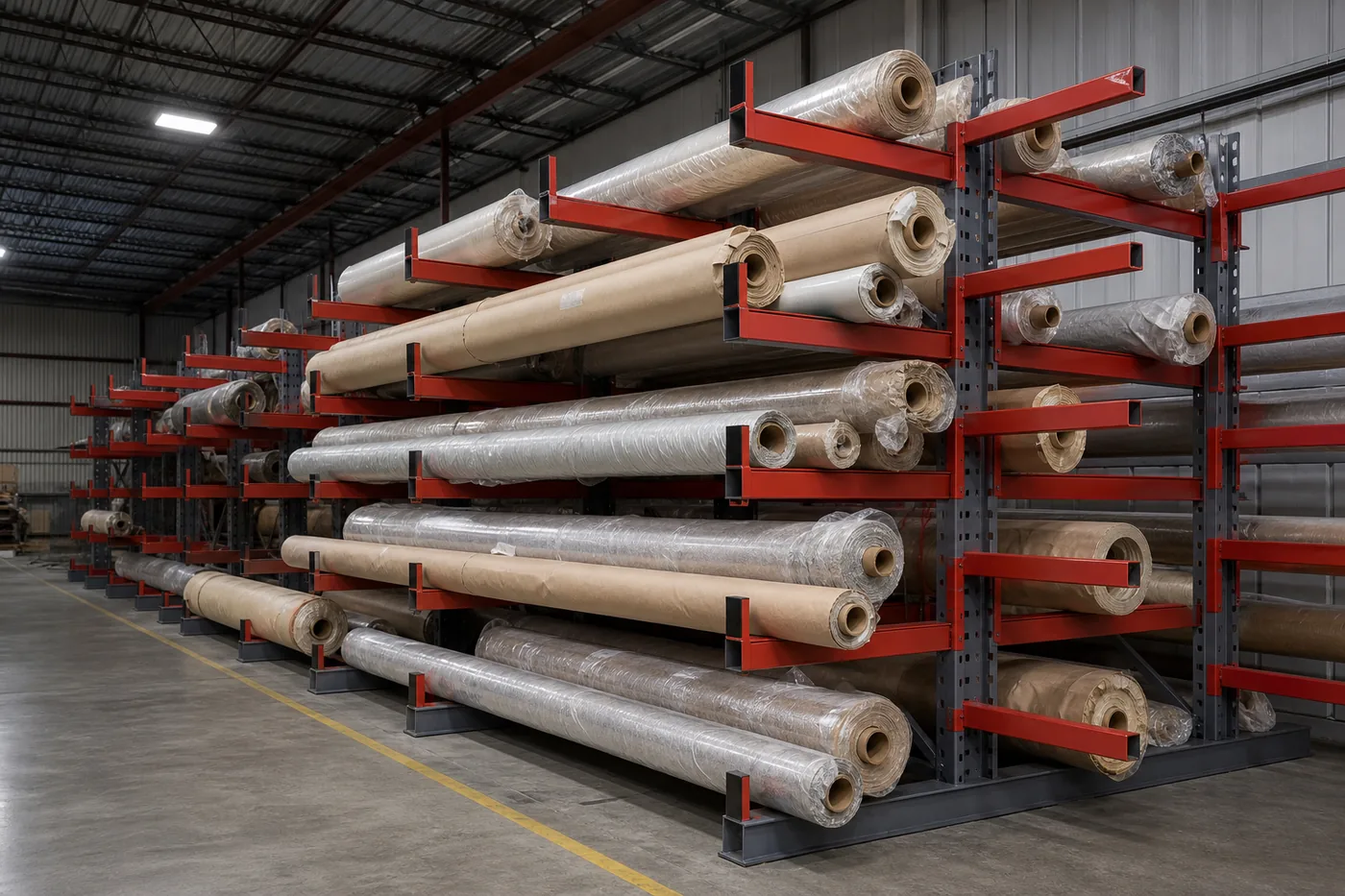
A cantilever rack uses arms that project from a column, so the front of the bay stays open. A carpet roll rack behaves more like a very deep shelf with decking. A vertical storage unit holds rolls upright or in horizontal cradles inside a cabinet and rotates the one you want down to the operator. Those three shapes solve different problems, and the wrong one shows up fast in handling time, aisle conflicts and sprinkler layout.
Cantilever suits mixed lengths, odd diameters and side loading from a forklift or a delivery truck. Carpet roll racks suit uniform inventory and dense horizontal storage. Vertical units suit operations where retrieval frequency, ergonomics and floor space matter more than raw capacity.
The trade is not only footprint. Cantilever gives open access but tends to need wider bays and leaves product more exposed. Roll racks pack stock tightly, yet they ask for cleaner roll sizes and more discipline at putaway. Vertical systems save floor space, then trade that back in slower replenishment and more moving parts to maintain.
| Storage format | Best roll mix | How it is loaded | Where it struggles |
|---|---|---|---|
| Carpet roll rack | Uniform rolls, high volume, dense stock | Forklift with a carpet pole, straight into the depth of the bay | Odd lengths and very large diameters |
| Cantilever rack | Long, mixed or irregular rolls | Side loading from the aisle with a pole or forks | Floor space, since open bays are less dense |
| Vertical storage unit | Narrow roll range, frequent picks, tight rooms | Rolls delivered to an operator at waist height | Broad, mixed inventory and heavy throughput |
One question sorts most projects. How often does a roll get touched, and by what equipment. That answer usually points at the format before anyone draws a rack line. If cantilever looks like the fit, the cantilever rack section and the cantilever pallet racking page cover arm length, bay depth and aisle access, and the cantilever rack vs pallet rack comparison is a useful next read.
Cantilever Racking for Carpet Rolls: When It Wins
Cantilever racking for carpet rolls earns its keep whenever the inventory will not sit still long enough for a fixed-depth roll rack to make sense. Because the arms leave the front of the bay open, an operator can side load a 15 ft roll next to a 9 ft roll on the same level without forcing either one into a slot it does not fit. That flexibility is the whole case for cantilever over a deep roll rack: it trades some density for the ability to handle whatever roll shows up next, which matters most for distributors who carry mixed remnants, area rugs, vinyl plank cores and specialty rolls alongside standard broadloom.
Carpet roll storage racks, by contrast, are the better call once the roll mix settles down. A distributor running mostly one or two standard roll lengths gets more pallet positions per square foot from a deep roll rack than from cantilever arms, because the roll rack does not need the open face that cantilever relies on for side loading. The trade is flexibility for density. If a new product line or a seasonal buy changes the roll mix, plan for it before the layout is finalized rather than retrofitting arms onto a roll rack bay later.
Best Carpet Storage Racks for a Flooring Warehouse
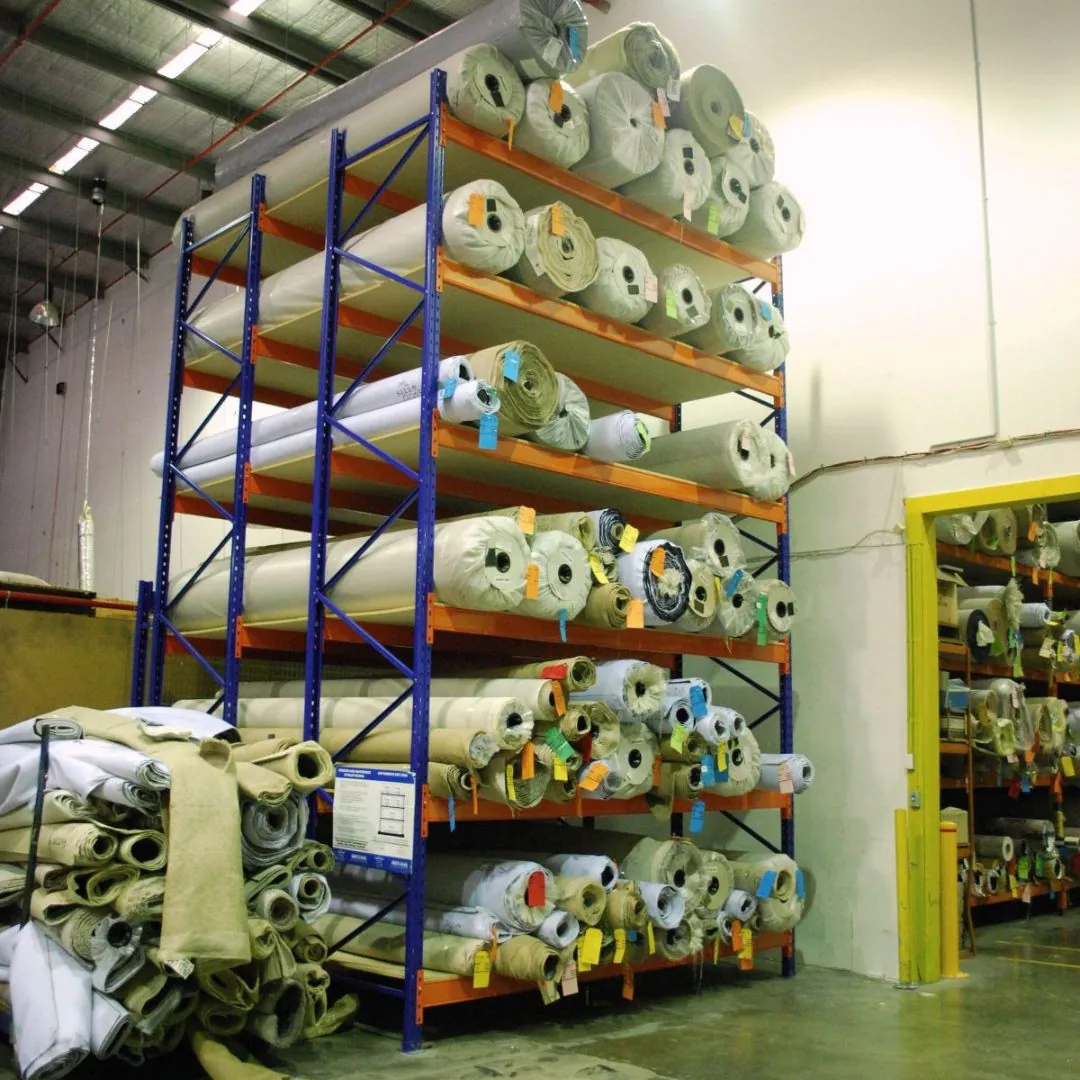
For a flooring warehouse or distributor, the best carpet storage rack is usually a horizontal carpet roll rack built on a heavy duty frame, because it packs uniform rolls densely and lets a forklift with a carpet pole reach every roll from the aisle. The right pick still depends on your inventory and your building, so match the format to how you actually operate.
- High volume, uniform broadloom. A horizontal carpet roll rack gives the most dense storage and the fastest forklift picks.
- Long, mixed or irregular rolls. A cantilever layout keeps the bay face open so the operator can side load odd lengths without fighting the depth.
- Showrooms, cut rooms and tight backrooms. A vertical storage unit brings the roll to the operator and saves floor space when the roll range is narrow.
Most flooring warehouses end up with a mix: deep roll racks for the fast moving broadloom, a run of cantilever pallet racking for the long or odd rolls, and sometimes a vertical unit near the cut station. Size each area to the rolls it holds rather than forcing one format across the whole building.
Sizing Carpet Storage Racks the Right Way

Start with the floor plan, not the brochure. Carpet rack layouts tend to land in a few familiar ranges. Single rack rows are often 12 to 15 ft deep to match 12 ft rolls, back to back rows land near 24 to 30 ft, storage height is usually planned somewhere between 12 and 24 ft, and tier spacing often runs around 3 ft so a large diameter roll clears the level above it. Treat those as starting points to check against your own roll mix, not as specifications.
Depth changes everything downstream. As rows get deeper, mast reach and aisle discipline matter more, and the operator needs more room to line up the pole. As rows get taller, the fire protection designer has to account for ceiling height and what happens above the top level. Tier spacing matters because a roll has to sit flat without binding on the deck or hanging up on the way out.
| Dimension | Common field range | What it controls |
|---|---|---|
| Single row depth | 12 to 15 ft | Roll length that fits, and how far the forklift has to reach |
| Back to back row depth | 24 to 30 ft | Density, flue space and row spacing |
| Storage height | Commonly 12 to 24 ft | Fire protection design and the handling envelope |
| Tier spacing | Around 3 ft | Roll diameter that fits per level |
| Beams per level | Often four | Support along the roll so it does not sag |
Field check: if a quote asks only for bay width and never asks about roll diameter or roll weight, the layout is incomplete.
Keep the sizing conversation tied to the real roll mix and the real building. Our carpet roll storage guide covers the storage side in more depth. The final answer still comes from measuring the floor, checking the reach of the equipment you own, and confirming the rack can be built, picked and inspected without rework.
Measurements to Take Before You Request a Quote
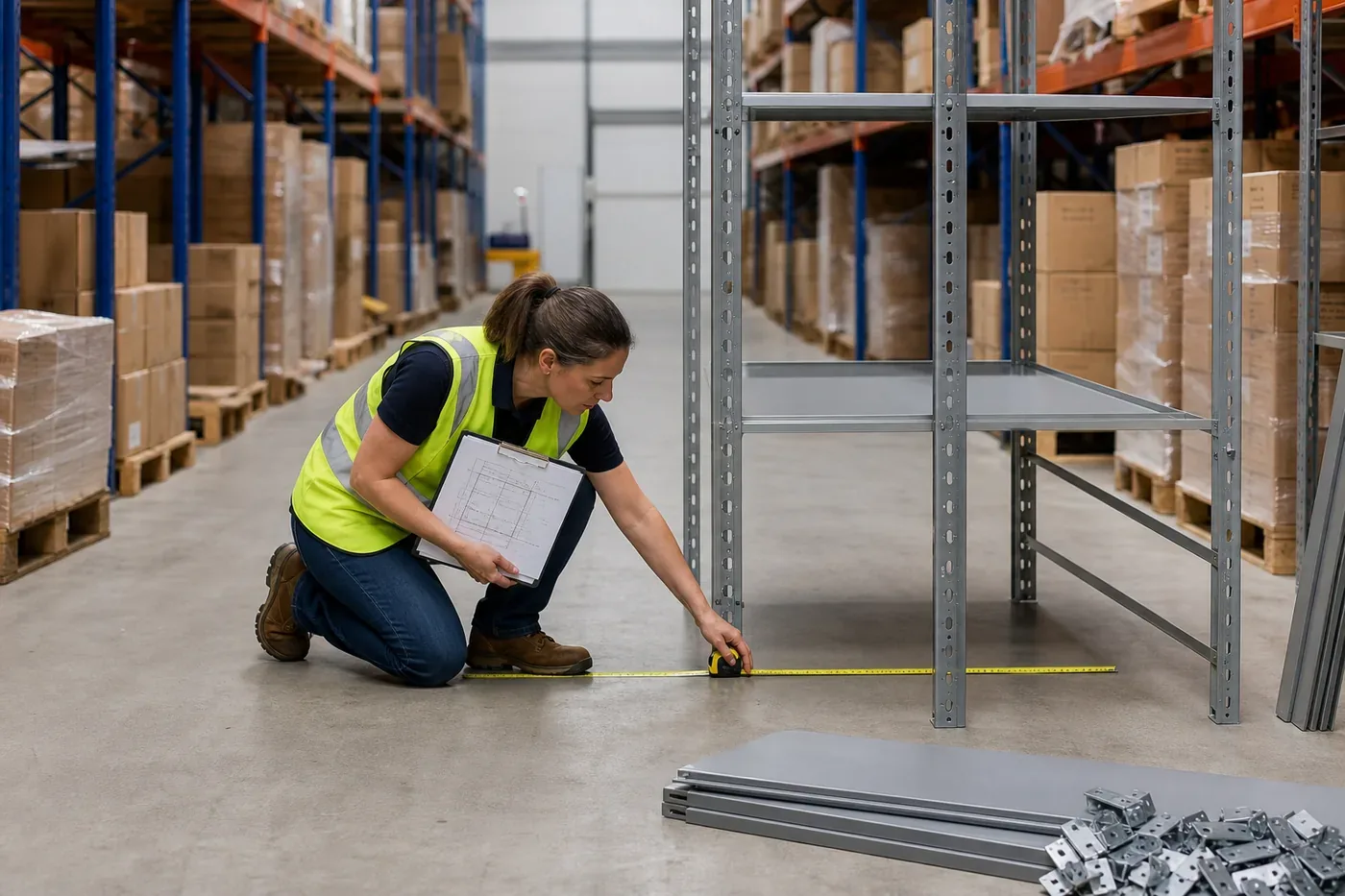
A good rack quote starts with floor facts, not assumptions. Measure the building and the rolls before anyone prices a system. It keeps the proposal tied to a layout that can actually be installed.
- Measure the longest roll. Use the longest roll in the mix, not the average. Roll length sets rack depth and how the beams or arms have to be spaced.
- Weigh the heaviest roll. Design around the worst case roll. Roll weight sets beam capacity, upright capacity and how many levels the frame can carry.
- Measure clear ceiling height. Measure from the finished floor to the lowest obstruction, which is often a sprinkler line, a duct or a light. That number caps usable storage height.
- Measure the aisle you have. Measure the lane the forklift uses today, not the one on the drawing. Remember the carpet pole adds length in front of the truck.
- Check door and dock clearances. Walk the path every rack component and every roll has to travel. A tight door turns into a stalled install.
- Map columns and obstacles. Note building columns, floor curbs, drains, sprinkler drops, lights and mezzanine legs. These set bay spacing and where rows can start and stop.
- Collect the code notes. If the project involves seismic review or a fire protection constraint from the authority having jurisdiction, gather that early. A designer can work around a constraint only when it is known before the drawings are stamped.
With those seven numbers in hand, a designer can lay out rows, pick a frame, and tell you where the fire protection conversation is going to start.
Have your measurements ready? Lay the system out yourself in the cantilever rack configurator or the pallet rack configurator, then send the configuration to our team for pricing. Prefer to talk it through? Call (800) 326-4403.
Fire Protection and Code Triggers to Plan For
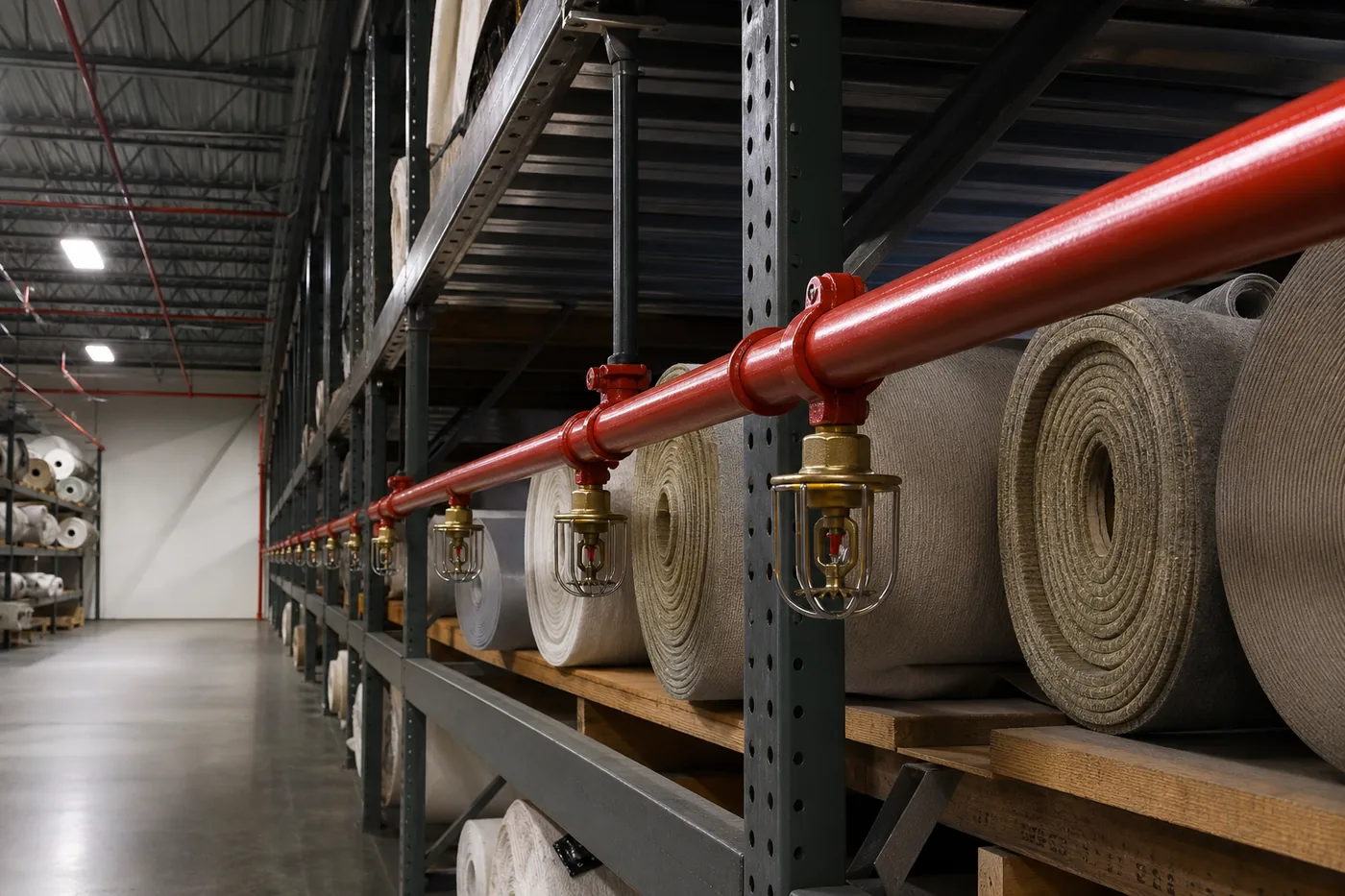
Rolled carpet carries a heavy fuel load, and the storage arrangement changes the fire conversation quickly. FM Global publishes Data Sheet 8-30, Storage of Carpets, which covers carpets made from wool, cotton, man made fibers and synthetic blends. Facilities insured to FM guidance use it as the reference for how carpet racks are arranged and protected. Buildings under other insurers or under NFPA 13 follow a different path, so confirm which rule set applies before you finalize a layout.
A few points from that data sheet shape the steel, not just the sprinkler drawing.
- Flue space is part of the design. The guidance calls for a transverse flue space of about 2 to 4 in at the vertical supports, and roughly 1 ft of space between the vertical members of back to back rows.
- Keep product off the floor. The lowest level of carpet storage should sit at least 4 in above the floor to limit water damage.
- Clearance below sprinklers matters. The guidance asks for a minimum of 36 in below sprinkler deflectors, which quietly caps the top of your rack.
- Twelve feet is a break point. For storage 12 ft and lower on standard carpet racks without in rack sprinklers, the data sheet asks for at least 8 ft of clear space roughly every 100 ft along the length of the rack to slow fire spread. Go higher and in rack sprinklers enter the design.
- Sprinkler selection is specified. New ceiling installations use sprinklers with a 286 degree F temperature rating, wet pipe or preaction systems are preferred with dry pipe accepted, and in rack sprinklers are FM Approved quick response heads with a nominal 160 degree F rating positioned at the bottom of the rack horizontal support.
- Not everything is a rack question. Carpet rolls stored on the floor and smaller carpet pieces are protected as a Class 4 commodity under Data Sheet 8-9, and foam or rubber carpet pads follow the expanded plastic guidance in the same data sheet.
Ceiling sprinkler density and design area come from a table in the data sheet that varies with storage height and rack type, so have the fire protection engineer pull the current edition rather than reusing a number from an old submittal. The practical takeaway is simple: rack depth, height and face access all shape where heads can go, and a late change to the rack usually means a change to the sprinkler design.
For broader context before layouts are locked, the warehouse fire safety page is worth a read. It helps line up facility decisions with insurance and inspection expectations before steel shows up on the dock.
A rack quote that ignores sprinkler coordination is only half a quote.
Documentation matters on the insurance side too, especially if a project follows a loss or a remodel. For a plain language overview of how commercial claims work, this article on property insurance claim disputes is a reasonable primer. For operations teams the lesson is the same, review rack layout and fire protection together.
How Carpet Racks Compare to Pallet Rack and Vertical Carousels

Standard pallet rack is familiar and often looks cheaper on the first pass, but long rolls sit awkwardly on it unless you add roll supports, cradles or full decking. Without that support the roll bridges between two beams and slowly deforms. Pallet rack also assumes fork access, and carpet needs pole access.
Vertical carousels move in the other direction. They cut lifting, shrink the footprint and put the roll in front of the operator (see how a vertical carpet carousel works), which helps in showrooms, cut and roll rooms, and tight backrooms. They pencil out when the roll range is narrow and the pick pattern is steady, not when a distributor is turning hundreds of mixed rolls a week.
| System | Storage density | Roll access | Labor profile | Best use case |
|---|---|---|---|---|
| Carpet roll rack | High for rolled goods | Good, every roll reachable from the aisle | Forklift driven | Distributors and mills with mixed flooring inventory |
| Standard pallet rack | Lower for rolls | Limited without roll supports or decking | Forklift driven | Boxed goods, pallets, cut pieces and samples |
| Vertical carousel | Compact footprint | Very good for the rolls loaded in the unit | Less manual lifting, more maintenance | Showrooms and cut rooms with a narrow roll range |
If your operation stores long rolled materials beyond carpet, our vertical carousels page shows the retrieval style that keeps showing up in tight rooms, and the Vidir vertical storage solutions pages cover roll handling in more detail. It can cut forklift travel and hand strain, but it stays a better fit for selected roll groups than for broad, mixed carpet stock.
For most warehouses the split is simple. Use carpet racks when you need density without losing access to individual rolls. Use vertical storage when the product set is narrow and the handling risk is high enough to justify the machine. Use standard pallet rack only when the product is already being handled like palletized goods.
Common Mistakes Buyers Make With Carpet Storage Racks
The costliest mistake is buying a rack that fits the floor plan but misses the roll envelope or the sprinkler layout. Teams lock in a sketch before they know the heaviest roll, the clear height or the aisle they really have. The drawing looks fine, then the install crew is changing bay spacing in the field.
Under specifying the structure is the other common failure. Uprights, beams, decking, finish and hardware all have to match the load profile. With a mixed roll inventory, design for the worst case roll rather than the average one.
A few site issues show up again and again.
- Ignoring roll overhang. A roll can fit the level by diameter and still stick into the aisle at the ends. Measure the full envelope, including the core tube.
- Choosing depth that fights the forklift. Deep rows look efficient, then leave no room to line up the pole. Match depth to the truck and the pole you own.
- Mixing roll diameters on one level with no plan. That creates uneven loading and awkward picks. Group similar diameters by level or bay when inventory allows it.
- Skipping seismic bracing. In many jurisdictions this changes the rack package, the anchor plan and the permit path.
- Picking decking without asking the fire marshal. Deck type affects how water reaches a fire inside the rack, and it is much cheaper to ask before the order than after.
- Treating sprinklers as someone else’s problem. Fire protection and steel layout are linked. If one moves, the other usually moves too.
Cost is usually driven by total steel tonnage, upright and beam capacity, deck type, finish, seismic design category and how much sprinkler coordination the project needs. Schedule is driven by engineering, permitting, hardware availability and whether stamped drawings are required before fabrication. A measured, stamped layout sent early installs cleaner than a rushed purchase order built from a rough sketch, and that matters most in an active building where downtime is expensive.
Two projects that show what a measured layout looks like in practice: Ogden’s Flooring and Design in Roy, Utah and a flooring rack installation in Calimesa, California.
Storing Carpet Pad and Underlayment
Carpet pad and underlayment do not behave like broadloom, so carpet pad racking is its own question. Pad rolls are lighter but bulkier, they compress, and foam or rubber pad carries a different fire profile than carpet. A few points keep pad storage clean:
- Do not crush it. Pad flattens under its own weight faster than carpet, so avoid stacking heavy rolls on soft pad and give each roll its own support.
- Keep it off the floor. The same rule that protects carpet from water damage applies to pad, so store the lowest level above the slab.
- Check the fire class. Foam or rubber carpet pads are treated as an expanded plastic under FM Global Data Sheet 8-9, not as carpet, so the protection can differ from the rack next to it. Confirm the rule set with your fire protection engineer.
- Use the same racking family. Pad rolls store well on the same deep roll racks or cantilever arms as carpet, sized for the lighter but bulkier rolls.
Carpet Storage Rack FAQ
How tall can carpet racks be?
Common carpet rack layouts run between 12 and 24 ft, but the real limit is your building. Clear height, the reach of your forklift, the clearance required below sprinkler deflectors and the fire protection design all cap the top level.
What roll length can a cantilever rack handle?
It depends on arm length, column capacity and the roll envelope. Long or mixed length rolls are usually a better fit for cantilever than for a shelf style system, because the open face lets the operator load from the side.
Should carpet be stored vertically or horizontally?
Most warehouse volume is stored horizontally on carpet racks because it is denser and faster with a forklift. Vertical storage units make more sense when picks are frequent, the roll range is narrow and floor space is tight.
Do carpet racks need sprinklers?
Sprinkler protection is set by the code and insurance rules that apply to your building, not by the rack alone. FM Global Data Sheet 8-30 treats 12 ft as a break point for standard carpet racks, and taller storage brings in rack sprinklers into the design. Have a fire protection engineer confirm the current requirements for your site.
What should I measure before getting a quote?
Longest roll length, heaviest roll weight, clear ceiling height, existing aisle width, door and dock clearances, and the location of columns and other obstacles. Those six numbers let a designer produce a layout that can actually be installed.
Is pallet rack the same as a carpet rack?
No. Pallet rack can carry rolls when it is built deep and decked for it, but a carpet rack is designed around roll length, pole access and support along the full length of the roll.
How are carpet rolls loaded into the rack?
With a carpet pole, sometimes called a ram, mounted on the forklift. The pole slides through the hollow core tube at the center of the roll, so the operator needs clear space in front of the bay for both the roll and the pole.
What causes lead time delays?
Stamped engineering, seismic review, finish selection, hardware availability and fire protection coordination are the usual causes. Ask for the schedule drivers in writing when you review a quote.
Are carpet racking systems different from standard pallet racking?
They share the same core parts, but a carpet racking system is sized for depth and roll support rather than pallet width. Many are built on a heavy duty pallet rack platform with extra beams per level, row spacers for flue space, and decking or cradles that keep long rolls from sagging.
Can you store carpet pad on the same racks as carpet?
Usually yes. Carpet pad and underlayment store well on the same deep roll racks or cantilever arms, sized for the lighter but bulkier rolls. The main difference is fire protection, because foam and rubber pad is treated as an expanded plastic rather than as carpet, so confirm the rule set for your site.
Next Steps for Your Carpet Storage Project
If you are sorting through carpet storage racks for a warehouse, showroom or plant, work in this order: measure the building and the rolls, choose the storage format, size the steel, then align the sprinkler and code review. That sequence prevents most of the rework that shows up on the floor.
Material Handling USA designs and supplies rack systems, storage layouts and warehouse solutions that fit real buildings. Configure your system in one of our free online design tools, request a quote, or call (800) 326-4403 to review your measurements with a project specialist.
Design it yourself, then get a quote
Use our free online design tools to configure exactly what this article describes, then send the configuration to our team for pricing: