
Home › Food Service › Stadium, Arena & Concessions
Stadium, Arena & Concessions Equipment
Concession stand build-outs, portable bars and carts, commissary transport and hot holding — specified for a venue’s peak minutes, its off-season install window and its concessionaire agreement.
8-12 min
Typical intermission rush
60-70%
Of sales in peak windows
Off-season
Standard install window
1997
MH-USA serving the West
Venue Foodservice Is a Peak-Minute Business

A stadium kitchen is idle for most of its life and then, for about thirty minutes spread across a night, it is one of the busiest foodservice operations in the state. Nothing about that shape resembles a restaurant. A restaurant smooths demand over hours; a ballpark concession stand takes the majority of its revenue in three short windows, with a hard ceiling on how many people can physically stand behind the counter and hand product across it.
That single fact should drive every equipment decision. Cooking capacity rarely limits a venue stand — holding capacity, pickup positions, restock paths and register count do. Equipment that cannot be cleaned in the ninety minutes after an event, or cannot be rolled out of a concourse when the venue converts to a concert floor, costs the operator far more over a season than the difference in purchase price ever saved.
MH-USA represents Eagle Group, a stainless steel foodservice manufacturer founded in 1947 in Clayton, Delaware with more than 17,000 standard models, plus SpecFAB custom fabrication for the counters, portable bars and hoods that never match a catalog dimension. Product-by-product detail lives in our commercial foodservice equipment cluster. This page is about how a venue operator or concessionaire should put the package together, and it sits under our food service material handling hub.
Design Around the Demand Curve, Not the Seat Count
Seat count tells you almost nothing on its own. A 18,000-seat arena hosting a hockey game, a country concert and a high school tournament produces three completely different demand curves out of the same building. Before anyone specifies a well count, put numbers on the curve: how many guests a stand serves, when they arrive, and how long they are willing to stand in line before they give up and go back to their seat.
| Event type | Demand shape | What the stand needs most | Common specification mistake |
|---|---|---|---|
| Baseball / long game | Long, moderately flat demand with a pre-game spike and slow innings | Deep hot holding, ice capacity, restock paths that work while selling continues | Under-specifying ice and beverage staging because the peak looks gentle |
| Hockey / basketball | Two or three violent intermission spikes of 8 to 12 minutes | Maximum pickup positions, pre-built product in holding, portable stands to split the queue | Adding wells instead of adding hands and pickup positions |
| Concert / one-off event | Enormous doors-open and set-break peaks, unknown menu mix | Portable bars, mobile carts, ice caddies, hands-free portable hand sinks | Relying only on fixed stands that cannot follow where the crowd stands |
| Family / matinee event | Slow steady sales, high grab-and-go and low alcohol mix | Grab-n-go carts, countertop warmers, fewer stands opened | Opening every stand and paying labor that the mix cannot cover |
| Premium club / suite service | Timed service windows tied to the game clock | Hot/cold mobile units, banquet carts, dedicated pantry and underbar | Treating suites as catering overflow instead of a scheduled service line |
Count pickup positions before you count wells
Most stalled concession stands are not short on food — they are short on places where a finished item can be handed to a guest. If you are adding capacity, price a second pickup counter and register position before you price a longer hot food table.
Concession Stand Build-Outs
A concession stand is a narrow room with a queue on one side, a restock door on the other, and no forgiveness for a layout that makes staff cross paths. The rule that fixes most stands: the guest-facing zone, the finishing zone and the restock zone should never overlap. Product comes in the back, moves forward through holding, and exits the front. Anything that forces a runner to walk through the pickup line costs you seconds on every transaction during the exact minutes that matter.
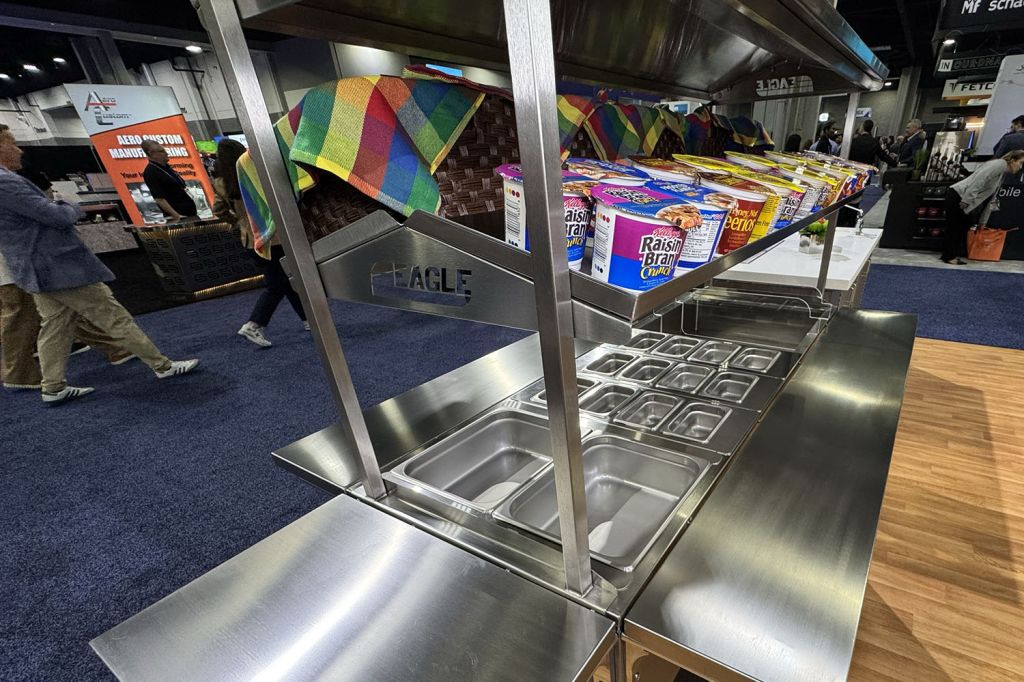
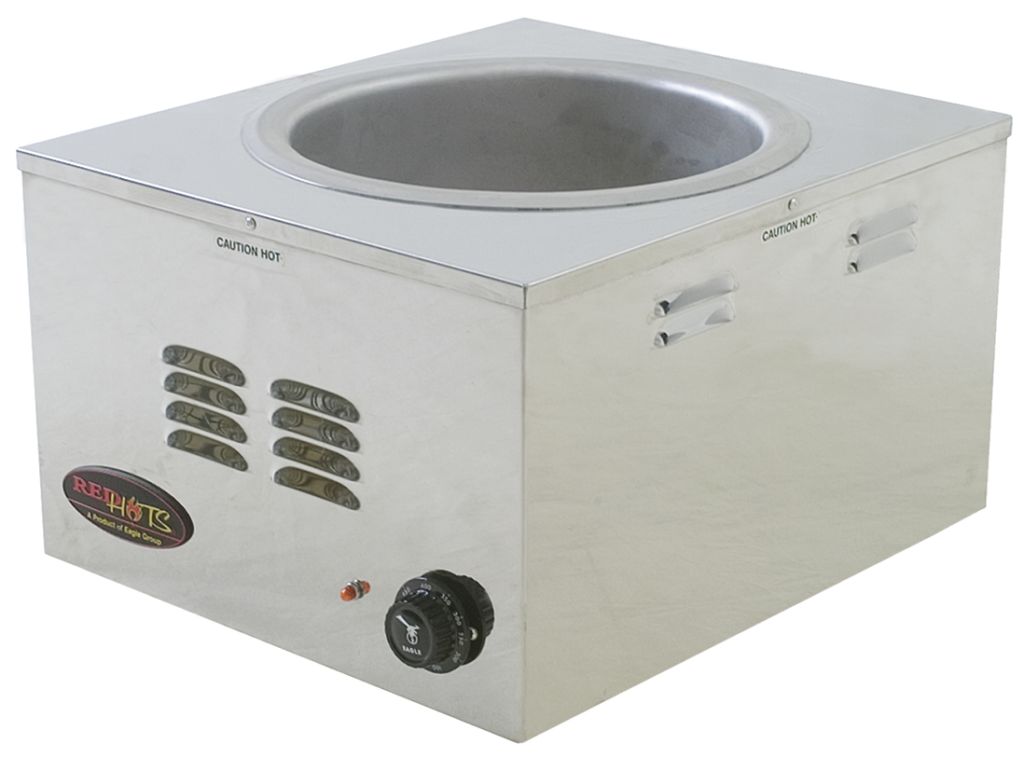
Work the stand front-to-back. At the front, pickup counter surface and overhead heat lamps with an aluminized reflector plate to focus heat and a toggle switch per element. Behind it, holding: sealed wells or countertop warmers with deep-drawn 304 heat wells, infinite control and wet or dry operation. Behind that, any cooking the stand actually needs — countertop fryers with removable 10-inch by 14-inch fry tanks, or a griddle with a 3/4-inch plate and controls set at a 45-degree angle. At the back, landing space, a hand sink, and a clear path to the restock door.
Two things get missed on nearly every stand drawing we review. First, landing surface: there is never enough stainless top for an arriving transport cabinet to be unloaded onto. Second, the hand sink location — placing it where it is convenient for the drawing rather than within reach of the person handling food means it stops being used by the second period.
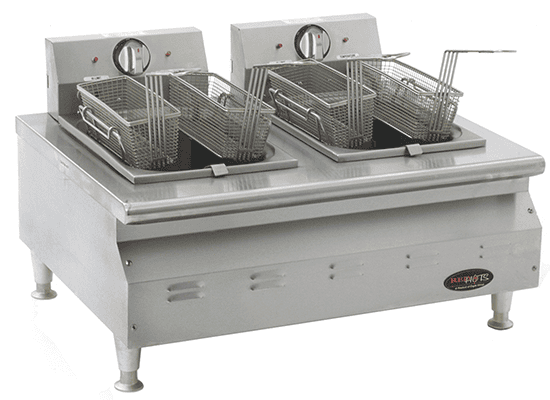 Countertop FryersRemovable deep-drawn fry tank, snap-action thermostat with indicator light and hi-limit safety with reset. Use where fries and fresh-fried items cannot survive a hold — and only where hood capacity exists.
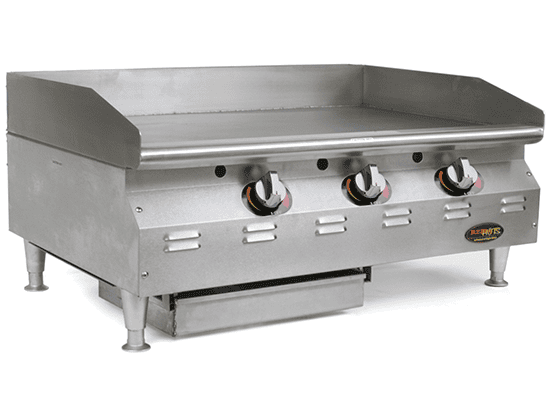 Countertop Griddles3/4-inch griddle plate fully welded to the top assembly, stainless grease drawer, controls angled 45 degrees for reach across a crowded counter.
 Heat Lamps at PickupExtruded aluminum housing with aluminized reflector, standard or high wattage, shatter-proof coated bulbs. Holds finished product at the handoff instead of overdriving the wells.
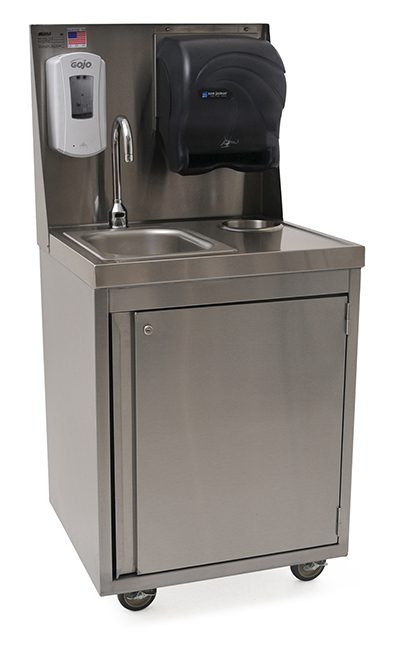 Portable Hand SinksTouch-free faucet, soap and towel dispensers with no additional plumbing required — the practical answer for temporary stands, festival plazas and portable bar positions.
Portable Bars, Carts and Mobile Selling Points
Fixed stands are placed for an average event. Real crowds do not distribute themselves like an average — they bunch at the entry the parking structure feeds, at the end of the concourse nearest the stage, at whatever gate the visiting team’s fans use. Portable equipment is how an operator moves capacity to where the people actually are, and for concert-heavy buildings it is often the highest-return line on the equipment schedule.

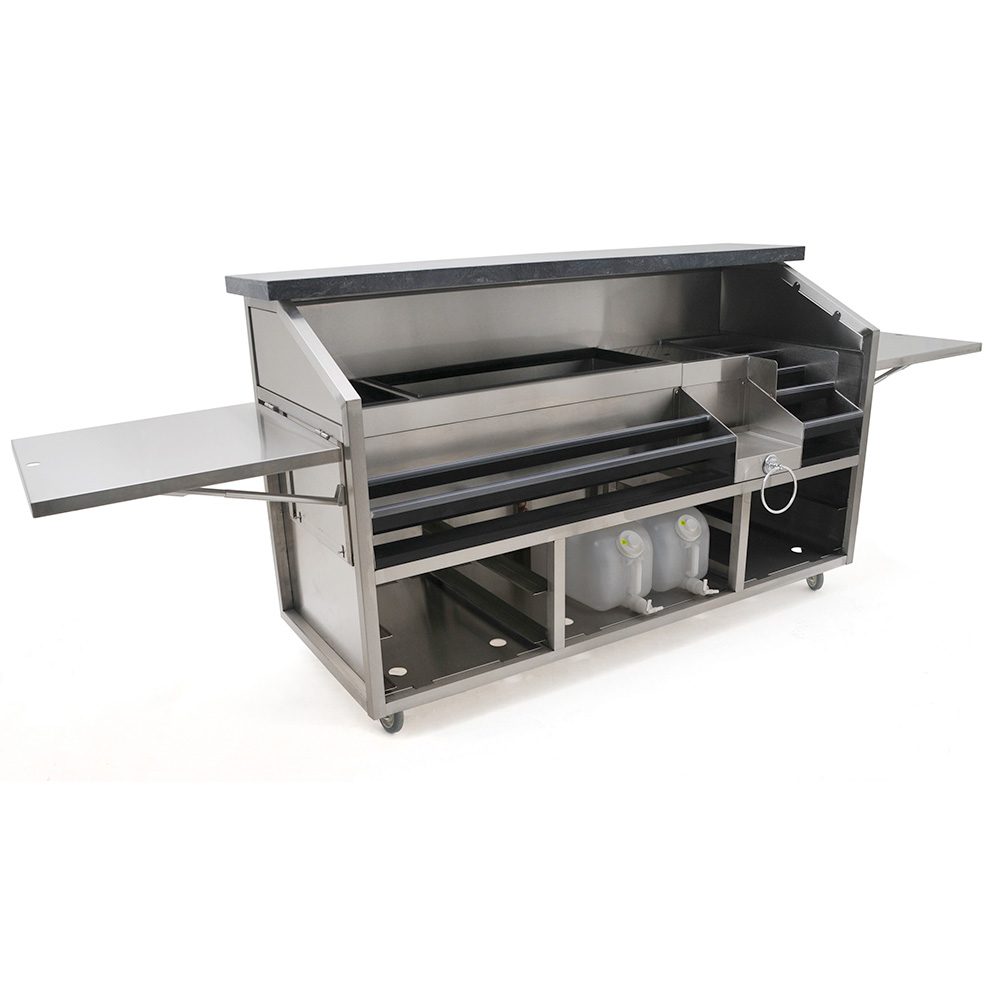
Portable bars come in two useful families. Indoor melamine-exterior bars ship fully assembled with a stainless interior working surface, a 15 3/8-inch by 19 3/4-inch by 8-inch ice bin with a 1 1/2-inch drain, 4-inch by 1-inch plate casters with two brakes, front corner guards, and a choice of black, white or vintage exterior with a matching top — a good look for club plazas and sponsor activations, and indoor use only. Stainless tubular-frame portable bars are the workhorse alternative: welded 1 1/2-inch type 300 stainless square tubular base, stainless top with marine edge, and configurations with a 12-inch blender station and liquor display, a 48-inch workboard with embossments, or double 15-inch by 21-inch by 8-inch ice bins with a dump sink.
Choose between them on abuse and storage, not appearance. A melamine bar looks better on a club level; a stainless bar survives being wheeled onto a truck and stored in a hot room all summer. Most buildings buy some of each and standardize on one footprint so covers, dollies and storage racks fit everything.
 Double Ice Bin Portable BarsTwo 15″ x 21″ x 8″ ice bins with 1½-inch drains, marine-edge stainless top and a 10″ x 12″ dump sink with perforated insert — built for beverage-only volume positions.
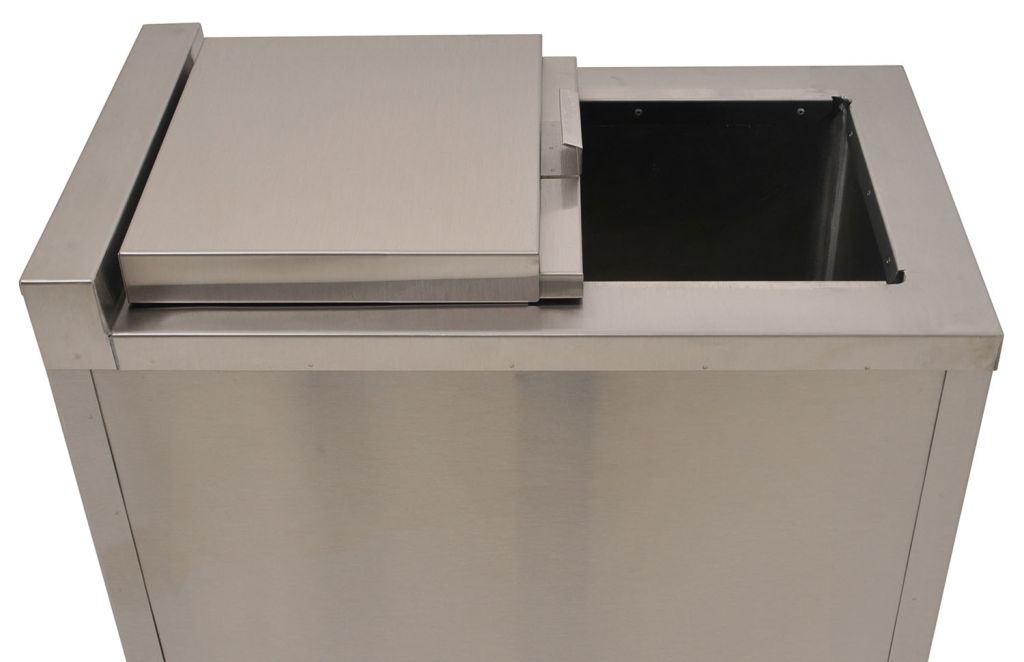 Mobile Ice CaddiesFoamed-in-place insulated bin, lift-off sliding cover and 5-inch casters with brakes, at a 29-inch height that rolls under a standard bar or counter for mid-event restock.
 Underbar Ice ChestsType 304 insulated bin with sliding cover and 1½-inch drain. Ice is the most commonly under-specified item in a venue — model the melt rate, not the bin volume.
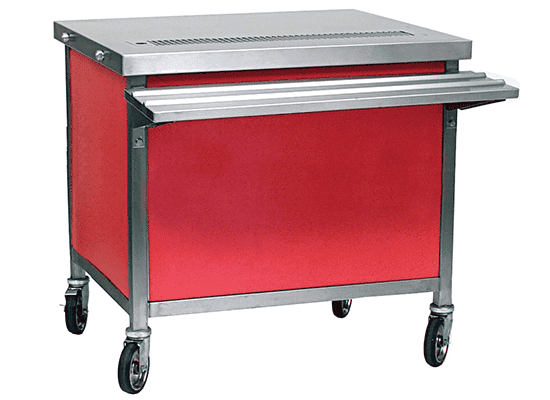 Mobile Beverage UnitsUrn trough 2 inches deep by 4½ inches wide sloped to a 1-inch drain with a louvered anti-splash cover, on 5-inch casters. Pulls drinks off the main queue.
Standardize the footprint
Venues that buy portables one event at a time end up with a storage room of orphans. Pick one or two footprints, buy covers and dollies to match, and every future purchase inherits the same storage plan, the same power drop and the same crew training.
Commissary-to-Stand Distribution
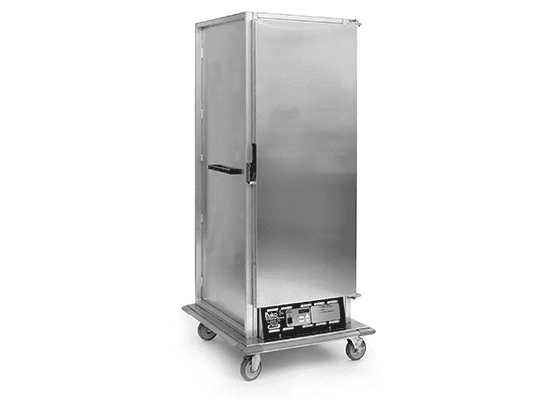
In most large venues the real kitchen is a commissary in the service level, and the stands are finishing and selling points. That makes distribution — not cooking — the backbone of the operation. Product is batch-cooked and panned up hours before doors, loaded into transport, staged on the service level, and pushed to stands on an elevator schedule that has to clear before the crowd arrives.
The equipment that carries this: full-size and half-size heated transport cabinets with aluminum interior and exterior, patented TEMP-GARD air flow, bottom-mount controls, adjustable digital temperature control with LCD readout, removable slides on 2 1/4-inch standard spacing, a full perimeter bumper, an 8-foot cord and 5-inch heavy duty polymer casters with brakes. The readout is what a stand lead records on a temperature log; the bumper is what keeps a freight elevator door from destroying the cabinet in year two; the caster diameter decides whether the cabinet crosses a service tunnel expansion joint without spilling.
Half-size cabinets matter more in venues than in most other segments, because service elevators and suite pantry doors set the ceiling. Measure the elevator interior and the tightest door on the route before choosing sizes — a full-size cabinet that cannot turn out of an elevator lobby becomes a very expensive stationary holding box.
| Route | Typical carrier | Why | Specify carefully |
|---|---|---|---|
| Commissary to concourse stand | Full-size heated transport cabinet | Highest volume per trip, product holds through the pre-game staging window | Elevator interior dimension, cord length versus available outlets at the stand |
| Service level to suite pantry | Half-size heated cabinet or banquet cart | Tight pantry doors and short runs with plated or panned product | Door width, turning radius, whether the cart must fit a lift |
| Kitchen to portable position | Utility cart plus insulated pan cart | Portable positions rarely have power or hot water at the point of sale | Caster size for floor seams, cover for exposed outdoor runs |
| Bulk restock during event | Stainless utility carts, dollies, nesting racks | Restock has to happen while the stand is selling | Restock path that never crosses the guest queue |
| Post-event breakdown | Nesting racks and covered carts | Everything must clear the concourse the same night | Nesting geometry, so the storage room fits the whole fleet |

Full detail on racks, banquet carts and heated transport is on our pan racks and transport carts page.
Hot Holding for Long Dwell Times

Venue holding is unusual: product frequently sits far longer than any restaurant would tolerate, because the operator has to be ready for a peak that arrives in one lump. The design goal is not to hold hotter, it is to hold gently and in a well that can be controlled independently, so a soft product and a crisp product are not forced to share one setting.
Sealed-well hot food tables are the venue standard for that reason. The top and body are heavy gauge type 430 stainless, heat compartments are one-piece deep-drawn type 304 with fully coved corners, insulated on all sides, each well has a 3/4-inch drain with strainer tied to a common copper manifold, and the recessed control panel gives individual infinite controls with high and low settings per well. Sealed wells wipe out fast after an event and spills stay in the well rather than running into the frame — worth a great deal when the cleaning window is the ninety minutes after the final whistle.
Two practical adjustments for venues. First, dedicate at least one well to dry operation for anything breaded, and keep the wet wells for braised and sauced items. Second, move the last stage of holding to the pickup counter under heat lamps rather than pushing well temperatures up — lamps hold appearance, wells hold temperature, and the two jobs are not the same.
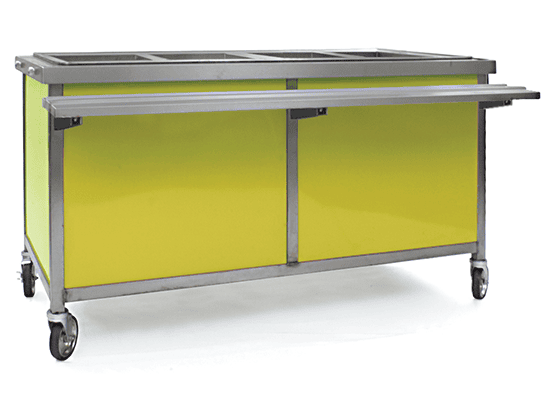
Dual-temperature units are worth a look where a single position has to switch roles: type 304 construction, a 16 gauge 2-inch tall top, pre-wired hot/cold selector switch with thermostatic controls and pilot light, welded 1 1/2-inch square tubular stainless base and 5-inch poly tread casters with two brakes. One unit can run a hot carving position on a hockey night and a chilled display for a matinee. Full serving-line detail is on our hot food tables and serving lines page.
Send us your stand list, your event calendar and your concourse plan
We will configure stands, portables, transport and commissary equipment, confirm model-specific details in writing, and quote it with freight so it can be approved by both the venue and the concessionaire. Call (800) 326-4403.
Club Level, Premium Suites and Bar Service

Premium areas are judged on a different scale than the concourse. The guest paid for the experience, service windows are tied to the game clock, and the equipment is visible. What that means practically: bar service quality drives the review, the pantry is always smaller than it should be, and everything has to be quiet and clean-looking because guests are standing three feet away from it.
Bar equipment is where the specification effort belongs. Cocktail stations bring an overshelf with removable perforated inserts, a tubing chase, work surface, blender shelf, double speed rail steps, 20 gauge stainless bowls and ice bins, 14 gauge blender shelf ends and speed rails, and a T&S faucet on 4-inch centers requiring hot and cold connections. Glass rack storage units are modular in 12-, 18- or 24-inch widths, with 24-inch units sized for nominal 20-inch by 20-inch full-size glass racks, and available with a flatboard top, an open top, or a recessed workboard with a removable perforated insert and 1 1/2-inch drain.
The pantry side is a transport-and-holding problem more than a cooking problem. Half-size heated cabinets, banquet carts and dual-temp mobile units cover most suite programs; the pantry itself needs landing surface, a hand sink and enough shelving that a runner is not stacking on the floor. Underbar options are detailed on our underbar equipment page.
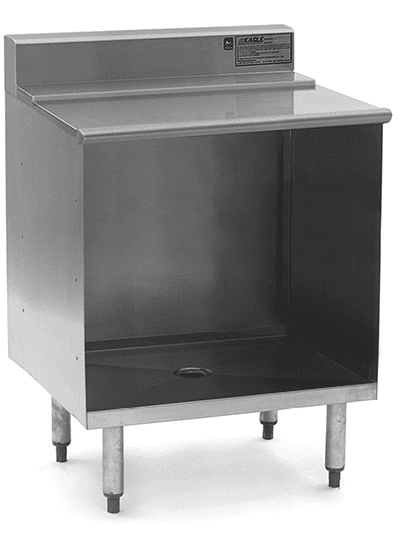 Glass Rack StorageModular all-welded stainless in 12″, 18″ or 24″ widths on heavy duty galvanized legs, with 24-inch units built around full-size glass racks — the difference between a bar that resets in minutes and one that does not.
 Half-Size TransportSame TEMP-GARD air flow and digital readout as the full-size cabinets in a footprint that clears suite pantry doors and service elevators.
 Stainless Utility CartsThree stainless shelves welded to angle legs, galvanized caster channel frame and a 1-inch upturn option to keep product on the cart in a service corridor.
 Warewashing Runs16 or 14 gauge, 30-inch-wide soiled tables in nine lengths, left or right hand operation, with a 20″ x 20″ x 5″ prerinse sink and adjustable non-marking feet.
Storage, Warewashing and Equipment That Gets Put Away
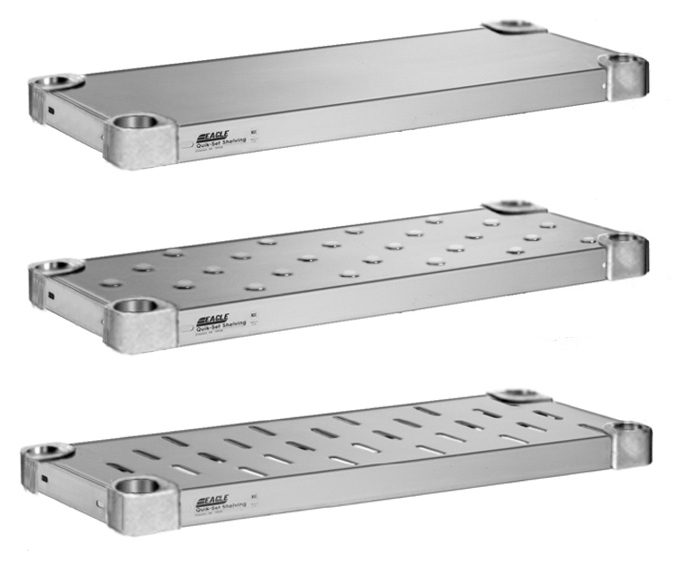
Venue storage has a shape nobody else deals with: the building has to hold everything for a sold-out night, then absorb all of it into back-of-house rooms between events, and sit on it for months when the season ends. Storage is not the leftover space on the drawing — it is the thing that determines whether the fleet of carts and portables you bought is still usable in year five.
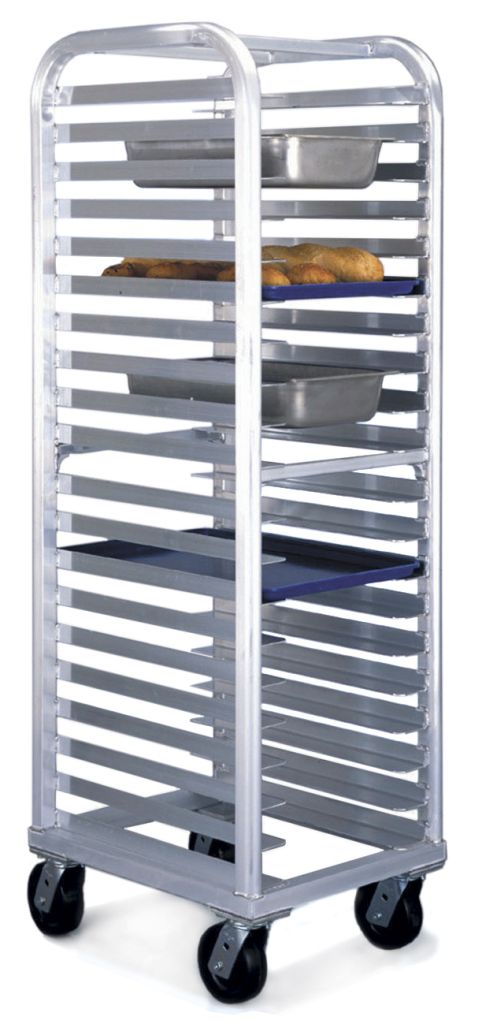
The workhorses are unglamorous. Solid shelving with 14 or 16 gauge construction, a 2-inch downturn and marine edge, heavy duty aluminum corner castings and 1,000 pounds evenly distributed per shelf handles concession inventory and case goods. Dunnage racks — wire, aluminum or polymer — keep bulk product at a 14-inch off-floor height where inspectors look for it, with platform versions rated to 600 pounds. Nesting pan racks in all-welded aluminum with Z-shaped supports collapse into each other, holding 20 or 30 18-inch by 26-inch sheet pans at 2- or 3-inch slide spacing, which is exactly the property you want when the same room has to store the fleet in July.
For the heavier storage problem — commissary warehousing, cooler and freezer racking, bulk beverage — see food and beverage storage solutions and sanitation-rated shelving solutions. Foodservice-side shelving options are on our foodservice shelving and storage page.
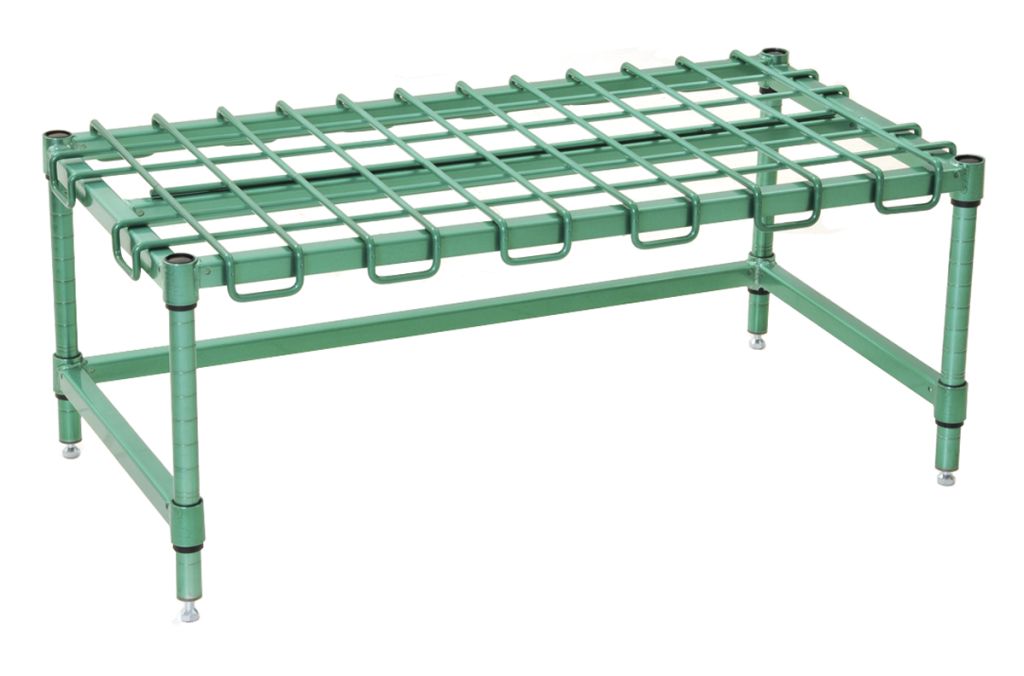 Dunnage RacksFour-sided frames with center supports and removable wire mats, or 14-inch-high dunnage racks with grooved 1-inch posts, in stationary or mobile versions with 5-inch casters.
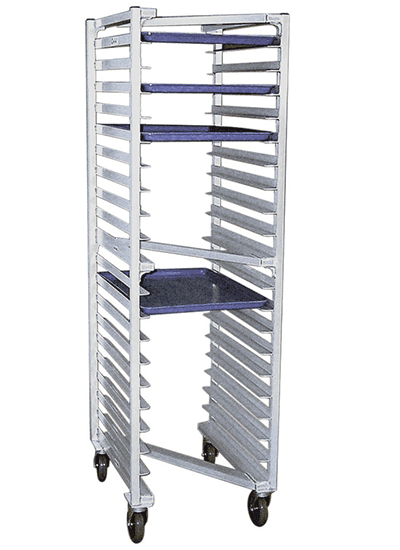 Nesting Pan RacksAll-welded aluminum "Z" supports let racks nest inside each other after an event, which is how a small storage room absorbs a large fleet.
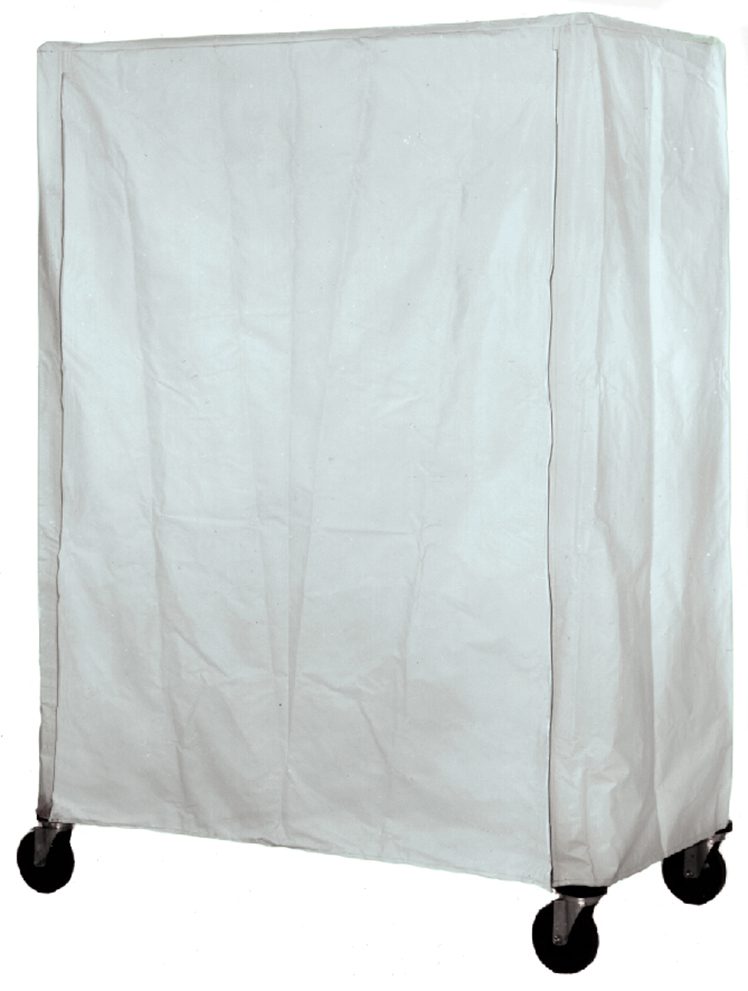 Cart CoversVelcro or poly-zipper covers with reinforced corners, in washable polyester or coated vinyl nylon, to keep airborne dust off stored carts and deter pilferage during shutdown.
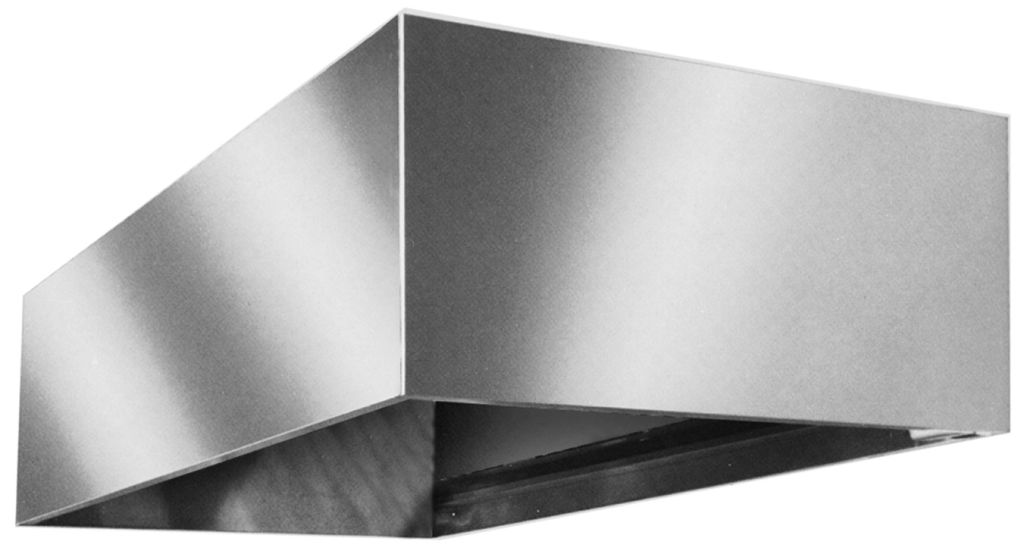 Condensate & Exhaust HoodsSpec-Air condensate hoods over warewashing and Spec-Air exhaust over cooking, quoted with the package rather than left to a separate trade to discover late.
Warewashing in a venue is a post-event sprint, not a steady flow. Size the soiled side for the pile that arrives all at once and buy the longest clean-side landing the room allows — layouts are covered on our dishtables and warewashing page, and sink and hand sink options on commercial sinks and hand sinks.
Off-Season Shutdown and the Install Window
Venue equipment work happens in a gap between event calendars, and that gap is never as long as the first schedule says it is. A ballpark’s winter shrinks around stadium events and facility maintenance; an arena’s summer disappears the moment a tour routes through. The projects that go well are the ones sequenced backwards from the first event the equipment has to serve, with the long-lead items released before anything else.
Post-season walk
Walk every stand, portable position, pantry and the commissary with the operator while the failures of the last season are still fresh. List what broke, what slowed the line and what never got used.
Scope and split
Separate fixed venue-owned assets from movable concessionaire assets, and price them as separate schedules so both parties can approve their own portion.
Release long-lead first
Hoods and SpecFAB custom fabrication set the critical path. Field dimensions usually cannot be taken until demolition, so budget that gap or specify standard sizes with filler pieces.
Sequence deliveries
Deliver by zone and by trade, with freight held when a concourse is not ready. Confirm who signs for freight at a building with no receiving staff in the off-season.
Set, test and train
Set and connect, run a full-load test on holding equipment, and walk the crew through the stand before the first paid event — not on the day of it.
Freight elevators are the real schedule
In a stadium, the constraint on install is almost never the loading dock — it is the number of freight elevators and who else is using them. Confirm elevator availability and interior dimensions before the delivery sequence is locked, and specify half-size and knock-down items where the elevator says so.
Working With Concessionaires and Venue Operators
Venue equipment purchases have two signatures and one shared operation. Getting the ownership split right at quoting time saves weeks later, because a quote that mixes both parties’ scope cannot be approved by either of them.
- Ownership split stated on the quote — fixed counters, hoods and plumbed fixtures on the venue schedule, portables, carts and movable equipment on the concessionaire schedule
- Model-specific spec sheets for every line item, so a facilities reviewer can verify the equipment without calling us
- CAD drawings and Revit families from Eagle’s published library for the architect, kitchen consultant or in-house facilities team
- Rough-in dimensions and utility requirements per model, so electrical, plumbing and mechanical scope is priced against the real equipment rather than the old counter
- Freight named on the quote with delivery method and site access assumptions, including dock, elevator and concourse constraints
- Phased quotes by zone so a multi-level building can award, fund or defer level by level without re-quoting
- Or-equal documentation when a specification names another manufacturer and a comparable substitution has to be reviewed
- Written confirmation of listings — third-party sanitation and electrical listings are model-specific, and we confirm the current status of each model in writing rather than asserting it in a proposal
Shop Concessions & Event Equipment Online
Buy select items directly from our online store, or request a quote for volume, custom sizes and freight-rated orders.


Design & price it online: Metro Banquet, Transport & Insulated Carriers Configurator
Configure banquet cabinets, insulated carriers and transport racks in our free Metro Banquet, Transport & Insulated Carriers configurator — build the layout, see a full bill of materials and save or send the quote in minutes. Need a different Metro product? Browse all 17 tools in the Metro configurator hub.
Get a free quote
Tell us what you are storing, the room size and your timeline. A project specialist will follow up with layout options and pricing. Prefer to talk? Call (800) 326-4403.
Frequently Asked Questions
How do you size a concession stand for peak between-period demand?
Should we cook at the stand or hold product from a commissary?
What holding equipment survives a four-hour dwell without ruining the product?
How do we choose carts that can be moved, stored and abused for years?
Can equipment be installed during a short off-season window?
Do you work with concessionaires as well as venue owners?
Is the equipment certified for venue foodservice sanitation?
Where is MH-USA and can you supply venues outside Utah?
Quote a Stadium, Arena or Concessions Package
Send the stand list, the concourse plan and your event calendar. We will configure stands, portables, transport and commissary equipment and get a freight-included quote back in time for your off-season window.