
Portable Cantilever Carts for Bar Stock, Pipe and Long Parts
A cantilever rack on casters: how mobile cantilever carts work, what the 400 lb per arm pair rating really allows, which size to pick, and when a fixed cantilever rack is the better buy.
400 lb
Per arm pair (one level)
2,000 lb
Overall cart rating
24 or 30 in
Usable arm length
6 in
Arm height adjustment
Shop Portable Cantilever Carts
Vestil portable cantilever carts ship in about 2 working days per Vestil. For full-length stock that stays in one place, compare our fixed cantilever rack kits.


When a Cantilever Rack on Wheels Makes Sense
A fixed cantilever rack is the standard answer for storing long material: no front columns, so bar, pipe, tube and lumber slide straight onto the arms. But a lot of long material in a shop is not in storage. It is on its way somewhere: from the receiving dock to the saw, from the saw to a weld cell, or from the shop out to a job. Every one of those moves usually means carrying bars by hand, two people at a time, or piling them across a flat cart where they slide and roll.
A portable cantilever cart is a small cantilever rack built on a caster base. It holds a few levels of long stock the same way a fixed rack does, then rolls wherever the work is. It does not replace a storage row. It fills the gap between the storage row and the machine. If you are still planning the main rack, our cantilever rack design guide covers that side, and the pallet rack section covers everything that arrives on pallets.
How a Portable Cantilever Cart Is Built
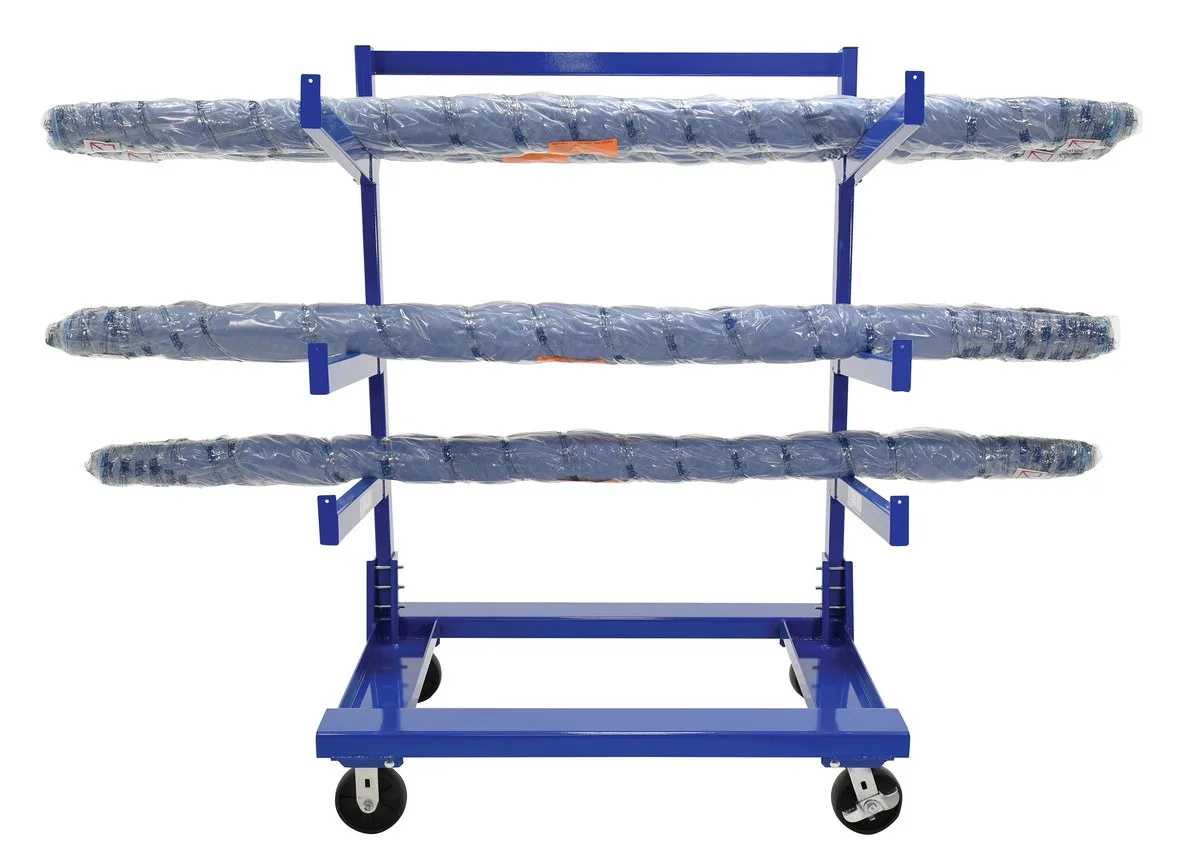
The Vestil CANT series that we sell is a good example of the type. A welded steel base sits on four 6 x 2 in glass-filled nylon casters: two swivel casters with brakes and two rigid casters. Two upright posts bolt to the base and are tied together at the top by a cross brace. The arms slide around the posts in pairs, one arm on each post, and are held by a bolt resting on bearing pins spaced 6 in apart.
Material rests across a pair of arms, so a bar or bundle spans the gap between the two uprights and can run past the ends of the cart. The arms reach out from one face of the posts, which keeps the other face clear for pushing and lets you load from the side, exactly like a single-sided fixed rack.

Photo: Vestil (manufacturer product image). Side view: arms reach out from one face of the uprights.
- Three arm pairs come standard; extra pairs are sold separately.
- Built-in fork pockets (5-3/8 in wide x 2 in high per Vestil’s drawing) let a forklift lift the loaded cart.
- All-steel construction with a blue powder-coat finish; the cart ships for assembly with bolt-together posts and arms.
- Arms have a lip at the tip to help keep stock from sliding off the end.
Sizes and Specifications
All three carts share the same capacity, height and arm hardware. They differ in deck length and arm length. The figures below come from Vestil’s approval drawings and instruction manual.
| Model | Overall W x L x H | Deck length | Usable arm | Capacity | Net weight |
|---|---|---|---|---|---|
| CANT-3048 | 30 x 48-9/16 x 64-11/16 in | 48 in | 24 in | 400 lb per arm pair, 2,000 lb overall | about 177 lb |
| CANT-3060 | 30 x 60-9/16 x 64-11/16 in | 60 in | 24 in | 400 lb per arm pair, 2,000 lb overall | about 191 lb |
| CANT-3648 | 36 x 48-9/16 x 64-11/16 in | 48 in | 30 in | 400 lb per arm pair, 2,000 lb overall | about 190 lb |
Check the door and aisle widths along the route the cart will travel, not just where it parks. Remember the stock is usually longer than the cart, so the real turning footprint is the length of the longest bar you load, not the 48 or 60 in deck. Extra or replacement arm pairs come in the two usable lengths the carts use: 24 in arm pairs ($55.76) and 30 in arm pairs ($60.70). Tell us which cart you have before ordering.
Reading the Capacity: 400 lb per Level, 2,000 lb per Cart
The two numbers work together. Each arm pair, which is one level, is rated for 400 lb. The whole cart is rated for 2,000 lb. Vestil’s manual says not to exceed either one, to center every load on its arm pair, and to load from the bottom up.
With the three standard arm pairs, the most you can put on the cart is 3 x 400 = 1,200 lb, because the per-level limit is reached first. Adding arm pairs lets you use more of the 2,000 lb overall rating, but the total across every level still may not go past 2,000 lb.
| Stock (steel unless noted) | Approx. weight per ft | Example per level | Approx. level load |
|---|---|---|---|
| 1 in round bar | 2.67 lb | 24 bars at 6 ft | about 385 lb |
| 2 in Schedule 40 pipe | 3.65 lb | 13 pieces at 8 ft | about 380 lb |
| 1-1/2 in Schedule 40 pipe | 2.72 lb | 18 pieces at 8 ft | about 390 lb |
| 1 in round bar, 6061 aluminum | 0.92 lb | 35 bars at 12 ft | about 385 lb |
Weights in the table are approximate standard reference values; use your mill or supplier data for real stock. The point of the exercise is that 400 lb goes faster than most people expect with steel. Two dozen 6-ft pieces of 1 in round bar already fill a level. Aluminum, plastic pipe and trim are a different story: they fill the arm space long before they reach the weight limit.
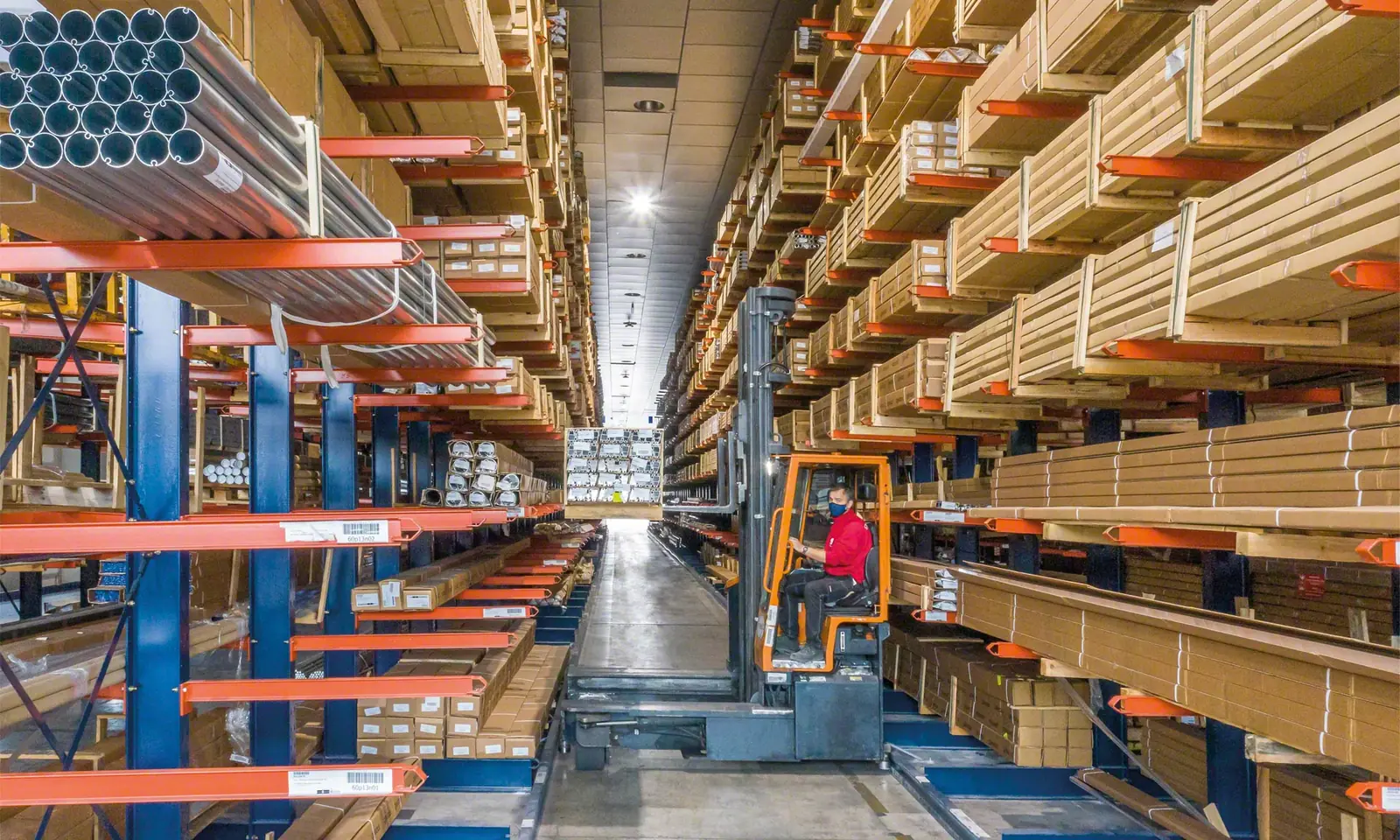
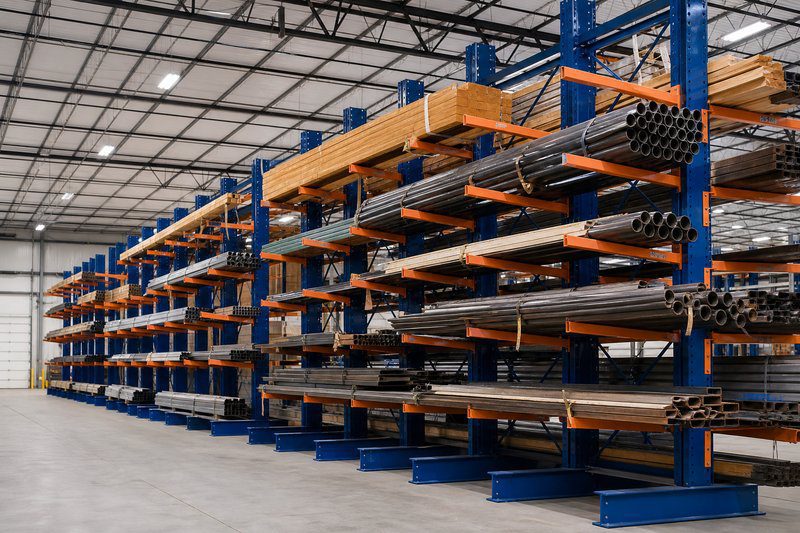
That is also the honest dividing line between a cart and a rack. If one level needs to carry a 1,000 lb bundle or a lift of mill-length pipe, you are in fixed-rack territory, where arms are rated in the thousands of pounds. Our guide to cantilever load capacity by arm length explains how those ratings work.
Photo: Interlake Mecalux (authorized use). A fixed cantilever rack for full bundles, shown for comparison.
Straight or Inclined Arms: 2 Degrees or 7 Degrees
Each arm bracket has two bolt holes. Bolted through the lower hole, the arm sits at 2 degrees above horizontal, close to level. Bolted through the upper hole, it tilts up to 7 degrees, so material settles back toward the upright. Pick the angle when you set up each level; it does not have to be the same on every level.
- 7 degrees for round bar, pipe, tube and conduit that would otherwise roll toward the arm tips when the cart moves.
- 2 degrees for flat bar, angle, channel, extrusions and trim that should lie flat and stay easy to pull.
- Keep both arms of a pair at the same height and angle so the load bears evenly.
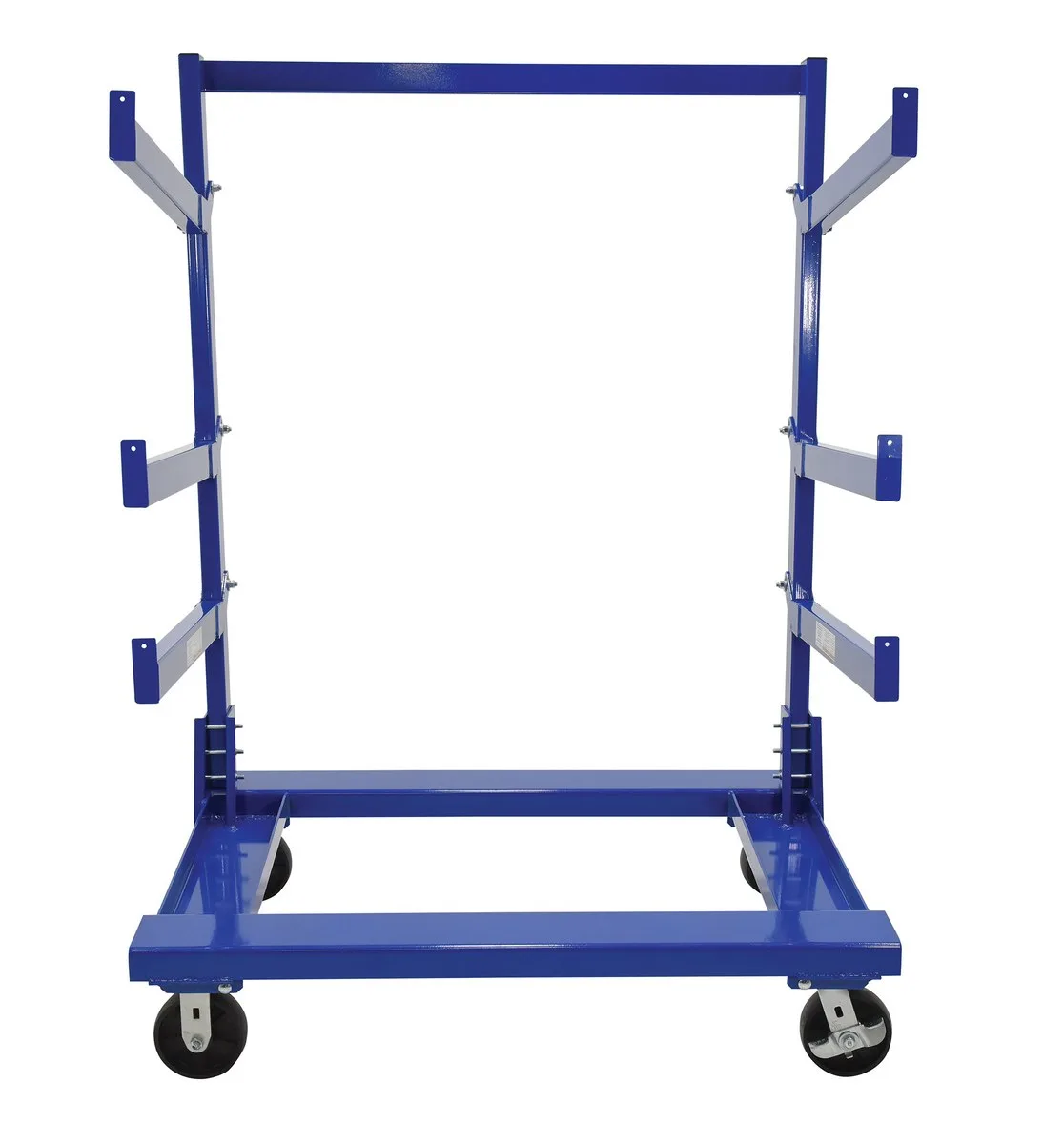
Photo: Vestil (manufacturer product image). Arm pairs bolted in the inclined position.
The same logic applies to fixed racks, where inclined arms are the usual choice for round stock; our cantilever pipe rack and tubing storage page goes deeper on pipe stops and inclined arms for full-length pipe.
Loading, Moving and Parking a Loaded Cart
A rolling rack with long material on it behaves differently from a parked rack. These rules come straight from Vestil’s manual, plus what we tell shops that are adding carts.
Long overhangs need extra care. Stock that runs well past the end of the cart swings wide on every turn and can strike people, columns or other racks, so route carts along marked aisles and move slowly around corners. Vestil also warns against material that extends significantly beyond the edges of the arms. OSHA’s general rule for material storage, 29 CFR 1910.176, says stored bundles must be stable and secure against sliding or collapse, which on a cart means nothing loose on top of a level and nothing hanging off the arm tips.
Portable Cart, Fixed Cantilever Rack or Bar Rack?
| Option | Best for | Limits |
|---|---|---|
| Portable cantilever cart | Staging, kitting, drops, moving cut lengths between work areas | 400 lb per level, 2,000 lb total, level floors only |
| Fixed cantilever rack | Bulk storage of full-length bar, pipe, lumber and bundles, loaded by forklift | Does not move; needs aisle room for the load length |
| Bar rack (horizontal or vertical) | Many small sizes of bar stock pulled by hand in a compact footprint | Short lengths and modest weights per opening |
| Panel or sheet cart | Moving sheets of plywood, drywall or panels | Built for flat sheets, not bundles of long round stock |
Most shops that buy a cantilever cart already have, or need, a fixed rack for the mill-length material. The fixed row holds 12-ft and 20-ft lifts; the cart carries the day’s cut lengths. Our metal and steel storage cantilever racking page covers the storage side for service centers and fabricators, and if you are weighing bar rack instead, see how one Salt Lake City tool manufacturer made that call in our cantilever rack vs bar rack case study. For sheets, a vertical panel cart or the layouts in our sheet goods cantilever guide are the better fit.
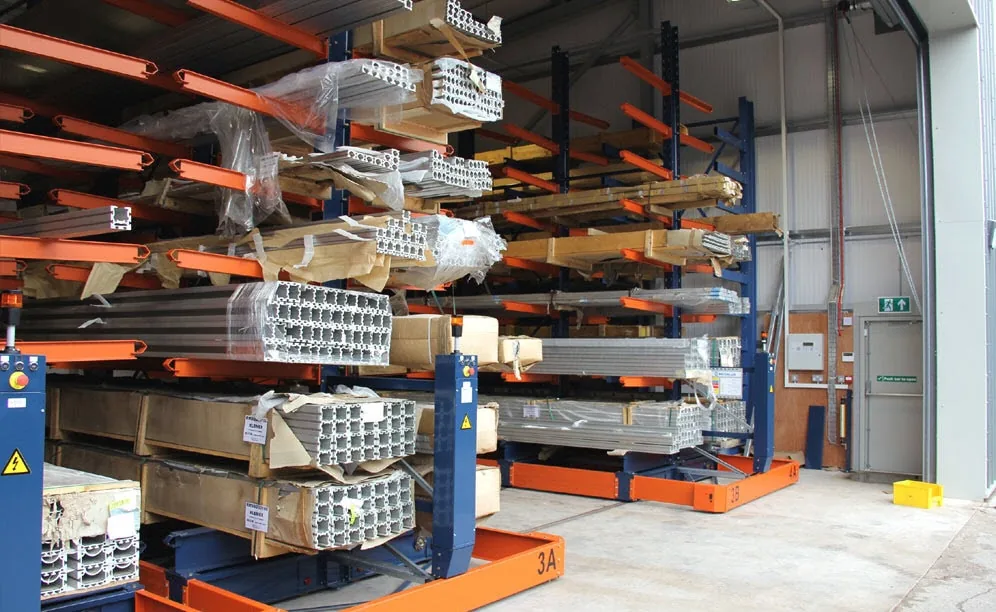 Fixed Cantilever Rack SystemsArm styles, column heights and capacities for storage rows.
 Cantilever Rack ComponentsUprights, arms, braces and accessories explained.
 Lumber Storage Cantilever RackingArm length, spacing and layout for lumber and building materials.
Inspecting a Portable Cantilever Cart
Carts take more abuse than fixed racks: they get bumped, pushed over thresholds and lifted by forklifts. Vestil’s manual asks for a written record of the cart’s normal condition before first use, including how the arms react under load, and an inspection at least once a month against that record.
| Check monthly | Take it out of service if you find |
|---|---|
| Casters and caster receivers | Bent, cracked or badly worn casters; loose receiver hardware; brakes that do not hold |
| Base frame and deck | Deformation, cracked welds, heavy corrosion or a deck that is out of square |
| Uprights and post brackets | Bent or twisted posts, distorted brackets, loose bolts |
| Arms and arm brackets | Cracks, cracked welds, bends, enlarged bolt holes |
| Labels | Capacity labels that are missing, damaged or unreadable |
If anything fails, unload the cart, tag it out of service and replace the part with a manufacturer-approved one before it goes back to work. The Rack Manufacturers Institute’s best practices for cantilevered storage racks make the same point for fixed rack: damaged arms and bases get unloaded and assessed first.
Planning Carts and Racks Together
| Tell us | Why it matters |
|---|---|
| What you move and the longest cut length | Deck length (48 or 60 in) and arm length (24 or 30 in) |
| Weight per piece or per bundle | Whether 400 lb per level is enough or you need fixed rack |
| Round or flat stock | Arm angle and whether you need more arm pairs |
| Route: doors, aisles, ramps, floor condition | Cart width and whether carts are practical at all |
| Where full-length stock lives now | Sizing the fixed cantilever row that feeds the carts |
You can price carts and complete fixed sections online, sketch a storage row in our free 3D cantilever rack configurator, or send us the list above. If you are tempted by used rack for the storage side, read our used vs new cantilever rack guide first. Every arm, upright and brace we stock is listed in the cantilever rack shop.
Get a free quote
Tell us what you are storing, the room size and your timeline. A project specialist will follow up with layout options and pricing. Prefer to talk? Call (800) 326-4403.
Portable Cantilever Carts: FAQs
What is a portable cantilever cart?
How much weight can a portable cantilever cart hold?
What is the difference between the CANT-3048, CANT-3060 and CANT-3648?
Can a forklift move a portable cantilever cart?
Should I use straight or inclined arms on the cart?
Can a cantilever cart replace a cantilever rack?
Can I use a cantilever cart outdoors?
Need Carts, a Rack, or Both?
Tell us what you move, how long it is and what it weighs. We will match the cart size, and size the fixed cantilever row that feeds it. Call 800-326-4403.