
Home Medical Equipment Warehouse Racking: Bayview Homecare
DME warehouses are unusual: most of the inventory leaves, comes back dirty, gets cleaned and goes out again. Racking that ignores that loop fills up with equipment nobody can use.

2025
Year Bayview Homecare worked with us
Pallet rack
Product category we supplied
Home medical equipment
Application
Returnable stock
The defining constraint
Plan your layout before you buy
Configure upright height, beam width, bay count, and load levels in our free 3D Pallet Rack Configurator, then get an instant bill of materials and request a quote.
The project
Bayview Homecare is a home medical equipment provider. Material Handling USA supplied pallet rack for the company in 2025. The client, the year and the product category are the only project facts we publish — not layouts, quantities, capacities or values.
The reason this application is worth writing up is that durable medical equipment (DME) breaks almost every assumption behind a standard warehouse racking layout. In a distribution warehouse, product arrives once and leaves once. In a DME operation, a large share of the fleet cycles: out to a patient, back to the warehouse, into cleaning and repair, back into stock. The building has to hold a rental fleet as well as an inventory, and those are different things. This is a different problem from the one we wrote up in our medical distribution pallet rack case study, where the stock flows one way and lot control dominates.
Everything below is general engineering and planning guidance for pallet rack systems in this kind of building.
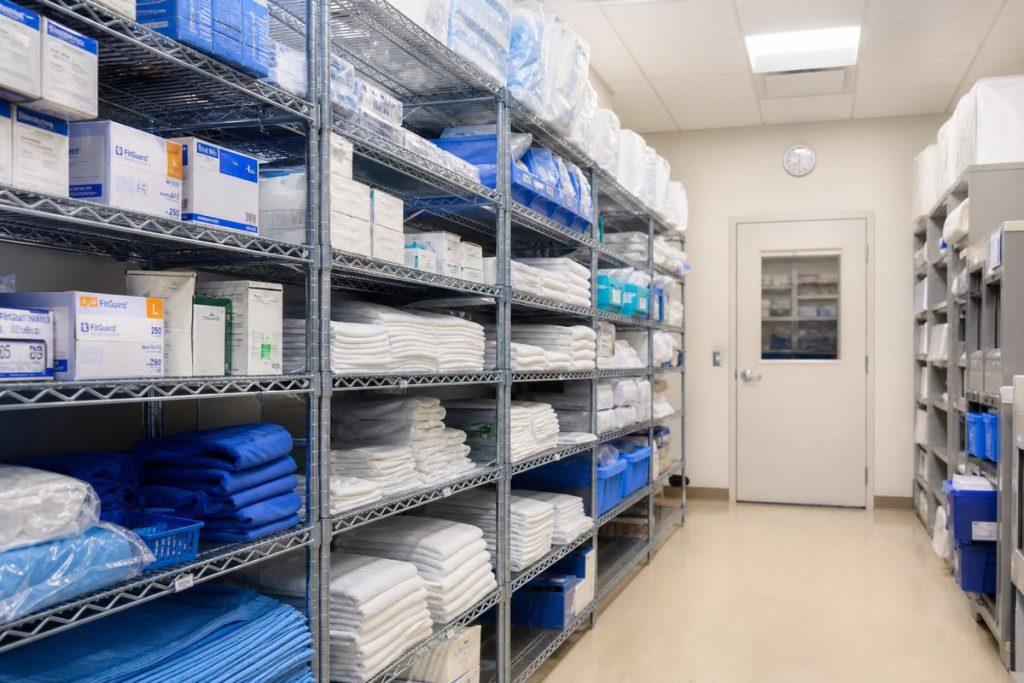
Why home medical equipment storage is different
Most of it is a fleet, not a stock. Hospital beds, wheelchairs, lifts, oxygen concentrators, CPAP units and walkers are assets that go out and come back. Stock levels swing with what is out in the field, not just with what has been bought.
It is bulky and light. Very little of a DME warehouse is heavy in pallet-rack terms. It is large, awkward and easily damaged, and it consumes cubic feet at a rate that has nothing to do with its weight.
Half of it is not palletized. A wheelchair, a shower chair and a bed frame do not sit on a pallet in any sensible way. A racking plan that assumes pallets will produce beam levels full of loose equipment stacked by hand.
It has a cleanliness state. Every item is either ready to issue, awaiting cleaning and inspection, or out of service. Storage has to make that state obvious at a glance, because a mistake here reaches a patient.
Deliveries are route-based. Product does not ship by carrier in most cases; it goes onto a van on a route with a technician. Staging for tomorrow’s routes is a real space requirement, not an afterthought.
Serialized items need traceability. Much of the fleet is tracked by serial number for service, recall and billing purposes, which means storage has to support exact location control.
The clean and dirty divide
If a DME warehouse gets only one thing right, it should be this. Returned equipment and ready-to-issue equipment must never share storage, and the layout should make it physically awkward to mix them rather than relying on a label or a habit.
| Zone | What lives there | Storage implications |
|---|---|---|
| Returns receiving | Equipment just back off a van, condition unknown | Floor space and low-level rack near the dock; nothing stored above head height until it is triaged |
| Cleaning and disinfection | Items in process | Wash area adjacency, wet-tolerant surfaces, short dwell, no long-term rack storage |
| Repair and parts | Items awaiting service, plus service parts | Shelving and bins near the bench; serialized items on labelled positions, not in a pile |
| Ready-to-issue fleet | Cleaned, inspected, tagged equipment | The main rack area — density matters here, and positions should be by item family |
| Route staging | Tomorrow’s deliveries, picked and grouped | Floor or low rack near the doors; sized to the busiest day, not the average |
| Quarantine / out of service | Recalled, damaged or condemned equipment | Physically separated, clearly marked, ideally locked or caged |
The most common failure we see is having no defined quarantine area. Out-of-service equipment then sits in the general rack with a piece of tape on it, and the tape eventually falls off. Give it a home, and make the home visibly different.

Bulky, light and awkward: what it does to the bay
Cube is the constraint, so beam levels are the lever. With light loads you can usually add levels and tighten spacing well before capacity becomes a question — provided the frame is designed for the configuration, since vertical beam spacing directly affects an upright’s capacity. See pallet racking weight capacity.
Set beam elevations from real item heights. Group the fleet into two or three height families — wheelchairs and walkers, concentrators and boxed goods, bed frames and lifts — and set beam levels by zone instead of using one universal spacing. This is where most of the wasted space in a DME building is hiding.
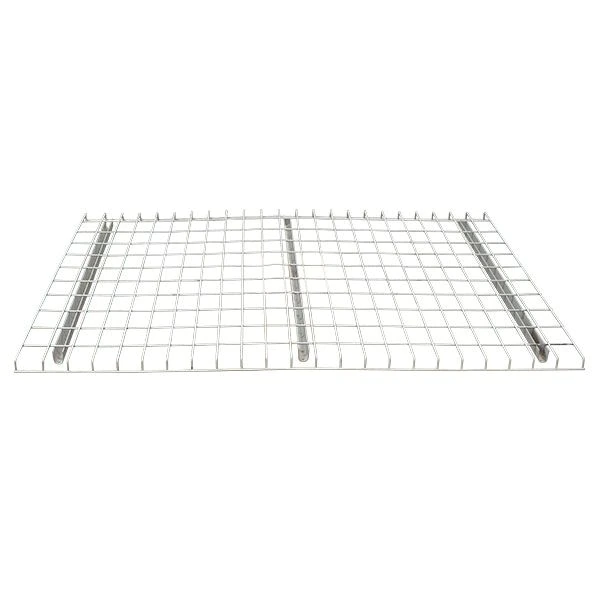
Deck everything. Unpalletized equipment needs a surface. Wire decking is the default: it holds loose items, lets sprinkler water through, and does not trap dust the way solid deck can.
Design for hand loading. A technician lifting a folded wheelchair onto the third level is an injury waiting to happen. Anything handled manually belongs between knee and shoulder height, with lift-truck-only stock above it.
Protect the finish. Chrome, plastic and upholstered surfaces scuff against bare beams and mesh. Where equipment is stored directly on deck, a liner or board is worth the small cost.
Don’t overhang the aisle. Bulky items overhang standard bays. Size the bay to the real footprint rather than letting handles and armrests hang into forklift traffic.
Rack type selection for a DME warehouse
- Selective pallet rack for the bulk of the fleet. High variety and low quantity per item is exactly the profile selective rack exists for. Density schemes actively cost you positions when every position holds something different.
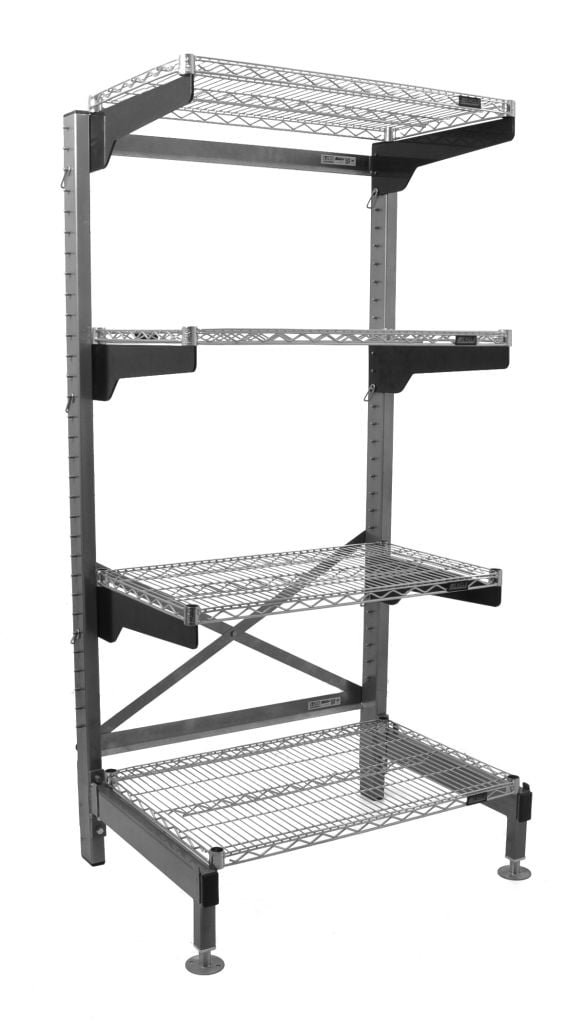
- Decked rack with shelving inserts for small equipment. Nebulizers, CPAP units, accessories and boxed consumables store better on boltless shelving built into the lower rack levels than on pallets.
- Cantilever rack for long and awkward items. Bed rails, ramps, walking frames and mattress overlays store cleanly on arms and badly on beams.
- Floor-level bays for wheeled equipment. Wheelchairs, rollators and commodes are rolled, not lifted. A floor position under the first beam level is the right home, and it keeps the level above available for boxed stock.
- Mobile shelving where the parts room is dense. Service parts and small accessories in a high-density mobile system can roughly double a parts room’s capacity in the same footprint.
- Do not buy density you cannot fill with like items. Drive-in and push-back need multiple identical pallets per lane. Very few DME warehouses have that profile.
Consumables, oxygen and controlled items
Alongside the equipment fleet, most DME providers carry a consumables business — tubing, masks, filters, wound care, incontinence supplies, nutrition — and often oxygen. These have different rules from the fleet.
| Category | What storage has to handle |
|---|---|
| Dated consumables | First-expiry-first-out rotation, which means date visibility at the pick face and enough positions to avoid mixing lots in one location |
| Sterile and single-use items | Protection from crushing, moisture and dust; packaging integrity is the product, so decking and handling matter |
| Bulk incontinence and nutrition | Very high cube, low value per pallet — the best candidates for the high beam levels |
| Oxygen cylinders | Not a pallet rack item. Cylinders need dedicated, secured, upright storage away from heat and traffic, with full and empty separated; check the requirements with your local fire authority |
| Batteries and chargers | Charging areas need ventilation and separation from combustible storage; do not charge on a rack level |
| Serialized and billable equipment | Exact location control per unit, so a serial number resolves to a bay, level and position |
Oxygen and compressed gas storage in particular is governed by fire code rather than by racking practice. The National Fire Protection Association publishes the relevant standards, and requirements are enforced locally — confirm them with your fire authority before designing the area.
Layout for a delivery-driven operation
The building flows in a circle, not a line. Receiving, cleaning, stock, staging, dispatch and returns all connect. Drawing the equipment loop before drawing rack lines usually changes where the rack should go.
Route staging needs real floor area. Vans are loaded in the morning in a rush. If there is no marked staging area, the aisles become one, which is both a safety problem and the reason loads go out wrong.
Keep the returns door away from the ready-to-issue rack. Physical distance is the cheapest contamination control available.
Put the fastest-moving fleet nearest dispatch. A small number of item types will account for most movements. Those belong closest to the door, at floor and first-beam level.
Plan for seasonal and contract swings. Patient census and contract wins change fleet size quickly. Leave a defined expansion run rather than absorbing growth into the aisles — our warehouse layout guide covers how to reserve that space deliberately.
Label everything, including floor positions. Serialized equipment in an unlabelled floor bay is untracked equipment.
Safety, damage and inspection
- Manual handling is the dominant injury risk. This is a building where people lift awkward objects all day. Storage height decisions are ergonomics decisions.
- Protect uprights in a mixed-traffic building. Carts, pallet jacks, forklifts and people share the same aisles. Rack guards and column protectors at aisle ends and door approaches are worth it.
- Light loads do not reduce anchorage requirements. Every frame still needs correct anchors, safety pins, plumb installation and an engineered design for its installed height.
- Inspect routinely and after every impact. A deformed upright is a compromised frame whatever it holds — see rack inspection and repair.
- Post and maintain load ratings. A bay holding walkers today may hold cases of nutrition next year, and that is a genuinely different load.
- Keep sprinkler clearance above the top of storage. Adding a level to a light-goods warehouse is easy; breaching required clearance above storage is easy too.
- Watch aisle housekeeping at peak. Returned equipment left in an aisle overnight is the most common hazard in this type of building.
We design, supply and install these systems across the region — see Utah pallet rack for local service.
Shop Pallet Rack Accessories Online
Protect and finish your pallet rack installation with these in-stock accessories, or request a quote for custom-sized rack, freight and volume pricing.

Frequently asked questions
What racking is best for a home medical equipment warehouse?
How do you separate clean and returned equipment in storage?
Does bulky, lightweight medical equipment need heavy-duty racking?
Where should serialized equipment be stored?
Can oxygen cylinders be stored on pallet rack?
How much space should be set aside for route staging?
How do we handle growth when a new contract lands?
Storing home medical equipment?
We design racking and shelving layouts for DME providers, home care operations and healthcare supply warehouses. Free design consultation.