
Advanced Composite Manufacturer Warehouse Racking: IsoTruss
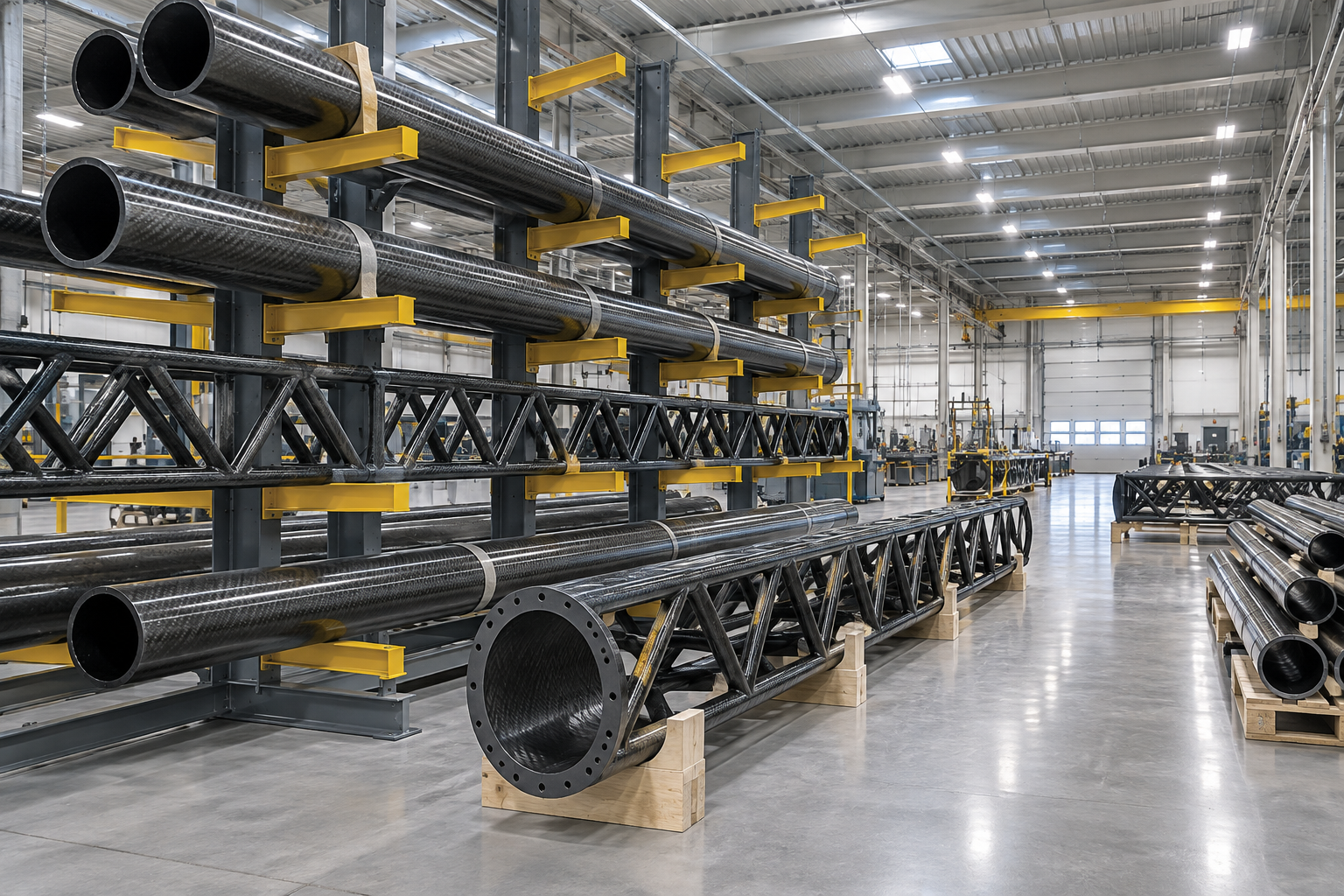
A carbon-fiber lattice structure manufacturer needs racking sized for long, rigid tube and truss stock — not standard palletized boxes.
Advanced manufacturing
Client sector
Cantilever rack & boltless shelving
Product category supplied
Springville, Utah
Client HQ
Composite tube & lattice stock
Application
Plan your layout before you buy
Configure upright height, beam width, bay count, and load levels in our free 3D Pallet Rack Configurator, then get an instant bill of materials and request a quote.
The project
IsoTruss, Inc. is an advanced-materials manufacturer headquartered in Springville, Utah, designing and producing patented carbon-fiber lattice structures — tubular truss components used for towers, poles and other structural applications. Material Handling USA supplied cantilever rack and boltless shelving for the facility’s raw material and finished-component storage.
Advanced composite manufacturing is a new sector for our case-study series, and it presents a storage problem that’s different from either of our metal or glass/aluminum manufacturing case studies. Our glass and aluminum extrusion warehouse project covers long metal and glass stock; a carbon-fiber lattice structure plant instead handles composite tube and truss sections that are long, lightweight relative to their size, and easily damaged by point-loading or careless handling — a combination that calls for its own rack and shelving approach.
Why composite tube and lattice stock needs different storage
Length drives the rack choice. Composite tube and truss sections run long relative to a standard pallet footprint, so they need open-arm support along their length rather than a flat pallet position sized for boxed goods.
Surface damage is a real cost. Unlike steel stock, a carbon-fiber composite surface can be scratched, dented or delaminated by contact with bare steel arms or careless stacking — storage has to protect the material, not just hold its weight.
Weight is lower than the stock looks. Composite tube and lattice sections are lightweight for their size compared with metal stock of the same dimensions, so rack and arm capacity gets specified to the real load rather than assumed from a metal-stock rule of thumb.
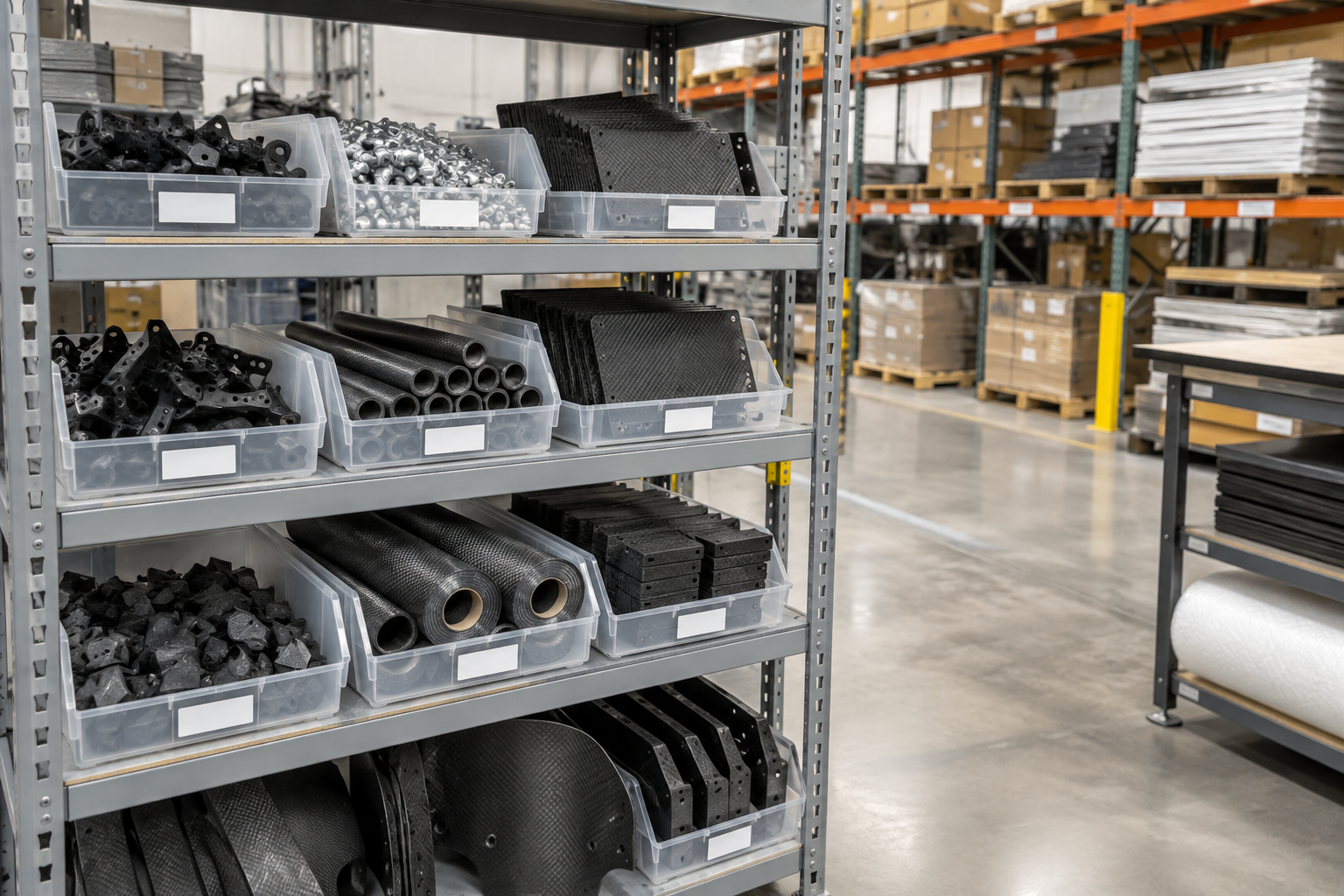
Small composite hardware and finished sub-components need their own system. Fittings, connectors and small finished parts are easy to lose track of if they’re staged loosely near long stock rather than sorted on dedicated shelving.
What an advanced composite plant stores
Based on the verified project scope, an advanced composite manufacturing operation typically stores several distinct material categories, each suited to a different rack or shelving type:
| Material | Storage need |
|---|---|
| Composite tube & lattice truss stock | Long, rigid sections needing open-arm cantilever support along their length. |
| Raw fiber and resin materials | Climate-sensitive materials often staged separately from finished goods. |
| Small composite hardware & fittings | High-count small parts sorted into bins on shelving. |
| Finished sub-components awaiting assembly | Short-term staging positions that keep work-in-process organized and countable. |
- Long composite tube and lattice truss stock stores on cantilever rack, where open arms support the material along its length without a pallet underneath.
- Boxed materials and shorter finished goods store on selective pallet rack for standard palletized positions.
- Small composite hardware, fittings and finished sub-components fit boltless shelving with bin storage, keeping high-count parts sorted and countable.
Protecting finished composite surfaces
A composite manufacturer’s storage plan has to account for surface protection in a way a typical metal-stock warehouse doesn’t need to:
Padded or coated arm surfaces reduce point-loading damage. Where cantilever arms support finished composite tube directly, a padded or coated contact surface helps prevent scratches or localized stress on the material compared with bare steel.
Separate raw stock from finished, inspected components. Keeping incoming tube and truss stock in a distinct rack zone from finished, quality-checked components reduces the chance of mixing unqualified material into an outgoing shipment.
Aisle protection matters more with composite material nearby. Column protectors and rack guards reduce the chance of a forklift or handling-equipment strike damaging both the rack and adjacent stored composite material.
Planning for a growing product line
Advanced-materials manufacturers often expand their product lines as new applications for a patented material are developed, so a few planning considerations help a layout hold up over time:
Leave open cantilever bays for new tube lengths or diameters. A new product variant can call for a different tube length or diameter than existing stock; open arm positions sized with some flexibility avoid a disruptive re-layout.
Group stock by production stage, not just by product. Separating raw stock, in-process material and finished, inspected components by rack zone keeps the manufacturing flow visible and reduces mix-ups.
Size arm capacity to the heaviest stock the line will realistically produce, not just current production, so a new heavier product variant doesn’t outgrow the rack on day one.
Plan floor space for both storage and staging. Advanced manufacturing floors often need space for both long-term rack storage and short-term staging near production equipment; a layout that accounts for both from the start avoids overflow material blocking aisles later.
Installation and safety
An advanced composite manufacturing facility’s racking follows the same structural design standard as any other cantilever rack or pallet rack project, sized to the actual loads and material handling involved rather than a generic assumption.
- Size arm and beam capacity to the real material weights involved — see pallet rack weight capacity guidance; composite stock weighs less than metal stock of the same size.
- Protect rack uprights with column protectors and end guards in aisles that see forklift traffic moving long composite stock.
- Inspect racking on a defined cycle — see rack inspection and repair.
- Anchor and install to the ANSI/RMI MH16.1 standard — see our rack installation guidance.
ANSI/RMI MH16.1 is published by the Rack Manufacturers Institute. Utah’s Wasatch Front sits in a moderate-to-high seismic zone, so rack anchoring and bracing for an advanced manufacturing facility get designed for seismic load combinations under the applicable building code, the same as any other cantilever rack or pallet rack installation in the region. We design, supply and install pallet rack, cantilever rack and boltless shelving for manufacturers across the Wasatch Front — see Utah pallet rack for more of our local project work.
Serving Utah advanced manufacturers
Material Handling USA has been an industry leader in storage and material handling since 1997, working from Salt Lake City with manufacturers across the Wasatch Front. See our related work for a glass and aluminum extrusion warehouse. For Utah projects call 801-328-8788, or see our Utah pallet rack page.
Shop Pallet Rack Accessories Online
Buy select items directly from our online store, or request a quote for volume, custom sizes and freight-rated orders.

Frequently asked questions
What storage suits a composite tube or lattice structure manufacturer?
Why does composite stock need different rack handling than metal stock?
Should raw and finished composite material be stored separately?
Should a composite manufacturer’s rack layout leave room to grow?
What’s the design standard for the rack itself?
Does seismic design matter for rack in Utah?
Planning storage for an advanced manufacturing facility?
We design pallet rack, cantilever rack and boltless shelving layouts for manufacturers with specialized material handling needs. Free design consultation.