
Glass and Architectural Aluminum Supply Racking: Alumatec Pacific Products
Glass is heavy, brittle and unforgiving of a single point load. Extrusions are long, soft and easy to mark. Storing both in one building takes two different systems. Long stock storage isn’t limited to metal and glass — an advanced composite manufacturer producing carbon-fiber tube and lattice structures has its own long-stock and surface-protection needs; see our advanced composite manufacturer warehouse racking case study.
2024
Year Alumatec Pacific Products worked with us
Pallet rack
Product category we supplied
Glass & aluminum supply
Client sector
Fragile plus long
The two problems in one building
Plan your layout before you buy
Configure upright height, beam width, bay count, and load levels in our free 3D Pallet Rack Configurator, then get an instant bill of materials and request a quote.
The project
Alumatec Pacific Products supplies the glass and architectural aluminum fabrication industry. Material Handling USA supplied pallet rack for the company in 2024. Client, year and product category are the only project facts we publish — no layouts, quantities, capacities or values.
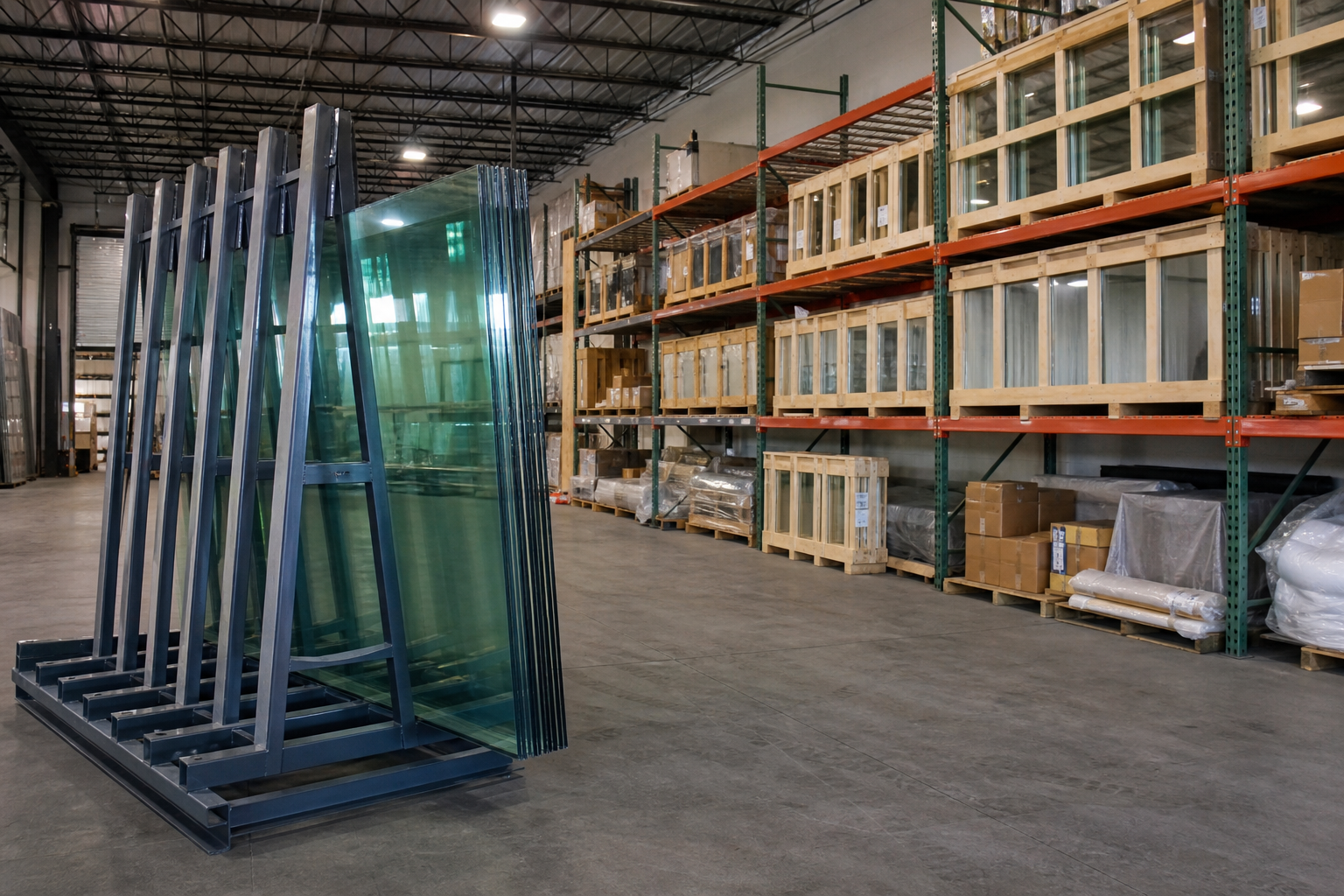
The reason this application is worth writing up is that it combines two of the harder storage problems in one building. Glass is dense, brittle and only stable in specific orientations. Architectural aluminum is long, comparatively soft, and marks if it is dragged or stacked carelessly. Around both sits a conventional distribution inventory of hardware, sealants, tooling and machinery that any pallet racking system handles well. Getting the building right means not forcing all three into the same rack line.
It is a distinct problem from a metal service center, where the stock is steel plate and bar and damage tolerance is high, and from a building products distributor, where the challenge is volume rather than fragility.
Two materials, two storage problems
Glass is extremely dense. Architectural glass weighs on the order of thirteen pounds per square foot for every quarter inch of thickness, so a modest crate of large lites reaches loads that surprise people used to cartoned goods. Insulated units and laminated glass are heavier still.
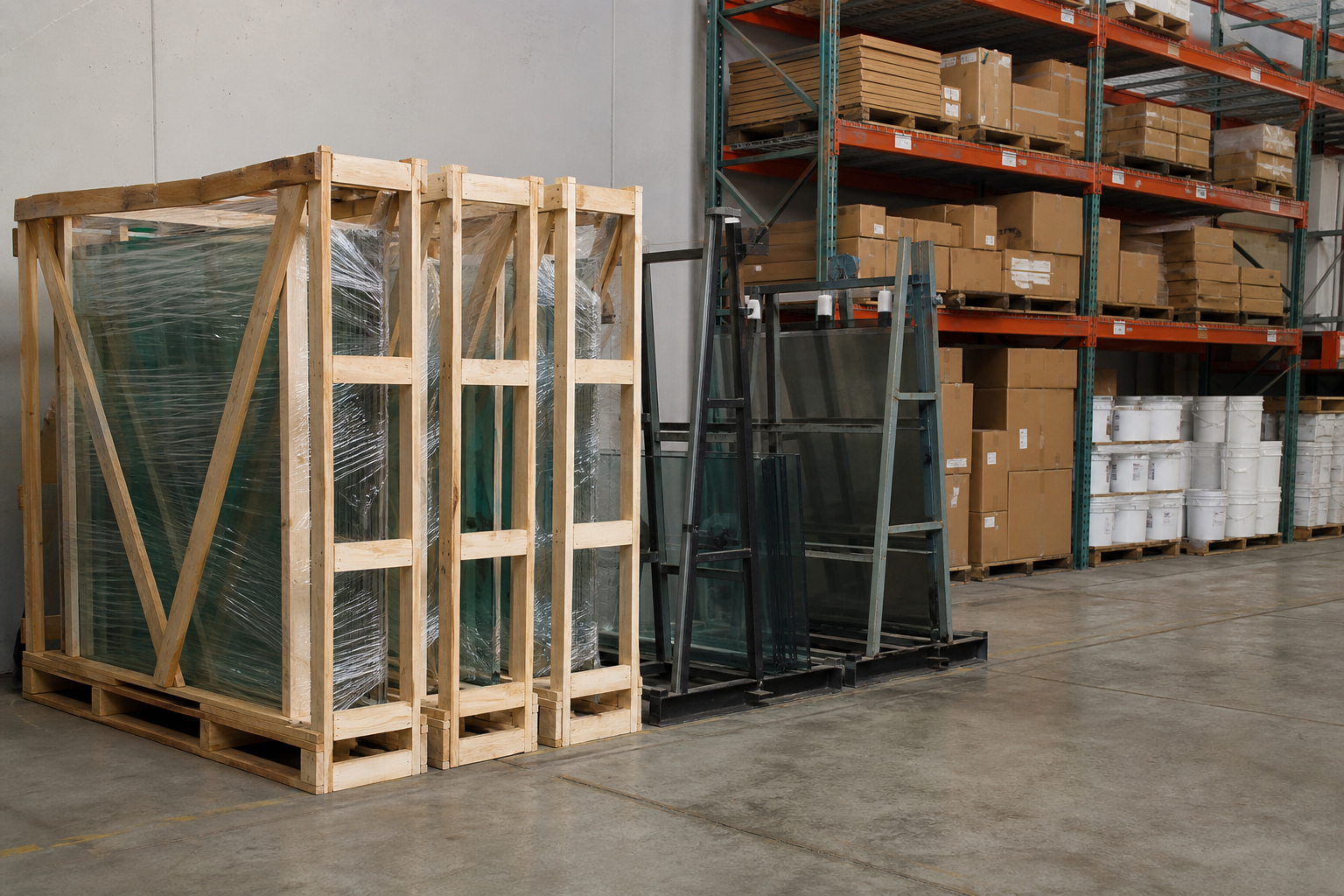
Glass is only stable on edge. Stored flat it point-loads on any high spot; stored upright at the wrong angle it walks or topples. The industry standard is storage on edge at a slight lean against a supported rack face.
Glass fails suddenly. There is no partial damage: a lite is either good or it is scrap and a hazard. That changes the economics of handling equipment and rack protection.
Extrusions are long and soft. Anodized and painted architectural aluminum marks easily, bends over a poorly spaced support, and comes in profiles that nest badly.
Both arrive as unit loads and leave as pieces. The building has to hold bulk and support order picking from the same stock without one damaging the other.
Everything is made to order. Glass cut for a project and extrusion cut to length are not fungible — damage means remaking, not restocking.
Storing glass safely
Glass storage is a specialist discipline, and most of the rules exist because someone learned them expensively.
- Store on edge, leaning against a supported face. A-frame and harp racks, and purpose-built glass storage systems, are designed around a small lean angle that keeps the lite stable against a padded upright. Vertical is not the same as stable.
- Support the full bottom edge on a compliant surface. Rubber, hardwood or polymer sills spread the load. Bare steel or concrete concentrates it on any imperfection, and that is where a chip becomes a crack.
- Never store glass flat and stacked. Any debris between lites becomes a point load under the weight of everything above it.
- Keep it in the manufacturer’s crate or stillage where possible. Crated glass is packed to be stable; breaking a crate down early doubles the handling.
- Interleave and separate. Interleaving material and spacers stop face-to-face contact, which prevents scratching and, in humid storage, staining of the glass surface.
- Control moisture. Glass stored wet or in condensing conditions can stain permanently. Storage should be dry, ventilated and away from doors that let weather in.
- Design the aisle for the handling equipment. Glass moves on vacuum lifters, manipulators, carts and stillages, all of which need more clearance and gentler approaches than a forklift with a pallet.
- Plan for breakage. A defined, contained area for broken glass with the right personal protective equipment is part of the layout, not an afterthought.
Conventional beam racking still has a role in a glass warehouse: crated glass, stillages and boxed units can be stored on structural pallet rack with fully decked levels, and the rack line usually forms the perimeter around the dedicated glass storage in the middle.
Aluminum extrusion storage
Architectural aluminum has a completely different failure mode: it is rarely destroyed, but it is easily made unsellable.
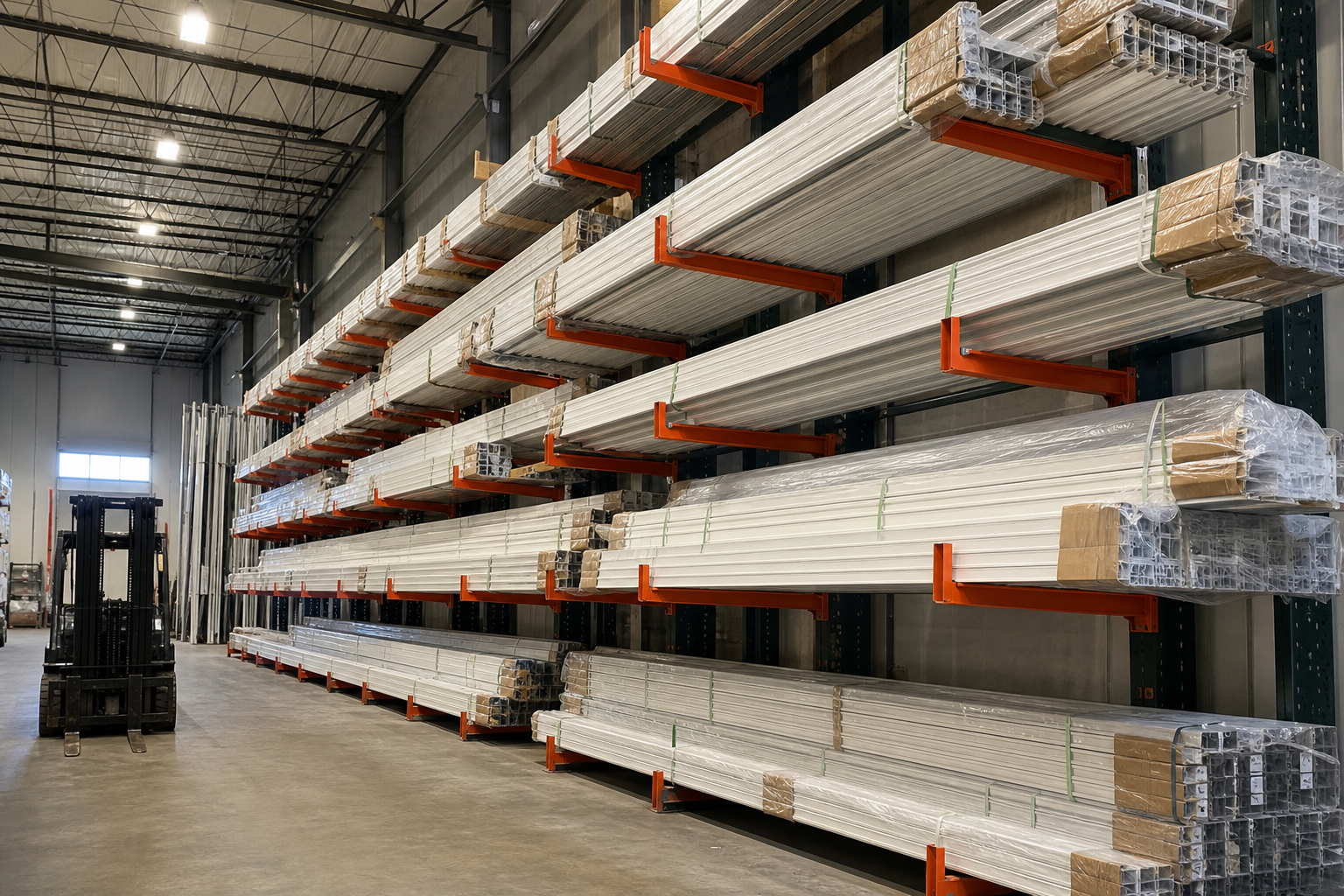
Cantilever rack is the default. Long profiles load from the side without a front column in the way, and the arms support the material along its length instead of bridging it between two beams.
Arm spacing controls sag. Slender profiles need closer support than heavy sections. Set the spacing from the lightest, longest profile you actually stock, not the average.
Protect the finish at the contact points. Anodized and powder-coated surfaces mark against bare steel. Arm covers, sleeves or timber packing at every contact point are cheap compared with a rejected order.
Do not drag. Pulling a length out of a nested bundle scratches every profile it touches. Storage that allows lifting, or bundles small enough to lift whole, avoids it.
Sort by profile, not by order. Mixed profiles in one arm level make picking a shuffling exercise and multiply handling damage.
Watch the ends. Overhanging aluminum into an aisle is both a damage risk and a safety hazard; arm length should be set by the longest stock length actually handled.
Consider vertical storage for short lengths. Offcuts and short profiles are far easier to manage standing in divided bins than lying in a mixed pile.
Hardware, sealants and machinery
Around the glass and the extrusion sits a conventional distribution business, and this is where a standard rack line does the work.
| Category | Behaviour | Storage |
|---|---|---|
| Glazing hardware and fittings | Small, numerous, picked constantly | Bins and shelving in low, decked rack levels close to the pick and pack area |
| Sealants, adhesives and tapes | Shelf-life driven, temperature-sensitive, moderately heavy | Selective rack with date-driven rotation in conditioned space; keep the oldest pallet the obvious one |
| Setting blocks, spacers and gaskets | Bulky, light, low value per cube | Upper beam levels — the classic use for height in this building type |
| Fabrication tooling and consumables | Heavy, high value, moderate frequency | Decked low levels near the counter or shipping, ideally within a controlled area |
| Machinery and equipment | Crated, very heavy, infrequent movement | Floor bays or heavy structural rack designed for concentrated point loads |
| Customer will-call orders | Mixed, time-critical | A dedicated staging zone that keeps customers out of the picking aisles |
Levels holding anything unpalletized need wire decking. Boxed hardware, loose fittings and part pallets have no business sitting on two beams.
Layout, handling and access
In a glass and aluminum warehouse, the layout question is less about density than about keeping incompatible activities apart.
- Keep glass handling away from forklift traffic. The single most effective safety measure is a glass storage and handling zone that trucks do not drive through.
- Give long material a straight run. Cantilever lines need approach length at the loading face; a bay that cannot be loaded is not storage.
- Put receiving next to bulk, and picking next to shipping. Crated glass and extrusion bundles should travel the shortest possible distance from the truck to their home.
- Size the will-call area properly. Fabricators collecting material are the reason the aisles get congested. A separate staging area fixes it.
- Leave clear space around A-frames. Glass being loaded or unloaded needs room for a lifter and two people, not the minimum aisle.
- Light it properly. Scratches, edge chips and inclusions in glass are invisible in poor light, and inspection happens where the material is stored.
- Design the floor for the equipment. Vacuum lifters and glass carts need flat, sound floors; a joint or a spall that a forklift ignores can jar a lite.
Modelling the bay sizes and aisle widths before ordering is worth the hour — our 3D pallet rack configurator will lay out the beam and frame configuration and price it.
Loads, seismic and floor design
Both principal materials are dense, and both are stored in ways that concentrate load. That makes the engineering less forgiving than in a typical distribution warehouse.
| Design input | Why it matters here |
|---|---|
| Actual weighed loads | Glass crates and extrusion bundles are much heavier than their footprint suggests; capacity has to come from weighed loads rather than category assumptions |
| Point loading | Stillages, crates and machinery bear on small contact areas, so beam and deck selection has to account for concentrated rather than uniform load |
| Eccentric load on cantilever | Arm rating and column rating are different numbers, and both are affected by how far out on the arm the load sits |
| Slab thickness and condition | Anchorage design depends on the real slab; heavy A-frames and loaded cantilever columns transmit significant local load |
| Seismic design category | In Utah and the Intermountain West this governs frame design and anchorage on every rack project |
| Impact protection | Glass warehouses have narrow tolerances for column damage; guarding is a design item, not an accessory |
Capacity fundamentals are covered in our guide to pallet racking weight capacity, and the racking design standard is ANSI/RMI MH16.1 from the Rack Manufacturers Institute.
Safety and inspection
Stored glass is one of the few warehouse materials that can injure someone without any equipment being involved, so the safety case is different from a normal rack line.
Restrain everything. A-frames, harp racks and stillages need anchoring, and glass on them needs straps or retention where it can slide.
Train for glass handling specifically. Cut-resistant gloves, sleeves, eye protection and safe manual handling technique are basic requirements, and the failure mode is immediate.
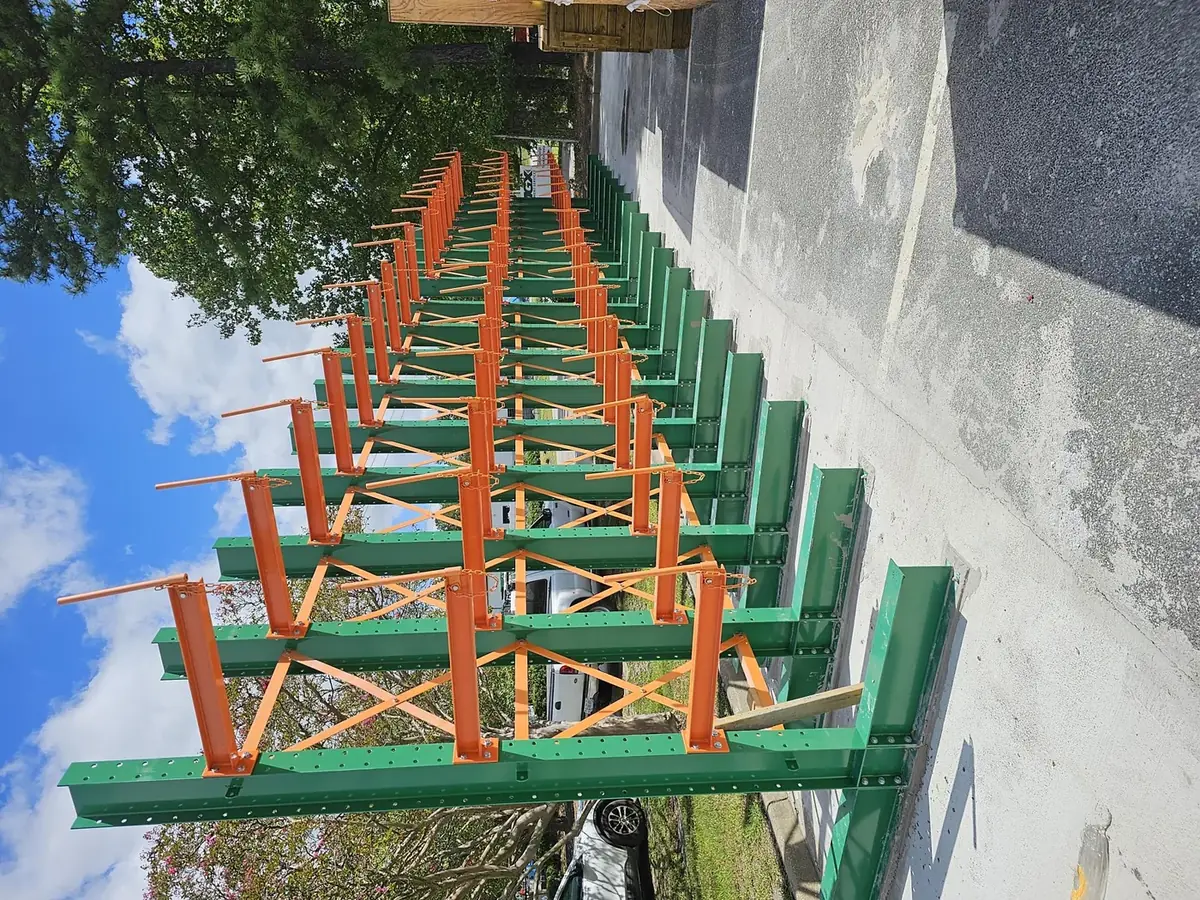
Protect columns properly. Damage to a cantilever column carrying eccentric load is more serious than the same damage to a beam frame. Column protectors and end guards belong at every exposed position.
Inspect after every impact. Bent arms, deformed columns and damaged base plates reduce capacity immediately — see rack inspection and repair for what to look for.
Keep aisles clear of offcuts and packaging. Timber crate debris and banding on a glass warehouse floor is a trip hazard next to material you never want to fall into.
Post current load ratings. Stock profiles change; the rating card should match what is actually stored today.
Use experienced installers. Anchorage, plumb and bracing on cantilever and glass storage are unforgiving of shortcuts — see rack installation.
General storage requirements for materials handling are set out in OSHA 1910.176. We design, supply and install racking for glass, glazing and metals distributors across the region — see Utah pallet rack, and our selective rack range for the conventional part of the building.
Utah pallet rack project: This case study supports our Utah pallet rack design and installation guide and, at the top level, our main pallet rack systems hub.
Shop Pallet Rack Products Online
Buy select items directly from our online store, or request a quote for volume, custom sizes and freight-rated orders.

Frequently asked questions
How should architectural glass be stored in a warehouse?
Can glass be stored on standard pallet racking?
What racking is best for aluminum extrusion?
How heavy is architectural glass for rack design?
What is an A-frame glass rack?
How do you protect extrusion finishes in storage?
Do glass and aluminum need separate areas in the warehouse?
Storing glass, extrusion and glazing supplies?
We design combined cantilever, structural rack and specialist storage layouts for glass and architectural metal distributors. Free design consultation.