
Battery Distribution Warehouse Racking: Johnson Battery Company
Batteries are the densest ordinary pallet load in distribution: a small footprint, a very large number on the scale, and consequences if any of it is guessed.
2021
Year Johnson Battery Company worked with us
Pallet rack
Product category we supplied
Battery distribution
Application
Weight, not cube
The constraint that sets the design
Plan your layout before you buy
Configure upright height, beam width, bay count, and load levels in our free 3D Pallet Rack Configurator, then get an instant bill of materials and request a quote.
The project
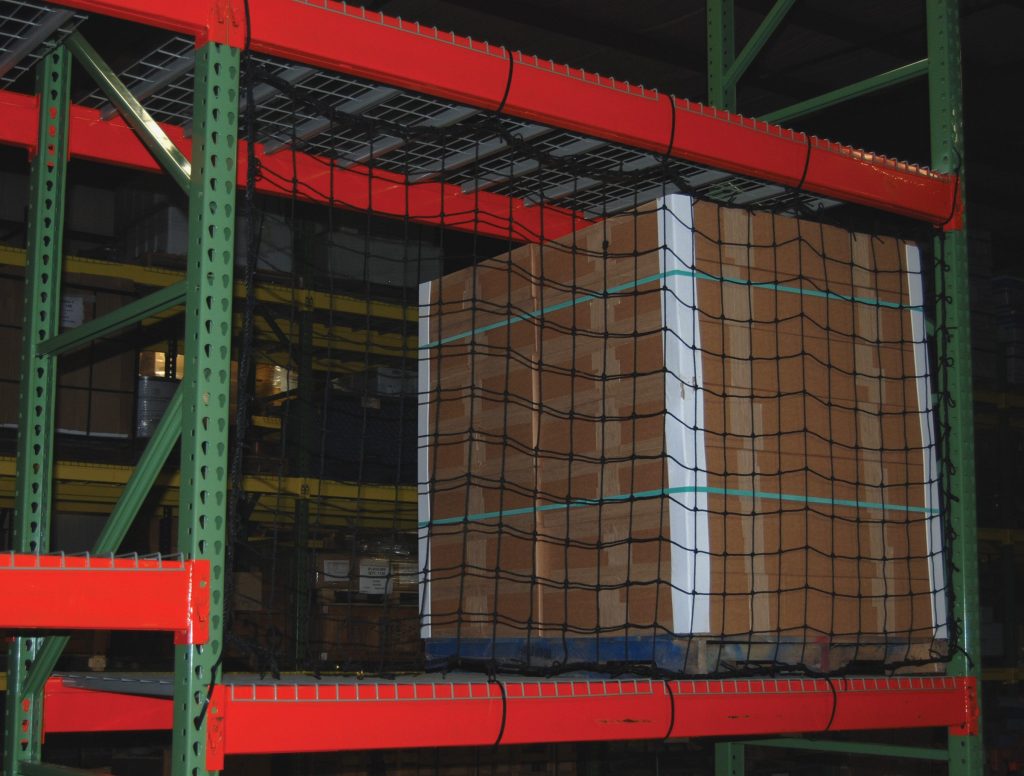
Johnson Battery Company is a battery distributor. Material Handling USA supplied pallet rack for the company in 2021. The client, the year and the product category are the only project details we publish — no layouts, dimensions or contract values, for any customer.
Battery storage deserves its own page because it inverts the assumption behind most warehouse design. Most distribution warehouses run out of cube before they run out of capacity; a battery warehouse runs out of capacity while the building still looks half empty. Everything below is how we approach pallet rack systems for weight-dense product: how the capacity is really calculated, where the load actually goes, and the operational details that keep a heavy rack safe.

Weight-limited, not space-limited
The pallet is small and the number is big. Lead-acid batteries are among the heaviest things routinely shipped on a standard pallet footprint. A layer that looks unremarkable from the aisle can be a multiple of what a general-goods bay is designed for.
Density does not need height. With weight-dense product, adding beam levels adds load to the frame far faster than it adds usable storage. The upright — not the beam — is usually what runs out first.
The mix moves. Automotive, commercial, marine and industrial batteries have very different weights per unit, and a bay that holds one profile safely may be well over its limit with another. Bay-by-bay assumptions have to be written down and labelled, not remembered.
Half a pallet is still a full load case. Partial pallets, mixed layers and returned cores all change how weight sits on the beams. A concentrated load in the middle of a span is not the uniformly distributed load the rating assumes.
The design conversation for this kind of product starts with a scale reading, not a floor plan. That is the opposite of how most warehouse projects begin.
Weigh a real pallet before anyone quotes steel
The single most useful thing a distributor can do before a rack project is put a full, typical pallet of the heaviest product on a scale and write the number down. Catalogue weights, estimates and ‘about a ton’ have all produced overloaded bays we have been called out to look at.
Reading a beam capacity honestly
Published capacities are precise statements about a specific arrangement. They are commonly read as general permission, which is where trouble starts.
| What the rating says | What people hear | What that means for heavy product |
|---|---|---|
| Capacity is per beam pair at a stated span | Capacity is per level regardless of length | A longer bay of the same beam carries less — span changes the number |
| Load is assumed uniformly distributed | Any load up to the number is fine | Two dense pallets in the middle of a wide span is a different, harsher load case |
| Frame capacity depends on beam elevations | The frame has one fixed rating | Adding or lowering a level changes the upright’s capacity — it must be re-checked |
| Deck capacity is separate from beam capacity | Decking is part of the beam rating | The deck can be the weakest element in a heavy bay |
| Ratings assume undamaged, plumb, anchored rack | Ratings apply to rack as it stands today | Any impact damage derates the bay until it is repaired |
Our pallet racking weight capacity guide works through the arithmetic, and pallet rack uprights explains why the frame rating changes when the beam levels change. For a heavy-product warehouse, ask the supplier for the manufacturer’s load table for your exact beam profile, span and level spacing — and keep it with the load application drawing where the team can find it.

Frames, decking and what happens at the floor
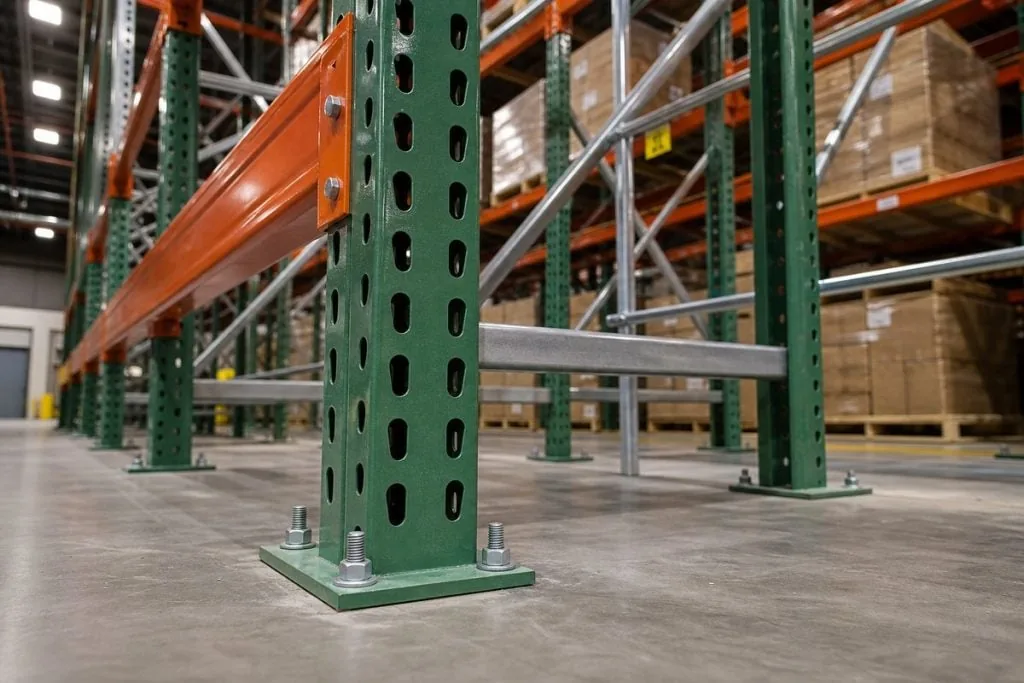
Structural rack starts to make sense. Where loads are heavy and traffic is constant, structural pallet rack — bolted hot-rolled steel rather than roll-formed — buys both capacity and impact resistance. In a battery warehouse where every pallet is at the top of the weight range, that margin is not a luxury.
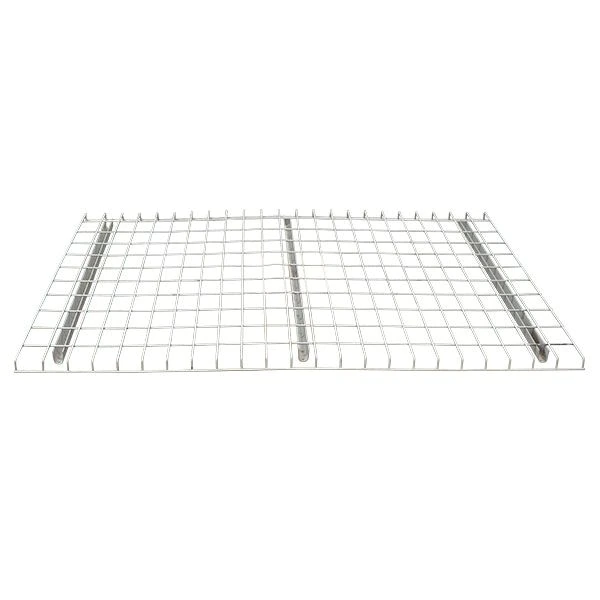
Deck for reality, not for the ideal pallet. Damaged pallets, part layers and returned cores all bear unevenly. Wire decking gives continuous support, keeps small items from falling through, and lets sprinkler water pass. Specify the deck capacity separately and match it to the concentrated loads you actually place.
The slab is part of the system. Heavy racking transmits its load into the floor at the base plates. Slab thickness, joint locations and subgrade all matter, and this is a question for the engineer of record rather than a catalogue. A base plate on a slab edge or a joint is not the same condition as one in a sound field of concrete.
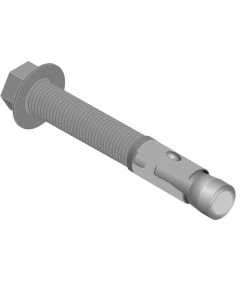
Anchor every column, properly. Anchor bolts are not a formality: they hold the rack in place under impact and under seismic load, and the anchor specification comes from the engineered design.
Handling and layout for dense product
The same ‘small, heavy, dense’ problem shows up in fastener and hardware distribution; our fastener distribution racking case study covers how capacity truth and the choice between rack and shelving play out there.
Electrolyte, charging and housekeeping
Batteries bring hazards that have nothing to do with steel, and they still belong in the storage plan.
Damaged units leak. Anything stored above head height that can leak needs a plan for what happens below it. Where damaged or suspect stock is quarantined, containment and an acid spill response belong in that area — see spill control and secondary containment.
Corrosion attacks the steel you rely on. Electrolyte on a base plate or the lower part of an upright is a structural issue, not a cosmetic one. In any area where spills are plausible, base plates go on the inspection list.
Charging areas are their own design problem. Battery charging — for the lift-truck fleet as much as for stock — involves ventilation, ignition-source control and electrical requirements that are governed separately from rack design. Keep it a defined area, not a corner of the racking.
Lithium-ion changes the fire question. Storage of lithium-ion product is treated differently from lead-acid in fire protection terms, and the requirements are evolving. If you are adding lithium product to an existing warehouse, raise it with your fire protection engineer and the authority having jurisdiction before you fill the bays.
Seismic design, installation and inspection
- Seismic design is driven by the weight you store. Rack seismic forces scale with the stored mass, so a heavy-product warehouse is exactly where the seismic design matters most. In the Intermountain West this is a routine part of every project, not an exception.
- Get the design stamped for your building. Seismic design category, site class and the actual load pattern all feed the calculation. A rack layout that is compliant in one building is not automatically compliant in another.
- Install plumb, anchored and to the drawing. The engineering assumes a correctly built rack; our installation teams build to the stamped layout.
- Guard the frames in the traffic lanes. Heavy loads mean heavier trucks and harder impacts — rack guards and column protectors pay for themselves.
- Inspect regularly and after every impact. Damage in a heavily loaded bay is far less forgiving than in a light one: rack repair and inspection.
- Re-check the design when the product changes. A new, heavier line, a new pallet pattern or an added beam level all change the load case. The rack does not know your product mix changed.
The governing reference for rack design and utilization is ANSI MH16.1, alongside the seismic provisions of the building code adopted where you are; OSHA 1910.176 covers stacking and securing stored material. We work with these on every Utah pallet rack project.
Shop Pallet Rack Accessories Online
Protect and finish your pallet rack installation with these in-stock accessories, or request a quote for custom-sized rack, freight and volume pricing.

Heavy and dense product racking FAQs
How heavy can a pallet rack level be loaded?
Should batteries be stored on structural or roll-formed rack?
Why does the upright rating matter more than the beam rating here?
Do we need containment under battery storage?
Does storing lithium-ion product change anything?
How often should heavy-loaded racking be inspected?
Utah pallet rack project: This case study supports our Utah pallet rack design and installation guide and, at the top level, our main pallet rack systems hub.
Racking Designed From the Scale Reading Up
Send us your heaviest pallet weight and your building, and we will design bays that carry it with the margin the code expects.