
Auto Parts Warehouse Pallet Rack: Payson Auto Supply
How an automotive parts distributor in Payson, Utah uses teardrop selective pallet racking to keep thousands of slow- and fast-moving SKUs pickable from a single aisle face — and what to consider before racking your own parts warehouse. Batteries are the heaviest thing most parts operations store — our battery distribution warehouse racking case study covers how weight-dense pallets change the rack design.

2025 & 2026
Years Payson Auto Supply worked with Material Handling USA on pallet rack
Payson, UT
Utah County automotive parts operation
Selective
Rack style that keeps every pallet position directly pickable
ANSI MH16.1
US design standard for industrial steel storage racks
Plan your layout before you buy
Configure upright height, beam width, bay count, and load levels in our free 3D Pallet Rack Configurator, then get an instant bill of materials and request a quote.
The project
Payson Auto Supply is an automotive parts business in Payson, Utah. Material Handling USA supplied pallet rack for the company in 2025 and again in 2026 — the second order is the pattern we see in almost every healthy parts warehouse: the first bays work, inventory grows into them, and the shelf plan gets extended rather than replaced.
That repeat pattern is the interesting part of this case study, and it is the reason we use it to explain how to plan an auto parts warehouse racking layout. Parts distribution is not high-throughput palletized distribution. It is a storage problem with a very long tail: a small number of items move constantly, a large number of items move a few times a year, and both have to be findable by a counter person or a delivery driver in a hurry. The rack has to serve picking first and pallet storage second, which changes almost every decision compared with a pure pallet-in / pallet-out building.
This page pairs the verified facts of that project with the engineering and planning considerations that apply to any automotive parts warehouse. The full range of systems we design and install is on our pallet rack systems page; the configuration used here belongs to the selective pallet racking family.
What we publish
We publish only what we can verify: the client, the years we worked together, and the product category supplied. We do not publish building dimensions, layouts, quantities, pricing or anything else about a customer’s facility. Everything else on this page is general engineering and planning guidance, not a description of this customer’s building.
What an auto parts warehouse actually has to store
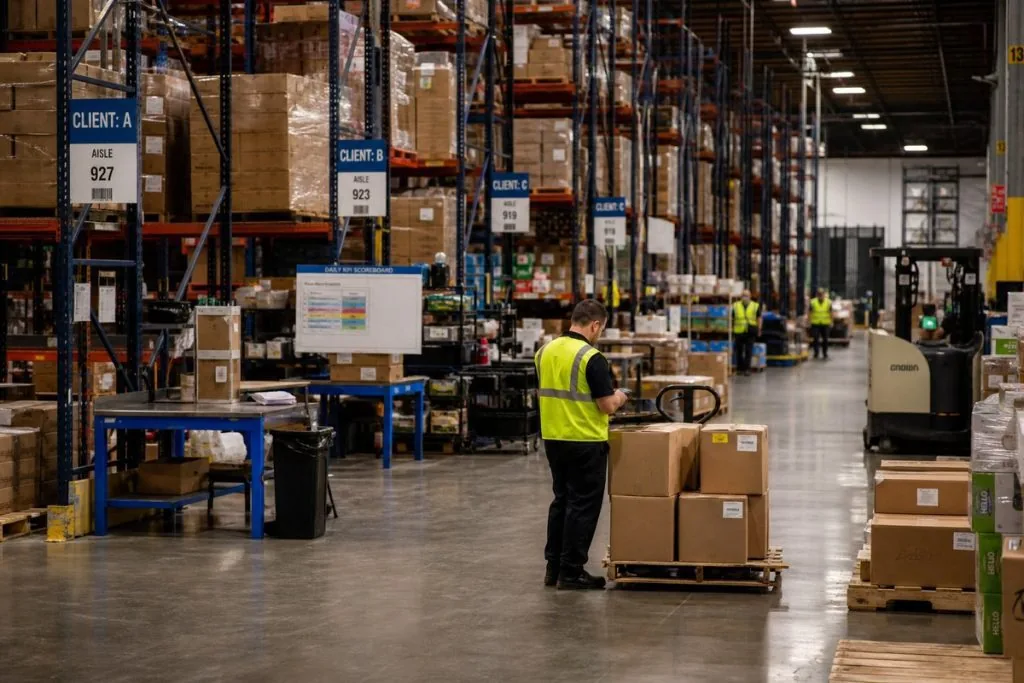
Before choosing a rack style, write down what is physically going on the shelf. In a jobber or parts distribution operation, four inventory profiles usually live in the same room: For the shelving, bin and slotting side of the same building, see auto parts warehouse shelving, bin storage and slotting.
Small, fast-moving boxed parts — filters, plugs, sensors, brake pads, belts, wiper blades. These are cartons, not pallets. They are picked several times a day and they want a low, waist-to-eye level position with an open pick face.
Bulky, awkward parts — bumpers, body panels, radiators, mufflers, exhaust assemblies, wheel and tire assemblies. These are light for their size and destroy any layout designed only around 48 × 40 pallets.
Palletized bulk and backstock — oil, antifreeze, washer fluid, batteries, cases of chemicals. These are dense, heavy, arrive by pallet and go up high or in a reserve row.
Long stock — exhaust tubing, trim, tailpipes, occasionally lengths of hose or tubing on a reel. Long unpalletized material is what cantilever racking exists for; putting it in a pallet bay is one of the most common ways a parts warehouse loses space.
A single rack style cannot serve all four well. The layouts that hold up over years mix a dominant selective pallet rack area with a small amount of the right specialty storage for the outliers.
Choosing the rack type for a parts operation
Dense storage systems — drive-in, push-back, pallet flow — trade selectivity for cubic capacity. They are excellent when you have many pallets of the same SKU. A parts warehouse is the opposite case: many SKUs, few pallets each. That is why nearly every parts warehouse racking plan starts with single-deep selective rack and adds density only where a genuine multi-pallet SKU exists (usually fluids, batteries or filters bought by the truckload).

Beam levels, shelf heights and decking
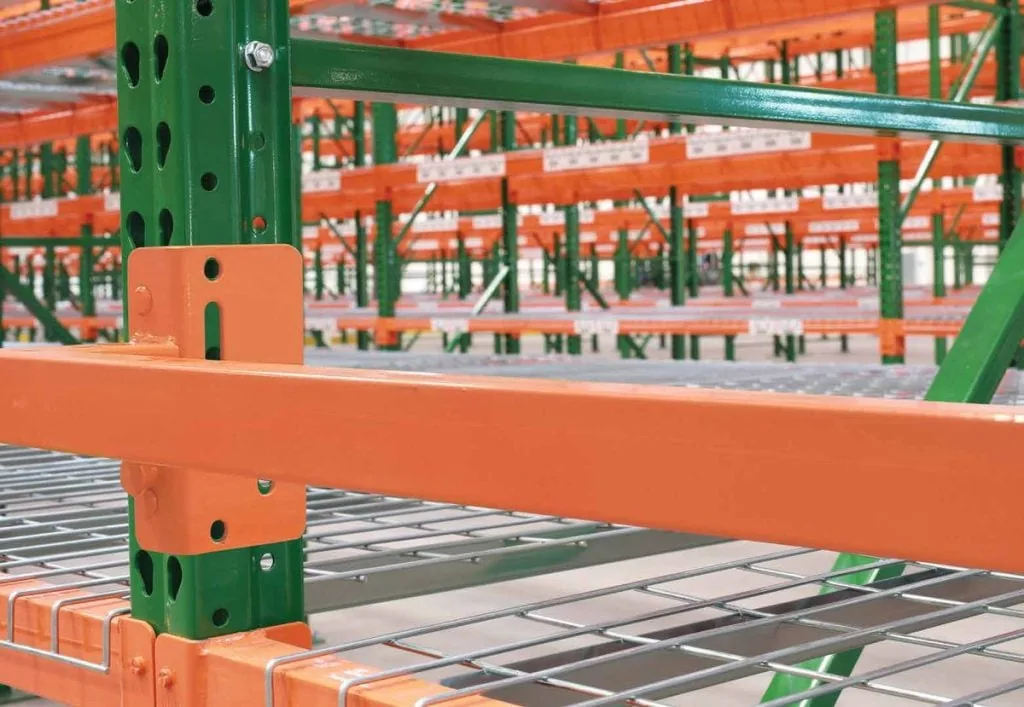
The single biggest capacity gain in a parts warehouse is not more rack — it is better beam spacing. Pallet rack beams are adjustable, and in a parts operation they should be adjusted to the goods rather than left on a default pitch.
Three rules do most of the work. First, size the opening to the load plus clearance for the handling equipment, not to a round number; every wasted inch above a carton is multiplied by every level in every bay. Second, put the fastest-moving items in the ergonomic band between roughly knee and shoulder height and push slow movers up. Third, remember that beam levels are cheap and uprights are not: adding a level to an existing frame is usually the least expensive capacity you will ever buy.
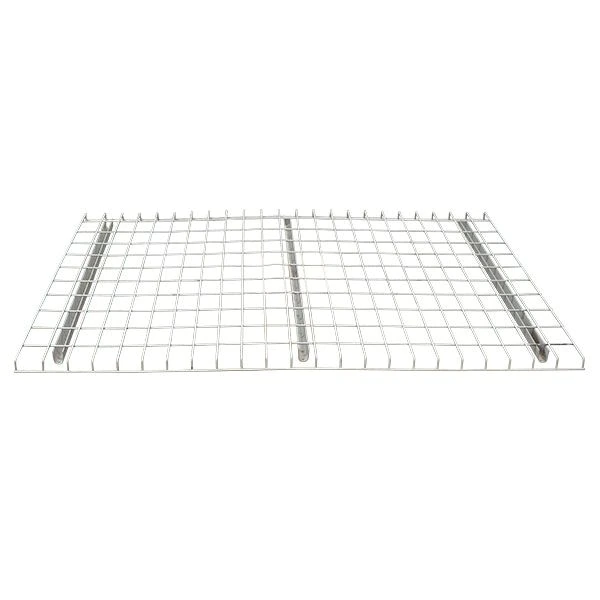
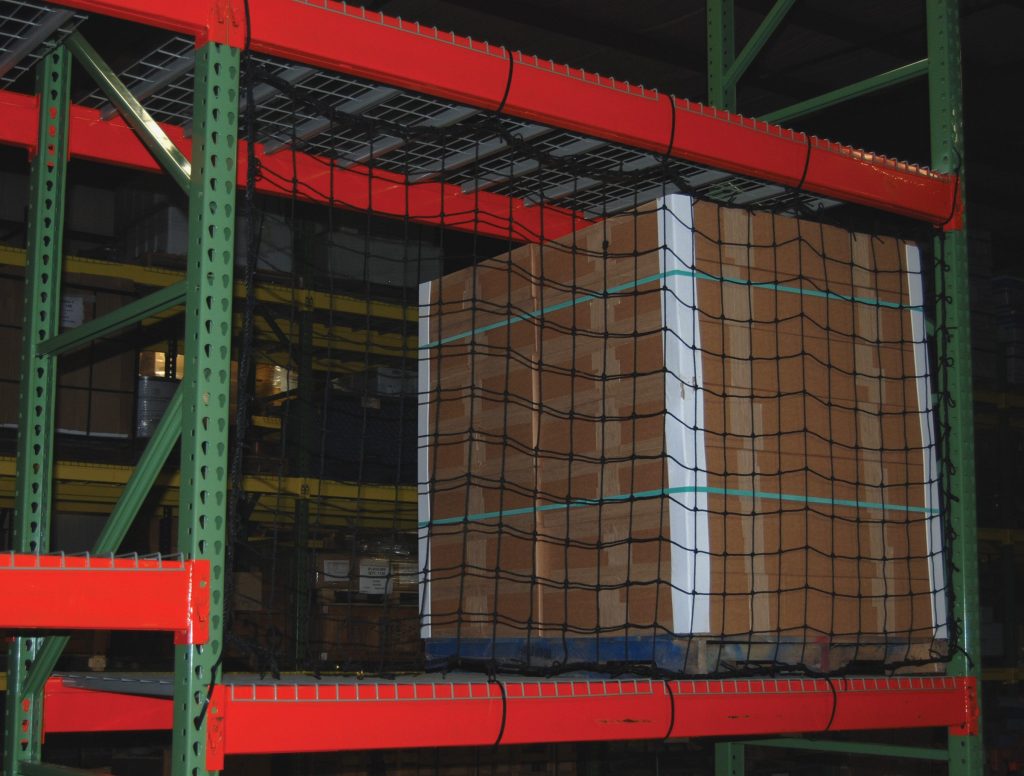
Because most parts are cartons rather than full pallets, the shelf level needs a deck. Welded wire decking is the usual choice: it supports loose cartons, lets sprinkler water and light through, does not hide dropped hardware, and is visible for inspection. It has to be sized to the beam and seated correctly — wire deck is designed to rest on the step of a step beam, and it should never be laid on a beam it does not fit. Solid decking traps water in a sprinklered building and needs fire protection review before it goes in.
Loads, capacity and the plaque nobody reads
Rack capacity is not one number. It is a system of numbers, and confusing them is how bays get overloaded without anyone intending to.
Beam capacity is the load a pair of beams can carry at a given span, evenly distributed across two pallets. Frame (upright) capacity is the total load a frame can carry, and it depends on the vertical spacing between beam levels: the same frame is worth less as the beam levels get farther apart. Deck capacity is separate again, and a wire deck rated for a distributed carton load is not rated for a concentrated point load. Nothing on a rack is rated for an impact load.
The American National Standard for these structures, ANSI MH16.1, Design, Testing and Utilization of Industrial Steel Storage Racks, is published through the Rack Manufacturers Institute at MHI and calls for the owner to have load information permanently displayed on the installed rack. In practice that means a capacity plaque at the end of each row, stating what the configuration was designed for. If your beam levels are later moved, that plaque no longer describes the system — which is exactly why moving beams should be treated as a design change and not as housekeeping.
Parts warehouses run into two specific capacity traps. The first is oil and fluid: a pallet of quarts or gallons is dramatically heavier than a pallet of filters occupying the same footprint, and it often gets put wherever there is room. The second is the “temporary” hand-stack — the level that was designed for cartons and slowly acquires a battery pallet on one end.
Rack overloading is an OSHA issue as well as an engineering one
OSHA’s general materials-handling rule, 29 CFR 1910.176(b), requires that stored material be stacked, blocked, interlocked and limited in height so it is stable and secure against sliding or collapse. Capacity is how you demonstrate that on a rack. Have your rack configuration reviewed by the manufacturer or a qualified engineer whenever the load profile changes.

Aisles, equipment and the counter
Aisle width is decided by the equipment, not by the rack. A sit-down counterbalanced forklift needs a wide aisle to turn and place a pallet square; a reach truck needs less; an order picker or a pallet jack needs less still. Narrowing the aisle beyond what the equipment can work in does not save space — it buys damaged uprights.
Parts warehouses add a wrinkle most warehouses do not have: people on foot, constantly, in the same aisles as the equipment. Counter staff and drivers pick small items all day. That argues for separating the hand-pick zone from the pallet-handling zone where the building allows it, for keeping the busiest pick faces off the main travel lane, and for a labelling scheme that lets somebody find a part without walking the aisle twice.
Also plan the receiving end. Parts arrive in a mix of pallets, totes and parcel cartons, and the staging space that mix needs is real floor area. A layout that fills every square foot with rack and leaves no decanting space will push receiving into the aisles within a month.
Code, seismic and the Utah question
Steel storage racks are structures. In jurisdictions that have adopted the International Building Code, racks over a defined height are permitted and designed as nonbuilding structures, with seismic demands determined under ASCE 7 and the rack design standard referenced above. Along the Wasatch Front — Payson, Provo, Spanish Fork and the rest of Utah County included — seismic design is a live requirement, not a formality.
Practically, that shows up in four places on a parts warehouse project:
Anchorage
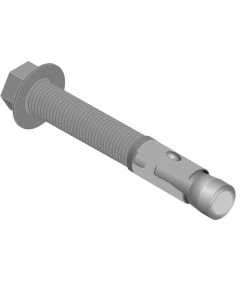
Every upright is anchored to the slab through its base plate with the specified anchor type, size, embedment and edge distance. Anchors are not interchangeable; see our page on pallet rack anchor bolts.
The slab itself
Anchors are only as good as the concrete. Slab thickness, strength, joint locations and any existing patching all affect what can be anchored where, and they need to be confirmed before the layout is fixed.
Configuration control
Seismic capacity is calculated for a specific frame, beam and level arrangement. Once a system is engineered, changing beam elevations or adding levels changes the calculation.
Permitting and review
Where a permit is required, the authority having jurisdiction will want engineered drawings and calculations for the rack. Building that into the schedule at the start avoids a stalled installation.
Planning a parts warehouse layout?
We design, supply and install pallet rack across Utah — including Provo and Utah County — and can review beam levels, capacity and anchorage before anything is ordered.
Request a Quote How to design a pallet rack layout Call (801) 328-8788

Protection, damage and inspection
The failure mode in a parts warehouse is rarely a design error. It is accumulated forklift contact at floor level: a scuffed upright at an aisle end, a dented column beside a dock door, a base plate whose anchors have been worked loose. Roll-formed uprights lose capacity when a column is dented or bowed, and they lose it at exactly the location that carries the most load.
Two responses matter. The first is physical protection where traffic actually is — column guards and row-end protectors at aisle ends, at cross-aisle openings and beside doors, plus row spacers keeping back-to-back frames square. The second is a routine of looking: a short walk-through on a set schedule, a rule that any damaged member is reported and its bay unloaded rather than watched, and a documented rack inspection and repair process for anything found. Rack manufacturers and the industry standard both call for damaged components to be unloaded and evaluated, not left in service because the load is still up.
How a project like this runs
Repeat orders like Payson Auto Supply’s are easiest when the first installation was planned as the first phase of something larger. That is mostly a matter of sequence.
Profile the inventory
Count what is actually stored by handling type — cartons, pallets, long stock, bulk fluid — before drawing anything.
Measure the building
Clear height under the lowest obstruction, column grid, door and dock locations, slab condition, sprinkler layout and the equipment you own.
Lay out for picking
Set the aisle to the equipment, put fast movers in the ergonomic band, and leave real receiving and staging space.
Engineer and specify
Frame and beam sizes, level elevations, decking, anchorage, protection and capacity plaques — documented, so phase two matches phase one.
Install and verify
Professional pallet rack installation, plumb and anchored to the drawings, with a walk-through before the first pallet goes up.
Inspect on a schedule
A repeating inspection, a damage-reporting rule, and a review of the capacity plaque whenever the load profile or beam levels change.
Shop Pallet Rack Accessories Online
Protect and finish your pallet rack installation with these in-stock accessories, or request a quote for custom-sized rack, freight and volume pricing.

Auto parts warehouse racking FAQs
What kind of pallet racking is best for an auto parts warehouse?
What is teardrop pallet rack, and why is it so common?
Can I put boxes straight on pallet rack beams?
How high can I stack parts on the rack?
Do I need engineering for pallet rack in Utah?
How often should pallet rack be inspected?
Can I add levels to pallet rack I already own?
Utah pallet rack project: This case study supports our Utah pallet rack design and installation guide and, at the top level, our main pallet rack systems hub.
Rack Your Parts Warehouse the Way It Actually Picks
Material Handling USA designs, supplies and installs pallet rack for automotive parts distributors across Utah and the Intermountain West.
Ready to configure your pallet rack system?
Use our guided configurator to choose the right configuration, review your parts and submit it for checkout or a formal quote.