
Heavy-Duty Boltless Shelving Ordered as Components: Utah Trust Lands Administration, Salt Lake City, UT
How the state agency that manages Utah’s school trust lands bought boltless shelving as a parts list instead of boxed units: heavy-duty posts, two shelf widths, tie plates and state contract pricing.

SLC, UT
Project location
State agency
Customer type
7 ft HD
Angle posts
2 widths
36 in and 30 in
The Project: Office Shelving for a State Land Trust Agency
The Utah School and Institutional Trust Lands Administration, now known as the Trust Lands Administration, is the state agency that manages the land Congress granted Utah at statehood to support its public schools and other institutions. Created by the Utah Legislature in 1994, it manages about 3.3 million acres of surface and mineral estate plus another 1.2 million acres of minerals only, and earns revenue for the trust from energy development, real estate and surface uses. The money goes into permanent endowments whose largest beneficiary is Utah’s public school system.
An agency like that runs on paper as much as on land: leases, plats, surveys, development plans, rolled maps and years of transaction records, plus the ordinary supplies of a busy office. That calls for plain, strong, adjustable steel shelving that can be fitted to the walls of an office storage room rather than a warehouse.
In October 2018 the agency asked our Salt Lake City team for boltless shelving. Chris Rodgers, our director of sales, quoted it on October 23, the order went to the manufacturer the next day, and the shelving was shipped by freight to the agency’s Salt Lake City office, where its own staff assembled it.
This project is one of the Salt Lake City jobs behind our boltless shelving in Salt Lake City service page. The product family is covered on our boltless shelving hub, part of our wider shelving solutions range, and public sector buyers will find more on our government storage shelving page.
A note on what we know
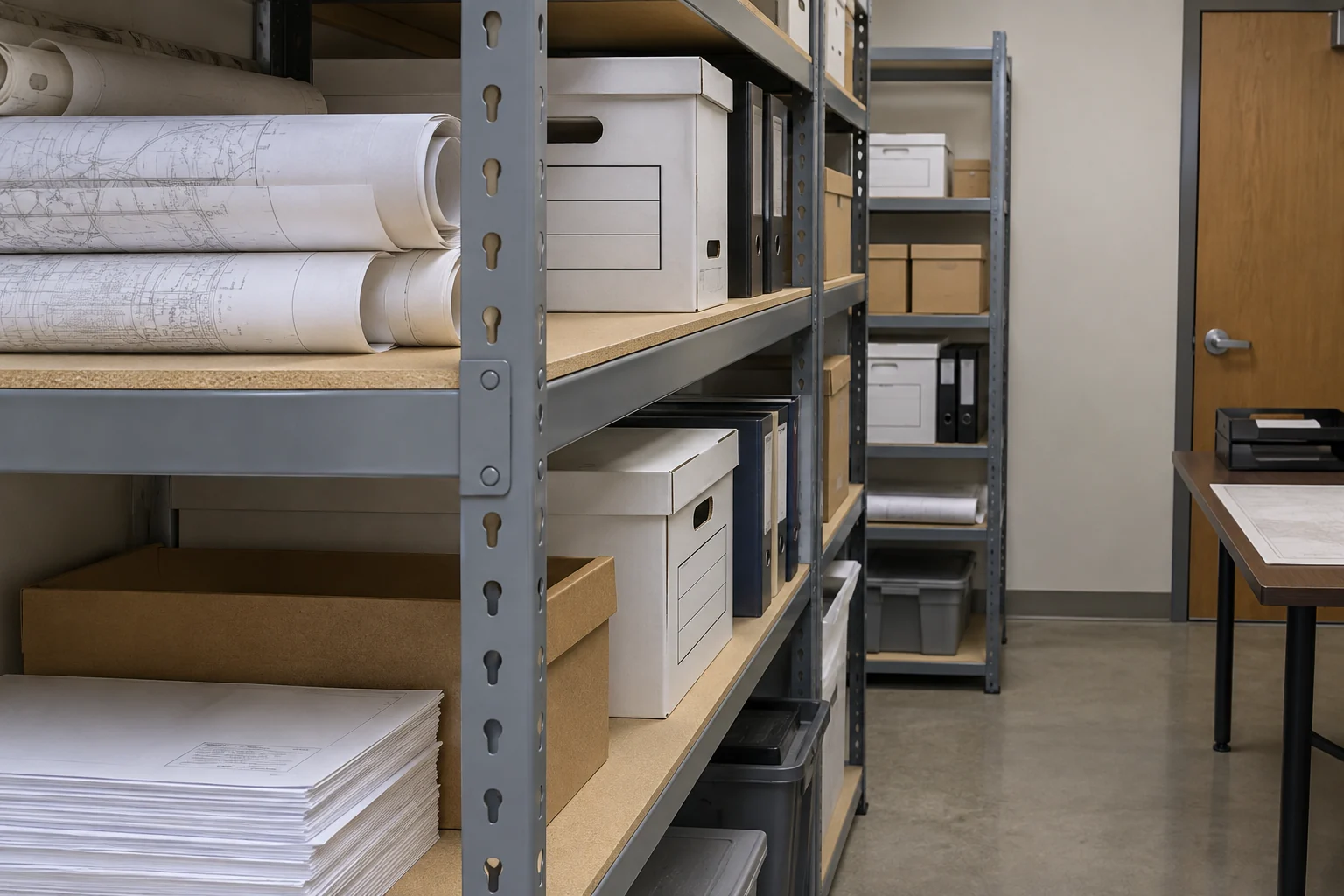
We supplied the shelving; we were not on site and do not know exactly which room it went into or what is stored on each shelf. We are not publishing the room layout, the street address, the order value or how many pieces were ordered. The photos on this page are illustrations, not photos of the agency’s office. Everything said about the shelving itself (components, sizes, purchasing and delivery) comes from the project’s quote, manufacturer purchase order and payment record, and the agency description comes from its own website.
Ordered as a Parts List, Not as Boxed Units
Most boltless shelving quotes describe finished sections: so many units, this wide, this deep, this tall, with this many levels. This quote was different. It listed the individual components, line by line, and left the agency to build them into exactly the units its room needed.
| Component on the quote | What it does in the finished shelving |
|---|---|
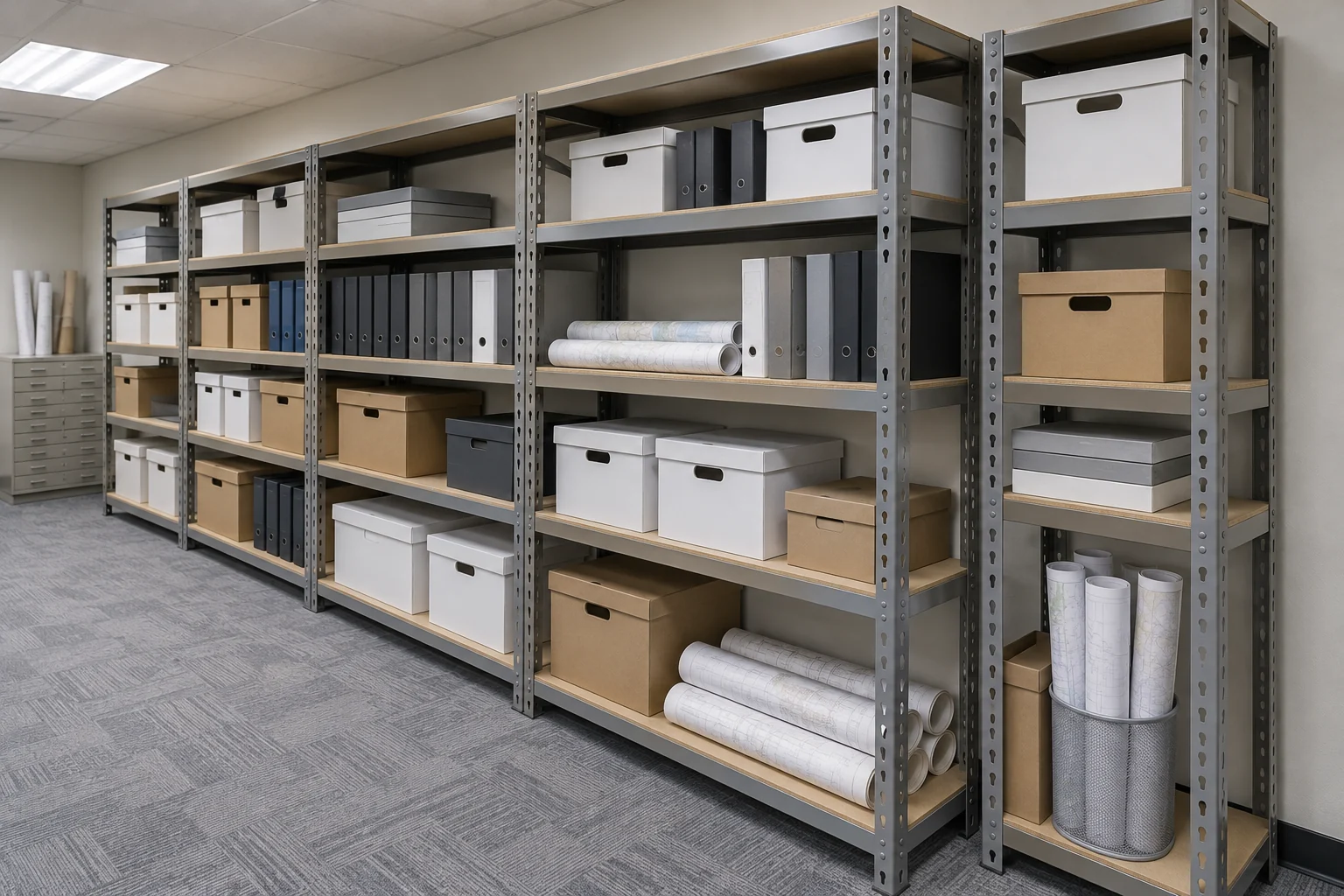
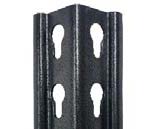
| 7 foot heavy-duty angle posts | The uprights. Heavier gauge steel than standard posts, with keyhole slots up the full height. |
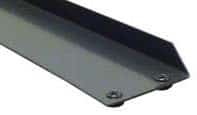
| 36 inch double rivet beams | Front and back beams for the standard 36 inch wide units. |
| 30 inch double rivet beams | Front and back beams for narrower 30 inch wide units. |
| 24 inch double rivet beams | End beams that set every unit at 24 inches deep and square it up. |
| Tie plates | Small steel plates that join the posts of neighboring units so a row stands together. |
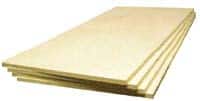
| 36 x 24 and 30 x 24 inch particle board decks | One solid deck per level, cut to match each width. |
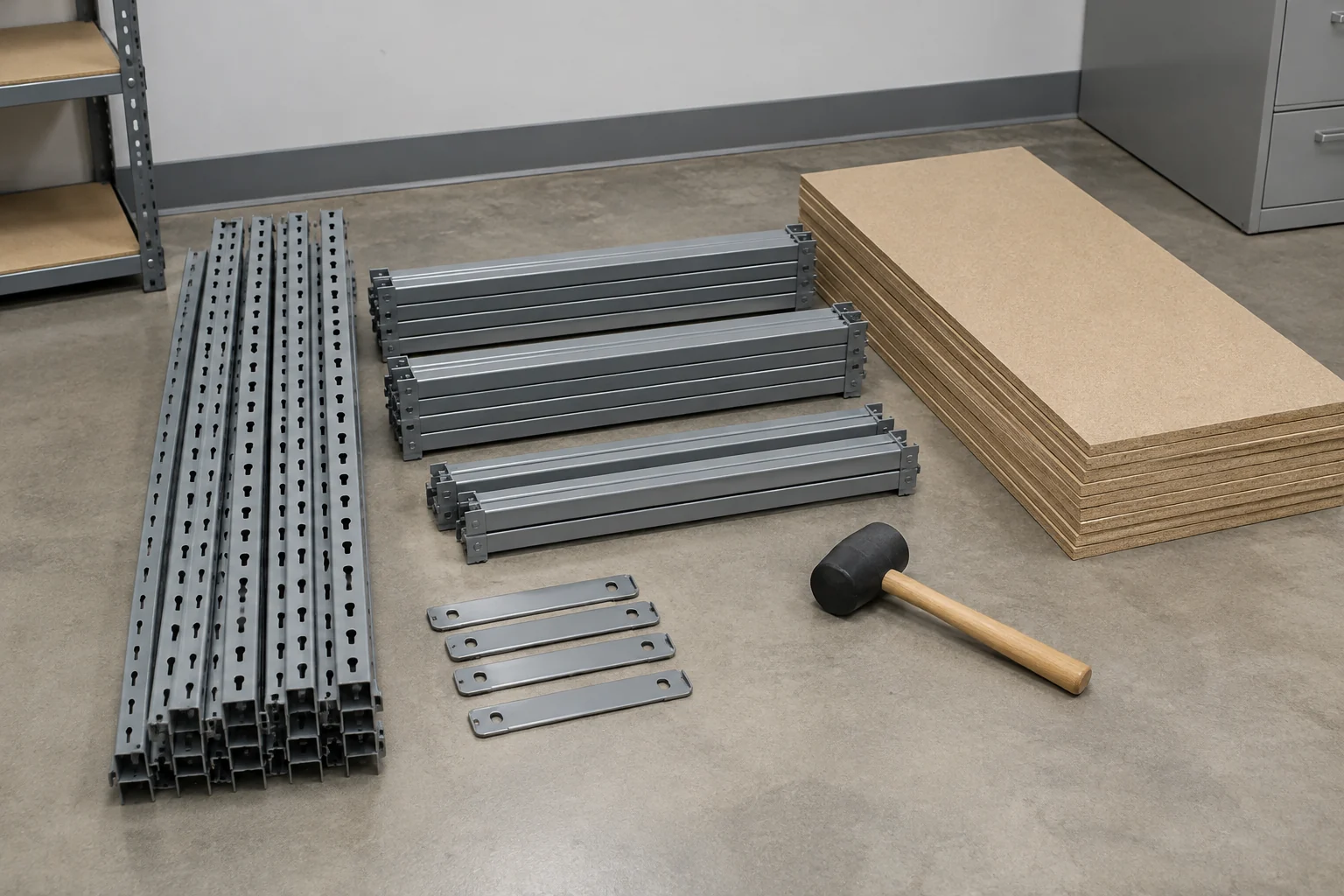
Buying the parts rather than the units has two practical advantages. First, nothing has to be a standard unit. The number of levels on each set of posts, the mix of widths and the way units join into a row are all decided by the parts count, not by a catalog number. Second, it avoids paying for pieces that would go unused, because the order includes exactly the posts, beams and decks the planned shelving needs.
The trade-off is that someone has to do the counting. Each level needs four beams (two for the width, two for the depth) and one deck, and each freestanding unit needs four posts. Getting those ratios right before the order ships is the difference between a finished room and a missing beam. Our custom boltless shelving guide walks through how posts, beams and decks combine, and replacement parts are listed on our boltless shelving accessories page.
Check the math on any parts-list order
Count levels, not units: every level needs two width beams, two depth beams and one deck. Then count posts: four per freestanding unit. If the beam and deck counts do not divide evenly into levels, something is missing.
Two Widths on One Depth: 36 Inch and 30 Inch Units
The parts list carried beams and decks in two widths, 36 inches and 30 inches, and one depth, 24 inches. The posts and the 24 inch end beams are the same for both widths, so the only parts that change between a 36 inch and a 30 inch unit are the front and back beams and the deck.
Mixing widths like this is the usual way to fit shelving to a real room. Walls are rarely an exact multiple of 36 inches, and a run of standard units often leaves an awkward gap at a corner, beside a door or next to a window. A narrower unit at the end of the run uses that space instead of wasting it. We do not have the room plan, so we cannot say exactly where each width went, but a parts list with most decks at 36 inches and a few at 30 inches is the classic pattern for that kind of fit.
Keeping one depth matters just as much. With every unit 24 inches deep, the shelf fronts line up along the wall, the aisle stays the same width all the way along, and any deck or depth beam fits any unit. Where our Weber County Library project mixed depths for different collections, this order kept depth constant and varied only the width.
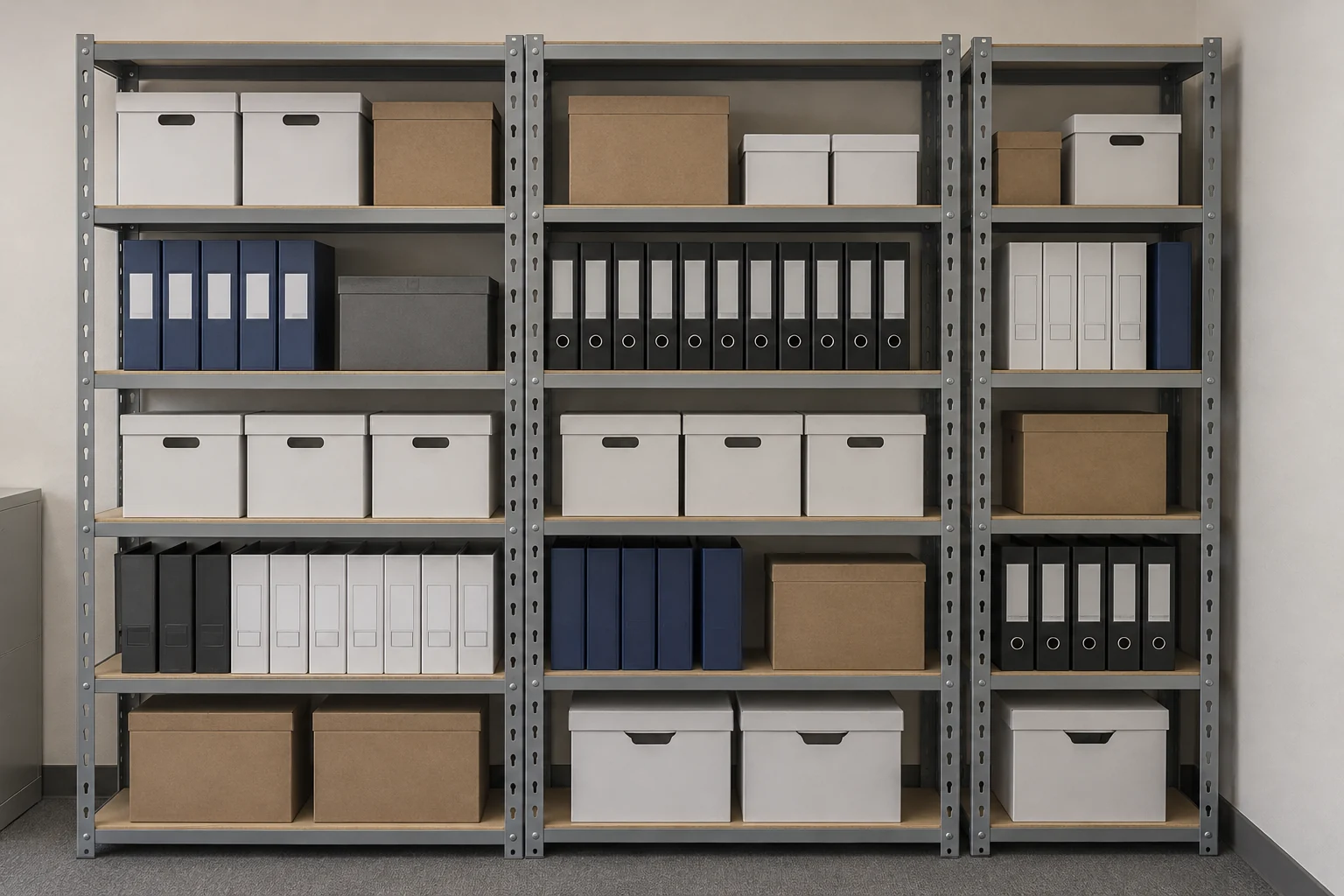
| Width | Typical use in an office storage room |
|---|---|
| 36 inch | The standard unit: file boxes three across, binders and office supplies, the bulk of the run. |
| 30 inch | Filling a shorter wall, a gap beside a door or the end of a run; also handy for rolled maps stood on end. |
| 24 inch depth (both) | Holds a standard records box lengthwise with room to spare and keeps the aisle open. |
Heavy-Duty Posts and Double Rivet Beams Throughout

Two choices on this order raise it above basic office shelving. The posts were heavy-duty angle posts, a heavier gauge upright than the standard post in the same series, and every beam, in every width and on every side, was a double rivet beam with two rivets at each end instead of one.
Paper is heavy. A shelf of full records boxes or bound files weighs far more than its size suggests, and office shelving tends to be loaded for years without being emptied. Double rivet beams are stiffer and connect to the post more strongly, which keeps the front edge of a loaded shelf straight, and heavy-duty posts add stiffness to the whole frame. On short 30 and 36 inch spans that is a comfortable margin rather than a necessity, which is exactly how you want office shelving specified.
There were no deck supports on the order. On a 24 inch deep deck spanning 30 or 36 inches, the particle board rests on beams that are close together, so the extra support bar used on longer and deeper decks was not part of the specification. Our Utah Breakers and City of Draper projects, with 72 and 96 inch spans, are examples of where deck supports do belong.
Load ratings
How much a level can carry depends on the beam type and the span. The manufacturer’s published capacities by beam length are on our single vs double rivet beams guide; confirm the rating for your heaviest boxes on the quote rather than estimating it.
For other deck materials, our boltless shelving decking options page compares particle board, wire and steel decks.
Tie Plates: Joining Separate Units Into One Row
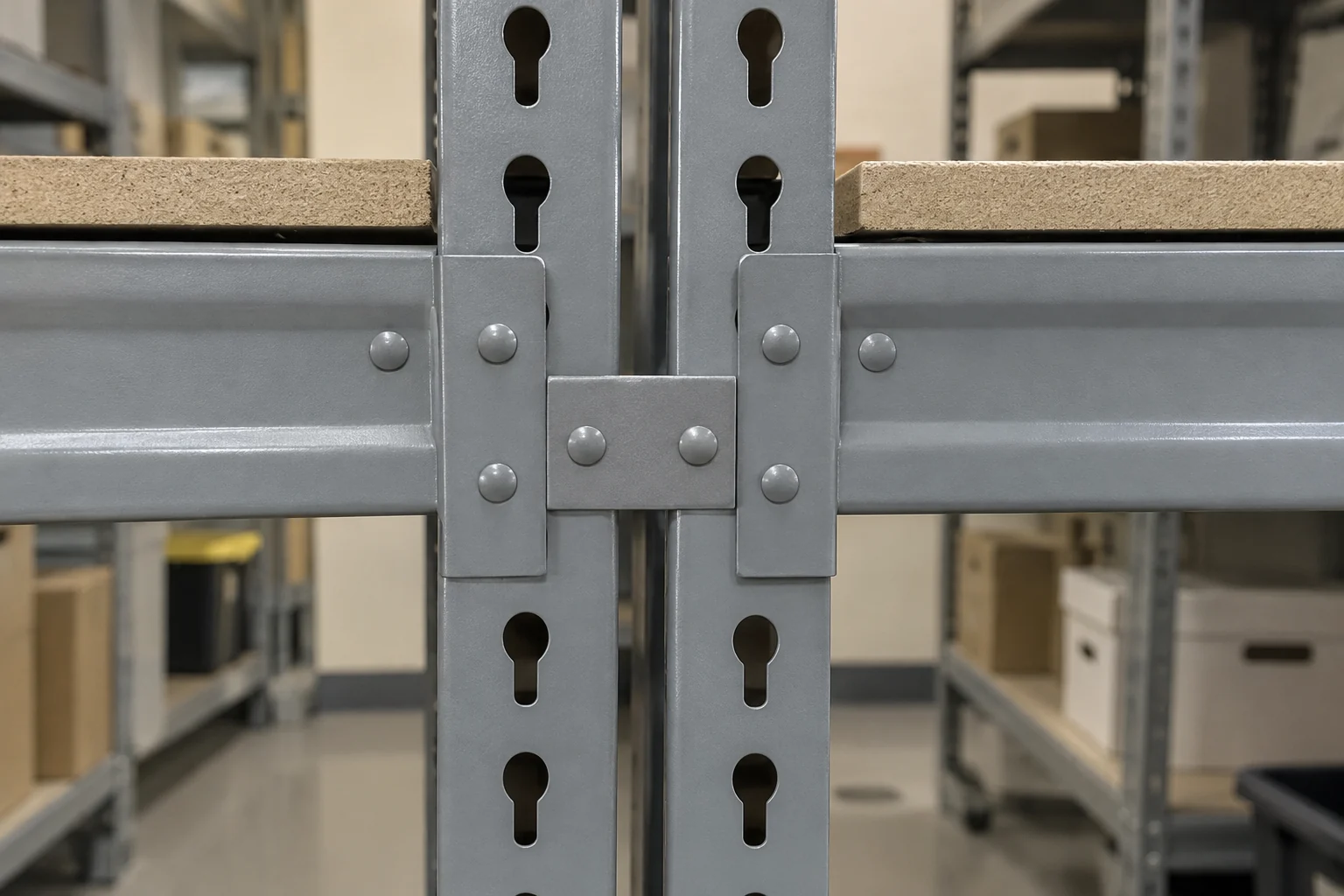
The post count on the order works out to four posts for every set of shelves, which means each unit was a complete freestanding unit with its own four corners, rather than a starter unit with add-on units that share posts. Freestanding units are the most flexible way to build boltless shelving: any unit can be emptied, moved and rebuilt without disturbing its neighbors.
The tie plates are what turn those separate units into a row. A tie plate is a small flat steel plate that fastens across two posts where neighboring units meet, so the units cannot drift apart or rock independently. A row tied together this way is stiffer than the same units standing loose, the shelf fronts stay aligned, and the gap between units stays closed so small items cannot fall between them.
That combination, freestanding units joined with tie plates, is a sensible default for an office. It gives the stability of a connected run while keeping the option to split the row later if the room is reorganized. Tall or heavily loaded rows should still be anchored to the wall or floor where the building or the agency’s facilities team requires it.
| Way to build a row | How it works | Best for |
|---|---|---|
| Starter plus add-on units | Neighboring units share a pair of posts | Fixed runs that will never be split; slightly fewer posts |
| Freestanding units joined with tie plates | Each unit has four posts; plates fasten neighboring posts together | Office and records rooms that may be rearranged later |
| Freestanding units, not joined | Each unit stands alone | Island units, mobile layouts, temporary storage |
Why 7 Foot Posts Suit an Office Storage Room
Warehouse boltless shelving is usually 8 feet tall or more. This order used 7 foot posts, and for an office storage room that is often the better height.
Office ceilings are lower than warehouse ceilings, and they carry lights, vents and sprinkler heads that need clearance above the top shelf. A 7 foot unit leaves room for all of that under a typical office ceiling. It also keeps the top level within easy reach of most staff, perhaps with a step stool, so the top shelf gets used for light, less active boxes instead of becoming a place things are forgotten.
Because boltless beams lock into keyhole slots up the full height of the post, the levels on a 7 foot unit can be spaced for what the room holds: tight spacing for binders and supplies, taller openings for records boxes or rolled maps stood upright. Heavier boxes belong on the lower levels and lighter archive boxes up top. Our records storage shelving and archive shelving pages cover box sizes and level spacing in more detail.

Leave clearance under sprinklers
Keep stored items well below sprinkler heads; 18 inches is the common rule, but confirm the requirement with your building’s fire marshal or facilities team before you set the top shelf height.
Buying on the State Contract, Freight Delivery and Self-Assembly
The quote was priced on the State of Utah cooperative shelving contract, the same way our City of Draper and Weber County Library orders were. For a state agency that matters: buying through an existing state contract means the price has already been competitively set, so the purchase can move ahead without a separate bid. Our State of Utah shelving contract page explains how public buyers can use it.
The quote promised delivery in about ten days. The manufacturer purchase order went out the day after the quote, the shelving shipped by freight to the agency’s Salt Lake City office, and payment was recorded about five weeks after the quote. Installation was not part of this order; the components arrived as loose parts and the agency’s own staff built the units.
A parts-list order is easy to assemble once it is on site. Beams drop into the post slots and lock with a tap of a rubber mallet, decks lay in on top, and tie plates go on as the units are stood up next to each other. The only real planning is sorting the beams by length before you start, so the 30 inch and 36 inch pieces do not get mixed up.
Measure the walls
Work out how many 36 inch units fit and where a narrower unit fills the gap.
Set depth and height
One depth for the whole room; post height to suit the ceiling and sprinklers.
Count the parts
Four beams and one deck per level, four posts per unit, tie plates per joint.
Order on contract
Public buyers can use the state contract; confirm lead time on the quote.
Sort, build and tie
Sort beams by length, build each unit, then join neighbors with tie plates.
Need it installed?
If your staff cannot assemble the shelving, installation can be added to the quote. See our boltless shelving installation page and our Utah shelving installation service.
Planning Checklist for Agency and Office Storage Room Shelving
State and local agencies, school district offices and professional offices face the same decisions this order answered. These steps cover most of them.
- Measure every wall and decide where a narrower unit fills the gap instead of leaving dead space.
- Keep one depth through the room; 24 inches suits records boxes, binders and office supplies.
- Pick a post height that clears lights, vents and sprinklers; 7 feet suits most office ceilings.
- Specify double rivet beams and heavy-duty posts where shelves will hold full records boxes for years.
- Decide between shared-post add-on units and freestanding units joined with tie plates.
- If you order components, check the counts: four beams and one deck per level, four posts per unit.
- Use the state contract if you are a public buyer, and confirm lead time and freight delivery on the quote.
- Anchor tall or heavily loaded rows where your building or facilities team requires it.
More for public sector buyers: government material handling solutions and our guide to records room shelving for Utah municipal offices. Other Utah boltless projects include City of Draper, Weber County Library and Utah Breakers & Supply. For Utah projects, start with our Salt Lake City boltless shelving page or the statewide Utah boltless shelving overview, read the boltless shelving buying guide and the rivet shelving overview, or, if you already know what you need, order boltless shelving directly.
What we verified for this case study
This page is built from the project’s own records: the Zoho deal, the customer quote, the manufacturer purchase order and the payment record, plus the agency’s own website for what it does. Email correspondence from 2018 is not archived, so no staff quotes or design discussion are included, and the agency’s reasons are described from what it ordered rather than from what it said. Order values, part quantities, the room layout, the street address, purchase order numbers and contact names are deliberately not published.
Shop Boltless Shelving Parts Online
Buy select items directly from our online store, or request a quote for volume, custom sizes and freight-rated orders.

Frequently Asked Questions
Can I buy boltless shelving as individual parts instead of complete units?
What is a tie plate on boltless shelving?
Can I mix 36 inch and 30 inch wide units in the same row?
What is the difference between heavy-duty and standard boltless posts?
Do 24 inch deep boltless shelves need deck supports?
How tall should shelving be in an office storage room?
Can Utah state agencies buy boltless shelving on a state contract?
Planning Office or Agency Shelving in Utah?
Send us your wall measurements and what you need to store. We will size the widths, depth and height, build the parts list and quote it on the state contract or for delivery to your Salt Lake City area office.