
Used vs New Boltless Shelving: What to Inspect, What Fits and When to Buy New in Utah
Used boltless shelving can look like a bargain on a pallet, but the savings are usually gone by the time it is installed. Here is why parts rarely fit back together after disassembly, how to inspect a used lot, when reusing shelving you already own can work, and why new often costs less for Salt Lake City and Utah buyers.

Install cost
Where used savings usually go
1 brand per run
Keyhole spacing is not universal
ANSI MH28.2
The US boltless shelving standard
801-328-8788
Salt Lake City quoting line
Used vs New Boltless Shelving at a Glance
Boltless shelving, also called rivet shelving, is one of the most resold storage products there is. It comes apart without tools, stacks flat on a pallet and outlives most of the businesses that buy it, so warehouses, schools and offices across Utah regularly sell it off when they move, close or reorganize. That makes used shelving easy to find. Whether it is a good buy depends on four things you can check before you pay: the condition of the steel, whether the parts belong to one product line, whether you know what each shelf is rated to hold, and whether the sizes you are offered actually fit your room.
| Question | Used boltless shelving | New boltless shelving |
|---|---|---|
| Purchase price | Lower on the pallet | Higher per unit; price is known before you commit |
| Installed cost | Often higher than new once fitting and fix-up labor is added | Predictable: parts fit the first time |
| Load rating | Often unknown once labels and paperwork are gone | Published per-shelf capacity by beam and span |
| Parts match | Lots can mix brands, series, colors and post styles | One manufacturer and series, so every part fits |
| Sizes | You take the widths, depths and heights on offer | Chosen to fit your room, aisle and what you store |
| Decks | Particle board may be swollen, chipped or missing | Fresh particle board, wire or steel decks as specified |
| Hardware | Deck supports, foot plates and tie plates often missing | Supplied complete for the configuration |
| Adding on later | Hard if the brand or series is unknown | Add-on units and extra levels match the original order |
| Installer time | Straightening, sorting and forcing parts to fit | Assembles as designed, delivered or installed |
The real cost of used shelving
In our experience the savings from buying used are typically used up, and then some, by the time the shelving is installed. Parts generally do not fit back together well after disassembly, and the time it takes an installer to straighten things out and make everything fit ends up costing more than new would have. Used can work out if you already own the shelving, but even then new sometimes costs less once the extra fix-up time is counted. A quick call to our sales team with a few pictures can often tell you which option is really cheaper.
We quote new boltless and rivet shelving, so read this with that in mind. This guide still covers how to inspect a used lot, so you can judge one honestly if you are offered it. If you are new to the product, the main boltless shelving guide explains how the system works and where it fits within our wider shelving solutions range.
When Used Shelving Can Work, and Why It Usually Costs More
The price on a used lot is only part of the cost. Boltless shelving that has been taken down, stacked and hauled rarely goes back up the way it came apart. Posts pick up small bends, beam rivets loosen, slots wear and decks get chipped or damp. An installer then spends hours sorting parts, straightening what can be straightened and working beams into posts that no longer line up, and that labor typically uses up the savings and then some. By the time a used lot is standing and loaded, it often costs more than new would have.
Used can work in narrow cases: a light, temporary use where you assemble it yourself, or shelving you already own and know. Even then, it pays to compare the fix-up time against a new quote before deciding.

- Light, evenly spread loads such as paper, soft goods, empty totes or supplies
- Temporary or overflow storage where a mismatch costs little
- One complete lot from one source, same brand, series and color throughout
- Short, freestanding units rather than tall runs that need anchoring and tie plates
- A buyer with the time and a truck to inspect, sort, haul and rebuild it
Used shelving makes the least sense for installed projects, heavy parts rooms, records storage, anything loaded near the top of a tall unit, or a room you need to fill exactly. Those are the jobs where installer time, an unknown rating or a few missing parts turn a low price into a higher total. Not sure which side your project falls on? Call our Salt Lake City team at 801-328-8788 and send a few pictures; that is often enough for us to tell you the best option.
How to Inspect Used Boltless Shelving Before You Buy
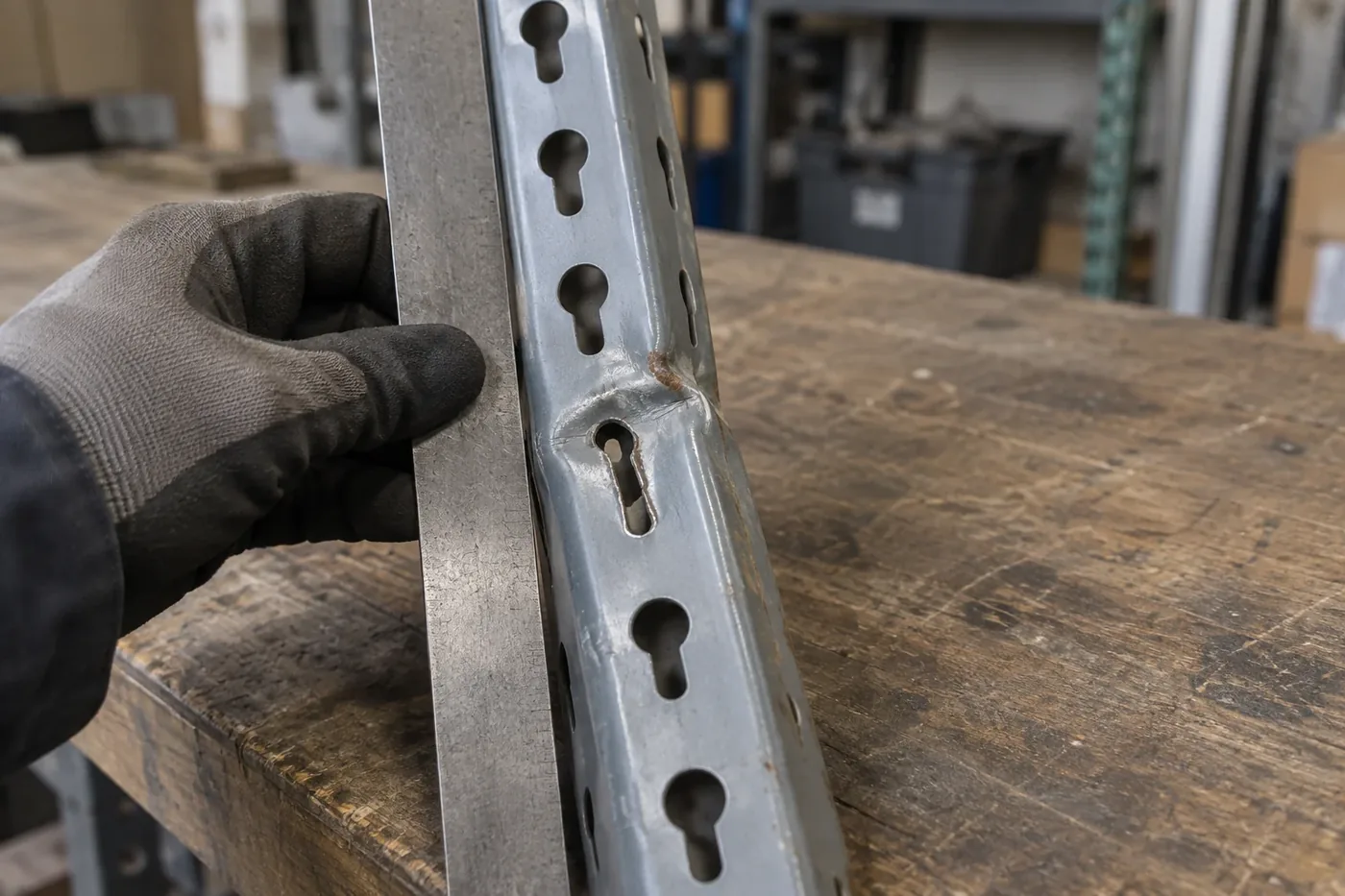
Take the lot apart, or ask to see it standing, and check every component. Boltless shelving gets its strength from straight posts and rivets seated tightly in undamaged slots. A post that has been struck by a pallet jack, a beam that has been overloaded until it bowed, or a keyhole slot that has stretched oval from repeated hammering will not carry what it once did, and it rarely looks dramatic from a few feet away.
Bring a straightedge or a level, gloves and a tape measure. Sight down the length of each post. Lay each beam on a flat floor and look for twist. Compare a few keyhole slots side by side. It takes time, but it is the only way to know what you are buying.
The four component checks
Do not straighten bent steel
A bent post or beam that has been hammered back looks fine and is weaker than it was. Treat any part that has been visibly bent as scrap, even if it is straight now. This is also where used savings disappear: every part an installer has to straighten, replace or force into place is paid labor.
For a part-by-part view of what each component does, see our boltless shelving parts guide and the boltless shelving accessories page, which lists replacement beams, deck supports, tie plates and foot plates.
The Hidden Cost: Mixing Brands and Series
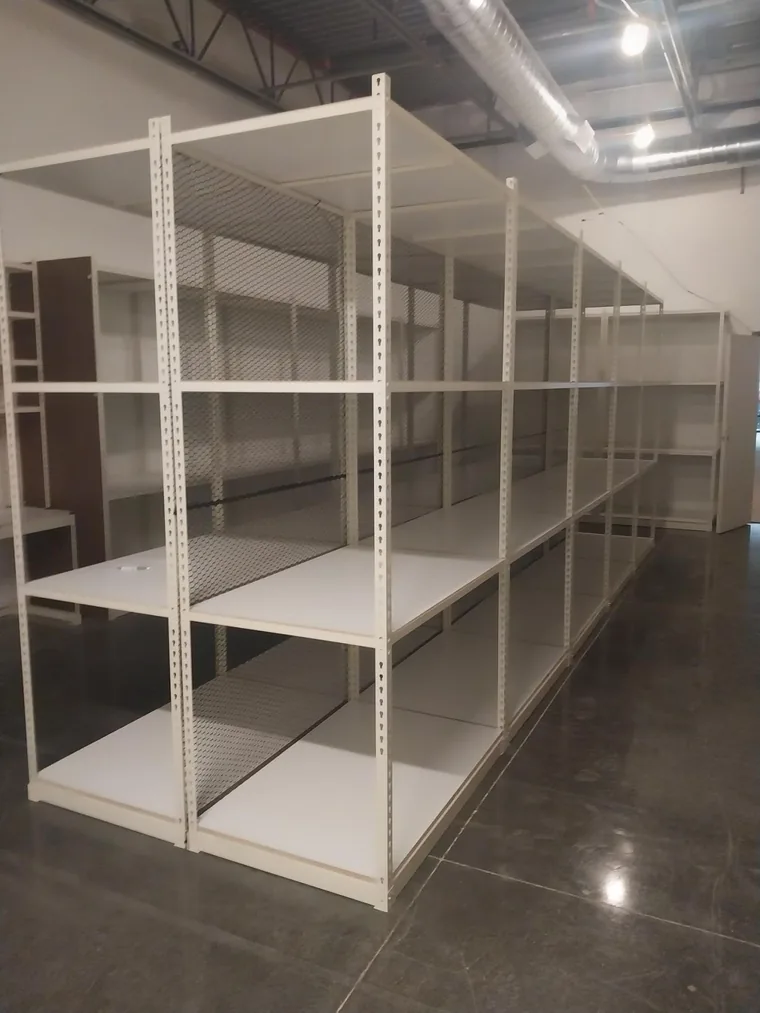
Most boltless shelving looks alike: angle posts with keyhole slots, beams with rivets at each end, a deck on top. In practice the parts are anything but interchangeable. Slot shape, slot spacing, rivet spacing, beam end thickness and deck size all vary between manufacturers, and sometimes between product lines from the same manufacturer. Tennsco’s published Z-Line spec, for example, punches its angle posts with keyhole slots on 1-1/2 in. centers, and Jaken’s Series 200 shelves adjust every 1-1/2 in.; matching numbers on paper still does not prove the rivets and slots of two brands seat together.
A beam that almost seats will often hold a shelf on day one and then work loose under load or vibration. That is why we keep every run on one brand and series.
Find the maker
Look for a stamp, label or part number on posts and beams. Note the post color and profile.
Measure the pattern
Measure slot spacing, rivet spacing and beam length, and photograph a beam end next to a post.
Test fit early
Seat a beam from the lot into a post from your existing shelving before you buy. It should drop in fully and lock.
Keep runs pure
If parts do not match, keep the used lot as its own freestanding run instead of mixing it into existing units.
Our rivet shelving page covers the same rule from the product side: keyhole spacing and rivet geometry are not universal, so a run should stay on one brand and series. Decks follow the same logic; our boltless shelving decking options guide explains why a deck made for one beam profile may sit proud or refuse to seat on another.
Reusing Shelving You Already Own: When It Works and When New Costs Less

The cheapest shelving is usually the shelving already in your building. When you already know the brand, the series and what it has held, adding to it with new matching parts gives you most of the savings of buying used with none of the guesswork. Extra shelf levels need only beams and decks; extending a run needs add-on units that share posts with the existing bay; a heavier load may need only deck supports or stronger beams on a few levels.
Even with shelving you own, new sometimes costs less in the end. If the shelving has to be taken down, moved and rebuilt, the extra time to fix bent parts and get everything to fit can outweigh what you save. A quick call to our sales team with a photo of a beam end and a post, the post height and the shelf width and depth usually tells us whether reusing, adding matching parts or starting new is the better value.
Projects in this cluster show how it works. LF Illumination in Chatsworth, California added wire deck shelf levels to existing boltless shelving after testing a sample for fit. The Utah High School Cycling League in American Fork added beams-and-decks-only shelf levels to its existing units before expanding again. Source Energy Company in Longmont, Colorado built out its stockroom in phases on one low-profile boltless line, so every later order matched the first.
Moving shelving you already own
Disassembly is when shelving stops fitting well. If you do move it, take it down level by level, keep beams and decks sorted by bay, check each part against the list above and replace anything bent before it goes back up. Price the teardown, fix-up and rebuild labor against new before you commit; new is sometimes the cheaper finished job.
Where Used Boltless Shelving Comes From in Utah
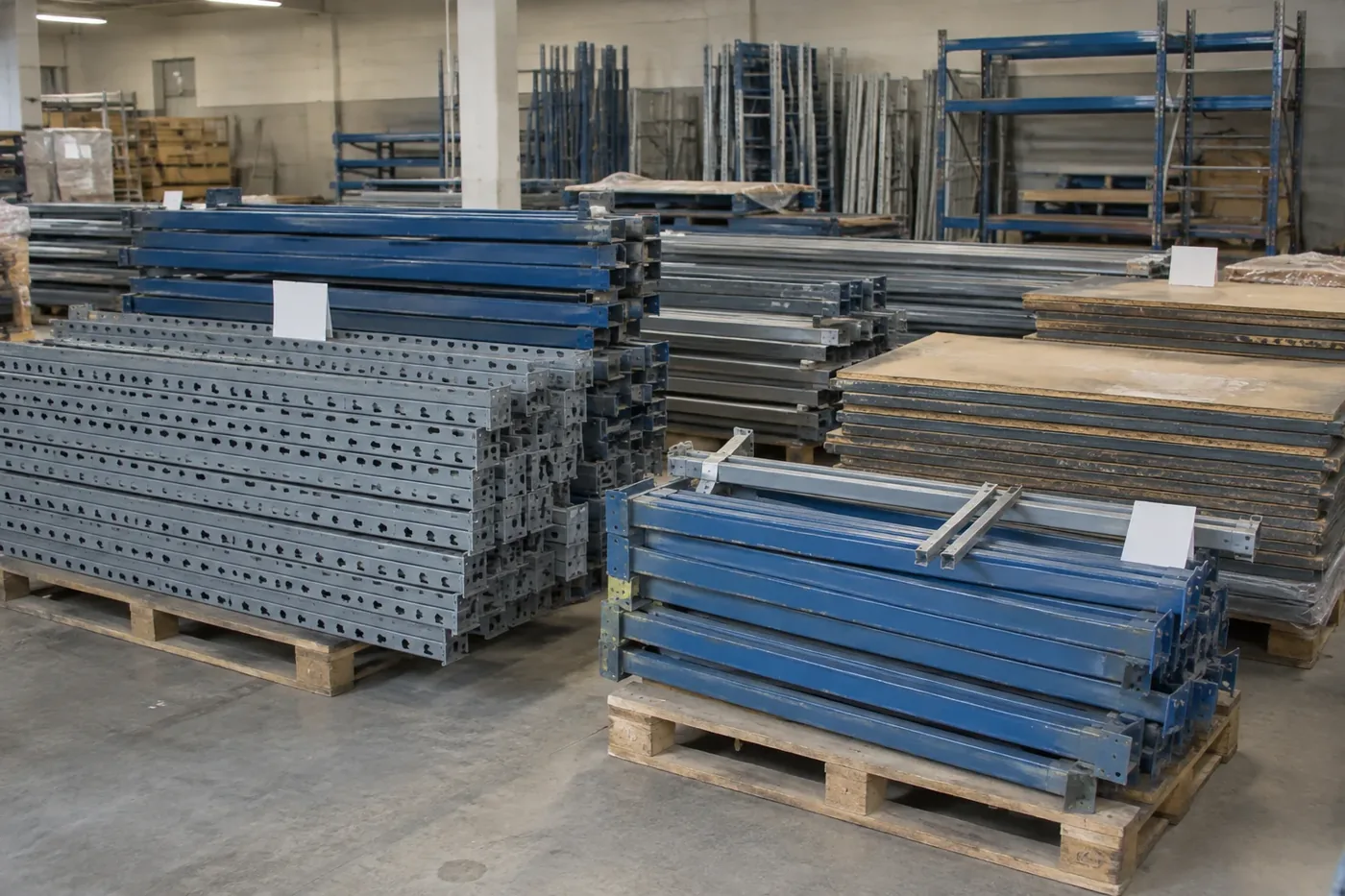
Used shelving in Utah usually comes from one of four places: a business that is moving or closing, an online classified listing, a liquidation or equipment auction, or government surplus. Each has a different risk profile. A single seller emptying one room is the easiest to inspect and the most likely to be one product line. Auction and liquidation lots are often bundles of whatever was left over, sold as is, with mixed posts and beams on one pallet.
Public surplus is a real source too. The State of Utah’s State Surplus Property program, run by the Division of Purchasing and General Services, first offers property to state and other government agencies and then to the public, in some cases by sealed bid or auction.
| Source | What to expect | What to ask |
|---|---|---|
| Business moving or closing | One room, often one product line, standing so you can see it loaded | What did it hold? Can I take it down myself? |
| Online classifieds | Small lots, quick sales, little history | Brand? Any bent parts? Are all decks and supports included? |
| Auctions and liquidators | Bundled lots sold as is, often mixed | Can I inspect before bidding? Are lots counted by unit or by part? |
| Government surplus | Public sale after agencies have had first choice | Lot contents, pickup window, and whether parts are bundled |
Whatever the source, budget for the hidden work: a truck and crew to haul it, time to sort and clean, decks to replace, missing deck supports and foot plates, and above all the installer time to make parts that came apart fit back together. Those costs typically use up the savings that made the low price look attractive.
What Buying New Gets You
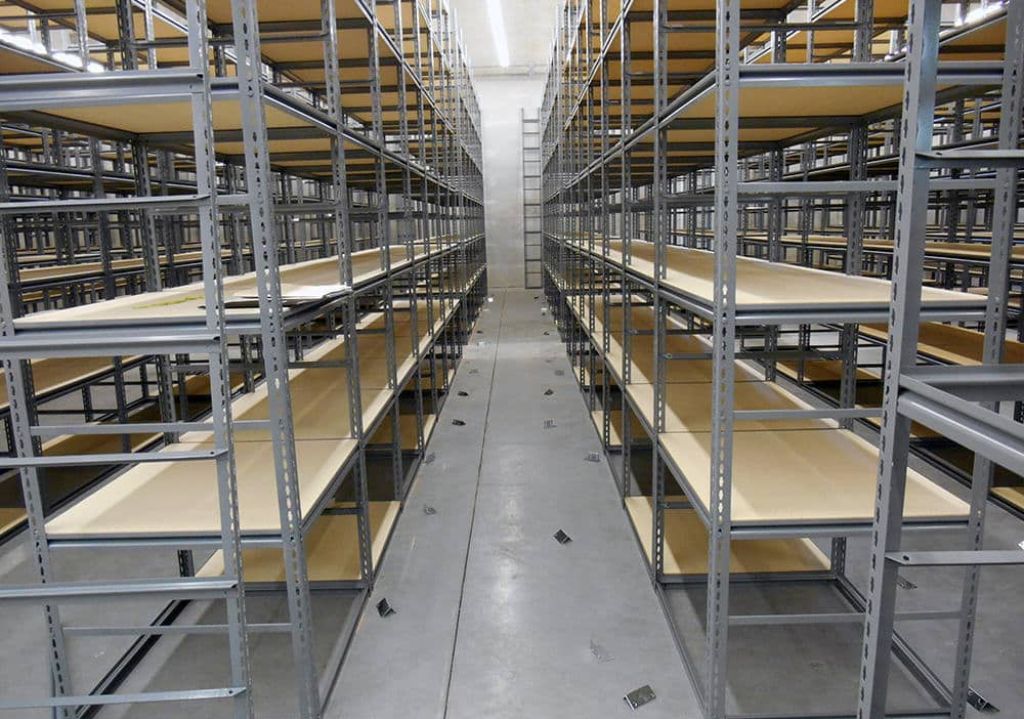
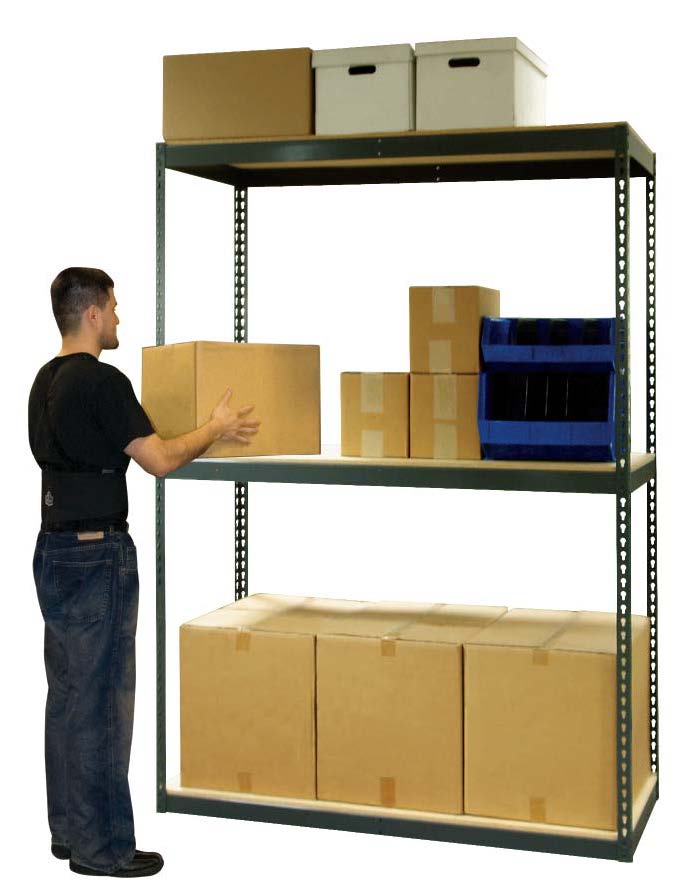
New shelving costs more per unit, but you buy certainty. Every post, beam and deck comes from one line, so add-on units and extra levels will match years from now. The capacity for each shelf is published by beam type and span, so you can plan the load instead of guessing. And the sizes are chosen for your room: the right depth for what you store, the right height for your ceiling and the right width for your aisle.
New also means a known standard. Industrial steel boltless shelving in the United States is covered by ANSI MH28.2, Design, Testing, and Utilization of Industrial Steel Boltless Shelving, published through MHI’s Storage Manufacturers Association. A used lot with no maker or label cannot be traced back to any rating at all.
- Published per-shelf capacity for the exact beam, span and deck on your quote
- Particle board, wire or steel decks chosen for what you store
- Deck supports, foot plates and tie plates included for the configuration
- Matching add-on units and extra levels available later from the same line
- Freight to your dock or curb, or delivery and installation where quoted
Beam choice drives most of the capacity story; our guide to single rivet vs double rivet boltless shelving beams sets out the published ratings by span. For budgeting, see our boltless shelving cost page or price units yourself in the Jaken shelving designer. If you already know the parts, you can order boltless shelving directly. Some common sizes are in stock at select manufacturers, subject to confirmation.
A Simple Way to Decide
Describe the load
What goes on the shelves, roughly how heavy, and how high it will be stacked.
Measure the room
Wall lengths, ceiling height, doors and the aisle you need to keep clear.
Check what you own
Photograph existing shelving: beam end, post, labels. It may only need parts.
Call with pictures
Call 801-328-8788 and send photos. We can often tell you quickly whether used, reuse or new is cheaper installed.
Public buyers have one more option worth knowing about. Granite School District bought new heavy-duty boltless shelving for a district carpenter shop on a State of Utah cooperative contract, with freight included, which removes most of the hauling and paperwork that makes used purchases awkward for agencies.
Notes for Salt Lake City and Utah Buyers
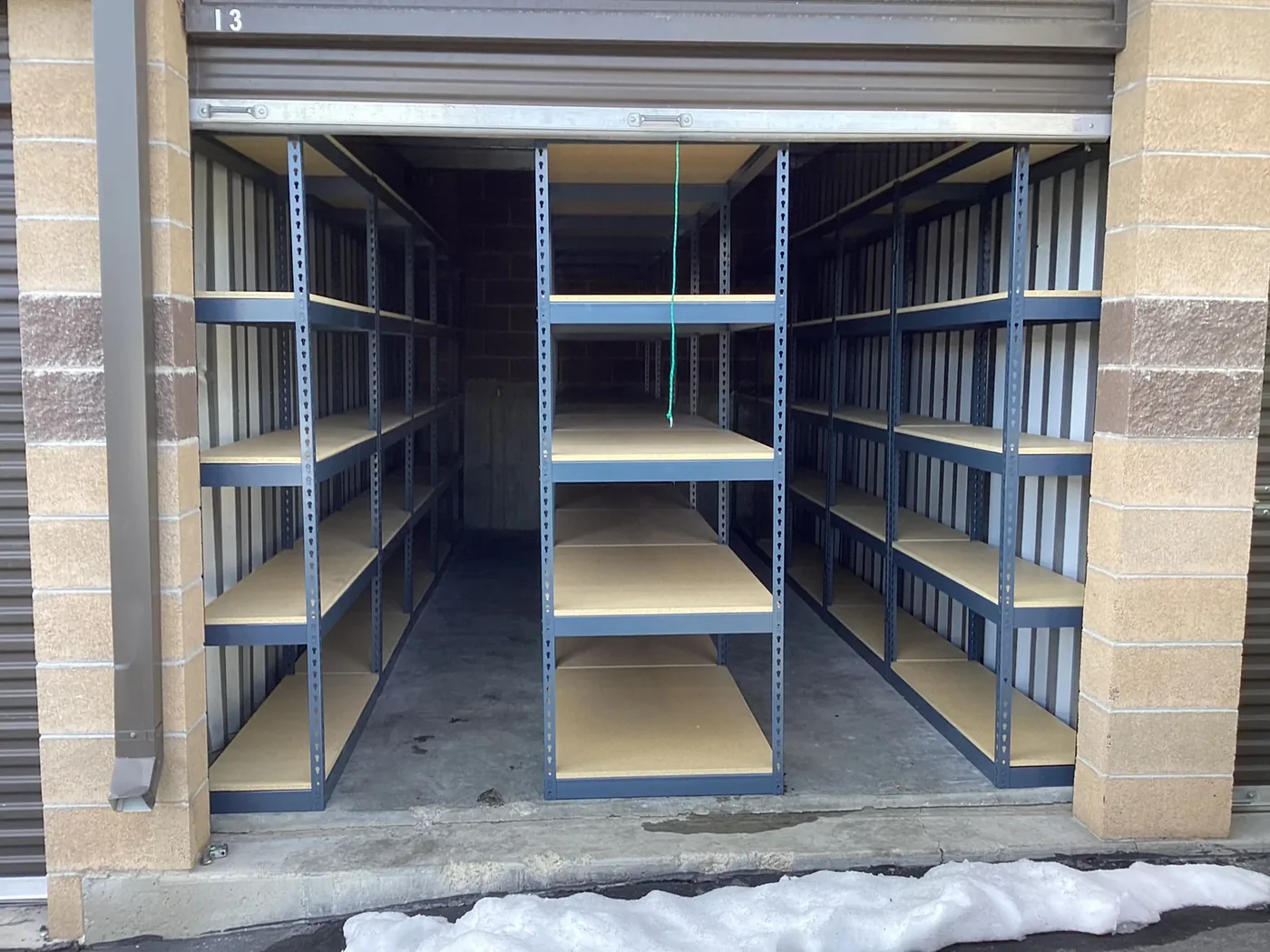
Our Salt Lake City team quotes new boltless shelving across Utah, from freight-only orders for crews who assemble their own to delivered and installed projects along the Wasatch Front. Kirton McConkie used new boltless shelving to turn a rented self-storage unit in Lehi into archive box storage, and Ogden Housing Authority had boltless shelving received, delivered and installed in an apartment building with no loading dock.
Tall shelving in Utah deserves extra care whether it is new or used. Anchoring units to the floor and tying them into rows matters more than the beam. Ask your building official what your site requires, and we can quote foot plates and tie plates to match.
More Utah resources: our Utah boltless shelving overview, the Salt Lake City boltless shelving page, shelving installation in Utah and general boltless shelving installation guidance. Setting up packing or repair areas too? Boltless workbenches use the same posts and beams.
About this guide
This page is general buying guidance, not an inspection or engineering service. Ratings quoted on our pages come from the manufacturer’s published specifications for new product. Used shelving without a known maker or rating should be treated as unrated.
Shop New Boltless and Rivet Shelving Online
Buy select items directly from our online store, or request a quote for volume, custom sizes and freight-rated orders.


Frequently Asked Questions
Is used boltless shelving worth buying?
Is it cheaper to reuse shelving I already own?
What should I check on used rivet shelving?
Can I mix used boltless shelving with my existing shelving?
How do I know what used boltless shelving can hold?
Can you match parts to shelving I already own?
Is new boltless shelving built to a standard?
Where can I find used shelving in Utah?
Do you deliver new boltless shelving in Salt Lake City?
Weighing Used Shelving Against New?
Give our sales team a quick call and send a few pictures of the shelving and the room. We can often tell you right away whether used, reusing what you own or new will cost less once it is installed.