
Art Storage Racks for Museums, Galleries and Collections
A buyer’s guide to painting storage racks: pull-out sliding screens, mobile art racks on rails, vertical painting bins and flat files, and how to size, place and specify them for a real collection.
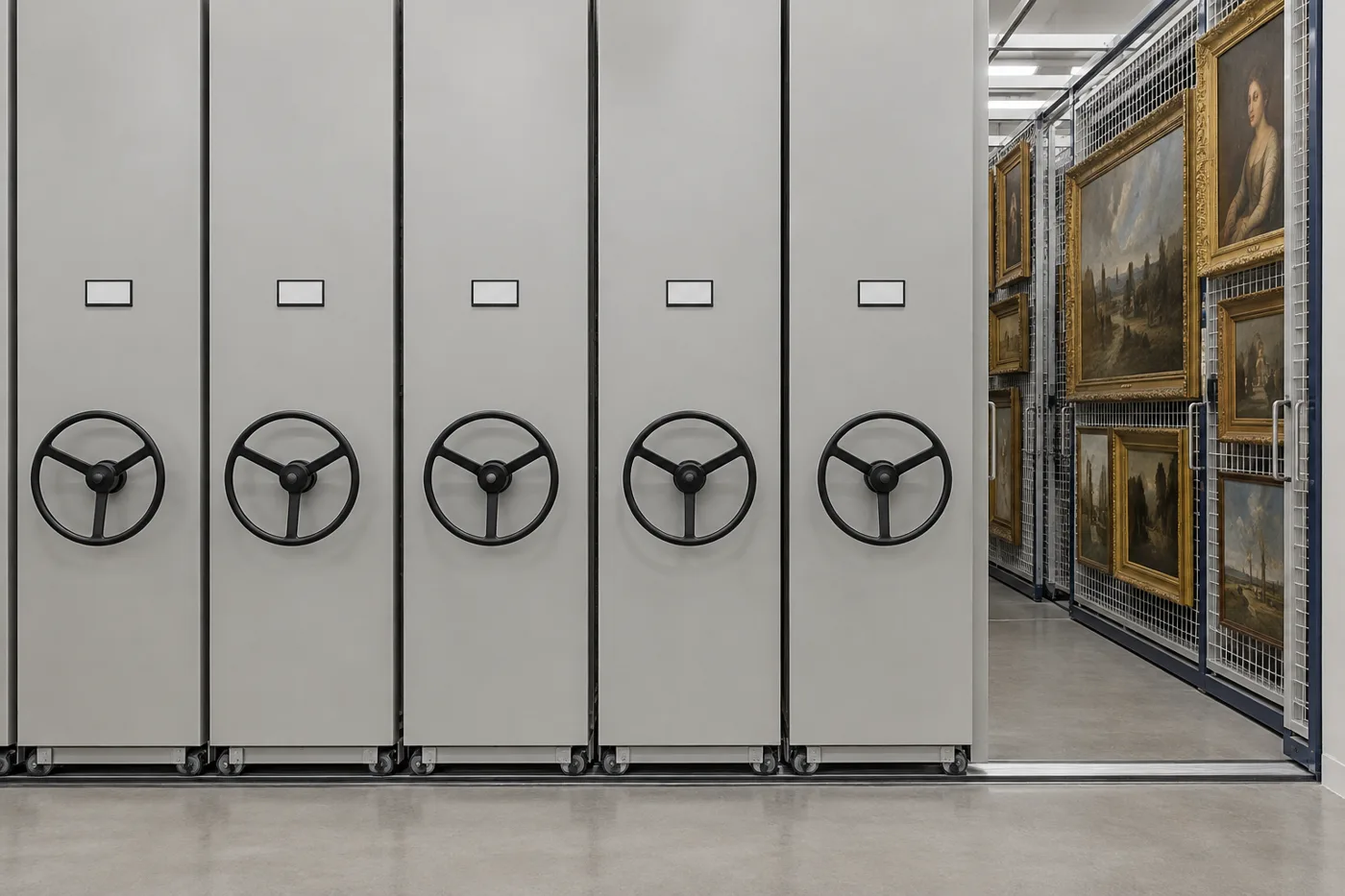
Framed works
Hang on wire-mesh screens with rigid hooks, one face per side
Unframed & damaged
Vertical bins with padded dividers, or flat on shelves
Works on paper
Flat file drawers and archival boxes, not screens
Who it is for
Museums, university galleries, corporate and municipal collections, art schools
Why paintings need their own storage system
Paintings are the one part of a collection that does not fit on shelves. They are flat but large, they vary in size from a postcard study to a canvas taller than the room door, their frames are often more fragile than the picture, and almost every guidance document tells you not to stack them. Leaning canvases against a wall with cardboard between them is the default in many storerooms, and it is exactly the method the National Park Service Museum Handbook appendix on paintings says to use only as a temporary measure, and only for paintings in good condition.
Art storage racks solve that. A painting rack is any system that holds each work on its own, upright or hanging, with air around it and no pressure on the surface: wire-mesh screens that slide out of a frame, screens mounted on mobile shelving carriages that roll on floor rails, or slotted bins with padded dividers. Picked well, a rack lets a registrar find and pull a single work without moving three others, which is where most handling damage happens.
This guide is written for the people who buy these systems: museum and gallery registrars, collections managers, university facilities teams, corporate art program managers and city arts offices. It covers the main rack types, how to size them from your inventory, where they can and cannot go in a building, and what to settle before ordering. It is general planning guidance, not a substitute for a paintings conservator, structural engineer or fire marshal.
The four main types of art storage racks
Most painting storerooms use a mix of these. The right split depends on how many framed, unframed, damaged and paper works you hold, how often they move, and how much floor space you have.
| Rack type | How it works | Best for | Trade-offs |
|---|---|---|---|
| Pull-out sliding screens | Tall wire-mesh panels hang from an overhead track or ride a floor guide and slide out into an aisle one at a time | Framed paintings in good condition; mid-size collections | Needs a clear pull-out aisle as long as the screens |
| Mobile art racks on rails | Mesh screens or panels mounted on mobile shelving carriages that roll sideways to open one aisle | Large collections where floor area is the limit | Rails and floor capacity to check; carriages must move gently |
| Fixed wall or freestanding screens | Mesh panels bolted to a wall or a frame, both faces used | Small collections, offices, galleries with a back room | Least dense; uses wall length |
| Vertical painting bins | Steel racks divided into upright slots with padded dividers | Unframed canvases, odd sizes, works in transit, small framed pieces | One work per slot; surfaces can touch dividers if overfilled |
Works on paper (prints, drawings, photographs, posters) are a separate category. Unless they are framed and glazed they belong flat, in flat file drawers or archival boxes, not on a painting rack.
Pull-out sliding screens
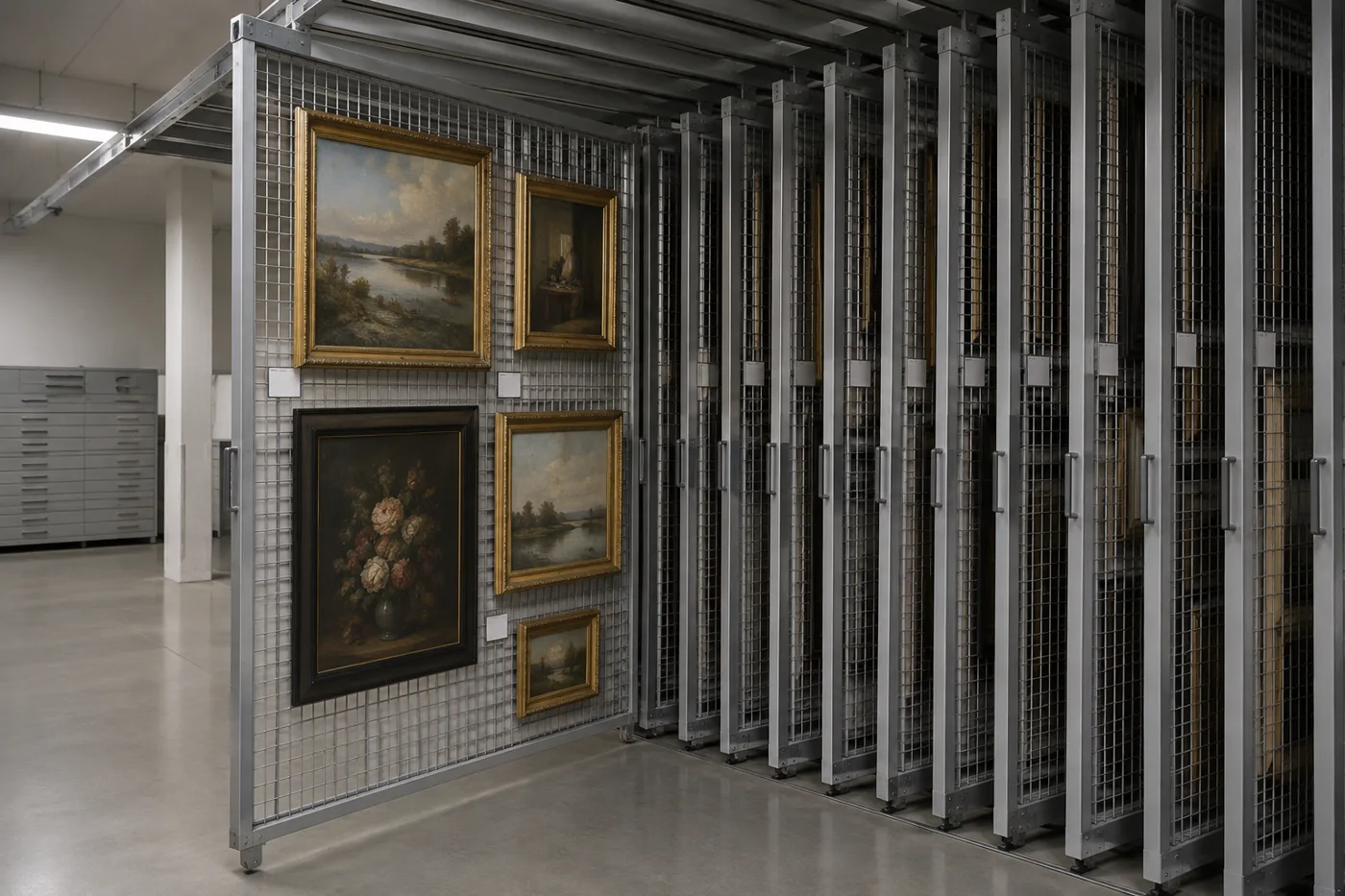
Pull-out screens are what most people picture when they think of an art rack: a row of tall parallel wire-mesh panels, a few inches apart, each on rollers. To see the paintings on one screen you pull it out into the aisle, look at both faces, and push it back. Nothing else has to move.
The two common designs are top-hung, where each screen hangs from an overhead track and barely touches the floor, and floor-supported, where the weight rides on a floor guide and the top track only keeps the screen upright. Top-hung systems leave the floor clear and roll very smoothly, but the ceiling or a freestanding frame has to carry the load. Floor-supported systems put the weight on the slab, which is simpler in older buildings with weak ceilings.
The aisle is the catch. A screen that is ten feet long needs roughly ten feet of clear aisle in front of the rack, plus room for a person and a cart. In a narrow room that aisle can take as much floor as the rack itself, which is why larger collections often move to mobile carriages.
Mobile art racks on rails
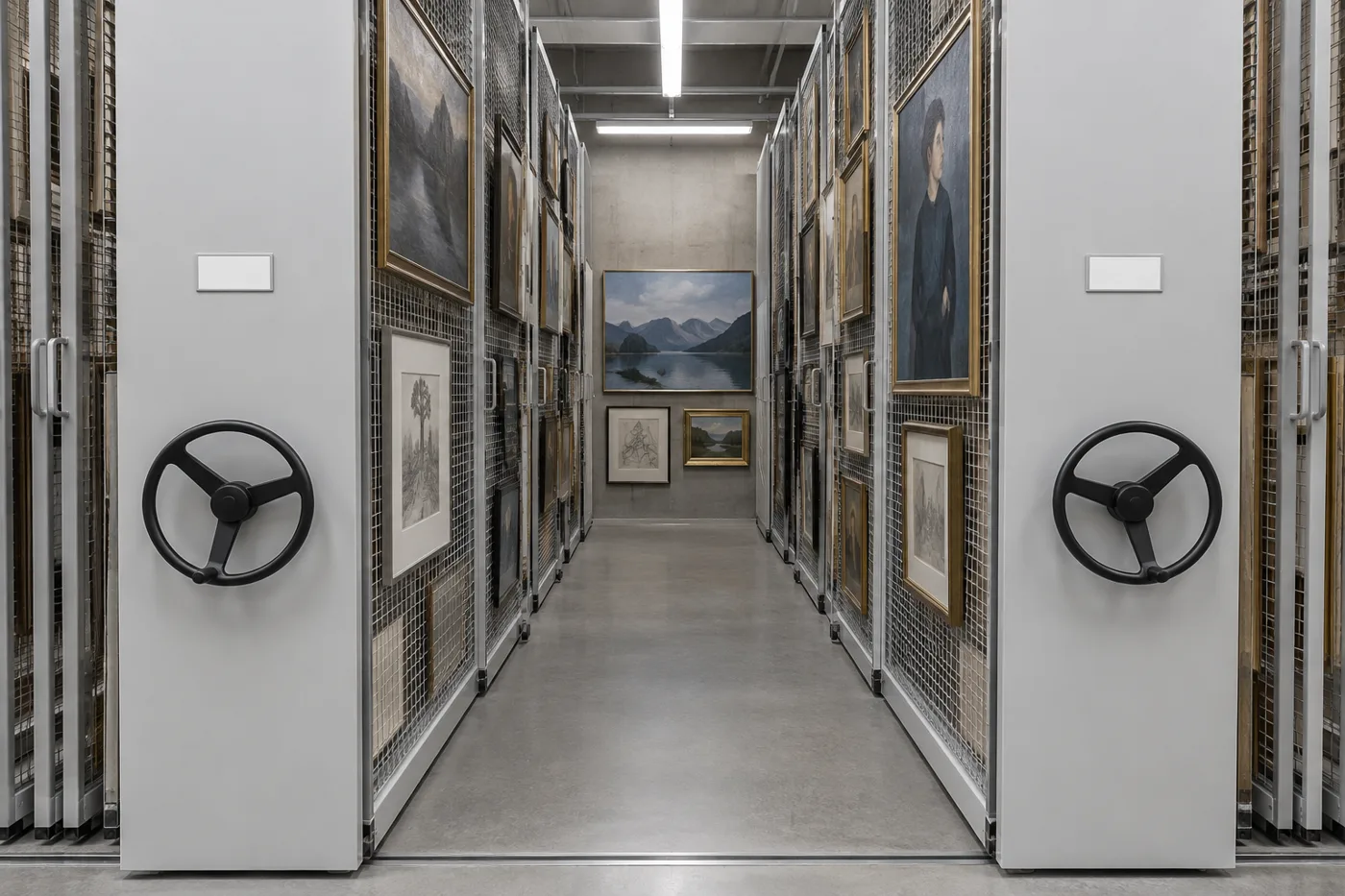
A mobile art rack puts the screens on carriages that roll sideways along floor rails, the same way mobile shelving works for records and library stacks. Instead of a pull-out aisle for every rack, the whole bank shares one moving aisle. Turn the handwheel on a carriage end and the aisle opens where you need it, with paintings on both sides.
That shared aisle is the reason to choose mobile. The NPS Museum Handbook chapter on collection storage lists mobile storage with painting racks among the equipment for collection storerooms, and it is the densest way to hang framed works. Screens and other storage can share one rail system: a bank can mix painting screens with shelving for boxed objects or flat file units, so one room holds the whole collection. Our page on museum and archival collections mobile shelving covers that mixed approach.
Paintings ask more of a mobile system than boxes do. Carriages should start and stop smoothly, with mechanical-assist handwheels or soft-start powered drives rather than a hard push. Screens should be braced so they do not sway when the carriage moves, works should be hooked top and bottom, and the aisle safety and locking features matter because the contents are high-value. Floor load and rail installation are the other two questions; both are covered below.
Hanging paintings on art screens
Screens only protect paintings that are fit to hang. The NPS paintings appendix describes storage screens as a vertical frame with fencing material or rigid wire mesh attached, with paintings in good condition hung from rigid hooks, and notes the method is particularly useful in earthquake zones. Its companion Conserve O Gram 12/1, Storage Screens for Paintings, covers construction. A few rules follow from that guidance and from good practice:
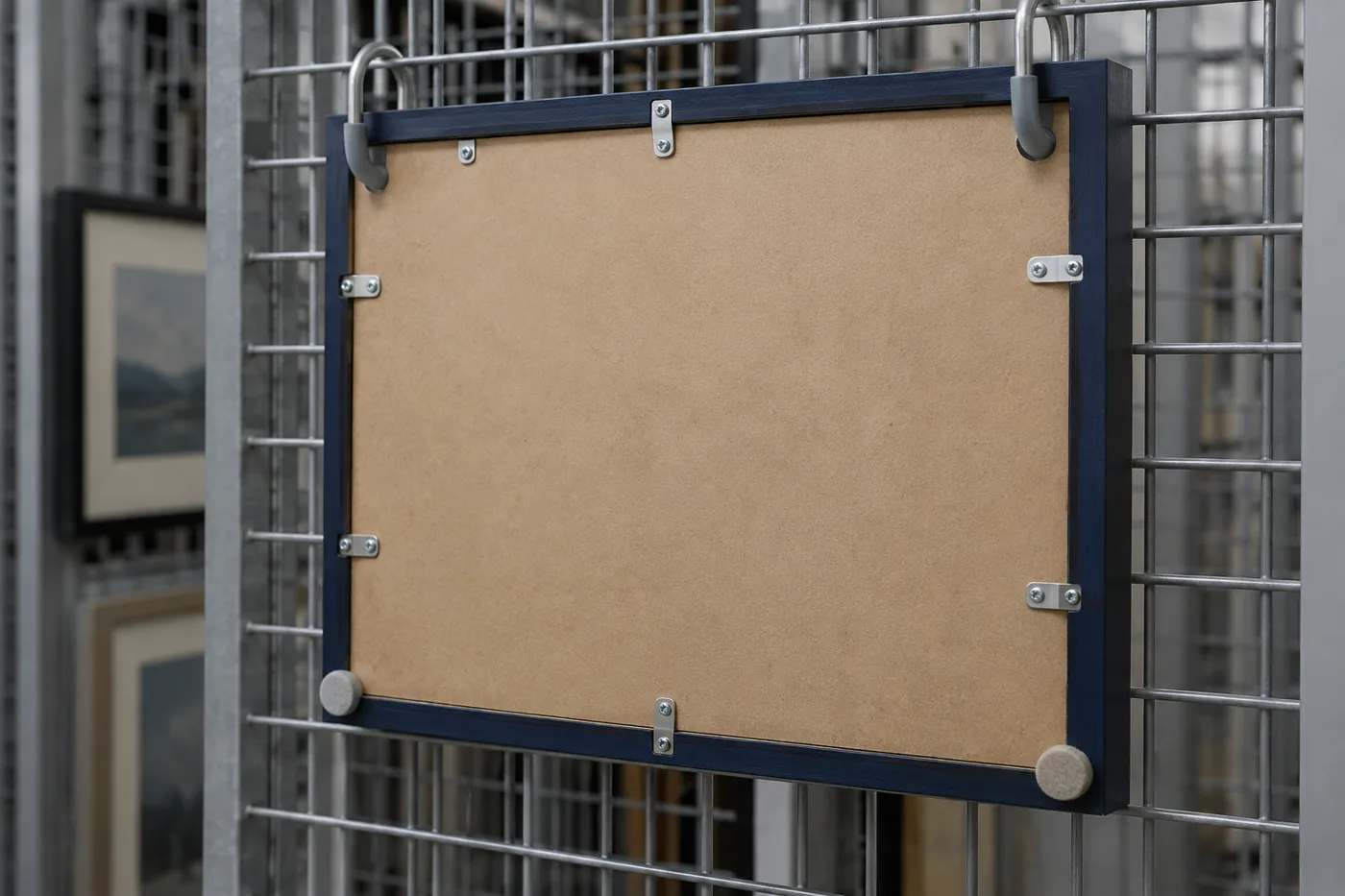
- Remove hanging wire and hooks first. The NPS appendix says to take wires, hooks and other hanging devices off a painting before storage, because they can pierce canvas and scratch frames. Hang from the frame with rigid hooks or D-rings instead.
- Use backing boards. A rigid backing board screwed to the back of the frame blocks knocks and punctures from behind and buffers the canvas. Ask a conservator before fitting one to an important historic frame.
- Secure the bottom too. A second hook or clip at the bottom of the frame stops the work from swinging when the screen or carriage moves; padded bumpers keep the frame off the mesh.
- Do not hang damaged work. Paintings with flaking paint should not be stored vertically. The appendix says to lay them flat on shelves.
- Leave clearance. Plan the gap between screens for the deepest frame on each face, plus a margin so frames on facing screens never touch.
Painting bins, shelves and flat files
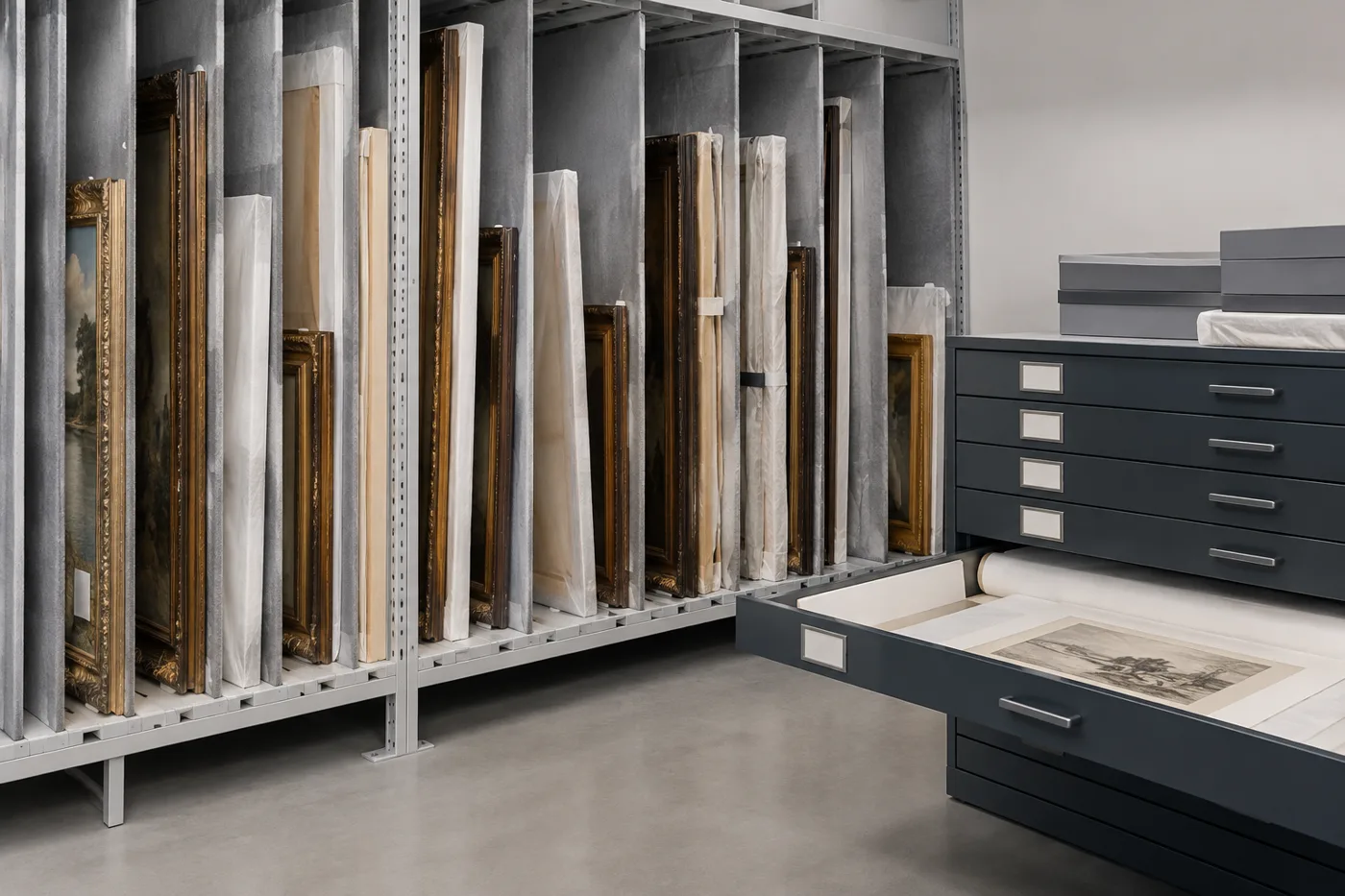
Not every work belongs on a screen. Unframed canvases, very small or very large pieces, works waiting for conservation and anything traveling in and out on loan usually go in vertical painting bins: steel racks split into upright slots with padded dividers. The NPS appendix recommends one painting per vertical compartment; if you must store two, separate them with heavy acid-free board larger than the largest painting. It also says never to stack paintings horizontally.
Raise everything off the floor. The same guidance calls for paintings to be stored at least four inches above the floor, which keeps dust down and protects against a leak or flood. Bins with a raised, slatted or padded base do that automatically.
Works on paper go flat. Flat file cabinets with wide, shallow drawers hold prints, drawings and photographs in folders or mats; boxed paper collections fit archival shelving. In a mobile system, flat files can ride on the same carriages as painting screens. Our pages on museum storage cabinets and museum storage design cover cabinets and specialty units.
How to size a painting rack from your inventory
Painting racks are sized by face area and frame depth, not by number of works. A simple inventory gets you most of the way:
Screen height is limited by the ceiling, sprinkler clearance and the reach of the staff who handle works. Oversize paintings that will not fit the standard screen height usually get a short run of taller screens or a dedicated bin rather than driving up the height of every screen in the room. Our capacity sizing guide explains the general method for mobile systems.
Room, environment and safety questions to settle early
Where the rack goes matters as much as which rack you buy. These are the items that shape the design:
- Location. The NPS paintings appendix says never to store paintings in attics or basements, against exterior walls, near furnaces or HVAC vents, below water pipes, or in areas of heavy vibration. Pick an interior room first, then fit the rack to it.
- Temperature and humidity. The same appendix recommends 64 to 75 °F and 40 to 55% relative humidity, with a stable set point; below 35% RH paintings embrittle and crack, and above 65% mold can grow. A rack does not control climate. That comes from the room’s HVAC, so plan airflow around and between the screens.
- Light. Pigments fade with exposure and the damage is cumulative. Storage lighting should be off when no one is working, and closed mobile banks keep most works in the dark.
- Floor capacity. Mobile carriages concentrate weight on the rails, and large framed works add up. Upper floors may need a structural check; see mobile shelving floor load requirements.
- Seismic anchorage. In seismic regions racks need anchorage designed for the site, and works should be hooked top and bottom. See seismic anchoring requirements.
- Fire protection. Screen height and layout must respect sprinkler clearances; see sprinkler, lighting and HVAC coordination.
- Security. Art storage is a high-value room. Lockable carriages, keyed or keypad access and a clear sign-out process belong in the design; see security and access control.
Sliding screens or mobile carriages?
Both systems hang paintings the same way. The choice comes down to floor area, ceiling structure and budget:
| Question | Pull-out sliding screens | Mobile art racks |
|---|---|---|
| Floor area | Needs a pull-out aisle per rack | One shared moving aisle for the bank |
| Structure | Top-hung needs ceiling or frame capacity | Rails on the slab; floor load check |
| Access | Any screen any time | One aisle open at a time |
| Mixed storage | Screens only | Screens, shelving and flat files on one rail system |
| Best fit | Small to mid collections, galleries, offices | Large collections and growing museums |
For mobile banks, compare drive types in manual vs mechanical-assist vs powered mobile shelving. Mechanical-assist handwheels give the smooth, controlled movement paintings need without power; powered carriages suit long or heavily loaded banks.
How an art storage project gets specified
Art storage is often designed late, after galleries and offices. Working through these steps early keeps the storeroom from being squeezed:
Helpful references: cost and budget drivers and the specification and submittal checklist. Public museums and universities often buy through cooperative contracts; see GSA and cooperative contract purchasing.
Common mistakes with painting storage
- Counting paintings instead of measuring them, so the largest frames do not fit.
- Spacing screens for average frames, so deep frames on facing screens rub.
- Leaving original hanging wire on works hung from screens.
- Hanging flaking or damaged paintings that should lie flat.
- Putting the storeroom against an exterior wall or under plumbing.
- Filling every screen on day one with no room for acquisitions.
Related pages
For the rest of the collection, see museum and archival collections mobile shelving, museum storage design and museum storage cabinets. Campus galleries often share storage with libraries; see compact library shelving. Browse every option on our mobile shelving and high-density storage hub. For a manufacturer example with real installation photos, see Aurora Art Rack on mobile carriages and Aurora sliding art screens and flat files. The full Aurora art and museum line, including Art-Stor panels and museum cabinets, is on Aurora art racks and museum storage systems.
Shop Storage Components for Small Collections and Art Rooms
Wire grid panels for hanging small framed works, shelf dividers that turn wire shelving into upright slots, a track-mounted mobile shelving kit and archive racks for boxed works on paper. Full art rack and mobile art storage systems are designed and quoted to your collection.


Get a free quote
Tell us what you are storing, the room size and your timeline. A project specialist will follow up with layout options and pricing. Prefer to talk? Call (800) 326-4403.
Frequently asked questions
What is an art storage rack?
How should paintings be stored long term?
What temperature and humidity are best for stored paintings?
Are sliding screens or mobile art racks better?
Can unframed canvases go on an art screen?
How much does art storage cost?
Planning painting or art storage?
Send us the room dimensions, ceiling height, door and sprinkler locations, and a size list of the works you need to store. We will lay out screens, mobile carriages, bins and flat files, size them for growth and flag the floor, seismic and security questions to settle. Call (800) 326-4403 to start.