
Home › Shelving › Rolling Shelving
Rolling Shelving Units on Tracks & Casters
Two different products share this name: shelving on casters that goes anywhere, and shelving on a track that rolls in one line to close aisles. Ninety seconds here will tell you which one your project needs — and send you straight to it.

Shop Rolling Shelving Units on Tracks and Casters
Real catalog categories with the lowest current in-stock price we found in each (checked October 13, 2026). Track runs are ordered as parts: a track set plus mobile and stationary unit kits, then the shelves. Some common sizes are in stock at select manufacturers, subject to confirmation; final price, freight and availability are confirmed on the product page or your quote.


Which kind of rolling shelving do you mean?
Almost every enquiry that starts with “rolling shelving” is really one of two questions. Either you want the shelving itself to travel — out of the way, over to a workstation, into another room — or you want to stop paying for aisles and only open one where someone is standing. Those are different products, different hardware and different money, and the fastest way through a quote is to name yours first.
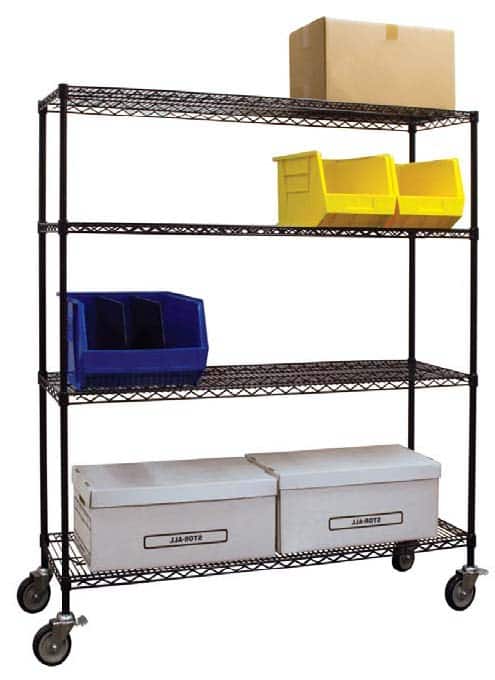
 I want to move the shelving → castersFreestanding units on swivel or rigid casters, usually with brakes. They go anywhere the floor and doorways allow. Nothing is fastened to the building. Best for units that get repositioned, wheeled to a point of use, or moved for cleaning.
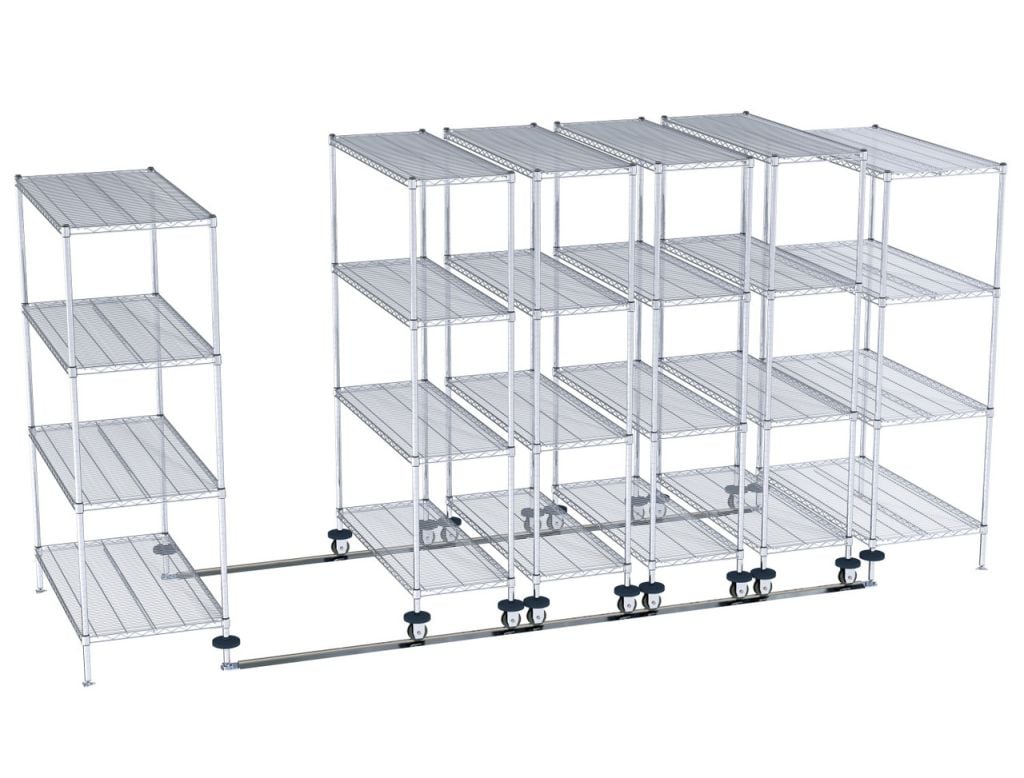
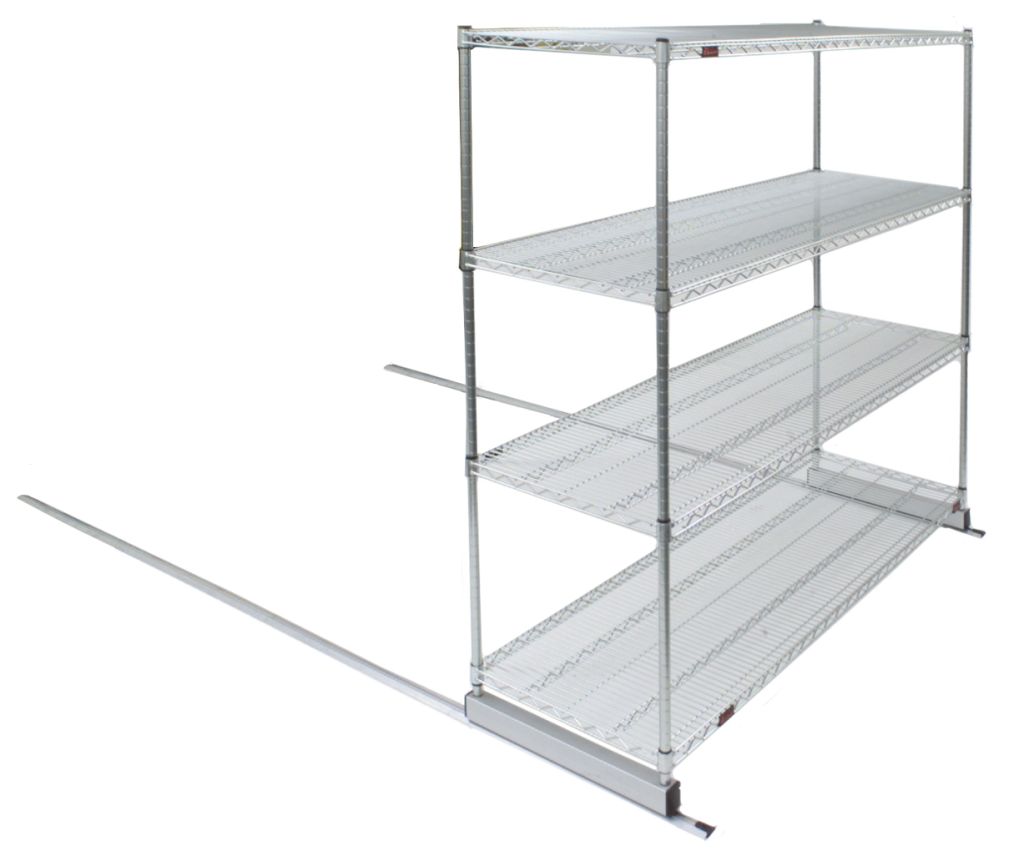 I want to remove aisles → trackUnits captured by an overhead or floor rail so a row closes into a block and one aisle opens where it is needed. The track keeps units aligned and takes the side load. Best when the room is out of space, not out of mobility.
There is a third answer for whole rooms
If the project is a records room, evidence room, archive or library stack area — a room full of shelving rather than a run of it — you are looking for a designed movable-aisle system with carriages, a drive mechanism, aisle safety and a floor-load and anchorage design. Start at mobile shelving and high-density storage, or at high-density shelving to compare density options across formats.
Caster-mounted rolling shelving: mobility, not density
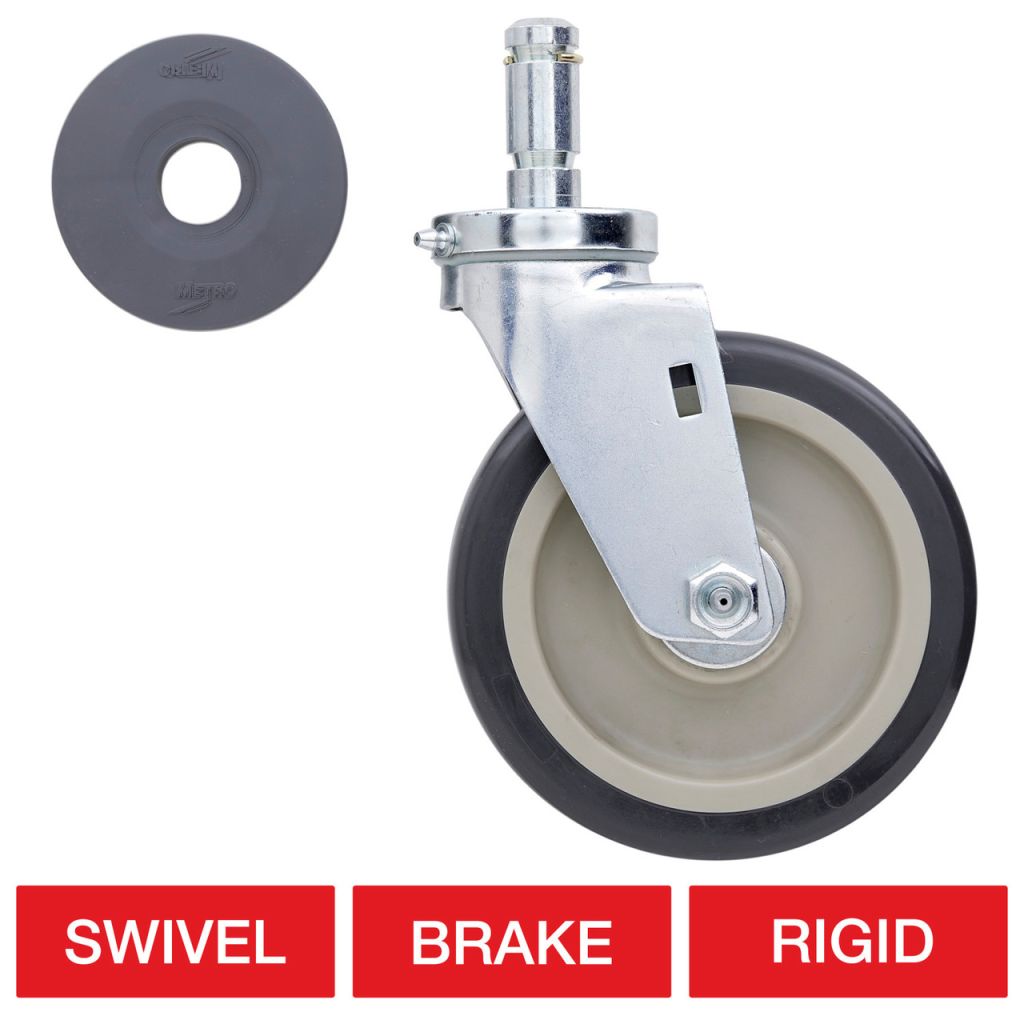
Putting a unit on casters is the cheapest change you can make to a shelving layout, and it is the right change surprisingly often: units that get pulled out for cleaning, stock that has to arrive at a bench or a bedside, seasonal shelving that lives in one place for four months a year. There is no track to align, nothing to anchor, and no structural question to answer.
What it does not do is save floor space. A caster unit still needs its aisle, because there is nothing to keep several of them square to each other once they are pushed together. Treat casters as a mobility feature and track as a space feature, and the two stop competing.
Four details decide whether a caster unit is pleasant or dangerous to use:
- Mobile capacity, not stationary capacity. A unit on casters carries less than the same unit on feet, and the caster has its own per-wheel rating. Use the published mobile figure for the exact combination.
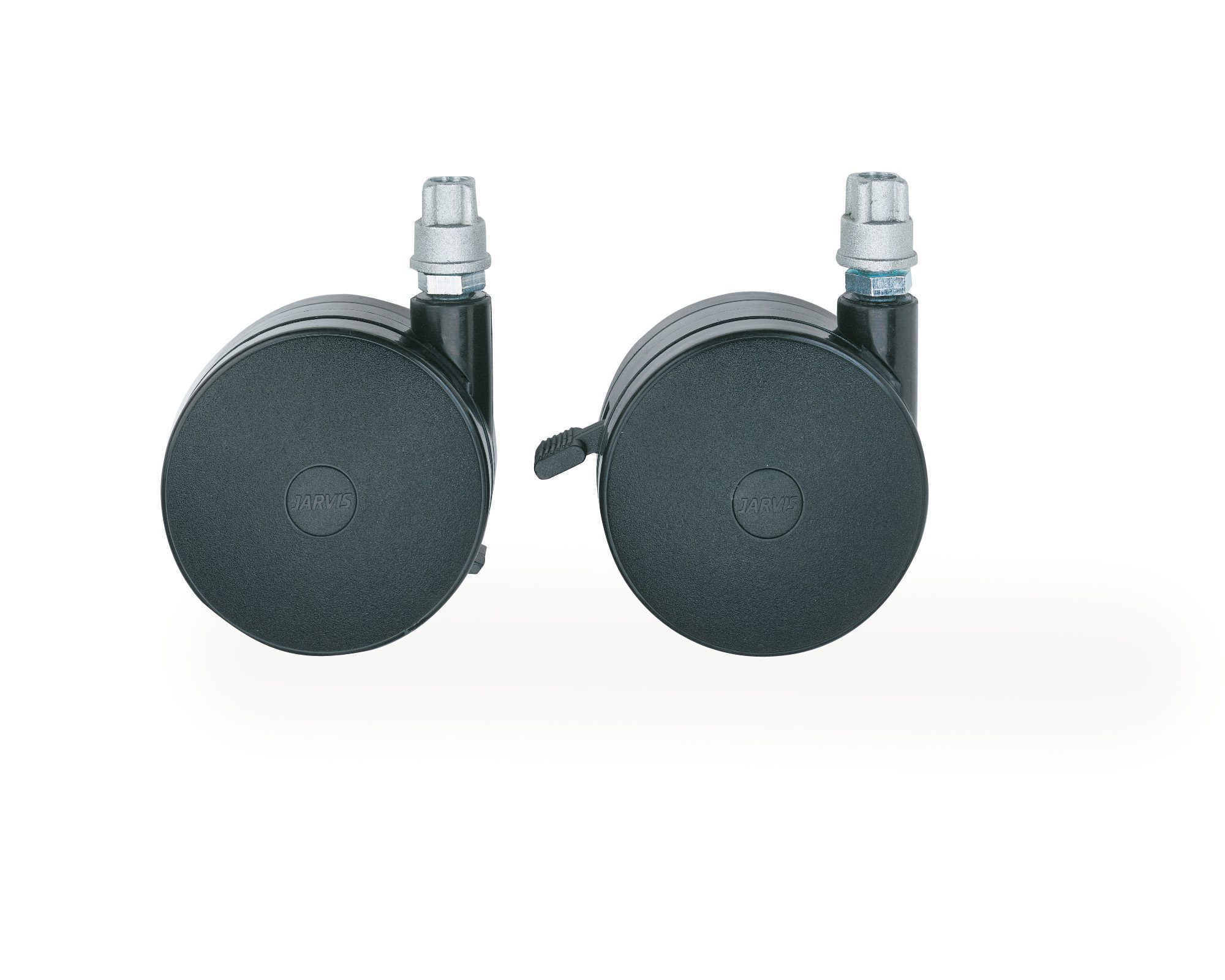
- Brakes and swivel layout. Two swivel with brakes plus two without is the common pattern; two rigid plus two swivel tracks straighter down a long aisle.
- Wheel diameter and tread against your floor. Small hard wheels roll easily on smooth sealed floors and stop dead at a threshold; larger softer wheels ride over imperfections but can mark soft flooring.
- Height and load placement. Casters raise the whole unit. Keep heavy stock low, and think about whether a tall loaded unit should be rolling at all.
If casters are clearly your answer, the shelving itself is a normal wire shelving decision and the casters are an accessory: Metro HDC5BB 4 in. polymer swivel/brake caster for wire shelving is a typical swivel-and-brake choice, and the full range sits in All shelving casters and stem casters. Send us the post model numbers and we will confirm the stem fits before you order.
Comparing complete units rather than casters? Our mobile shelving units on casters guide compares wire, polymer, bin and locking security shelving on wheels, with caster types, mobile capacity and braking.
Ready to buy? Complete rolling shelving units on casters are sold by size online, and caster sets for shelving you already own are in the shop row above.
Track-mounted rolling shelving: aisles you stop paying for
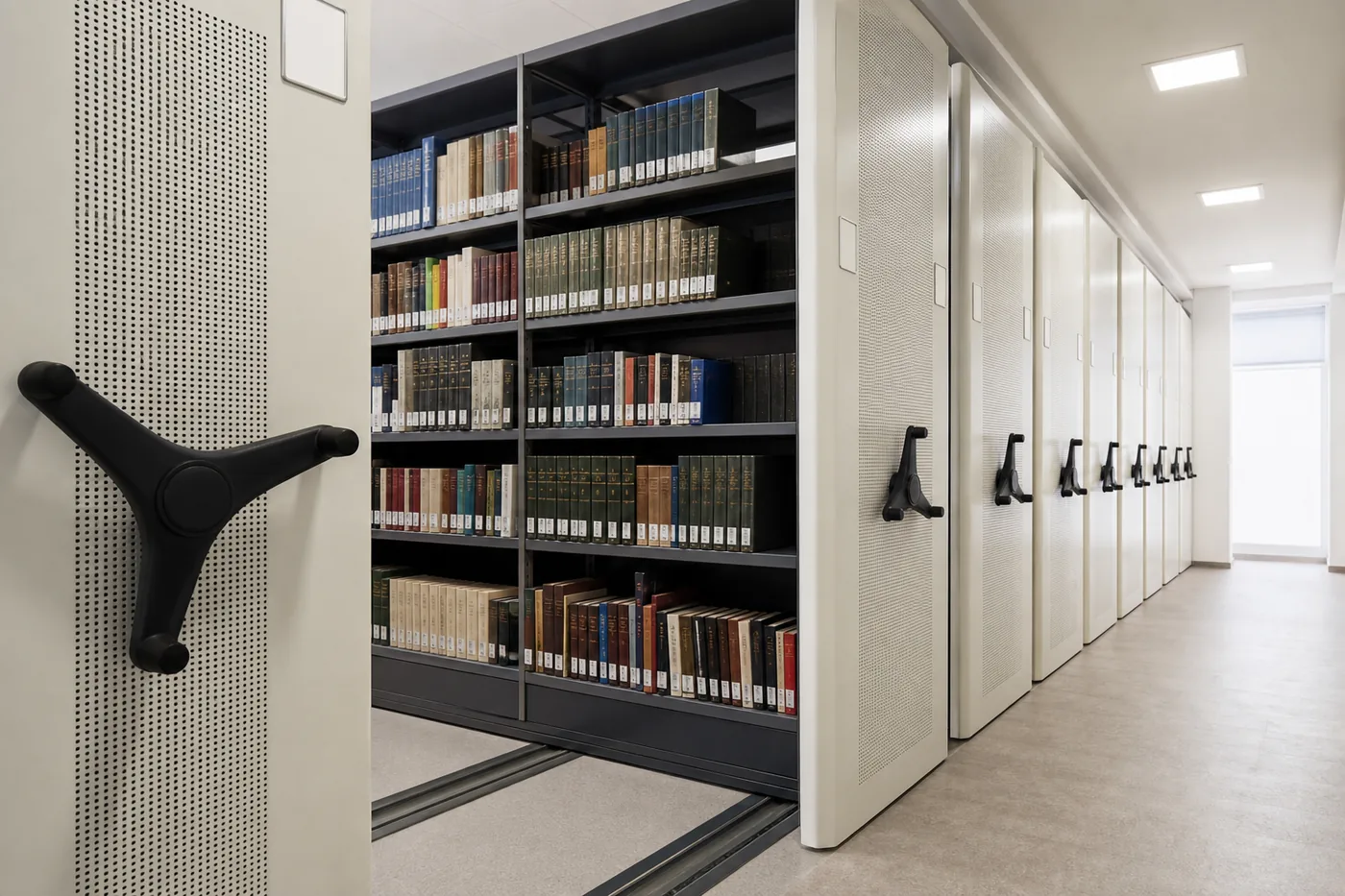
Track shelving keeps the rolling but takes away the freedom, on purpose. Each unit is captured by a rail — overhead in a top-track system, on the slab in a floor-track system — so it can only travel along one straight line. That constraint is what lets a row be pushed closed into a solid block and reopened at any one position, and it is why track systems stay square and stay usable when they are fully loaded.
The choice inside the track family is simply which surface can help you. Top-track leaves the floor completely clear and needs sound structure or a wall to hang the rail from. Floor-track needs nothing overhead and works under low or non-structural ceilings, but the rail is in the traffic path and the slab has to be flat enough to shim it straight. The full comparison, with the requirements to verify in your room before ordering, is on our track shelving page.
Searches like “rolling shelving units on tracks”, “rolling track shelving systems” and “moving shelves on tracks” almost always mean this product, not casters. The rolling shelving units on tracks section below explains how a run is built, sized and ordered.
Still not sure which one you need?
Tell us what has to happen in the room: are you moving shelving, or are you out of floor space? Add the run length, the ceiling type and the floor condition and we will name the product and quote the exact parts.
Rolling Shelving Units on Tracks: How a Track Run Is Built
Rolling shelving units on tracks are standard shelving units on wheels, guided by a rail so the whole row moves in one straight line. Push the units together and the row closes into a solid block of storage. Slide them apart and an aisle opens wherever you need it. One run can replace two or three fixed aisles, so a stockroom, cooler or supply room holds noticeably more on the same floor. Unlike room-scale mobile shelving, a track run is ordered as a kit of parts and can usually be assembled by your own staff.
Top-track rolling shelving: rails overhead, floor clear
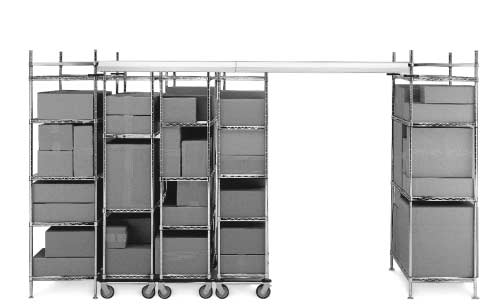
In a top-track system the units still roll on ordinary casters, but a guide rail mounted above the shelving holds every unit in line. Mobile units hang a guide from that overhead rail and are pushed open or closed by hand. Stationary end units at each end of the run carry the rail, so most kits need no fastening to the ceiling, and a wall-mount bracket can end the rail at a wall instead.
Because nothing sits on the floor, carts roll straight through and wet-mopping is quick. That makes top-track the usual choice for walk-in coolers, kitchens and clean back rooms. Metro sells complete Top-Track kits sized for 10, 14 and 16 ft spaces, or you can order the parts separately.

Floor-track rolling shelving: rails on the floor, nothing overhead
A floor-track system such as Metro qwikTRAK sets low-profile aluminum rails on the slab. Each mobile unit kit has wheels that ride in the rail, so the run stays square even when shelves are fully loaded and pushed hard. Floor-track needs nothing above the units, so it fits under low ceilings, sprinklers, ductwork and drop-ceiling grids.
The trade-off is the rail in the walkway. Plan where carts and pallet jacks cross the run, check that the floor is flat enough to shim the rail straight, and use end stops so units cannot roll off the end.
What is in a rolling shelving track kit
Whichever rail you choose, the parts list follows the same pattern. Most orders combine the components below with the shelves and posts for each unit. Our team checks the full list against the manufacturer’s component chart before you buy.
| Kit component | What it does | What to check |
|---|---|---|
| Track set | The rail pair the mobile units follow, overhead for top-track or on the floor for floor-track. | Length equals the total depth of all units on the run plus one working aisle. |
| Mobile unit kit | Posts fitted with casters (and guides or track wheels) that turn shelves into a unit that rolls along the rail. | Match the shelf family, shelf width and post finish to the shelving you are using. |
| Stationary end unit kit | Fixed unit at the end of the run; on top-track systems it also carries the overhead rail. | One at each end of the run unless the rail ends at a wall bracket. |
| Stationary intermediate unit kit | Fixed unit set mid-run where the rail needs extra support or a second run meets. | Needed on longer runs; follow the maker’s spacing. |
| Stop plates and wall brackets | End the travel safely and anchor a top-track rail to a wall. | Always fit stops; a rolling unit should never be able to leave the rail. |
| Double-deep kits | A second, wider track lets mobile units park in front of a stationary back row. | Roughly doubles what one wall holds; leave room to slide the front units aside. |
Sizing a run: the one-open-aisle rule
Add up the depth of every unit that will sit on the track, then add one access aisle wide enough for a person and whatever they carry. That total is the track length. A run only ever has one aisle open, so if two people regularly need different shelves at the same time, split the storage into two shorter runs or keep the busiest items on fixed shelving at the end of the run.
- Width: unit width sets the width of the track pair. Keep every unit on one run the same width.
- Height and load: keep heavy items on the lower shelves of mobile units, and use the published rating for the mobile unit kit rather than the stationary shelving rating.
- Clearances: check door swings, sprinkler heads, light fixtures and the path carts take across a floor rail before fixing the layout.
- Single or double deep: one row of mobile units on its own rail, or mobile units parked in front of a fixed back row for the most storage per wall.
Where rolling shelving on tracks earns its keep
Track runs suit rooms where the storage is fixed to one wall or bay, items are picked by one or two people, and floor space is the limiting factor:
What to send us for a quote
Send the wall or bay length, the ceiling height and what sits overhead, the floor type, what is stored and roughly how heavy it is, and whether the room is cold, wet or clean. We will recommend top-track or floor-track, list every component and price the run. If you already own Metro or similar wire shelving, include the model numbers and we will check which unit kits fit it. For a whole room of shelving on carriages with handle or powered drives, see mobile shelving instead.
Casters vs track run vs room-scale system
| Casters (freestanding) | Track run (product) | Room-scale movable aisle (system) | |
|---|---|---|---|
| What it is for | Moving shelving around | Deleting aisles in a run | Deleting aisles across a whole room |
| Where it can go | Anywhere the floor and doors allow | Only along its rail | Only along its rails |
| Attached to the building | No | Yes — overhead rail or floor rail | Yes — rails and anchorage, designed per room |
| Stays aligned when closed | No | Yes | Yes |
| Saves floor space | No | Yes, within the run | Yes, room-wide |
| Typical buy | Shelving unit plus casters | Track kit or track plus mobile unit kits | Designed and installed system |
| Engineering to settle first | Mobile capacity, brakes, floor and thresholds | Ceiling structure or slab flatness, anchors, aisle width | Floor load, seismic, drive type, egress and accessibility |
| Where to go next | Shop wire shelving | Track shelving | Mobile shelving |
Five questions that settle it
Where to go from here
Shop Online at MaterialHandling-USA.com
This page is a signpost, not a catalogue. Pick the route that matches the answer you just reached and the products are one click away:
Guides for the two destinations: track shelving: top-track vs floor-track for a run on a rail, and mobile shelving for a whole room, including the engineering series on floor load, rail type and sizing a room. If you already own shelving and want it to roll either way, send the model numbers — the hardware is family-specific and we check it against the manufacturer’s component list rather than assuming.
Design & price it online: Metro Mobile Shelving & Stem-Caster Carts Configurator
Configure mobile shelving units and stem-caster carts in our free Metro Mobile Shelving & Stem-Caster Carts configurator — build the layout, see a full bill of materials and save or send the quote in minutes. Need a different Metro product? Browse all 17 tools in the Metro configurator hub.
Get a free quote
Tell us what you are storing, the room size and your timeline. A project specialist will follow up with layout options and pricing. Prefer to talk? Call (800) 326-4403.
Rolling shelving questions we get asked
What does “rolling shelving” actually mean?
Is shelving on casters as strong as shelving on feet?
Do I need brakes on rolling shelving?
Can caster-mounted shelving be pushed together to save space like a track system?
What is the difference between rolling shelving on tracks and high-density mobile shelving?
What floor do casters need?
Can I convert shelving I already own to roll?
How much do rolling shelving units on tracks cost?
Is top-track or floor-track better for a walk-in cooler?
How many units can go on one track?
Tell us the room and we will name the right product
Send the run length, the ceiling, the floor and what is being stored. You will get the product, the part list and the manufacturer data behind it — not a guess.