
Laboratory Security Cage: Analytical Resource Laboratories
How an accredited testing laboratory uses welded wire enclosures to control sample retention, reference standards and reagent storage — and how to plan restricted-access storage inside a lab without building walls.
2016–2022
Period over which Material Handling USA supplied security cage and wire partition product to ARL
Lehi, Utah
Headquarters of an independent consumer-products testing laboratory founded in 2000
Multi-site
A lab group operating several locations, each with its own storage constraints
Modular panels
Restricted-access storage added inside finished lab space without construction
The project
Analytical Resource Laboratories (ARL) is an independent consumer-products testing laboratory headquartered in Lehi, Utah, founded in 2000, with additional locations in Utah, Arizona and Florida. The lab is ISO/IEC 17025 accredited and performs microbiological and chemical testing — HPLC, GC, ICP and stability work — for the food, cosmetics, dietary supplement and pharmaceutical industries.
Material Handling USA supplied welded wire security cage and partition product to ARL across several orders between 2016 and 2022. Laboratories are an unusual environment for enclosures: the building is finished, the space is expensive per square foot, the finishes are cleanable, and the reason for restricting access is documentation and integrity as much as theft.
What follows sits under our welded wire security cage hub and describes the general design problem an accredited lab faces and how MH-USA approaches it. It contains no facility layout, no dimensions, no inventory detail and no security information specific to this customer.
Why a laboratory needs caged storage at all
A lab’s storage problem is not the warehouse problem. Very little of what a lab stores is attractive to a casual thief, and the quantities are small. What matters is that certain material must be demonstrably controlled — that the lab can show who had access to it, and that it has not been altered, substituted or mixed up.
That requirement comes from several directions at once. Accreditation and quality systems require control of samples, reference standards and records. Clients submitting product for testing expect their material to be handled as confidential. Certain categories carry their own regulatory access requirements. And retained samples occupy space for years, tempting everyone to treat them as clutter.
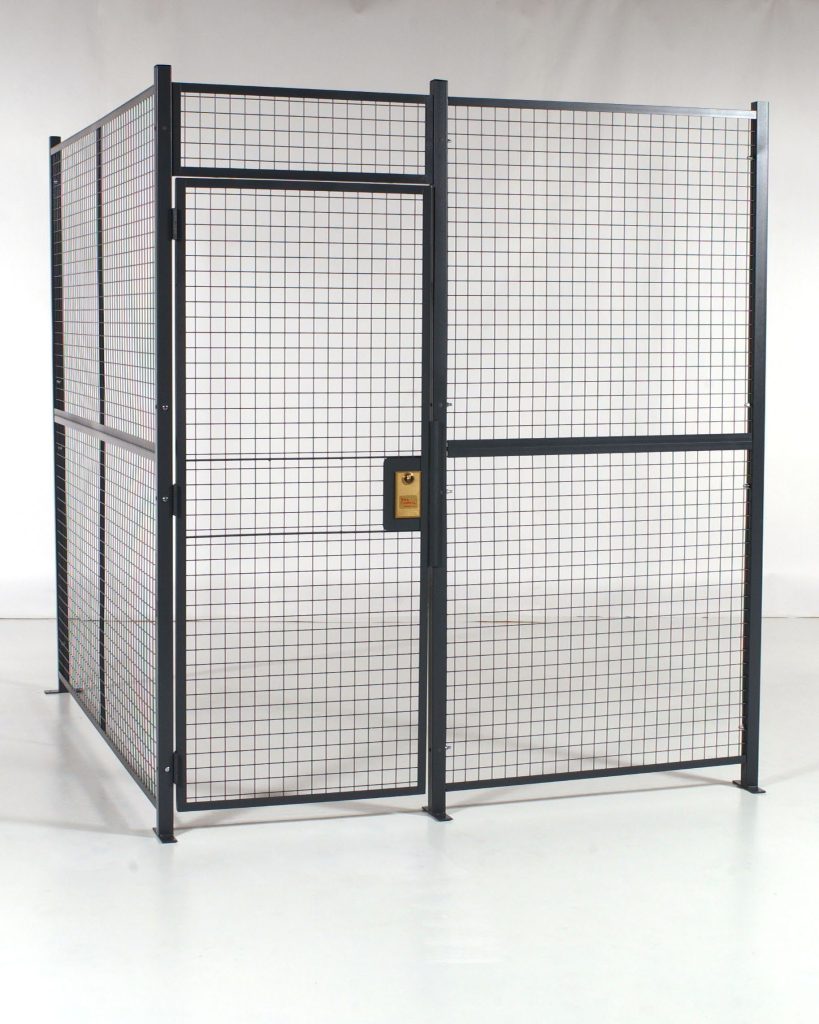
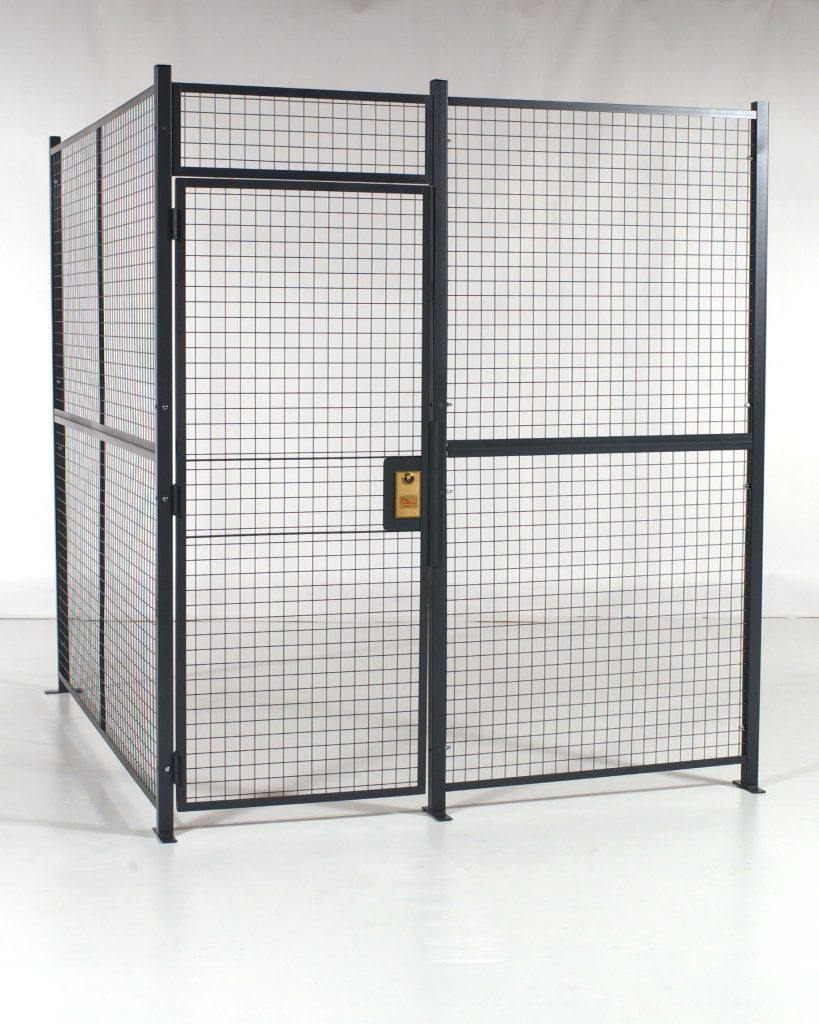
A locked room solves this, but rooms are expensive, permanent and slow to build inside a leased lab. Welded wire enclosures give a lab a defined, lockable, visibly controlled area that can be installed in a weekend, extended when the lab grows, and taken along at the end of a lease. Because they are open mesh, they also keep sprinkler coverage, airflow and light distribution largely intact — a serious practical advantage over a stud-and-drywall room.

What a laboratory puts behind mesh
Labs generally end up with several small controlled areas rather than one large one, because each category has a different access list and a different retention rule:
Fit-out inside the enclosure — shelving, bins, workbench, labelling — is the same kit used for any tool crib, adapted to cleanable surfaces and lab load sizes.
Chain of custody and access control
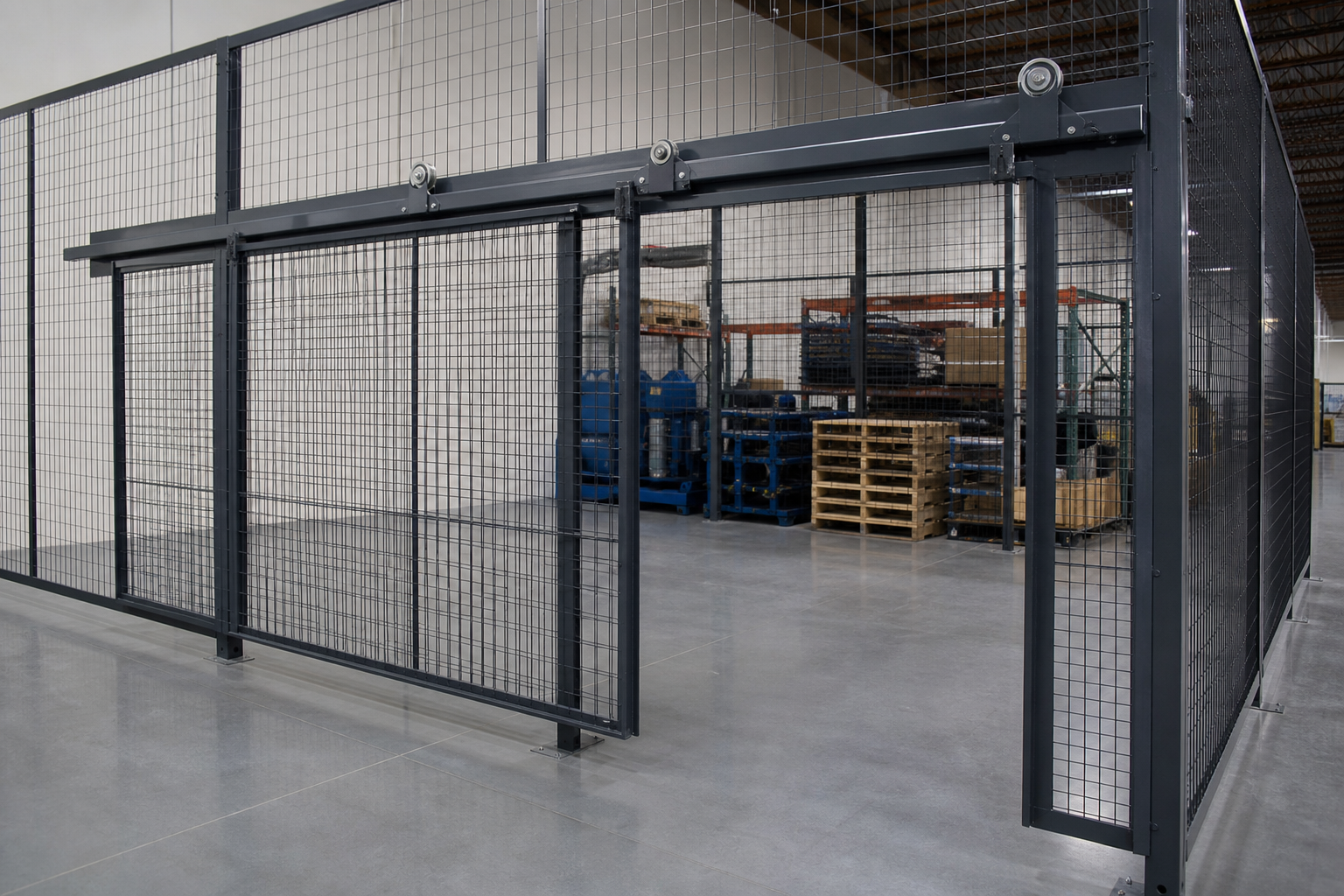
An enclosure earns its keep when it turns access into an event that can be recorded. Three design choices do most of that work:
- One opening. A single controlled entry is worth more than any lock upgrade. Multiple convenience doors quietly destroy the audit story.
- Hardware that matches the record you need. A padlock proves nothing about who entered. Keyed cylinders with a controlled key list are better. Where the lab needs a per-person record, the enclosure is specified access-control-ready so the building’s existing credential system operates the door — see cage locks.
- Visibility. Mesh means an auditor, a supervisor or a camera can see the area is orderly and undisturbed without anyone opening it. Solid walls hide both good and bad housekeeping.
An enclosure supports a chain-of-custody procedure; it does not create one. The lab’s SOP still defines who may enter, how transfers are logged, and how discrepancies are handled. What the cage does is make the boundary unambiguous, so “controlled access” stops being a claim and becomes something you can point at.
Chemical storage, ventilation and fire protection
This is where lab enclosures need the most care, and where a wire cage is often the wrong answer on its own.
- Flammables belong in listed cabinets. Flammable and combustible liquids are stored per 29 CFR 1910.106 and the applicable fire code — in approved cabinets or rooms, in permitted quantities. A mesh enclosure can restrict who reaches the cabinet; it never replaces it.
- Segregation still applies. Incompatible chemical classes must be separated by the lab’s chemical hygiene plan, which is required for laboratories under 29 CFR 1910.1450. Putting a mixed shelf behind mesh does not make it compliant.
- Ventilation and airflow. Open mesh is one of the strongest reasons labs choose cages over rooms: supply and return patterns, pressure relationships and general exhaust are far less disturbed by a wire barrier than by full-height drywall.
- Sprinklers. Mesh ceilings are cut around sprinkler heads, and any enclosure must be reviewed against the building’s sprinkler design and the authority having jurisdiction before it is built. Storage height and obstruction rules are decided by the fire protection engineer, not the cage supplier. Options are covered on our cage ceilings page.
- Egress and clearances. Exit access, door swing, electrical panel clearance and eyewash/shower access all take priority over the storage layout.
Our regulations and compliance by industry guide covers how these requirements differ across industries, and why an enclosure is a control measure rather than a compliance shortcut.
Working inside a finished lab building
Lab installations are the opposite of a bare warehouse bay. The floor is sealed or coated, the ceiling is often a grid, the rooms are small, and the work cannot stop for a construction project.
- Floor finish protection. Anchoring into epoxy, sealed concrete or resilient flooring is planned so the finish is not compromised; base details and anchor selection are chosen for the actual floor build-up, not assumed.
- Ceiling grid and height. Where a mesh top is wanted below a suspended ceiling, the enclosure height, grid interference, lighting and diffuser positions are all confirmed on site.
- Dust and downtime. Drilling generates particulate that instruments and microbiology work will not tolerate. Work is scheduled off-hours and contained, and the area is cleaned before it is handed back.
- Door and corridor access. Panels have to reach the room through the building’s actual doors and elevators — a routine reason for panel size decisions in lab and office buildings.
- Reconfigurability. Growing labs move faster than construction schedules. Bolted panels extend or relocate as testing capacity changes; drywall does not.
Details on our approach are on the security cage installation page, and what to measure before ordering is on the sizing guide.


Panels, doors and pass-throughs
Specification for a lab enclosure is short, and driven by cleanability and traffic:
- Panels. Welded wire panels in a powder-coated steel frame wipe down, resist damage from carts, and can be replaced individually. Mesh opening and wire diameter are selected for the level of control needed — see panel options.
- Height. Partial height suits supervised interior rooms; full height to deck or a mesh top is used where the enclosure must be a genuinely closed volume.
- Doors. Hinged doors for personnel access; sliding doors where the aisle cannot give up swing clearance. Both are covered on cage doors.
- Pass-through window. A service window lets samples and standards be handed out without a second person entering — the same throughput logic as an industrial issue window, applied to custody.
- Interior fit-out. Shelving depth, bin sizes and labelling matter more than they look like they should: a retention area that is hard to file into becomes a pile on the floor.
For low-cost, lower-security separation of bulk or non-critical material, a chain link storage cage is often the more economical enclosure.
Accreditation, audits and what an assessor actually looks at
Labs operating to ISO/IEC 17025 are assessed on whether their arrangements genuinely protect the integrity of items, records and results. Storage comes up in that conversation, and the questions are practical rather than product-specific:
- Is access to controlled material actually limited, and is the limit enforced by something physical?
- Can the lab identify who has access, and is that list current after staff changes?
- Are retained items identifiable, segregated and protected from deterioration, loss or substitution?
- Do storage conditions match what the method or the client agreement requires?
- Is the arrangement documented in the quality system and followed in practice?
Nothing in that list is satisfied by buying an enclosure. What an enclosure does is make items one to three demonstrable in a walk-through instead of arguable on paper — and MH-USA scopes lab projects with that conversation in mind. Enclosures should be walked periodically like any other equipment; see the maintenance and inspection guide.
MH-USA supports Utah laboratories from Lehi and the Salt Lake corridor to St. George — see security cages in Utah and Salt Lake City — and ships nationwide. Start at the security cages hub for the full range of enclosures.
Shop Pre-Configured Wire Mesh Cage Kits Online
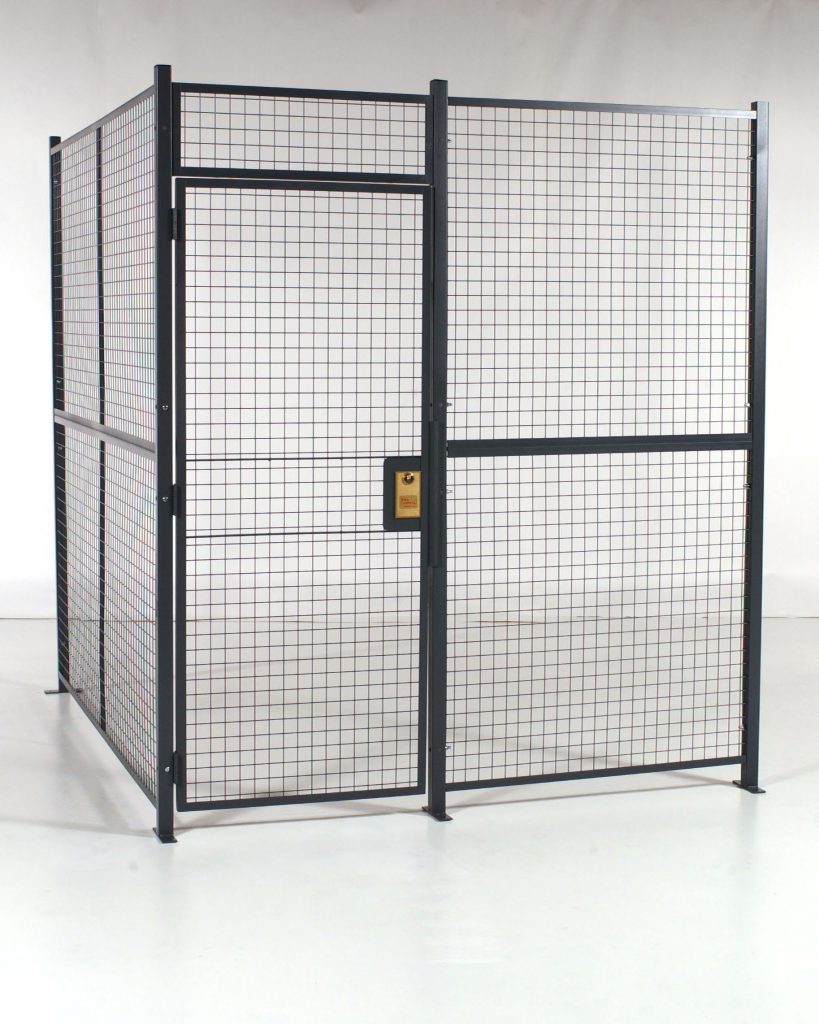
Standard-size welded wire cage kits, priced online, for smaller storage needs. Every kit still needs to be anchored to sound concrete — for tall, braced or engineered enclosures, request a quote with your building location and floor details.
Frequently asked questions
Can a wire mesh cage be used for chemical storage in a lab?
Why choose a cage over building a locked room?
Does a security cage satisfy ISO/IEC 17025 requirements?
How should retained sample storage be organized?
Can the cage door work with our existing badge system?
Will installation contaminate the lab?
What about material with its own licensing requirements?
Controlled storage that fits inside your lab
Material Handling USA designs, supplies and installs welded wire security cages and wire partitions for laboratories in Utah and nationwide.