
Tool and Die Crib Security Cage: Means Industries
How a Michigan metal-forming plant controls dies, perishable tooling and precision gages with welded wire cribs — and how to plan a caged tooling area that keeps a production floor moving instead of slowing it down.

2020–2024
Period over which Material Handling USA supplied security cage and wire partition product to Means Industries
Saginaw, MI
Home plant of a metal forming and clutch systems manufacturer founded in 1922
Repeat orders
Caged areas added function by function as the plant changed
Bolt-together
Modular welded wire panels installed around live production
The project
Means Industries is a Saginaw, Michigan manufacturer founded in 1922, now part of Amsted Automotive. The company builds one-way and selectable one-way clutch systems and complex metal-forming assemblies for automotive and electric-drive propulsion customers. That combination — stamping, forming, machining, assembly and a heavy engineering content — produces exactly the kind of plant where secured storage is an operations problem, not a crime problem.
Material Handling USA supplied welded wire security cage and partition product to Means Industries on repeat orders between 2020 and 2024, including pallet rack security enclosure work. Rather than one large caged room designed once, the pattern was incremental: a function needed to be controlled, an enclosure was added, and the next need was solved the same way. That is the normal life cycle of caged storage in a manufacturing plant, and it is the reason modular welded wire mesh partitions outlast fixed construction on a production floor.
This page sits under our security cages hub and describes the general design problem a metal-forming plant faces and how MH-USA approaches it. It contains no plant layout, no dimensions, no equipment list and no security detail specific to this customer.
Why tooling is the theft-and-loss problem in a plant
Ask a plant manager what walks out of the building and the answer is almost never finished product. Finished parts are counted, packed and shipped against an order. The losses are upstream, in the things production consumes: cordless tools and batteries, indexable inserts and cutters, air tools, calibrated gages, hand tools, load-cell and fixture components, spare motors and drives, and the endless supply of consumables that no one reconciles.
The financial loss is real, but the schedule loss is worse. A missing insert is a $30 problem until a line is down waiting for it. A gage that cannot be found is a quality hold. A die that is moved to the wrong staging area by a well-meaning operator is a changeover that runs an hour long. In an automotive supply chain where launch and delivery performance is scored, unplanned downtime caused by missing tooling costs far more than the tooling.
Caging does not solve this alone. What a crib does is force a transaction. When tooling lives inside a controlled enclosure and leaves through one opening, someone can be accountable for it, consumption can be measured, and reorder points stop being guesses.
What a metal-forming plant actually cages
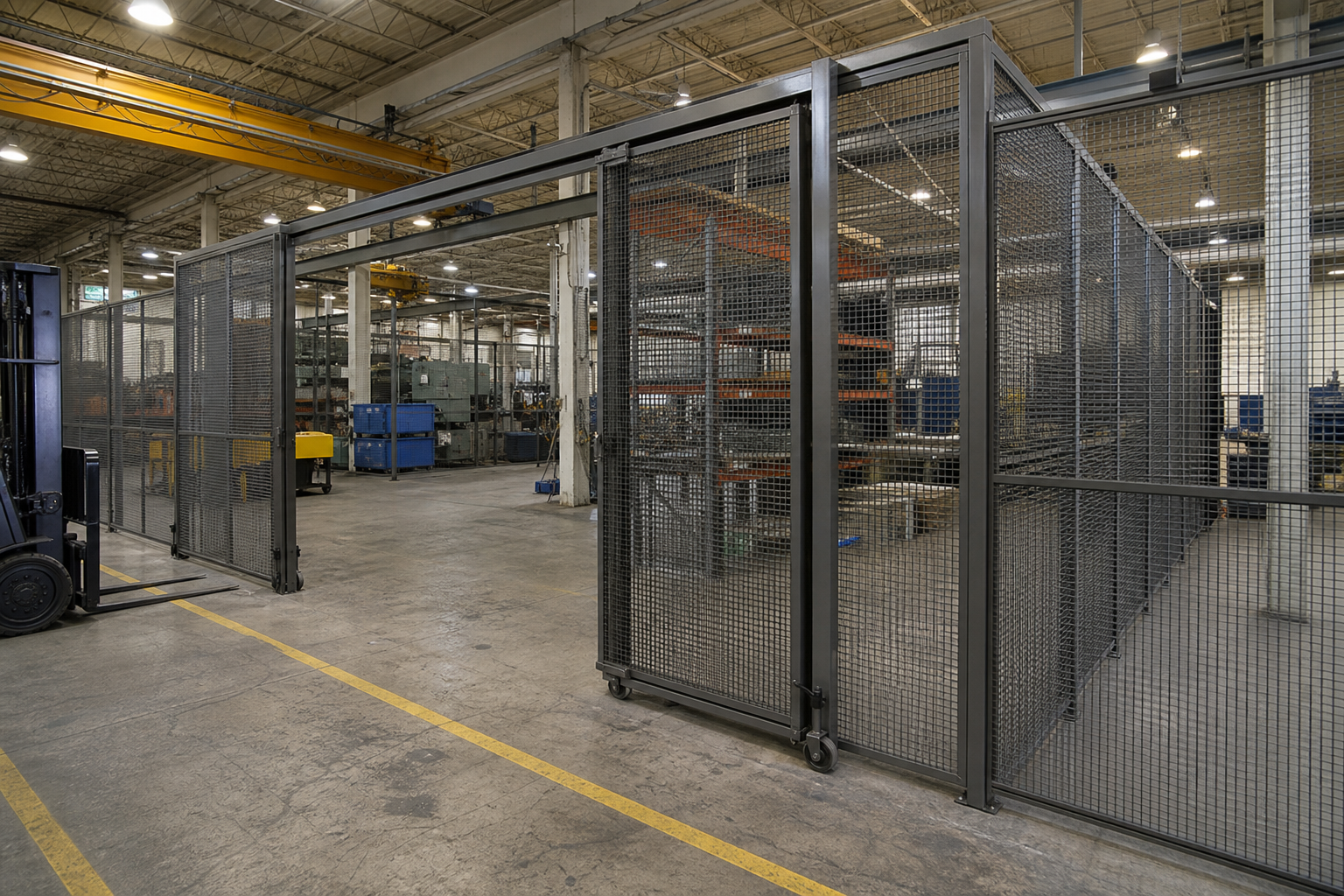
Manufacturers rarely need one enclosure. They need several small ones owned by different functions, because the access lists are different and the traffic patterns are different. The most common caged zones in a plant like this:
Splitting these into separate enclosures keeps key lists short. One large caged room with twenty keyholders provides documentation, not control. Several small enclosures, each owned by the function that uses it, provide both. Our tool crib page covers the shelving, bins and workbench fit-out that goes inside them.
Layout on a live production floor
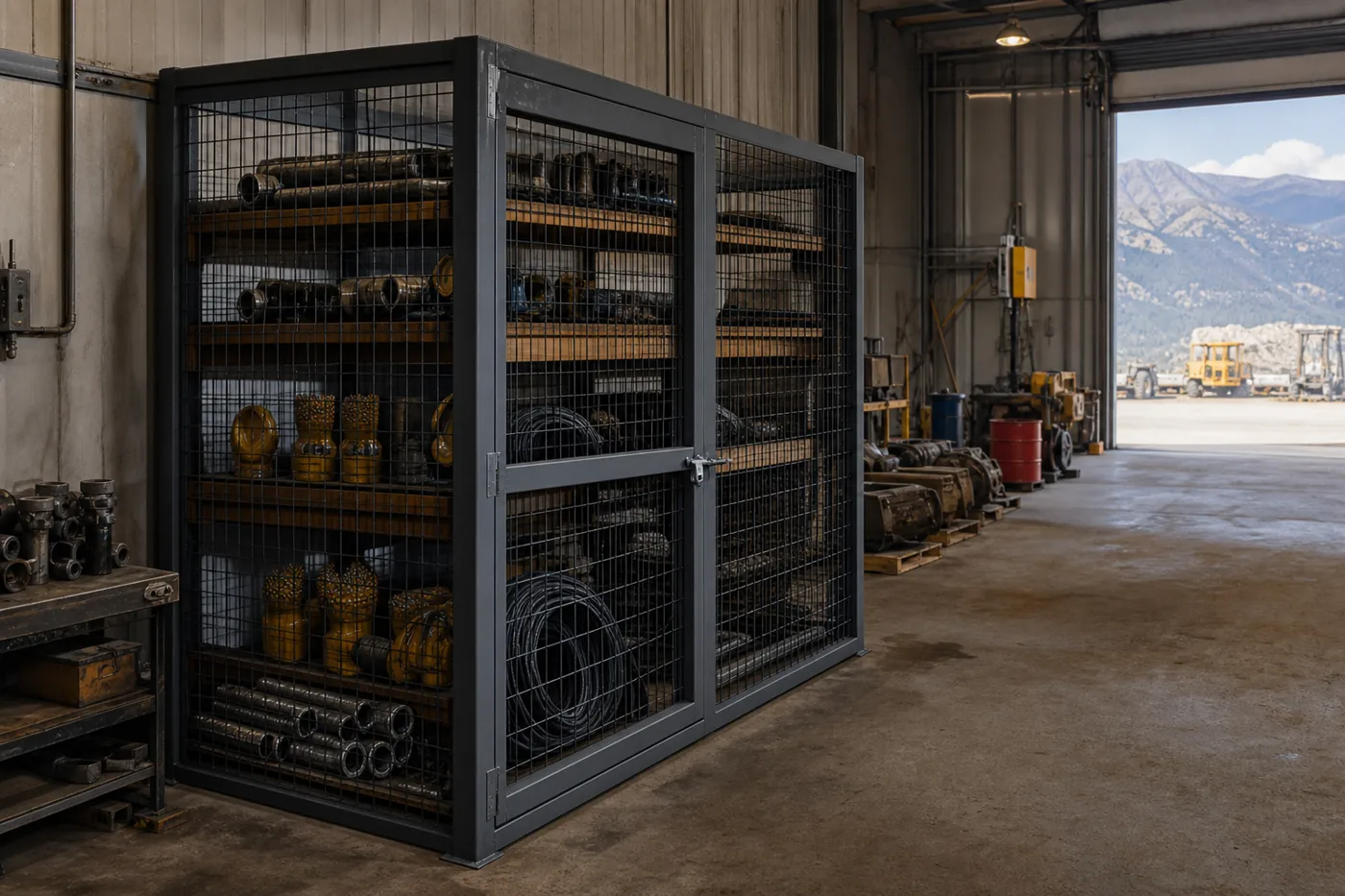
The constraint that decides a plant enclosure is rarely the wall — it is everything already occupying the space. Before panel layout starts, we walk the area for:
- Aisle and forklift paths. A crib that narrows a main aisle below the width the plant actually drives will be resented within a week and modified within a month.
- Overhead cranes and hoists. Bridge crane travel, hook approach and any jib radius set a hard ceiling on panel height and often decide whether the enclosure gets a mesh top at all.
- Columns, footings and pits. Press pits, trenches, floor drains and equipment footings dictate where posts can be anchored.
- Utilities in the floor and overhead. Conduit, air drops, hydraulic lines, bus duct and data trays all decide where a partition line can run.
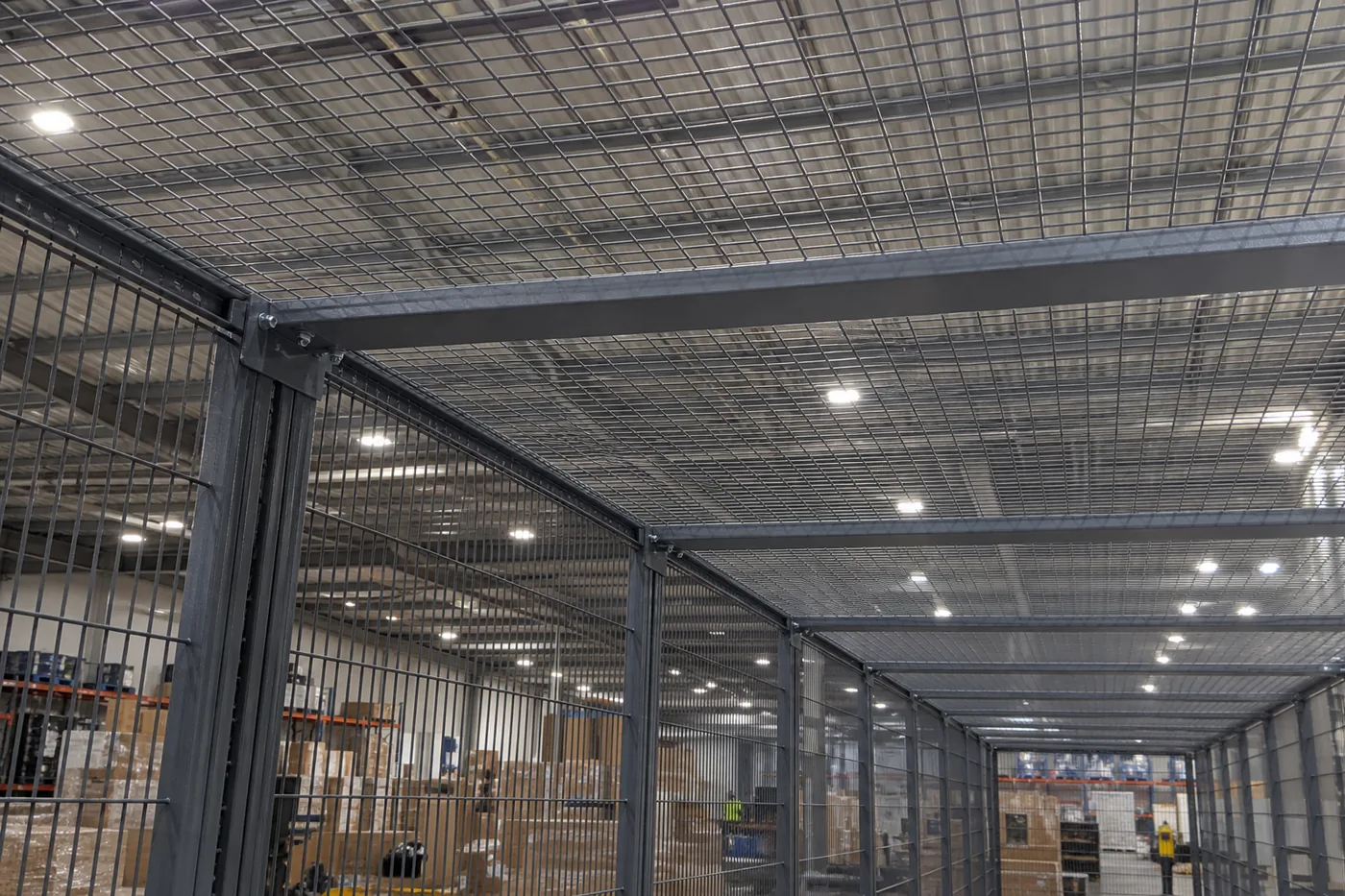
- Lighting and sprinkler heads. Mesh ceilings interrupt both. Heads are cut around, never enclosed — see our cage ceiling options.
- Egress. Aisles serving as exit access must stay clear and doors must swing correctly. Nothing about an enclosure may reduce the building’s means of egress.
Practically, most plant cribs end up in a corner or against a hard wall. Two mesh walls instead of four cuts cost, simplifies anchoring and shortens installation — and a masonry or precast wall is a better boundary than mesh anyway.
Load, weight and die handling
This is where manufacturing enclosures differ most from a warehouse or office cage. Dies and forming tooling are dense. A modest die can outweigh an entire pallet of consumer goods in a fraction of the footprint, and it is moved by forklift, crane or die cart rather than by hand.
That has three consequences for the enclosure design:
Storage under the tooling comes first
The rack, die shelving or floor slab carries the load — not the cage. Mesh panels are a barrier, not structure. Capacity is confirmed against the shelving or rack rating and, for heavy point loads, the slab, before anyone talks about panels.
Openings are sized for the handling method, not the tool
A door wide enough for the die is not wide enough for the truck carrying it, the operator’s sight line, or the swing of a die cart. Openings get sized around the equipment and its approach, which is why plant cribs so often use sliding doors instead of swing doors.
Impact is designed in, not hoped away
Anywhere powered equipment approaches an enclosure, protection belongs in front of the panels: guard posts, bollards, base channel or rail. Wire mesh is resilient and repairable, but a corner post taken out by a loaded truck is a downtime event you can design out cheaply.
Storage above pick level is enclosed separately
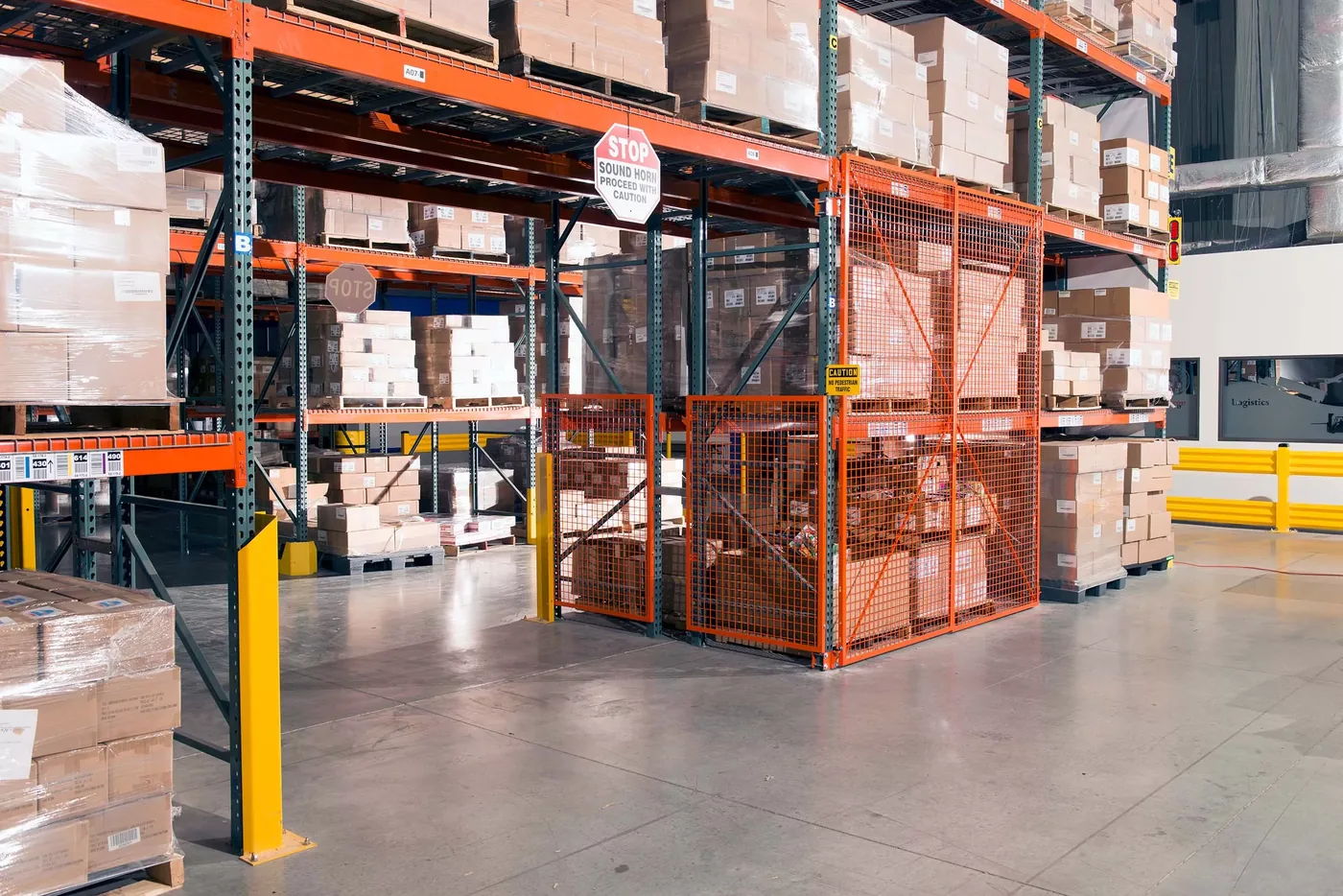
Where tooling is stored on rack above a caged area or beside a busy aisle, the falling-object risk is handled by rack safety accessories and backing, not by the security barrier. See our pallet rack security enclosures for the combined approach.
OSHA’s general materials handling and storage requirements at 29 CFR 1910.176 govern stable, orderly storage and clear passageways; the enclosure has to support that, never work against it.
Panels, doors and issue windows
Specification for a plant crib is a short list of decisions, and most of them are about throughput rather than security:
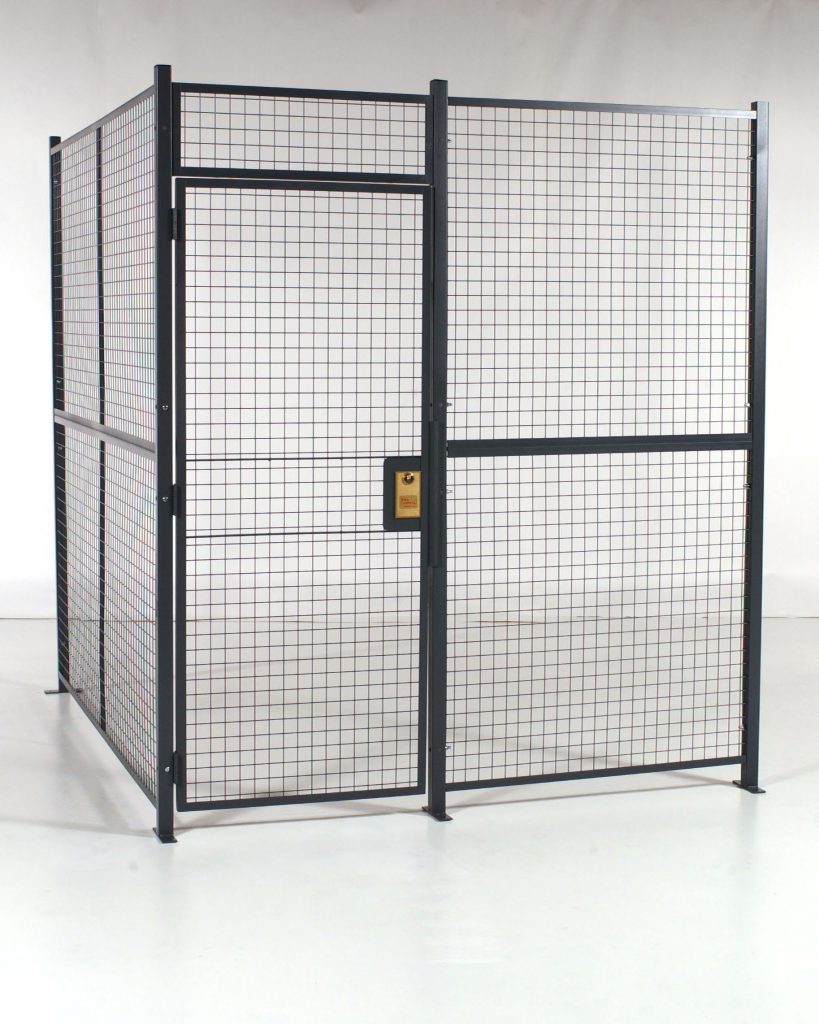
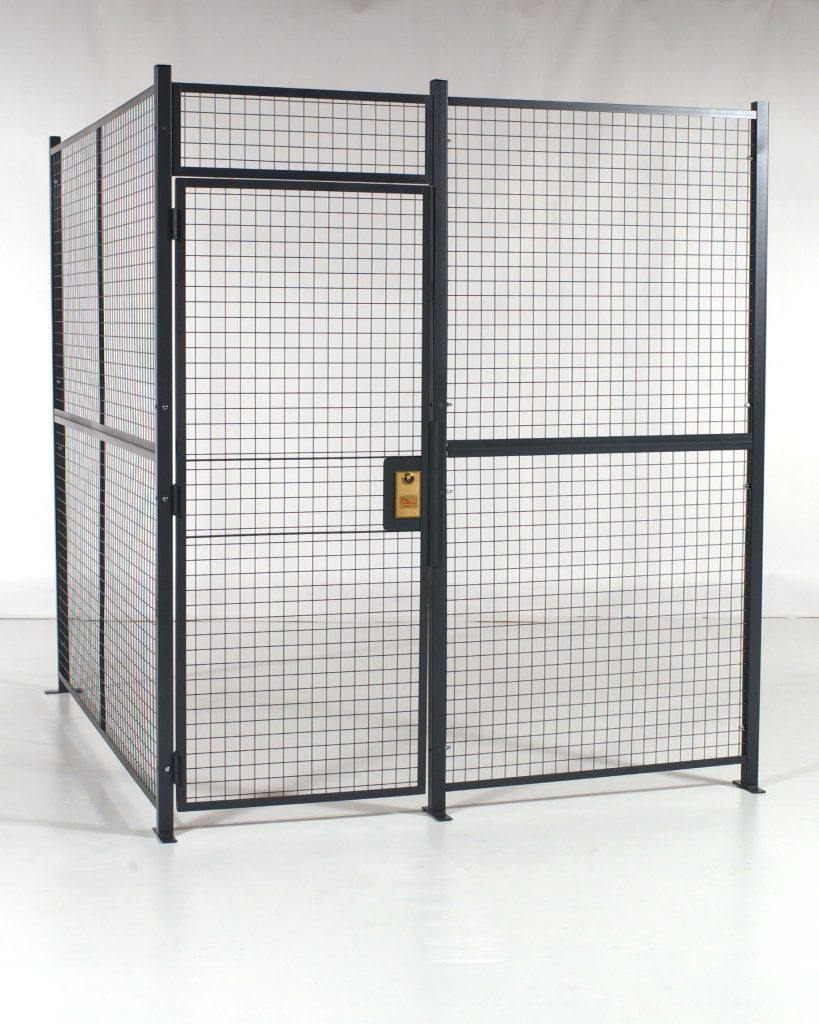
- Mesh and frame. Welded wire panels in a steel frame are the default for tooling areas: they let light and air through, they can be seen through by supervision, and a damaged panel is replaced individually. Panel options cover mesh opening, wire diameter and framing choices.
- Height and top. Partial height is enough where the area is supervised and the ceiling is open. Full height to deck, or a mesh top, is used where reach-over is realistic or the plant wants a defined room.
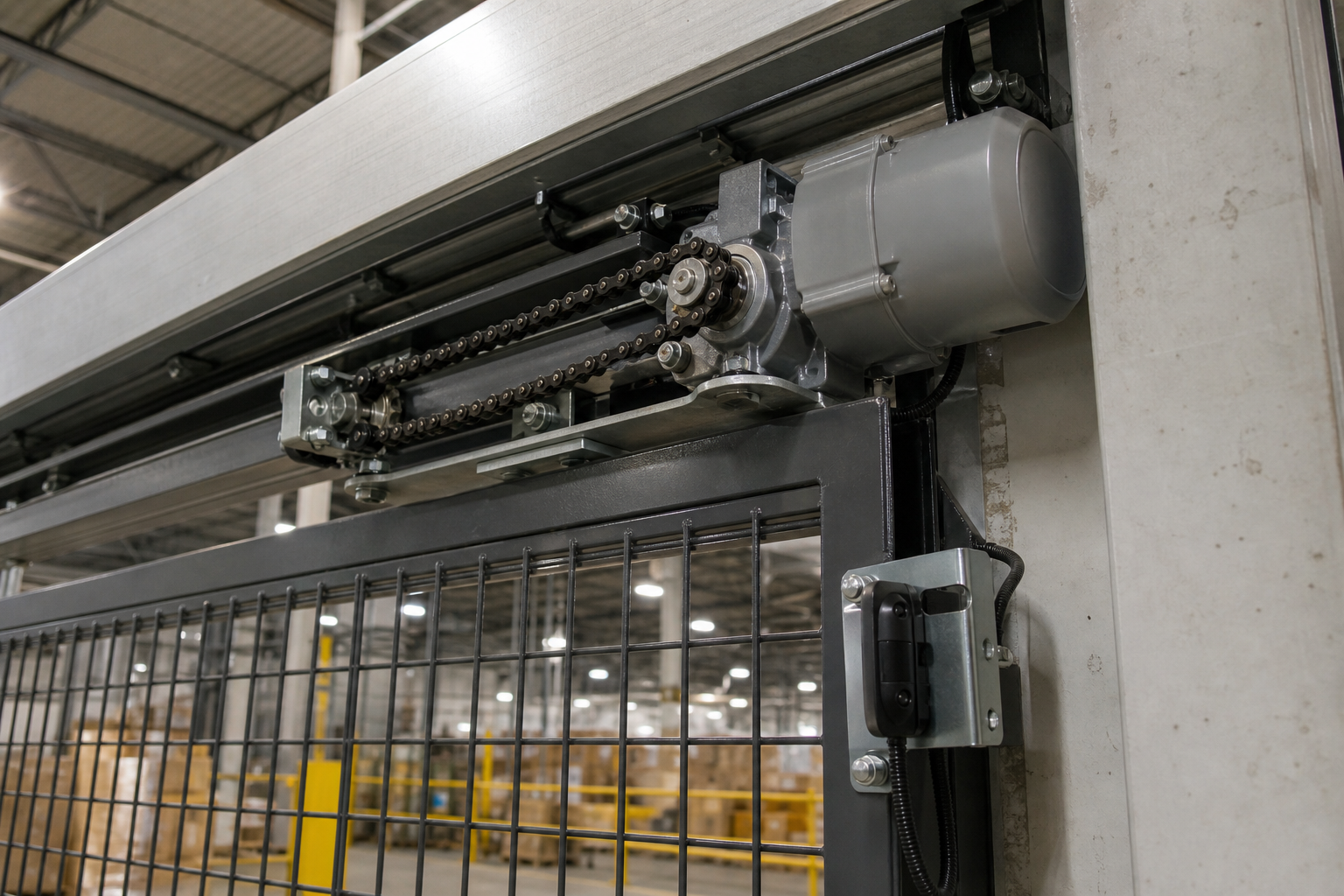
- Doors. Sliding doors dominate plant applications because they need no swing clearance in a tight aisle; hinged doors are used at personnel openings. Powered operators are added where traffic is continuous. See cage doors.
- Issue window or dutch door. The single most effective throughput feature in a crib. The tool comes out through the window, the crib stays closed, and no one else walks in. Details on service windows.
- Locking. From padlock hasps to keyed cylinders to access-control-ready hardware. The right answer is the one the plant will actually use every shift — see cage locks.
Where a lighter-duty, lower-cost barrier is enough — seasonal storage, yard and utility areas — a chain link storage cage is often the better economic answer than welded wire.
Guarding is not security — keep the two projects separate
Plants often ask for “cages” in the same breath for two completely different purposes: keeping people out of hazardous machine areas, and keeping product and tooling secure. They use similar-looking mesh and they are not interchangeable.
Machine safeguarding is governed by OSHA’s machine guarding requirements at 29 CFR 1910.212 and related consensus standards. Guarding panels are engineered for safe distance from the hazard, opening size relative to reach, impact resistance, and interlocked access. A storage enclosure is not designed to any of those criteria and must never be installed as a substitute for a guard.
The reverse also matters: a properly interlocked guarding enclosure is a poor tool crib, because every access event is a safety event. Where a plant needs both, MH-USA scopes them separately — see machine guarding for the safeguarding side and manufacturing security cages for the wider plant application.
Installing without stopping production
No plant shuts a department down for a storage project. Every enclosure MH-USA installs in an operating facility is planned around that reality.
- Sequence by bay, not by building. One area is emptied, laid out, anchored and closed before the next is opened, so the plant never loses two storage areas at once.
- Anchoring windows. Drilling into a slab creates dust and noise; scheduling it into off-shifts or planned downtime avoids conflicts with machining, metrology and painted or coated surfaces nearby.
- Verify before you order. Field-measured openings, confirmed ceiling clearances and a photographed obstruction list prevent the change orders that turn a two-day install into a two-week one. Our sizing guide covers what to record.
- Modularity is the point. Bolted panel systems can be extended, reconfigured or moved when the line changes — and in a plant supporting new propulsion programs, the line always changes.
- Inspect it like equipment. Panels, latches, door tracks and anchors get walked periodically; see the maintenance and inspection guide.
Full installation detail is on our security cage installation page.
Why this application is different
A distribution warehouse cages inventory that is counted and shipped. A plant cages the things that make inventory: tooling that is consumed, gages that must stay calibrated, dies that are heavy and moved by machine, and spares whose only value shows up on the day a press is down. Design decisions follow from that — sliding doors instead of swing doors, issue windows instead of open access, several small enclosures instead of one big one, and load carried by rack and slab rather than by the enclosure.
Material Handling USA designs, supplies and installs these systems nationwide. Start at the security cages hub for the full range of enclosure types, or talk to our team about the specific bay you are trying to control.
Shop Pre-Configured Wire Mesh Cage Kits Online
Standard-size welded wire cage kits, priced online, for smaller storage needs. Every kit still needs to be anchored to sound concrete — for tall, braced or engineered enclosures, request a quote with your building location and floor details.
Frequently asked questions
What is the difference between a tool crib and a security cage?
Should a plant build one large caged area or several small ones?
Can a security cage be used as a machine guard?
How do you keep a crib from slowing down changeovers?
Do the cage panels carry the weight of dies and tooling?
Can an enclosure be installed while the plant is running?
Can a caged area be moved when the line changes?
Plan a tooling crib that production will actually use
Material Handling USA designs, supplies and installs welded wire tool cribs and security cages for manufacturing plants nationwide.