
Storeganizer for Electrical, Plumbing and HVAC Distributors
Fittings, connectors, breakers and valves are the inventory that fills a wholesale branch first. Pocket storage puts hundreds of those part numbers into the rack bays you already own — within a few steps of the will-call counter.

Up to 40%
more usable space (Leuven, 2013)
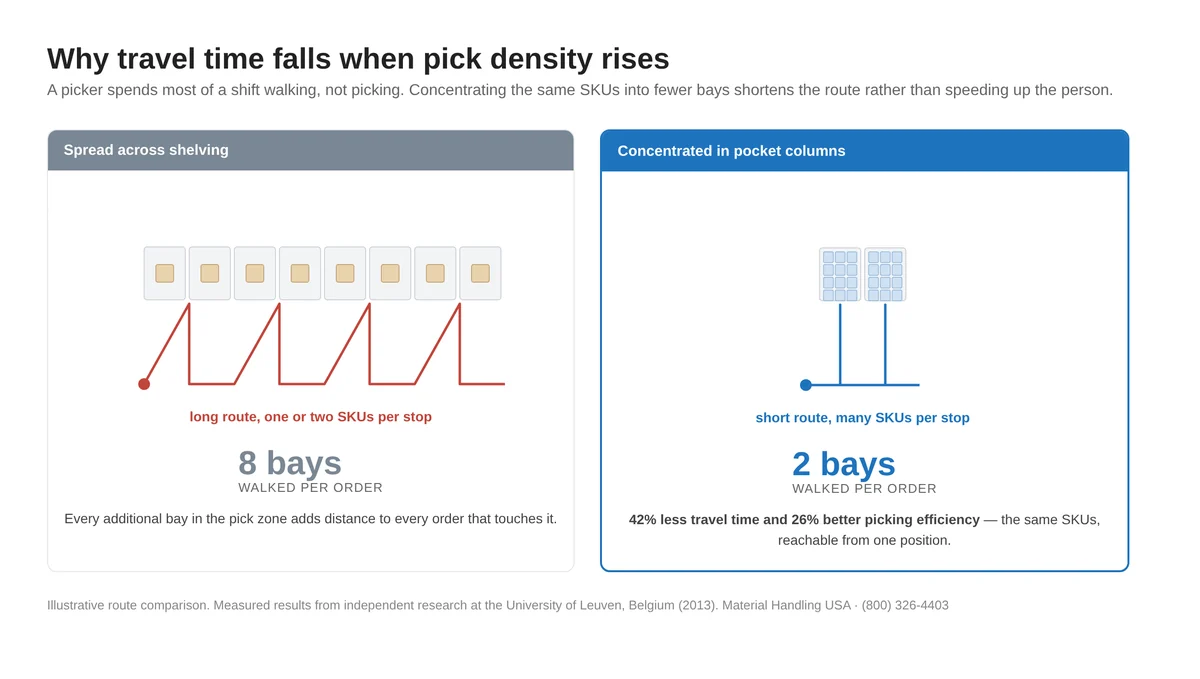
42%
less travel time (Leuven, 2013)
5 sizes
XS–XL standard US pockets
4 rows
of pockets deep per rack bay
Why an electrical, plumbing or HVAC branch runs out of locations before it runs out of building
Wholesale distribution in these trades has a distinctive inventory shape: a very long tail of small, cheap, low-velocity part numbers that customers still expect off the shelf today. A branch can carry thousands of fittings, connectors, devices and control parts that together account for a small share of revenue and a large share of the floor.
The result is familiar. Shelf after shelf of half-empty bins, because the carton or the bin — not the part — sets the shelf pitch. Slow movers creeping into prime counter-side space. Overflow stacked on the floor at the end of an aisle. A counter person walking the length of the building for two 3/4" couplings.
The shortage is almost never floor area. It is pick faces: individual, labelled locations. That is precisely what pocket storage manufactures out of cube you are already paying rent on.
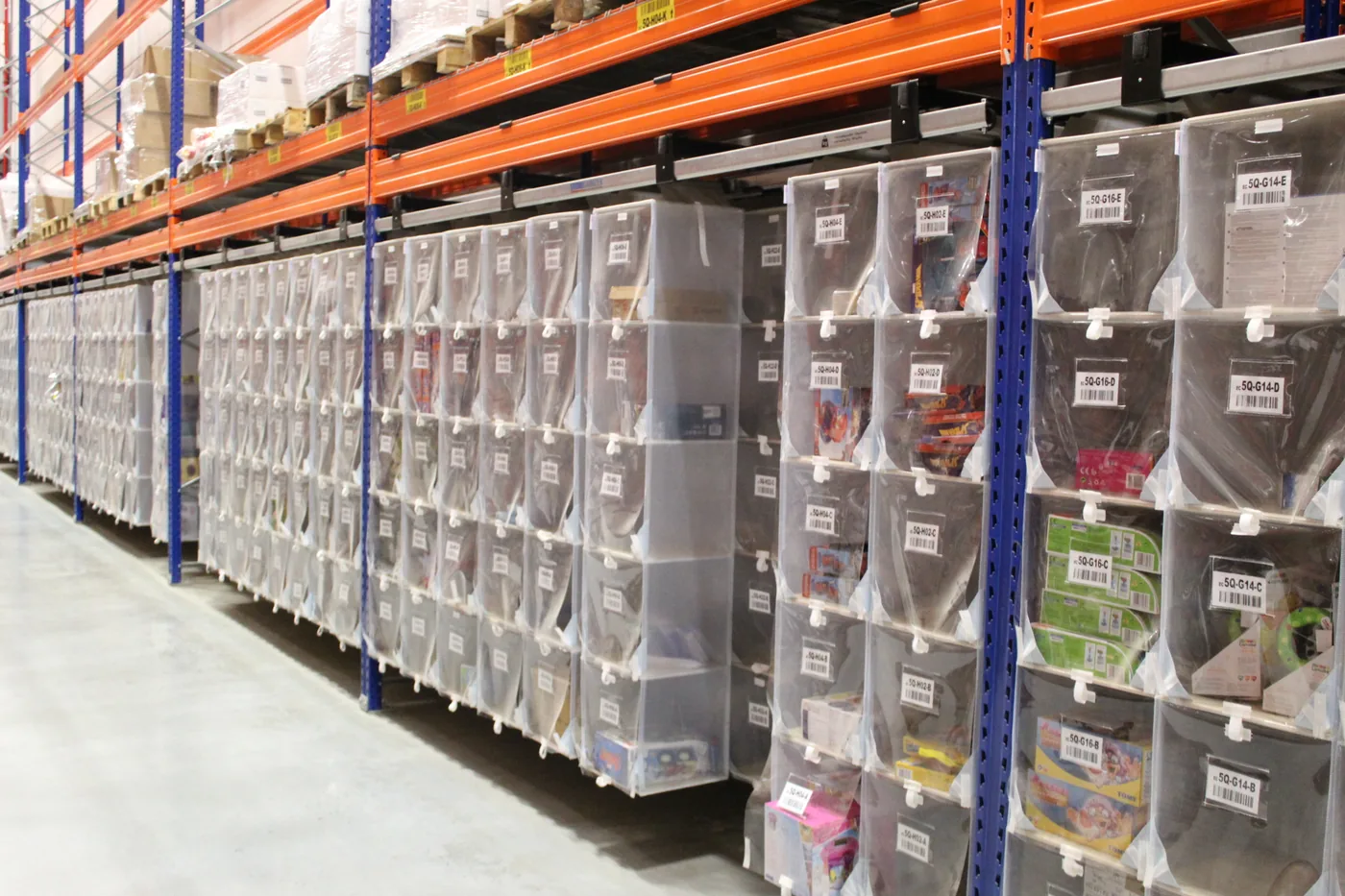
A single selective pallet rack bay used as small-parts shelving commonly holds a handful of storage positions where the same bay could hold dozens. Storeganizer — a textile pocket system from KTP conTeyor — hangs from a suspension rail inside that bay and turns the empty air between beam levels into individually labelled hand-pick locations. Nothing is built, and nothing is poured.
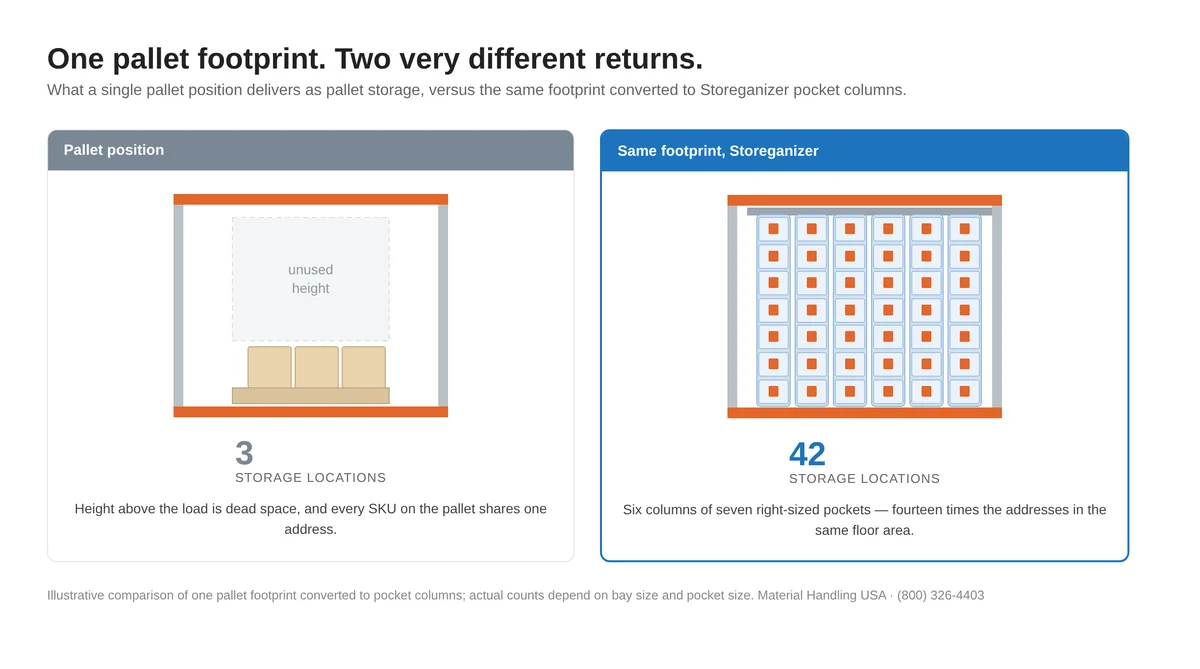
The arithmetic is what makes branch managers look twice: a pallet footprint holding a handful of positions as conventional storage can hold dozens of discrete pocket locations instead, depending on the pocket size mix you specify.
Our pallet rack space optimization page walks that audit bay by bay, and the Storeganizer system overview explains how the columns hang.
What belongs in a pocket — and what does not
MH-USA sells rack, cantilever, shelving and vertical carousels as well as pocket storage, so this table is written the way we walk a branch rather than as a pitch for one product. The deciding factors are item size, weight and how it is picked — never the industry label on the door.
| Branch inventory | Where it belongs | Why |
|---|---|---|
| Fittings, couplings, bushings, reducers | Storeganizer pockets (XS–S) | Hundreds of part numbers, tiny each, ordered in ones and twos — the classic shelving eater |
| Breakers, devices, connectors, lugs | Storeganizer pockets (XS–S) | Cartoned, light, hand-picked; a pocket per part number keeps counter picks unambiguous |
| Valves, unions, thermostats, controls | Storeganizer pockets (S–M) | Medium-size, moderate movement, high SKU count and easy to mis-pick from a shared shelf |
| Gas-valve, igniter and filter-drier kits | Storeganizer pockets (M–L) | Boxed service kits within hand-pick weight; pockets keep matched kits intact |
| Wire, cable and cord reels | Vidir wire spool carousel or reel rack | Round, heavy, awkward to hand-pick — a pocket is the wrong tool |
| Pipe, conduit, tubing, strut | Cantilever rack | Long goods need arms and open access, not a bay of pockets |
| Water heaters, rooftop units, air handlers, coils | Selective pallet rack | Palletized and far past pocket and column weight ratings |
| Boxed sheet metal, fittings in bulk cases | Pallet rack or bulk shelving | Case-quantity movement belongs on a pallet position, not a hand-pick face |
The slotting rule of thumb: pockets earn their place when items are small, hand-pickable and slow to medium moving. Fast, case-quantity movers usually stay where they are, close to the counter or the dock.
Round and long goods are a different problem with a different answer. Wire, cable and cord reels belong on a wire spool carousel built for electrical supply distribution; pipe, conduit and strut belong on cantilever racking. Using the right one for each family is how a branch gets its aisles back.
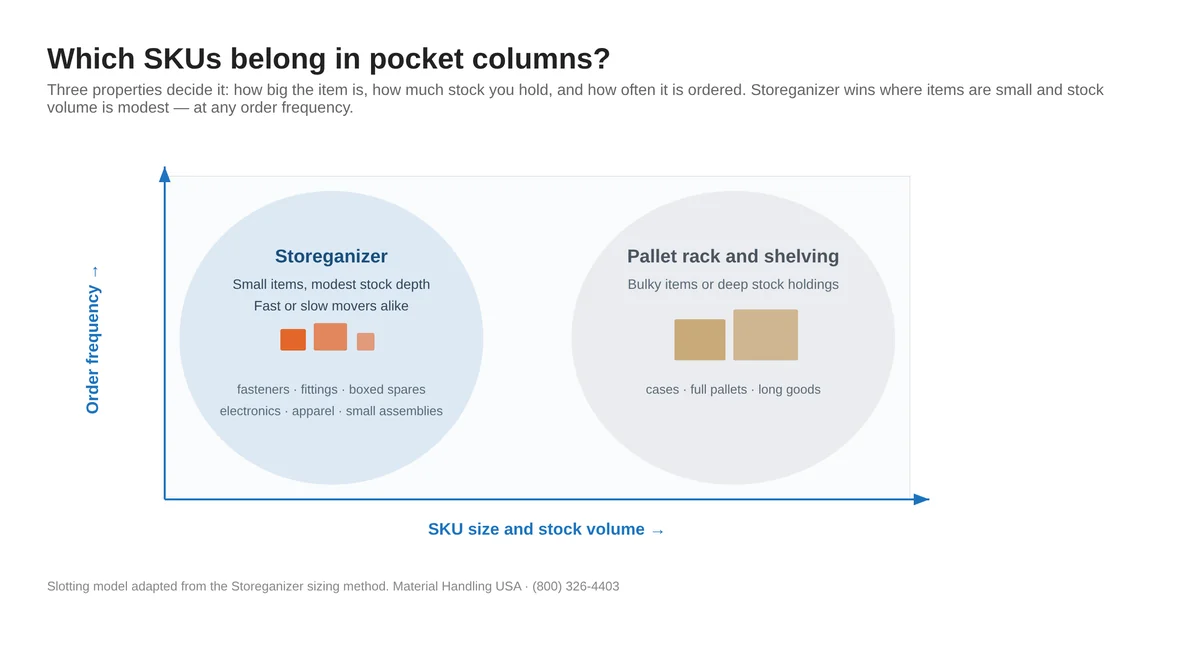
The weight line, stated plainly
20 kg (44 lb) per pocket and 100 kg (220 lb) per standard column. A fully configured bay can carry more than 3,000 kg. If the heaviest item in a family is past hand-pick weight, that family is not a pocket candidate — and we will tell you so before quoting.
The will-call counter: fewer steps, fewer wrong parts
Counter service is measured in minutes and in returns. Both suffer from the same root cause: too many similar part numbers sharing too few locations, too far from the counter.
A pocket is a single, labelled location for a single part number. Label and barcode holders on the pocket face make it a scannable bin location in your ERP, so a new hire can scan-verify a pick instead of recognising a fitting by eye. Everten Supplies reported mispicks down about 50% after their conversion.

- Long-tail part numbers move from a distant overflow aisle into bays near the counter, because the same footprint now holds many times the locations.
- One part number per pocket removes the shared-shelf confusion behind most counter mis-picks.
- Barcode holders support scan-verified picking without changing your location naming scheme.
- Pick routes shorten: locations stack up the aisle face instead of spreading down the aisle.
- Front covers and dividers keep small loose items and matched service kits intact.

Depth is the other half of the density story. Pockets can sit up to four rows deep in a bay, and the front columns roll aside by hand, so a counter person reaches the back rows without a ladder, a lift or a second aisle.
If picking throughput is the metric you are being held to, our order-picking efficiency page covers the slotting and travel side in detail.
Pocket sizes and textile grades for hardware-heavy inventory
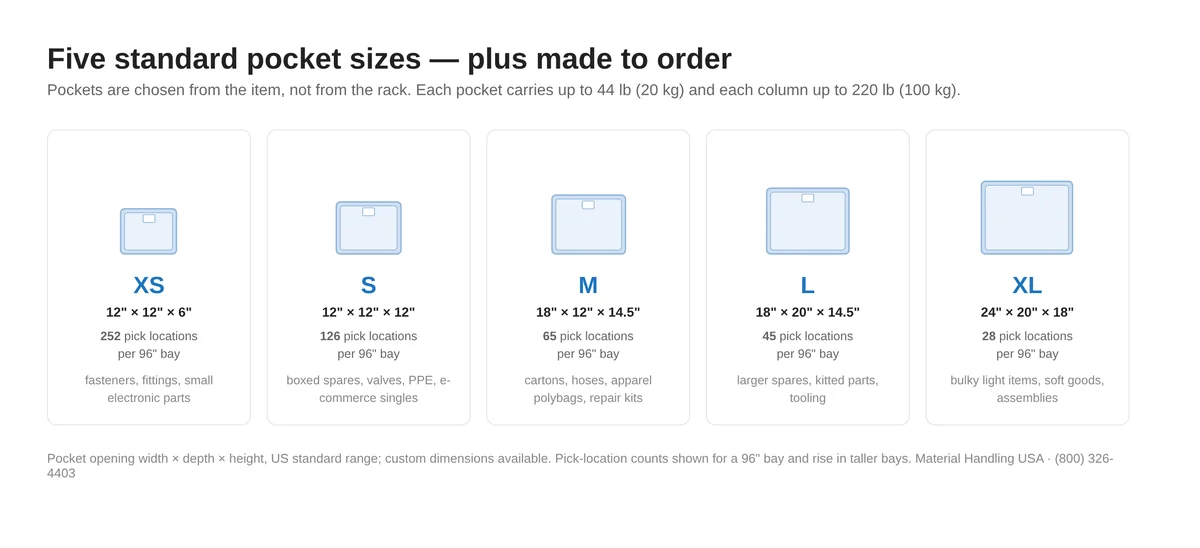
The standard US range is five sizes, XS through XL, plus bespoke dimensions where a family genuinely needs them. Size mix is the single biggest driver of how many locations a bay holds — published pick locations per 96" bay run from 252 at the smallest size down to 28 at the largest.
For a supply branch that usually means a mix: XS and S for fittings, connectors and devices; S and M for valves and controls; M and L for boxed service kits. The full size and capacity table lives on the Storeganizer specifications page, which is the only place we publish dimensions.
Textile grade is a specification, not an afterthought
Brass, steel and cast fittings are abrasive, and sometimes sharp. The textile range is graded for exactly that: Tiger at roughly 70 lb tensile and 50,000 abrasion cycles, Tiger+ at roughly 100 lb and 150,000 cycles, Tiger++ at roughly 140 lb and 300,000 cycles, and PC380 at roughly 165 lb and 500,000 cycles. The system carries an up-to-10-year rip-and-crack warranty. NexTTex is a 100% recyclable polypropylene option — as strong as PVC-coated, about 30% lighter, with no plasticiser migration and roughly half the carbon footprint.
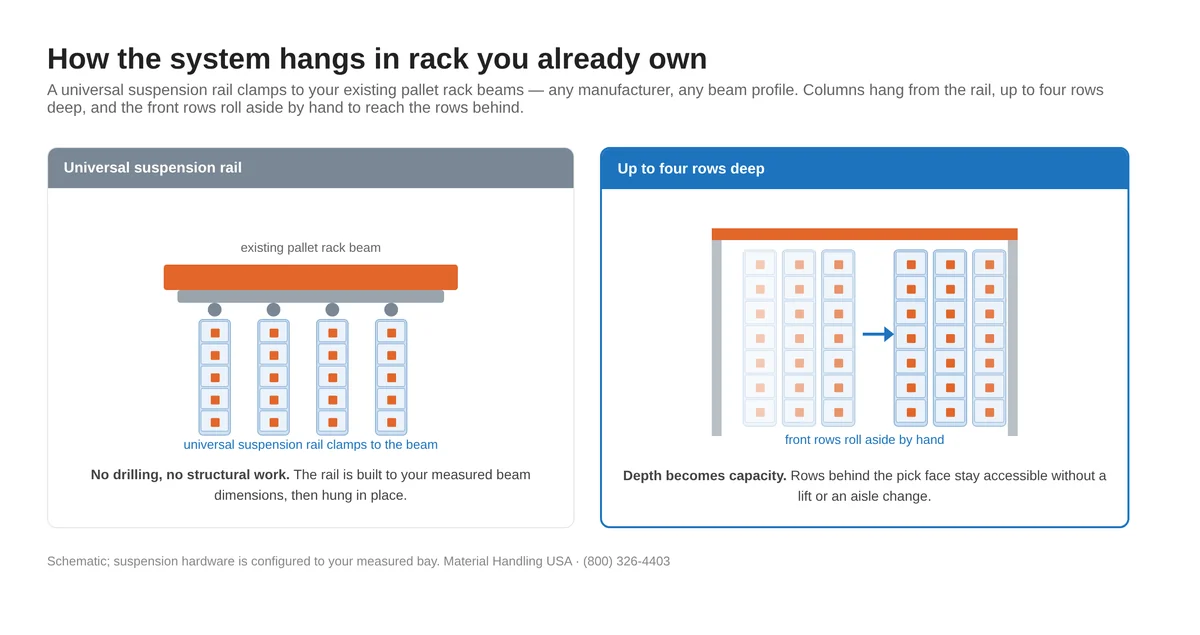
Every pocket hangs on the same universal suspension rail, which is what makes a retrofit into existing rack practical: the rail sits on the beam, the columns hang from the rail, and the bay keeps doing its job.
Options that matter in a supply house: label and barcode holders, front covers, dividers and front stops. Where sustainability reporting matters to your customers, the sustainability page sets out the recyclability and carbon figures we are willing to stand behind.
Model your own branch bays
Set bay size and pocket mix in the Storeganizer Configurator and see how many pick locations a single bay of your rack would gain.
Request a Quote Open the Storeganizer Configurator Call (800) 326-4403
One branch first, then the network
Multi-branch distributors rarely want a program before they have a proof. Pocket storage suits that pattern, because the unit of work is a rack bay, not a building: a handful of bays at one branch is a real installation, measurable against the shelving it replaced.
What we ask you to measure is not square feet. It is pick locations per bay, plus counter pick time and mis-pick rate on the families you converted. If the multiple holds at one branch, it holds at the others — because the same rack and the same long tail repeat across the network.
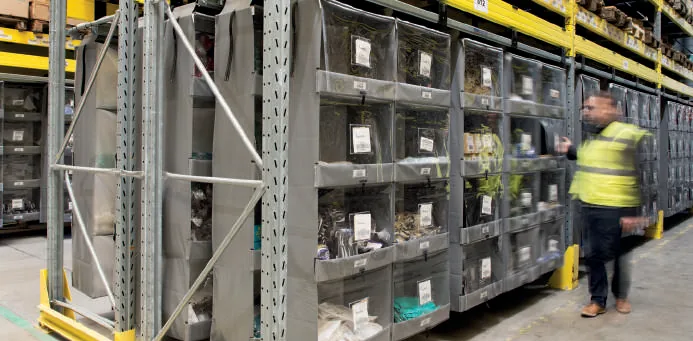
Installation happens bay by bay inside a live operation, which matters when a branch cannot close for a project. Because columns and rails can be moved and re-slotted, a rollout is also reversible in a way that a mezzanine or a building expansion is not — we compare those three options honestly on Storeganizer vs. a mezzanine or a building expansion.
Leased buildings are the other common case. A branch on a five-year lease is a poor candidate for construction and a good candidate for equipment that comes with you: the rail and columns unbolt and re-hang in the next building’s rack.
Price drivers — bay count, pocket size mix and textile grade — are set out on our Storeganizer cost and ROI page. Every project is quoted individually; we do not publish list pricing.
What other distribution operations published
These are manufacturer-documented results, each attributed to the operation that reported it. None of them is an electrical or plumbing wholesaler, and we are not going to pretend otherwise — they are distribution operations with the same long-tail problem. Results depend on SKU profile, so treat them as evidence that the approach works rather than as a forecast for your branch.
| Operation | What changed | Published result |
|---|---|---|
| Everten Supplies | 18 bays mixing small, medium and large pockets in an at-capacity warehouse | 2,759 locations in 50 m²; that footprint went from 10% to 25% of stock lines; mispicks down about 50%; relocation postponed |
| Chalhoub Group | Static mezzanine shelving replaced with 46 bays of pockets, three rows deep | 8,611 sq ft of shelving consolidated into 1,335 sq ft; 25–30 to 60–80 pick lines per hour |
| CEVA Logistics, Daventry | 26 bays across five pocket sizes on a 90,000 sq ft site | Scattered small parts consolidated; picking accuracy reported at 100% |
| DSV | 19 medium-pocket bays | Reported 50% space saving and 30% picking efficiency gain in the first weeks |
| Ingram Micro, Northampton | Pocket columns added to an existing small-parts operation | 40% more SKUs per linear travel distance (David Cuddeford, Principal Engineer) |
Our own documented US project is an aerospace and defense parts room — read the aerospace parts storage case study, or browse every vetted result on the Storeganizer case studies index.
If you would rather see the generic version of the argument first, Storeganizer for small-parts warehouse storage is the sibling page that covers SKU selection without an industry lens.

How an MH-USA branch project runs
Walk the branch
Which families are eating shelving, how far the counter walks, and how much cube sits unused above the top beam.
Measure the bays
Bay width and depth, beam elevations you can give up, aisle access and whether a forklift works the aisle.
Slot on paper
Which part numbers go to pockets, which stay on shelving, and which belong on cantilever, rack or a carousel instead.
Specify sizes and textile
Pocket size mix, textile grade for the abrasion you actually have, and label, divider and cover options.
Install bay by bay
Retrofit into the existing rack while the branch keeps trading; locations are relabelled as each bay comes online.
Measure and repeat
Locations per bay, counter pick time and mis-picks on the converted families — then decide about the next branch.

We quote the whole answer, not just the pockets. If a family needs cantilever, a carousel or plain shelving, that is what goes in the proposal — a branch that is 80% better is worth more than a branch that bought one product.
Start anywhere: send bay dimensions and a slow-mover part list, or model it yourself in the Storeganizer Configurator.
Related reading
 Storeganizer for Small-Parts StorageThe generic version: which SKUs earn a pocket, and how a bay is slotted for density.
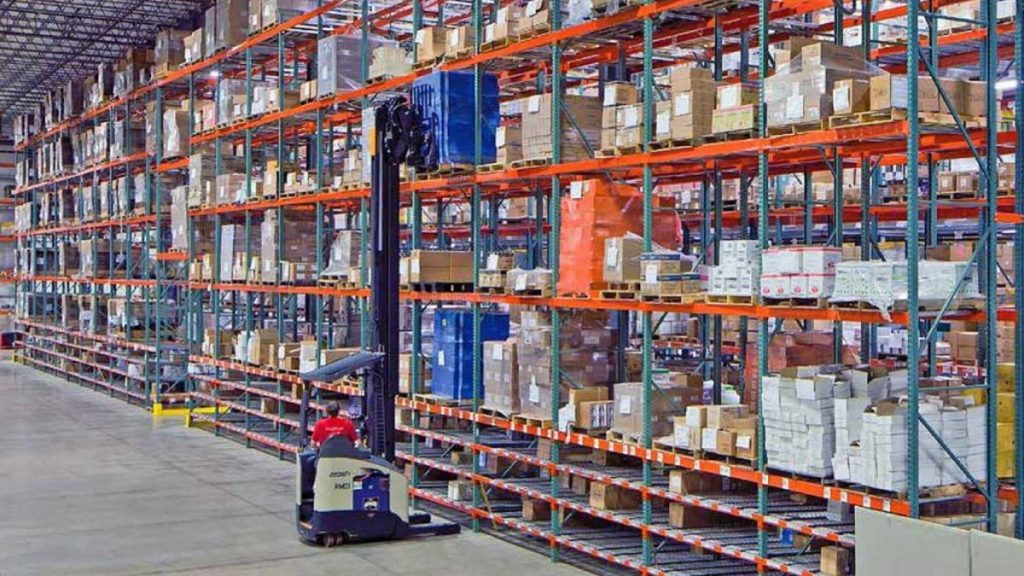 Pallet Rack SystemsCompare rack systems for your loads, forklifts and space — the structure pocket columns hang in.
 Storeganizer vs. Shelving, Bins, Flow Rack and VLMsAn honest equipment comparison from a distributor that sells all of them.
 SKU Slotting and Rack-Space ROISlot by SKU size, stock volume and order frequency to get the most pick locations per bay.
Get a free quote
Tell us what you are storing, the room size and your timeline. A project specialist will follow up with layout options and pricing. Prefer to talk? Call (800) 326-4403.
Frequently asked questions
What kind of electrical, plumbing or HVAC parts suit pocket storage?
Can it go in the rack we already have at the branch?
How many locations does a bay hold?
Does it work with scanning and our ERP bin locations?
Is the textile durable enough for sharp brass and steel fittings?
Will it slow down the will-call counter?
Who makes Storeganizer, and who installs it?
See how many pick locations your branch rack is hiding
Send us bay dimensions and a list of your slow-moving fittings, devices or controls and we will slot a sample before anything is quoted — or model it yourself in the Storeganizer Configurator. Call (800) 326-4403.