
Paint and Coatings Distribution Warehouse Racking: Industrial Finishes
Coatings are heavy, valuable and flammable at the same time. That combination decides the rack layout long before throughput does.
2024
Year Industrial Finishes worked with us
Pallet rack
Product category we supplied
Paint & coatings
Distribution segment
Fire code first
What drives the layout
Plan your layout before you buy
Configure upright height, beam width, bay count, and load levels in our free 3D Pallet Rack Configurator, then get an instant bill of materials and request a quote.
The project
Industrial Finishes is a distributor in the paint and coatings sector. Material Handling USA supplied pallet rack for the company in 2024. The client name, the year and the product category are the only project facts we publish — no layouts, quantities, capacities or contract values.
What makes the application worth writing up is the constraint set. A coatings branch stores dense liquid in small containers, in volumes that push against fire-code thresholds, with a colour-matching operation attached to the front of it. The pallet rack systems in that building have to satisfy the fire protection design before they satisfy anyone’s opinion about pick paths.
This page is about the engineering and planning of that kind of warehouse. It is a companion to our chemical and pesticide distribution racking case study, which deals with concentrated agricultural chemistry, and our drum and IBC storage racking case study, which deals with bulk liquid in 55-gallon containers. Packaged coatings sit between the two.

Why coatings warehouses are different
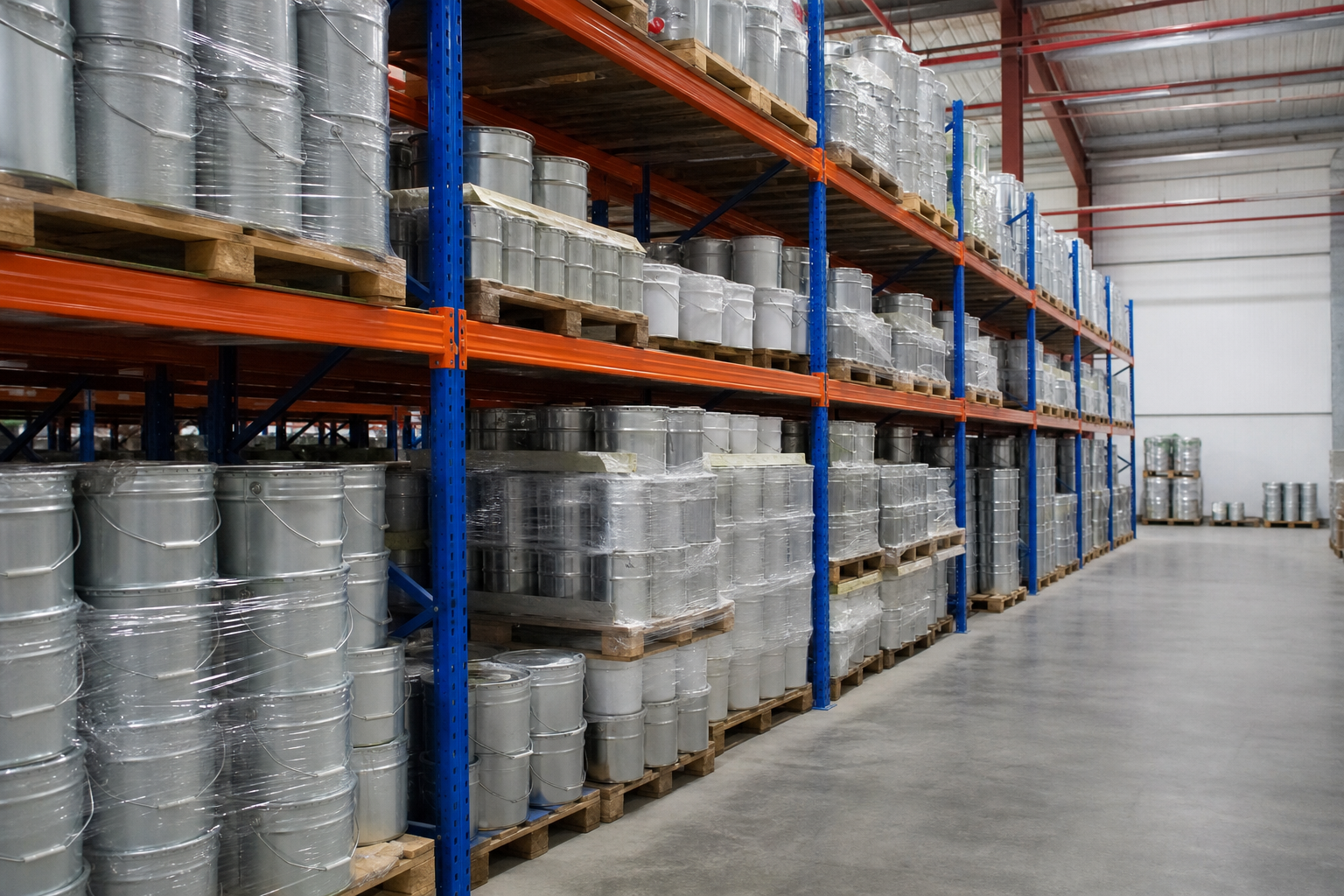
The product is dense. A pallet of full five-gallon pails weighs far more than a pallet of the cartons most warehouses are designed around. Beam levels sized by eye for “a pallet” are routinely wrong in a paint warehouse.
The product is flammable, and how flammable varies by SKU. Solvent-borne coatings, reducers, hardeners and cleaning solvents fall into different liquid classes than water-borne products, and the classification — not the label colour — drives what the fire code allows.
Containers are small and numerous. Quarts, gallons, pails and cases mean a lot of pick faces relative to the pallet count, and a lot of opportunity for a partial pallet to become an unstable pallet.
Leaks are a storage problem, not a housekeeping problem. A punctured pail three levels up spreads across everything below it. Where liquid can go is part of the rack design.
Shelf life and batch matter. Coatings have a usable life, and batch consistency matters to customers matching a colour across a job. First-in, first-out is not optional.
Temperature swings are real. Water-borne products are freeze-sensitive, and a poorly conditioned corner of the warehouse can quietly ruin inventory over one cold weekend.
What is actually on the pallets
A coatings branch looks like one product category from outside and like five from inside. Each group behaves differently in a rack.
| Group | Typical containers | Storage implication |
|---|---|---|
| Solvent-borne coatings, reducers and cleaners | Quarts, gallons, 5-gallon pails, some drums | Ignitable liquids — storage height, quantity and protection are set by fire code, not by convenience |
| Water-borne coatings | Gallons, pails, totes | Far lower fire load, but freeze-sensitive and just as heavy; suits conventional selective rack in conditioned space |
| Two-component systems and catalysts | Small cans, kits, cases | Small, high-value, expiry-driven; belongs on decked levels or shelving near the counter, not on high beams |
| Aerosols | Cases of cans | A special fire-protection category in their own right; segregate and follow the sprinkler design for the building |
| Abrasives, masking, sundries and equipment | Cartons, rolls, boxed spray equipment | Bulky, light and non-hazardous — the natural candidate for the high beam levels |
The single most useful early decision is separating that last group from the first four. Sundries are the easy inventory: put them where the fire-protected space is not needed, and free up the protected area for the product that legally requires it.
Fire protection drives the rack design
In most warehouses the sprinkler system is designed around the racking. In a coatings warehouse it is closer to the other way round: the protection scheme, the liquid classes and the allowable storage arrangement are established first, and the rack is configured to match.
The governing documents are not optional reading. Storage of flammable and combustible liquids in containers is addressed by NFPA 30, the Flammable and Combustible Liquids Code, alongside the International Fire Code as adopted locally. OSHA’s requirements for flammable liquids sit in 29 CFR 1910.106.
Maximum allowable quantities and control areas come first. How much of each liquid class may be stored in an area, and how those areas are separated, is a code question with a building answer. It sets the footprint the racking has to live inside.
Storage height is a protection variable. The height you may stack a given liquid class in a given container type is tied to the sprinkler design. Adding a beam level is a fire protection change, not a shelving change.
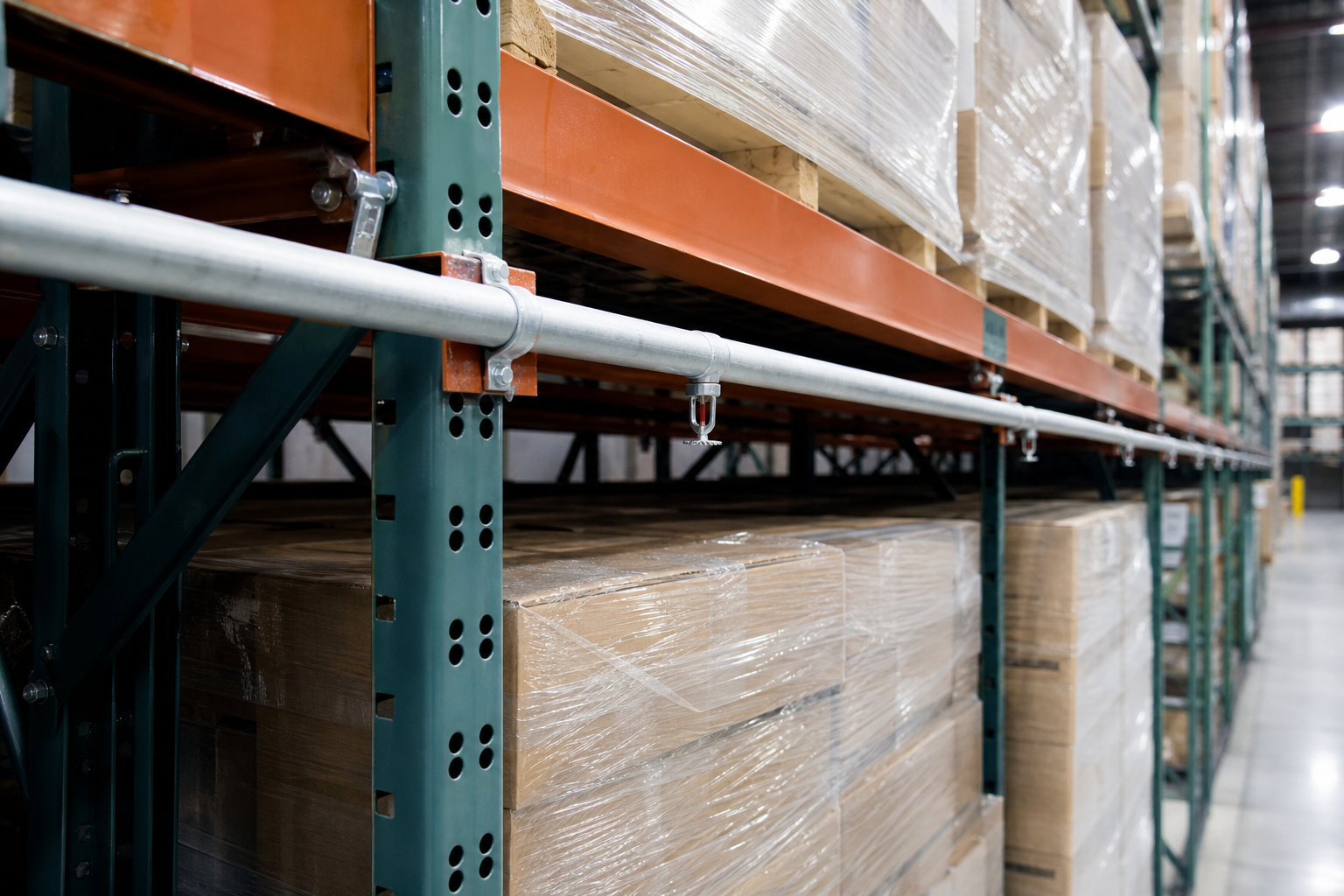
In-rack sprinklers change the rack geometry. Where the protection scheme calls for sprinkler lines inside the rack, the racking must accommodate the piping, the flue spaces must stay open, and the beam elevations have to line up with the design.
Flue spaces are part of the system. Transverse and longitudinal flues let sprinkler water reach a fire lower in the rack. Solid decking, over-wide pallets and casual overhang defeat them.
Talk to the fire protection engineer before ordering steel. The most expensive mistake in this building type is buying racking sized for the space and discovering it does not suit the approved protection scheme. Rack elevations, aisle widths, decking type and even pallet selection can all be constrained by the sprinkler design.
None of this is a substitute for a design by a qualified fire protection engineer and approval by the authority having jurisdiction. We design the storage system to fit the approved scheme; we do not certify compliance.
Rack types that suit a coatings branch
Once the protected footprint is fixed, the choice of rack is about density, rotation and the fact that the load is heavy for its cube.
- Selective pallet rack for the majority of the building. High SKU count, modest depth per SKU and a legal requirement to keep every pallet reachable make selective the default. It also keeps flue spaces simple.
- Structural rack where the loads and the traffic are heaviest. Bolted structural steel takes impact better than roll-formed, which matters in a branch where the same aisle is worked all day.
- Pallet flow for fast-moving, date-sensitive stock. Where a small number of SKUs move in volume and FIFO matters, flow lanes enforce rotation instead of relying on discipline — but check the arrangement against the protection scheme first.
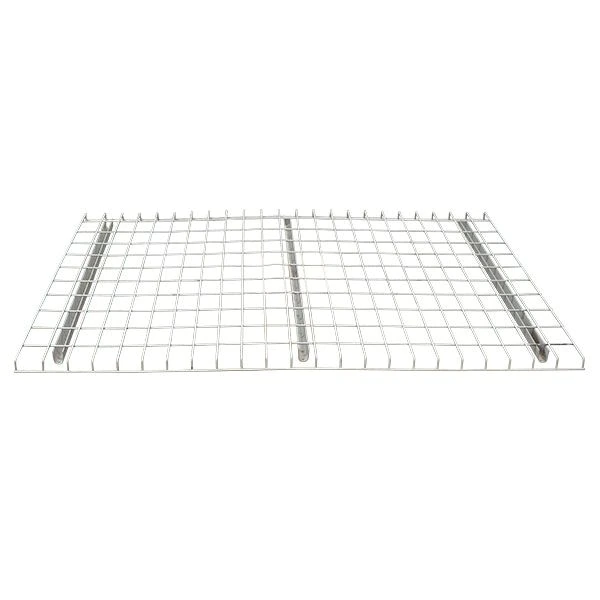
- Wire decking almost everywhere. Partial pallets, loose cases and small cans need a surface. Choose a decking style compatible with the sprinkler design; open-mesh decking is normally specified precisely because water has to pass through it.
- Low beam levels for dense product. Full pails belong near the floor. It reduces the consequence of a fall, shortens the reach for hand-picking, and keeps the heaviest load off the top of the frame.
- Shelving, not rack, for the pick face. Quarts, cartridges, tint bases and kits are picked by hand in small quantities. Steel shelving or decked low levels beat a pallet position for that work.
Aerosols, drums and the containment zone
Aerosols are their own problem. A case of aerosol cans behaves very differently in a fire from a pail of the same product, and fire codes treat aerosol storage as a distinct category with its own protection requirements. In practice that means a defined area, a known quantity and a protection scheme that was designed for aerosols — not a spare bay at the end of an aisle.
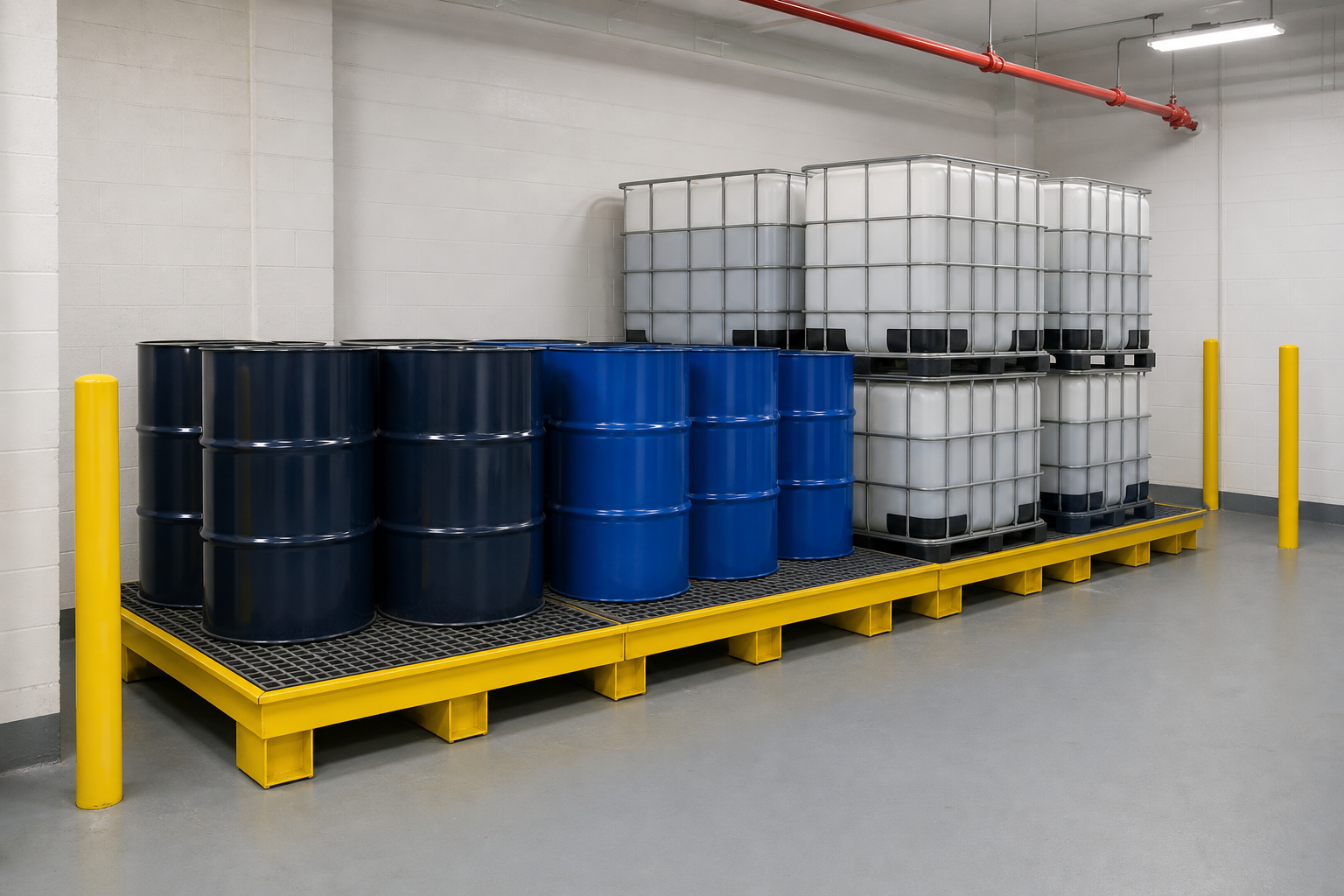
Drums need a different structure. Where a coatings branch also stocks drums of solvent or resin, drum storage wants purpose-built cradles or a rack designed for the load and for access with a drum handler. We covered that in depth in our drum and IBC storage case study.
Containment is a rack accessory decision. Sumped containment pallets and containment shelving on the lower levels keep a leak inside a defined volume instead of on the floor, and they are much easier to install at the outset than retrofit. See our spill control and secondary containment range for the equipment side.
Segregate incompatible chemistry. Catalysts, peroxides and acids do not belong next to solvents. Physical separation in the rack layout is the cheapest control available.
Keep the returns and damaged-goods area out of the rack. Dented pails and leaking returns need a defined floor area with containment, not a top beam somewhere.
Colour, batch and the mixing counter
Most coatings branches are half warehouse and half service counter. The mixing operation is where the value is added, and the storage behind it either supports that or fights it.
| Requirement | What it means for the storage design |
|---|---|
| Tint bases and toners are picked constantly | They belong in dense, eye-level shelving immediately behind the mixing bench — not in the rack line |
| Batch consistency matters to the customer | Storage has to keep batches together and rotate them predictably; mixed batches in one pick face cause callbacks |
| Shelf life is finite | Date-driven rotation needs either flow lanes or a labelling and slotting discipline that makes the oldest pallet the obvious one |
| Colour matching needs consistent light and temperature | The mixing area is a conditioned zone; storage layout should not force staff to walk cold aisles with open product |
| Will-call customers arrive continuously | A staging area between the rack line and the counter stops pickers and customers from occupying the same aisle |
| Equipment and sundries sell alongside coatings | Bulky, light and safe — put them on the upper beams and at the far end of the building |
The general principle is the same one that governs any counter-plus-warehouse operation: the fastest-moving, smallest items should be closest to the point of use, and the rack line should hold replenishment rather than pick stock. Body shops solve a compact version of the same problem — see our body shop paint mixing room storage page.
Installation, seismic and inspection
Racking in a coatings warehouse carries dense load in a building with an engineered fire protection system. Both facts raise the standard for installation and for the inspection routine afterwards.
- Anchor and engineer for the real load. Liquid is heavy. Capacity has to be calculated from actual pallet weights, not category averages — see pallet rack weight capacity.
- Seismic design category is a Utah reality. Frame design and anchorage in the Intermountain West are governed by the seismic design category for the site, and a dense stored load increases the demand.
- Protect uprights in a branch that runs all day. Column protectors and end-of-aisle guards pay for themselves the first time a pallet jack clips a frame in a narrow will-call aisle.
- Keep flue spaces clear as an operating rule. An in-rack sprinkler scheme only works if the flue spaces stay open. That has to become a daily habit, not an annual audit item.
- Post load ratings and keep them current. Product mixes in a coatings branch change with seasons and with customers; the rating card should reflect the current pallet, not the one the rack was ordered for.
- Inspect after every impact and on a set cycle. Deformed columns, damaged base plates and dislodged beam connectors all reduce capacity — see rack inspection and repair.
- Use an installer who has worked around fire protection. Pipe routing, sprinkler head clearance and flue geometry all need coordinating on site — the practical side is on our rack installation page.
The structural design standard for the racking itself is ANSI/RMI MH16.1, published by the Rack Manufacturers Institute. We design, supply and install engineered racking across the region — see Utah pallet rack.
Shop Pallet Rack Accessories Online
Protect and finish your pallet rack installation with these in-stock accessories, or request a quote for custom-sized rack, freight and volume pricing.

Utah pallet rack project: This case study supports our Utah pallet rack design and installation guide and, at the top level, our main pallet rack systems hub.
Frequently asked questions
What racking is used in a paint and coatings warehouse?
Do flammable liquids change how pallet rack is designed?
What are in-rack sprinklers and how do they affect racking?
How should aerosols be stored in a distribution warehouse?
Why do paint pallets overload standard rack beams?
Can water-borne and solvent-borne coatings share the same rack line?
How do you keep coatings rotating first-in, first-out?
Planning racking for a coatings or chemical warehouse?
We design pallet rack layouts that work with your fire protection scheme, not against it. Free design consultation.