
Solar Contractor Warehouse Racking: Intermountain Wind and Solar
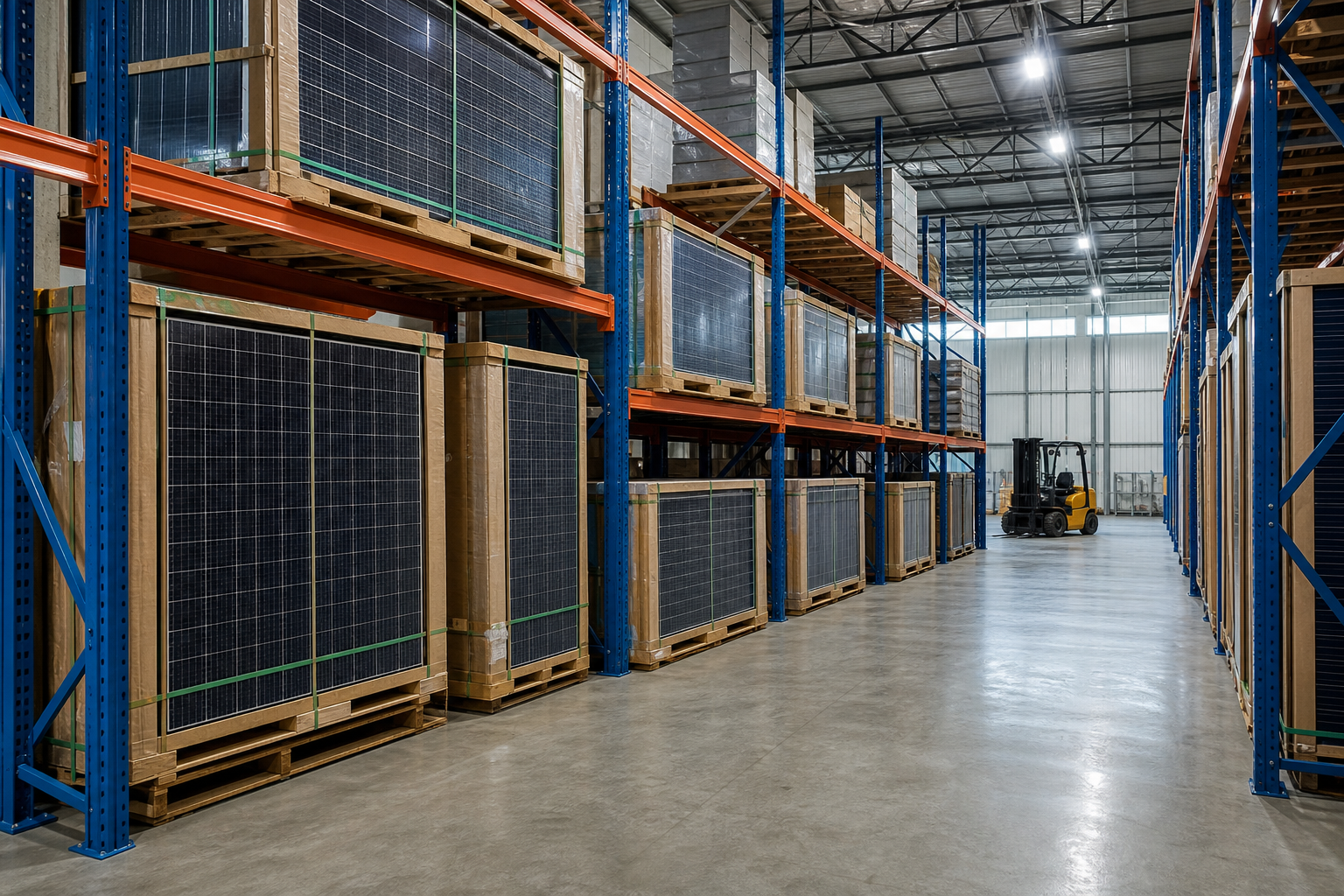
Modules are large, fragile and expensive, and they arrive by the truckload weeks before the crews need them. The warehouse decides whether that is an advantage or a breakage bill.
2021
Year Intermountain Wind and Solar worked with us
Pallet rack + boltless shelving
Product categories we supplied
Renewable energy
Client sector
Project-based staging
The organizing principle
Plan your layout before you buy
Configure upright height, beam width, bay count, and load levels in our free 3D Pallet Rack Configurator, then get an instant bill of materials and request a quote.
The project
Intermountain Wind and Solar is a renewable energy contractor. Material Handling USA supplied pallet rack together with boltless shelving for the company in 2021. Client, year and product categories are the only project facts we publish — no layouts, quantities, capacities or values.
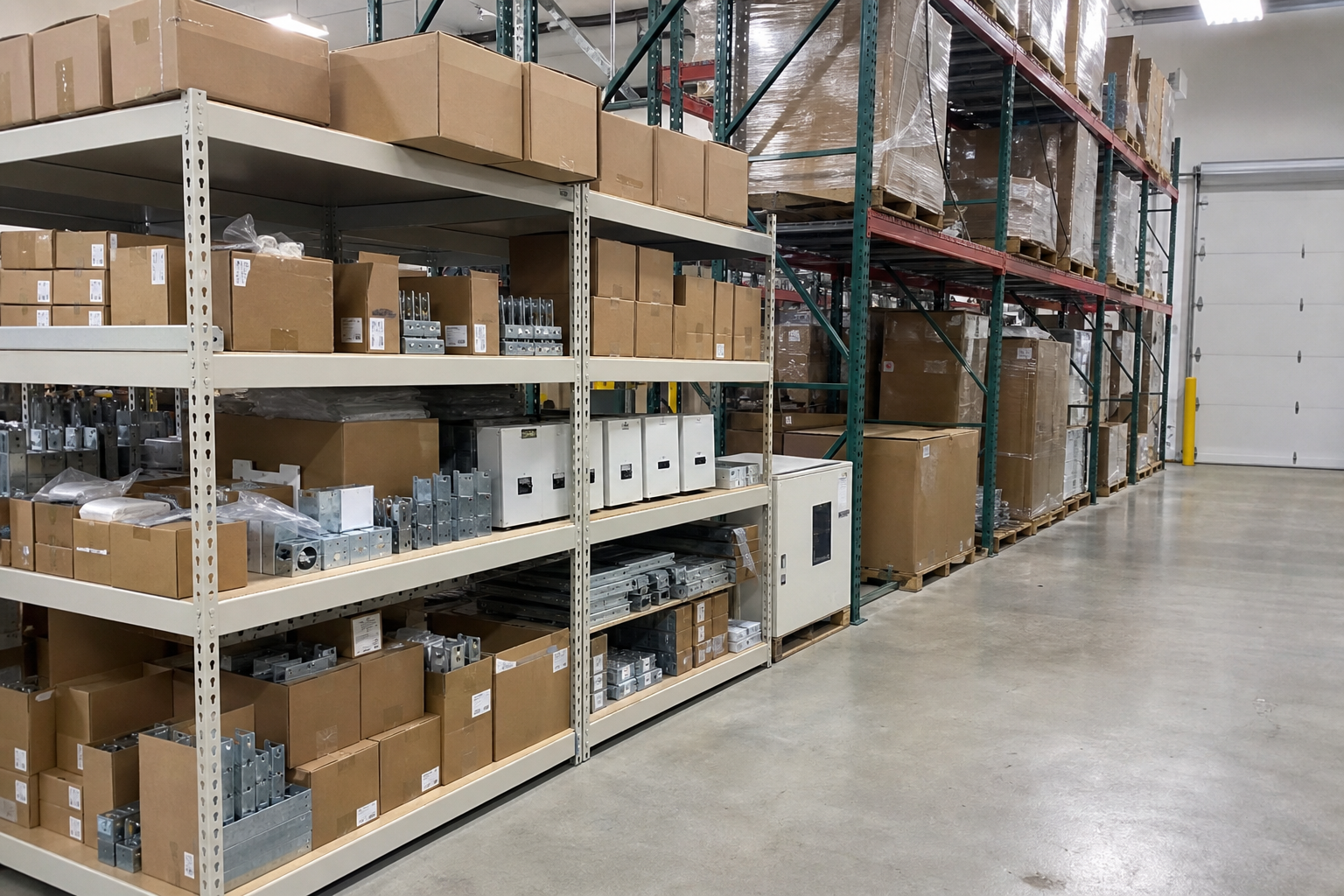
The pairing is the interesting part. Solar contractors have two completely different inventories in one building: very large, very fragile modules that arrive palletized and crated, and a long tail of small, valuable balance-of-system components. One wants engineered pallet rack systems; the other wants boltless shelving. Buildings that try to solve both with a single storage type end up with crushed modules or a shelving row full of pallets.
The nearest comparison on this site is our electrical contractor warehouse racking case study — a similar mix of long goods, reels and small parts — but solar adds a module handling problem that has no equivalent in most contractor warehouses.
Why solar inventory is awkward
Modules are large and fragile at the same time. A photovoltaic module is mostly glass with a laminate behind it. It tolerates uniform pressure across its face and very little point loading anywhere else. Damage is frequently invisible — micro-cracking in the cells that only shows up later as lost output.
The pallets are oversize. Module pallets and crates are wider and longer than the standard footprints most warehouses and most rack bays are laid out around.
Deliveries are lumpy. Material arrives for a project, in project quantities, often well ahead of the install date. Storage demand is spiky rather than steady.
Component variety is enormous. Inverters, optimizers, monitoring hardware, combiner boxes, connectors, wire, mounting rails, flashings, clamps and fasteners — hundreds of small items, each of which will stop a crew if it is missing.
Some of it is very attractive to thieves. Inverters, optimizers, copper wire and loose modules all have a resale market.
Everything eventually leaves as a kit. The unit of issue is not a SKU, it is a job: one truck, one address, one set of parts.
What a solar contractor stores
Sorting the inventory by physical behaviour rather than by product family is what makes the layout obvious.
| Group | Examples | Storage that suits it |
|---|---|---|
| Modules | Palletized or crated PV modules, spares from previous projects | Wide, deep, heavily decked rack bays sized to the actual pallet, with the load kept low and handled as few times as possible |
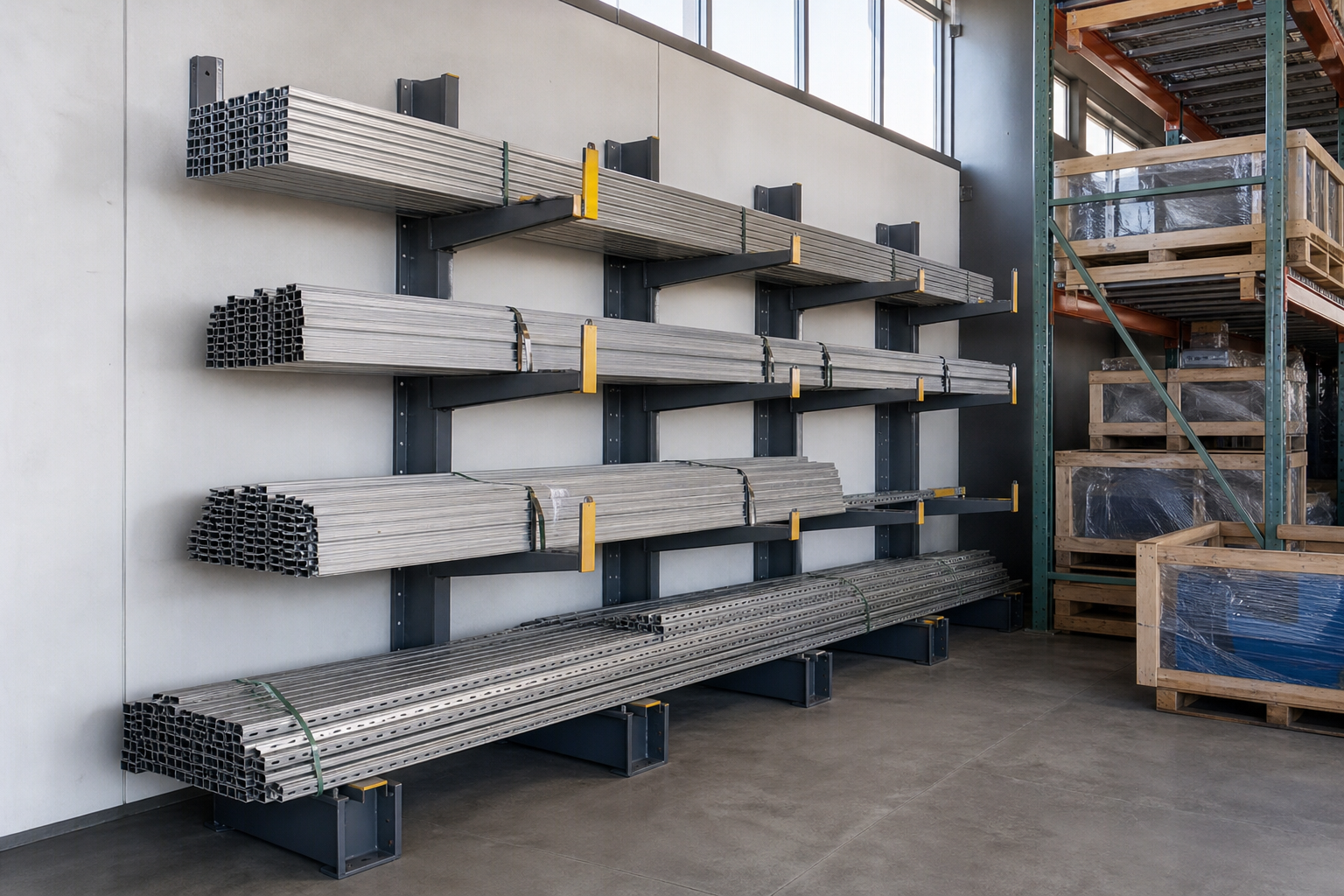
| Long goods | Mounting rails, strut, conduit, ballast rails, ladders | Cantilever rack — arms rather than beams, loading from the side without a front column |
| Power electronics | String and micro inverters, optimizers, combiner boxes, monitoring gear | Boltless shelving or decked low rack levels in a secure area; high value, moderate size, frequent picking |
| Wire and cable | PV wire, feeder cable, grounding conductor | Reel storage on dedicated reel racks or cantilever arms, not stacked flat where a reel can roll |
| Attachment hardware | Flashings, clamps, lag bolts, connectors, fasteners | Bins and small-parts shelving next to the kitting bench; these are the items that strand a crew |
| Batteries and storage systems | Home and commercial energy storage units | Heavy, code-sensitive and temperature-sensitive; store per the manufacturer’s requirements and the fire code, not on a spare beam |
| Project kits and returns | Staged loads, surplus from completed jobs | Defined floor or low-bay positions labelled by project, with a strict close-out rule |
Storing modules without breaking them
Module handling is the difference between a warehouse that saves money and one that quietly generates warranty arguments.
Keep them in the manufacturer’s packaging until they leave. Factory crating is engineered for the module’s supported orientation. Repacking a partial pallet is where most damage is introduced.
Respect the supported orientation. Modules are packed either flat or on edge for a reason. Storing them the other way, or stacking loose modules on top of one another, point-loads the glass.
Never stack pallets unsupported. If module pallets are to be stored two or three high, they belong in engineered rack levels, not stacked on each other on the floor.
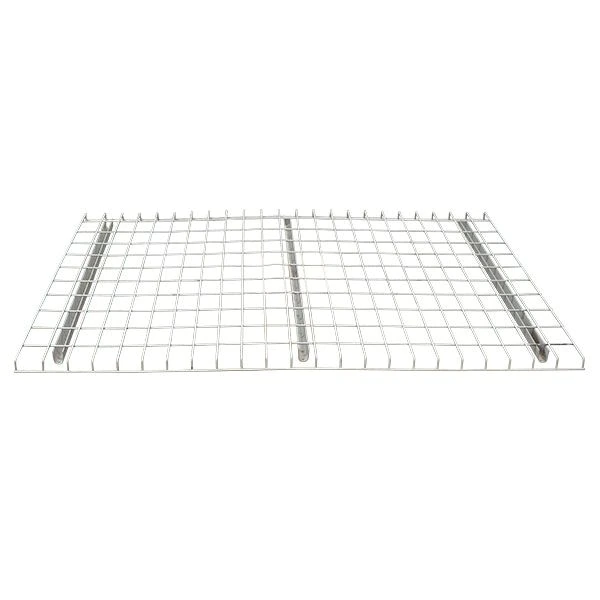
Deck the levels fully. An oversize crate bridging two beams concentrates load at two lines. Full wire decking or reinforced supports spread it.
Size the bay to the crate, with clearance. Overhang into the aisle is how modules get clipped by passing equipment.
Keep them dry, ventilated and off the slab. Condensation and standing water do not belong anywhere near stored modules or their connectors.
Handle once. Every additional lift is another chance for a micro-crack nobody sees until commissioning.
Racking versus shelving for balance of system
The rule of thumb is simple: if it is handled by a forklift it belongs in rack, and if it is handled by a person it belongs on shelving. Most solar warehouses need a deliberate boundary between the two.
- Selective pallet rack for palletized bulk. Modules, ballast, racking hardware in pallet quantities, and anything arriving on a truck as a unit load.
- Structural rack where loads are heavy and traffic is constant. Bolted structural steel absorbs impact better than roll-formed, which suits a busy contractor yard with mixed equipment.
- Cantilever rack for rails, strut and conduit. Arm length, arm capacity and vertical spacing come from the actual material profile, not from a catalogue default.
- Boltless shelving for the component tail. Inverters, optimizers, connectors and hardware are picked by hand many times a day; shelving with fixed, labelled locations beats a pallet position every time.
- Bins at the kitting bench. The small hardware that strands a crew — clamps, lag bolts, flashings, connectors — should be within arm’s reach of where kits are built.
- Low levels for heavy and fragile. Batteries, inverters and module crates all belong near the floor; light bulky packaging goes up high.
- Leave room to grow. Solar inventory profiles change fast as module sizes and mounting systems change. Bays and shelving that can be reconfigured are worth more than the last few percent of density.
If you want to test bay sizes against your actual module pallet dimensions before ordering, our 3D pallet rack configurator will model the layout and price it.

Staging by project, not by SKU
A distributor stores by SKU because any customer might order anything. A contractor knows exactly which job each item is for, which makes project-based staging both possible and much faster to load.
Give committed material a project bay. Modules, inverters and mounting hardware bought for a specific site are stored together and labelled with the job, so loading is a bay number rather than a hunt.
Keep common stock separate. Consumables, fasteners and generic hardware are drawn by every job and belong in a conventional product-based area.
Build kits before the truck arrives, not while it waits. A kitting bench next to the small-parts shelving turns a chaotic morning into a scheduled task.
Stage the next load at floor level near the door. The bottom of the rack line closest to shipping is the natural staging position.
Close projects out deliberately. When a job finishes, its bay is emptied and surplus returns to common stock; otherwise project bays silently become permanent storage and the warehouse fills with orphaned material.
Label for the schedule. A bay labelled with a job name and an install week tells you what should leave next. A bay labelled with a part number does not.
Security, high-value stock and returns
Solar warehouses hold an unusual concentration of small, valuable, easily resold equipment, and they often sit in a yard with vehicle access after hours.
| Risk | Practical control |
|---|---|
| Inverters, optimizers and monitoring hardware walk | A caged area inside the building, with controlled access and a check-out record — see security cages |
| Copper wire and cable disappear | Store reels inside a secured zone rather than in the yard, and record issue by job |
| Loose modules are attractive and easy to move | Keep modules crated, keep partial pallets inside, and store them where they are visible from staffed areas |
| Returns and surplus lose their identity | A defined returns area with a labelling rule; unlabelled surplus becomes scrap eventually |
| Damaged modules get mixed back into good stock | Quarantine damaged or suspect modules physically, not with a sticker — a separate bay with no picking |
| Equipment left in the yard degrades | Anything stored outdoors needs galvanized or coated racking, drainage detail and a wind-load-aware design |
The same segregation logic applies to any warehouse holding high-value, easily moved equipment; our data center staging and critical spares case study covers the caged storage pattern in more detail.
Installation, seismic and inspection
Contractor warehouses are often leased industrial space chosen for yard access rather than for storage, which puts a premium on getting the engineering right at the outset.
- Design to real pallet weights. Module pallets are heavier than they look and crate sizes vary between manufacturers — see pallet rack weight capacity and have the layout engineered rather than estimated.
- Seismic design category governs frames and anchorage. In Utah and across the Intermountain West this is a design input on every project, not a formality.
- Check the slab before anchoring. Leased buildings vary; anchorage design depends on the actual slab thickness and condition.
- Protect uprights from mixed equipment. Contractor fleets include telehandlers and rough-terrain machines that are less precise than warehouse trucks — column protectors and end guards earn their keep.
- Set the top-of-storage height from the obstructions, not the roof. Lighting, heaters and sprinkler heads set the real usable height.
- Inspect on a cycle and after every impact. Bent beams and deformed columns reduce capacity immediately — see rack inspection and repair.
- Use an installer who works to the standard. The design standard for the racking is ANSI/RMI MH16.1 — the practical side is on our rack installation page.
ANSI/RMI MH16.1 is published by the Rack Manufacturers Institute. We design, supply and install racking and shelving for contractors across the region — see Utah pallet rack.
Shop Pallet Rack Accessories Online
Protect and finish your pallet rack installation with these in-stock accessories, or request a quote for custom-sized rack, freight and volume pricing.

Utah pallet rack project: This case study supports our Utah pallet rack design and installation guide and, at the top level, our main pallet rack systems hub.
Frequently asked questions
How should solar panels be stored in a warehouse?
Can module pallets be stacked on top of each other?
Why do solar warehouses need both pallet rack and shelving?
What racking suits mounting rails and strut?
How do you stop project material getting mixed up?
What about batteries and energy storage systems?
Is outdoor storage viable for solar equipment?
Setting up a solar or renewables contractor warehouse?
We design combined pallet rack, cantilever and shelving layouts for contractors staging project material. Free design consultation.