
State Highway Maintenance Shed Racking: UDOT
Utah’s state highway agency maintains roads across the entire state from a network of regional maintenance sheds — each one storing guardrail, culvert pipe, signage and seasonal deicing materials that a standard warehouse layout wasn’t built to hold.
State government
Client sector
Pallet rack & boltless shelving
Product category supplied
Utah
Client HQ
Guardrail, culvert & deicing material
Application
Plan your layout before you buy
Configure upright height, beam width, bay count, and load levels in our free 3D Pallet Rack Configurator, then get an instant bill of materials and request a quote.
The project
The Utah Department of Transportation (UDOT) maintains state highways, bridges and roadside infrastructure from a network of regional maintenance sheds across Utah. Material Handling USA has supplied pallet rack systems and boltless shelving for UDOT maintenance shed storage.
This case study covers a different scale of problem than the other public-sector storage projects in our series. Our county road & bridge department case study covers a single county shop, and our transit authority case study covers buses and rail rather than roadway materials. A state DOT runs many maintenance sheds statewide, each needing a consistent, repeatable storage approach for the same categories of bulky, awkward and seasonal materials — a standardization problem more than a single-building layout problem.
Why a state DOT maintenance shed is different
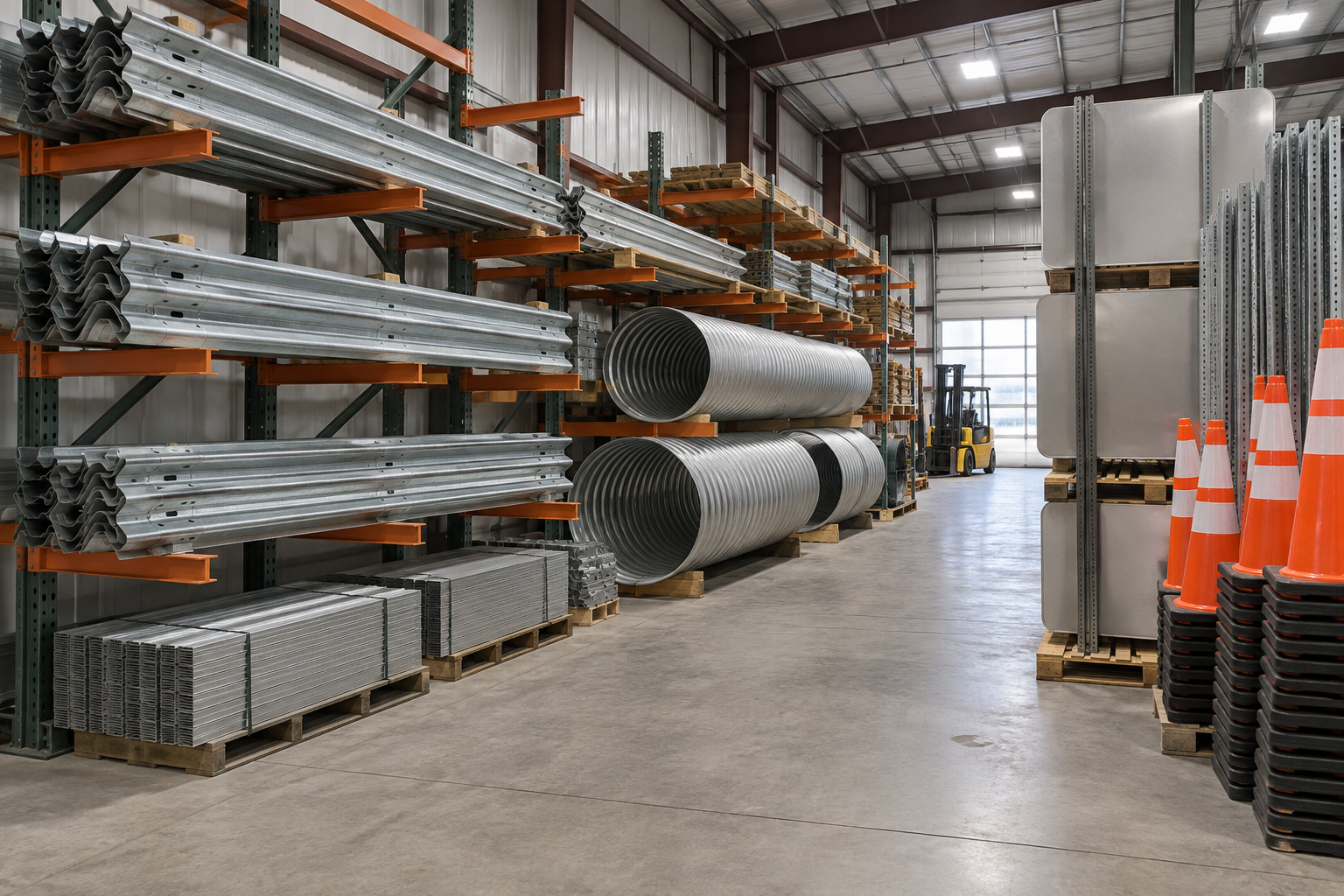
Materials are long, heavy and awkward. Guardrail sections, corrugated culvert pipe and highway sign posts don’t stack neatly on a pallet — they need open, arm-supported storage built for long stock.
Demand is seasonal and weather-driven. Deicing and anti-icing material, snowplow attachments and barricades need to be staged and ready before a storm, then stored compactly the rest of the year.
Every shed needs the same categories of storage. A statewide agency benefits from a repeatable rack and shelving standard across its maintenance sheds rather than a one-off layout at each location, so staff can find the same materials in the same place at any shed.
Inventory mixes bulky steel stock with small parts. Guardrail and pipe sit next to bagged material, barricades, cones and signage — a layout has to serve both ends of that range well.
What a highway maintenance shed stores
Based on the verified project scope, a state DOT maintenance shed typically stores several distinct material categories, each suited to a different rack or shelving type:
| Material | Storage need |
|---|---|
| Guardrail sections & sign posts | Long steel stock that needs open-arm support, not a flat pallet position. |
| Culvert pipe | Large-diameter corrugated pipe stored horizontally on cantilever arms. |
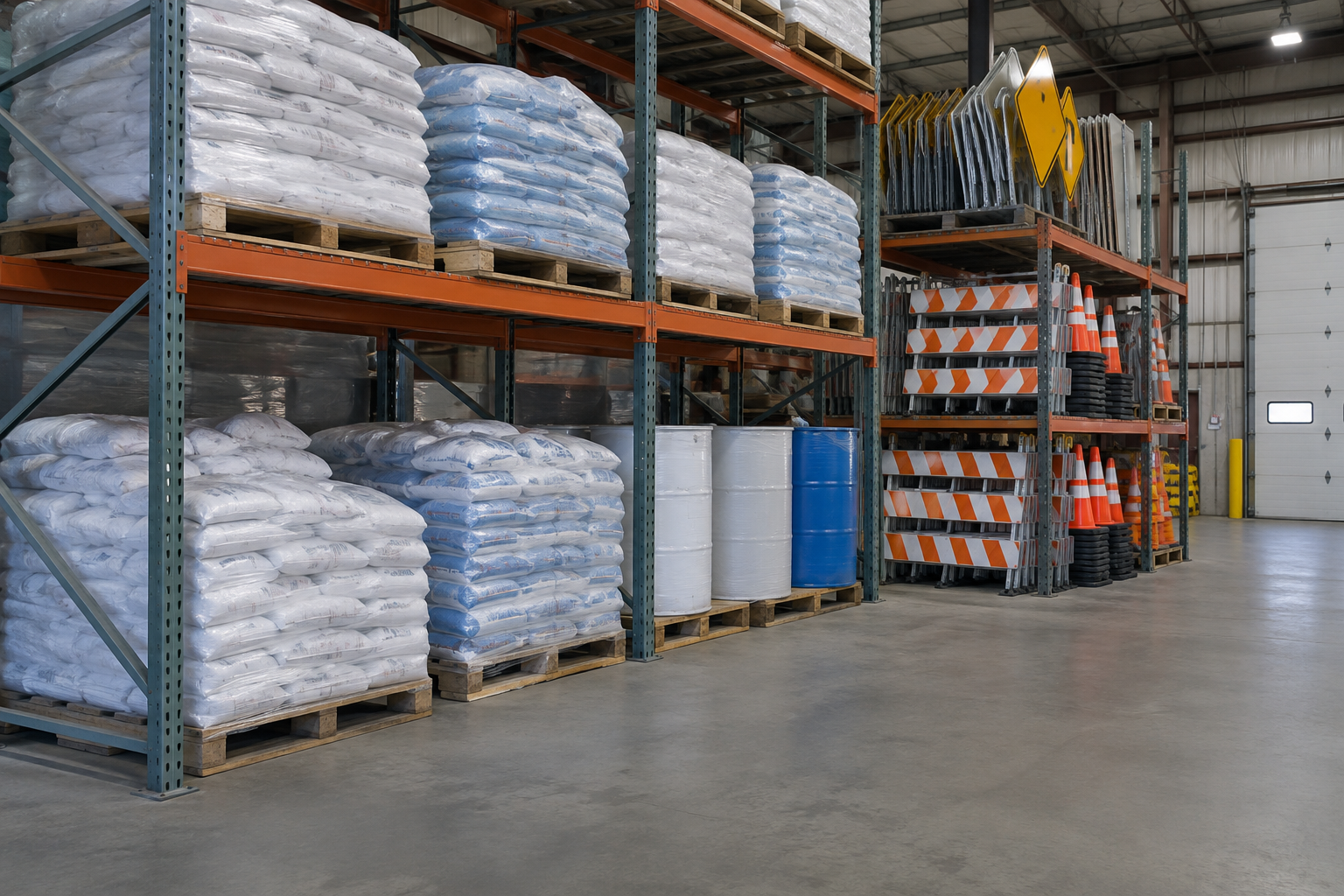
| Deicing & anti-icing material | Palletized bagged material and drums staged for fast seasonal access. |
| Traffic control equipment | Cones, barricades and portable signage stored compactly between storms. |
- Guardrail, sign posts and culvert pipe store on cantilever rack, where open arms support long and round loads without a pallet.
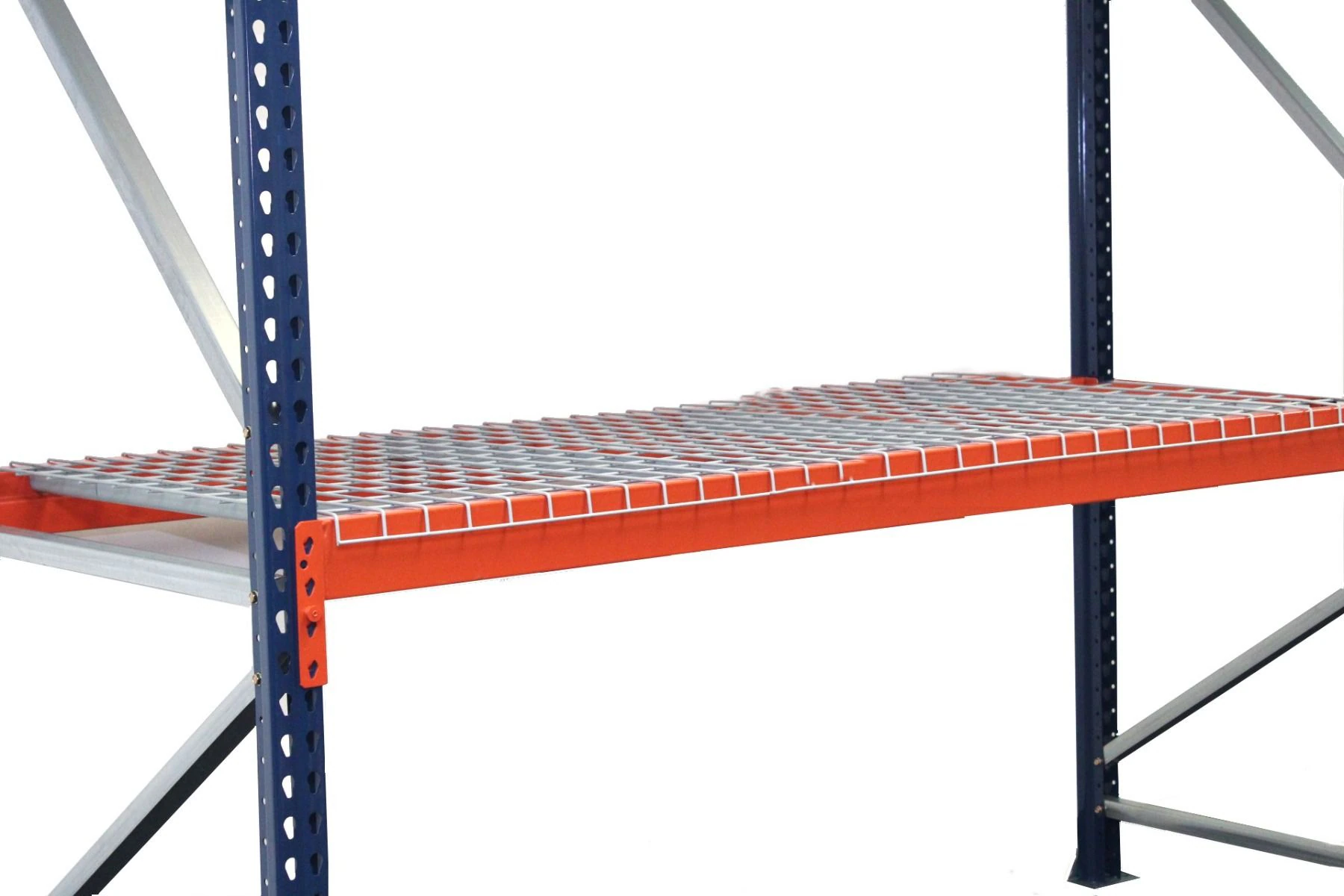
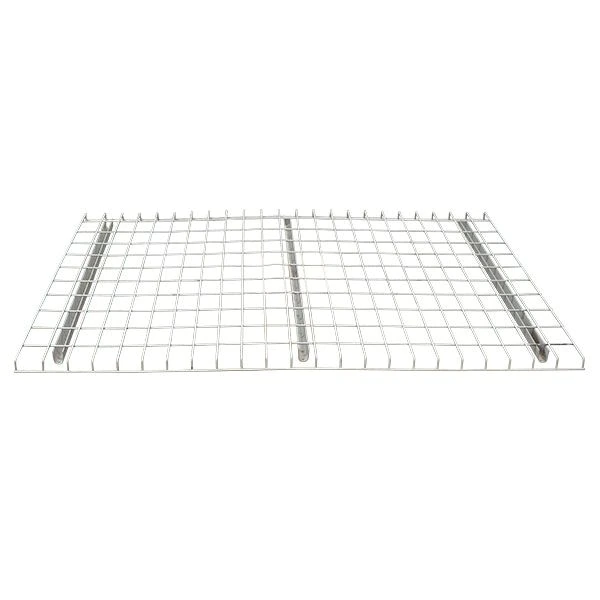
- Palletized deicing material and drums store on selective pallet rack with wire decking where smaller containers need support.
- Cones, barricades and portable signage fit boltless shelving, positioned for fast seasonal turnover before and after a storm.
Standardizing racking across multiple maintenance sheds
A statewide agency gets more value from a repeatable storage standard than from a custom layout at each shed. A few planning considerations that come up on projects like this:
Use the same rack and shelving categories at every location. Standardizing on cantilever bay sizes for guardrail and pipe, and a consistent selective rack and boltless shelving footprint for palletized and small-parts storage, makes it easier to train staff, order replacement components, and plan future sheds without redesigning from scratch each time.
Plan for seasonal swings, not average inventory. A maintenance shed’s deicing material and traffic control equipment inventory can swing sharply between storm season and the rest of the year; leaving open bays sized for peak seasonal volume, not average volume, avoids overflow storage outside the rack system.
Keep frequently rotated stock accessible. Barricades, cones and portable signage move in and out constantly during storm response, so those items belong on shelving near a loading or staging area rather than deep in bulk storage.
Coordinate rack specification with procurement. A standard rack and shelving spec that a state agency can reuse across sheds simplifies future procurement and keeps replacement parts compatible across locations.
Account for the wide weight range in a single bay. A run of guardrail, a bundle of sign posts and a coil of culvert pipe can carry very different loads per linear foot even though they all fit the same cantilever arm length; specifying arm capacity to the heaviest realistic load for that bay, not an average, keeps every bay safe regardless of which material is staged there that week.
Installation and safety
A state DOT maintenance shed installation follows the same structural design standard as any other pallet rack or cantilever rack project, sized to the actual loads involved rather than a generic assumption.
- Size beam and arm capacity to the real load weights involved — see pallet rack weight capacity guidance; guardrail, pipe and bagged material loads vary widely and should be verified, not assumed.
- Protect rack uprights with column protectors and end guards in aisles that see forklift and loader traffic moving long stock.
- Inspect racking on a defined cycle — see rack inspection and repair.
- Anchor and install to the ANSI/RMI MH16.1 standard — see our rack installation guidance.
ANSI/RMI MH16.1 is published by the Rack Manufacturers Institute. Utah’s Wasatch Front sits in a moderate-to-high seismic zone, so rack anchoring and bracing for a maintenance shed get designed for seismic load combinations under the applicable building code, the same as any other pallet rack or cantilever rack installation in the region. We design, supply and install pallet rack, cantilever rack and boltless shelving for government agencies and contractors across the Wasatch Front — see Utah pallet rack for more of our local project work.
Serving Utah state and local government agencies
Material Handling USA has been an industry leader in storage and material handling since 1997, working from Salt Lake City with government agencies and municipalities across the Wasatch Front. See our related work for a county road & bridge department. For Utah projects call 801-328-8788, or see our Utah pallet rack page.
What we publish
For public-sector clients, we publish only the general storage application and the rack or shelving categories involved. We do not publish facility layouts, dimensions, security details, or deal values for government projects. The details on this page reflect that standard.
Shop Pallet Rack Products Online
Buy select items directly from our online store, or request a quote for volume, custom sizes and freight-rated orders.
Frequently asked questions
What storage suits a state DOT maintenance shed?
Why does a highway maintenance shed need cantilever rack?
How should a maintenance shed plan for seasonal swings in inventory?
Can a statewide agency use the same rack standard at every maintenance shed?
What’s the design standard for the rack itself?
Does seismic design matter for rack in Utah?
Planning storage for a highway maintenance shed or public works facility?
We design pallet rack, cantilever rack and boltless shelving layouts for state and local government agencies. Free design consultation.